anaheim-gazette 1934-01-25
Scanned page
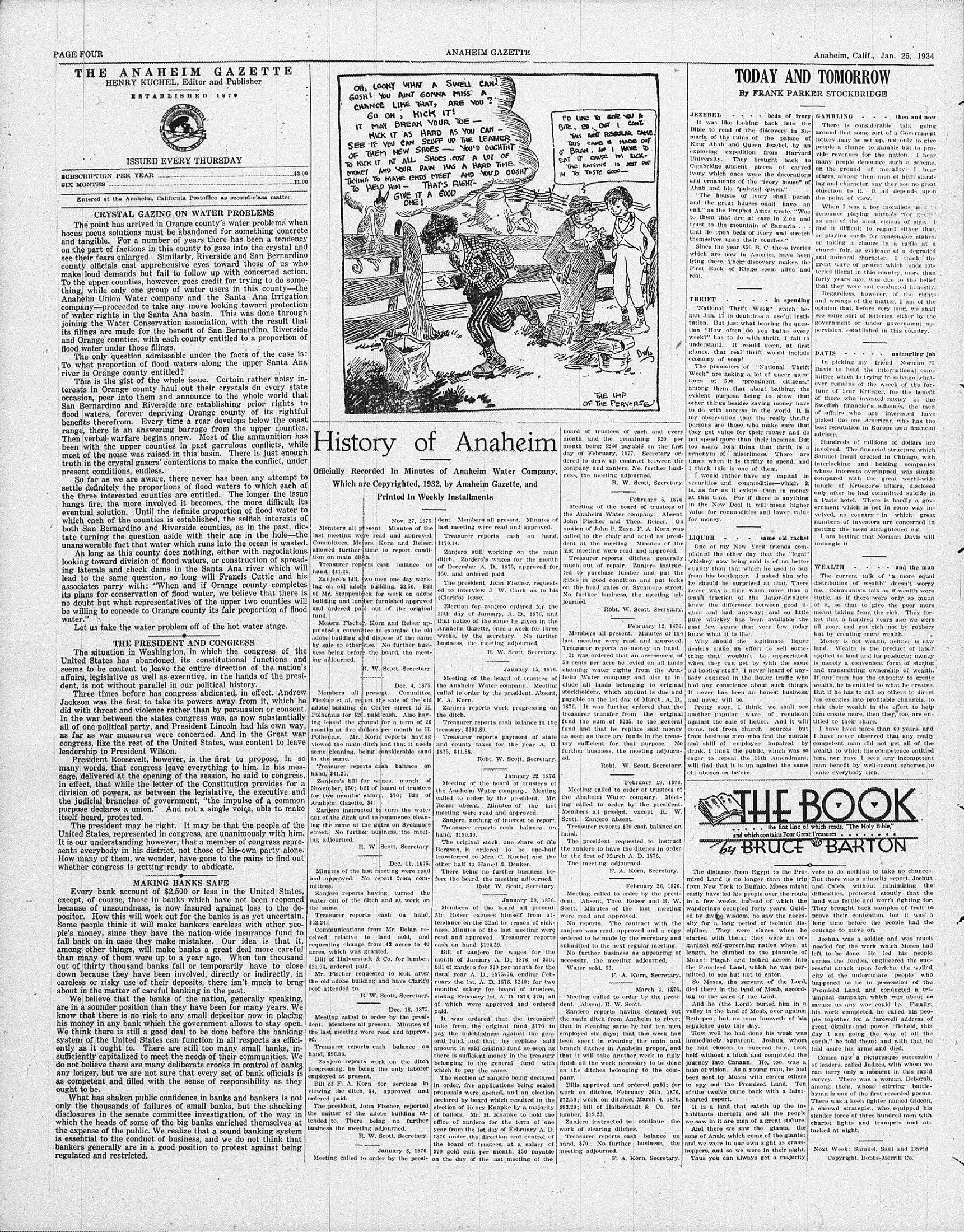
Searchable text
THE ANAHEIM GAZETTE
HENRY KUCHEL, Editor and Publisher
ESTABLISHED 1870
ISSUED EVERY THURSDAY
SUBSCRIPTION PER YEAR ... $2.00
SIX MONTHS ... $1.00
Entered at the Anaheim, California Postoffice as second-class matter.
CRYSTAL GAZING ON WATER PROBLEMS
The point has arrived in Orange county's water problems when hocus pocus solutions must be abandoned for something concrete and tangible. For a number of years there has been a tendency on the part of factions in this county to gaze into the crystal and see their fears enlarged. Similarly, Riverside and San Bernardino county officials cast apprehensive eyes toward those of us who make loud demands but fail to follow up with concerted action. To the upper counties, however, goes credit for trying to do something, while only one group of water users in this county—the Anaheim Union Water company and the Santa Ana Irrigation company—proceeded to take any move looking toward protection of water rights in the Santa Ana basin. This was done through joining the Water Conservation association, with the result that its filings are made for the benefit of San Bernardino, Riverside and Orange counties, with each county entitled to a proportion of flood water under those filings.
The only question admissable under the facts of the case is: To what proportion of flood waters along the upper Santa Ana river is Orange county entitled?
This is the gist of the whole issue. Certain rather noisy interests in Orange county haul out their crystals on every state occasion, peer into them and announce to the whole world that San Bernardino and Riverside are establishing prior rights to flood waters, forever depriving Orange county of its rightful benefits therefrom. Every time a roar develops below the coast range, there is an answering barrage from the upper counties. Then verbal warfare begins anew. Most of the ammunition has been with the upper counties in past garrulous conflicts, while most of the noise was raised in this basin. There is just enough
To what proportion of flood waters along the upper Santa Ana river is Orange county entitled?
This is the gist of the whole issue. Certain rather noisy interests in Orange county haul out their crystals on every state occasion, peer into them and announce to the whole world that San Bernardino and Riverside are establishing prior rights to flood waters, forever depriving Orange county of its rightful benefits therefrom. Every time a roar develops below the coast range, there is an answering barrage from the upper counties. Then verbal warfare begins anew. Most of the ammunition has been with the upper counties in past garrulous conflicts, while most of the noise was raised in this basin. There is just enough truth in the crystal gazers' contentions to make the conflict, under present conditions, endless.
So far as we are aware, there never has been any attempt to settle definitely the proportions of flood waters to which each of the three interested counties are entitled. The longer the issue hangs fire, the more involved it becomes, the more difficult its eventual solution. Until the definite proportion of flood water to which each of the counties is established, the selfish interests of both San Bernardino and Riverside counties, as in the past, dictate turning the question aside with their ace in the hole—the unanswerable fact that water which runs into the ocean is wasted.
As long as this county does nothing, either with negotiations looking toward division of flood waters, or construction of spreading laterals and check dams in the Santa Ana river which will lead to the same question, so long will Francis Cuttle and his associates parry with: "When and if Orange county completes its plans for conservation of flood water, we believe that there is no doubt but what representatives of the upper two counties will be willing to concede to Orange county its fair proportion of flood water."
Let us take the water problem off of the hot water stage.
THE PRESIDENT AND CONGRESS
The situation in Washington, in which the congress of the United States has abandoned its constitutional functions and seems to be content to leave the entire direction of the nation's affairs, legislative as well as executive, in the hands of the president, is not without parallel in our political history.
Three times before has congress abdicated, in effect. Andrew Jackson was the first to take its powers away from it, which he did with threat and violence rather than by persuasion or consent. In the war between the states congress was, as now substantially all of one political party, and President Lincoln had his own way, as far as war measures were concerned. And in the Great war congress, like the rest of the United States, was content to leave leadership to President Wilson.
President Roosevelt, however, is the first to propose, in so many words, that congress leave everything to him. In his message, delivered at the opening of the session, he said to congress, in effect, that while the letter of the Constitution provides for a division of powers, as between the legislative, the executive and the judicial branches of government, "the impulse of a common purpose declares a union." And not a single voice, able to make itself heard, protested.
The president may be right. It may be that the people of the United States, represented in congress, are unanimously with him. It is our understanding however, that a member of congress represents everybody in his district, not those of his own party alone. How many of them, we wonder, have gone to the pains to find out whether congress is getting ready to abdicate.
sage, delivered at the opening of the session, he said to congress,
in effect, that while the letter of the Constitution provides for a
division of powers, as between the legislative, the executive and
the judicial branches of government, "the impulse of a common
purpose declares a union." And not a single voice, able to make
itself heard, protested.
The president may be right. It may be that the people of the
United States, represented in congress, are unanimously with him.
It is our understanding however, that a member of congress represents everybody in his district, not those of his own party alone.
How many of them, we wonder, have gone to the pains to find out
whether congress is getting ready to abdicate.
MAKING BANKS SAFE
Every bank account of $2,500 or less in the United States,
except, of course, those in banks which have not been reopened
because of unsoundness, is now insured against loss to the depositor. How this will work out for the banks is as yet uncertain.
Some people think it will make bankers careless with other people's money, since they have the nation-wide insurance fund to
fall back on in case they make mistakes. Our idea is that it,
among other things, will make banks a great deal more careful
than many of them were up to a year ago. When ten thousand
out of thirty thousand banks fail or temporarily have to close
down because they have been involved, directly or indirectly, in
careless or risky use of their deposits, there isn't much to brag
about in the matter of careful banking in the past.
We believe that the banks of the nation, generally speaking,
are in a sounder position than they have been for many years. We
know that there is no risk to any small depositor now in placing
his money in any bank which the government allows to stay open.
We think there is still a good deal to be done before the banking
system of the United States can function in all respects as effectively as it ought to. There are still too many small banks, insufficiently capitalized to meet the needs of their communities. We
do not believe there are many deliberate crooks in control of banks
any longer, but we are not sure that every set of bank officials is
as competent and filled with the sense of responsibility as they
ought to be.
What has shaken public confidence in banks and bankers is not
only the thousands of failures of small banks, but the shocking
disclosures in the senate committee investigation, of the way in
which the heads of some of the big banks enriched themselves at
the expense of the public. We realize that a sound banking system
is essential to the conduct of business, and we do not think that
bankers generally are in a good position to protest against being
regulated and restricted.
OH, LOOKY WHAT A SWELL CAN!
GOSH! YOU AINT GONNA MISS A CHANCE LIKE THAT, ARE YOU?
GO ON, KICK IT!
IT MAY BREAK YOUR TOE —
KICK IT AS HARD AS YOU CAN —
SEE IF YOU CAN SCUFF UP THE LEATHER OF THEM NEW SHOES — YOU'D OUGHT TO KICK IT AT ALL SHOES COST A LOT OF MONEY AND YOUR PAW HAS A HARD TIME TRYING TO MAKE ENDS MEET AND YOU'D OUGHT TO HELP HIM — THAT'S RIGHT—
GIVE IT A GOOD ONE!
I'D LIKE TO GIVE YOU A BITE, EO., BUT I CAN'T THIS AMEN REBOLAR CASE.
THIS CAME IS MADE OUT OF BRAN, AND I HAVE D EAT IT CAUSE MY SICK- THE RAISINS IS JUST PUT IN TO TASTE GOOD—
THE IMP
OF THE PERVERSE
History of Anaheim
History of Anaheim
Officially Recorded In Minutes of Anaheim Water Company,
Which are Copyrighted, 1932, by Anaheim Gazette, and
Printed In Weekly Installments
Nov. 27, 1875.
Members all present. Minutes of the last meeting were read and approved.
Committees, Messrs. Korn and Reiser, allowed further time to report condition on main ditch.
Treasurer reports cash balance on hand, $41.25.
Zanjero's bill, two men one day working on old adobe building, $2.50. Bill of Mr. Stoppenbock for work on adobe building and lumber furnished approved and ordered paid out of the original fund.
Messrs. Fischer, Korn and Reiser appointed a committee to examine the old adobe building and dispose of the same by sale or otherwise. No further business being before the board, the meeting adjourned.
R. W. Scott, Secretary.
Dec. 4, 1875.
Members all present. Fischer et al., report the sale of the old adobe building on Center street to H. Polhemus for $26, paid cash. Also having leased the ground for a term of 26 months at five dollars per month to H. Polhemus. Mr. Korn reports having viewed the main ditch and that it needs some cleaning, being considerable sand in the same.
Treasurer reports cash balance on hand, $41.25.
Zanjero's bill for wages, month of November, $50; bill of board of trustees for two months' salary, $70; Bill of Anaheim Gazette, $4.
Zanjero instructed to turn the water out of the ditch and to commence cleaning the same at the gates on Sycamore street. No further business, the meeting adjourned.
R. W. Scott, Secretary.
Dec. 11, 1875.
Minutes of the last meeting were read and approved.
Board of trustees of each and every month, and the remaining $20 per month being $240 payable on the first day of February, 1877. Secretary ordered to draw up contract between the company and zanjero. No further business, the meeting adjourned.
R. W. Scott, Secretary.
February 5, 1876
Meeting of the board of trustees of the Anaheim Water company. Absent John Fischer and Theo. Reiser. On motion of John P. Zeyn, F. A. Korn was called to the chair and acted as president at the meeting. Minutes of the last meeting were read and approved.
Treasurer reports ditches generally much out of repair. Zanjero instructed to purchase lumber and put the gates in good condition and put locks on the head gates on Sycamore street. No further business, the meeting adjourned.
Robt. W. Scott, Secretary.
February 12, 1876
Members all present. Minutes of the last meeting were read and approved.
Treasurer reports no money on hand.
It was ordered that an assessment of 50 cents per acre be levied on all lands claiming water rights from the Anaheim Water company and also to include all lands belonging to origina stockholders, which amount is due and payable on the 1st day of March, A.D. 1876. It was further ordered that the treasurer transfer from the origina fund the sum of $235, to the general fund and that he replace said money as soon as there are funds in the treasury sufficient for that purpose. No further business, the meeting adjourned.
Robt. W. Scott, Secretary.
January 15, 1876
Meeting of the board of trustees of the Anaheim Water company. Meeting called to order by the president. Absent, F. A. Korn.
Zanjero reports work progressing on the ditch.
Treasurer reports cash balance in the treasury, $202.89.
Treasurer reports payment of state and county taxes for the year A.D. 1875, $11.88.
Robt. W. Scott, Secretary.
January 22, 1876
Meeting of the board of trustees of the Anaheim Water company. Meeting called to order by the president. Mr. Reiser absent. Minutes of the last meeting were read and approved.
Zanjero, nothing of interest to report.
Treasurer reports cash balance on hand, $190.39.
The original stock, one share of Ole Bergson, is ordered to be one-half transferred to Mrs. C. Kuchel and the other half to Hamel & Denker.
February 19, 1876
Meeting called to order of trustees of the Anaheim Water company. Meeting called to order by the president. Members all present except R. W. Scott. Zanjero absent.
Treasurer reports $70 cash balance on hand.
The president requested to instruct the zanjero to have the ditches in order by the first of March A.D. 1876.
The meeting adjourned.
January 22, 1876.
Meeting of the board of trustees of the Anaheim Water company. Meeting called to order by the president. Mr. Reiser absent. Minutes of the last meeting were read and approved.
Zanjero, nothing of interest to report.
Treasurer reports cash balance on hand, $190.39.
The original stock, one share of Ole Bergson, is ordered to be one-half transferred to Mrs. C. Kuchel and the other half to Hamel & Denker.
There being no further business before the board, the meeting adjourned.
Robt. W. Scott, Secretary.
January 29, 1876.
Members of the board all present. Mr. Reiser excuses himself from attendance on the 22nd by reason of sickness. Minutes of the last meeting were read and approved. Treasurer reports cash on hand $190.39.
Bill of zanjero for wages for the month of January A. D., 1876, of $50; bill of zanjero for $20 per month for the fiscal year A. D., 1875-76, ending February the 1st, A. D., 1876, $240; for two months' salary for board of trustees, ending February 1st, A. D., 1876, $70; all of which were approved and ordered paid.
It was ordered that the treasurer take from the original fund $170 to pay the indebtedness against the general fund, and that he replace said amount in said original-fund so soon as there is sufficient money in the treasury belonging to the general fund with which to pay the same.
The election of zanjero being declared in order, five applications being sealed proposals were opened, and an election declared by board which resulted in the election of Henry Knapke by a majority of ballots. Mr. H. Knapke to hold the office of zanjero for the term of one year from the 1st day of February A.D. 1876 under the direction and control of the board of trustees, at a salary of $70 gold coin per month, $50 payable on the day of the last meeting of the
February 19, 1876.
Meeting called to order of trustees of the Anaheim Water company. Meeting called to order by the president. Members all present, except R. W. Scott. Zanjero absent.
Treasurer reports $70 cash balance on hand.
The president requested to instruct the zanjero to have the ditches in order by the first of March A.D. 1876.
The meeting adjourned.
F. A. Korn, Secretary.
February 26, 1876.
Meeting called to order by the president. Absent, Theo. Reiser and R. W. Scott. Minutes of the last meeting were read and approved.
No reports. The contract with the zanjero was read, approved and a copy ordered to be made by the secretary and submitted to the next regular meeting.
No further business as appearing of necessity, the meeting adjourned.
Water sold, $3.
F. A. Korn, Secretary.
March 4, 1876.
Meeting called to order by the president. Absent, R. W. Scott.
Zanjero reports having cleaned out the main ditch from Anaheim to river; that in cleaning same he had ten men employed six days; that this week has been spent in cleaning the main and branch ditches in Anaheim proper, and that it will take another week to fully finish all the work necessary to be done on the ditches belonging to the company.
Bills approved and ordered paid: for work on ditches, February 26th, 1876, $72.50; work on ditches, March 4, 1876, $93.20; bill of Halberstadt & Co. for lumber, $19.23.
Zanjero instructed to continue the work of clearing ditches.
Treasurer reports cash balance on hand, $70. No further business, the meeting adjourned.
F. A. Korn, Secretary.
TODAY AND TOMORROW
By FRANK PARKER STOCKBRIDGE
JEZEBEL beds of ivory
It was like looking back into the Bible to read of the discovery in Samaria of the ruins of the palace of King Ahab and Queen Jezebel, by an exploring expedition from Harvard University. They brought back to Cambridge ancient pieces of carved ivory which once were the decorations and ornaments of the "ivory house" of Ahab and his "painted queen."
"The houses of ivory shall perish and the great houses shall have an end," as the Prophet Amos wrote. "Woe to them that are at ease in Zion and trust to the mountain of Samaria... that lie upon beds of ivory and stretch themselves upon their couches."
Since the year 850 B.C. these ivories which are now in America have been lying there. Their discovery makes the First Book of Kings seem alive and real.
THRIFT in spending
"National Thrift Week" which began Jan. 17 is doubtless a useful institution. But just what bearing the question "How often do you bathe every week?" has to do with thrift, I fail to understand. It would seem, at first glance, that real thrift would include economy of soap!
The promoters of "National Thrift Week" are asking a lot of queer questions of 500 "prominent citizens," among them that about bathing, the evident purpose being to show that other things besides saving money have to do with success in the world. It is my observation that the really thrifty persons are those who make sure that they get value for their money and do not spend more than their incomes. But too many folk think that thrift is a synonym of miserliness. There are
GAMBLING then and now
There is considerable talk going around that some sort of a Government lottery may be set up, not only to give people a chance to gamble but to provide revenues for the nation. I hear many people denounce such a scheme, on the ground of morality. I hear others, among them men of high standing and character, say they see no great objection to it. It all depends upon the point of view.
When I was a boy moralists used to denounce playing marbles "for keeps" as one of the most vicious of sins. I find it difficult to regard either that, or playing cards for reasonable stakes, or taking a chance in a raffle at a church fair, as evidence of a degraded and immoral character. I think the great wave of protest which made lotteries illegal in this country, more than forty years ago, was due to the belief that they were not conducted honestly.
Regardless, however, of the rights and wrongs of the matter, I am of the opinion that, before very long, we shall see some sort of lotteries, either by the government or under government supervision, established in this country.
DAVIS untangling job
In picking my friend Norman H. Davis to head the international committee which is trying to salvage whatever remains of the wreck of the fortune of Ivar Krueger, for the benefit of those who invested money in the Swedish financier's schemes, the men of affairs who are interested have picked the one American who has the best reputation in Europe as a financial adviser.
Hundreds of millions of dollars are involved. The financial structure which Samuel Insull erected in Chicago, with
The promoters of "National Thrift Week" are asking a lot of queer questions of 500 "prominent citizens," among them that about bathing, the evident purpose being to show that other things besides saving money have to do with success in the world. It is my observation that the really thrifty persons are those who make sure that they get value for their money and do not spend more than their incomes. But too many folk think that thrift is a synonym of miserliness. There are times when it is thrifty to spend, and I think this is one of them.
I would rather have my capital in securities and commodities—which it is, as far as it exists—than in money at this time. For if there is anything in the New Deal it will mean higher value for commodities and lower value for money.
LIQUOR same old racket
One of my New York friends complained the other day that the "legal" whiskey now being sold is of no better quality than that which he used to buy from his bootlegger. I asked him why he should be surprised at that. There never was a time when more than a small fraction of the liquor-drinkers knew the difference between good liquor and bad, anyway; and so little pure whiskey has been available the past few years that very few today know what it is like.
Why should the legitimate liquor dealers make an effort to sell something that wouldn't be appreciated, when they can get by with the same old bootleg stuff? I never heard of anybody engaged in the liquor traffic who had any conscience about such things. It never has been an honest business, and never will be.
Pretty soon, I think, we shall see another popular wave of revulsion against the sale of liquor. And it will come, not from church sources but from business men who find the morale and skill of employees impaired by drink. I think the public, which was so eager to repeal the 18th Amendment, will find that it is up against the same old abuses as before.
In picking my friend Norman H. Davis to head the international committee which is trying to salvage whatever remains of the wreck of the fortune of Ivar Krueger, for the benefit of those who invested money in the Swedish financier's schemes, the men of affairs who are interested have picked the one American who has the best reputation in Europe as a financial adviser.
Hundreds of millions of dollars are involved. The financial structure which Samuel Insull erected in Chicago, with interlocking and holding companies whose interests overlapped, was simple compared with the great world-wide tangle of Krueger's affairs, disclosed only after he had committed suicide in a Paris hotel. There is hardly a government which is not in some way involved, no country in which great numbers of investors are concerned in getting the mess straightened out.
I am betting that Norman Davis will untangle it.
WEALTH and the man
The current talk of "a more equal distribution of wealth" doesn't worry me. Communists talk as if wealth were static, as if there were only so much of it, so that to give the poor more meant taking from the rich. They forget that a hundred years ago we were all poor, and got rich not by robbery but by creating more wealth.
Money is not wealth, neither is raw land. Wealth is the product of labor applied to land and its products; money is merely a convenient form of storing and transmitting ownership of wealth. If any man has the capacity to create wealth, he is entitled to what he creates. But if he has to call on others to direct his energies into profitable channels, to risk their wealth in the effort to help him create more, then they, too, are entitled to their share.
I have lived more than 60 years, and I have never observed that any really competent man did not get all of the wealth to which his competence entitled him, nor have I seen any incompetent man benefit by well-meant schemes to make everybody rich.
The distance from Egypt to the Promised Land is no longer than the trip from New York to Buffalo. Moses might easily have led his people over the route in a few weeks, instead of which the wanderings occupied forty years. Guided by divine wisdom, he saw the necessity for a long period of isolated discipline. They were slaves when he started with them; they were an organized self-governing nation when, at length, he climbed to the pinnacle of Mount Pisgah and looked across into the Promised Land, which he was permitted to see but not to enter.
So Moses, the servant of the Lord, died there in the land of Moab, according to the word of the Lord.
And he (the Lord) buried him in a valley in the land of Moab, over against Beth-peo; but no man knoweth of his sepulchre unto this day.
How well he had done his work was immediately apparent. Joshua, whom he had chosen to succeed him, took hold without a hitch and completed the journey into Canaan. He, too, was a man of vision. As a young man, he had been sent by Moses with eleven others to spy out the Promised Land. Ten of the twelve came back with a faint-hearted report.
It is a land that eateth up the inhabitants thereof; and all the people we saw in it are men of a great stature.
And there we saw the giants, the sons of Anak, which come of the giants: and we were in our own sight as grass-hoppers, and so we were in their sight.
Thus you can always get a majority vote to do nothing to take no chances. But there was a minority report. Joshua and Caleb, without minimizing the difficulties, protested stoutly that the land was fertile and worth fighting for. They brought back samples of fruit to prove their contention, but it was a long time before the people had the courage to move on.
Joshua was a soldier and was much needed for the work which Moses had left to be done. He led his people across the Jordon, engineered the successful attack upon Jericho, the walled city of the unfortunate people who happened to be in possession of the Promised Land, and conducted a triumphal campaign which was about as savage as any war could be. Finally, his work completed, he called his people together for a farewell address of great dignity and power "Behold, this day I am going the way of all the earth," he told them; and with that he laid aside his arms and died.
Comes now a picturesque succession of leaders, called Judges, with whom we can tarry only a moment in this rapid survey. There was a woman, Deborah, among them, whose stirring battle-hymn is one of the first recorded poems. There was a keen fighter named Gideon, a shrewd strategist, who equipped his slender force of three hundred men with chariot lights and trumpets and attacked at night.
Next Week: Samuel, Saul and David
Copyright, Bobbs-Merrill Co.