anaheim-gazette 1934-01-04
Scanned page
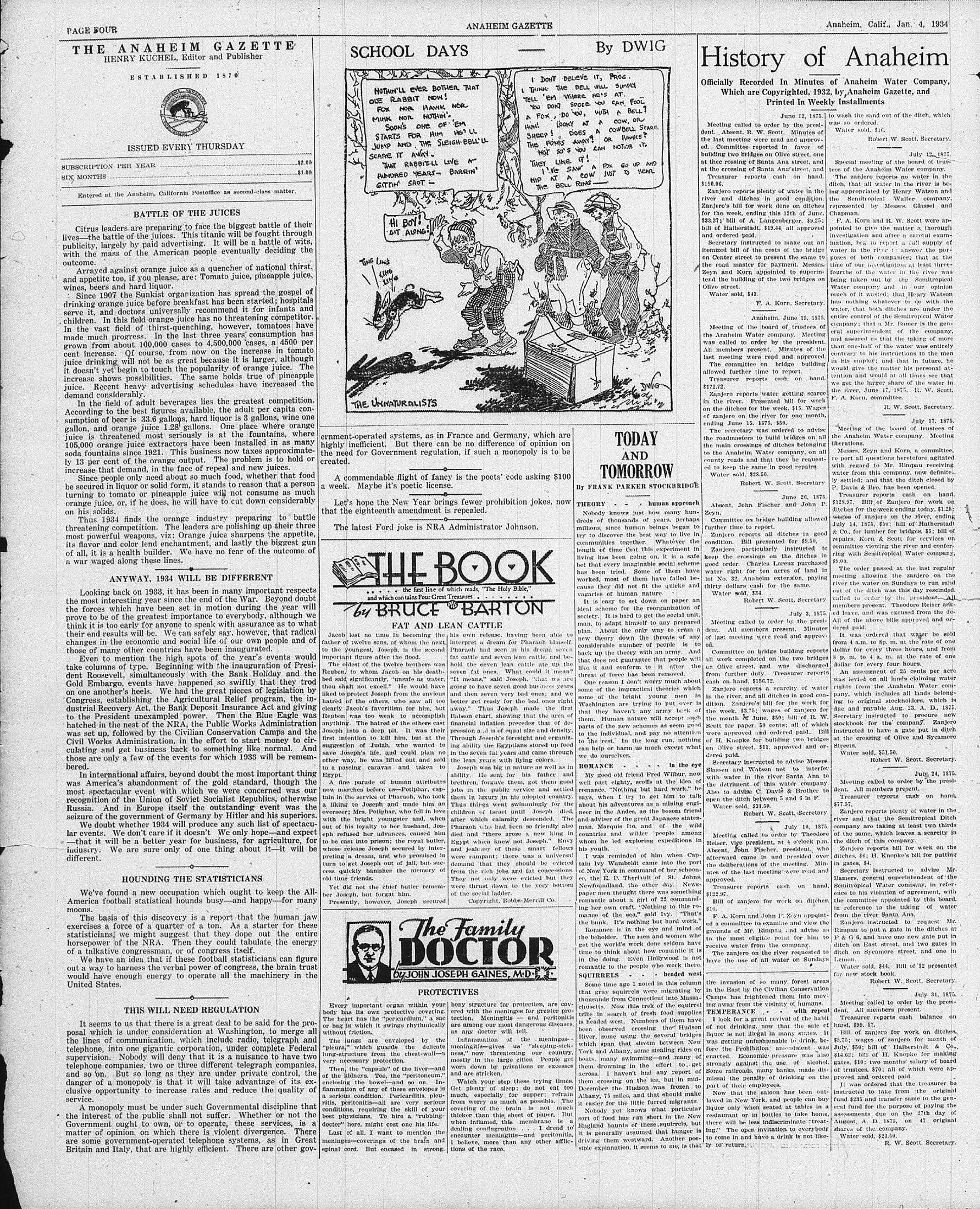
Searchable text
THE ANAHEIM GAZETTE
HENRY KUCHEL, Editor and Publisher
ESTABLISHED 1870
ISSUED EVERY THURSDAY
SUBSCRIPTION PER YEAR ... $2.00
SIX MONTHS ... $1.00
Entered at the Anaheim, California Postoffice as second-class matter.
BATTLE OF THE JUICES
Citrus leaders are preparing to face the biggest battle of their lives—the battle of the juices. This titanic will be fought through publicity, largely by paid advertising. It will be a battle of wits, with the mass of the American people eventually deciding the outcome.
Arrayed against orange juice as a quencher of national thirst, and appetite too, if you please, are: Tomato juice, pineapple juice, wines, beers and hard liquor.
Since 1907 the Sunkist organization has spread the gospel of drinking orange juice before breakfast has been started; hospitals serve it, and doctors universally recommend it for infants and children. In this field orange juice has no threatening competitor. In the vast field of thirst-quenching, however, tomatoes have made much progress. In the last three years consumption has grown from about 100,000 cases to 4,500,000 cases, a 4500 per cent increase. Of course, from now on the increase in tomato juice drinking will not be as great because it is larger, although it doesn't yet begin to touch the popularity of orange juice. The increase shows possibilities. The same holds true of pineapple juice. Recent heavy advertising schedules have increased the demand considerably.
In the field of adult beverages lies the greatest competition. According to the best figures available, the adult per capita consumption of beer is 33.6 gallons, hard liquor is 3 gallons, wine one gallon, and orange juice 1.28 gallons. One place where orange juice is threatened most seriously is at the fountains, where 105,000 orange juice extractors have been installed in as many
juice drinking will not be as great because it is larger, although it doesn't yet begin to touch the popularity of orange juice. The increase shows possibilities. The same holds true of pineapple juice. Recent heavy advertising schedules have increased the demand considerably.
In the field of adult beverages lies the greatest competition. According to the best figures available, the adult per capita consumption of beer is 33.6 gallons, hard liquor is 3 gallons, wine one gallon, and orange juice 1.28 gallons. One place where orange juice is threatened most seriously is at the fountains, where 105,000 orange juice extractors have been installed in as many soda fountains since 1921. This business now taxes approximately 13 per cent of the orange output. The problem is to hold or increase that demand, in the face of repeal and new juices.
Since people only need about so much food, whether that food be secured in liquor or solid form, it stands to reason that a person turning to tomato or pineapple juice will not consume as much orange juice, or, if he does, he will have to cut down considerably on his solids.
Thus 1934 finds the orange industry preparing to battle threatening competition. The leaders are polishing up their three most powerful weapons, viz: Orange juice sharpens the appetite, its flavor and color lend enchantment, and lastly the biggest gun of all, it is a health builder. We have no fear of the outcome of a war waged along these lines.
ANYWAY, 1934 WILL BE DIFFERENT
Looking back on 1933, it has been in many important respects the most interesting year since the end of the War. Beyond doubt the forces which have been set in motion during the year will prove to be of the greatest importance to everybody, although we think it is too early for anyone to speak with assurance as to what their end results will be. We can safely say, however, that radical changes in the economic and social life of our own people and of those of many other countries have been inaugurated.
Even to mention the high spots of the year's events would take columns of type. Beginning with the inauguration of President Roosevelt, simultaneously with the Bank Holiday and the Gold Embargo, events have happened so swiftly that they trod on one another's heels. We had the great pieces of legislation by Congress, establishing the Agricultural Relief program, the industrial Recovery Act, the Bank Deposit Insurance Act and giving to the President unexampled power. Then the Blue Eagle was hatched in the nest of the NRA, the Public Works Administration was set up, followed by the Civilian Conservation Camps and the Civil Works Administration, in the effort to start money to circulating and get business back to something like normal. And those are only a few of the events for which 1933 will be remembered.
In international affairs, beyond doubt the most important thing was America's abandonment of the gold standard, though the most spectacular event with which we were concerned was our recognition of the Union of Soviet Socialist Republics, otherwise Russia. And in Europe itself the outstanding event was the seizure of the government of Germany by Hitler and his superiors.
We doubt whether 1934 will produce any such list of spectacular events. We don't care if it doesn't. We only hope—and expect—that it will be a better year for business, for agriculture, for industry. We are sure only of one thing about it—it will be
In international affairs, beyond doubt the most important thing was America's abandonment of the gold standard, though the most spectacular event with which we were concerned was our recognition of the Union of Soviet Socialist Republics, otherwise Russia. And in Europe itself the outstanding event was the seizure of the government of Germany by Hitler and his superiors.
We doubt whether 1934 will produce any such list of spectacular events. We don't care if it doesn't. We only hope—and expect—that it will be a better year for business, for agriculture, for industry. We are sure only of one thing about it—it will be different.
HOUNDING THE STATISTICIANS
We've found a new occupation which ought to keep the All-America football statistical hounds busy—and happy—for many moons.
The basis of this discovery is a report that the human jaw exercises a force of a quarter of a ton. As a starter for these statisticians, we might suggest that they dope out the entire horsepower of the NRA. Then they could tabulate the energy of a talkative congressman, or of congress itself.
We have an idea that if these football statisticians can figure out a way to harness the verbal power of congress, the brain trust would have enough energy to operate all the machinery in the United States.
THIS WILL NEED REGULATION
It seems to us that there is a great deal to be said for the proposal which is under consideration at Washington, to merge all the lines of communication, which include radio, telegraph and telephone, into one gigantic corporation, under complete Federal supervision. Nobody will deny that it is a nuisance to have two telephone companies, two or three different telegraph companies, and so on. But so long as they are under private control, the danger of a monopoly is that it will take advantage of its exclusive opportunity to increase rates and reduce the quality of service.
A monopoly must be under such Governmental discipline that the interest of the public shall not suffer. Whether or not the Government ought to own, or to operate, these services, is a matter of opinion, on which there is violent divergence. There are some government-operated telephone systems, as in Great Britain and Italy, that are highly efficient. There are other gov-
SCHOOL DAYS — By DWIG
NOTHIN'LL EVER BOTHER THAT OLE RABBIT NOW!
FOX NOR HAWK NOR MINK NOR NOTHIN'.
SOON'S ONE OF 'EM STARTS FOR HIM HE'LL JUMP AND THE SLEIGH-BELL'LL SCARE IT AWAY.
THAT RABBIT'LL LIVE A HUNDRED YEARS—BARRIN' GITTIN' SAOT—
I DON'T BELIEVE IT, PROG.
I THINK THE BELL WILL SIMPLY TELL 'EM WHERE HE'S AT.
YOU DON'T SPOZE YOU CAN FOOL A FOX, DO 'YOU, WITH A BELL?
HUH! LOOKY AT A COW, OR SHEEP! DOES A COW/BELL SCARE THE FOXES AWAY? OR HAWKS?
NOT SO'S YOU CAN NOTICE IT.
THEY LIKE IT!
I'VE SAW A FOX GO UP AND HIP AT A COW JUST TO HEAR THE BELL RING—
HI BOY!
GIT ALONG!
THE UNNATURALISTS
ernment-operated systems, as in France and Germany, which are highly inefficient. But there can be no difference of opinion on the need for Government regulation, if such a monopoly is to be created.
A commendable flight of fancy is the poets' code asking $100 a week. Maybe it's poetic license.
Let's hope the New Year brings fewer prohibition jokes, now that the eighteenth amendment is repealed.
The latest Ford joke is NRA Administrator Johnson.
THE BOOK
the first line of which reads, "The Holy Bible," and which contains Four Great Treasures
by BRUCE BARTON
FAT AND LEAN CATTLE
Jacob lost no time in becoming the father of twelve sons, of whom the next to the youngest, Joseph, is the second important figure after the flood.
The oldest of the twelve brothers was Reuben, to whom Jacob on his deathbed said significantly, "unsafe as water, thou shalt not excel." He would have liked to protect Joseph from the envious hatred of the others, who saw all too clearly Jacob's favoritism for him, but Reuben was too weak to accomplish anything. The hatred of the others cast Joseph into a deep pit. It was their first intention to kill him, but at the suggestion of Judah, who wanted to save Joseph's life, and could plan no other way, he was lifted out and sold to a passing caravan and taken to Egypt.
A fine parade of human attributes now marches before us—Potiphar, captain in the service of Pharaoh, who took a liking to Joseph and made him an overseer; Mrs. Potiphar, who fell in love with the bright youngster and, when out of his loyalty to her husband, Joseph refused her advances, caused him to be cast into prison; the royal butler, whose release Joseph secured by inter-
TODAY
AND
TOMORROW
By FRANK PARKER STOCKBRIDGE
THEORY
human approach
Nobody knows just how many hundreds of thousands of years, perhaps millions, since human beings began trying to discover the best way to live communities together. What ever the length of time that this experiment living has been going on, it is a sad bet that every imaginable social scheme has been tried. Some of them had worked, most of them have failed because they did not fit the quirks and vagaries of human nature.
It is easy to set down on paper an ideal scheme for the reorganization society. It is hard to get the social unman, to adapt himself to any prepared plan. About the only way to cram new theory down the throats of a considerable number of people is back up the theory with an army. A that does not guarantee that people like it and conform to it after the threat of force has been removed.
One reason I don't worry much about some of the impractical theories while some of the bright young men in Washington are trying to put over that they haven't any army back them. Human nature will accept parts of the new schemes as seem good to the individual, and pay no attention to the rest. In the long run, nothing can help or harm us much except what we do ourselves.
ROMANCE
In the city
My good old friend Fred Wilbur, now well past eighty, scoffs at the idea romance. "Nothing but hard work," says, when I try to get him to talk about his adventures as a mining engineer in the Andes, as the bosom friend and adviser of the great Japanese statesman Marquis Ito, and of the countries and wilder people among whom he led exploring expeditions his youth.
A fine parade of human attributes now marches before us—Potiphar, captain in the service of Pharaoh, who took a liking to Joseph and made him an overseer; Mrs. Potiphar, who fell in love with the bright youngster and, when out of his loyalty to her husband, Joseph refused her advances, caused him to be cast into prison; the royal butler, whose release Joseph secured by interpreting a dream, and who promised in turn to get Joseph out of jail, but success quickly banishes the memory of old-time friends.
Yet did not the chief butler remember Joseph, but forgat him.
Presently, however, Joseph secured
Joseph was big in nature as well as in ability. He sent for his father and brethren, forgave them, got them good jobs in the public service and settled them in luxury in his adopted country. Thus things went swimmingly for the children of Israel until Joseph died, after which calamity descended. The Pharaoh who had been so friendly also died and "there arose a new king in Egypt which knew not Joseph." Envy and jealousy of these smart fellows were rampant; there was a universal demand that they should be evicted from the rich jobs and fat concessions. They not only were evicted but they were thrust down to the very bottom of the social ladder.
Copyright, Bobbs-Merrill Co.
PROTECTIVES
Every important organ within your body has its own protective covering. The heart has the "pericardium," a sac or bag in which it swings rhythmically without friction.
The lungs are enveloped by the "pleura," which guards the delicate lung-structure from the chest-wall—a very necessary protection.
Then, the "capsule" of the liver—and of the kidneys. Too, the "peritoneum," enclosing the bowel—and so on. Inflammation of any of these envelopes is a serious condition. Pericarditis, pleuritis, peritonitis—all are very serious conditions, requiring the skill of your best physicians. To hire a "rubbing-doctor" here, might cost one his life.
Last of all, I want to mention the meninges—coverings of the brain and spinal cord. But encased in strong,
bony structure for protection, are covered with the meninges for greater protection. Meningitis — and peritonitis are among our most dangerous diseases, as any doctor will tell.
Inflammation of the meninges—meningitis—gives us "sleeping-sickness," now threatening our country, mostly in the large cities. People get worn down by privations or excesses and are stricken.
Watch your step these trying times. Get plenty of sleep; do not eat too much, especially for supper; refrain from worry as much as possible. The covering of the brain is not much thicker than this sheet of paper. But when inflamed, this membrane is a dealing conflagration. I dread to encounter meningitis—and peritonitis, I believe, more than any other afflictions of the race.
ROMANCE
My good old friend Fred Wilbur, my well past eighty, scoffs at the idea of romance. "Nothing but hard work," says, when I try to get him to talk about his adventures as a mining engineer in the Andes, as the bosom friend and adviser of the great Japanese state man. Marquis Ito, and of the two countries and wilder people among whom he led exploring expeditions to his youth.
I was reminded of him when Cain Ivy Wamboldt came into the picture of New York in command of her schooler, the E. P. Theriault of St. John Newfoundland, the other day. New paper men thought there was something romantic about a girl of 22 commandoing her own craft. "Nothing to this manance of the sea," I said Ivy. "That bunk. It's nothing but hard work."
Romance is in the eye and mind of the beholder. The men and women we get the world's work done seldom have time to think about how romantic it is in doing. Even Hollywood is not romantic to the people who work there.
SQUIRRELS
Some time ago I noted in this column that gray squirrels were migrating thousands from Connecticut into Massachusetts. Now this trek of the squirrel tribe in search of fresh food supplies is headed west. Numbers of them have been observed crossing the Hudson River, some using the several bridges which span that stretch between New York and Albany, some stealing rides boats, many swimming—and many them drowning in the effort to cross. I haven't had any report them crossing on the ice, but in December the Hudson was frozen in Albany, 75 miles, and that should make it easier for the little furred migrants.
Nobody yet knows what particular sort of food has run short in the New England haunts of these squirrels, but it is generally assumed that hungery driving them westward. Another possible explanation, it seems to me, is that...
History of Anaheim
Officially Recorded In Minutes of Anaheim Water Company,
Which are Copyrighted, 1932, by Anaheim Gazette, and
Printed In Weekly Installments
June 12, 1875.
Meeting called to order by the president. Absent, R. W. Scott. Minutes of the last meeting were read and approved. Committee reported in favor of building two bridges on Olive street, one at the crossing of Santa Ana street, and at the crossing of Santa Ana street, and Treasurer reports cash on hand, $190.06.
Zanjero reports plenty of water in the river and ditches in good condition. Zanjero's bill for work done on ditches for the week, ending this 12th of June, $33.37; bill of A. Langenberger, $9.25; bill of Halberstadt, $19.44, all approved and ordered paid.
Secretary instructed to make out an itemized bill of the costs of the bridge on Center street to present the same to the road master for payment. Messrs. Zeyn and Korn appointed to superintend the building of the two bridges on Olive street.
Water sold, $43.
F. A. Korn, Secretary.
Anaheim, June 19, 1875.
Meeting of the board of trustees of the Anaheim Water company. Meeting was called to order by the president. All members present. Minutes of the last meeting were read and approved.
The committee on bridge building allowed further time to report.
Treasurer reports cash on hand, $172.72.
Zanjero reports water getting scarce in the river. Presented bill for work on the ditches for the week, $15. Wages of zanjero on the river for one month, ending June 15, 1875, $50.
The secretary was ordered to advise the roadmasters to build bridges on all the main crossings of ditches belonging to wash the sand out of the ditch, which was so ordered.
Water sold, $16.
Robert W. Scott, Secretary.
July 12, 1875.
Special meeting of the board of trustees of the Anaheim Water company.
The zanjero reports no water in the ditch, that all water in the river is being appropriated by Henry Watson and the Semitropical Walter company, represented by Messrs. Glassel and Chapman.
F. A. Korn and R. W. Scott were appointed to give the matter a thorough investigation and after a careful examination, beg to report a full supply of water in the river to answer the purposes of both companies; that at the time of our investigation at least three-fourths of the water in the river was being taken out by the Semitropical Water company and in our opinion much of it wasted; that Henry Watson has nothing whatever to do with the water, that both ditches are under the entire control of the Semitropical Water company; that a Mr. Bamer is the general superintendent of the company, and assured us that the taking of more than one-half of the water was entirely contrary to his instructions to the men in his employ; and that in future, he would give the matter his personal attention and would at all times see that we get the larger share of the water in the river, June 17, 1875. R. W. Scott, F. A. Korn, committee.
R. W. Scott, Secretary.
July 17, 1875.
Meeting of the board of trustees of the Anaheim Water company. Meeting liberations.
Messrs. Zeyn and Korn, a committee.
TODAY AND TOMORROW
PARKER STOCKBRIDGE
human approach knows just how many hunts of years, perhaps human beings began to live in together. Whatever the name that this experiment in been going on, it is a safe imaginable social scheme. Some of them have failed beeld not fit the quirks and human nature.
To set down on paper an idea for the reorganization of his hard to get the social unit, apt himself to any prepared but the only way to cram down the throats of any number of people is to theory with an army. And not guarantee that people will conform to it after the force has been removed.
In I don't worry much about impractical theories which the bright young men in are trying to put over is haven't any army bank of man nature will accept such new schemes as seem good individual, and pay no attention. In the long run, nothing harm us much except what ourselves.
In the eye old friend Fred Wilbur, now eighty, scoffs at the idea of Nothing but hard work," he I try to get him to talk adventures as a mining engi-Andes, as the bosom friend of the great Japanese states-uis Ito, and of the wild and wilder people among used exploring expeditions in
last meeting were read and approved.
The committee on bridge building allowed further time to report.
Treasurer reports cash on hand, $172.72.
Zanjero reports water getting scarce in the river. Presented bill for work on the ditches for the week, $15. Wages of zanjero on the river for one month, ending June 15, 1875, $50.
The secretary was ordered to advise the roadmasters to build bridges on all the main crossings of ditches belonging to the Anaheim Water company, on all county roads and that they be requested to keep the same in good repairs.
Water sold, $28.50.
Robert W. Scott, Secretary.
June 26, 1875.
Absent, John Fischer and John P. Zeyn.
Committee on bridge building allowed further time to report.
Zanjero reports all ditches in good condition. Bill presented for $9.50.
Zanjero particularly instructed to keep the crossings on the ditches in good order. Charles Lorenz purchased water right for ten acres of land in lot No. 32, Anaheim extension, paying thirty dollars cash for the same.
Water sold, $34.
Robert W. Scott, Secretary.
July 3, 1875.
Meeting called to order by the president. All members present. Minutes of last meeting were read and approved.
Committee on bridge building reports all work completed on the two bridges on Olive street, and was discharged from further duty. Treasurer reports cash on hand, $156.72.
Zanjero reports a scarcity of water in the river, and all ditches in good condition. Zanjero's bill for the work for the week, $3.75; wages of zanjero for the month of June, $50; bill of R.W. Scott for paper, 50 cents; all of which were approved and ordered paid.. Bill of H. Knopke for building two bridges on Olive street, $11, approved and ordered paid.
Secretary instructed to advise Messrs. Slassen and Watson not to interfere with water in the river Santa Ana to the detriment of this water company. Also to advise C. Davis & Brother to open the ditch between 5 and 6 in F.
Water sold, $31.50.
Robert W. Scott, Secretary.
July 10, 1875.
Meeting called to order by Theodore Reiser, vice president, at 4 o'clock p.m. Absent, John Fischer, president, who in his employ; and that in future, he would give the matter his personal attention and would at all times see that we get the larger share of the water in the river, June 17, 1875. R.W. Scott, F.A.Korn, committee.
R.W. Scott, Secretary.
July 17, 1875.
Meeting of the board of trustees of the Anaheim Water company. Meeting liberations.
Messrs. Zeyn and Korn, a committee, re port all questions heretofore agitated with regard to Mr. Rimpau receiving water from this company, now definitely settled; and that the ditch closed by P.Davis & Bro. has been opened.
Treasurer reports cash on hand, $128.97. Bill of Zanjero for work on ditches for the week ending today,$1.25; wages of zanjero on the river, ending July 14, 1875, $50; bill of Hatherstadt & Co., for lumber for bridges, $5; bill of repairs, Korn & Scott for services on committee viewing the river and conferring with Semitropical Water company,$9.00.
The order passed at the last regular meeting allowing the zanjero on the river the water on Sundays to run sand out of the ditch was this day rescinded called to order by the president. All members present. Theodore Reiser asked leave, and was excused from the de-All of the above bills approved and ordered paid.
It was ordered that water be sold from 4 a.m. to $p.m. at the rate of one dollar for every three hours, and from 8 p.m. to 4 a.m. at the rate of one dollar for every four hours.
An assessment of 25 cents per acre was levied on all lands claiming water rights from the Anaheim Water company, which includes all lands belonging to original stockholders, which is due and payable Aug. 23, A.D., 1875. Secretary instructed to procure new stockbook for the company. Zanjero instructed to have a gate put in ditch at the crossing of Olive and Sycamore Streets.
Water sold,$51.50.
Robert W. Scott, Secretary.
July 24, 1875.
Meeting called to order by the president. All members present.
Treasurer reports cash on hand,$77.57.
Zanjero reports plenty of water in the river and that the Semitropical Ditch company are taking at least two thirds of the same, which leaves a scarcity in the ditch of this company.
Zanjero reports bill for work on
In the eye of old friend Fred Wilbur, now slightly, scoffs at the idea of Nothing but hard work," he I try to get him to talk adventures as a mining engineer. Andes, as the bosom friend of the great Japanese statesman Ito, and of the wild and wilder people among exploring expeditions in minded of him when Cap-camboldt came into the port in command of her schooner P. Theriault of St. Johns, and the other day. News thought there was something about a girl of 22 commanding a craft. "Nothing to this robe sea," said Ivy. "That's it nothing but hard work." Is in the eye and mind of Mr. The men and women who old's work done seldom have think about how romantic it is. Even Hollywood is not the people who work there.
The ago I noted in this column squirrels were migrating by from Connecticut into Massachusetts; now this trek of the squirrel march of fresh food supplies rest. Numbers of them have crossed the Hudson River using the several bridges that stretched between New Albany, some stealing rides on busy swimming—and many of them in the effort to get havent had any report of being on the ice, but in mid-the Hudson was frozen to smiles, and that should make the little furred migrants. Yet knows what particular has run short in the New Counts of these squirrels, but really assumed that hunger is from westward. Another position, it seems to me, is that Secretary instructed to advise Messrs Slassen and Watson not to interfere with water in the river Santa Ana to the detriment of this water company. Also to advise C. Davis & Brother to open the ditch between 5 and 6 in F. Water sold, $31.50.
Robert W. Scott, Secretary
July 10, 1875
Meeting called to order by Theodore Reiser, vice president, at 4 o'clock p.m. Absent John Fischer, president, who afterward came in and presided over the deliberations of the meeting. Minutes of the last meeting were read and approved.
Treasurer reports cash on hand, $122.97.
Bill of zanjero for work on ditches, $10.
F. A. Korn and John P. Zeyn appointed a committee to examine and view the grounds of Mr. Rimpau and advise as to the most eligible point for him to receive water from the company.
The zanjero on the river requested to have the use of all water on Sundays
the invasion of so many forest areas in the East by the Civilian Conservation Camps has frightened them into moving away from the visinity of humans.
TEMPERANCE with repeal
I look for a great revival of the habit of not drinking, now that the sale of liquor is not illegal in many states. It was getting unfashionable to drink, before the Prohibition amendment was enacted. Economic pressure was also strongly against the use of alcohol. Some railroads, many banks, made dismissal the penalty of drinking on the part of their employees.
Now that the saloon has been outlawed in New York, and people can buy liquor only when seated at tables in a restaurant or in bottles to take home, there will be less indiscriminate "treating." The open invitation to everybody to come in and have a drink is not likely to return.
Robert W. Scott, Secretary.
July 24, 1875
Meeting called to order by the president. All members present.
Treasurer reports cash on hand, $77.57.
Zanjero reports plenty of water in the river and that the Semitropical Ditch company are taking at least two thirds of the same, which leaves a scarcity in the ditch of this company.
Zanjero reports bill for work on the ditches, $6; H. Knopke's bill for putting in gates, $4.
Secretary instructed to advise Mr. Bamers, general superintendent of the Semitropical Water company, in reference to his violation of agreement, with the committee appointed by this board, in reference to the taking of water from the river Santa Ana.
Zanjero instructed to request Mr. Rimpau to put a gate in the ditches at F & G 6, and have one new gate put in ditch on East street, and two gates in ditch on Sycamore street, and one in Lemon.
Water sold, $44. Bill of $2 presented for new stock book.
Robert W. Scott, Secretary.
July 31, 1875
Meeting called to order by the president. All members present.
Treasurer reports cash balance on hand, $99.57.
Bill of zanjero for work on ditches, $8.75; wages of zanjero for month of July, $50; bill of Halberstadt & Co., $14.62; bill of H. Knopke for making gates, $10; two months' salary of board of trustees, $70; all of which were approved and ordered paid.
It was ordered that the treasurer be instructed to take from the original fund $235 and transfer same to the general fund for the purpose of paying the assessments due on the 27th day of August, A.D. 1875, on 47 original shares of the company.
Water sold, $23.50.
R. W. Scott, Secretary.