anaheim-gazette 1932-12-29
Scanned page
Searchable text
THE ANAHEIM GAZEITE
HENRY KUCHEL, Editor and Publisher
ESTABLISHED 1870
ISSUED EVERY THURSDAY
SUBSCRIPTION PER YEAR $2.00
SIX MONTHS $1.00
Entered at the Anaheim, California Postoffice as second-class matter.
THE FOLLIES OF 1932
In these last days of 1932, like the anti-climax of a long mystery drama everything ends all right with Santa Claus scampering across the national stage. There may be doubt in our minds as to the true meaning of some phases of the world-wide drama, in which many experienced actors so forget themselves as to lose their temper, but in calmer days of retrospection we hope to look on with Mellowness of understanding.
In the first scene 1932, way back in January and February, the plot was laid for national hysteria. Banks by the hundreds closed their doors in the faces of anxious depositors as episodes in the continuity of depression. The build-up included a clamor of long-suffering farmers seeking to lighten their mortgage burdens. Then came in rapid succession the farmers' strikes for higher prices on their produce, and the bugaboo of over-production in corn and wheat and pork and cotton. In the side show of tragedy we had the kidnapping and murder of Charles Augustus Lindberg, junior; as a highlight or relief, we witnessed the jailing of Al Capone.
Thus was laid the groundwork for the greatest spectacle of all—politics. Governor Franklin D. Roosevelt, remembering the axiom about the early bird getting the worm, began his campaigning early. Hardly had spring arrived when he claimed enough delegates to assure him of democratic nomination. The episode ended melodramatically when California's William Gibbs McAdoo switched the Golden State's and Texas' Garner votes to the early bird. Roosevelt followed religiously the political advice of his idol, Theodore Roosevelt, in his sage warnings to William Howard Taft to "smile always smile." Attack your opponents.
Thus was laid the groundwork for the greatest spectacle of all—politics. Governor Franklin D. Roosevelt, remembering the axiom about the early bird getting the worm, began his campaign early. Hardly had spring arrived when he claimed enough delegates to assure him of democratic nomination. The episode ended melodramatically when California's William Gibbs McAdoo switched the Golden State's and Texas' Garner votes to the early bird. Roosevelt followed religiously the political advice of his idol, Theodore Roosevelt, in his sage warnings to William Howard Taft to "smile, always smile. Attack your opponents. Don't explain."
In contrast, President Herbert Hoover, who was "put on the spot" because he held the executive reins of the country, had to explain. He brought out the reconstruction finance corporation. Governor Roosevelt shied at attacking the R. F. C. directly, but his cohorts fired darts about a $12,000,000 loan to a Missouri railroad and about General Gates Dawes drawing $89,000,000 "on account." Defender Hoover mentioned the Home Loan Banks, the conferences with industrial leaders which resulted in less labor troubles than ever before during similar trying times; he stressed the decline of bank failures since inauguration of his policies; he blamed the depression on world-wide influences, defended the Smoot-Hawley tariff, made a plea for continuance of his policies to end depression. Warrior Roosevelt pointed his spear toward Hoover, attacking him on the grounds of not doing anything for the forgotten man. Defender Hoover, in desperation, charged with his famous "grass on the streets" tangent. Governor Roosevelt, following Teddy's well thought-out plan, did not explain. He wrote a letter to a New Yorker promising a job for everyone of the 11 million unemployed.
So, the 11 million unemployed and many millions more of harrassed voters, tired and weary from a long campaign and worn to a frazzle with hard times, trekked to the polls on November 8. In the battle of ballots, Warrior Roosevelt won the fair-haired heroine, Victory. Since then the element of mystery has diminished, and into its place is expectancy. Thus ushers in the era of watchful waiting till March 4.
As the show closes and curtain drops for The Follies of 1932 we begin to get a better understanding of the mystery drama. All the sad events which led to the hectic dethroning of President Hoover, all the tragic episodes of bonus marchers and farmers' strikes, are bombastic surface indications of the eternal fountain of hope and youth that is America. Uncle Sam, weaned away from the traditional hatreds of the Old World and an orphan in the comity of nations, is determined to work out his own solution peaceably and with dispatch. If his choice of leaders in 1932 does not result in reduced governmental overhead for 1933, if taxes do not drop drastically and racketeering and swindling of American people through mismanaged corporate enterprises does not halt with this New Year and the next, the citizens of this country will call for a new deal in 1934.
But underneath the whole external play is a deeper understanding by the American people of the real values of humanity. The average citizen has discovered that the road to happiness is not through superficial spending and hilarity which marked the past decade. The Follies of 1932 taught him that. True happiness lies in honest achievement, friendship and intellectual endeavor. Let us hope that we will capitalize on this discovery during the year 1933.
butter. For several years nation began feeling that His distress was a major In the meantime the praised progressed by enlarging buying distressed merchant competitor has grown up at the very life of our
The examples of care where until the market thousands of dollars ee store, instead of staying the district, are sent away Money made here is used with the process growing
Where will it end? depression, refuse to try indirectly robbing us or penny today, but save
"A C"
While discussing the independence, Senator Royaled amazement that so appeared to be interested asked for permission to in the Congressional R
"It is because I want or other the senate of question of the alienationthe present moment, 11 there are eight senators an hour and 10 minutes are vacant."
Senator Copeland's has been in the gallery important legislation vthe membership was psenators from the chap physician and surgeonical advice. He always marks of how well Pro draw attention to his instance is sound:
"Senators are hung I hope they will not eat the average man live doctors live on the other gestion which I hope r
ARE CHAIN STORES THE CAUSE OF THE DEPRESSION
The practice of certain Anaheim chain grocery stores in purchasing fresh vegetables from dealers in Los Angeles, unless they can buy the same products from local farmers at a much less price, is the crux of a situation which gradually is enveloping Orange county farmers in a slough of despondency. One example is enough to suffice as to the methods pursued by chain grocery stores: A local farmer secured an order at the market price from one of the larger chain stores of Anaheim for 40 lugs of ripe tomatoes and as large an order of green corn. He delivered the tomatoes and corn at the designated time, only to have the manager of the store refuse to accept the order, unless the price was considerably lower than in Los Angeles wholesale markets for the same quality of produce. The farmer expended labor worth the price of the corn and tomatoes, in good faith he delivered the produce, and now he faced the proposition of selling it at less than agreed on, peddling it from door to door, or letting it spoil. He was forced to accept the lower price.
This example can be elaborated on many times. But it serves the purpose of showing the means by which certain chain stores are MAKING A PROFIT ON THE FARMERS' MISERY. On the opening day of the strawberry season certain chain stores refused to handle the berries, thereby "breaking" the market price, and literally breaking the grower as well. It is a vicious circle. In order to best the next store in price, in order to offer "specials" that will draw the bargain-hunting throngs, the chain stores deliberately are knocking down the market until all produce is distress produce. This makes the farmer a pauper. He cannot pay his taxes, to say nothing of paying labor to help raise his produce, buying new machinery or needed clothing or other food-stuffs. When the farmer cannot buy, numerous people dependent upon his trade cannot buy, and the people dependent upon them cannot buy, and so on until the whole nation is affected.
The farmer for ten years has not been making his bread and
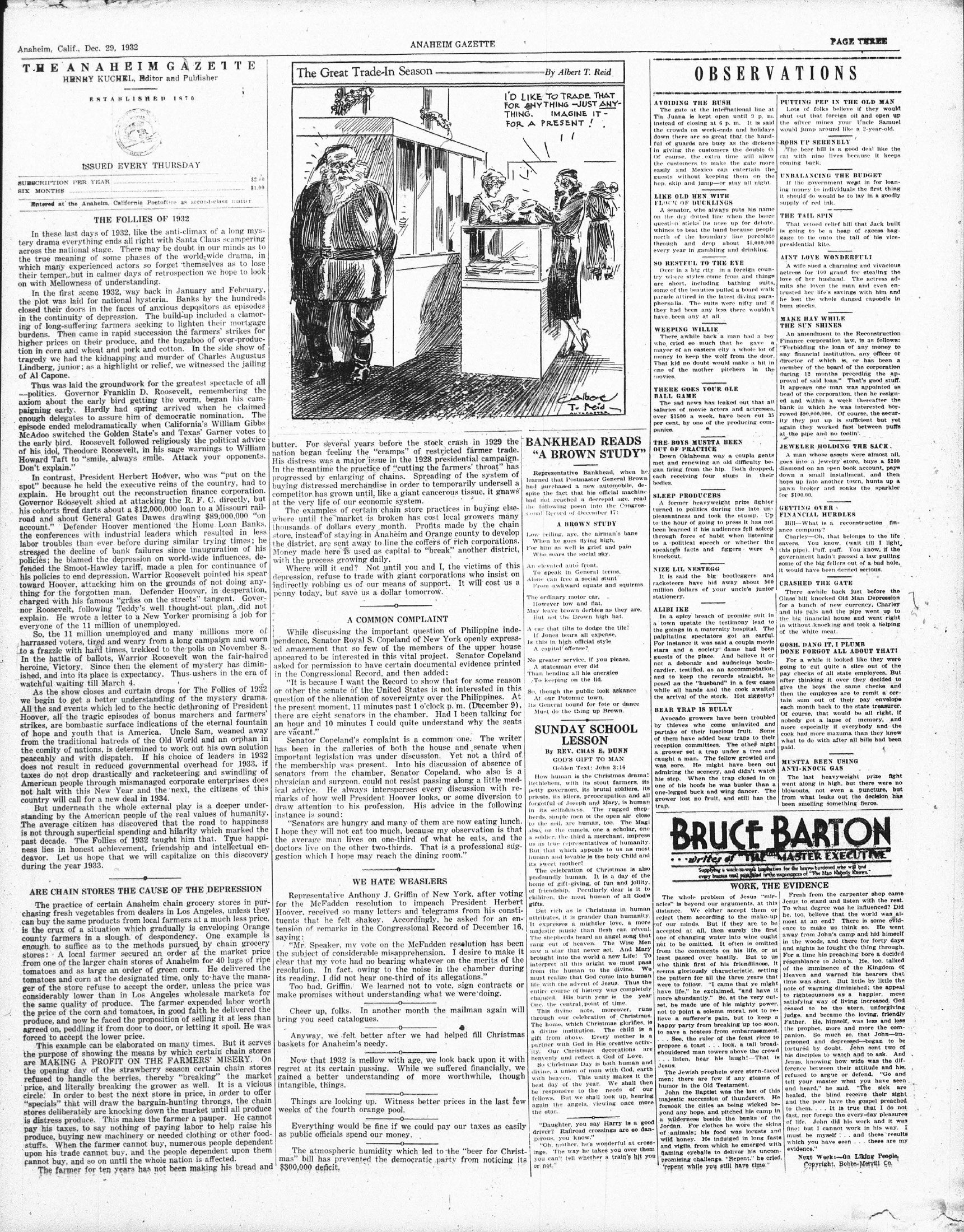
The Great Trade-In Season
By Albert T. Reid
I'D LIKE TO TRADE THAT FOR ANYTHING - JUST ANYTHING. IMAGINE IT FOR A PRESENT!
BANKHEAD READS "A BROWN STUDY"
After. For several years before the stock crash in 1929 the nation began feeling the "cramps" of restricted farmer trade. His distress was a major issue in the 1928 presidential campaign. In the meantime the practice of "cutting the farmers' throat" has progressed by enlarging of chains. Spreading of the system of buying distressed merchandise in order to temporarily undersell a competitor has grown until, like a giant cancerous tissue, it gnaws at the very life of our economic system.
The examples of certain chain store practices in buying elsewhere until the market is broken has cost local growers many thousands of dollars every month. Profits made by the chain store, instead of staying in Anaheim and Orange county to develop the district, are sent away to line the coffers of rich corporations. Money made here is used as capital to "break" another district, with the process growing daily.
Where will it end? Not until you and I, the victims of this depression, refuse to trade with giant corporations who insist on directly robbing us of our means of support. It will cost us aanny today, but save us a dollar tomorrow.
A COMMON COMPLAINT
While discussing the important question of Philippine independence, Senator Royal S. Copeland of New York openly expresses amazement that so few of the members of the upper house appeared to be interested in this vital project. Senator Copeland asked for permission to have certain documentary evidence printed in the Congressional Record, and then added:
"It is because I want the Record to show that for some reason other senate of the United States is not interested in this question of the alienation of sovereignty over the Philippines. At the present moment, 11 minutes past 1 o'clock p.m. (December 9), there are eight senators in the chamber. Had I been talking for an hour and 10 minutes I could quite understand why the seats are vacant."
Senator Copeland's complaint is a common one. The writer has been in the galleries of both the house and senate when important legislation was under discussion. Yet not a third of the membership was present. Into his discussion of absence of senators from the chamber, Senator Copeland, who also is a physician and surgeon, could not resist passing along a little medical advice. He always intersperses every discussion with remarks of how well President Hoover looks, or some diversion to draw attention to his profession. His advice in the following instance is sound:
"Senators are hungry and many of them are now eating lunch. Hope they will not eat too much, because my observation is that the average man lives on one-third of what he eats, and the doctors live on the other two-thirds. That is a professional suggestion which I hope may reach the dining room."
WE HATE WEASLERS
Representative Anthony J. Griffin of New York, after voting for the McFadden resolution to impeach President Herbert Hoover, received so many letters and telegrams from his constituents that he felt shakey. Accordingly, he asked for an extension of remarks in the Congressional Record of December 16, saying:
"Mr. Speaker, my vote on the McFadden resolution has been the subject of considerable misapprehension. I desire to make it clear that my vote had no bearing whatever on the merits of the resolution. In fact, owing to the noise in the chamber during its reading, I did not hear one-third of its allegations."
Too bad, Griffin. We learned not to vote, sign contracts or make promises without understanding what we were doing.
Cheer up, folks. In another month the mailman again will bring you seed catalogues.
Anyway, we felt better after we had helped fill Christmas maskets for Anaheim's needy.
Now that 1932 is mellow with age, we look back upon it with regret at its certain passing. While we suffered financially, we gained a better understanding of more worthwhile, though untangible, things.
Things are looking up. Witness better prices in the last few weeks of the fourth orange pool.
Everything would be fine if we could pay our taxes as easily as public officials spend our money.
The atmospheric humidity which led to the "beer for Christmas" bill has prevented the democratic party from noticing its $300,000 deficit,
How human is the Christmas drama! Bethlehem, with its stout farmers, its petty governors, its brutal soldiers, its priests, its idlers, preoccupation and all forgetful of Joseph and Mary, is human in its selfishness. The rugged shepherds, simple men of the open air close to the soil, are human, too. The Magi also, on the camels, one a scholar, one a soldier, the third a merchant, impress us as true representatives of humanity. But that which appeals to us as most human and lovable is the holy Child and its sweet mother!
The celebration of Christmas is also profoundly human. It is a day of the home of gift-giving, of fun and jollity, of friendship. Pecullarly dear is it to children, the most human of all God's gifts.
But rich as is Christmas in human attributes, it is grander than humanity. It expresses a mightier love, a more majestic music than flesh can reveal. The shepherds heard an angel song that rang out of heaven. The Wise Men saw a star that never set. And Mary brought into the world a new Life! To interpret all this aright we must pass from the human to the divine. We must realize that God came into human life with the advent of Jesus. Thus the entire course of history was completely changed. His birth year is the year One, the central point of time.
This divine note, moreover, runs through our celebration of Christmas. The home, which Christmas glorifies, is a divine institution. The child is a gift from above. Every mother is a partner with God in His creative activity. Our Christmas decorations are heavenly and reflect a God of Love.
So Christmas Day is both human and divine, a union of man with God, earth with heaven. This unity makes it the best day of the year. We shall then be responsive to the needs of our fellows. But we shall look up, hearing again the angels, viewing once more the star.
"Daughter, you say Harry is a good driver? Railroad crossings are so dangerous, you know."
"Oh, mother, he's wonderful at crossings. The way he takes you over them you can't tell whether a train's hit you or not."
OBSERVATIONS
AVOIDING THE RUSH
The gate at the international line at Tia Juana is kept open until 9 p.m. instead of closing at 6 p.m. It is said the crowds on weekends and holidays down there are so great that the handful of guards are busy as the dickens in giving the customers the double O. Of course, the extra time will allow the customers to make the gate more easily and Mexico can entertain the guests without keeping them on the hop, skip and jump—or stay all night.
LIKE OLD HEN WITH FLOCK OF DUCKLINGS
A senator, who always puts his name on the dry dotted line when the booze question sticks its nose up for debate, whines to beat the band because people north of the boundary line percolate through and drop about $5,000,000 every year in gambling and drinking.
SO RESTFUL TO THE EYE
Over in a big city in a foreign country where styles come from and things are short, including bathing suits, some of the beauties pulled a board walk parade attired in the latest diving paraphernalia. The suits were nifty and if they had been any less there wouldn't have been any at all.
WEEPING WILLIE
There awhile back a man had a boy who cried so much that he gave a mayor of an eastern city a whole lot of money to keep the wolf from the door. That kid no doubt would make a hit in one of the mother pitchers in the movies.
THERE GOES YOUR OLE BALL GAME
The sad news has leaked out that all salaries of movie actors and actresses, over $1500 a week, have been cut 35 per cent, by one of the producing companies.
THE BOYS MUSTTA BEEN OUT OF PRACTICE
Down Oklahoma way a coupla gents putTING PEP IN THE OLD MAN
Lots of folks believe if they would shut out that foreign oil and open up the silver mines your Uncle Samuel would jump around like a 2-year-old.
ROBS UP SERENELY
The beer bill is a good deal like the cat with nine lives because it keeps coming back.
UNBALANCING THE BUDGET
If the government went in for loaning money to individuals the first thing it should do would be to lay in a goodly supply of red ink.
THE TAIL SPIN
That vetoed relief bill that Jack built is going to be a heap of excess baggage to tie onto the tail of his vice-presidential kite.
AINT LOVE WONDERFUL!
A wife sued a charming and vivacious actress for 100 grand for stealing the love of her husband. The actress admits she loves the man and even entrusted her life's savings with him and he lost the whole danged capoodle in bum stocks.
MAKE HAY WHILE THE SUN SHINES
An amendment to the Reconstruction Finance corporation law, is as follows: "Forbidding the loan of any money to any financial institution, any officer or director of which is, or has been a member of the board of the corporation during 12 months preceding the approval of said loan." That's good stuff. It appears one man was appointed as head of the corporation, then he resigned and within a week thereafter the bank in which he was interested borrowed $90,000,000. Of course, the security they put up is sufficient but yet again they worked fast between puffs at the pipe and no foolin'.
JEWELER HOLDING THE SACK.
A man whose assets were almost nil.
THERE GOES YOUR OLE BALL GAME
The sad news has leaked out that all salaries of movie actors and actresses, over $1500 a week, have been cut 35 per cent, by one of the producing companies.
THE BOYS MUSTTA BEEN OUT OF PRACTICE
Down Oklahoma way a couple gents met and renewing an old difficulty began firing from the hip. Both dropped, each receiving four slugs in their bodies.
SLEEP PRODUCERS
A former heavyweight prize fighter turned to politics during the late unpleasantness and took the stump. Up to the hour of going to press it has not been learned if his audiences fell asleep through force of habit when listening to a political speech or whether the speaker's facts and figgers were a knockout.
NIZE LIL NESTEGG
It is said the big bootleggers and racketeers have hid away about 500 million dollars of your uncle's junior stationery.
ALIBI IKE
In a spicy breach of promise suit in a town upstate the testimony lead to the goings in a maternity hospital. The palpitating spectators got an earful. For instance it was said a couple movie stars and a society dame had been guests of the place. And believe it or not a debonair and audacious boule-cardier, testified, as an accommodation, and to keep the records straight, he posed as the "hueband" in a few cases while all hands and the cook awaited the arrival of the stork. Hot ziggetty!
BEAR TRAP IS BULLY
Avocado growers have been troubled by thieves who come uninvited and partake of their luscious fruit. Some of them have added bear traps to their reception committees. The other night a grower set a trap under a tree and caught a man. The fellow growled and was sore. He might have been out admiring the scenery, and didn't watch his step. When the trap closed in on one of his hoofs he was busier than a one-legged buck and wing dancer. The grower lost no fruit, and still has the trap.
JEWELER HOLDING THE SACK
A man whose assets were almost nil, goes into a jewelry store, buys a $200 diamond on an open book account, pays down a small installment, and then hops up into another town, hunts up a pawn broker and soaks the sparkler for $100.00.
GETTING OVER FINANCIAL HURDLES
Bill—What is a reconstruction finance company?
Charley—Oh, that belongs to the life savers. You know, (wait till I light this pipe). Puff, puff. You know, if the government hadn't passed a law pulling some of the big fellers out of a bad hole, it would have been derned serious.
CRASHED THE GATE
There awhile back just before the Glass bill knocked Old Man Depression for a bunch of new currency. Charley and his pals and the pipe went up to the big financial house and went right in without knocking and took a helping of the white meat.
GOSH, DANG IT, I PLUMB
DONE FORGOT ALL ABOUT THAT!
For a while it looked like they were going to cut quite a slice out of the pay checks of all state employees. But after thinking it over they decided to give the boys the same checks and then the employees are to remit a certain sum out of their pay envelope each month back to the state treasurer. Of course, that would be all right, if nobody got a lapse of memory, and more especially if everybody and the cook had more mazuma than they knew what to do with after all bills had been paid.
MUSTTA BEEN USING ANTI-KNOCK GAS
The last heavyweight prize fight went along in high, but there were no blowouts, not even a puncture, but from what leaks out the decision has been smelling something fierce.
WORK, THE EVIDENCE
The whole problem of Jesus "miracles" is beyond our arguments, at this distance. We either accept them or reject them according to the make-up of our minds. But if they are to be accepted at all, then surely the first one of changing water into wine ought not to be omitted. It often is omitted from the comments on his life, or at least passed over hastily. But to us who think first of his friendliness, it seems gloriously characteristic, setting the pattern for all the three years that were to follow. "I came that ye might have life," he exclaimed, "and have it more abundantly." So, at the very outset, he made use of his mighty power, not to point a solemn moral, not to relieve a sufferer's pain, but to keep a happy party from breaking up too soon, to save a hostess from embarrassment.
See, the ruler of the feast rises to propose a toast ... look, a tall broad-shouldered man towers above the crowd ... listen, hear his laugh!—That is Jesus.
The Jewish prophets were stern-faced men; there are few if any gleams of humor in the Old Testament.
John the Baptist was the last of this majestic succession of thunderers. He forsook the cities as being wicked beyond any hope, and pitched his camp in a wilderness beside the banks of the Jordan. For clothes he wore the skins of animals; his food was locusta and wild honey. He indulged in long fasts and vigils, from which he emerged with flaming eyeballs to deliver his uncompromising challenge. "Repent," he cried, "repent while you still have time."
Fresh from the carpenter shop came Jesus to stand and listen with the rest. To what degree was he influenced? Did he, too, believe that the world was almost at an end? There is some evidence to make us think so. He went away from John's camp and hid himself in the woods, and there for forty days and nights he fought the thing through. For a time his preaching bore a decided resemblance to John's. He, too, talked of the imminence of the Kingdom of Heaven and warned his hearers that time was short. But little by little the note of warning diminished; the appeal to righteousness as a happier, more satisfying way of living increased. God ceased to be the stern, unforgiving judge, and became the loving, friendly Father. He himself, was less and less the prophet, more and more the companion. So much so, that John—imprisoned and depressed—began to tortured by doubt. John sent two of his disciples to watch and to ask. And Jesus, knowing how wide was the difference between their attitude and his, refused to argue or defend. "Go and tell your master what you have seen and heard." he said. "The sick are healed, the blind receive their sight and the poor have the gospel preached to them. It is true that I do not fast, nor forego the every-day pleasures of life. John did his work and it was fine; but I cannot work in his way. I must be myself ... and these results which you have seen ... these are my evidence."
Next Week:—On Liking People,
Copyright, Bobbs-Merrill Co.