anaheim-gazette 1932-11-24
Scanned page
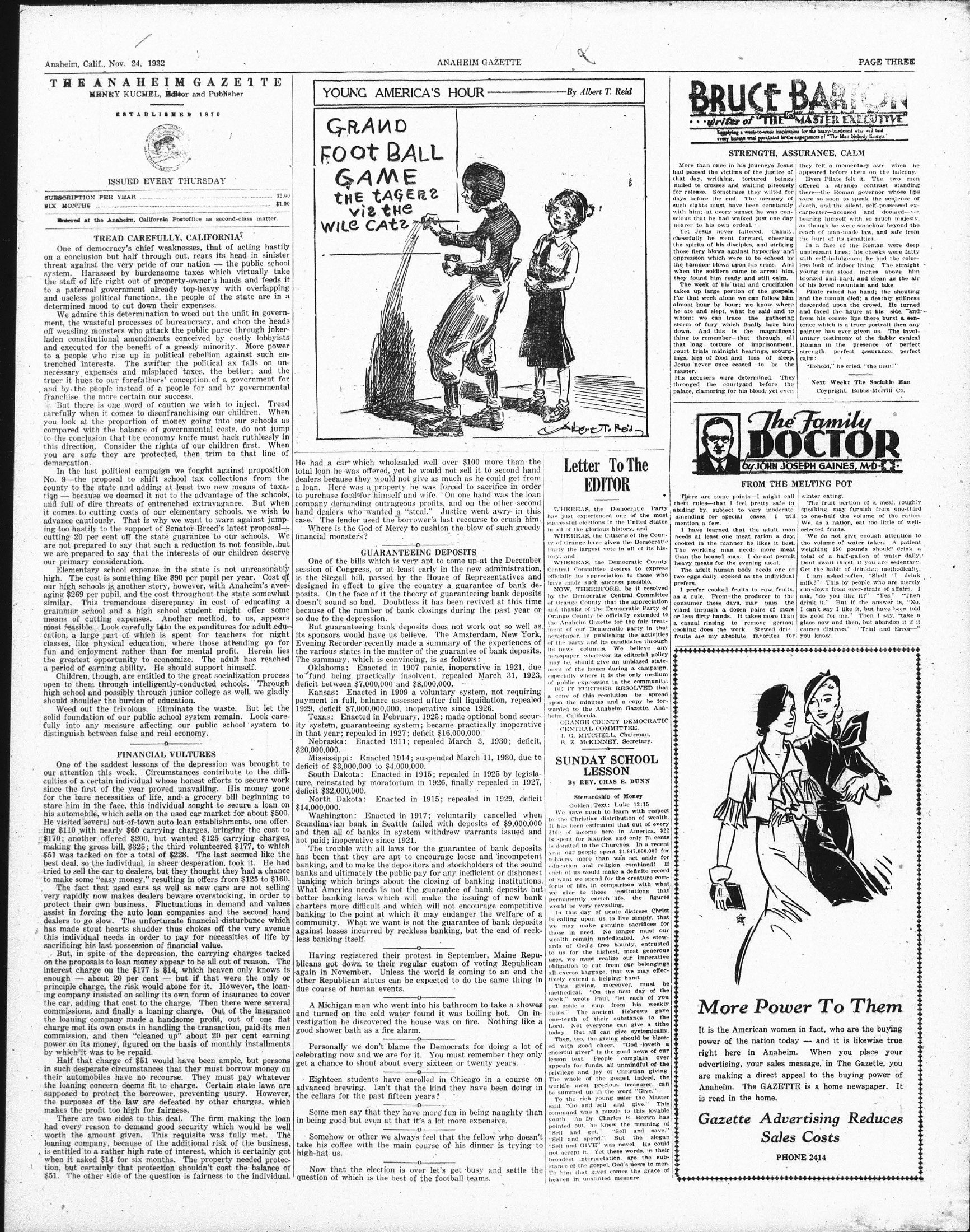
Searchable text
THE ANAHEIM GAZEITE
HENRY KUCHEL, Editor and Publisher
ESTABLISHED 1870
ISSUED EVERY THURSDAY
SUBSCRIPTION PER YEAR ... $2.00
SIX MONTHS ... $1.00
Entered at the Anaheim, California Postoffice as second-class matter.
TREAD CAREFULLY, CALIFORNIA
One of democracy's chief weaknesses, that of acting hastily on a conclusion but half through out, rears its head in sinister threat against the very pride of our nation — the public school system. Harassed by burdensome taxes which virtually take the staff of life right out of property-owner's hands and feeds it to a paternal government already top-heavy with overlapping and useless political functions, the people of the state are in a determined mood to cut down their expenses.
We admire this determination to weed out the unfit in government, the wasteful processes of bureaucracy, and chop the heads off weasling monsters who attack the public purse through joker-laden constitutional amendments conceived by costly lobbyists and executed for the benefit of a greedy minority. More power to a people who rise up in political rebellion against such entrenched interests. The swifter the political ax falls on unnecessary expenses and misplaced taxes, the better; and the truer it hues to our forefathers' conception of a government for and by the people instead of a people for and by governmental franchise, the more certain our success.
But there is one word of caution we wish to inject. Tread carefully when it comes to disenfranchising our children. When you look at the proportion of money going into our schools as compared with the balance of governmental costs, do not jump to the conclusion that the economy knife must hack ruthlessly in this direction. Consider the rights of our children first. When you are sure they are protected, then trim to that line of
trenched interests. The swifter the political ax falls on unnecessary expenses and misplaced taxes, the better; and the truer it hues to our forefathers' conception of a government for and by the people instead of a people for and by governmental franchise, the more certain our success.
But there is one word of caution we wish to inject. Tread carefully when it comes to disenfranchising our children. When you look at the proportion of money going into our schools as compared with the balance of governmental costs, do not jump to the conclusion that the economy knife must hack ruthlessly in this direction. Consider the rights of our children first. When you are sure they are protected, then trim to that line of demarcation.
In the last political campaign we fought against proposition No. 9—the proposal to shift school tax collections from the county to the state and adding at least two new means of taxation — because we deemed it not to the advantage of the schools, and full of dire threats of entrenched extravagance. But when it comes to cutting costs of our elementary schools, we wish to advance cautiously. That is why we want to warn against jumping too hastily to the support of Senator Breed's latest proposal—cutting 20 per cent off the state guarantee to our schools. We are not prepared to say that such a reduction is not feasible, but we are prepared to say that the interests of our children deserve our primary consideration.
Elementary school expense in the state is not unreasonably high. The cost is something like $90 per pupil per year. Cost of our high schools is another story, however, with Anaheim's averaging $269 per pupil, and the cost throughout the state somewhat similar. This tremendous discrepancy in cost of educating a grammar school and a high school student might offer some means of cutting expenses. Another method, to us, appears most feasible. Look carefully into the expenditures for adult education, a large part of which is spent for teachers for night classes, like physical education, where those attending go for fun and enjoyment rather than for mental profit. Herein lies the greatest opportunity to economize. The adult has reached a period of earning ability. He should support himself.
Children, though, are entitled to the great socialization process open to them through intelligently-conducted schools. Through high school and possibly through junior college as well, we gladly should shoulder the burden of education.
Weed out the frivolous. Eliminate the waste. But let the solid foundation of our public school system remain. Look carefully into any measure affecting our public school system to distinguish between false and real economy.
FINANCIAL VULTURES
One of the saddest lessons of the depression was brought to our attention this week. Circumstances contribute to the difficulties of a certain individual whose honest efforts to secure work since the first of the year proved unavailing. His money gone for the bare necessities of life, and a grocery bill beginning to stare him in the face, this individual sought to secure a loan on his automobile, which sells on the used car market for about $500. He visited several out-of-town auto loan establishments, one offering $110 with nearly $60 carrying charges, bringing the cost to $170; another offered $200, but wanted $125 carrying charges, making the gross bill, $325; the third volunteered $177, to which $51 was tacked on for a total of $228. The last seemed like the best deal, so the individual, in sheer desperation, took it. He had tried to sell the car dealers, but they thought they had a chance
our attention this week. Circumstances contribute to the unculties of a certain individual whose honest efforts to secure work since the first of the year proved unavailing. His money gone for the bare necessities of life, and a grocery bill beginning to stare him in the face, this individual sought to secure a loan on his automobile, which sells on the used car market for about $500. He visited several out-of-town auto loan establishments, one offering $110 with nearly $60 carrying charges, bringing the cost to $170; another offered $200, but wanted $125 carrying charges, making the gross bill, $325; the third volunteered $177, to which $51 was tacked on for a total of $228. The last seemed like the best deal, so the individual, in sheer desperation, took it. He had tried to sell the car to dealers, but they thought they had a chance to make some "easy money," resulting in offers from $125 to $160.
The fact that used cars as well as new cars are not selling very rapidly now makes dealers beware overstocking, in order to protect their own business. Fluctuations in demand and values assist in forcing the auto loan companies and the second hand dealers to go slow. The unfortunate financial disturbance which has made stout hearts shudder thus chokes off the very avenue this individual needs in order to pay for necessities of life by sacrificing his last possession of financial value.
But, in spite of the depression, the carrying charges tacked on the proposals to loan money appear to be all out of reason. The interest charge on the $177 is $14, which heaven only knows is enough — about 20 per cent — but if that were the only or principle charge, the risk would atone for it. However, the loaning company insisted on selling its own form of insurance to cover the car, adding that cost to the charge. Then there were several commissions, and finally a loaning charge. Out of the insurance the loaning company made a handsome profit, out of one flat charge met its own costs in handling the transaction, paid its men commission, and then "cleaned up" about 20 per cent earning power on its money, figured on the basis of monthly installments by which it was to be repaid.
Half that charge of $51 would have been ample, but persons in such desperate circumstances that they must borrow money on their automobiles have no recourse. They must pay whatever the loaning concern deems fit to charge. Certain state laws are supposed to protect the borrower, preventing usury. However, the purposes of the law are defeated by other charges, which makes the profit too high for fairness.
There are two sides to this deal. The firm making the loan had every reason to demand good security which would be well worth the amount given. This requisite was fully met. The loaning company, because of the additional risk of the business, is entitled to a rather high rate of interest, which it certainly got when it asked $14 for six months. The property needed protection, but certainly that protection shouldn't cost the balance of $51. The other side of the question is fairness to the individual.
South Dakota: ture, reinstated b deficit $32,000,000
North Dakota: $14,000,000.
Washington: Scandinavian bank and then all of b not paid; inoperat
The trouble we has been that the banking, and to my banks and ultimate banking which br What America no better banking law charters more difficult banking to the poor community. What against losses inc less banking itself
Having regist publicans got down again in November other Republican due course of hur
A Michigan man and turned on the investigation he dis good shower bath
Personally we celebrating now and get a chance to sh Eighteen stud advanced brewing the cellars for th Some men say in being good but Somehow or o take his coffee w high-hat us.
Now that the question of which
ANAHEIM GAZETTE
YOUNG AMERICA'S HOUR By Albert T. Reid
GRAND
FOOT BALL
GAME
THE TAGGER?
VIZ THE
WILE CAT?
He had a car which wholesaled well over $100 more than the total loan he was offered, yet he would not sell it to second hand dealers because they would not give as much as he could get from a loan. Here was a property he was forced to sacrifice in order to purchase food for himself and wife. On one hand was the loan company demanding outrageous profits, and on the other second hand dealers who wanted a "steal." Justice went awry in this case. The lender used the borrower's last recourse to crush him.
Where is the God of Mercy to cushion the blow of such greedy financial monsters?
GUARANTEEING DEPOSITS
One of the bills which is very apt to come up at the December session of Congress, or at least early in the new administration, is the Stegall bill, passed by the House of Representatives and designed in effect to give the country a guarantee of bank deposits. On the face of it the theory of guaranteeing bank deposits doesn't sound so bad. Doubtless it has been revived at this time because of the number of bank closings during the past year or so due to the depression.
But guaranteeing bank deposits does not work out so well as its sponsors would have us believe. The Amsterdam, New York, Evening Recorder recently made a summary of the experiences of the various states in the matter of the guarantee of bank deposits. The summary, which is convincing, is as follows:
Oklahoma: Enacted in 1907 panic, inoperative in 1921, due to fund being practically insolvent, repealed March 31, 1923, deficit between $7,000,000 and $8,000,000.
Kansas: Enacted in 1909 a voluntary system, not requiring payment in full, balance assessed after full liquidation, repealed 1929, deficit $7,000,000,000, inoperative since 1926.
Texas: Enacted in February, 1925; made optional bond security system, guaranteeing system; became practically inoperative in that year; repealed in 1927; deficit $16,000,000.
Nebraska: Enacted 1911; repealed March 3, 1930; deficit, $20,000,000.
Mississippi: Enacted 1914; suspended March 11, 1930, due to deficit of $3,000,000 to $4,000,000.
South Dakota: Enacted in 1915; repealed in 1925 by legislature, reinstated by moratorium in 1926, finally repealed in 1927, deficit $32,000,000.
North Dakota: Enacted in 1915; repealed in 1929, deficit $14,000,000.
Washington: Enacted in 1917; voluntarily cancelled when Scandinavian bank in Seattle failed with deposits of $9,000,000 and then all of banks in system withdrew warrants issued and not paid; inoperative since 1921.
The trouble with all laws for the guarantee of bank deposits has been that they are apt to encourage loose and incompetent banking, and to make the depositors and stockholders of the sound...
South Dakota: Enacted in 1915; repealed in 1925 by legislature, reinstated by moratorium in 1926, finally repealed in 1927, deficit $32,000,000.
North Dakota: Enacted in 1915; repealed in 1929, deficit $14,000,000.
Washington: Enacted in 1917; voluntarily cancelled when Scandinavian bank in Seattle failed with deposits of $9,000,000 and then all of banks in system withdrew warrants issued and not paid; inoperative since 1921.
The trouble with all laws for the guarantee of bank deposits has been that they are apt to encourage loose and incompetent banking, and to make the depositors and stockholders of the sound banks and ultimately the public pay for any inefficient or dishonest banking which brings about the closing of banking institutions. What America needs is not the guarantee of bank deposits but better banking laws which will make the issuing of new bank charters more difficult and which will not encourage competitive banking to the point at which it may endanger the welfare of a community. What we want is not the guarantee of bank deposits against losses incurred by reckless banking, but the end of reckless banking itself.
Having registered their protest in September, Maine Republicans got down to their regular custom of voting Republican again in November. Unless the world is coming to an end the other Republican states can be expected to do the same thing in due course of human events.
A Michigan man who went into his bathroom to take a shower and turned on the cold water found it was boiling hot. On investigation he discovered the house was on fire. Nothing like a good shower bath as a fire alarm.
Personally we don't blame the Democrats for doing a lot of celebrating now and we are for it. You must remember they only get a chance to shout about every sixteen or twenty years.
Eighteen students have enrolled in Chicago in a course on advanced brewing. Isn't that the kind they have been doing in the cellars for the past fifteen years?
Some men say that they have more fun in being naughty than in being good but even at that it's a lot more expensive.
Somehow or other we always feel that the fellow who doesn't take his coffee with the main course of his dinner is trying to high-hat us.
Now that the election is over let's get busy and settle the question of which is the best of the football teams.
STRENGTH, ASSURANCE, CALM
More than once in his journeys Jesus had passed the victims of the justice of that day, writhing, tortured beings nailed to crosses and waiting piteously for release. Sometimes they wilted for days before the end. The memory of such sights must have been constantly with him; at every sunset he was conscious that he had walked just one day nearer to his own ordeal.
Yet Jesus never faltered. Calmly, cheerfully he went forward, cheering the spirits of his disciples, and striking those fiery blows against hypocrisy and oppression which were to be echoed by the hammer blows upon his cross. And when the soldiers came to arrest him, they found him ready and still calm.
The week of his trial and crucifixion takes up large portion of the gospels. For that week alone we can follow him almost hour by hour; we know where he ate and slept, what he said and to whom; we can trace the gathering storm of fury which finally bore him down. And this is the magnificent thing to remember—that through all that long torture of imprisonment, court trials midnight hearings, scourgings, loss of food and loss of sleep, Jesus never once ceased to be the master.
His accusers were determined. They thronged the courtyard before the palace, clamoring for his blood; yet even they felt a momentary awe when he appeared before them on the balcony.
Even Pilate felt it. The two men offered a strange contrast standing there—the Roman governor whose lips were so soon to speak the sentence of death, and the silent, self-possessed ex-carpenter—accused and doomed—yet bearing himself with so much majesty, as though he were somehow beyond the reach of man-made law, and safe from the hurt of its penalties.
In a face of the Roman were deep unpleasant lines; his cheeks were fatty with self-indulgence; he had the colorless look of indoor living. The straight young man stood inches above him bronzed and hard, and clean as the air of his loved mountain and lake.
Pilate raised his hand; the shouting and the tumult died; a deathly stillness descended upon the crowd. He turned and faced the figure at his side, and from his coarse lips there burst a sentence which is a truer portrait then any painter has ever given us. The involuntary testimony of the flabby cynical Roman in the presence of perfect strength, perfect assurance, perfect calm:
"Behold," he cried, "the man!"
Next Week: The Soclable Man
Copright, Bobbs-Merrill Co.
FROM THE MELTING POT
There are some points—I might call them rules—that I feel pretty safe in abiding by, subject to very moderate amending for special cases. I will mention a few.
I have learned that the adult man needs at least one meat ration a day, cooked in the manner he likes it best. The working man needs more meat than the housed man. I do not permit heavy meats for the evening meal.
The adult human body needs one or two eggs daily, cooked as the individual prefers.
I prefer cooked fruits to raw fruits, as a rule. From the producer to the consumer these days, may pass the viand through a dozen pairs of more or less dirty hands. It takes more than a casual rinsing to remove germs; cooking does the work. Stewed dried fruits are my absolute favorites for winter eating.
The fruit portion of a meal, roughly speaking, may furnish from one-third to one-half the volume of the ration. We, as a nation, eat too little of well-selected fruits.
We do not give enough attention to the volume of water taken. A patient weighing 150 pounds should drink a total of a half-gallon of water daily. Dont await thirst, if you are sedentary. Get the habit of drinking; methodically.
I am asked often, "Shall I drink milk?" This by people who are merely run-down from over-strain of affairs. I ask, "do you like it?" "Yes." "Then drink it." But if the answer is, "No, I can't say I like it, but have been told its good for me." Then I say, "take a glass now and then, but abandon it if it causes distress." "Trial and Error—" you know.
More Power To Them
It is the American women in fact, who are the buying power of the nation today — and it is likewise true right here in Anaheim. When you place your advertising, your sales message, in The Gazette, you are making a direct appeal to the buying power of Anaheim. The GAZETTE is a home newspaper. It is read in the home.
Gazette Advertising Reduces Sales Costs
PHONE 2414