anaheim-gazette 1932-10-20
Scanned page
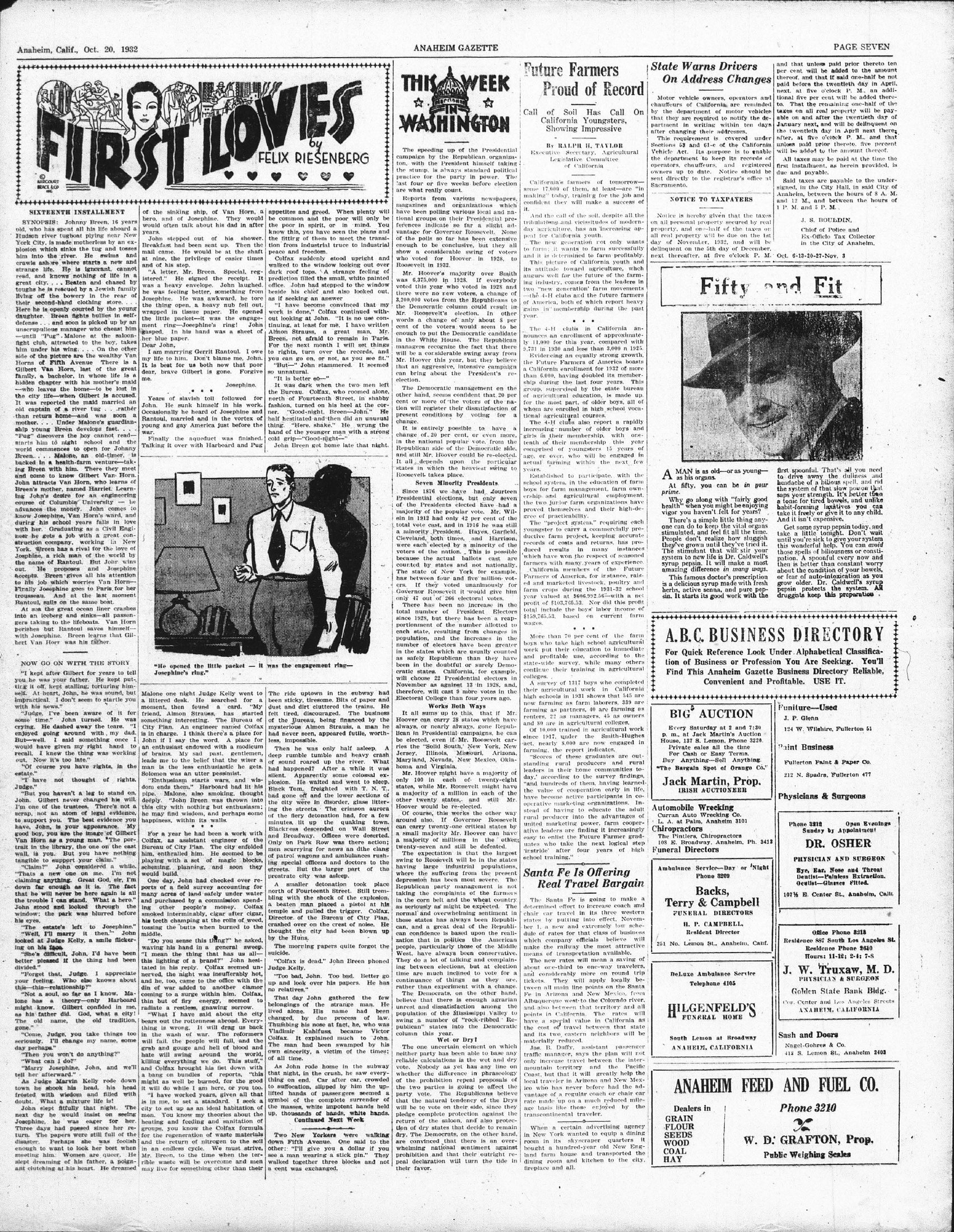
Searchable text
SIXTEENTH INSTALLMENT
SYNOPSIS: Johnny Breen, 16 years old, who has spent all his life aboard a Hudson river tugboat plying near New York City, is made motherless by an explosion which sinks the tug and tosses him into the river. He swims and crawls ashore where starts a new and strange life. He is ignorant, cannot read, and knows nothing of life in a great city. Beaten and chased by toughs he is rescued by a Jewish family living off the bowery in the rear of their second-hand clothing store. Here he is openly courted by the young daughter. Breen fights bullies in self-defense and soon is picked up by an unscrupulous manager who cheast him—until "Pug". Malone at the saloon-fight club, attracted to the boy, takes him under his wing. On the other side of the picture are the wealthy Van Horns of Fifth Avenue There is a Gilbert Van Horn, last of the great family, a bachelor, in whose life is a hidden chapter with his mother's maid—who leaves the home—to be lost in the city life—when Gilbert is accused. It was reported the maid married an old captain of a river tug rather than return home—and was soon a mother. Under Malone's guardianship young Breen develops fast. "Pug" discovers the boy cannot read—starts him to night school and the world commences to open for Johnny Breen. Malone, an old-timer, of the sinking ship, of Van Horn, a hero, and of Josephine. They would often talk about his dad in after years.
John stepped out of his shower. Breakfast had been sent up. Then the mail came. He would be at the shaft at nine, the privilege of easier times and of his step.
"A letter, Mr. Breen. Special, registered." He signed the receipt. It was a heavy envelope. John laughed. he was feeling better, something from Josephine. He was awkward, he tore the thing open, a heavy nub fell out, wrapped in tissue paper. He opened the little packet—it was the engagement ring—Josephine's ring! John gasped. In his hand was a sheet of her blue paper.
Dear John,
I am marrying Gerrit Rantoul. I owe my life to him. Don't blame me, John. It is best for us both now that poor dear, brave Gilbert is gone. Forgive me.
Josephine.
Years of slavish toil followed for John. He sunk himself in his work. Occasionally he heard of Josephine and Rantoul, married and in the vortex of young and gay America just before the war.
Finally the aqueduct was finished. Talking it over with Harboard and Pug appetites and greed. When he be common and the poor wished the poor in spirit, or in know this, you have seen them fitting of them to meet from industrial truce to peace and freedom.
Colfax suddenly stood up walked to the window looking dark roof tops. A strange prediction filled the small, white office. John had stepped to beside his chief and also lashed if seeking an answer.
"I have become convinced work is done," Colfax continued out looking at John. "It is not continuing, at least for me. I have Almon Strauss, a great Breen, not afraid to remain For the next month I will to rights, turn over the reel you can go on, or not, as yet."
"But—" John stammered so unnatural.
"It is better so—"
It was dark when the two the Bureau. Colfax, who root north of Fourteenth Street, fashion, turned on his heel aner. "Good-night, Breen—Joh half hesitated and then did a thing. "Here, shake." He hand of the younger man with cold grip—"Good-night—"
John Breen got home late
NOW GO ON WITH THE STORY
"I kept after Gilbert for years to tell you he was your father. He kept putting it off, kept stalling, torturing himself. At heart, John, he was sound, but impractical. I don't seem to startle you with his news."
"Judge, I've been aware of it for some time." John turned. He was crying. He dashed away the tears. "I enjoyed going around with my dad. But—well, I said something once I would have given my right hand to recall. I knew the thing was working out. Now it's too late."
"Of course you have rights, in the estate."
"I have not thought of rights, Judge."
"But you haven't a leg to stand on, John. Gilbert never changed his will. I'm one of the trustees. There's not a scrap, not an atom of legal evidence, to support you. The best evidence you have, John, is your appearance. My good boy, you are the image of Gilbert Van Horn as a young man." The portrait in the library, the one on the east wall, is you. But you have nothing tangible to support your claim."
"Claim?" John considered a while.
It is best for us both now that poor dear, brave Gilbert is gone. Forgive me.
Josephine.
Years of slavish toll followed for John. He sunk himself in his work. Occasionally he heard of Josephine and Rantoul, married and in the vortex of young and gay America just before the war.
Finally the aqueduct was finished. Talking it over with Harboard and Pug
"He opened the little packet — it was the engagement ring— Josephine's ring."
Malone one night Judge Kelly went to a littered desk. He searched for a moment, then found a card. "My friend, Almon Strauss, has started something interesting. The Bureau of City Plan. An engineer named Colfax is in charge. I think there's a place for John if I say the word. A place for an enthusiast endowed with a modicum of brains. My sad past, gentlemen, leads me to the belief that the wiser a man is the less enthusiastic he gets. Solomon was an utter pessimist.
"Enthusiasm starts wars, and wisdom ends them." Harboard had lit his pipe. Malone, also smoking, thought deeply. "John Breen was thrown into this city with nothing but enthusiasm; he may find wisdom, and perhaps some happiness, within its walls."
For a year he had been a work with Colfax, as assistant engineer of the Bureau of City Plan. The city enfolded him, enthralled him. He seemed to be playing with a set of magic blocks, scheming, planning, and soon they
The ride uptown in the sub been sticky, tiresome. Bits of dust and dirt cluttered the felt tired, discouraged. Th of the Bureau, being finance mysterious Almon Strauss, had never seen, appeared futless, impossible.
Then he was only half deep rumble tumble and he of sound roared up the river had happened? After a whilent. Apparently some collision. He waited and were Black Tom, freighted with had gone off and the lower the city were in disorder, going the streets. The crimes of the fiery detonation had minutes, lit up the quake Blackress descended on W and Broadway. Offices were Only on Park Row was the men scurrying for news an of patrol wagons and ambulining special officers and doctor streets. But the larger par
"I have not thought of rights, Judge."
"But you haven't a leg to stand on, John. Gilbert never changed his will. I'm one of the trustees. There's not a scrap, not an atom of legal evidence, to support you. The best evidence you have, John, is your appearance. My good boy, you are the image of Gilbert Van Horn as a young man. The portrait in the library, the one on the east wall, is you. But you have nothing tangible to support your claim."
"Claim?" John considered a while, "That's a new one on me. I'm not claiming anything. Great God, sir, I'm down far enough as it is. The fact that he will never be here again is all the trouble I can stand. What a hero." John stood and looked through the window; the park was blurred before his eyes.
"The estate's left to Josephine."
"Well, I'll marry it then." John looked at Judge Kelly, a smile flickering on his face.
"She's difficult, John, I'd have been better pleased if the thing had been divided."
"Forget that, Judge. I appreciate your feeling. Who else knows about this—this—relationship?"
"Not a soul, so far as I know. Malone has a theory—only Harboard might know. Gilbert confided in me, as his father did. God, what a city! The old name, the old tradition, gone."
"Come, Judge, you take things too seriously. I'll change my name, some day perhaps."
"Then you won't do anything?"
"What can I do?"
"Marry Josephine, John, and we'll tell her afterward."
As Judge Marvin Kelly rode down town he shook his head, his head frosted with wisdom and filled with doubt. What a mixture life is!
John slept fitfully that night. The next day he would insist on seeing Josephine, he was eager for her. Three days had passed since her return. The papers were still full of the disaster. Perhaps she was foolish enough to want to look her best when meeting him. Women are queer. He slept dreaming of his father, a polignant clutching at his heart. He dreamed
"Enthusiasm starts wars, and wisdom ends them." Harboard had lit his pipe. Malone, also smoking, thought deeply. "John Breen was thrown into this city with nothing but enthusiasm; he may find wisdom, and perhaps some happiness, within its walls.
For a year he had been a work with Colfax, as assistant engineer of the Bureau of City Plan. The city enfolded him, enthralled him. He seemed to be playing with a set of magic blocks, scheming, planning, and soon they would build.
One day, John had checked over reports of a field survey accounting for many acres of land safely under water and purchased by a commission spending other people's money. Colfax smoked interminably, cigar after cigar, his teeth champing at the rolls of weed, tossing the butts when burned to the middle.
"Do you sense this thing?" he asked, waving his hand in a general sweep. "I mean the thing that has us all—this lighting of a brand?" John hesitated in his reply. Colfax seemed unnerved, the night was insufferably hot, and he, too, came to the office with the din of war added to another clamor coming to a surge within him. Colfax, thin but of fire energy, seemed to radiate a restless, gnawing sorrow.
"What I have said about the city bears out the rottenness abroad. Everything is wrong. It will drag us back in the wash of war. The reformers will fail. the people will fall, and the grab and gouge and hell of blood and hate will swing around the world, killing everything we do. This stuff," and Colfax brought his fist down with a bang on bundles of reports, "this might as well be burned, for the good it will do while I am here, or you too.
"I have worked years, given all that is in me, to set a standard. I seek a city to set up as an ideal habitation of men. You know my theories about the heating and feeding and sanitation of groups, you know the Colfax formula for the regeneration of waste materials and the return of nitrogen to the soil in an endless cycle. We must strive, Mr. Breen, to the time when the terrible waste will be overcome and men may live for something other than their silent. Apparently some collision. He waited and went Black Tom, freighted with had gone off and the lower the city were in disorder, giving the streets. The crimes of the flery detonation had minutes, lit up the quake Blackress descended on Ward Broadway. Offices were Only on Park Row was the men scurrying for news an of patrol wagons and ambulance special officers and doctors streets. But the larger parish prostrate city was asleep.
A smaller detention north of Fourteenth Street. Blinding with the shock of the beaten man placed a pis temple and pulled the trigger Director of the Bureau of Crash over on the crest of thought the city had been by the Huns.
The morning papers quite suicide.
"Colfax is dead." John Brex Judge Kelly.
"Too bad, John. Too bad up and look over his papers no relatives."
That day John gathered belongings of the strange lived alone. His name changed, by due process Thunbing his nose at fact, he Vladimir Kahlussa became Colfax. It explained much The man had been swampown sincerity, a victim of all time.
As John rode home in that night, in the crush, he thing on end. Car after car to suffocation, slipped by his lifted hands of passengers symbol of the complete success up, thousands of hands, which
Continued Next Week
Two New Yorkers were down Fifth Avenue. One shot other: "I'll give you a dose see a man wearing a stick p walked together three blocks a cent was exchanged.
ANAHEIM GAZETTE
THE WEEK IN WASHINGTON
The speeding up of the Presidential campaign by the Republican organization, with the President himself taking the stump, is always standard political practice for the party in power. The last four or five weeks before election are what really count.
Reports from various newspapers, magazines and organizations which have been polling various local and national groups on their Presidential preferences indicate so far a slight advantage for Governor Roosevelt. None of the polls so far has been extensive enough to be conclusive, but they all show a considerable swing of voters who voted for Hoover in 1928, to Roosevelt in 1932.
Mr. Hoover's majority over Smith was 6,375,000 in 1928. If everybody voted this year who voted in 1928 and there were no new voters, a change of 3,200,000 votes from the Republicans to the Democratic column could result in Mr. Roosevelt's election. In other words a change of anly about 8 per cent of the voters would seem to be enough to put the Democratic candidate in the White House. The Republican managers recognize the fact that there will be a considerable swing away from Mr. Hoover this year, but they believe that an aggressive, intensive campaign can bring about the President's re-election.
The Democratic management on the other hand, seems confident that 20 per cent or more of the voters of the nation will register their dissatisfaction of present conditions by voting for a change.
It is entirely possible to have a change of 20 per cent, or even more, in the national popular vote, from the Republican side of the Democratic side, and still Mr. Hoover could be re-elected.
Future Farmers Proud of Record
Call of Soil Has Call On California Youngsters, Showing Impressive
By RALPH H. TAYLOR
Executive Secretary, Agricultural Legislative Committee of California
California's farmers of tomorrow—some 17,000 of them, at least—are "in making" today, training for the job and confident they will make a success of it.
And the call of the soil, despite all the tribulations and vicissitudes of modern-day agriculture, has an increasing appeal for California youth.
The new generation not only wants to farm; it wants to farm successfully and it is determined to farm profitably.
This picture of California youth and its attitude toward agriculture, which augurs well for the future of the farming industry, comes from the leaders in two "new generation' farm movements—the 4-H clubs and the future farmers of America, both of which report heavy gains in membership during the past year.
The 4-H clubs in California announce an enrollment of approximately 11,000 for this year, compared with 9,731 in 1930 and less than 3,000 n 1925.
Evidence of an equally strong growth, the Future Farmers of America boasts a California enrollment for 1932 of more than 6,000, having doubled its membership during the last four years. This group, supervised by the state bureau of agricultural education, is made up for the most part, of older boys, all of whom are enrolled in high school vocational agricultural courses.
The 4-H clubs also report a rapidly increasing number of older boys and girls in their membership, with one-tenth of their membership this year comprised of youngsters 15 years of age, or over, who will be engaged in
the engagement ring—
ride uptown in the subway had sticky, tiresome. Bits of paper and dirt cluttered the trains. He tired, discouraged. The business the Bureau, being financed by the bitterous Almon Strauss, a man he never seen, appeared futile, worthless, impossible.
when he was only half asleep. A rumble tumble and heavy crash sound roared up the river. What happened? After a while it was hurt. Apparently some colossal explosion. He waited and went to sleep. Jack Tom, freighted with T. N. T., gone off and the lower sections of city were in disorder, glass littered the streets. The crimson aurora the fiery detonation had, for a few minutes, lit up the quaking town. Address descended on Wall Street Broadway. Offices were deserted. On Park Row was there action; scurrying for news an dthe clang of wagons and ambulances rush special officers and doctors to the sets. But the larger part of that an aggressive, intensive campaign can bring about the President's re-election.
The Democratic management on the other hand, seems confident that 20 per cent or more of the voters of the nation will register their dissatisfaction of present conditions by voting for a change.
It is entirely possible to have a change of 20 per cent, or even more, in the national popular vote. from the Republican side of the Democratic side, and still Mr. Hoover could be re-elected. It all depends upon the particular states in which the heaviest swing to Roosevelt takes place.
Seven Minority Presidents.
Since 1876 we have had fourteen Presidential elections, but only seven of the Presidents elected have had a majority of the popular vote. Mr. Wilstein in 1912 had only 42 per cent of the total vote cast, and in 1916 he was still a minority President. Hayes, Garfield, Cleveland, both times, and Harrison, were each elected by a minority of the voters of the nation. This is possible because the actual ballots cast are counted by states and not nationally. The state of New York for example, has between four and five million voters. If they voted unanimously for Governor Roosevelt it would give him only 47 out of 266 electoral votes.
There has been no increase in the total number of President Electors since 1928, but there has been a re-portionment of the number allotted to each state, resulting from changes in population, and the increases in the number of electors have been greater in the states which are usually counted as safely Republican than they have been in the doubtful or surely Democratic states. California, for example, will choose 22 Presidential electors in November as against 13 in 1928, and, therefore, will cast 9 more votes in the Electoral College than four years ago.
Works Both Ways
It all sums up to this, that if Mr. Hoover can carry 28 states which have always, or nearly always, gone Republican in Presidential campaigns, he can be elected, even if Mr. Roosevelt carries the "Solid South,' New York, New Jersey, Illinois, Missouri, Arizona, Maryland, Nevada, New Mexico, Oklahoma and Virginia.
Mr. Hoover might have a majority of only 100 in each of twenty-eight states, while Mr. Roosevelt might have a majority of a million in each of the other twenty states, and still Mr. Hoover would be re-elected.
Of course, this works the other way around also. If Governor Roosevelt can carry twenty-one critical states by a small majority Mr. Hoover can have a majority of millions in the other twenty-seven and still be defeated.
The expectation is that the largest swing to Roosevelt will be in the states having large industrial populations,
the Future Farmers of America boasts a California enrollment for 1932 of more than 6,000, having doubled its membership during the last four years. This group, supervised by the state bureau of agricultural education, is made up for the most part, of older boys, all of whom are enrolled in high school vocational agricultural courses.
The 4-H clubs also report a rapidly increasing number of older boys and girls in their membership, with one-tenth of their membership this year comprised of youngsters 15 years of age, or over, who will be engaged in actual farming within the next few years.
Established to participate, with the school system, in the education of farm boys for farm management, farm ownership and agricultural employment, the two junior farm organizations have proved themselves and their high-degree of practicability.
The "project system," requiring each youngster to carry a commercially productive farm project, keeping accurate records of costs and returns, has produced results in many instances which have won the respect of seasoned farmers with many years of experience.
California members of the Future Farmers of America, for instance, raised and marketed livestock, poultry and farm crops during the 1931-32 school year valued at $606,992.56—with a net profit of $103,765.53. Nor did this profit total include the boys' labor income of $159,765.53, based on current farm wages.
More than 70 per cent of the farm boys who take high school agricultural work put their education to immediate and profitable use, according to the state-wide survey, while many others continue their training in agricultural colleges.
A survey of 1317 boys who completed their agricultural work in California high schools in 1931 shows that 545 are now farming as farm laborers; 339 are farming as partners; 40 are farming as renters; 22 as managers; 45 as owners and 80 are in agricultural colleges.
Of 10,000 trained in agricultural work since 1917, under the Smith-Hughes act, nearly 8,000 are now engaged in farming; the report indicates.
"Scores of these graduates are outstanding rural producers and rural leaders in their home communities today," according to the survey findings,"and hundreds of them, having learned the value of cooperation early in life, have become active participants in cooperative marketing organizations. Instead of having to educate the adult rural producer into the advantages of united marketing power, farm cooperative leaders are finding it increasingly easy to enlist the Future Farmer graduates who take the next logical step 'firstride' after four years of high school training."
Apparently some colossal exile. He waited and went to sleep.
Back Tom, freighted with T. N. T., gone off and the lower sections of city were in disorder, glass littering the streets. The crimson aurora the flery detonation had, for a few minutes, lit up the quaking town. Blackress descended on Wall Street Broadway. Offices were deserted. On Park Row was there action; scurrying for news an dthe clang control wagons and ambulances rush-special officers and doctors to the streets. But the larger part of the outrage city was asleep.
The smaller detention took place in Fourteenth Street. Still trembling with the shock of the explosion, Beaten man placed a pistol at his people and pulled the trigger. Colfax, vector of the Bureau of City Plan, shed over on the crest of noise. He might the city had been blown up by the Huns.
The morning papers quite forgot the hide. Colfax is dead." John Breen phoned George Kelly.
Too bad, John. Too bad. Better go and look over his papers. He has relatives."
That day John gathered the few hangings of the strange man. He had alone. His name had been tagged, by due process of law, fimbring his nose at fact, he, who wasimir Kahllussa, became Victor Max. It explained much to John. The man had been swamped by his sincerity, a victim of the times; all time.
John rode home in the subway on night, in the crush, he saw every-thing on end. Car after car, crowded suffocation, slipped by him the upward hands of passengers seemed a symbol of the complete surrender of masses, white impotent hands held thousands of hands, white hands.
Continued Next Week
Two New Yorkers were walking on Fifth Avenue. One said to the narrator: "I'll give you a dollar if you a man wearing a stick pin." They kissed together three blocks and not intent was exchanged.
Mr. Hoover might have a majority of only 100 in each of twenty-eight states, while Mr. Roosevelt might have a majority of a million in each of the other twenty states, and still Mr. Hoover would be re-elected.
Of course, this works the other way around also. If Governor Roosevelt can carry twenty-one critical states by a small majority Mr. Hoover can have a majority of millions in the other twenty-seven and still be defeated.
The expectation is that the largest swing to Roosevelt will be in the states having large industrial populations, where the suffering from the present depression has been most severe. The Republican party management is not taking the complaints of the farmers in the corn belt and the wheat country as seriously as might be expected. The normal and overwhelming sentiment in these states has always been Republican, and a great deal of the Republican confidence is based upon the realization that in politics the American people, particularly those of the Middle West, have always been conservative. They do a lot of talking and complaining between elections, but at election time are much inclined to vote for a continuance of things as they are, rather than experiment with a change.
The Democrats, on the other hand, believe that there is enough agrarian unrest and dissatisfaction among the population of the Mississippi Valley to swing a number of "rock-ribbed Republican" states into the Democratic column this year.
Wet or Dry!
The one uncertain element on which neither party has been able to base any reliable calculations is the wet and dry vote. Nobody as yet has any line on whether the difference in phraseology of the prohibition repeal proposals of the two parties is going to affect the party vote. The Republicans believe that the natural tendency of the Drys will be to vote on their side, since they pledge complete protection against the return of the saloon, and also protection of dry states that decide to remain dry. The Democrats, on the other hand, are convinced that there is an overwhelming national sentiment against prohibition and that their outright repeal declaration will turn the tide in their favor.
Santa Fe Is Offering Real Travel Bargain
The Santa Fe is going to make a determined effort to increase coach and chair car travel in its three western states by putting into effect November 1, a new and extremely low schedule of rates for that class of business which company officials believe will make the railway the most attractive means of transportation available.
The new rates will mean a saving of about one-third to one-way travelers, and considerably more on round trip tickets. They will apply locally between all main line points on the Santa Fe in Arizona and New Mexico, from Albuquerque west to the Colorado river, and also between that territory and all points in California. The rates will have a special value in California as the cost of travel between that state and its two eastern neighbors will be materially reduced.
Jas. B. Duffy, assistant passenger traffic manager, says the plan will not only increase travel between the intermountain territory and the Pacific Coast, but that it will greatly help the local traveler in Arizona and New Mexico who has never before had the advantage of a regular coach or chair car rate made up on a much reduced mileage basis like those enjoyed by the transcontinental traveler.
When a certain advertising agency in New York wanted to equip a dining room in its skyscraper quarters it bought a hundred-year old New England farm house and transported the dining room and kitchen to the city, fireplace and all.
State Warns Drivers On Address Changes
Motor vehicle owners, operators and chauffeurs of California are reminded by the department of motor vehicles that they are required to notify the department in writing within ten days after changing their addresses.
This requirement is covered under Sections 53 and 61-c of the California Vehicle Act. Its purpose is to enable the department to keep its records of operators, chauffeurs, and registered owners up to date. Notice should be sent directly to the registrar's office at Sacramento.
NOTICE TO TAXPAYERS
Notice is hereby given that the taxes on all personal property secured by real property, and one-half of the taxes on all real property will be due on the 1st day of November, 1932, and will be delinquent on the 5th day of December, next thereafter, at five o'clock P.M.
J. S. BOULDIN,
Chief of Police and
Ex-Officio Tax Collector
in the City of Anaheim.
Oct. 6-13-20-27-Nov. 3
A MAN is as old—or as young—as his organs.
At fifty, you can be in your prime.
Why go along with "fairly good health" when you might be enjoying vigor you haven't felt for years?
There's a simple little thing anyone can do to keep the vital organs stimulated, and feel fit all the time. People don't realize how sluggish they've grown until they've tried it. The stimulant that will stir your system to new life is Dr. Caldwell's syrup pepsin. It will make a most amazing difference in many ways.
This famous doctor's prescription is a delicious syrup made with fresh herbs, active senna, and pure pepsin. It starts its good work with the first spoonful. That's all you need to drive away the dullness and headache of a bilious spell, and rid the system of that slow poison that saps your strength. It's better than a tonic for tired bowels, and unlike habit-forming laxatives you can take it freely or give it to any child. And it isn't expensive.
Get some syrup pepsin today, and take a little tonight. Don't wait until you're sick to give your system this wonderful help. You can avoid those spells of biliousness or constipation. A spoonful every now and then is better than constant worry about the condition of your bowels, or fear of auto-intoxication as you grow older. Dr. Caldwell's syrup pepsin protects the system. All druggists keep this preparation.
A.B.C. BUSINESS DIRECTORY
For Quick Reference Look Under Alphabetical Classification of Business or Profession You Are Seeking. You'll Find This Anaheim Gazette Business Directory Reliable, Convenient and Profitable. USE IT.
BIG AUCTION
Every Saturday at 2 and 7:30 p.m., at Jack Martin's Auction House, 137 S. Lemon, Phone 3220.
Private sales all the time For Cash or Easy Terms.
Buy Anything—Sell Anything.
"The Bargain Spot of Orange Co."
Jack Martin, Prop.
IRISH AUCTIONEER
Automobile Wrecking
Curran Auto Wrecking Co.
L. A. at Palm, Anaheim 3101
Chiropractors
The Pintlers, Chiropractors
108 E. Broadway, Anaheim, Ph. 3413
Funeral Directors
Funiture—Used
J. P. Glenn
124 W. Wilshire, Fullerton 51
Paint Business
Fullerton Paint & Paper Co.
212 N. Spadra, Fullerton 477
Physicians & Surgeons
Phone 3219 Open Evenings
Sunday by Appointment
DR. OSHER
PHYSICIAN AND SURGEON
Jack Martin, Prop.
IRISH AUCTIONEER
Automobile Wrecking
Curran Auto Wrecking Co.
L. A. at Palm, Anaheim 3101
Chiropractors
The Pintlers, Chiropractors
108 E. Broadway, Anaheim, Ph. 3413
Funeral Directors
Ambulance Service—Day or Night
Phone 3209
Backs,
Terry & Campbell
FUNERAL DIRECTORS
H. P. CAMPBELL,
Resident Director
251 No. Lemon St., Anaheim, Calif.
DeLuxe Ambulance Service
Telephone 4105
HILGENFELD'S
FUNERAL HOME
South Lemon at Broadway
ANAHEIM, CALIFORNIA
Physicians & Surgeons
Phone 3212 Open Evenings
Sunday by Appointment
DR. OSHER
PHYSICIAN AND SURGEON
Eye, Ear, Nose and Throat Dentist—Painless Extraction.
Oculist—Glasses Fitted.
107½ E. Center St., Anaheim, Calif.
Office Phone 8318
Residence 887 South Los Angeles St.
Residence Phone 2610
Hours: 11-12; 2-4; 7-8
J. W. Truxaw, M. D.
PHYSICIAN & SURGEON
Golden State Bank Bldg.
Corp. Center and Los Angeles Streets
ANAHEIM, CALIFORNIA
Sash and Doors
Nagel-Gohres & Co.
418 S. Lemon St., Anaheim 2403
ANAHEIM FEED AND FUEL CO.
Dealers in
GRAIN
FLOUR
SEEDS
WOOD
COAL
HAY
Phone 3210
W. D.: GRAFTON, Prop.
Public Weighing Scales