anaheim-gazette 1932-10-13
Scanned page
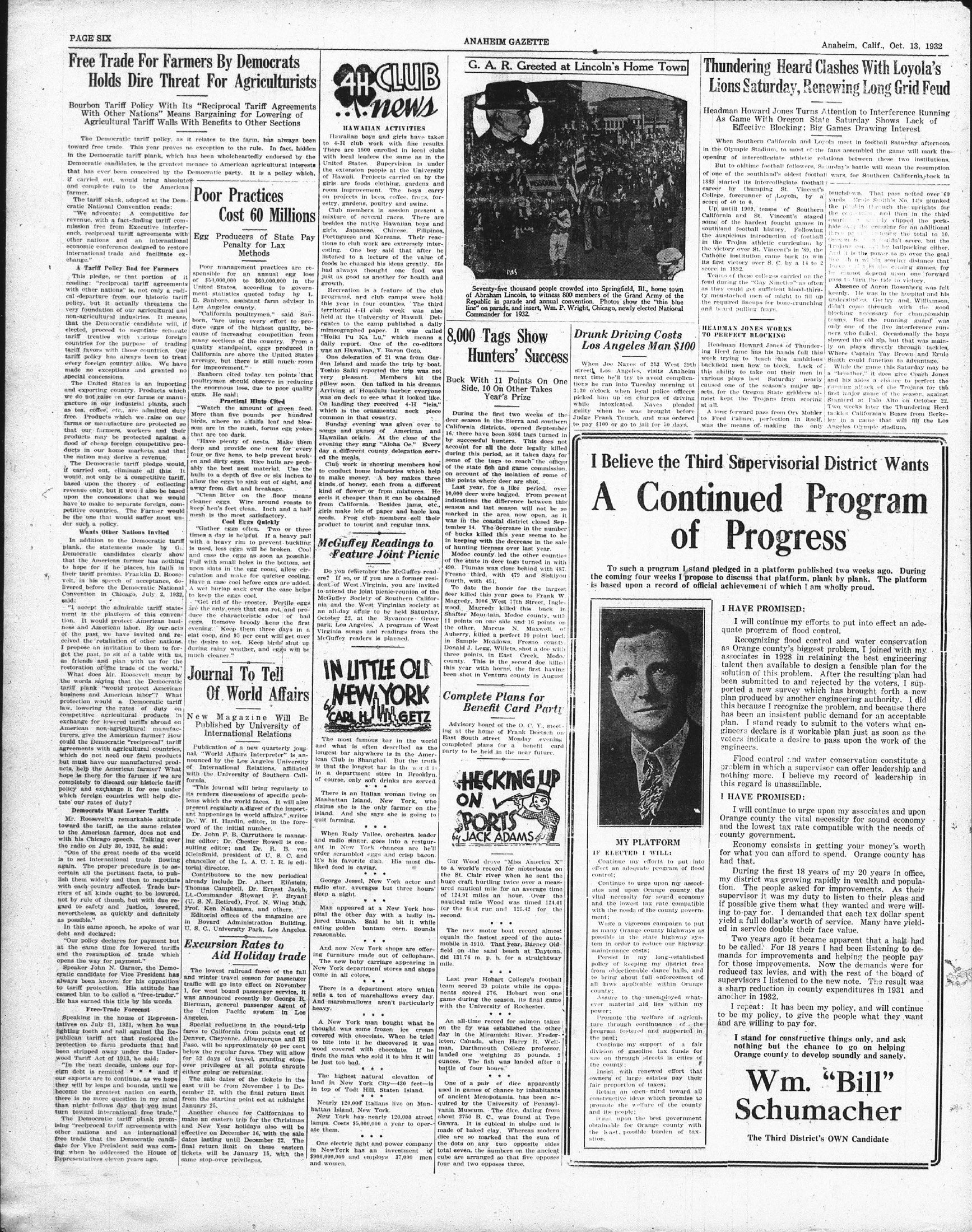
Searchable text
Free Trade For Farmers By Democrats Holds Dire Threat For Agriculturists
Bourbon Tariff Policy With Its “Reciprocal Tariff Agreements With Other Nations” Means Bargaining for Lowering of Agricultural Tariff Walls With Benefits to Other Sections
The Democratic tariff policy, as it relates to the farm, has always been toward free trade. This year proves no exception to the rule. In fact, hidden in the Democratic tariff plank, which has been wholeheartedly endorsed by the Democratic candidates, is the greatest menace to American agricultural interests that has ever been conceived by the Democratic party. It is a policy which, if carried out, would bring absolute and complete ruin to the American farmer.
The tariff plank, adopted at the Democratic National Convention reads:
“We advocate: A competitive for revenue, with a fact-finding tariff commission free from Executive interference, reciprocal tariff agreements with other nations and an international economic conference designed to restore international trade and facilitate exchange.”
A Tariff Policy Bad for Farmers
This pledge, or that portion of it reading: “reciprocal tariff agreements with other nations” is, not only a radical departure from our historic tariff policy, but it actually threatens the very foundation of our agricultural and non-agricultural industries. It means, that the Democratic candidate will, if elected, proceed to negotiate separate tariff treaties with various foreign countries for the purpose of trading tariff favors with those countries. Our tariff policy has always been to treat every foreign country alike. We have made no exceptions and granted no special concessions.
The United States is an importing and exporting country. Products which we do not raise on our farms or manufacture in our industrial plants, such as tea, coffee, etc., are admitted duty free. Products which we raise on our farms or manufacture are protected so that our farmers, workers and their products may be protected against a flood of cheap foreign competitive products in our home markets, and that the nation may derive a revenue.
Poor Practices Cost 60 Millions
Egg Producers of State Pay Penalty for Lax Methods
Poor management practices are responsible for an annual egg loss of $50,000,000 to $60,000,000 in the United States, according to government statistics quoted today by L. D. Sanborn, assistant farm advisor in Los Angeles county.
“California poultrymen,” said Sanborn, “are using every effort to produce eggs of the highest quality, because of increasing competition from many sections of the country. From a quality standpoint, eggs produced in California are above the United States average, but there is still much room for improvement.”
Sanborn cited today ten points that poultrymen should observe in reducing the enormous loss due to poor quality eggs. He said:
Practical Hints Cited
“Watch the amount of green feed. More than five pounds per hundred birds, where no alfalfa leaf and blossom are in the mash, forms egg yokes that are too dark.
“Have plenty of nests. Make them deep and provide one nest for every four or five hens, to help prevent brook-
every foreign country alike. We have made no exceptions and granted no special concessions.
The United States is an importing and exporting country. Products which we do not raise on our farms or manufacture in our industrial plants, such as tea, coffee, etc., are admitted duty free. Products which we raise on our farms or manufacture are protected so that our farmers, workers and their products may be protected against a flood of cheap foreign competitive products in our home markets, and that the nation may derive a revenue.
The Democratic tariff pledge would, if carried out, eliminate all this. It would, not only be a competitive tariff, based upon the theory of collecting revenue only, but it would also be based upon the concessions that we would have to make to separate foreign, competitive countries. The Farmer would be the one that would suffer most under such a policy.
Wants Other Nations Invited
In addition to the Democratic tariff plank, the statements made by the Democratic candidates clearly show that the American farmer has nothing to hope for if he places his faith in their tariff promise. Franklin D. Roosevelt, in his speech of acceptance, delivered before the Democratic National Convention in Chicago, July 2, 1932, said:
"I accept the admirable tariff statement in the platform of this convention. It would protect American business and American labor. By our acts of the past we have invited and received the retaliation of other nations. I propose an invitation to them to forget the past, to sit at a table with us, as friends and plan with us for the restoration of the trade of the world."
What does Mr. Roosevelt mean by the words saying that the Democratic tariff plank "would protect American business and American labor"? What protection would a Democratic tariff law, lowering the rates of duty on competitive agricultural products in exchange for lowered tariffs abroad on American non-agricultural manufacturers, give the American farmer? How could the Democratic "reciprocal" tariff agreements with agricultural countries, which do not need our farm products but must have our manufactured products, help the American farmer? What hope is there for the farmer if we are completely to discard our historic tariff policy and exchange it for one under which foreign countries will help dictate our rates of duty?
Democrats Want Lower Tariffs
Mr. Roosevelt's remarkable attitude toward the tariff, as the same relates to the American farmer, does not end with his Chicago speech. Talking over the radio on July 30, 1932, he said:
"One of the great needs of the world is to set international trade flowing again. The proper procedure is to assemble foreign countries."
Democrats Want Lower Tariffs
Mr. Roosevelt's remarkable attitude toward the tariff, as the same relates to the American farmer, does not end with his Chicago speech. Talking over the radio on July 30, 1932, he said:
"One of the great needs of the world is to set international trade flowing again. The proper procedure is to ascertain all the pertinent facts, to publish them widely and then to negotiate with each country affected. Trade barriers of all kinds ought to be lowered, not by rule of thumb, but with due regard to safety and justice, lowered, nevertheless, as quickly and definitely as possible."
In this same speech, he spoke of war debt and declared:
"Our policy declares for payment but at the same time for lowered tariffs and the resumption of trade which opens the way for payment."
Speaker John N. Garner, the Democratic candidate for Vice President has always been known for his opposition to tariff protection. His attitude has caused him to be called a "free-trader." He has earned this title by his words.
Free-Trade Forecast
Speaking in the house of Representatives on July 21, 1921, when he was fighting tooth and nail against the Republican tariff act that restored the protection to farm products that had been stripped away under the Underwood Tariff Act of 1913, he said:
"在 next decade, unless our foreign debt is remitted * * * and if our exports are to continue, as we hope they will by leaps and bounds, until we become the greatest nation on earth, there is no more question in my mind than night follows day that you must turn toward international free trade."
The Democratic tariff plank promising "reciprocal tariff agreements with other nations and an international free trade that the Democratic candidate for Vice President said was coming when he addressed the House of Representatives eleven years ago.
"This journal will bring regularly to its readers discussions of specific problems which the world faces. It will also present regularly a digest of the important happenings in world affairs," write Dr. W. H. Hardin, editor, in the foreword of the initial number.
Dr. John F. B. Carruthers is managing editor; Dr. Chester Rowell is consulting editor; and Dr. R. B. von KleinSmid, president of U. S. C. and chancellor of the L. A. U. I. R. is editorial director.
Contributors to the new periodical already include Dr. Albert Einstein, Thomas Campbell, Dr. Ernest Jackh, Lt.-Commander Stewart F. Bryant (U. S. N. Retired), Prof. N. Wing Mah, Prof. Ken Nakazawa, and others.
Editorial offices of the magazine are in Bovard Administration Building, U. S. C., University Park, Los Angeles.
Excursion Rates to Aid Holiday trade
The lowest railroad fares of the fall and winter travel season for passenger traffic will go into effect on November 1, for west bound passenger service, it was announced recently by George R. Bierman, general passenger agent of the Union Pacific system in Los Angeles.
Special reductions in the round-trip fares to California from points east of Denver, Cheyenne, Albuquerque and El Paso, will be approximately 40 per cent below the regular fares. They will allow for 52 days of travel, granting stop-over privileges at all points enroute either going or returning.
The sale dates of the tickets in the east will be from November 1 to December 22, with the final return limit from the starting point set at midnight January 25.
Another chance for Californians to make an eastern trip for the Christmas and New Year holidays also will be effective on December 16, with the sale dates lasting until December 22. The final return limit on these eastern tickets will be January 15, with the same stop-over privileges.
ANAHEIM GAZETTE
4H CLUB news
HAWAIIAN ACTIVITIES
Hawaiian boys and girls have taken to 4-H club work with fine results. There are 1500 enrolled in local clubs with local leaders the same as in the United States. Supervision is under the extension people at the University of Hawaii. Projects carried on by the girls are foods clothing, gardens and room improvement. The boys carry on projects in bees, coffee, frogs, forestry, gardens, poultry and swine.
Club members in session present a mixture of several races. There are besides the native Hawaiian boys and girls, Japanese, Chinese, Filipinos, Portuguese and Koreans. Their reactions to club work are extremely interesting. One boy said that after he listened to a lecture of the value of foods he changed his ideas greatly. He had always thought one food was just as good as another for health and growth.
Recreation is a feature of the club programs, and club camps were held this year in four counties. The third territorial 4-H club week was also held at the University of Hawaii. Delegates to the camp published a daily mimeographed paper. It was called "Holiki Pu Ka Lu," which means a daily report. One of the co-editors was an Hawaiian, Y. Baron Goto.
One delegation of 21 was from Garden Island and made the trip by boat. Toshio Salki reported the trip was not very pleasant. Members hit the pillow soon. Oen talked in his dreams. Arriving at Honolulu harbor everyone was on deck to see what it looked like. On landing they received 4-H "leis," which is the ornamental neck piece common in that country.
Sunday evening was given over to songs and games of American and Hawaiian origin. At the close of the evening they sang "Aloha Oe." Every day a different county delegation served the meals.
G. A. R. Greeted at Lincoln's Home Town
Seventy-five thousand people crowded into Springfield, Ill., home town of Abraham Lincoln, to witness 800 members of the Grand Army of the Republic in parade and annual convention. Photos show the "thin blue line" on parade, and insert, Wm. P. Wright, Chicago, newly elected National Commander for 1932.
8,000 Tags Show Hunters' Success
Buck With 11 Points On One Side, 10 On Other Takes Year's Prize
During the first two weeks of the deer season in the Sierra and southern California districts, opened September 16; there have been 8086 tags turned in by successful hunters. This does not account for all the deer legally killed during this period, as it takes days for some to be found.
Drunk Driving Costs Los Angeles Man $10
When Joe Naves of 213 West 22nd Street, Los Angeles, visits Anahe next time he'll try to avoid complications he ran into Tuesday morning at 3:30 o'clock when local police office picked him up on charges of driving while intoxicated. Naves pleaded guilty when he was brought before Judge Frank Tausch, and was ordered to pay $100 or go to jail for 50 days.
den Island and made the trip by boat.
Toshio Salki reported the trip was not very pleasant. Members hit the pillow soon. Oen talked in his dreams.
Arriving at Honolulu harbor everyone was on deck to see what it looked like.
On landing they received 4-H "leis," which is the ornamental neck piece common in that country.
Sunday evening was given over to songs and games of American and Hawaiian origin. At the close of the evening they sang "Aloha Oe." Every day a different county delegation served the meals.
Club work is showing members how to conduct home industries which help to make money. A boy makes three kinds of honey, each from a different kind of flower or from mixtures. He eels it cheaper than it can be obtained from California. Besides jams, etc., girls make leis of paper and haole koa seeds. Frog club members sell their product to tourist and regular inns.
McGuffey Readings to Feature Joint Picnic
Do you remember the McGuffey readers? If so, or if you are a former resident of West Virginia, you are invited to attend the joint picnic-reunion of the McGuffey Society of Southern California and the West Virginian society at an all-day affair to be held Saturday, October 22, at the Sycamore Grove park, Los Angeles. A program of West Virginia songs and readings from the McGuffey readers is planned.
IN LITTLE OLD NEW YORK CARL H GETZ
The most famous bar in the world and what is often described as the longest bar anywhere is in the American Club in Shanghai. But the truth is that the longest bar in the world is in a department store in Brooklyn. Of course, only soft drinks are served.
There is an Italian woman living on Manhattan Island, New York, who claims she is the only farmer on the island. And she says she is going to quit farming.
When Rudy Vallee, orchestra leader and radio singer, goes into a resturant in New York chances are he'll order scrambled eggs and crisp bacon. It's his favorite dish. His most disliked food is caviar.
Buck With 11 Points On One Side, 10 On Other Takes Year's Prize
During the first two weeks of the deer season in the Sierra and southern California districts, opened September 16; there have been 8086 tags turned in by successful hunters. This does not account for all the deer legally killed during this period, as it takes days for some of the tags to reach the offices of the state fish and game commission. On account of the isolation of some of the points where deer are shot.
Last year, for a like period, over 10,000 deer were bagged. From present indications the difference between this season and last season will not be so marked in the area now open, as it was in the coastal district closed September 14. The decrease in the number of bucks killed this year seems to be in keeping with the decrease in the sale of hunting licenses over last year.
Modoc county led the other counties of the state in deer tags turned in with 490. Plumas was close behind with 487. Fresno third, with 479 and Siskiyou fourth, with 451.
To date the honor for the largest deer killed this year goes to Frank W. Magredy, 3006 West 77th Street, Inglewood. Magredy killed this buck in Shafter Mountain, Modoc county, with 11 points on one side and 16 points on the other. Marcus N. Maxwell, of Auberry, killed a perfect 10 point buck in Sample Meadows, Fresno county. Donald J. Legg, Willets, shot a doe with three points, in East Creek, Modoc county. This is the second doe killed this year with horns, the first having been shot in Ventura county in August.
Complete Plans for Benefit Card Party
Advisory board of the O. C. Y., meeting at the home of Frank Doetsch on East South street Monday evening completed plans for a benefit card party to be held in the near future.
HECKING UP ON PORTS JACK ADAMS
Gar Wood drove "Miss America X" to a world's record for motorboats on
There is an Italian woman living on Manhattan Island, New York, who claims she is the only farmer on the island. And she says she is going to quit farming.
When Rudy Vallee, orchestra leader and radio singer, goes into a restaurant in New York chances are he'll order scrambled eggs and crisp bacon. It's his favorite dish. His most disliked food is caviar.
George Jessel, New York actor and radio star, averages but three hours' sleep a night.
Man appeared at a New York hospital the other day with a badly injured thumb. Said he bit it while eating golden bantam corn. Sounds reasonable.
And now New York shops are offering furniture made out of cellophane. The new baby carriage appearing in New York department stores and shops come in all colors.
There is a department store which sells a ton of marshallows every day. And marshallows aren't particularly heavy.
A New York man bought what he thought was some frozen ice cream covered with chocolate. When he tried to bite into it he discovered it was wood covered with chocolate. If he finds the man who sold it to him it will be just too bad.
The highest natural elevation of land in New York City—430 feet—is in top of Todt Hill, Staten Island.
Nearly 120,000 Italians live on Manhattan Island, New York.
New York has nearly 120,000 street lamps. Costs $5,000,000 a year to operate them.
One electric light and power company in New York has an investment of $900,000,000 and employs 37,000 men and women.
Gar Wood drove "Miss America X" to a world's record for motorboats on the St. Clair river when he sent the huge craft hurtling twice over a measured nautical mile for an average time of 124.91 miles an hour. Over the nautical mile Wood was timed 124.41 for the first run and 125.42 for the second.
The new motor boat record almost equals the fastest speed of the automobile in 1910. That year, Barney Oldfield on the sand beach at Daytona did 131.76 m. p. h. for a straightway mile.
Last year Hobart College's football team scored 39 points while its opponents scored 276. Hobart won one game during the season, its final game with the University of Rochester.
An all-time record for salmon taken on the fly was established the other day in the Miramichi River, Fredericton, Canada, when Harry R. Wellman, Darthmouth College professor, landed one weighing 35 pounds, 2 ounces. The fish was landed after a battle of four hours.
One of a pair of dice apparently used in games of chance by inhabitants of ancient Mesopotamia, has been acquired by the University of Pennsylvania Museum. The dice, dating from about 2750 B. C., was found at Tepe Gawra. It is cubical in shape and is made of baked clay. Whereas modern dice are so marked that the sum of the dots on any two opposite sides total seven, the numbers on the ancient cube are arranged so that five opposes four and two opposes three.
MY PLATFORM
IF ELECTED I WILL:
Continue my efforts to put effect an adequate program of control;
Continue to urge upon my allies and upon Orange county vital necessity for sound economy and the lowest tax rate complying with the needs of the county government;
Wage a vigorous campaign to as many Orange county highwaymen in order to reduce our high maintenance costs;
Persist in my long-established policy of keeping my district from objectionable dance halls; to bring about full enforcement of all laws applicable within Or County;
Assure to the unemployed ever material aid lies within power;
Promote the welfare of agriculture through continuance of program fostered and supported the past;
Continue my support of a division of gasoline tax funds use on through streets in cities the county;
Insist with renewed effort owners of large estates pay fair proportion of taxes;
Retain an open mind toward constructive ideas which promote the welfare of the co- and its people;
Insist upon the best governors obtainable for Orange county for the least possible burden of action.
Thundering Heard Clashes With Loyola’s Lions Saturday, Renewing Long Grid Feud
Headman Howard Jones Turns Attention to Interference Running As Game With Oregon State Saturday Shows Lack of Effective Blocking; Big Games Drawing Interest
When Southern California and Loyola meet in football Saturday afternoon in the Olympic Stadium, to most of the fans assembled the game will mark the opening of intercollegiate athletic relations between these two institutions.
But to oldtime football followers, Saturday’s battle will mean the resumption of one of the southland’s oldest football wars, for Southern California, back in 1889 started its intercollegiate football career by thumping St. Vincent’s College, forerunner of Loyola, by a score of 40 to 0.
Up until 1909, teams of Southern California and St. Vincent’s staged some of the hardest fought games in southland football history. Following the auspicious introduction of football in the Trojan athletic curriculum by the victory over St. Vincent’s in ‘89, the Catholic institution came back to win its first victory over S. C. by a 14 to 2 score in 1892.
Teams of these colleges carried on the feud during the “Gay Nineties” as often as they could get sufficient blood-thirsty moustached men of might to fill up the required lineups for bone-crunching and beard pulling frays.
HEADMAN JONES WORKS TO PERFECT BLOCKING
Headman Howard Jones of Thundering Herd fame has his hands full this week trying to teach this ambitious backfield men how to block. Lack of this ability to take out their men in various plays last Saturday nearly caused one of the season’s major upsets, for the Oregon State gridders almost kept the Trojans from scoring at all.
A long forward pass from Orv Mohler to Ford Palmer, perfection in itself, was the means of making the only touchdown. That pass netted over 60 yards. Ercole Smith’s No. 14’s plunked the playin through the uprights for the conversion, and then in the third quarter a closely clipped the pork-hide over the crossbar for an additional three points bringing the total to 10. Oregon Smith couldn’t score, but the Trojang contiued by ballpacking either. And it is the power to go over the goal line with scoring distance that Joey McCarthy hit in the coining games, for he cannot depend upon one forward pass to turn the tide to victory.
Absence of Aaron Rosenberg was felt keenly. He was in the hospital and his understudies, Gertrude and Williamson, didn’t come through with the good blocking necessary for championship teams. But the running guard was only one of the five interference runners who failed. Occasionally the boys showed the old zip, but that was mainly on plays directly through tackles, Where Captain Tay Brown and Ernie Smith could function to advantage.
While the game this Saturday may be a “breather,” it does give Coach Jones and his aides a chance to perfect the running attack of the Trojans for the first major game of the season, against Stanford at Palo Alto on October 22. Two weeks later the Thundering Herd tackles California’s Bears from Berkeley in a game that will fill the Los Angeles Olympic stadium.
Believe the Third Supervisorial District Wants
A Continued Program of Progress
To such a program I stand pledged in a platform published two weeks ago. During coming four weeks I propose to discuss that platform, plank by plank. The platform issued upon a record of official achievement of which I am wholly proud.
I HAVE PROMISED:
I will continue my efforts to put into effect an adequate program of flood control.
Recognizing flood control and water conservation as Orange county’s biggest problem, I joined with my associates in 1928 in retaining the best engineering talent then available to design a feasible plan for the solution of this problem. After the resulting plan had been submitted to and rejected by the voters, I supported a new survey which has brought forth a new plan produced by another engineering authority. I did this because I recognize the problem, and because there has been an insistent public demand for an acceptable plan. I stand ready to submit to the voters what engineers declare is a workable plan just as soon as the voters indicate a desire to pass upon the work of the engineers.
Flood control and water conservation constitute a problem in which a supervisor can offer leadership and nothing more. I believe my record of leadership in this regard is unassailable.
I HAVE PROMISED:
I will continue to urge upon my associates and upon Orange county the vital necessity for sound economy and the lowest tax rate compatible with the needs of county government.
Economy consists in getting your money’s worth for what you can afford to spend. Orange county has had that.
During the first 18 years of my 80 years
MY PLATFORM
LECTED I WILL:
continue my efforts to put into
an adequate program of flood
ol;
continue to urge upon my associand upon Orange county the
necessity for sound economy
the lowest tax rate compatible
the needs of the county governance costs;
dist in my long-established
of keeping my district free
objectionable dance halls, and
ing about full enforcement of
news applicable within Orange
fure to the unemployed whatmaterial aid lies within my
note the welfare of agriculthrough continuance of the
un fostered and supported in
st;
continue my support of a fair
of gasoline tax funds for
through streets in cities of
county;
with renewed effort that
of large estates pay their
proportion of taxes;
in an open mind toward all
ductive ideas which promise to
te the welfare of the county
people;
upon the best government
able for Orange county with
ast possible burden of tax-
I HAVE PROMISED:
I will continue to urge upon my associates and upon Orange county the vital necessity for sound economy and the lowest tax rate compatible with the needs of county government.
Economy consists in getting your money’s worth for what you can afford to spend. Orange county has had that.
During the first 18 years of my 20 years in office, my district was growing rapidly in wealth and population. The people asked for improvements. As their supervisor it was my duty to listen to their pleas and if possible give them what they wanted and were willing to pay for. I demanded that each tax dollar spent yield a full dollar’s worth of service. Many have yielded in service double their face value.
Two years ago it became apparent that a halt had to be called. For 18 years I had been listening to demands for improvements and helping the people pay for those improvements. Now the demands were for reduced tax levies, and with the rest of the board of supervisors I listened to the new note. The result was a sharp reduction in county expenditures in 1931 and another in 1932.
I repeat: It has been my policy, and will continue to be my policy, to give the people what they want and are willing to pay for.
I stand for constructive things only, and ask nothing but the chance to go on helping Orange county to develop soundly and sanely.
Wm. “Bill”
Schumacher
The Third District’s OWN Candidate