anaheim-gazette 1932-10-13
Scanned page
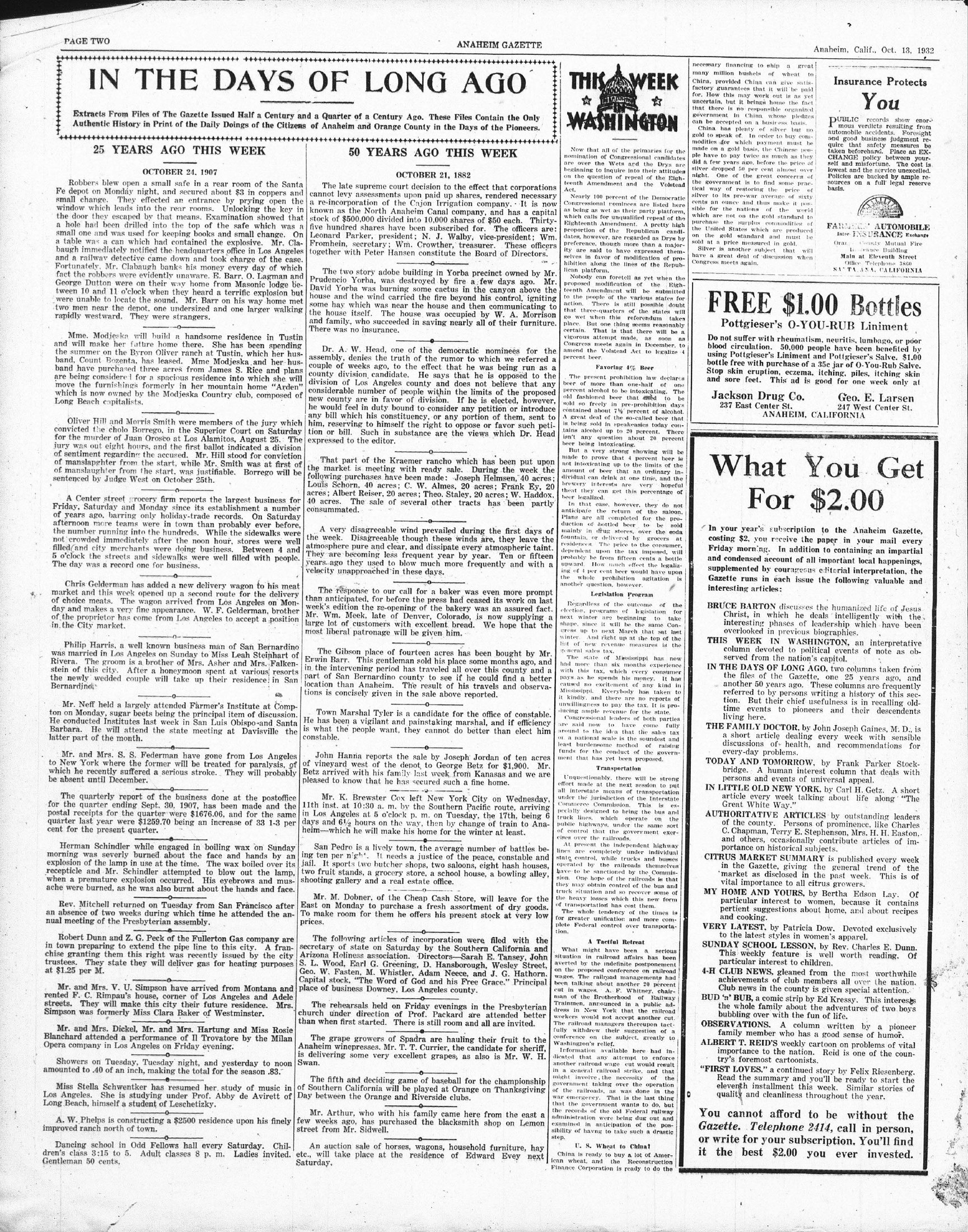
Searchable text
IN THE DAYS OF
Extracts From Files of The Gazette Issued Half a Century and a Quarter of Authentic History in Print of the Daily Doings of the Citizens of Anaheim a
25 YEARS AGO THIS WEEK
OCTOBER 24, 1907
Robbers blew open a small safe in a rear room of the Santa Fe depot on Monday night, and secured about $3 in coppers and small change. They effected an entrance by prying open the window which leads into the rear rooms. Unlocking the key in the door they escaped by that means. Examination showed that a hole had been drilled into the top of the safe which was a small one and was used for keeping books and small change. On a table was a can which had contained the explosive. Mr. Clabaugh immediately notified the headquarters office in Los Angeles and a railway detective came down and took charge of the case. Fortunately, Mr. Clabaugh banks his money every day of which fact the robbers were evidently unaware. E. Barr, O. Lagman and George Dutton were on their way home from Masonic lodge between 10 and 11 o'clock when they heard a terrific explosion but were unable to locate the sound. Mr. Barr on his way home met two men near the depot, one undersized and one larger walking rapidly westward. They were strangers.
Mme. Modjeska will build a handsome residence in Tustin and will make her future home there. She has been spending the summer on the Byron Oliver ranch at Tustin, which her husband, Count Bozenta, has leased. Mme Modjeska and her husband have purchased three acres from James S. Rice and plans are being considered for a spacious residence into which she will move the furnishings formerly in her mountain home "Arden" which is now owned by the Modjeska Country club, composed of Long Beach capitalists.
Oliver Hill and Morris Smith were members of the jury which convicted the cholo Borrego, in the Superior Court on Saturday for the murder of Juan Orosco at Los Alamitos, August 25. The jury was out eight hours, and the first ballot indicated a division of sentiment regarding the accused. Mr. Hill stood for conviction
Oliver Hill and Morris Smith were members of the jury which convicted the cholo Borrego, in the Superior Court on Saturday for the murder of Juan Orosco at Los Alamitos, August 25. The jury was out eight hours, and the first ballot indicated a division of sentiment regarding the accused. Mr. Hill stood for conviction of manslapghter from the start, while Mr. Smith was at first of manslaughter from the start, was justifiable. Borrego will be sentenced by Judge West on October 25th.
A Center street grocery firm reports the largest business for Friday, Saturday and Monday since its establishment a number of years ago, barring only holiday-trade records. On Saturday afternoon more teams were in town than probably ever before, the number running into the hundreds. While the sidewalks were not crowded immediately after the noon hour, stores were well filled (and city merchants were doing business). Between 4 and 5 o'clock the streets and sidewalks were well filled with people. The day was a record one for business.
Chris Gelderman has added a new delivery wagon to his meat market and this week opened up a second route for the delivery of choice meats. The wagon arrived from Los Angeles on Monday and makes a very fine appearance. W. F. Gelderman, brother of the proprietor has come from Los Angeles to accept a position in the City market.
Philip Harris, a well known business man of San Bernardino was married in Los Angeles on Sunday to Miss Leah Steinhart of Rivera. The groom is a brother of Mrs. Asher and Mrs. Falkenstein of this city. After a honeymoon spent at various resorts the newly wedded couple will take up their residence in San Bernardino.
Mr. Neff held a largely attended Farmer's Institute at Compton on Monday, sugar beets being the principal item of discussion. He conducted Institutes last week in San Luis Obispo and Santa Barbara. He will attend the state meeting at Davisville the latter part of the month.
Mr. and Mrs. S. S. Federman have gone from Los Angeles to New York where the former will be treated for paralysis, of which he recently suffered a serious stroke. They will probably be absent until December.
The quarterly report of the business done at the postoffice for the quarter ending Sept. 30, 1907, has been made and the postal receipts for the quarter were $1676.06, and for the same quarter last year were $1259.70 being an increase of 33 1-3 per cent for the present quarter.
Herman Schindler while engaged in boiling wax on Sunday morning was severely burned about the face and hands by an explosion of the lamp in use at the time. The wax boiled over its band have purchased three acres from James S. Rice and plans are being considered for a spacious residence into which she will move the furnishings formerly in her mountain home "Arden" which is now owned by the Modjeska Country club, composed of Long Beach capitalists.
That part of the market is following purchase Louis Schorn, acres; Albert K 40 acres. The consummated.
A very distractive week. Dis atmosphere purifies they are become years ago they velocity unappreciated.
The response than anticipate week's edition Mr. Wm. Meek large lot of cur most liberal pa
The Gibson Erwin Barr. T in the intervening part of San Ben location than A tions is concise.
Town Marsh He has been a v is what the pee constable.
John Hannah of vineyard we Betz arrived w pleased to know
Mr. K. Br 11th inst. at 10 days and 6½ ho heim—which he
San Pedro is ing ten per night jail. It sports t
The quarterly report of the business done at the postoffice for the quarter ending Sept. 30, 1907, has been made and the postal receipts for the quarter were $1676.06, and for the same quarter last year were $1259.70 being an increase of 33 1-3 per cent for the present quarter.
Herman Schindler while engaged in boiling wax on Sunday morning was severely burned about the face and hands by an explosion of the lamp in use at the time. The wax boiled over its recepticle and Mr. Schindler attempted to blow out the lamp, when a premature explosion occurred. His eyebrows and musache were burned, as he was also burnt about the hands and face.
Rev. Mitchell returned on Tuesday from San Francisco after an absence of two weeks during which time he attended the annual meeting of the Presbyterian assembly.
Robert Dunn and Z. G. Peck of the Fullerton Gas company are in town preparing to extend the pipe line to this city. A franchise granting them this right was recently issued by the city trustees. They state they will deliver gas for heating purposes at $1.25 per M.
Mr. and Mrs. V. U. Simpson have arrived from Montana and rented F. C. Rimpau's house, corner of Los Angeles and Adele streets. They will make this city their future residence. Mrs. Simpson was formerly Miss Clara Baker of Westminster.
Mr. and Mrs. Dickel, Mr. and Mrs. Hartung and Miss Rosie Blanchard attended a performance of Il Trovatore by the Milan Opera company in Los Angeles on Friday evening.
Showers on Tuesday, Tuesday night, and yesterday to noon amounted to .40 of an inch, making the total for the season .83.
Miss Stella Schwentker has resumed her study of music in Los Angeles. She is studying under Prof. Abby de Avirett of Long Beach, himself a student of Leschetizky.
A. W. Phelps is constructing a $2500 residence upon his finely improved ranch north of town.
Dancing school in Odd Fellows hall every Saturday. Children's class 3:15 to 5. Adult classes 8 p.m. Ladies invited. Gentleman 50 cents.
50 YEARS AGO THIS WEEK
OCTOBER 21, 1882
The late supreme court decision to the effect that corporations cannot levy assessments upon paid up shares, rendered necessary a re-incorporation of the Cajon Irrigation company. It is now known as the North Anaheim Canal company, and has a capital stock of $500,000 divided into 10,000 shares of $50 each. Thirty-five hundred shares have been subscribed for. The officers are: Leonard Parker, president; N. J. Walby, vice-president; Wm. Fromhein, secretary; Wm. Crowther, treasurer. These officers together with Peter Hansen constitute the Board of Directors.
The two story adobe building in Yorba precinct owned by Mr. Prudencio Yorba, was destroyed by fire a few days ago. Mr. David Yorba was burning some cactus in the canyon above the house and the wind carried the fire beyond his control, igniting some hay which was near the house and then communicating to the house itself. The house was occupied by W. A. Morrison and family, who succeeded in saving nearly all of their furniture. There was no insurance.
Dr. A. W. Head, one of the democratic nominees for the assembly, denies the truth of the rumor to which we referred a couple of weeks ago, to the effect that he was being run as a county division candidate. He says that he is opposed to the division of Los Angeles county and does not believe that any considerable number of people within the limits of the proposed new county are in favor of division. If he is elected, however, he would feel in duty bound to consider any petition or introduce any bill which his constituency, or any portion of them, sent to him, reserving to himself the right to oppose or favor such petition or bill. Such in substance are the views which Dr. Head expressed to the editor.
Now that all of the primaries for the nomination of Congressional candidates are over the Wets and the Drys are beginning to inquire into their attitudes on the question of repeal of the Eighteenth Amendment and the Volstead Act.
Nearly 100 percent of the Democratic Congressional nominees are listed here as being as wet as their party platform which calls for unqualified repeal of the Eighteenth Amendment. A pretty high proportion of the Republican candidates, however, are regarded as Drys by preference, though more than a majority are said to have expressed themselves in favor of modification of prohibition along the lines of the Republican platform.
Nobody can foretell as yet when the proposed modification of the Eighteenth Amendment will be submitted to the people of the various states for action. There is still possible doubt that three-quarters of the states will go wet when this referendum takes place. But one thing seems reasonably certain. That is that there will be a vigorous attempt made, as soon as Congress meets again in December, to amend the Volstead Act to legalize 4 percent beer.
Favoring 4% Beer
The present prohibition law declares beer of more than one-half of one percent alcohol to be intoxicating. The old fashioned beer that used to be sold so freely in pre-prohibition days contained about 7½ percent of alcohol. A great deal of the so-called beer that is being sold in speakeasies today contains alcohol up to 20 percent. There isn't any question about 20 percent beer being intoxicating.
But a very strong showing will be made to prove that 4 percent beer is
couple of weeks ago, to the effect that he was being run as a county division candidate. He says that he is opposed to the division of Los Angeles county and does not believe that any considerable number of people within the limits of the proposed new county are in favor of division. If he is elected, however, he would feel in duty bound to consider any petition or introduce any bill which his constituency, or any portion of them, sent to him, reserving to himself the right to oppose or favor such petition or bill. Such in substance are the views which Dr. Head expressed to the editor.
That part of the Kraemer rancho which has been put upon the market is meeting with ready sale. During the week the following purchases have been made: Joseph Helmsen, 40 acres; Louis Schorn, 40 acres; C. W. Almes, 20 acres; Frank Ey, 20 acres; Albert Reiser, 20 acres; Theo. Staley, 20 acres; W. Haddox, 40 acres. The sale of several other tracts has been partly consummated.
A very disagreeable wind prevailed during the first days of the week. Disagreeable though these winds are, they leave the atmosphere pure and clear, and dissipate every atmospheric taint. They are becoming less frequent year by year. Ten or fifteen years ago they used to blow much more frequently and with a velocity unapproached in these days.
The response to our call for a baker was even more prompt than anticipated, for before the press had ceased its work on last week's edition the re-opening of the bakery was an assured fact. Mr. Wm. Meek, late of Denver, Colorado, is now supplying a large lot of customers with excellent bread. We hope that the most liberal patronage will be given him.
The Gibson place of fourteen acres has been bought by Mr. Erwin Barr. This gentleman sold his place some months ago, and in the intervening period has traveled all over this county and a part of San Bernardino county to see if he could find a better location than Anaheim. The result of his travels and observations is concisely given in the sale above reported.
Town Marshal Tyler is a candidate for the office of constable. He has been a vigilant and painstaking marshal, and if efficiency is what the people want, they cannot do better than elect him constable.
John Hanna reports the sale by Joseph Jordan of ten acres of vineyard west of the depot to George Betz for $1,900. Mr. Betz arrived with his family last week from Kanasas and we are pleased to know that he has secured such a fine home.
Mr. K. Brewster Cox left New York City on Wednesday, 11th inst. at 10:30 a.m. by the Southern Pacific route, arriving in Los Angeles at 5 o'clock p.m. on Tuesday, the 17th, being 6 days and 6½ hours on the way, then by change of train to Anaheim—which he will make his home for the winter at least.
San Pedro is a lively town, the average number of battles being ten per night. It needs a justice of the peace, constable and jail. It sports two butcher shops, two saloons, eight hash houses, two fruit trees.
Favoring 4% Beer
The present prohibition law declares beer of more than one-half of one percent alcohol to be intoxicating. The old fashioned beer that need to be sold so freely in pre-prohibition days contained about 7½ percent of alcohol. A great deal of the so-called beer that is being sold in speakeasies today contains alcohol up to 20 percent. There isn't any question about 20 percent beer being intoxicating.
But a very strong showing will be made to prove that 4 percent beer is not intoxicating up to the limits of the amount of beer that an ordinary individual can drink at one time, and the brewery interests are very hopeful that they can get this percentage of beer legalized.
In that case, however, they do not anticipate the return of the saloon. Plans are all completed for the production of bottled beer to be sold mainly in drug stores, over the soda fountain, or delivered by grocers at residences. The price to the consumer, dependent upon the tax imposed, will probably be from fifteen cents a bottle upward. How much effect the legalizing of 4 per cent beer would have upon the whole prohibition agitation is another question, however.
Legislation Program
Regardless of the outcome of the election, programs of legislation for next winter are beginning to take shape, since it will be the same Congress up to next March that sat last winter. And right up at the top of the list of new revenue measures is the general sales tax.
The state of Mississippi has now had more than six months experience with this tax, which every consumer pays as he spends his money. It has caused no excitement of any kind in Mississippi. Everybody has taken to it kindly, and there are no reports of unwillingness to pay the tax. It is producing ample revenue for the state.
Congressional leaders of both parties are said now to have come fully around to the idea that the sales tax or a national scale is the soundest and least burdensome method of raising funds for the conduct of the government that has yet been proposed.
Transportation
Unquestionably, there will be strong effort made at the next session to put all interstate means of transportation under the jurisdiction of the Interstate Commerce Commission. This is especially designed to bring the bus and truck lines, which operate on the public highways, under the same sort of control that the government exercises over the railroads.
At present the independent highway lines are completely under individual state control, while trucks and buses operated by the railroads themselves have to be maintained.
Mr. K. Brewster Cox left New York City on Wednesday, 11th inst. at 10:30 a.m. by the Southern Pacific route, arriving in Los Angeles at 5 o'clock p.m. on Tuesday, the 17th, being 6 days and 6½ hours on the way, then by change of train to Anaheim—which he will make his home for the winter at least.
San Pedro is a lively town, the average number of battles being ten per night. It needs a justice of the peace, constable and jail. It sports two butcher shops, two saloons, eight hash houses, two fruit stands, a grocery store, a school house, a bowling alley, shooting gallery and a real estate office.
Mr. M. Dobner, of the Cheap Cash Store, will leave for the East on Monday to purchase a fresh assortment of dry goods. To make room for them he offers his present stock at very low prices.
The following articles of incorporation were filed with the secretary of state on Saturday by the Southern California and Arizona Holiness association. Directors—Sarah E. Tansey, John S. L. Wood, Earl G. Greening, D. Hansborough, Wesley Street, Geo. W. Fasten, M. Whistler, Adam Neece, and J. G. Hathorn. Capital stock, "The Word of God and his Free Grace." Principal place of business Downey, Los Angeles county.
The rehearsals held on Friday evenings in the Presbyterian church under direction of Prof. Packard are attended better than when first started. There is still room and all are invited.
The grape growers of Spadra are hauling their fruit to the Anaheim winepresses. Mr. T. T. Currier, the candidate for sheriff, is delivering some very excellent grapes; as also is Mr. W. H. Swan.
The fifth and deciding game of baseball for the championship of Southern California will be played at Orange on Thanksgiving Day between the Orange and Riverside clubs.
Mr. Arthur, who with his family came here from the east a few weeks ago, has purchased the blacksmith shop on Lemon street from Mr. Sidwell.
An auction sale of horses, wagons, household furniture, hay etc., will take place at the residence of Edward Evey next Saturday.
Unquestionably, there will be strong effort made at the next session to put all interstate means of transportation under the jurisdiction of the Interstate Commerce Commission. This is especially designed to bring the bus and truck lines, which operate on the public highways, under the same sort of control that the government exercises over the railroads.
At present the independent highway lines are completely under individual state control, while trucks and buses operated by the railroads themselves have to be sanctioned by the Commission. One hope of the railroads is that they may obtain control of the bus and truck situation and so recover some of the heavy losses which this new form of transportation has cost them.
The whole tendency of the times is for greater unification and more complete Federal control over transportation.
A Tactful Retreat
What might have been a serious situation in railroad affairs has been averted by the indefinite postponement on the proposed conference on railroad wages. The railroad management had been talking about another 20 percent cut in wages. A. F. Whitney, chairman of the Brotherhood of Railway Trainmen, announced in a public address in New York that the railroad workers would not accept another cut. The railroad managers thereupon tactfully withdrew their suggestion of a conference on the subject, greatly to Washington's relief.
Information available here had indicated that any attempt to enforce another railroad wage cut would result in a general railroad strike, and that might involve the necessity of the government taking over the operation of the railroads, as was done in the war emergency. That is the last thing that the government wants to do, but the records of the old Federal railway administration were being dug out and examined in anticipation of the possibility of having to take such a drastic step.
U.S. Wheat to China?
China is ready to buy a lot of American wheat, and the Reconstruction Finance Corporation is ready to do the
WEEK
WASHINGTON
All of the primaries for the Congressional candidates Wets and the Drys are enquire into their attitudes on repeal of the Eighment and the Volstead amendment. A pretty high Republican candidate are regarded as Drys byough more than a major to have expressed themor of modification of prothe lines of the Repubtion.
foretell as yet when theification of the Eighment will be submitted of the various states for it is still possible doubt parters of the states will this referendum takes one thing seems reasonably is that there will be aempt made, as soon as again in December, to molstead Act to legalize 4% Beer prohibition law declares than one-half of one to be intoxicating. The beer that used to be in pre-prohibition days but 7½ percent of alcohol of the so-called beer that speakeasies today conup to 20 percent. There question about 20 percent toxicating.
necessary financing to ship a great many million bushels of wheat to China, provided China can give satisfactory guarantees that it will be paid for. How this may work out is as yet uncertain, but it brings home the fact that there is no responsible organized government in China whose pledges can be accepted on a business basis.
China has plenty of silver but no gold to speak of. In order to buy commodities for which payment must be made on a gold basis, the Chinese people have to pay twice as much as they did a few years ago, before the price of silver dropped 50 per cent almost over night. One of the great concerns of the government is to find some practical way of restoring the price of silver to its pre-war average of sixty cents an ounce and thus make it possible for the nations of the world which are not on the gold standard to purchase the surplus commodities of the United States which are produced on the gold standard and must be sold at a price measured in gold.
Silver is another subject that will have a great deal of discussion when Congress meets again.
Insurance Protects You
PUBLIC records show enormous verdicts resulting from automobile accidents. Foresight and good business judgment require that safety measures be taken beforehand. Place an EXCHANGE policy between yourself and misfortune. The cost is lowest and the service unexcelled. Policies are backed by ample resources on a full legal reserve basis.
FARMERS' AUTOMOBILE Inter-INSURANCE Exchange
Orange County Mutual Fire Insurance Building
Main at Eleventh Street
Office Telephone 3860
SANTA ANA, CALIFORNIA
FREE $1.00 Bottles
Pottgieser's O-YOU-RUB Liniment
Do not suffer with rheumatism, neuritis, lumbago, or poor blood circulation. 50,000 people have been benefited by using Pottgieser's Liniment and Pottgieser's Salve. $1.00 bottle free with purchase of a 35c jar of O-You-Rub Salve. Stop skin eruption, eczema, itching, piles, itching skin and sore feet. This ad is good for one week only at Jackson Drug Co.
Geo. E. Larsen
237 East Center St.
247 West Center St.
ANAHEIM, CALIFORNIA
What You Get For $2.00
In your year's subscription to the Anaheim Gazette, costing $2, you receive the paper in your mail every Friday morning. In addition to containing an impartial and condensed account of all important local happenings, supplemented by courageous editorial interpretation, the Gazette runs in each issue the following valuable and interesting articles:
BRUCE BARTON discusses the humanized life of Jesus Christ, in which he deals intelligently with the interesting phases of leadership which have been overlooked in previous biographies.
THIS WEEK IN WASHINGTON, an interpretative column devoted to political events of note as observed from the nation's capitol.
IN THE DAYS OF LONG AGO, two columns taken from the files of the Gazette, one 25 years ago, and another 50 years ago. These columns are frequently referred to by persons writing a history of this section. But their chief usefulness is in recalling old-time events to pioneers and their descendents living here.
THE FAMILY DOCTOR, by John Joseph Gaines, M. D., is a short article dealing every week with sensible discussions of health, and recommendations for everyday problems.
TODAY AND TOMORROW, by Frank Parker Stockbridge. A human interest column that deals with persons and events of universal appeal.
IN LITTLE OLD NEW YORK, by Carl H. Getz. A short article every week talking about life along "The Great White Way."
AUTHORITATIVE ARTICLES by outstanding leaders of the county. Persons of prominence, like Charles C. Chapman, Terry E. Stephenson, Mrs. H. H. Easton, and others, occasionally contribute articles of importance on historical subjects.
CITRUS MARKET SUMMARY is published every week in the Gazette, giving the general trend of the
IN LITTLE OLD NEW YORK, by Carl H. Getz. A short article every week talking about life along "The Great White Way."
AUTHORITATIVE ARTICLES by outstanding leaders of the county. Persons of prominence, like Charles C. Chapman, Terry E. Stephenson, Mrs. H. H. Easton, and others, occasionally contribute articles of importance on historical subjects.
CITRUS MARKET SUMMARY is published every week in the Gazette, giving the general trend of the market as disclosed in the past week. This is of vital importance to all citrus growers.
MY HOME AND YOURS, by Bertha Edson Lay. Of particular interest to women, because it contains pertinent suggestions about home, and about recipes and cooking.
VERY LATEST, by Patricia Dow. Devoted exclusively to the latest styles in women's apparel.
SUNDAY SCHOOL LESSON, by Rev. Charles E. Dunn. This weekly feature is well worth reading. Of particular interest to children.
4-H CLUB NEWS, gleaned from the most worthwhile achievements of club members all over the nation. Club news in the county is given special attention.
BUD 'n' BUB, a comic strip by Ed Kressy. This interests the whole family about the adventures of two boys bubbling over with the fun of life.
OBSERVATIONS. A column written by a pioneer family member who has a good sense of humor.
ALBERT T. REID'S weekly cartoon on problems of vital importance to the nation. Reid is one of the country's foremost cartoonists.
"FIRST LOVES," a continued story by Felix Riesenberg. Read the summary and you'll be ready to start the eleventh installment this week. Similar stories of quality and cleanliness throughout the year.
You cannot afford to be without the Gazette. Telephone 2414, call in person, or write for your subscription. You'll find it the best $2.00 you ever invested.