anaheim-gazette 1932-10-06
Scanned page
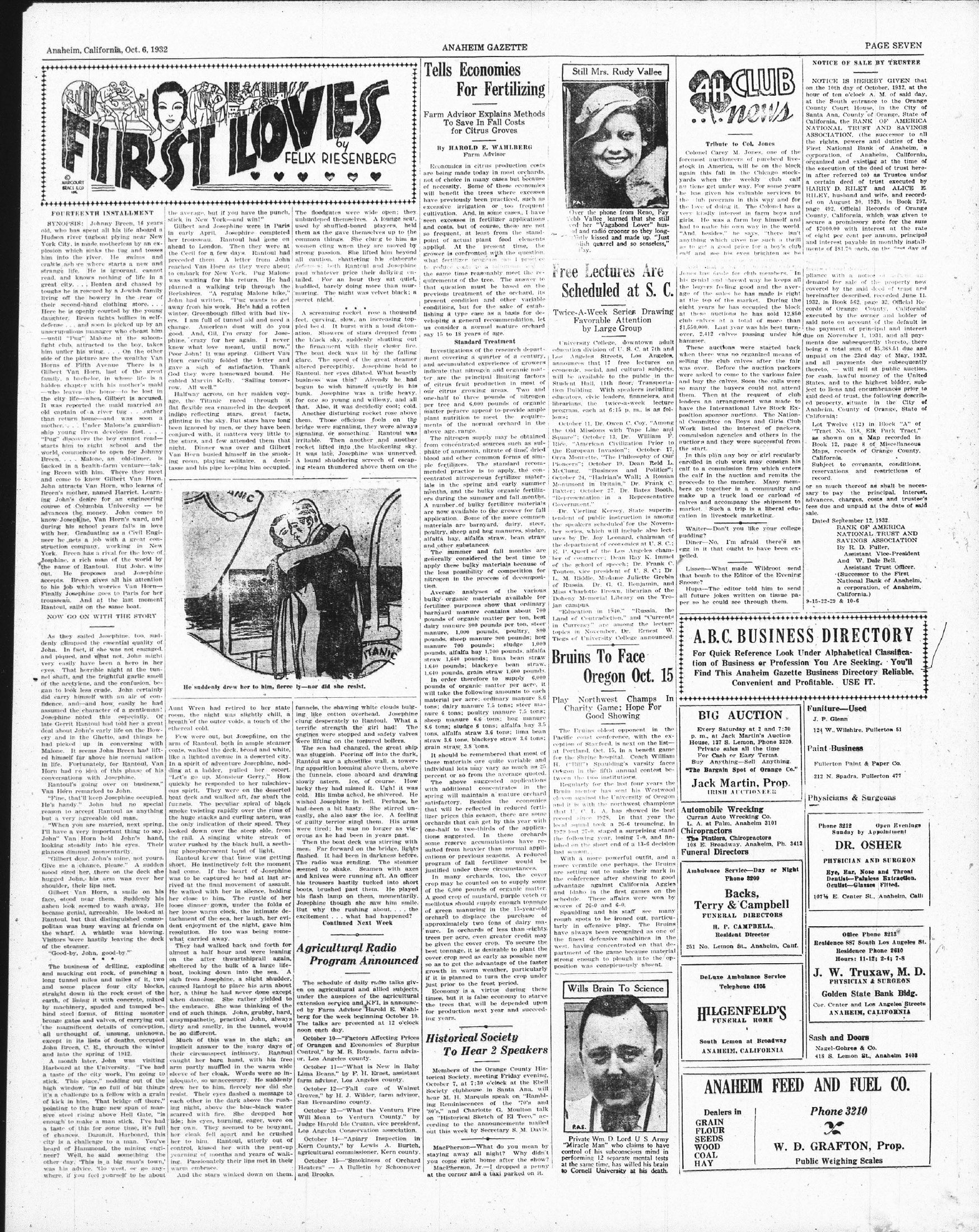
Searchable text
FOURTEENTH INSTALLMENT
SYNOPSIS: Johnny Breen, 16 years old, who has spent all his life aboard a Hudson river tugboat plying near New York City, is made motherless by an explosion which sinks the tug and tosses him into the river. He swims and crawls ashore where starts a new and strange life. He is ignorant, cannot read, and knows nothing of life in a great city. Beaten and chased by toughs he is rescued by a Jewish family living off the bowery in the rear of their second-hand clothing store. Here he is openly courted by the young daughter. Breen fights bullies in self-defense and soon is picked up by an unscrupulous manager who cheats him—until "Pug" Malone at the saloon-fight club, attracted to the boy, takes him under his wing. On the other side of the picture are the wealthy Van Horns of Fifth Avenue. There is a Gilbert Van Horn, last of the great family, a bachelor, in whose life is a hidden chapter with his mother's maid—who leaves the home—to be lost in the city life—when Gilbert is accused. It was reported the maid married an old captain of a river tug... rather than return home—and was soon a mother... Under Malone's guardianship young Breen develops fast... "Pug" discovers the boy cannot read—starts him to night school and the world, commences to open for Johnny Breen.
the average, but if you have the punch, stick in New York—and win!"
Gilbert and Josephine were in Paris in early April. Josephine completed her trousseau. Rantoul had gone on ahead to London. Then they were at the Cecil for a few days. Rantoul had preceded them. A letter from John reached Van Horn as they were about to embark for New York. Pug Malone was waiting for his return. He had planned a walking trip through the Berkshires. "A regular Malone hike," John had written. "Pug wants to get away from his work. He's had a rotten winter, Greenbough filled with bad livers. I am full of tunnel aid and need a change. American dust will do you good. And, Gil, I'm crazy for Josephine, crazy for her again. I never knew what love meant, until now." Poor John! It was spring. Gilbert Van Horn carefully folded the letter and gave a sigh of satisfaction. Thank God they were homeward bound. He cabled Marvin Kelly. "Sailing tomorrow. All well."
Halfway across, on her maiden voyage, the Titanic raced through a flat flexible sea enameled in the deepest indigo reflecting stars, great facts, glinting in the sky. But stars have long been ignored by men, or they have been conjured with, it matters very little to the stars, and few attended them that night. Dinner was over and Gilbert Van Horn busied himself in the smok-
The floodgates were unburdened themselves used by shuffled-board them as the gave them common things. She women cling when the strong passion. She lie all caution, shattering defenses; both Rantoul paid whatever price she tailed. For an hour he huddled, barely doing muring. The night was secret night.
A screaming rocket feet, curving, slow, and plied betd. It burst wiation. Showers of stair the black sky, sudden the firmament with the boat deck was glare. The speed of the altered perceptibly. J Rantoul, her eyes dilated business was this? begun to wish himself bunk. Josephine was for one so young and that. Also, it was decelerated disturbing them. Those officious bridge were signaling, signaling, or something irritable. Then another rocket lifted into the It was late. Josephine
Horns of Fifth Avenue There is a Gilbert Van Horn, last of the great family, a bachelor, in whose life is a hidden chapter with his mother's maid—who leaves the home—to be lost in the city life—when Gilbert is accused. It was reported the maid married an old captain of a river tug... rather than return home—and was soon a mother... Under Malone's guardianship young Breen develops fast... "Pug" discovers the boy cannot read—starts him to night school and the world, commences to open for Johnny Breen... Malone, an old-timer, is backed in a health-farm venture—taking Breen with him. There they meet and come to know Gilbert Van Horn. John attracts Van Horn, who learns of Breen's mother, named Harriet. Learning John's desire for an engineering course of Columbia University — he advances the money. John comes to know Josephine, Van Horn's ward, and during his school years falls in love with her. Graduating as a Civil Engineer he gets a job with a great construction company, working in New York. Breen has a rival for the love of Josephine, a rich man of the world by the name of Rantoul. But John wins out. He proposes and Josephine accepts. Breen gives all his attention to his job which worries Van Horn—Finally Josephine goes to Paris for her trousseau. And at the last moment Rantoul, sails on the same boat.
NOW GO ON WITH THE STORY
As they sailed Josephine, too, suddenly glimpsed the essential quality of John. In fact, if she was not engaged, and piqued, and what not, John might very easily have been a hero in her eyes. That horrible night at the tunnel shaft, and the frightful garlic smell of the acetylene, and the confusion, began to look less crude. John certainly did carry himself with an air of confidence, and—and how, easily he had assumed the character of a gentleman! Josephine noted this especially. Of late Gerrit Rantoul had told her a great deal about John's early life on the Bowery and in the Ghetto, and things he had picked up in conversing with Malone. It seems John Breen had lifted himself far above his normal sation in life. Fortunately, for Rantoul, Van Horn had no idea of this phase of his conversations with Josephine.
Rantoul's going over on business," Van Horn remarked to John.
"Fine, that'll keep Josephine occupied. He's handy." John had no special reason to accept Rantoul as anything but a very agreeable old man.
"When you are married, next spring, I'll have a very important thing to say, John" Van Horn held John's hand, looking steadily into his eyes. Their glances dimmed momentarily.
"Gilbert dear, John's mine, not yours. Give me a chance, please." A sudden gave a sigh of satisfaction. Thank God they were homeward bound. He cabled Marvin Kelly. "Sailing tomorrow. All well."
Halfway across, on her maiden voyage, the Titanic raced through a flat flexible sea enameled in the deepest indigo reflecting stars, great facts, glinting in the sky. But stars have long been ignored by men, or they have been conjured with, it matters very little to the stars, and few attended them that night. Dinner was over and Gilbert Van Horn busied himself in the smoking room, playing solitaire, a demi-tasse and his pipe keeping him occupied.
Aunt Wren had retired to her state room, the night was slightly chill, a breath of the outer voids, a touch of the ethereal cold.
Few were out, but Josephine, on the arm of Rantoul, both in ample steamer coats, walked the deck, broad and white, like a lighted avenue in a deserted city. In a spirit of adventure Josephine nodding at a ladder, pulled her escort. "Let's go up. Monsieur Gerry." How quickly he responded to her mischievous spirit. They were on the deserted boat deck and walked aft, far abaft the funnels. The peculiar spiral of black smoke twisting rapidly over the rims of the huge stacks and curling astern, was the only indication of their speed. They looked down over the steep side, from the rail. A singing white streak of water rushed by the black hull, a seething phosphorescent band of light.
Rantoul krew that time was getting short. He instinctively felt the moment funnels, the shawing waving like cotton overclung desperately to Rantoul's engines were stopped and were lifting on the torrents.
The sea had changed was sluggish. Peering at Rantoul saw a ghostly apparition looming at the funnels, close about slowly astern. Ice, or lucky they had missed cold. His limbs ached, wished Josephine in his had been a bit hasty; easily she also saw that of guilty terrior sized were tired; he was no oros as he had been.
Then the boat deck men. Far forward on flashed. It had been in The radio was sending seemed to shake.
Rantoul's going over on business," Van Horn remarked to John.
"Fine, that'll keep Josephine occupied. He's handy." John had no special reason to accept Rantoul as anything but a very agreeable old man.
"When you are married, next spring, I'll have a very important thing to say, John." Van Horn held John's hand, looking steadily into his eyes. Their glances dimmed momentarily.
"Gilbert dear, John's mine, not yours. Give me a chance, please." A sudden mood sized her, there on the deck she hugged John, his arm was over her shoulder, their lips met.
Gilbert Van Horn, a smile on his face, stood near them. Suddenly his ashen look seemed to wash away. He became genial, agreeable. He looked at Rantoul, but that distinguished cosmopolitan was busy waving at friends on the wharf. A whistle was blowing. Visitors were hastily leaving the deck of the steamer.
"Good-by, John, good-by."
The business of drilling, exploding and mucking out rock, of punching a long tunnel miles and miles of it, two and some places four city blocks, straight down in the rock crust of the earth, of lining it with concrete, mixed by machinery, spaded and tamped behind steel forms, of fitting monster bronze gates and valves, of carrying out the magnificent details of conception, all unthought of, unsung, unknown, except in its lists of deaths, occupied John Breen, C. E., through the winter and into the spring of 1912.
A month later, John was visiting Harboard at the University. "I've had a taste of the city work, I'm going to stick. This place," nodding out of the high window, "is so full of big things it's a challenge to a fellow with a grain of kick in him. That bridge off there," pointing to the huge new span of massive steel rising above Hell Gate, "is enough to make a man stick. I've had a taste of this for some time, it's full of chances. Dammit, Harboard, this city is a challenge to a man. You've heard of Hammond, the mining engineer? Well, he said something the other day; 'This is a big man's town,' was his advice. Go west, or go anywhere, if you feel yourself to be about "Let's go up, Monsieur Gerry." How quickly he responded to her mischievous spirit. They were on the deserted boat deck and walked aft, far abaft the funnels. The peculiar spiral of black smoke twisting rapidly over the rims of the huge stacks and curling astern, was the only indication of their speed. They looked down over the steep side, from the rail. A singing white streak of water rushed by the black hull, a seething phosphorescent band of light.
Rantoul knew that time was getting short. He instinctively felt the moment had come. If the heart of Josephine was to be captured he had at last arrived at the final movement of assault. He walked with her in silence, holding her close to him. The rustle of her loose dinner gown, under the folds of her loose warm clock, the intimate detachment of the sea, her laugh, her evident enjoyment of the night, gave him resolution. He too was being somewhat carried away.
They had walked back and forth for almost a half hour and were leaning on the after thwartshiprail again, sheltered by the bulk of a large lifeboat, looking down into the sea. A sigh from Josephine, a slight shudder, caused Rantoul to place his arm about her, a thing he had never done except when dancing. She rather yielded to the embrace. She was thinking of the end of such things. John, grubby, hard, unsympathetic, practical John, always dirty and smelly, in the tunnel, would be so different.
Much of this was in the sigh; an implicit answer to the many days of their circumspect intimacy. Rantoul caught her bare hand, with his free arm partly muffled in the warm wide sleeve of her cloak. Words were so inadequate, so unnecessary. He suddenly drew her to him, fiercely nor did she resist. Their eyes flashed a message to each other in the dark above the rushing night, above the blue-black water scarred with fire. She dropped her lids; his eyes, burning, eager, were on her own. They seemed to be bouyant, her cloak fell apart and he crushed her to him. Rantoul, utterly out of control, kissed her with the pent-up yearning of months and years of waiting. Passionately their lips met in their warm embrace.
And the stars winked down on them.
The schedule of daily en on agricultural and under the auspices of extension service and ed by Farm Advisor Berg for the week begin. The talks are present noon each day.
October 10—"Factory of Oranges and Econ Control," by M. B. Roeror, Los Angeles county.
October 11—"What Lima Beans," by F. H. farm advisor, Los Angeles.
October 12—"Fall Groves," by H. J. Will San Bernardino county.
October 13—"What Will Mean to Ventu Judge Harold Ide Cruz Los Angeles Conserva
October 14—"Apiary Kern County," by L.A. agricultural commission.
October 15—"Smokey Heaters" — A Bullet and Brooks.
ANAHEIM GAZETTE
Tells Economies For Fertilizing
Farm Advisor Explains Methods To Save In Fall Costs for Citrus Groves
By HAROLD E. WAHLBERG
Farm Advisor
Economics in citrus production costs are being made today in most orchards, not of choice in many cases but because of necessity. Some of these economies will benefit the trees where excesses have previously been practiced, such as excessive irrigation or too frequent cultivation. And, in some cases, I have seen excesses in fertilizer applications and costs, but of course, these are not so frequent, at least from the standpoint of actual plant food elements applied. At the present time, the grower is confronted with the question: what fertilizer program can I practice to reduce costs to a minimum? The same time reasonably meet the requirements of the tree. The answer to that question must be based on the previous treatment of the orchard, its present condition and other variable conditions, but for the sake of establishing a type case as a basis for developing a general recommendation, let us consider a normal mature orchard say 15 to 18 years of age.
Standard Treatment
Investigations of the research department covering a quarter of a century, and accumulated experience of growers indicate that nitrogen and organic matter are the principal limiting factors of citrus fruit production in most of our citrus growing areas. Two and one-half to three pounds of nitrogen per tree and 6,000 pounds of organic matter peracre appear to provide ample plant nutrition to meet the requirements of the normal orchard in the above age range.
The nitrogen supply may be obtained from concentrated sources such as sulphate of ammonia, nitrate of lime, dried blood and other common forms of sim-
Still Mrs. Rudy Vallee
Over the phone from Reno, Fay Webb Vallee learned that she still loved her "Vagabond Lover" husband and radio crooner so they longingly kissed and made up. "Justlish quarrel and so senseless," Day.
Free Lectures Are Scheduled at S. C.
Twice-A-Week Series Drawing Favorable Attention by Large Group
University College, downtown adult education division of U. S. C. at 7th and Los Angeles Streets, Los Angeles, announces that 17 free lectures on economic, social, and cultural subjects will be available to the public in the Student Hall, 11th floor; Transportation Building. With speakers including educators, civic leaders, financiers, and librarians, the twice-a-week lecture program, each at 6:15 p.m., is as follows:
October 11, Dr. Owen C. Coy, "Among the Old Missions with Tape Line and Square"; October 13, Dr. William F. Rice, "American Civilization Prior to the European Invasion"; October 17, Orra Monnette, "The Philosophy of Our
altered perceptibly. Josephine held to Rantoul, her eyes dilated. What beastly business was this? Already he had begun to wish himself quietly in his bunk. Josephine was a trifle heavy, for one so young and willowy, and all that. Also, it was decidedly cool; cold.
Another disturbing rocket rose above them. Those officious fools on the bridge were signaling, they were always signaling, or something. Rantoul was irritable. Then another and another rocket lifted into the blackening sky. It was late, Josephine was unnerved. A loud shuddering screech of escaping steam thundered above them on the summer and fall months are generally considered the best time to apply these bulky materials because of the less possibility of competition for nitrogen in the process of decomposition.
Average analyses of the various bulky organic materials available for fertilizer purposes show that ordinary barnyard manure contains about 700 pounds of organic matter per ton, best dairy manure 800 pounds per ton, steer manure 1,000 pounds, poultry 800 pounds, sheep manure 900 pounds; hog manure 700 pounds; sludge 1,000 pounds, alfalfa hay 1,700 pounds, alfalfa straw 1,640 pounds; lima bean straw 1,640 pounds; blackeye bean straw 1,640 pounds; grain straw 1,600 pounds.
In order therefore to supply 6,000 pounds of organic matter per acre, it will take the following amounts to each material per acre: ordinary manure 8.6 tons; dairy manure 7.5 tons; steer manure 6 tons; poultry manure 7.5 tons; sheep manure 6.6 tons; hog manure 8.6 tons; sludge 6 tons; alfalfa hay 3.5 tons, alfalfa straw 3.6 tons; lima bean straw 3.6 tons, blackeye straw 3.6 tons; grain straw 3.8 tons.
It should be remembered that most of these materials are quite variable and individual lots may vary as much as 25 percent or so from the average quoted.
The above suggested applications with additional concentrates in the spring will maintain a mature orchard satisfactory. Besides the economies that will be reflected in reduced fertilizer prices this season, there are some orchards that can get by this year with one-half to two-thirds of the applications suggested. In these orchards some reserve accumulations have resulted from heavier than normal applications or previous seasons. A reduced program of fall fertilizer would be justified under these circumstances.
and accumulated experience of growers indicate that nitrogen and organic matter are the principal limiting factors of citrus fruit production in most of our citrus growing areas. Two and one-half to three pounds of nitrogen per tree and 6,000 pounds of organic matter per acre appear to provide ample plant nutrition to meet the requirements of the normal orchard in the above age range.
The nitrogen supply may be obtained from concentrated sources such as sulphate of ammonia, nitrate of lime, dried blood and other common forms of simple fertilizers. The standard recommended practice is to apply the concentrated nitrogenous fertilizer materials in the spring and early summer months, and the bulky organic fertilizers during the summer and fall months. A number of bulky fertilizer materials are now available to the grower for fall application. Some of the more common materials are barnyard, dairy, steer, poultry, sheep and hog manures, sludge, alfalfa hay, alfalfa straw, bean straw and other substances.
The summer and fall months are generally considered the best time to apply these bulky materials because of the less possibility of competition for nitrogen in the process of decomposition.
Dr. Vierling Kersey, State superintendent of public instruction is among the speakers scheduled for the November series, which will include also lectures by Dr. Joy Leonard, chairman of the department of economics at U.S.C.; E.P. Quorl of the Los Angeles chamber of commerce; Dean Ray K. Immel of the school of speech; Dr. Frank C.Touton, vice president of U.S.C.; Dr.L.M.Riddle, Madame Juliette Grebin of Russia; Dr.G.G.Benjamin, and Miss Charlotte Brown, librarian of the Doheny Memorial Library on the Trojan campus.
"Education in 1940," "Russia, the Land of Contradiction," and "Currents in Currency" are among the lecture topics in November, Dr. Ernest W.Tiegs of University College announced.
Bruins To Face Oregon Oct. 15
Play Northwest Champs In Charity Game; Hope For Good Showing
The Bruins oldest opponent in the Pacific coast conference, with the exception of Starford, is next on the list—at Portland, Oct. 15, in a benefit game for the Shrine hospital. Coach William H. ("Bill") Spaulding's varsity faces Oregon in the fifth annual contest between the two institutions.
Regularly for the last four years the Bruin mentor has sent his Westwood eleven against the University of Oregon and it is with the northwest champions that U.C.L.A. has showed its best record since 1928. In that year the local squound took a 26-6 trouncing, in 1929 lost 27-0, staged a surprising stand the following year, losing 7-0, and finished on the short end of a 13-6 decision last season.
With a more powerful outfit, and a more versatile one perhaps, the Bruins make their mark in
the funnels, close aboard and drawing slowly astern. Ice, of course. How lucky they had missed it. Ugh! it was cold. His limbs ached, he shivered. He wished Josephine in hell. Perhaps, he had been a bit hasty. She stirred uneasily, she also saw the ice. A feeling of guilty terrior sized them. His arms were tired; he was no longer as vigorous as he had been in years past.
Then the boat deck was stirring with men. Far forward on the bridge, lights flashed. It had been in darkness before. The radio was sending. The steamer seemed to shake. Seamen with axes and knives were running aft. An officer his trousers hastily tucked into short boots, brushed past them. He played his flash lamp on them, momentarily. Josephine though she saw him smile. But why the rushing about... the excitement... what had happened?
Continued Next Week
Agricultural Radio Program Announced
The schedule of daily radio talks given on agricultural and allied subjects, under the auspices of the agricultural extension service and KFI, is announced by Farm Advisor Harold E. Wahlberg for the week beginning October 10. The talks are presented at 12 o'clock noon each day.
October 10—"Factors Affecting Prices of Oranges and Economies of Surplus Control," by M. B. Rounds, farm advisor, Los Angeles county.
October 11—"What is New in Baby Lima Beans," by F. H. Ernst, assistant farm advisor, Los Angeles county.
October 12—"Fall care of Walnut Groves," by H. J. Wilder, farm advisor, San Bernardino county.
October 13—"What the Ventura Fire Will Mean to Ventura County," by Judge Harold Ide Cruzan, vice president, Los Angeles Conservation association.
October 14—"Apiary Inspection in Kern County," by Lewis A. Burtch, agricultural commissioner, Kern county.
October 15—"Smokiness of Orchard Heaters" — A Bulletin by Schoonover and Brooks.
The above suggested applications with additional concentrates in the spring will maintain a mature orchard satisfactory. Besides the economies that will be reflected in reduced fertilizer prices this season, there are some orchards that can get by this year with one-half to two-thirds of the applications suggested. In these orchards some reserve accumulations have resulted from heavier than normal applications or previous seasons. A reduced program of fall fertilizer would be justified under these circumstances.
In many orchards, too, the cover crop may be counted on to supply some of the 6,000 pounds of organic matter. A good crop of mustard, purple vetch or melilotus should supply enough tonnage of green manuring in the 15-year-old orchard to displace the purchase of approximately two tons of dairy manure. In orchards of less than eighty trees per acre, even greater credit may be given the cover crop. To secure the best tonnage, it is desirable to plant the cover crop seed as early as possible now so as to get the advantage of the faster growth in warm weather, particularly if it is planned to turn the crop under just prior to the frost period.
Economy is a virtue during these times, but it is false economy to starve the trees that will be depended upon for production next year and succeeding years.
Historical Society To Hear 2 Speakers
Members of the Orange County Historical Society, meeting Friday evening, October 7, at 7:30 o'clock at the Ebell Society clubhouse in Santa Ana, will hear M. H. Marquis speak on "Rambling Reminiscences of the '70's and '80's," and Charlotte G. Moulton talk on "Historical Sketch of El Toro," according to the announcements mailed out this week by Secretary S. M. Davis.
MacPherson—What do you mean by staying away all night? Why didn't you come right home after the show?
MacPherson, Jr.-I dropped a penny at the corner and a taxi parked on it.
Regularly for the last four years the Bruin mentor has sent his Westwood eleven against the University of Oregon and it is with the northwest champions that U. C. L. A., has showed its best record since 1928. In that year the local squad took a 26-6 trouncing, in 1929 lost 27-0, staged a surprising stand the following year, losing 7-0, and finished on the short end of a 13-6 decision last season.
With a more powerful outfit, and a more versatile one perhaps, the Bruins are setting out to make their mark in the conference after showing to good advantage against California Aggies and Idaho in the first games on the schedule. These affairs were won by scores of 26-0 and 6-0.
Spaulding and his staff see many rough spots to be ironed out, particularly in offensive play. The Bruins have always been recognized as one of the finest defensive machines in the west, having concentrated on that department of the game because material strong enough to plough into the opposition was conspicuously absent.
Private Wm. D. Lord. U.S Army "Miracle Man" who claims to have control of his subconscious mind in performing 12 separate mental tests at the same time, has willed his brain to Cornell University at his death.
NOTICE OF SALE BY TRUSTEE
NOTICE IS HEREBY GIVEN that on the 10th day of October, 1932, at the hour of ten o'clock A.M. of said day, at the South entrance to the Orange County Court House, in the City of Santa Ana, County of Orange, State of California, the BANK OF AMERICA NATIONAL TRUST AND SAVINGS ASSOCIATION, (the successor to all the rights, powers and duties of the First National Bank of Anaheim, a corporation, of Anaheim, California, organized and existing at the time of the execution of the deed of trust herein after referred to) as Trustee under a certain deed of trust executed by HARRY D. RILEY and ALICE E. RILEY, husband and wife, and recorded on August 30, 1929, in Book 297, page 492. Official Records of Orange County, California, which was given to secure a promissory note for the sum of $7000.00 with interest at the rate of eight per cent per annum, principal and interest payable in monthly installments of $81.70 each, on the first day of Jones has made for club members. In his genial and shrewd way he keeps all the buyers feeling good and the average of the sales he has made is right at the top of the market. During the eight years he has occupied the block at these auctions he has sold 12,850 club calves at a total of more than $1,550,000. Last year was his best turnover, 2,412 calves passing under his hammer.
These auctions were started back when there was no organized means of selling the club calves after the fair was over. Before the auction packers were asked to come to the various fairs and buy the calves. Soon the calls were so many the buyers could not attend them. Then at the request of club leaders an arrangement was made to have the International Live Stock Exposition sponsor auctions. The National Committee on Boys and Girls Club Work listed the interest of packers, commission agencies and others in the auctions and they were successful from the start.
In this plan any boy or girl regularly compliance with a notice of sale can demand for sale of the property now covered by the said deed of trust and hereinafter described, recorded June 11, 1932, in Book 562, page 32. Official Records of Orange County, California executed by the owner and holder of said note on account of the default in the payment of principal and interest due on November 1, 1931, and all payments due subsequently thereto, there being a total sum of $5,368.51 due and unpaid on the 23rd day of May, 1932, and all payments due subsequently thereto, — will sell at public auction, for cash, lawful money of the United States, and to the highest bidder, subject to liens and encumbrances prior to said deed of trust, the following described property, situate in the City of Anaheim, County of Orange, State of California:
Lot Twelve (12) in Block "A" of "Tract No. 158, Elk Park Tract," as shown on a Map recorded in Book 12, page 8 of Miscellaneous Maps, records of Orange County, California.
Before the auction packers were asked to come to the various fairs and buy the calves. Soon the calls were so many the buyers could not attend them. Then at the request of club leaders an arrangement was made to have the International Live Stock Exposition sponsor auctions. The National Committee on Boys and Girls Club Work listed the interest of packers, commission agencies and others in the auctions and they were successful from the start.
In this plan any boy or girl regularly enrolled in club work may consign his calf to a commission firm which enters the calf in the auction and remits the proceeds to the member. Many members go together in a community and make up a truck load or carload of calves and accompany the shipment to market. Such a trip is a liberal education in livestock marketing.
Waiter—Don't you like your college pudding?
Diner—No. I'm afraid there's an egg in it that ought to have been expelled.
Lissen—What made Wildroot send that bomb to the Editor of the Evening Snooze?
Hupa—The editor told him to send all future jokes written on tissue paper so he could see through them.
A.B.C. BUSINESS DIRECTORY
For Quick Reference Look Under Alphabetical Classification of Business or Profession You Are Seeking. You'll Find This Anaheim Gazette Business Directory Reliable, Convenient and Profitable. USE IT.
BIG AUCTION
Every Saturday at 2 and 7:30 p.m., at Jack Martin's Auction House, 137 S. Lemon, Phone 3220.
Private sales all the time
For Cash or Easy Terms.
Buy Anything—Sell Anything.
"The Bargain Spot of Orange Co."
Jack Martin, Prop.
IRISH AUCTIONEER
Automobile Wrecking
Curran Auto Wrecking Co.
L. A. at Palm, Anahelm 3101
Chiropractors
The Pintlers, Chiropractors
108 E. Broadway, Anahelm, Ph. 3413
Funeral Directors
Funiture—Used
J. P. Glenn
124 W. Wilshire, Fullerton 51
Paint Business
Fullerton Paint & Paper Co.
212 N. Spadra, Fullerton 477
Physicians & Surgeons
Phone 3212 Open Evenings Sunday by Appointment
DR. OSHER
PHYSICIAN AND SURGEON
Jack Martin, Prop.
IRISH AUCTIONEER
Automobile Wrecking
Curran Auto Wrecking Co.
L. A. at Palm, Anaheim 3101
Chiropractors
The Pintlers, Chiropractors
108 E. Broadway, Anaheim, Ph. 3413
Funeral Directors
Ambulance Service—Day or Night
Phone 8209
Backs,
Terry & Campbell
FUNERAL DIRECTORS
H. P. CAMPBELL,
Resident Director
251 No. Lemon St., Anaheim, Calif.
DeLuxe Ambulance Service
Telephone 4105
HILGENFELD'S
FUNERAL HOME
South Lemon at Broadway
ANAHEIM, CALIFORNIA
ANAHEIM FEED AND FUEL CO.
Dealers in
GRAIN
FLOUR
SEEDS
WOOD
COAL
HAY
Phone 3210
W. D. GRAFTON, Prop.
Public Weighing Scales