anaheim-gazette 1932-09-22
Scanned page
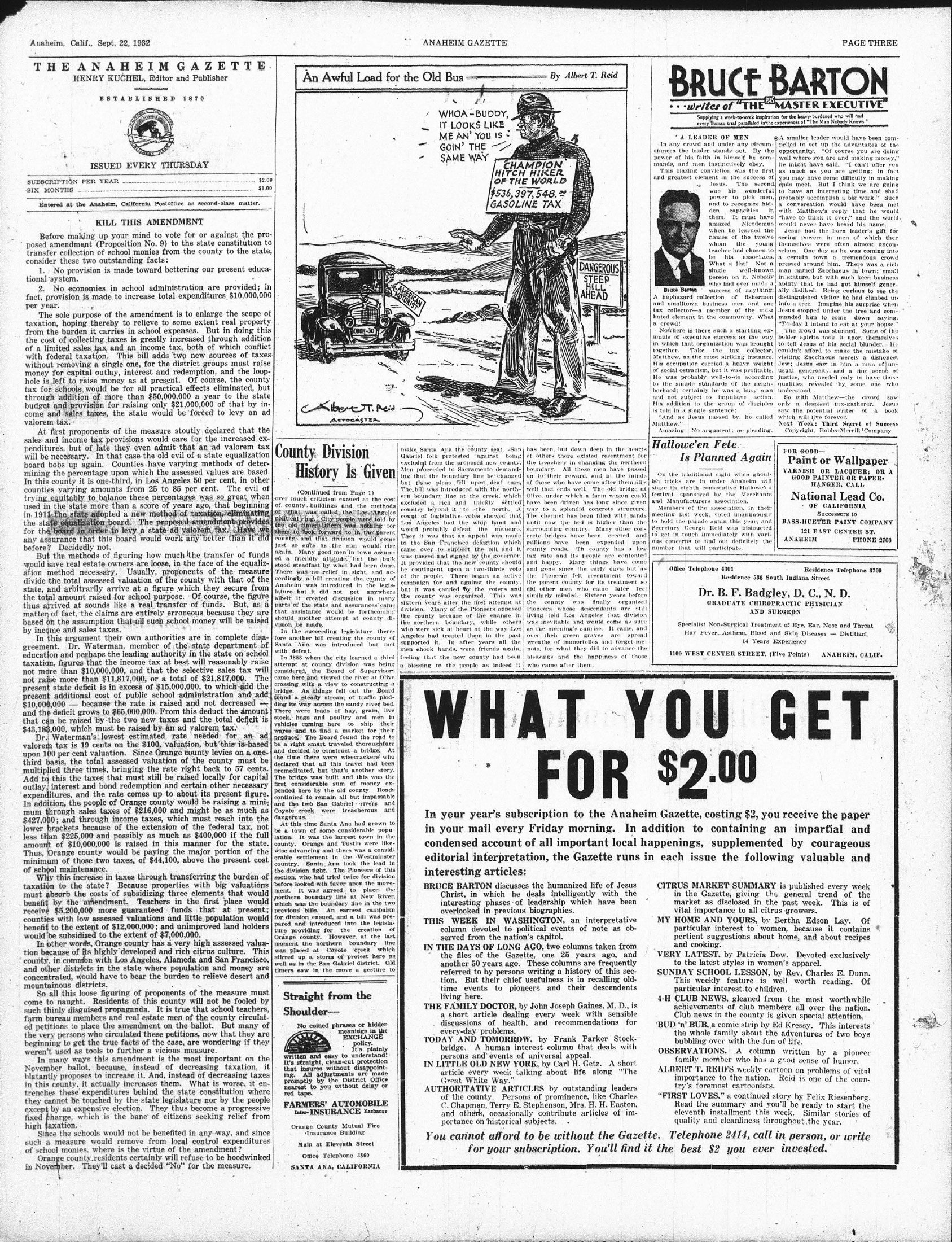
Searchable text
THE ANAHEIM GAZETTE
HENRY KUCHEL, Editor and Publisher
ESTABLISHED 1870
ISSUED EVERY THURSDAY
SUBSCRIPTION PER YEAR ... $2.00
SIX MONTHS ... $1.00
Entered at the Anaheim, California Postoffice as second-olass matter.
KILL THIS AMENDMENT
Before making up your mind to vote for or against the proposed amendment (Proposition No. 9) to the state constitution to transfer collection of school monies from the county to the state, consider these two outstanding facts:
1. No provision is made toward bettering our present educational system.
2. No economies in school administration are provided; in fact, provision is made to increase total expenditures $10,000,000 per year.
The sole purpose of the amendment is to enlarge the scope of taxation, hoping thereby to relieve to some extent real property from the burden it carries in school expenses. But in doing this the cost of collecting taxes is greatly increased through addition of a limited sales tax and an income tax, both of which conflict with federal taxation. This bill adds two new sources of taxes without removing a single one, for the district groups must raise money for capital outlay, interest and redemption, and the loophole is left to raise money as at present. Of course, the county tax for schools would be for all practical effects eliminated, but through addition of more than $50,000,000 a year to the state budget and provision for raising only $21,000,000 of that by income and sales taxes, the state would be forced to levy an ad valorem tax.
At first proponents of the measure stoutly declared that the sales and income tax provisions would care for the increased expenditures, but of late they even admit that an ad valorem tax will be necessary. In that case the old evil of a state equalization
without removing a single one, for the district groups must raise money for capital outlay, interest and redemption, and the loophole is left to raise money as at present. Of course, the county tax for schools would be for all practical effects eliminated, but through addition of more than $50,000,000 a year to the state budget and provision for raising only $21,000,000 of that by income and sales taxes, the state would be forced to levy an ad valorem tax.
At first proponents of the measure stoutly declared that the sales and income tax provisions would care for the increased expenditures, but of late they even admit that an ad valorem tax will be necessary. In that case the old evil of a state equalization board bobs up again. Counties have varying methods of determining the percentage upon which the assessed values are based. In this county it is one-third, in Los Angeles 50 per cent, in other counties varying amounts from 25 to 85 per cent. The evil of trying equitably to balance these percentages was so great when used in the state more than a score of years ago, that beginning in 1911 the state adopted a new method of taxation, eliminating the state equalization board. The proposed amendment provides for the board in order to levy a state ad valorem tax. Have we any assurance that this board would work any better than it did before? Decidedly not.
But the methods of figuring how much the transfer of funds would save real estate owners are loose, in the face of the equalization method necessary. Usually, proponents of the measure divide the total assessed valuation of the county with that of the state, and arbitrarily arrive at a figure which they secure from the total amount raised for school purpose. Of course, the figure thus arrived at sounds like a real transfer of funds. But, as a matter of fact, the claims are entirely erroneous because they are based on the assumption that all such school money will be raised by income and sales taxes.
In this argument their own authorities are in complete disagreement. Dr. Waterman, member of the state department of education and perhaps the leading authority in the state on school taxation, figures that the income tax at best will reasonably raise not more than $10,000,000, and that the selective sales tax will not raise more than $11,817,000, or a total of $21,817,000. The present state deficit is in excess of $15,000,000, to which add the present additional cost of public school administration and add $10,000,000 — because the rate is raised and not decreased — and the deficit grows to $65,000,000. From this deduct the amount that can be raised by the two new taxes and the total deficit is $43,183,000, which must be raised by an ad valorem tax.
Dr. Waterman's lowest estimated rate needed for an ad valorem tax is 19 cents on the $100. valuation, but this is based upon 100 per cent valuation. Since Orange county levies on a one-third basis, the total assessed valuation of the county must be multiplied three times, bringing the rate right back to 57 cents. Add to this the taxes that must still be raised locally for capital outlay, interest and bond redemption and certain other necessary expenditures, and the rate comes up to about its present figure. In addition, the people of Orange county would be raising a minimum through sales taxes of $216,000 and might be as much as $427,000; and through income taxes, which must reach into the lower brackets because of the extension of the federal tax, not less than $225,000 and possibly as much as $400,000 if the full amount of $10,000,000 is raised in this manner for the state. Thus, Orange county would be paying the major portion of the minimum of those two taxes, of $44,100, above the present cost of school maintenance.
Why increase in taxes through transferring the burden of
Add to this the taxes that must still be raised locally for capital outlay, interest and bond redemption and certain other necessary expenditures, and the rate comes up to about its present figure.
In addition, the people of Orange county would be raising a minimum through sales taxes of $216,000 and might be as much as $427,000; and through income taxes, which must reach into the lower brackets because of the extension of the federal tax, not less than $225,000 and possibly as much as $400,000 if the full amount of $10,000,000 is raised in this manner for the state. Thus, Orange county would be paying the major portion of the minimum of those two taxes, of $44,100, above the present cost of school maintenance.
Why this increase in taxes through transferring the burden of taxation to the state? Because properties with big valuations must absorb the costs of subsidizing three elements that would benefit by the amendment. Teachers in the first place would receive $5,200,000 more guaranteed funds that at present; counties with low assessed valuations and little population would benefit to the extent of $12,000,000; and unimproved land holders would be subsidized to the extent of $7,000,000.
In other words, Orange county has a very high assessed valuation because of its highly developed and rich citrus culture. This county, in common with Los Angeles, Alameda and San Francisco, and other districts in the state where population and money are concentrated, would have to bear the burden to relieve desert and mountainous districts.
So all this loose figuring of proponents of the measure must come to naught. Residents of this county will not be fooled by such thinly disguised propaganda. It is true that school teachers, farm bureau members and real estate men of the county circulated petitions to place the amendment on the ballot. But many of the very persons who circulated these petitions, now that they are beginning to get the true facts of the case, are wondering if they weren't used as tools to further a vicious measure.
In many ways this amendment is the most important on the November ballot, because instead of decreasing taxation, it blatantly proposes to increase it. And, instead of decreasing taxes in this county, it actually increases them. What is worse, it entrenches these expenditures behind the state constitution where they cannot be touched by the state legislature nor by the people except by an expensive election. They thus become a progressive fixed charge; which is the bane of citizens seeking relief from high taxation.
Since the schools would not be benefited in any way, and since such a measure would remove from local control expenditures of school monies, where is the virtue of the amendment?
Orange county residents certainly will refuse to be hoodwinked in November. They'll cast a decided "No" for the measure.
AN AWFUL LOAD FOR THE OLD BUS BY ALBERT T. REID
WHOA-BUDDY,
IT LOOKS LIKE
ME AN' YOU IS
GOIN' THE
SAME WAY
CHAMPION
HITCH HIKER
OF THE WORLD
$536,397,548.
GASOLINE TAX
DANGEROUS
STEEP
HILL
AHEAD
Albert JT. Reid
ARTOCASTER
County Division History Is Given
(Continued from Page 1)
Over much criticism existed at the cost of county buildings and the methods of what was called the Los Angeles political ring. City people were told by the old timers there was nothing for them to look forward to in the parent county, and that division would come just so sure as the sun would rise again. Many good men in town assumed a friendly attitude, but the bulk good steadfast by what had been done. There was no relief in sight, and accordingly a bill creating the county of Anaheim was introduced in the legislature but it did not get anywhere built it created discussion in many parts of the state and assurances came that assistance would be forthcoming should another attempt at county division be made.
In the succeeding legislature there were another bill creating the county of Santa Ana was introduced but met with defeat.
In 1888 when the city learned a third attempt at county division was being considered, the Board of Supervisors came here and viewed the river at Olive crossing with a view to constructing a bridge. As things fell out the Board found a steady stream of traffic plodding its way across the sandy river bed. There were loads of hay, grain, live stock, hogs and poultry and men in vehicles coming here to ship their hares and to find a market for their produce. The Board found the road to a right smart traveled thoroughfare and decided to construct a bridge. At the time there were wisecrackers who declared that all this travel had been remedited, but that's another story. The bridge was built and this was the first considerable sum of money extended here by the old county. Roads continued to remain all but impassable and the two San Gabriel rivers and Poyote creek were treacherous and dangerous.
At this time Santa Ana had grown to be a town of some considerable population. It was the largest town in the county. Orange and Tustin were likewise advancing and there was a considerable settlement in the Westminster country. Santa Ana took the lead in the division fight. The Pioneers of this section who had tried twice for division make Santa Ana the county seat. San Gabriel folk protested against being excluded from the proposed new county. Men proceeded to Sacramento demanding that the boundary line be changed but these pleas fell upon deaf ears. The bill was introduced with the northern boundary line at the creek, which excluded a rich and thickly settled country beyond it to the north. A count of legislative votes showed that Los Angeles had the whip hand and would probably defeat the measure. Then it was that an appeal was made to the San Francisco delegation which came over to support the bill and it was passed and signed by the governor. It provided that the new county should be contingent upon a two-thirds vote of the people. There began an active campaign for and against the county, but it was carried by the voters and the county was organized. This was sixteen years after the first attempt at division. Many of the Pioneers opposed the county because of the change in the northern boundary, while others who were sick at heart at the way Los Angeles had treated them in the past supported it. In after years all the men shook hands, were friends again, feeling that the new county had been a blessing to the people as indeed it has been, but down deep in the hearts of others there existed resentment for the treachery in changing the northern boundary. All these men have passed on to their reward, and in the minds of those who have come after them, all's well that ends well. The old bridge at Olive, under which a farm wagon could have been driven has long since given way to a splendid concrete structure. The channel has been filled with sands until now the bed is higher than the surrounding country. Many other concrete bridges have been erected and millions have been expended upon county roads. Th county has a low tax rate and its people are contented and happy. Many things have come and gone since the early days but as the Pioneers felt resentment toward the parent county for its treatment so did other men who came later feel similarly minded. Sixteen years before the county was finally organized Pioneers whose descendants are still living told Los Angeles that division was inevitable and would come as sure as the morning's sunrise. It came, and over their green graves are spread wreaths of immortelles and forget-me-nots, for what they did to advance the blessings and the happiness of those who came after them.
WHAT YOU FOR $
In your year’s subscription to the Anaheim Gazette in your mail every Friday morning. In addition condensed account of all important local happen- editorial interpretation, the Gazette runs in ea- interesting articles:
In your year’s subscription to the Anaheim Gazette in your mail every Friday morning. In addition, condensed account of all important local happenings editorial interpretation, the Gazette runs in easy interesting articles:
BRUCE BARTON discusses the humanized life of Jesus Christ, in which he deals intelligently with the interesting phases of leadership which have been overlooked in previous biographies.
THIS WEEK IN WASHINGTON, an interpretative column devoted to political events of note as observed from the nation’s capitol.
IN THE DAYS OF LONG AGO, two columns taken from the files of the Gazette, one 25 years ago, and another 50 years ago. These columns are frequently referred to by persons writing a history of this section. But their chief usefulness is in recalling old-time events to pioneers and their descendants living here.
THE FAMILY DOCTOR, by John Joseph Gaines, M. D., is a short article dealing every week with sensible discussions of health, and recommendations for everyday problems.
TODAY AND TOMORROW, by Frank Parker Stockbridge. A human interest column that deals with persons and events of universal appeal.
IN LITTLE OLD NEW YORK, by Carl H. Getz. A short article every week talking about life along “The Great White Way.”
AUTHORITATIVE ARTICLES by outstanding leaders of the county. Persons of prominence, like Charles C. Chapman, Terry E. Stephenson, Mrs. H. H. Easton, and others, occasionally contribute articles of importance on historical subjects.
You cannot afford to be without the Gazette. For your subscription. You’ll find it there.
BRUCE BARTON
writes of "THE MASTER EXECUTIVE"
Supplying a week-to-week inspiration for the heavy-burdened who will find every human trial paralleled in the experiences of "The Man Nobody Knows."
A LEADER OF MEN
In any crowd and under any circumstances the leader stands out. By the power of his faith in himself he commands, and men instinctively obey.
This blazing conviction was the first and greatest element in the success of Jesus. The second was his wonderful power to pick men, and to recognize hidden capacities in them. It must have amazed Nicodemus when he learned the names of the twelve whom the young teacher had chosen to be his associates. What a list! Not a single well-known person on it. Nobody who had ever made a success of anything.
A haphazard collection of fishermen and smalltown business men and one tax collector—a member of the most hated element in the community. What a crowd!
Nowhere is there such a startling example of executive success as the way in which that organization was brought together. Take the tax collector, Matthew, as the most striking instance. His occupation carried a heavy weight of social ostracism, but it was profitable. He was probably well-to-do according to the simple standards of the neighborhood; certainly he was a busy man and not subject to impulsive action. His addition to the group of disciples is told in a single sentence:
"And as Jesus passed by, he called Matthew."
Amazing. No argument; no pleading.
A smaller leader would have been compelled to set up the advantages of the opportunity. "Of course you are doing well where you are and making money," he might have said. "I can't offer you as much as you are getting; in fact you may have some difficulty in making ends meet. But I think we are going to have an interesting time and shall probably accomplish a big work." Such a conversation would have been met with Matthew's reply that he would "have to think it over," and the world would never have heard his name.
Jesus had the born leader's gift for seeing powers in men of which they themselves were often almost unconscious. One day as he was coming into a certain town a tremendous crowd pressed around him. There was a rich man named Zacchaeus in town; small in stature, but with such keen business ability that he had got himself generally disliked. Being curious to see the distinguished visitor he had climbed up into a tree. Imagine his surprise when Jesus stopped under the tree and commanded him to come down saying: "Today I intend to eat at your house."
The crowd was stunned. Some of the bolder spirits took it upon themselves to tell Jesus of his social blunder. He couldn't afford to make the mistake of visiting Zacchaeus merely a dishonest Jew; Jesus saw in him a man of unusual generosity and a fine sense of justice, who needed only to have those qualities revealed by some one who understood.
So with Matthew—the crowd saw only a despised tax-gatherer. Jesus saw the potential writer of a book which will live forever.
Next Week: Third Secret of Success
Copyright, Bobbs-Merrill Company
Hallowe’en Fete Is Planned Again
On the traditional night when ghoulish tricks are in order Anaheim will stage its eighth consecutive Hallowe’en festival, sponsored by the Merchants and Manufacturers association.
Members of the association, in their meeting last week, voted unanimously to hold the parade again this year, and Secretary George Reid was instructed to get in touch immediately with various concerns to find out definitely the number that will participate.
FOR GOOD—
Paint or Wallpaper
VARNISH OR LACQUER; OR A GOOD PAINTER OR PAPER-HANGER, CALL
National Lead Co.
OF CALIFORNIA
Successors to
BASS-HUETER PAINT COMPANY
121 EAST CENTER ST.
ANAHEIM PHONE 9708
Office Telephone 4301 Residence Telephone 8709
Residence 536 South Indiana Street
Dr. B. F. Badgley, D. C., N. D.
GRADUATE CHIROPRACTIC PHYSICIAN AND SURGEON
Specialist Non-Surgical Treatment of Eye, Ear, Nose and Throat
Hay Fever, Asthma, Blood and Skin Diseases — Dietitian
14 Years Experience
1100 WEST CENTER STREET, (Five Points) ANAHEIM, CALIF.
The Anaheim Gazette, costing $2, you receive the paper being. In addition to containing an impartial and current local happenings, supplemented by courageous letter runs in each issue the following valuable and
CITRUS MARKET SUMMARY is published every week in the Gazette, giving the general trend of the market as disclosed in the past week. This is of vital importance to all citrus growers.
MY HOME AND YOURS, by Bertha Edson Lay. Of particular interest to women, because it contains pertinent suggestions about home, and about recipes and cooking.
VERY LATEST, by Patricia Dow. Devoted exclusively to the latest styles in women's apparel.
SUNDAY SCHOOL LESSON, by Rev. Charles E. Dunn. This weekly feature is well worth reading. Of particular interest to children.
4-H CLUB NEWS, gleaned from the most worthwhile achievements of club members all over the nation. Club news in the county is given special attention.
BUD 'n' BUB, a comic strip by Ed Kressy. This interests the whole family about the adventures of two boys bubbling over with the fun of life.
OBSERVATIONS. A column written by a pioneer family member who has a good sense of humor.
ALBERT T. REID'S weekly cartoon on problems of vital importance to the nation. Reid is one of the country's foremost cartoonists.
"FIRST LOVES," a continued story by Felix Riesenberg. Read the summary and you'll be ready to start the eleventh installment this week. Similar stories of quality and cleanliness throughout the year.
In the Gazette. Telephone 2414, call in person, or write you'll find it the best $2 you ever invested.