anaheim-gazette 1932-09-15
Scanned page
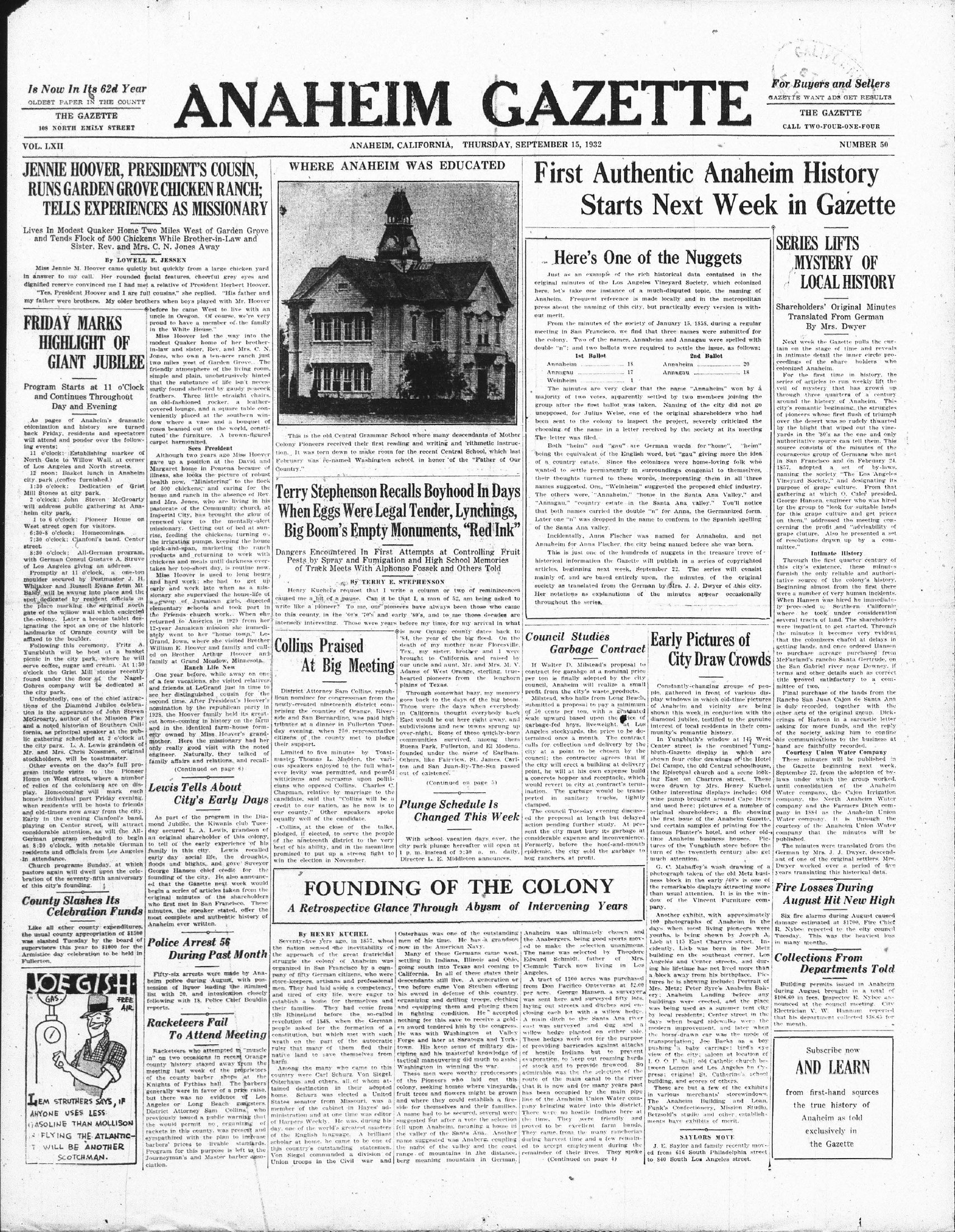
Searchable text
JENNIE HOOVER, PRESIDENT'S COUSIN,
RUNS GARDEN GROVE CHICKEN RANCH;
TELLS EXPERIENCES AS MISSIONARY
Lives In Modest Quaker Home Two Miles West of Garden Grove and Tends Flock of 500 Chickens While Brother-in-Law and Sister, Rev. and Mrs. C. N. Jones Away
By LOWELL E. JESSEN
Miss Jennie M. Hoover came quietly but quickly from a large chicken yard in answer to my call. Her rounded facial features, cheerful grey eyes and dignified reserve convinced me I had met a relative of President Herbert Hoover.
"Yes, President Hoover and I are full cousins," she replied. "His father and my father were brothers. My older brothers when boys played with Mr. Hoover before he came West to live with an uncle in Oregon. Of course, we're very proud to have a member of the family in the White House."
Miss Hoover led the way into the modest Quaker home of her brother-in-law and sister, Rev. and Mrs. C. N. Jones, who own a ten-acre ranch just two miles west of Garden Grove. The friendly atmosphere of the living room, simple and plain, unobtrusively hinted that the substance of life isn't necessarily found sheltered by gaudy peacock feathers. Three little straight chairs, an old-fashioned rocker, a leather-covered lounge, and a square table conveniently placed at the southern window where a vase and a bouquet of roses beamed out on the world, constituted the furniture. A brown-figured carpet harmonized.
Sees President
Although two years ago Miss Hoover
Program Starts at 11 o'Clock and Continues Throughout Day and Evening
As pages of Anaheim's dramatic colonization and history are turned back Friday, residents and spectators will attend and ponder over the following events:
11 o'clock: Establishing marker of North Gate to Willow Wall, at corner of Los Angeles and North streets.
12 noon: Basket lunch in Anaheim city park (coffee furnished).
1:30 o'clock: Dedication of Grist Mill Stones at city park.
2 o'clock: John Steven McGroarty will address public gathering at Anaheim city park.
1 to 6 o'clock: Pioneer Home on West street open for visitors.
6:30-8 o'clock: Homecomings.
7:30 o'clock: Cianfoni's band. Center street.
8:30 o'clock: All-German program, with German Consul Gustave A. Struve of Los Angeles giving an address.
Promptly at 11 o'clock, a one-ton moulder secured by Postmaster J. H. Whitaker and Russell Evans from Mt. Baldy will be swung into place and the spot dedicated by resident officials as the place marking the original north gate of the willow wall which encircled the colony. Later a bronze tablet designating the spot as one of the historic landmarks of Orange county will be affixed to the boulder.
Following this ceremony, Fritz A. Yungbluth will be host at a basket picnic in the city park, where he will serve coffee, sugar and cream. At 1:30 o'clock the Grist Mill stones recently found under the floor of the Nagel-Gohres company will be dedicated at the city park.
Undoubtedly, one of the chief attractions of the Diamond Jubilee celebration is the appearance of John Steven McGroarty, author of the Mission Play and a noted historian of Southern California, as principal speaker at the public gathering scheduled at 2 o'clock at the city park. L. A. Lewis grandson of Mr. and Mrs. Chris Nossman, original stockholders, will be toastmaster.
Other events on the day's full program include visits to the Pioneer Home on West street, where a number of relics of the colonizers are on display. Homecoming will mark each home's individual part Friday evening, when residents will be hosts to friends and old-timeers now away from the city. Early in the evening Cianfoni's band, playing on Center street, will attract considerable attention, as will the All-German program scheduled to begin at 8:30 o'clock, with notable German residents and officials from Los Angeles in attendance.
Church programs Sunday, at which friendly atmosphere of the living room, simple and plain, unobtrusively hinted that the substance of life isn't necessarily found sheltered by gaudy peacock feathers. Three little straight chairs, an old-fashioned rocker, a leather-covered lounge, and a square table conveniently placed at the southern window where a vase and a bouquet of roses beamed out on the world, constituted the furniture. A brown-figured carpet harmonized.
Sees President
Although two years ago Miss Hoover gave up a position at the David and Margaret home in Pomona because of illness, she looks the picture of robust health now. "Ministering" to the flock of 500 chickens; and caring for the house and ranch in the absence of Rev. Mrs. Jones, who are living in his pastorate of the Community church, at Imperial City, has brought the glow of renewed vigor to the mentally-alert missionary. Getting out of bed at sunrise, feeding the chickens; turning on the irrigating pumps, keeping the house spick-and-span, marketing the ranch products and returning to work with chickens and meals until darkness overtakes her too-short day, is routine now.
Miss Hoover is used to long hours and hard work; she had to get up early and work late when as a missionary she supervised the home-life of a group of Jamaican girls, directed elementary schools and took part in the Friends-church work. When she returned to America in 1929 from her 12-year Jamaican mission she immediately went to her "home town." LeGrand, Iowa, where she visited Brother William E. Hoover and family and called on Brother Arthur Hoover and family at Grand Meadow, Minnesota.
Ranch Life New
One year before, while away on one of a few vacations, she visited relatives and friends at LeGrand just in time to see her distinguished cousin for the second time. After President's Hoover's nomination by the republican party in 1928, the Hoover family held its greatest home-coming in history on the farm and in the identical farm-house formerly owned by Miss Hoover's grandmother. Here the missionary had her only really good visit with the noted engineer. Naturally, they talked of family affairs and relations, and recall (Continued on page 6)
Lewis Tells About City's Early Days
As part of the program in the Diamond Jubilee, the Kiwanis club Tuesday secured L. A. Lewis, grandson of an original shareholder of this colony, to tell of the early experience of his family in this city. Lewis recalled early day social life, the droughts, floods and blights, and gave Suveyor George Hansen chief credit for the friendly atmosphere of the living room, simple and plain, unobstrusively hinted that the substance of life isn't necessarily found sheltered by gaudy peacock feathers. Three little straight chairs, an old-fashioned rocker, a leather-covered lounge, and a square table conveniently placed at the southern window where a vase and a bouquet of roses beamed out on the world, constituted the furniture. A brown-figured carpet harmonized.
This is the old Central Colony Pioneers received their tion. It was torn down to February was re-named Country."
Terry Stephen When Eggs Were Big Boom's Eyes
Dangers Encountered Pests by Spray and Track Meets Witness
Henry Kuchel's request caused me a bit of a pause; write like a pioneer? To this county in the '60's intensely interesting. Those citizens of the county meet their support.
Limited to five minutes master Thomas L. Maddeous speakers enjoyed to th ever levity was permitted; witticisms and sarcasm cians who opposed Collins. Chapman, relative by mar candidate, said that "Collins credit to our nation, as h our county." Other spea equally well of the candidate.
Collins, at the close of pledged, if elected, to serve of the nineteenth district best of his ability, and in th promised to put up a str win the election in November.
Home on West street, where a number of relics of the colonizers are on display. Homecoming will mark each home's individual part Friday evening, when residents will be hosts to friends and old-timers now away from the city. Early in the evening Cianfoni's band, playing on Center street, will attract considerable attention, as will the All-German program scheduled to begin at 8:30 o'clock, with notable German residents and officials from Los Angeles in attendance.
Church programs Sunday, at which pastors again will dwell upon the celebration of the seventy-fifth anniversary of this city's founding.
County Slashes Its Celebration Funds
Like all other county expenditures, the usual county appropriation of $1500 was slashed Tuesday by the board of supervisors this year to $1000 for the Armistice day celebration to be held in Fullerton.
Lewis Tells About City's Early Days
As part of the program in the Diamond Jubilee, the Kiwanis club Tuesday secured L. A. Lewis, grandson of an original shareholder of this colony, to tell of the early experience of his family in this city. Lewis recalled early day social life, the droughts, floods and blights, and gave Surveyor George Hansen chief credit for the founding of the city. He also announced that the Gazette next week would begin a series of articles taken from the original minutes of the shareholders who first met in San Francisco. These minutes, the speaker stated, offer the most complete and authentic history of Anaheim ever written.
Police Arrest 56 During Past Month
Fifty-six arrests were made by Anaheim police during August, with possession of liquor leading the itinerary list with 20, and intoxication closely following with 18. Police Chief Bouldin reports.
Racketeers Fail To Attend Meeting
Racketeers who attempted to "muscle in" on two occasions in recent Orange county history stayed away from the meeting last week of the proprietors of the county barber shops at the Knights of Pythias hall. The barbers generally were in favor of a price raise, but there was no evidence of Los Angeles or Long Beach gangsters. District Attorney Sam Collins, who previously issued a public warning that the would permit no organizing of rackets in this county, was present and sympathized with the plan to increase barbers' prices to livable standards. Program for this purpose is left in the Journeyman's and Master barber association.
By HENRY KUCH
Seventy-five years ago, in the nation sensed the inexact approach of the great struggle the colony of Arizona organized in San Francisco company of fifty German citizen store-keepers, artisans and men. They had laid aside a land and tired of city life, we establish a home for their families. They had the Rhineland before the revolution of 1848, when people asked for the form constitution, but which met wrath on the part of the ruler that many of them native land to save them harm.
Among the many who came country were Carl Schurz, Osterhaus and others, all obtained destination in the home. Schurz was elected States senator from Missouri member of the cabinet in administration and at one time of Harpers Weekly. He was day one of the world's greatest English language scholar at home; he came to this country's outstanding Von Siegel commanded a Union troops in the Civil War.
AHEIM GAZETE
ANAHEIM, CALIFORNIA, THURSDAY, SEPTEMBER 15, 1932
WHERE ANAHEIM WAS EDUCATED
First Authentic Starts New
Here's One of the
Just as an example of the rich historic original minutes of the Los Angeles Vineyard here, let's take one instance of a much-distinct Anaheim. Frequent reference is made local press about the naming of this city, but practice out merit.
From the minutes of the society of Janua meeting in San Francisco, we find that three the colony. Two of the names, Annaheim and double "n"; and two ballots were required to
1st Ballot
Annaheim 18 Ann
Annagau 17 Ann
Weinheim 1
The minutes are very clear that the majority of two votes, apparently settled by group after the first ballot was taken. Named unopposed, for Julius Weise, one of the ori been sent to the colony to inspect the process of the name in a letter received by The letter was filed.
Both "heim" and "gau" are German being the equivalent of the English word, but
This is the old Central Grammar School where many descendants of Mother Colony Pioneers received their first reading and writing and rithmatic instruction. It was torn down to make room for the recent Central School, which last February was re-named Washington school, in honor of the "Father of Our Country."
Terry Stephenson Recalls Boyhood In Days When Eggs Were Legal Tender, Lynchings, Big Boom’s Empty Monuments, “Red Ink”
Dangers Encountered In First Attempts at Controlling Fruit Pests by Spray and Fumigation and High School Memories of Track Meets With Alphonso Fossek and Others Told
BY TERRY E. STEPHENSON
Henry Kuchel's request that I write a column or two of reminiscences caused me a bit of a pause. Can it be that I, a man of 52, am being asked to write like a pioneer? To me, our pioneers have always been those who came to this county in the '60's '70's and early '80's, and to me those decades are intensely interesting. Those were years before my time, for my arrival in what is now Orange county dates back to '84, the year of the big flood. On the death of my mother near Floresville, Tex., my sister, brother and I were brought to California and raised by our uncle and aunt, Mr. and Mrs. M. V. Adams of West Orange, sterling, true-hearted pioneers from the longhorn plains of Texas.
Through somewhat hazy, my memory goes back to the days of the big boom. Those were the days when everybody in California thought everybody back East would be out here right away, and subdivisions and new towns sprung up over-night. Some of those quickly-born communities survived among them Buena Park, Fullerton, and El Modena, founded under the name of Earlham. Others, like Fairview, St. James, Carlton and San Juan-By-The-Sea passed out of existence.
(Continued on page 5)
Plunge Schedule Is Changed This Week
With school vacation days over, the city park plunge hereafter will open at 1 p.m. instead of 9:30 a.m. daily. Director L. E. Middleton announces.
Council Studies Garbage Contract
If Walter D. Milstead's proposal to contract for garbage at a nominal price per ton is finally adopted by the city council, Anaheim will realize a small profit from the city's waste products.
Milstead, who halls from Long Beach, submitted a proposal to pay a minimum of 50 cents per ton, with a graduated scale upward based upon the price of garbage-fed boys, liveweight, at Los Angeles stockyards, the price to be determined once a month. The contract calls for collection and delivery by the city at a point to be chosen by the council; the contractor agrees that if the city will erect a building at delivery point, he will at his own expense build a concrete hopper and receptacle, which would revert to city at contract's termination. The garbage would be transported in sanitary trucks, tightly clamped.
The council Tuesday evening discussed the proposal at length but delayed action pending further study. At present the city must bury its garbage at considerable expense and inconvenience. Formerly, before the hoof-and-mouth epidemic, the city sold the garbage to hog ranchers, at profit.
Early C
Constable ple, gath play wint of Anah shown t diamond interest munity's.
In Yu Center bluth-Ga shown for Del Camthe Epising were dr Other ir wine pu used original first and cert famous time Artures of turn of much au
FOUNDING OF THE COLONY
A Retrospective Glance Through Abysm of Intervening Years
By HENRY KUCHEL
Seventy-five years ago, in 1857, when the nation sensed the inevitability of the approach of the great fratricidal struggle the colony of Anaheim was organized in San Francisco by a company of fifty German citizens, who were mere-keepers, artisans and professional men. They had laid aside a competency, tired of city life, were eager to establish a home for themselves and their families. They had come from Rhineland before the so-called revolution of 1848, when the German people asked for the formation of a institution, but which met with such path on the part of the autocratic leader that many of them fled their native land to save themselves from harm.
Among the many who came to this country were Carl Schurz, Von Siegel, Oberhaus and others, all of whom attained destiny in their adopted state. Schurz was elected a United States senator from Missouri, was a member of the cabinet in Hayes' administration and at one time was editor Harpers Weekly. He was, during his one of the world's greatest masters of the English language. A brilliant solar at home, he came to be one of its country's outstanding statesmen. In Siegel commanded a division of infant troops in the Civil war and Osterhaus was one of the outstanding men of his time. He has a grandson now in the American Navy.
Many of these Germans came west, settling in Indiana, Illinois and Ohio, going south into Texas and coming to California. In all of these states their descendants still live. A generation or two before came Von Steuben offering his sword in defense of this country, organizing and drilling troops, clothing and equipping them and placing them in fighting condition. He accepted nothing for this save to receive a golden sword tendered him by the congress. He was with Washington at Valley Forge and later at Saratoga and Yorktown. His keen sense of military discipline and his masterful knowledge of tactical maneuvering did much to assist Washington in winning the war.
These men were worthy predecessors of the Pioneers who laid out this colony, seeking homes where vineyards, fruit trees and flowers might be grown and where they could establish a fire-side for themselves and their families. A name had to be secured, several were suggested but after a vote the selection fell upon Anaheim, meaning a home in the valley of the Santa Ana. Another name suggested was Anaberg, coupling the name of the valley and the coast range of mountains in the distance, berg meaning mountain in German.
Anaheim was ultimately chosen and the Anabergers being good sports moved to make the selection unanimous. The name was selected by Theodore Edward Schmidt, father of Mrs. Clemmie Turck now living in Los Angeles.
A tract of 1100 acres was purchased from Don Pacifico Onteveras at $2.00 per acre. George Hansen, a surveyer, was sent here and surveyed fifty lots, laying out streets and ditches and enclosing each lot with a willow hedge. A main ditch to the Santa Ana river east was surveyed and dug and a willow hedge planted on either side. These hedges were not for the purpose of providing barricades against attacks of hostile Indians but to prevent evaporation, to keep out roaming herds of stock and to provide firewood. So admirable was the selection of the route of the main canal to the river that it is now and for many years past has been occupied by the main pipe line of the Anaheim Union Water company bringing water into this district. There were no hostile Indians here at the time. They were friendly and proved to be excellent farm hands. They came from the many rancherias during harvest time and a few remained to accept employment during the remainder of their lives. They spoke (Continued on page 4)
For Buyers and Sellers
GAZETTE WANT ADS GET RESULTS
THE GAZETTE
CALL TWO-FOUR-ONE-FOUR
2 NUMBER 50
Authentic Anaheim History
starts Next Week in Gazette
One of the Nuggets
Sample of the rich historical data contained in the Los Angeles Vineyard Society, which colonized instance of a much-disputed topic, the naming of reference is made locally and in the metropolitan ring of this city, but practically every version is with-
of the society of January 15, 1858, during a regular Francisco, we find that three names were submitted for the names, Annaheim and Annagau were spelled with ballots were required to settle the issue, as follows:
Ballot 18 Annaheim 20
Ballot 17 Annagau 18
1
The very clear that the name "Annaheim" won by a series apparently settled by two members joining the ballot was taken. Naming of the city did not go Weise, one of the original shareholders who had objection to inspect the project, severely criticized the one in a letter received by the society at its meeting.
and "gau" are German words for "home", "heim" of the English word, but "gau" giving more the idea.
SERIES LIFTS
MYSTERY OF
LOCAL HISTORY
Shareholders' Original Minutes
Translated From German
By Mrs. Dwyer
Next week the Gazette pulls the curtain on the stage of time and reveals in intimate detail the inner circle proceedings of the share holders who colonized Anaheim.
For the first time in history, the series of articles to run weekly lift the veil of mystery that has grown up through three quarters of a century around the history of Anaheim. This city's romantic beginning, the struggles of pioneers whose first flush of triumph over the desert was so rudely thwarted by the blight that wiped out the vineyards in the '80's as the one and only authoritative source can tell them. This source consists of the minutes of the courageous group of Germans who met
Early Pictures of City Draw Crowds
Constantly-changing groups of people, gathered in front of various display windows in which old-time pictures of Anaheim and vicinity are being shown this week in conjunction with the diamond jubilee, testified to the genuine interest of local residents in their community's romantic history.
In Yungbluth's window at 145 West Center street is the combined Yungbluth-Gazette display in which are shown four color drawings of the Hotel Del Campo, the old Central schoolhouse, the Episcopal church and a scene looking East on Chartres street. These were drawn by Mrs. Henry Kuchel. Other interesting displays include: Old wine pump brought around Cape Horn and used here; pictures of a number of original shareholders; a file showing the first issue of the Anaheim Gazette, and certain samples of printing for the famous Planter's hotel, and other old-time Anaheim business houses. Pictures of the Yungbluth store before the turn of the twentieth century also get much attention.
G. C. Mahaffey's wash drawing of a series of articles to run weekly lift the veil of mystery that has grown up through three quarters of a century around the history of Anaheim. This city's romantic beginning, the struggles of pioneers whose first flush of triumph over the desert was so rudely thwarted by the blight that wiped out the vineyards in the '80s as the one and only authoritative source can tell them. This source consists of the minutes of the courageous group of Germans who met in San Francisco and on February 24, 1857, adopted a set of by-laws, naming the society "The Los Angeles Vineyard Society," and designating its purpose of grape culture. From that gathering at which O. Calef presided, George Hansen, engineer who was hired by the group to "look for suitable lands for this grape culture and get prices on them," addressed the meeting concerning the profit and "advisability of grape clulture." Also he presented a set of resolutions drawn up by a committee."
Intimate History
Through the first quarter century of this city's existence, these minutes furnish the only reliable and authoritative source of the colony's history. Beginning almost from the first there were a number of very human incidents. When Hansen was hired he immediately proceeded to Southern California where he took under consideration several tracts of land. The shareholders were impatient to get started. Through the minutes it becomes very evident that the colonizers chafed at delays in getting lands, and once ordered Hansen to purchase acreage purchased from McFarland's rancho Santa Gertrude, on the San Gabriel river near Downey. If terms and other details such as correct title proved satisfactory to a committee of two.
Final purchase of the lands from the Rancho San Juan Cajon de Santa Ana is duly recorded, together with the other acts of the original group. Dickerings of Hansen in a sarcastic letter asking for more funds, and the reply of the society asking him to confine his communications to the business at hand are faithfully recorded.
Courtesy Union Water Company
These minutes will be published in the Gazette beginning next week, September 22, from the adoption of bylaws under which the group worked, until consolidation of the Anaheim Water company, the Cajon Irrigation company, the North Anaheim Water company and the Farmers Ditch company in 1884 as the Anaheim Union Water company. It is through the courtesy of the Anaheim Union Water company that the minutes will be published.
The minutes were translated from the German by Mrs. J. J. Dwyer, descendant of one of the original settlers. Mrs. Dwyer worked over a period of five
EVERY YEARS
was purchased overas at $2.00 a surveyor eyed fifty lots, pitches and enwilow hedge. Santa Ana river dug and a man either side for the purpose against attacks to prevent roaming herds of firewood. So selection of the rail to the river many years past the main pipe on Water company this district. Indians here at friendly and farm hands. Many rancherias a few remain during the day. They spoke usage 4)
G. C. Mahaffey's wash drawing of a photograph taken of the old Metz business block in the early 60's is one of the remarkable displays attracting more than usual attention. It is in the window of the Vincent Furniture company.
Another exhibit, with approximately 100 photographs of Anaheim in the days when most living pioneers were youths, is being shown by Joseph A. Lieb at 115 East Chartres street. Incidently, Lieb was born in the Metz building on the southeast corner, Los Angeles and Center streets, and during his lifetime has not lived more than a block away from his birthplace. Pictures he is showing include: Portrait of Mrs. Metz; Peter Syre's Anaheim Bakery; Anaheim Landing before any buildings were erected, and the place was being used as a summer tent city by local residents; Center street in the days when board sidewalks were the modern improvement, and later when the horse-drawn car was the mode of transportation; Joe Backs as a boy pushing a baby carriage; bird's eye view of the city; saloon at location of I. O. O. F hall; old Catholic church between Lemon and Los Angeles bn Cypress; original St. Catherine's school building, and scores of others.
These are but a few of the exhibits in various merchants' storewindows. The Anaheim Building and Loan, Funk's Confectionery, Mission Studio, Betzsold's studio and other establishments have exhibits of merit.
SAYLORS MOVE
J. E. Saylor and family recently moved from 616 South Philadelphia street to 840 South Los Angeles street.
September 22, from the adoption of bylaws under which the group worked, until consolidation of the Anaheim Water company, the Cajon Irrigation company, the North Anaheim Water company and the Farmers Ditch company in 1884 as the Anaheim Union Water company. It is through the courtesy of the Anaheim Union Water company that the minutes will be published.
The minutes were translated from the German by Mrs. J. J. Dwyer, descendant of one of the original settlers. Mrs. Dwyer worked over a period of five years translating this historical data.
Fire Losses During August Hit New High
Six fire alarms during August caused damage estimated at $1700, Fire Chief R. Nyboe reported to the city council Tuesday. This was the heaviest loss in many months.
Collections From Departments Told
Building permits issued in Anaheim during August brought in a total of $106.60 in fees. Inspector R. Nyboe announced at the council meeting. City Electrician V. W. Hannum reported that his department collected $36.65 for the month.
Subscribe now
AND LEARN
from first-hand sources
the true history of
Anaheim as told
exclusively in
the Gazette