anaheim-gazette 1932-07-28
Scanned page
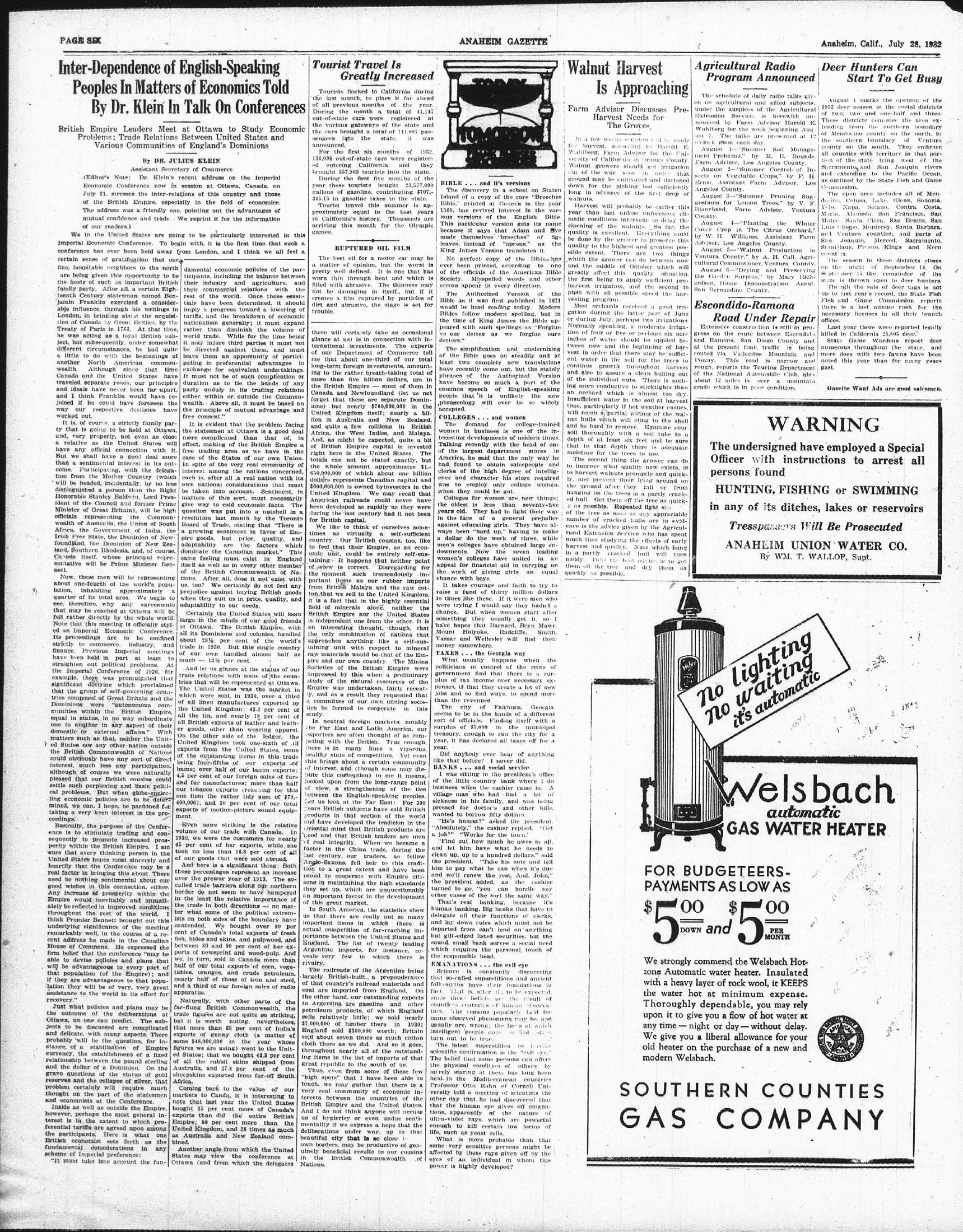
Searchable text
Inter-Dependence of English-Speaking Peoples In Matters of Economics Told By Dr. Klein In Talk On Conferences
British Empire Leaders Meet at Ottawa to Study Economic Problems; Trade Relations Between United States and Various Communities of England's Dominions
By DR. JULIUS KLEIN
Assistant Secretary of Commerce
(Editor's Note: Dr. Klein's recent address on the Imperial Economic Conference now in session at Ottawa, Canada, on July 21, stresses the inter-relations of this country and those of the British Empire, especially in the field of economics. The address was a friendly one, pointing out the advantages of mutual confidence and trade. We reprint it for the information of our readers.)
We in the United States are going to be particularly interested in this Imperial Economic Conference. To begin with, it is the first time that such a conference has ever been held away from London, and I think we all feel a certain sense of gratification that our fine, hospitable neighbors to the north are being given this opportunity to be the hosts of such an important British family party. After all, a certain Eighteenth Century statesman named Benjamin Franklin exercised a considerable influence, through his writings in London, in bringing about the acquisition of Canada by Great Britain, by the Treaty of Paris in 1763. At that time, he was acting as a loyal British subject, but subsequently, under somewhat different circumstances, he had quite a little to do with the beginnings of another North American commonwealth. Although since that time Canada and the United States have traveled separate roads, our principles and ideals have never been far apart, and I think Franklin would have rejoiced if he could have foreseen the way our respective destinies have worked out.
It is, of course, a strictly family party that is going to be held at Ottawa, and, very properly, not even as close a relative as the United States will have any official connection with it. But we shall have a good deal more fundamental economic policies of the participants, including the balance between their industry and agriculture, and their commercial relations with the rest of the world. Once those essentials have been determined, it should imply a progress toward a lowering of tariffs, and the breakdown of economic nationalism generally; it must expand rather than diminish the volume of world trade. While for the time being it may injure third parties it must not be directed against them, and must leave them an opportunity of participating in preferential advantages in exchange for equivalent undertakings. It must not be of such complication or duration as to tie the hands of any party unduly in its trading relations either within or outside the Commonwealth. Above all, it must be based on the principle of mutual advantage and free consent."
It is evident that the problem facing the statesmen at Ottawa is a good deal more complicated than that of, in effect, making of the British Empire a free trading area as we have in the case of the States of our own Union.
Tourist Travel
Tourists flock to the last month of all previous visits. During the mid-out-of-state car ride, the various gates the cars brought sengers into announced.
For the first 136,098 out-of-state entrants brought 357,969.
During the five year these tour gallons of gasoline 385.15 in gasoline.
Tourist travel proximately equates in California's arriving this new games.
RUPTURE
The best oil is a matter of opinion worn thin through filled with abrasion not be damaged creates a film dirt and abrasion trouble.
there will certainly glance at us) international investment of our Department me that about long-term foreign ing to the rather more than five the British Empire Canada and New forget that these ions) but nearly United Kingdom in Australia and quite a few Africa, the West And, as might be of British Empire right here in the totals can not
It is, of course, a strictly family party that is going to be held at Ottawa, and, very properly, not even as close a relative as the United States will have any official connection with it. But we shall have a good deal more than a sentimental interest in its outcome. Participating, with the delegation from the Mother Country (which will be headed, incidentally, by no less distinguished a person than the Right Honorable Stanley Baldwin, Lord President of the Council and former Prime Minister of Great Britain), will be high officials representing the Commonwealth of Australia, the Union of South Africa, the Government of India, the Irish Free State, the Dominion of Newfoundland, the Dominion of New Zealand, Southern Rhodesia, and, of course, Canada itself, whose principal representative will be Prime Minister Bennett.
Now, these men will be representing about one-fourth of the world's population, inhabiting approximately a quarter of its total area. We begin to see, therefore, why any agreements that may be reached at Ottawa will be felt rather directly by the whole world. Note that this meeting is officially styled an Imperial Economic Conference. Its proceedings are to be confined strictly to commerce, industry, and finance. Previous Imperial meetings have been held in part at least to straighten out political problems. At the Imperial Conference of 1926, for example, there was promulgated that significant doctrine which proclaimed that the group of self-governing countries composed of Great Britain and the Dominions were "autonomous communities within the British Empire, equal in status, in no way subordinate one to another in any aspect of their domestic or external affairs." With matters such as that, neither the United States nor any other nation outside the British Commonwealth of Nations could obviously have any sort of direct interest, much less any participation; although of course we were naturally pleased that our British cousins could settle such perplexing and basic political problems. But when globe-encircling economic policies are to be determined, we can, I hope, be pardoned for taking a very keen interest in the proceedings.
Basically, the purpose of the Conference is to stimulate trading and consequently to promote increased prosperity within the British Empire. I am sure that every thinking person in the United States hopes most sincerely and heartily that the Conference may be a long-term foreigning to the rather more than five British Empire Canada and New York forget that these nations) but nearer United Kingdom in Australia and quite a few Africa, the West And, as might be of British Empire right here in the totals can not be the whole amount 650,000,000 of dollars represent $600,000,000 is over United Kingdom American railroad been developed during the last year for British capital.
We like to think times as virtuous country. Our Brit feel that their omic unit could taining: It happes of view is correct the moment such important items are from British Manhattan that we sell them it is a fact that field of minerals British Empire is independent on an interesting in the only combining approaches anything training unit with raw materials would pire and our own Societies of the impressed by this study of the nati Empire was underly, and as a result a committee of our ties be formed to study.
In neutral foreground the Far East and exporters are often competing with the British there is in many healthy state of co this brings about of interest, and (to put this concept looked upon from all view, a streng between the English Let us look at the years British subject products in that and have developed Oriental mind that good and that Brit factor in the Chin last century, our Anglo-Saxons, fellion to a great e
Basically, the purpose of the Conference is to stimulate trading and consequently to promote increased prosperity within the British Empire. I am sure that every thinking person in the United States hopes most sincerely and heartily that the Conference may be a real factor in bringing this about. There need be nothing sentimental about our good wishes in this connection, either. Any increase of prosperity within the Empire would inevitably and immediately be reflected in improved conditions throughout the rest of the world. I think Premier Bennett brought out this underlying significance of the meeting remarkably well, in the course of a recent address he made in the Canadian House of Commons. He expressed the firm belief that the conference "may be able to devise policies and plans that will be advantageous to every part of that population (of the Empire); and if they are advantageous to that population they will be of very, very great assistance to the world in its effort for recovery."
Just what policies and plans may be the outcome of the deliberations at Ottawa, no one can predict. The subjects to be discussed are complicated and delicate, with many aspects. There probably will be the question, for instance, of a stabilization of Empire currency, the establishment of a fixed relationship between the pound sterling and the dollar of a Dominion. On the grave questions of the status of gold reserves and the collapse of silver, that problem certainly will require much thought on the part of the statesmen and economists at the Conference.
Inside as well as outside the Empire, however, perhaps the most general interest is in the extent to which preferential tariffs are agreed upon among the participants. Here is what one British economist sets forth as the fundamental considerations in any scheme of Imperial preference:
"It must take into account the fun-
4.5 per cent of our foreign sales of furs and fur manufactures; more than half our tobacco exports (reaching for this one item the rather tidy sum of $79.400,000), and 30 per cent of our total exports of motion-picture sound equipment.
Even more striking is the relative volume of our trade with Canada. In 1930, we were the customers for nearly 45 per cent of her exports, while she took no less than 16.8 per cent of all of our goods that were sold abroad.
And here is a significant thing: Both those percentages represent an increase over the prewar year of 1913. The so-called trade barriers along our northern border do not seem to have hampered in the least the relative importance of the trade in both directions — no matter what some of the political extremists on both sides of the boundary have contended. We bought over 90 per cent of Canada's total exports of fresh fish, hides and skins, and pulpwood, and between 80 and 90 per cent of her exports of newsprint and wood-pulp. And we, in turn, sold in Canada more than half of our total exports of corn, vegetables, oranges, and crude petroleum, nearly half of those of iron and steel, and a third of our foreign sales of radio apparatus.
Naturally, with other parts of the far-flung British Commonwealth, the trade figures are not quite so striking, but it is worth noting, nevertheless, that more than 65 per cent of India's exports of gunny cloth (a matter of some $48,000,000 in the year whose figures we are using) went to the United States; that we bought 43.3 per cent of all the rabbit skins shipped from Australia, and 27.4 per cent of the sheepskins exported from far-off South Africa.
Coming back to the value of our markets to Canda, it is interesting to note that last year the United States bought 15 per cent more of Canada's exports than did the entire British Empire; 50 per cent more than the United Kingdom, and 28 times as much as Australia and New Zealand combined.
Another angle from which the United States may view the conference at Ottawa (and from which the delegates
looked upon from one view, a strong between the English Let us look at the years British subject products in that and have developed Oriental mind that Good and that British of real integrity.
Factor in the Chin last century, our Anglo-Saxons, fellow to a great expedition to cooperatezens in maintaining they set up, which an important factor of this great market.
In South America us that there are important items in actual competition importance between England. The list Argentine imports veals very few rivalry.
The railroads of largely British-built of that country's rail coal are imported by the other hand, owing to Argentina are petroleum products sells relatively little $7,000,000 of lumber England sold $300 sold about seven cloth there as we throughout nearly ing items in the list great republic to thus, even from "high spots" that touch, we may gain very real community interests between the British Empire and And I do not think us of hypocrisy or mentality if we experience deliberations under beautiful city that own borders, may be unninely beneficial rea in the British Nations.
Tourist Travel Is Greatly Increased
Tourists flocked to California during the last month, to place it far ahead of all previous months of the year. During the month a total of 41,147 out-of-state cars were registered at the various gateways of the state and the cars brought a total of 111,097 passengers into the state, it was announced.
For the first six months of 1932, 136,098 out-of-state cars were registered entering California and they brought 357,969 tourists into the state.
During the first five months of the year these tourists bought 23,577,000 gallons of gasoline, contributing $707,-385.15 in gasoline taxes to the state.
Tourist travel this summer is approximately equal to the best years in California's history. Thousands are arriving this month for the Olympic games.
RUPTURED OIL FILM
The best oil for a motor car may be a matter of opinion, but the worst is pretty well defined. It is one that has worn thin through heat and which is filled with abrasive. The thinness may not be damaging in itself, but if it creates a film ruptured by particles of dirt and abrasive, the stage is set for trouble.
there will certainly take an occasional glance at us) is in connection with international investments. The experts of our Department of Commerce tell me that about one-third of our total long-term foreign investments, amounting to the rather breath-taking total of more than five billion dollars, are in the British Empire — most of them in Canada and Newfoundland (let us not forget that these are separate Dominions) but nearly $700,000,000 in the United Kingdom itself; nearly a billion in Australia and New Zealand, and quite a few millions in British Africa, the West Indies, and Malaya. And, as might be expected, quite a bit of British Empire capital is invested right here in the United States. The totals can not be stated exactly but
BIBLE ... and it's versions
The discovery in a school on Staten Island of a copy of the rare "Breeches Bible," printed at Geneva in the year 1560, has revived interest in the various versions of the English Bible. This particular version gets its name because it says that Adam and Eve made themselves "breeches" of figleaves, instead of "aprone," as the King James Version translates it.
No perfect copy of the Bible has ever been printed, according to one of the officials of the American Bible Society. Misspelled words and other errors appear in every direction.
The Authorized Version of the Bible as it was first published in 1611 would be hard reading today. Modern Bibles follow modern spelling, but in the time of King James the Bible appeared with such spellings as "Forgiue vs our dettes as we forgiue oure detters."
The simplification and modernizing of the Bible goes on steadily and at least two complete new translations have recently come out, but the stately phrases of the Authorized Version have become so much a part of the common speech of English-speaking people that it is unlikely the new phraseology will ever be so widely accepted.
COLLEGES ... and women
The demand for college-trained women in business is one of the interesting developments of modern times. Talking recently with the head of one of the largest department stores in America, he said that the only way he
Walnut Harvest Is Approaching
Farm Advisor Discusses Preharvest Needs for The Groves.
In a few weeks walnuts will be ready for harvest, according to Harold Walshberg. Farm Advisor for the University of California in Orange County Walnut growers should get irrigation out of the way soon in order to ground may be cultivated and thinner down for the picking bed sufficient long in advance of the first drop walnuts.
Harvest will probably be earlier than last unless unforeseen ormatic conditions intervene to delay ripening of the walnuts. So far, the quality is excellent. Everything must be done by the grower to preserve the quality to the highest and greatest possible extent. There are two things which the grower can do between now and the middle of October which will greatly affect this quality situation: the first being to apply sufficient harvest irrigation, and the second pushing with all possible speed the harvesting program.
Most orchards received a good irrigation during the latter part of July or during July, perhaps two irrigation Normally speaking, a moderate irrigation of four or five or perhaps six inches of water should be applied between now and the beginning of harvest in order that there may be sufficient water in the soil for the trees to continue growth throughout harvest and also to assure a clean hulling off of the individual nuts. There is not nothing more conductive to sticktights than an orchard which is almost too dry. Insufficient water in the soil at harvest time, particularly if hot weather ensues will mean a partial wilting of the walnut hulls which will cling to the shank and be hard to remove. Examine your soil thoroughly with a soil tube to depth of at least six feet and be sure that to that depth there is adequate moisture for the trees to use.
The second thing the grower should consider is...
long-term foreign investments, amounting to the rather breath-taking total of more than five billion dollars, are in the British Empire — most of them in Canada and Newfoundland (let us not forget that these are separate Dominions) but nearly $700,000,000 in the United Kingdom itself; nearly a billion in Australia and New Zealand, and quite a few millions in British Africa, the West Indies, and Malaya. And, as might be expected, quite a bit of British Empire capital is invested right here in the United States. The totals can not be stated exactly, but the whole amount approximates $1,650,000,000 of which about one billion dollars represents Canadian capital and $600,000,000 is owned by investors in the United Kingdom. We may recall that American railroads could never have been developed as rapidly as they were during the last century had it not been for British capital.
We like to think of ourselves sometimes as virtually a self-sufficient country. Our British cousins, too, like to feel that their Empire, as an economic unit, could be entirely self-sustaining. It happens that neither point of view is correct. Disregarding for the moment such tremendously important items as our rubber imports from British Malaya and the raw cotton that we sell to the United Kingdom, it is a fact that in the highly essential field of minerals alone, neither the British Empire nor the United States is independent one from the other. It is an interesting thought, though, that the only combination of nations that approaches anything like a self-sustaining unit with respect to mineral raw materials would be that of the Empire and our own country. The Mining Societies of the British Empire were impressed by this when a preliminary study of the natural resources of the Empire was undertaken, fairly recently, and as a result they requested that a committee of our own mining societies be formed to cooperate in this study.
In neutral foreign markets, notably the Far East and Latin America, our exporters are often thought of as competing with the British. True enough, there is in many lines a vigorous healthy state of competition. Yet even this brings about a certain community of interest, and (though some may dispute this conception) to me it means looked upon from the long-range point of view, a strengthening of the ties between the English-speaking peoples. Let us look at the Far East: For 300 years British subjects have sold British products in that section of the world and have developed the tradition in the Oriental mind that British products are good and that British traders are men of real integrity. When we became a factor in the China trade, during the last century, our traders, as fellow Anglo-Saxons, fell heir to this tradition to a great extent and have been least two complete new translations have recently come out, but the stately phrases of the Authorized Version have become so much a part of the common speech of English-speaking people that it is unlikely the new phraseology will ever be so widely accepted.
COLLEGES . . . and women
The demand for college-trained women in business is one of the interesting developments of modern times. Talking recently with the head of one of the largest department stores in America, he said that the only way he had found to obtain salespeople and clerks of the high degree of intelligence and character his store required was to employ only college women. when they could be got.
Colleges for women are new things; the oldest is less than seventy-five years old. They had to fight their way in the face of a general prejudice against educating girls. They have always been "hard up," having to make a dollar do the work of three, while men's colleges have obtained large endowments. Now the seven leading women's colleges have united in an appeal for financial aid in carrying on the work of giving girls an equal chance with boys.
It takes courage and faith to try to raise a fund of thirty million dollars in times like these. If it were men who were trying I would say they hadn't a chance. But when women start after something they usually get it, so I have hopes that Barnard, Bryn Mawr, Mount Holyoke, Radcliffe, Smith, Vassar and Wellesley will find their money somewhere.
TAXES . . . the Georgia way
What usually happens when the politicians in control of the reins of government find that there is a surplus of tax income over necessary expenses, is that they create a lot of new jobs and so find ways to spend more than the revenues.
The city of Fairburn, Georgia seems to be in the hands of a different sort of officials. Finding itself with a surplus of $5,000 in the municipal treasury, enough to run the city for a year, it has declared all taxes off for a year.
Did anybody ever hear of anything like that before? I never did.
BANKS . . . and social service
I was sitting in the president's office of the little country bank where I do business when the cashier came in. A village man who had had a lot of sickness in his family, and was being pressed for doctor's and other bills, wanted to borrow fifty dollars.
"He's honest?" asked the president. "Absolutely," the cashier replied. "Got a job?" "Works for the town."
Find out how much he owes in all, and let him have what he needs to clean up, up to a hundred dollars," said the president. "Take his note and tell him what he can when it's due... continue growth throughout harvest and also to assure a clean hulling oil of the individual nuts. There is nothing more conductive to sticktights than an orchard which is almost too dry. Insufficient water in the soil at harvest time, particularly if hot weather ensues will mean a partial wilting of the nut hulls which will cling to the shell and be hard to remove. Examine your soil thoroughly with a soil tube to depth of at least six feet and be sure that to that depth there is adequate moisture for the trees to use.
The second thing the grower can do to improve what quality now exists is to harvest walnuts promptly and quickly, and prevent their lying around on the ground after they fall or frost hanging on the trees in a partly cracked hull. Get them off the tree as quickly as possible. Repeated light shading of the tree as soon as any appreciable number of cracked hulls are in evidence is the advice given by the Agricultural Extension Service who has spent much time studying the effects of earl harvest and quality. Nuts which harbor in a partly cracked hull will moldy. Thus the best advice is to go them off the tree and dry them quickly as possible.
pute this conception) to me means,
looked upon from the long-range point of view, a strengthening of the ties between the English-speaking peoples.
Let us look at the Far East: For 300 years British subjects have sold British products in that section of the world and have developed the tradition in the Oriental mind that British products are good and that British traders are men of real integrity. When we became a factor in the China trade, during the last century, our traders, as fellow Anglo-Saxons, fell heir to this tradition to a great extent and have been proud to cooperate with Empire citizens in maintaining the high standards they set up, which are unquestionably an important factor in the development of this great market.
In South America, the statistics show us that there are really not so many important items in which there is actual competition of far-reaching importance between the United States and England. The list of twenty leading Argentine imports, for instance, reveals very few in which there is rivalry.
The railroads of the Argentine being largely British-built, a preponderance of that country's railroad materials and coal are imported from England. On the other hand, our outstanding exports to Argentina are gasoline and other petroleum products, of which England sells relatively little; we sold nearly $7,000,000 of lumber there in 1930; England sold $300,000 worth; Britain sold about seven times as much cotton cloth there as we did. And so it goes, throughout nearly all of the outstanding items in the list of imports of that great republic to the south of us.
Thus, even from some of these few "high spots" that I have been able to touch, we may gather that there is a very real community of economic interests between the countries of the British Empire and the United States. And I do not think anyone will accuse us of hypocrisy or even undue sentimentality if we express a hope that the deliberations under way, up in that beautiful city that is so close to own borders, may be productive of genuinely beneficial results to our cousins in the British Commonwealth of Nations.
I was sitting in the president's office of the little country bank where I do business when the cashier came in. A village man who had had a lot of sickness in his family, and was being pressed for doctor's and other bills, wanted to borrow fifty dollars.
"He's honest?" asked the president. "Absolutely," the cashier replied. "Got a job?" "Works for the town."
"Find out how much he owes in all, and let him have what he needs to clean up, up to a hundred dollars," said the president. "Take his note and tell him to pay what he can when it's due and we'll renew the rest. And, John," the president added, as the cashier turned to go, "you can handle any other cases of the sort the same way."
That's real banking, because it's human banking. Big banks that have to delegate all their functions of clerks, and lay down rules which must not be departed from can't lend on anything but gilt-edged listed securities, but the sound, small bank serves a social need which requires the personal touch of the responsible head.
EMANATIONS . . . the evil eye
Science is constantly discovering that so-called superstitions and ancient folk-myths have their foundations in fact. That is, after all, to be expected, since these beliefs are the result of countless centuries of human observation. The reasons popularly held for many observed phenomena may be, and usually are, wrong; the facts at which intelligent people once settled off turn out to be true.
The latest superstition to receive scientific confirmation is the "evil eye." The belief that some persons can affect the physical condition of others by merely staring at them has long been held in the Mediterranean countries Professor Otto Rahn of Cornell University told a meeting of scientists the other day that he had discovered that that the human eye gives off emanations, apparently of the nature of ultra-violet rays, which are powerful enough to kill certain low forms of life, such as yeast cells.
What is more probable than that some very sensitive persons might be affected by these rays given off by the eyes of an individual in whom this power is highly developed?
Agricultural Radio Program Announced
The schedule of daily radio talks given on agricultural and allied subjects, under the auspices of the Agricultural Extension Service, is herewith announced by Farm Advisor Harold E. Wahlberg for the week beginning August 1. The talks are presented at 12 o'clock noon each day.
August 1—"Summer Soil Management Problems," by M. B. Rounds, Farm Advisor, Los Angeles County.
August 2—"Summer Control of Insects on Vegetable Crops," by F. H. Ernst, Assistant Farm Advisor, Los Angeles County.
August 3—"Summer Pruning Suggestions for Lemon Trees," by V. F. Blanchard, Farm Advisor, Ventura County.
August 4—"Planting the Winter Cover Crop in The Citrus Orchard," by W. H. Williams, Assistant Farm Advisor, Los Angeles County.
August 5—"Walnut Production in Ventura County," by A. H. Call, Agricultural Commissioner, Ventura County.
August 6—"Drying and Preserving the Garden Surplus," by Mary Richardson, Home Demonstration Agent, San Bernardino County.
Escondido-Ramona Road Under Repair
Extensive construction is still in progress on the route between Escondido and Ramona, San Diego County and at the present time, traffic is being routed via Vallecitos Mountain and Poway. This road is narrow and rough, reports the Touring Department of the National Automobile Club, also about 12 miles is over a mountain grade which is in poor condition.
Deer Hunters Can Start To Get Busy
August 1 marks the opening of the 1932 deer season in the costal districts of two, two and one-half and three. These districts comprise the area extending from the northern boundary of Mendocino county on the north, to the southern boundary of Ventura county on the south. They embrace all counties with territory in that portion of the state lying west of the Sacramento and San Joaquin rivers and extending to the Pacific Ocean, as outlined by the State Fish and Game Commission.
The open area includes all of Mendocino, Colusa, Lake, Glenn, Sonoma, Yolo, Napa, Solano, Contra Costa, Marin, Alameda, San Francisco, San Mateo, Santa Clara, San Benito, San Luis Obispo, Monterey, Santa Barbara, and Ventura counties; and parts of San Joaquin, Merced, Sacramento, Stanislaus, Fresno, Kings and Kern counties.
The season in these districts closes on the night of September 14. On September 15 the remainder of the state is thrown open to deer hunters.
Though the sale of deer tags is not up to last year's record, the State Fish and Game Commission reports there is a last minute rush for the necessary licenses in all their branch offices.
Last year there were reported legally killed in California 25,805 deer.
State Game Wardens report deer numerous throughout the state, and more does with two fawns have been noted this year than for many years past.
Gazette Want Ads are good salesmen.
WARNING
The undersigned have employed a Special Officer with instructions to arrest all
WARNING
The undersigned have employed a Special Officer with instructions to arrest all persons found
HUNTING, FISHING or SWIMMING
in any of its ditches, lakes or reservoirs
Trespassers Will Be Prosecuted
ANAHEIM UNION WATER CO.
By WM. T. WALLOP, Supt.
No lighting
No waiting
it's automatic
Welsbach
automatic
GAS WATER HEATER
FOR BUDGETERS
Welsbach automatic GAS WATER HEATER
FOR BUDGETEERS-PAYMENTS AS LOW AS
$5.00 DOWN and $5.00 PER MONTH
We strongly commend the Welsbach Hotzone Automatic water heater. Insulated
with a heavy layer of rock wool, it KEEPS
the water hot at minimum expense.
Thoroughly dependable, you may rely
upon it to give you a flow of hot water at
any time — night or day — without delay.
We give you a liberal allowance for your
old heater on the purchase of a new and
modern Welsbach.
SOUTHERN COUNTIES
GAS COMPANY