anaheim-gazette 1932-07-21
Scanned page
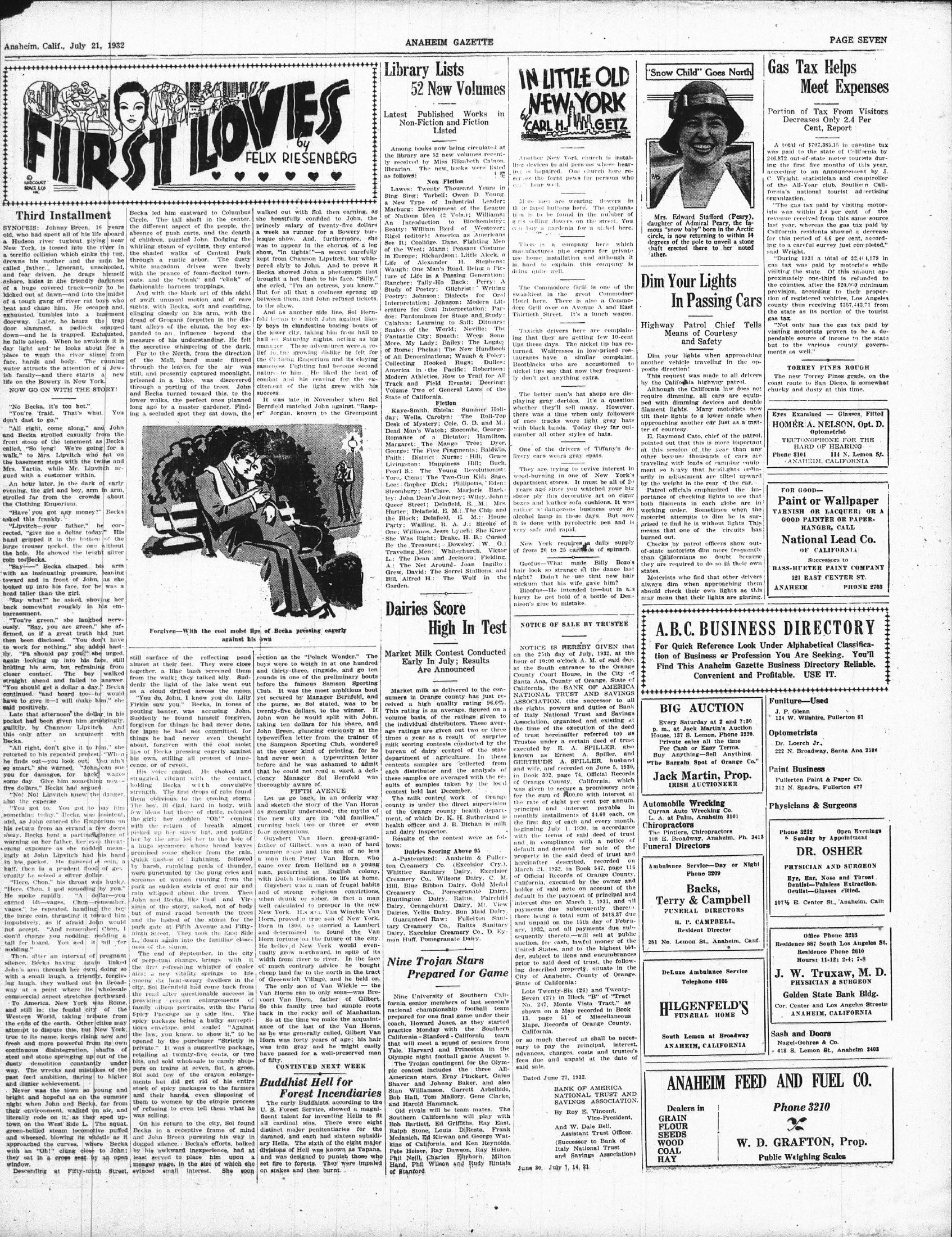
Searchable text
Third Installment
SYNOPSIS: Johnny Breen, 16 years old, who had spent all of his life aboard a Hudson river tugboat plying near New York, is tossed into the river in a terrific collision which sinks the tug, drowns his mother and the man he called father. Ignorant, unschooled, and fear driven, he drags himself ashore, hides in the friendly darkness of a huge covered truck—only to be kicked out at dawn—and into the midst of a tough gang of river rat boys who beat and chase him. He escapes and exhausted, tumbles into a basement doorway. Later, he hears the trap door slammed, a padlock snapped down—and he is trapped. Exhausted, he falls asleep. When he awakens it is day light and he looks about for a place to wash the river slime from face, hands and body. The running water attracts the attention of a Jewish family—and there starts a new life on the Bowery in New York.
NOW GO ON WITH THE STORY!
"No Becka, it's too hot."
"You're 'fraid. That's what. You don't dast to go."
"All right, come along," and John and Becka strolled casually from the front stoop of the tenement as Becka called, "So long! We're going for a walk," to Mrs. Lipvitch who sat on the basement steps with the twins and Becka led him eastward to Columbus Circle. The tall shaft in the center, the different aspect of the people, the absence of push carts, and the dearth of children, puzzled John. Dodging the whirling steam of cyclists, they entered the shaded walks of Central Park through a rustic arbor. The dusty white macadam drives were lively with the prance of foam-flecked turnouts, and the "clank" and "clink" of fashionable harness trappings.
And with the black art of this night of swift unusual motion and of rare sights, with Becka, soft and confiding, clinging closely on his arm, with the dread of Grogans forgotten in the distant alleys of the slums, the boy expanded to an influence beyond the measure of his understanding. He felt the secretive whispering of the dark.
Far to the North, from the direction of the Mall, band music filtered through the leaves, for the air was still, and presently captured moonlight, prisoned in a lake, was discovered through a parting of the trees. John and Becka turned toward this, to the lower walks, the perfect ones planned long ago by a master gardener. Finding a secluded spot they sat down, the walked out with Sol, then earned she boastfully confided to John princely salary of twenty-five a week as runner for a Bower lesque show. And, furthermore was to appear in the chorus, or show, "In tights!"—a secret caption from Channon Lipvitch, but perped slyly to John. And to be Becka showed John a photographer brought a hot flush to his face. She cried, "I'm an actress, you But for all that a coolness sprang between them, and John refused to the show.
And as another side line, Sol feld began to match John againly boys in clandestine boxing by the lower city, taking him from hall no Saturday nights, acting manager. These adventures were lief to the growing dislike he the Clothing Emporium and its sameness. Fighting had become nature to him. He liked the combat and his craving for citiment of the fight grew w success.
It was late in November when Bernfield matched John against er" Jorgan, known to the Gre
water attracts the attention of a Jewish family—and there starts a new life on the Bowery in New York.
NOW GO ON WITH THE STORY!
"No Becka, it's too hot."
"You're 'fraid. That's what. You don't dast to go."
"All right, come along," and John and Becka strolled casually from the front stoop of the tenement as Becka called, "So long! We're going for a walk," to Mrs. Lipvitch who sat on the basement steps with the twins and Mrs. Yartin, while Mr. Lipvitch argued with a customer within.
An hour later, in the dark of early evening, the girl and boy, arm in arm, strolled far from the crowds about the Clothing Emporium.
"Have you got any money?" Becka asked this frankly.
"Lipvitch—your father," he corrected, "give me a dollar today." His hand gripped it in the bottom of the large trouser pocket, the one without the hole. He showed the bright silver coin to Becka.
"Say——" Becka clasped his arm with an insinuating pressure, leaning toward and in front of John, as she looked up into his face, for he was a head taller than the girl.
"Say what?" he asked, shoving her back somewhat roughly in his embarrassment.
"You're green," she laughed nervously. "Say, you are green," she affirmed, as if a great truth had just been disclosed. "You don't have to work for nothing," she added hastily. "Pa should pay you," she urged, again looking up into his face, still holding his arm, but refraining from closer contact. The boy walked straight ahead and failed to answer. "You should get a dollar a day." Becka continued, "and board too—the would have to give it—I will make him," she said positively.
Late that afternoon the dollar in his pocket had been given him grudgingly, guiltily, by Channon Lipvitch. And this only after an argument with Becka.
"All right, don't give it to him," she retorted to his repeated protest. "When he finds out—you look out. You ain't so smart," she warned. "John can sue you for damages, for back wages some day. Give him something now—five dollars," Becka had argued.
"No! No! Lipvitch knew the danger, also the expense."
"You got to. You got to pay him something today." Becka was insistent, and, as John entered the Emporium on his return from an errand a few doors away, Becka bent a parting glance of warning on her father, her eyes threatening exposure as she nodded meaningly at John Lipvitch had his hand in his pocket. He fingered at coin, a half, then in a prudent flood of genuine through the leaves, for the air was still, and presently captured moonlight, prisoned in a lake, was discovered through a parting of the trees. John and Becka turned toward this, to the lower walks, the perfect ones planned long ago by a master gardener. Finding a secluded spot they sat down, the sameness. Fighting had become nature to him. He liked the combat and his craving for the citiment of the fight grew wi success.
It was late in November when Bernfield matched John against Jorgan, known to the Green
Forgiven—With the cool moist lips of Becka pressing eagerly against his own
still surface of the reflecting pond almost at their feet. They were close together, a lilac bush screened them from the walk; they talked idly. Suddenly the light of the lake went out as a cloud drifted across the moors.
"You do, John, I know you do. Lilly Firkin saw you." Becka, in tones of pouting banter, was accusing John. Suddenly he found himself forgiven, forgiven for things he had never done, for lapse he had not committed, for things he had never even thought about, forgiven with the cool moist lips of Becka pressing eagerly against his own, stilling all protest of innocence, or of revolt.
His voice rasped. He choked and struggled, vibrant with the contact, holding Becka with convulsive strength. The first drops of rain found them oblivious to the coming storm. The boy, ill clad, hard in body, with few ideas but those of strife, released the girl; her sudden "Oh!" coming with the return of breath almost picked up her straw hat, and pulling her by the arm led her to the bole of a huge sycamore whose broad leaves promised some shelter from the rain. Quick flashes of lightning followed by harsh, rumbling peals of thunder, were punctured by the pung erles and section as the "Polack Wonder," boys were to weigh in at one H and thirty-three, ringside, and rounds in one of the preliminaries before the famous Samson Club. It was the most ambition yet secured by Manager Bernfee the purse, so Sol stated, was twenty-five dollars, to the win. John won he would split with taking ten dollars for his share. John Breen, glancing curiously typewritten letter from the trainee Sampson Sporting Club, was at the queer kind of printing; had never seen a typewriter before and he was ashamed to that he could not read a word; cloncy Manager Sol Bernfee thoroughly aware of.
FIFTH AVENUE
Let us go back, in an order and sketch the story of the Van as generally understood; the man the new city are its "old fast running back two or three or four generations.
Guysbert Van Horn, great father of Gilbert, was a man of common sense and the son of a man then Peter Van Horn came over from Holland as a man, preferring an English
some day. Give him something now—five dollars," Becka had argued.
"No! No! Lipvitch knew the danger, also the expense.
"You got to. You got to pay him something today." Becka was insistent, and, as John entered the Emporium on his return from an errand a few doors away, Becka bent a parting glance of warning on her father, her eyes threatening exposure as she nodded meaningly at John Lipvitch had his hand in his pocket. He fingered a coin, a half, then in a prudent flood of generosity he seized a silver dollar.
"Here, Chon," his throat was husky. "Here, Chon, I god someday by you."
He spoke rapidly. "A dollar—you earned idt—vages, Chon—remember, vages," he repeated, handling the boy the large coin, thrusting it toward him impulsively, as if afraid John would not accept. "And remember, Chon, I don't charge you nodding, nodding a tall fer board. You ged it all fer nodding."
Then, after an interval of pregnant silence, Becka having again linked John's arm through her own doing so with a small laugh, a friendly, forgiving laugh, they walked out on Broadway at a point where its wholesale commercial aspect stretches northward.
To America, New York was Rome, and still is; the feudal city of the Western World, taking tribute from the ends of the earth. Other cities may attempt to dispute this, but New York, true to its name, keeps rising new and fresh and more powerful from its own continuous disintegration, shafts of steel and stone springing up out of the dusty demolition constantly under way. The wrecks and mistakes of the past feed ambition, flaring to higher and dizzier achievement.
Never was the town so young and bright and hopeful as on the summer night when John and Becka, far from their environment, walked on air, and literally rode on it, as they sped uptown on the West Side L. The squat, green-bellied steam locomotive puffed and wheezed, blowing its whistle as it approached the curves, where Becka with an "Oh!" clung close to John; they sat in a cross seat by an open window.
Descending at Fifty-ninth Street,
struggled, vibrant with the contact, holding Becka with convulsive strength. The first drops of rain found them oblivious to the coming storm. The boy, ill clad, hard in body, with few ideas but those of strife, released the girl; her sudden "Oh!" coming with the return of breath almost picked up her straw hat, and pulling her by the arm led her to the bole of a huge sycamore whose broad leaves promised some shelter from the rain. Quick flashes of lightning, followed by harsh, rumbling peals of thunder, were punctuated by the pung cries and screams of women running from the park as sudden swirls of cool air and rain whipped about the trees. Then John and Becka, like Paul and Virginia of the story, naked, not of body but of mind raced beneath the trees and the lashed of the storm for the park gate at Fifth Avenue and Fifty-ninth Street. They took the East Side L., down again into the familiar closeness of the slums.
The end of September, in the city of perpetual change, brings with it the first refreshing whisper of cooler air; a new vitality springs to life among the heat-weary dwellers in the city. Sol Bernfield had come back from the road after questionable success in providing crayon enlargements of family album portraits, with the Paris Spicy Package as a side line. The spicy package being a bulky surreptitious envelope, sold sealed: "Against the law, you know, to show it," to be opened by the purchaser "Strictly in private." It was a suggestive package, retailing at twenty-five cents, or two bits, and sold wholesale to candy shoppers on trains at seven, flat, a gross. Sol sold few of the crayon enlargements but did get rid of his entire stock of spicy packages to the farmers and their hands even disposing of them to women by the simple process of refusing to even tell them what he was selling.
On his return to the city, Sol found Becka in a receptive frame of mind and John Breen pursuing his way in dogged silence. Becka's efforts, balked by his awkward inexperience, had at least served to place him upon a meager wage, in the size of which she evinced small interest. She soon
cloncry Manager Sol Bernfeld thoroughly aware of.
FIFTH AVENUE
Let us go back, in an order and sketch the story of the Varn as generally understood; the man the new city are its "old face running back two or three or four generations.
Guysbert Van Horn, great father of Gilbert, was a man of common sense and the son of a man then Peter Van Horn came over from Holland as a man, preferring an English man with Dutch traditions, to life again.
Guysbert was a man of frugalism and of strong religious convictions when drunk or sober, in fact well calculated to prosper in the New York. H.s s.s., Van Wincel Horn, proved a true son of New Born in 1809, he married A.H. and determined to found that Horn fortune on the future of He believed New York would ultimately grow northward, in spite width from river to river. In addition of much contrary advice he cheap land far to the north in the Greenwich Village, and he only son of Van Horn ran to only sons—voort Van Horn, father of A.H. So this family tree had simply back in the rocky soil of Manhattan.
So at the time we make the advance of the last of the Varn as he was generally called, Gill Horn was forty years of age; was iron gray and he might have passed for a well-preserved fifty.
CONTINUED NEXT WEEK
Buddhist Hell for Forest Incendii
The early Buddhists, according U. S. Forest Service, showed aficient talent for inventing Heil all cardinal sins. There were distinct major penitentiaries damned, and each had sixteenary Hells. The sixth of the eight divisions of Hell was known as And was designed to punish that set fire to forests. They were on stakes and then burnt.
ANAHEIM GAZETTE
Library Lists
52 New Volumes
Latest Published Works in Non-Fiction and Fiction Listed
Among books now being circulated at the library are 52 new volumes recently received by Miss Elizabeth Calnon, librarian. The new books were listed as follows:
Non Fiction
Lawes: Twenty Thousand Years in Sing Sing; Tarbell: Owen D. Young. A New Type of Industrial Leader; Marburg: Development of the League of Nations Idea (2 Vols.); Williams: An Introduction to Biochemistry; Beatty: William Byrd of Westover; Rigel (editor): America as Americans See It; Coolidge, Dane, Fighting Men of the West; Mann: Peasant Costume in Europe; Richardson: Little Aleck, a Life of Alexander H. Stephens; Waugh: One Man's Road, Being a Picture of Life in a Passing Generation; Rancher: Tally-Ho Back; Perry: A Study of Poetry; Gilchrist: Writing Poetry; Johnson: Dialects for Oral Interpretation; Johnson: Modern Literature for Oral Interpretation; Pardoe: Pantomimes for Stage and Study; Calahan: Learning to Sall; Ditmars: Snakes of the World; Neville: The Fantastic City; Spaeth: Weep Some More, My Lady; Bailey: The Legacy of Rome; Phelan: The New Handbook of All Denominations; Waugh & Foley: Collecting Hooked Rugs; Dulles: America in the Pacific; Robertson: Modern Athletics, How to Trail for All Track and Field Events; Deering: Volume Two of General Laws of the State of California.
Fiction
Kaye-Smith, Shlela: Summer Holiday; Wells, Carolyn: The Roll-Top Desk of Mystery; Cole, G. D. and M.: Dead Man's Watch; Slocombe, George: Romance of a Dictator; Hamilton, Margaret: The Mango Tree; Dyer, George: The Five Fragments; Baldwin, Faith; District Nurse: Hill, Grace
IN LITTLE OLD NEW YORK CARL H. GETZ
Another New York church is installing devices to aid persons whose hearing is impaired. One church here reserves the fornt pews for persons who can hear well.
More men are wearing flowers in their lapel buttons here. The explanation is to be found in the number of girls selling dwarfs on the street. You can buy a gardenia for a nickel here.
There is a company here which manufactures pipe organs for private use home installation and although it is hard to explain, this company is doing quite well.
The Commodore Grill is one of the swankiest in the great Commodore Hotel here. There is also a Commodore Grill over on Avenue A and East Thirdieth Street. It's a lunch wagon.
Taxicab drivers here are complaining that they are getting few 10-cent tips these days. The nickel tip has returned. Waltresses in low-priced restaurants have a similar complaint. Bootblacks who are accustomed to nickel tips say that now they frequently don't get anything extra.
The better men's hat shops are displaying gray derbies. It's a question whether they'll sell many. However, there was a time when only followers of race tracks wore light gray hats with black bands. Today they far outnumber all other styles of hats.
One of the drivers of Tiffany's delivery cars wears gray spats.
Dairies Score High In Test
Market Milk Contest Conducted Early In July; Results Are Announced
Market milk as delivered to the consumers in Orange county has just received a high quality rating 96.6%. This rating is an average, figured on a volume basis, of the ratings given to the individual distributors. These average ratings are given out two or three times a year as a result of surprise milk scoring contests conducted by the bureau of dairy control of the state department of agriculture. In these contests samples are collected from each distributor and the analysis of these samples are averaged with the results of samples taken by the local contest held last December.
The milk control work of Orange county is under the direct supervision of the Orange county health department, of which Dr. K. H. Sutherland is health officer and J. B. Bichan is milk and dairy inspector.
Results of the contest were as follows:
Dairies Scoring Above 95
A-Pasteurized; Anaheim & Fullerton Creamery Co. (Excelsior Cry.), Whittler Sanitary Dairy, Excelsior
NOTICE OF SALE BY TRUSTEE
NOTICE IS HEREBY GIVEN that on the 25th day of July, 1932, at the hour of 10:00 o'clock A. M. of said day, at the South entrance to the Orange County Court House, in the City of Santa Ana, County of Orange, State of California, the BANK OF AMERICA NATIONAL TRUST AND SAVINGS ASSOCIATION, (the successor to all the rights, powers and duties of Bank of Italy National Trust and Savings Association, organized and existing at the time of the execution of the deed of trust hereinafter referred to) as Trustee under a certain deed of trust executed by E. A. SPILLER, also known as Ernest A. Spiller, and GERTRUDE A. SPILLER, husband and wife, and recorded on June 5, 1930, in Book 392, page 74, Official Records of Orange County, California, which was given to secure a promissory note for the sum of $400.00 with interest at the rate of eight per cent per annum, principal and interest payable in monthly installments of $4.60 each, on the first day of each and every month, beginning July 1, 1930, in accordance with the terms of said deed of trust and in compliance with a notice of default and demand for sale of the property in the said deed of trust and hereinafter described, recorded on March 21, 1932, in Book 547, page 116
FIFTH AVENUE
us go back, in an orderly way
match the story of the Van Horns
seriously understood; the myths of
new city are its "old families,"
going back two or three or even
generations.
Robert Van Horn, great-granddaughter of Gilbert, was a man of hard
smite and the son of no less
than Peter Van Horn, who
over from Holland as a young
preferring an English colony,
switch traditions, to life at home.
Robert was a man of frugal habits
strong religious convictions,
drunk or sober, in fact a man
calculated to prosper in the new
new York. His son, Van Winckle Van
proved a true son of New York.
In 1800, he married a Lambert
determined to found the Van
fortune on the future of the city.
New York would even-grow northward, in spite of its
from river to river. In the face
of such contrary advice he bought
land far to the north in the tract
Benwich Village, and he held on.
Only son of Van Wickle — the
horns ran to only sons—was BreVan Horn, father of Gilbert.
His family tree had simple roots
on the rocky soil of Manhattan.
At the time we make the acquaintance of the last of the Van Horns,
was generally called, Gilbert Van
was forty years of age; his hair
iron gray and he might easily
passed for a well-preserved man.
CONTINUED NEXT WEEK
Oldhist Hell for Forest Incendiaries
early Buddhists, according to the
Forest Service, showed a magnifital talent for inventing Hells to fit
cardinal sins. There were eight
major penitentiaries for the
Hell, and each had sixteen subsidinials. The sixth of the eight major
ships of Hell was known as Tapana,
was designed to punish those who
die to forests. They were impaled
kisses and then burnt.
Dairies Scoring Above 95
A-Pasteurized: Anaheim & Fullerton Creamery Co. (Excelsior Cry.).
Whittier Sanitary Dairy, Excelsior Creamery Co., Wilsons Dairy, C. M.
Hill, Blue Ribbon Dairy, Gold Medal Creamery Co., Pomegranate Dairy,
Huntington Dairy, Raitts, Fairchild Dairy, Orangehurst Dairy, Mt. View
Dairies, Yellis Dairy, Sun Maid Dairy.
Guaranteed Raw: Fullerton Sanitary Creamery Co., Raitts Sanitary Dairy, Excelsior Creamery Co., D. Eyman Huff. Pomegranate Dairy.
Nine Trojan Stars Prepared for Game
Nine University of Southern California senior members of last season's national championship football team prepared for one final game under their coach, Howard Jones, as they started practice Monday with the Southern California - Stanford - California team that will meet a squad of seniors from Yale, Harvard and Princeton in the Olympic night football game August 9.
The Trojan contingent for the Olympic contest includes the three All-American stars, Erny Pinckert, Galus Shaver and Johnny Baker, and also Stan Williamson, Garrett Arbelbide, Bob Hall, Tom Mallory, Gene Clarke, and Harold Hammack.
Old rivals will be team mates. The Southern Californians will play with Bob Bartlett, Ed Griffiths, Ray East,
Ralph Stone, Louis DiResta, Frank Medanich, Ed Kirwan and George Watkins of California, and Ken Reynolds,
Pete Heiser, Ray Dawson, Ray Hulen,
Phil Neill, Charles Ephron, Milton Hand, Phil Wilson and Rudy Rintala of Stanford.
BANK OF AMERICA
NATIONAL TRUST AND SAVINGS ASSOCIATION.
By Roy E. Vincent,
Vice-President,
And W. Dale Bell,
Assistant Trust Officer.
(Successor to Bank of Italy National Trust and Savings Association)
June 80, July 7, 14, 21
"Snow Child" Goes North
Mrs. Edward Stafford (Peary), daughter of Admiral Peary, the famous "snow baby" born in the Arctic circle, is now returning to within 14 degrees of the pole to unveil a stone shaft erected there to her noted father.
Dim Your Lights In Passing Cars
Highway Patrol Chief Tells Means of Courtesy and Safety
Dim your lights when approaching another vehicle travelling in the opposite direction!
This request was made to all drivers by the California highway patrol.
Although the California law does not require dimming, all cars are equipped with dimming devices and double filament lights. Many motorists now tilt their lights to a lower angle when approaching another car just as a matter of courtesy.
E. Raymond Cato, chief of the patrol, pointed out that this is more important at this session of the year than any other because thousands of cars are
Gas Tax Helps Meet Expenses
Portion of Tax From Visitors Decreases Only 2.4 Per Cent, Report
A total of $707,385.15 in gasoline tax was paid to the state of California by 246,872 out-of-state motor tourists during the first five months of this year, according to an announcement by J. C. Wright, statistician and comptroller of the All-Year club, Southern California's national tourist advertising organization.
"The gas tax paid by visiting motorists was within 2.4 per cent of the revenue received from this same source last year, whereas the gas tax paid by California residents showed a decrease for this period of 4.6 per cent, according to a careful survey just completed," said Wright.
"During 1931 a total of $2,404,179 in gas tax was paid by motorists while visiting the state. Of this amount approximately one-third is refunded to the counties, after the $20,000 minimum provision, according to their proportion of registered vehicles, Los Angeles county thus receiving $357,443.71 from the state as its portion of the tourist gas tax.
"Not only has the gas tax paid by visiting motorists proven to be a dependable source of income to the state but to the various county governments as well."
TORREY PINES ROUGH
The new Torrey Pines grade, on the coast route to San Diego, is somewhat chucky and dusty at this time.
Eyes Examined — Glasses Fitted
HOMER A. NELSON, Opt. D.
Optometrist
TEUTONOPHONE FOR THE HARD OF HEARING
Phone 8104 114 N. Lemon St.
ANAHEIM, CALIFORNIA
This request was made to all drivers by the California highway patrol.
Although the California law does not require dimming, all cars are equipped with dimming devices and double filament lights. Many motorists now tilt their lights to a lower angle when approaching another car just as a matter of courtesy.
E. Raymond Cato, chief of the patrol, pointed out that this is more important at this session of the year than any other because thousands of cars are travelling with loads of camping equipment so heavy that headlights ordinarily in adjustment are tilted upward by the weight in the rear of the car.
Patrol officials emphasized the importance of checking lights to see that both filaments in each globe are in working order. Sometimes when the motorist attempts to dim he is surprised to find he is without lights. This means that one of the circuits has burned out.
Checks by patrol officers show out-of-state motorists dim more frequently than Californians no doubt because they are required to do so in their own states.
Motorists who find that other drivers always dim when approaching them should check their own lights as this may mean that their lights are glaring.
A.B.C. BUSINESS DIRECTORY
For Quick Reference Look Under Alphabetical Classification of Business or Profession You Are Seeking. You'll Find This Anaheim Gazette Business Directory Reliable, Convenient and Profitable. USE IT.
BIG AUCTION
Every Saturday at 2 and 7:30 p.m., at Jack Martin's Auction House, 137 S. Lemon, Phone 3220.
Private sales all the time
For Cash or Easy Terms.
Buy Anything—Sell Anything.
"The Bargain Spot of Orange Co."
Jack Martin, Prop.
IRISH AUCTIONEER
Automobile Wrecking
Curran Auto Wrecking Co.
L. A. at Palm, Anaheim 3101
Chiropractors
The Pintlers, Chiropractors
108 E. Broadway, Anaheim, Ph. 3413
Funeral Directors
Ambulance Service—Day or Night
Phone 3209
Funiture—Used
J. P. Glenn
124 W. Wilshire, Fullerton 51
Optometrists
Dr. Loerch Jr.
222 N. Broadway, Santa Ana 2586
Paint Business
Fullerton Paint & Paper Co.
212 N. Spadra, Fullerton 477
Physicians & Surgeons
Phone 3212 Open Evenings
Sunday by Appointment
DR. OSHER
PHYSICIAN AND SURGEON
Jack Martin, Prop.
IRISH AUCTIONEER
Automobile Wrecking
Curran Auto Wrecking Co.
L. A. at Palm, Anaheim 3101
Chiropractors
The Pintlers, Chiropractors
108 E. Broadway, Anaheim, Ph. 3413
Funeral Directors
Ambulance Service—Day or Night
Phone 3209
Backs,
Terry & Campbell
FUNERAL DIRECTORS
H. P. CAMPBELL,
Resident Director
251 No. Lemon St., Anaheim, Calif.
DeLuxe Ambulance Service
Telephone 4105
HILGENFELD'S
FUNERAL HOME
South Lemon at Broadway
ANAHEIM, CALIFORNIA
ANAHEIM FEED AND FUEL CO.
Dealers in
GRAIN
FLOUR
SEEDS
WOOD
COAL
HAY
Phone 3210
W. D. GRAFTON, Prop.
Public Weighing Scales