anaheim-gazette 1932-07-21
Scanned page
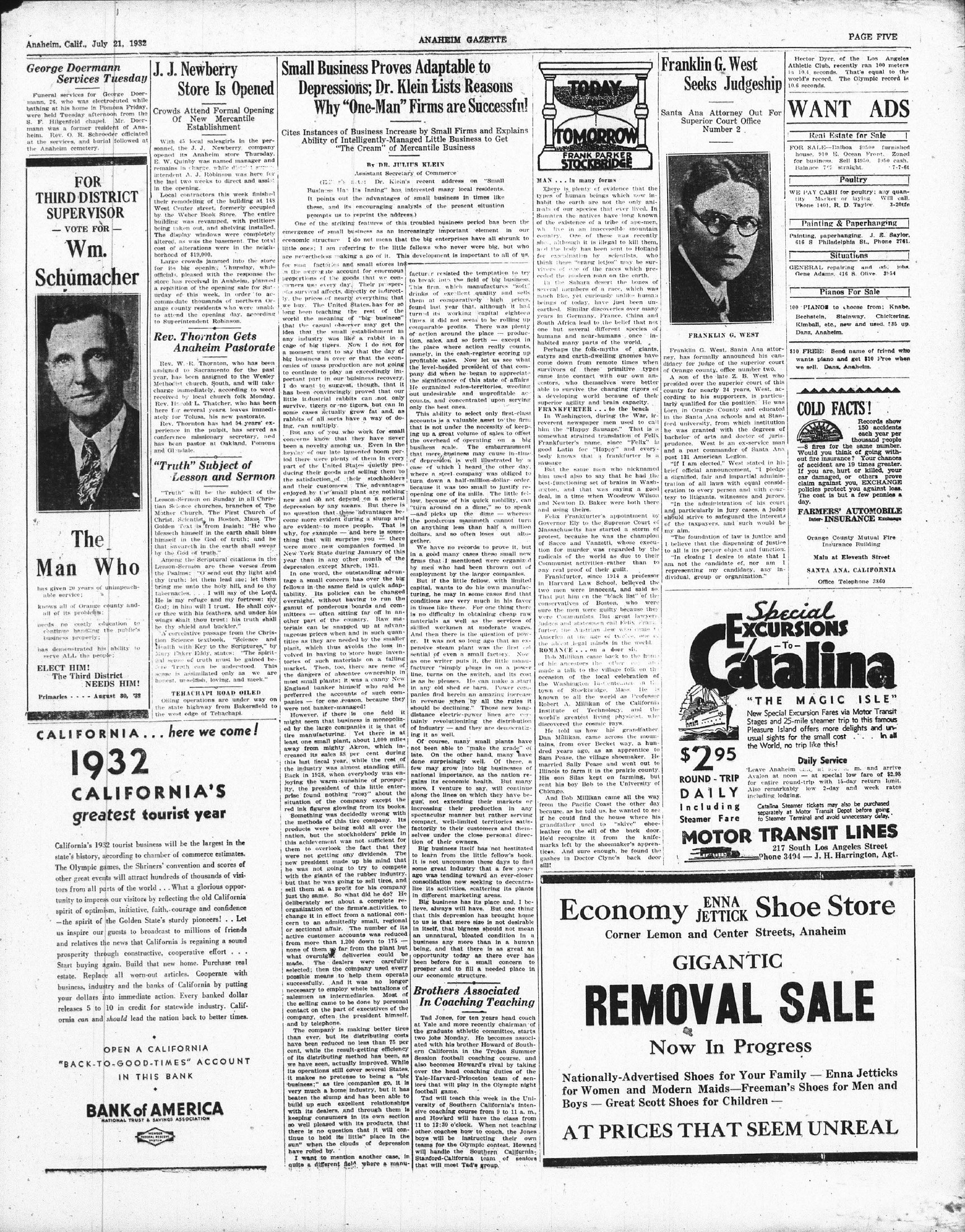
Searchable text
George Doermann Services Tuesday
Funeral services for George Doermann, 26, who was electrocuted while bathing at his home in Pomona Friday, were held Tuesday afternoon from the S. F. Hilgenfeld chapel. Mr. Doermann was a former resident of Anaheim. Rev. O. R. Schroeder officiated at the services, and burial followed at the Anaheim cemetery.
FOR THIRD DISTRICT SUPERVISOR — VOTE FOR — Wm. Schumacher
J. J. Newberry Store Is Opened
Crowds Attend Formal Opening Of New Mercantile Establishment
With 45 local salesgirls in the personnel, the J. J. Newberry company opened its Anaheim store Thursday. E. W. Quinby was named manager and remains in charge, while district superintendent A. J. Robinson was here for the last two weeks to direct and assist in the opening.
Local contractors this week finished their remodeling of the building at 148 West Center street, formerly occupied by the Weber Book Store. The entire building was revamped, with petitions being taken out, and shelving installed. The display windows were completely altered, as was the basement. The total cost of alterations were in the neighborhood of $19,000.
Large crowds jammed into the store for its big opening Thursday, while officials, pleased with the response the store has received in Anaheim, planned a reposition of the opening sale for Saturday of this week, in order to accommodate thousands of northern Orange county residents who were unable to attend the opening day, according to Superintendent Robinson.
Rev. Thornton Gets Anaheim Pastorate
Rev. W. R. Thornton, who has been assigned to Sacramento for the past year, has been assigned to the Wesley Methodist church, South, and will take charge immediately, according to word received by local church folk Monday. Rev. Harold L. Thatcher, who has been here for several years, leaves immediately for Tolusa, his new pastorate.
Rev. Thornton has had 54 years' experience in the pulpit, has served as conference missionary secretary, and has been pastor at Oakland, Pomona and Glendale.
Small Business Depression Why “On”
Cites Instances of Business Ability of Intelligent People
One of the striking fergence of small business economic structure I do little ones; I am referring are nevertheless making a for some factories and so on the aggregate account proportions of the goods farmers use every day. This survival affects directly the prices of nearly every we buy. The United States long been teaching the world the meaning of that the casual observer idea that the small industry was like a cage of big tigers. Now a moment want to say the big business is over or the omies of mass production to continue to play an important part in our buildup I do want to suggest, that has been convincingly prittle industrial rabbits survive, tigers or no tiger some cases actually grow rabbits of all sorts having ing, can multiply.
But any of you who wonders know that there been a novelty among us heyday of our late lamerlod there were plenty of
Rev. W. R. Thornton, who has been assigned to Sacramento for the past year, has been assigned to the Wesley Methodist church, South, and will take charge immediately, according to word received by local church folk Monday. Rev. Harold L. Thatcher, who has been here for several years, leaves immediately for Tolusa, his new pastorate.
Rev. Thornton has had 54 years' experience in the pulpit, has served as conference missionary secretary, and has been pastor at Oakland, Pomona and Glendale.
"Truth" Subject of Lesson and Sermon
"Truth" will be the subject of the Lesson-Sermon on Sunday in all Christian Science churches, branches of The Mother Church, The First Church of Christ, Scientist, in Boston, Mass. The Golden Text is from Isaiah: "He who blesseth himself in the earth shall bless himself in the God of truth; and he that swearth in the earth shall swear by the God of truth."
Among the Scriptural citations in the Lesson-Sermon are these verses from the Psalms: "O send out thy light and thy truth; let them lead me; let them bring me unto the holy hill, and to thy tabernacles. . . I will say of the Lord, He is my refuge and my fortress: my God; in him will I trust. He shall cover thee with his feathers, and under his wings shall thou trust: his truth shall be thy shield and buckler."
A correlative passage from the Christian Science textbook, "Science and Health with Key to the Scriptures," by Mary Baker Eddy, states: "The spiritual sense of truth must be gained before Truth can be understood. This sense is assimilated only as we are honest, unselfish, loving, and meek."
TEHACHAPI ROAD OILED
Oiling operations are under way on the state highway from Bakersfield to the west edge of Tehachapi.
In one word, the outstage a small concern has fellows in the same field of tability. Its policies can overnight, without having gamut of ponderous boa mittees — often sitting other part of the counterials can be snapped tageous prices when and titles as they are needed plant, which thus avoidvolved in having to store stories of such materials market. Then, too, there the dangers of absentee most small plants; it was England banker himself preferred the accounts panies — for one reason were not banker-managed.
However, if there is might seem that business ed by the large company tire manufacturing. Ye least one small plant, ab away from mighty Akr creased its sales 88 per this last fiscal year, whi the industry was almost Back in 1928, when ever joying the warm sunshirt, the president of the prise found nothing "ro situation of the compared ink figures glowing."
Something was decided the methods of this tire products were being sold nation, but the stockho this achievement was no them to overlook the were not getting any d new president made up he was not going to t
CALIFORNIA'S greatest tourist year
California's 1932 tourist business will be the largest in the state's history, according to chamber of commerce estimates. The Olympic games, the Shriners' convention and scores of other great events will attract hundreds of thousands of visitors from all parts of the world...What a glorious opportunity to impress our visitors by reflecting the old California spirit of optimism, initiative, faith, courage and confidence—the spirit of the Golden State's sturdy pioneers!...Let us inspire our guests to broadcast to millions of friends and relatives the news that California is regaining a sound prosperity through constructive, cooperative effort...Start buying again. Build that new home. Purchase real estate. Replace all worn-out articles. Cooperate with business, industry and the banks of California by putting your dollars into immediate action. Every banked dollar releases 5 to 10 in credit for statewide industry. California can and should lead the nation back to better times.
OPEN A CALIFORNIA "BACK-TO-GOOD-TIMES" ACCOUNT IN THIS BANK
BANK OF AMERICA
NATIONAL TRUST & SAVINGS ASSOCIATION
Small Business Proves Adaptable to Depressions; Dr. Klein Lists Reasons Why “One-Man” Firms are Successful
Cites Instances of Business Increase by Small Firms and Explains Ability of Intelligently-Managed Little Business to Get “The Cream” of Mercantile Business
By DR. JULIUS KLEIN
Assistant Secretary of Commerce
Dr. Klein’s recent address on "Small Business Has Its Inning" has interested many local residents. It points out the advantages of small business in times like these, and its encouraging analysis of the present situation prompts us to reprint the address.
One of the striking features of this troubled business period has been the emergence of small business as an increasingly important element in our economic structure. I do not mean that the big enterprises have all shrunk to little ones; I am referring to the little fellows who never were big, but who are nevertheless making a go of it. This development is important to all of us, for small factories and small stores in the aggregate account for enormous proportions of the goods that we consumers use every day. Their prosperity survival affects, directly or indirectly, the prices of nearly everything that we buy. The United States has for so long been teaching the rest of the world the meaning of "big business" that the casual observer may get the idea that the small establishment in any industry was like a rabbit in a cage of big tigers. Now I do not for a moment want to say that the day of big business is over or that the economies of mass production are not going to continue to play an exceedingly important part in our business recovery. I do want to suggest, though, that it has been convincingly proved that our little industrial rabbits can not only survive, tigers or no tigers, but can in some cases actually grow fat and, as rabbits of all sorts have a way of doing, can multiply.
But any of you who work for small concerns know that they have never been a novelty among us. Even in the heyday of our late lamented boom period there were plenty of them in every facturer resisted the temptation to try to break into the field of big business. This firm, which manufactures "soft" drinks of excellent quality and sells them at comparatively high prices, found last year that, although it had turned its working capital eighteen times it did not seem to be rolling up comparable profits. There was plenty of action around the place — production, sales, and so forth — except in the place where action really counts, namely, in the cash-register scoring up profitable sales. Now let us see what the level-headed president of that company did when he began to appreciate the significance of this state of affairs. He organized sales-territories, weeding out undesirable and unprofitable accounts, and concentrated upon serving only the best ones.
This ability to select only first-class accounts is a valuable asset to the firm that is not under the necessity of keeping up a great volume of sales to offset the overhead of operating on a big business scale. The embarrassment that mere business may cause in-time-manufacturing is a valuable asset to the firm that is not under the necessity of keeping up a great volume of sales to offset the overhead of operating on a big business scale.
MAN ... In many forms
There is plenty of evidence that the types of human beings which now inhabit the earth are not the only animals of our species that ever lived. In Sumatra the natives have long known of the existence of a tribe of apes-men, who live in an inaccessible mountain country. One of these was recently sheared, although it is illegal to kill them, and the body has been sent to Holland for examination by scientists, who think these "orang letjos" may be survivors of one of the races which preceded the modern man on the earth.
In the Sahara desert the bones of several members of a race, which was much like, yet curiously unlike human beings of today, have just been unearthed. Similar discoveries over many years in Germany, France, China and South Africa lead to the belief that not one but several different species of humans and near-humans once inhabited many parts of the world.
Perhaps the folk-myths of giants, satyrs and earth-dwelling gnomes have come down from remote times when survivors of these primitive types came into contact with our own ancestors, who themselves were better able to survive the changing rigors of a developing world because of their superior agility and brain capacity.
FRANKFURTER ... to the bench
In Washington, during the War, irreverent newspaper men used to call him the "Happy Sausage." That is a somewhat strained translation of Felix Frankfurter's name, since "Felix" is good Latin for "Happy" and everybody knows that a frankfurter is a
omies of mass production are not going to continue to play an exceedingly important part in our business recovery. I do want to suggest, though, that it has been convincingly proved that our little industrial rabbits can not only survive, tigers or no tigers, but can in some cases actually grow fat and, as rabbits of all sorts have a way of doing, can multiply.
But any of you who work for small concerns know that they have never been a novelty among us. Even in the heyday of our late lamented boom period there were plenty of them in every part of the United States quietly producing their goods and selling them to the satisfaction of their stockholders and their customers. The advantages enjoyed by the small plant are nothing new and do not depend on a general depression by any means. But there is no question that these advantages become more evident during a slump and are evident to more people. That is why, for example — and here is something that will surprise you — there were more new companies formed in New York State during January of this year than in any other month of the depression except March, 1931.
In one word, the outstanding advantage a small concern has over the big fellows in the same field is quick adaptability. Its policies can be changed overnight, without having to run the gamut of ponderous boards and committees — often sitting far off in another part of the country. Raw materials can be snapped up at advantageous prices when and in such quantities as they are needed by the smaller plant, which thus avoids the loss involved in having to store huge inventories of such materials on a falling market. Then, too, there are none of the dangers of absentee ownership in most small plants; it was a canny New England banker himself who said he preferred the accounts of such companies — for one reason, because they were not banker-managed!
However, if there is one field it might seem that business is monopolized by the large companies it is that of tire manufacturing. Yet there is at least one small plant, about 1,000 miles away from mighty Akron, which increased its sales 88 per cent during this last fiscal year, while the rest of the industry was almost standing still. Back in 1928, when everybody was enjoying the warm sunshine of prosperity, the president of this little enterprise found nothing "rosy" about the situation of the company except the red ink figures glowing from its books.
Something was decidedly wrong with the methods of this tire company. Its products were being sold all over the nation, but the stockholders' pride in this achievement was not sufficient for them to overlook the fact that they were not getting any dividends. The new president made up his mind that he was not going to try to compete
This ability to select only first-class accounts is a valuable asset to the firm that is not under the necessity of keeping up a great volume of sales to offset the overhead of operating on a big business scale. The embarrassment that mere business may cause in-time of depression is well illustrated by a case of which I heard the other day, where a steel company was obliged to turn down a half-million-dollar order because it was too small to justify reopening one of its mills. The little fellow, because of his quick mobility, can "turn around on a dime," so to speak—and picks up the dime — whereas the ponderous mammoth cannot turn on anything less than half a million dollars, and so often loses out altogether.
We have no records to prove it, but in a good many cases these small new firms that I mentioned were organized by men who had been thrown out of employment by the larger companies.
But if the little fellow, with limited capital, wants to do his own manufacturing, he may in some cases find that conditions are very much in his favor in times like these. For one thing there is no difficulty in obtaining cheap raw materials as well as the services of skilled workmen at moderate wages. And then there is the question of power. It was not so long ago that an expensive steam plant was the first essential of even a small factory. Now as one writer puts it, the little manufacturer "simply plugs in on a power line, turns on the switch, and its cost is as he pleases. He can make a start in any old shed or barn. Power companies find herein an amazing increase in revenue when by all the rules it should be declining." Those new long-distance electric-power lines are certainly revolutionizing the distribution of industry — and they are democratizing it as well.
Of course, many small plants have not been able to "make the grade" of late. On the other hand, many have done surprisingly well. Of these, a few may grow into big businesses of national importance, as the nation regains its economic health. But many more. I venture to say, will continue along the lines on which they have begun, not extending their markets or increasing their production in any spectacular manner but rather serving compact, well-limited territories satisfactorily to their customers and themselves under the close personal direction of their owners.
Big business itself has not hesitated to learn from the little fellow's book. It is not uncommon these days to find some great industry that a few years come down from remote times when survivors of these primitive types came into contact with our own ancestors, who themselves were better able to survive the changing rigors of a developing world because of their superior agility and brain capacity.
FRANKFURTER ... to the bench
In Washington during the War, irreverent newspaper men used to call him "Happy Sausage." That is a somewhat strained translation of Felix Frankfurter's name, since "Felix" is good Latin for "Happy" and everybody knows that a frankfurter is a sausage.
But the same men who nicknamed him used also to say that he had the best-functioning set of brains in Washington, and that was saying a good deal, in a time when Woodrow Wilson and Newton D. Baker were both there and using theirs.
Felix Frankfurter's appointment by Governor Ely to the Supreme Court of Massachusetts has started a storm of protest, because he was the champion of Sacco and Vanzetti, whose execution for murder was regarded by the radicals of the world as due to their Communist activities—rather than to any real proof of their guilt.
Frankfurter, since 1914 a professor in Harvard Law School, believed the two men were innocent, and said so. That put him on the "black list" of conservatives of Boston, who were sure the men were guilty because they were Communists. But great lawyers judges and statesmen call Felix Frankfurter, the Austrian Jew who came to America at the age of twelve, one of the abject legal minds in the world.
ROMANCE ... on a door shi.
Bob Millikan came back to the home of his ancestors the other day and made a talk to the village folk on the occasion of the local celebration of the Washington Li- Center near town of Stockbridge. Mass. He is known to all the world as Professor Robert A. Millikan of the California Institute of Technology, and the world's greatest living physicist, who discovered the cosmic rays.
He told us how his grandfather Dan Millikan came across the mountains from over Becket way, a hundred years ago, as an apprentice to Sam Pease, the village shoemaker. He married Sally Pease and went out to Illinois to farm in the prairie county. His son Silas kept on farming, but sent his boy Bob to the University of Chicago.
And Bob Millikan came all the way from the Pacific Coast the other day because, as he told us, he wanted to see if he could find the house where his grandfather used to "skive" shoe-leather on the sill of the back door. He'd recognize it from the knife-marks left by the shoemaker's apprentices. And sure enough, he found the gashes in Doctor Clyne's back door sill!
Back in 1928, when everybody was enjoying the warm sunshine of prosperity, the president of this little enterprise found nothing "rosy" about the situation of the company except the red ink figures glowing from its books.
Something was decidedly wrong with the methods of this tire company. Its products were being sold all over the nation, but the stockholders' pride in this achievement was not sufficient for them to overlook the fact that they were not getting any dividends. The new president made up his mind that he was not going to try to compete with the giants of the rubber industry, but that he was going to sell tires, and sell them at a profit for his company just the same. So what did he do? He deliberately set about a complete reorganization of the firms's activities, to change it in effect from a national concern to an admittedly small, regional or sectional affair. The number of its active customer accounts was reduced from more than 1,200 down to 175 — none of them so far from the plant but what overnight deliveries could be made. The dealers were carefully selected; then the company used every possible means to help them operate successfully. And it was no longer necessary to employ whole battalions of salesmen as intermediaries. Most of the selling came to be done by personal contact on the part of executives of the company, often the president himself, and by telephone.
The company is making better tires than ever, but its distributing costs have been reduced no less than 75 per cent, while the result-getting efficiency of its distributing method has been, as we have seen, actually improved. While its operations still cover several States, it makes no pretense to being a "big business;" as tire companies go, it is very much a home industry, but it has beaten the slump and has been able to build up such excellent relationships with its dealers, and through them is keeping consumers in its own section so well pleased with its products, that there is no question that it will continue to hold its little" place in the sun" when the clouds of depression have rolled by.
I want to mention another case, in quite a different field where a manu-
National importance, as the nation regains its economic health. But many more, I venture to say, will continue along the lines on which they have begun, not extending their markets or increasing their production in any spectacular manner but rather serving compact, well-limited territories satisfactorily to their customers and themselves under the close personal direction of their owners.
Big business itself has not hesitated to learn from the little fellow's book. It is not uncommon these days to find some great industry that a few years ago was tending toward an ever closer consolidation now seeking to decentralize its activities, scattering its plants in different marketing areas.
Big business has its place and, I believe, always will have. But one thing that this depression has brought home to us is that mere size is not desirable in itself, that bigness should not mean an unnatural, bloated condition in a business any more than in a human being, and that there is as great an opportunity today as there ever has been before for a small concern to prosper and to fill a needed place in our economic structure.
Brothers Associated In Coaching Teaching
Tad Jones, for ten years head coach at Yale and more recently chairman of the graduate athletic committee, starts two jobs Monday. He becomes associated with his brother Howard of Southern California in the Trojan Summer Session football coaching course, and also becomes Howard's rival by taking over the head coaching duties of the Yale-Harvard-Princeton team of seniors that will play in the Olympic night football game.
Tad will teach this week in the University of Southern California's intensive coaching course from 9 to 11 a.m., and Howard will have the class from 11 to 12:30 o'clock. When not teaching other coaches how to coach, the Jones boys will be instructing their own teams for the Olympic contest. Howard will handle the Southern California-Stanford-California team of seniors that will meet Tad's group.
Franklin G. West Seeks Judgeship
Santa Ana Attorney Out For Superior Court Office Number 2
FRANKLIN G. WEST
Franklin G. West, Santa Ana attorney, has formally announced his candidacy for judge of the superior court of Orange county, office number two.
A son of the late Z. B. West who presided over the superior court of this county for nearly 24 years, West, according to his supporters, is particularly qualified for the position. He was born in Orange County and educated in the Santa Ana schools and at Stanford university, from which institution he was granted with the degrees of bachelor of arts and doctor of jurisprudence. West is an ex-service man and a past commander of Santa Ana post 131 American Legion.
Hector Dyer, of the Los Angeles Athletic Club, recently ran 100 meters in 10.4 seconds. That's equal to the world's record. The Olympic record is 10.6 seconds.
WANT ADS
Real Estate for Sale
FOR SALE—Balboa $9500 furnished house. 910 E. Ocean Front. Zoned for business. Sell $4950. $950 cash. Balance 7% straight. 7-7-6t
Poultry
WE PAY CASH for poultry; any quantity market or laying Will call. Phone 1401. R. D. Taylor. 3-20tfo
Painting & Paperhanging
Painting, paperhanging. J. E. Saylor, 616 S Philadelphia St., Phone 2761.
Situations
GENERAL repairing and odc jobs. Gene Adams, 416 S. Olive. 3954
Pianos For Sale
100 PIANOS to choose from; Knabe, Bechstein, Steinway, Chickering, Kimball, etc., new and used. 735 up. Danz, Anaheim.
$10 FREE! Send name of friend who wants piano and get $10 Free when we sell. Danz, Anaheim.
COLD FACTS!
Records show 150 accidents each year per thousand people
8 fires for the same number. Would you think of going without fire insurance? Your chances
COLD FACTS!
Records show 150 accidents each year per thousand people
—8 fires for the same number. Would you think of going without fire insurance? Your chances of accident are 19 times greater. If you are hurt or killed, your car damaged, or others prove claim against you, EXCHANGE policies protect you against loss. The cost is but a few pennies a day.
FARMERS' AUTOMOBILE Inter-INSURANCE Exchange
Orange County Mutual Fire Insurance Building
Main at Eleventh Street
SANTA ANA, CALIFORNIA
Office Telephone 3860
Special Excursions To Catalina
"THE MAGIC ISLE"
New Special Excursion Fares via Motor Transit Stages and 25-mile steamer trip to this famous Pleasure Island offers more delights and unusual sights for the small cost... In all the World, no trip like this!
Daily Service
Leave Anaheim early at noon — at special low fare of $2.95 for entire round-trip with 15-day return limit. Also remarkably low 2-day and week rates including lodging.
Catalina Steamer tickets may also be purchased separately at Motor Transit Depot before going to Steamer Terminal and avoid unnecessary delay.
MOTOR TRANSIT LINES
217 South Los Angeles Street
Phone 3494 — J. H. Harrington, Agt.
ROUND - TRIP
DAILY
Including
Steamer Fare
Avalon at noon — at special low fare of $2.95
for entire round-trip with 15-day return limit.
Also remarkably low 2-day and week rates
including lodging.
Catalina Steamer tickets may also be purchased
separately at Motor Transit Depot before going
to Steamer Terminal and avoid unnecessary delay.
MOTOR TRANSIT LINES
217 South Los Angeles Street
Phone 3494 — J. H. Harrington, Agt.
Economy ENNA JETTICK Shoe Store
Corner Lemon and Center Streets, Anaheim
GIGANTIC
REMOVAL SALE
Now In Progress
Rally-Advertised Shoes for Your Family — Enna Jetticks
Men and Modern Maids—Freeman’s Shoes for Men and
Great Scott Shoes for Children —
PRICES THAT SEEM UNREAL