anaheim-gazette 1932-07-07
Scanned page
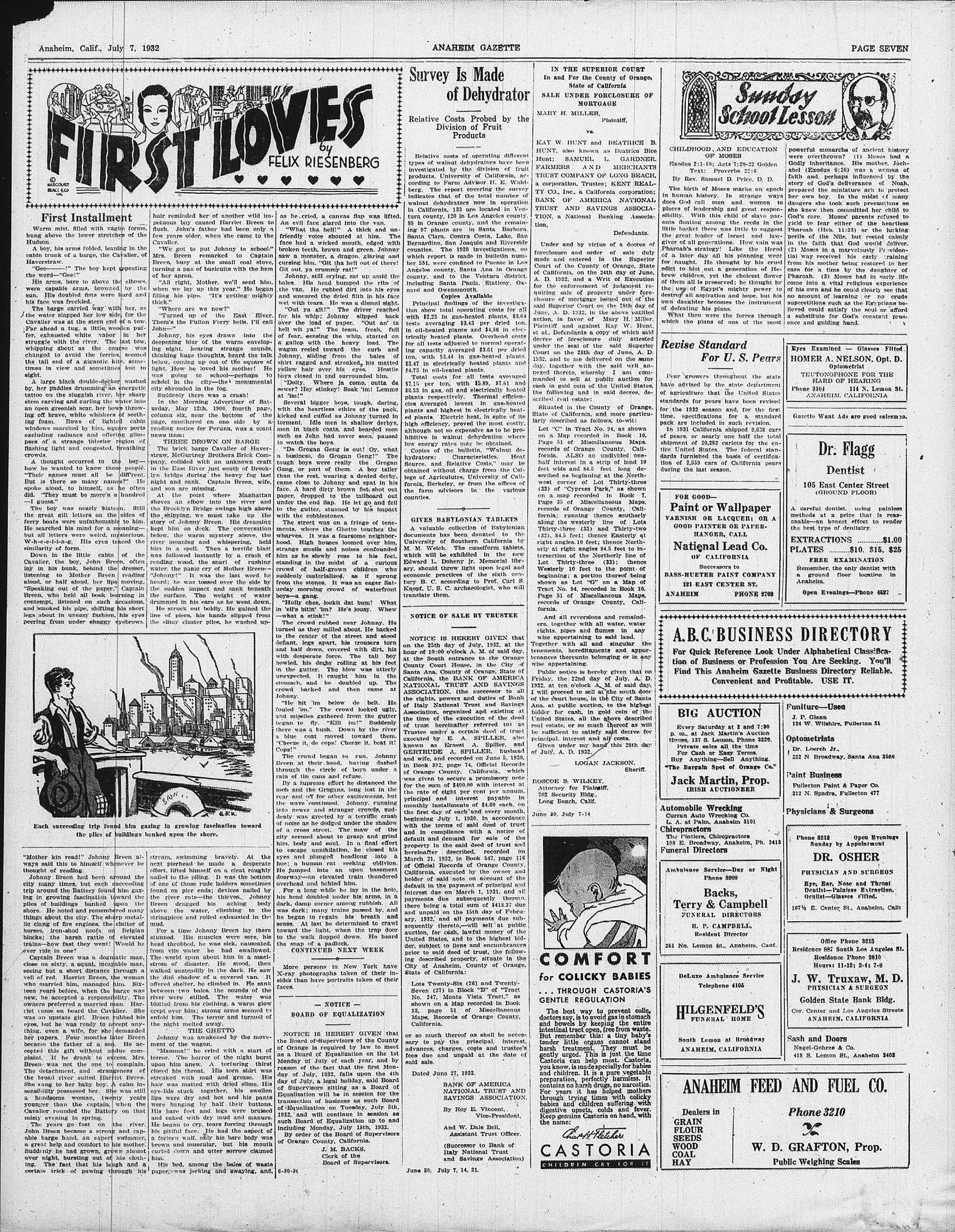
Searchable text
First Installment
Warm mist, filled with vague forms, hung above the lower stretches of the Hudson.
A boy, his arms folded, leaning in the cabin trunk of a barge, the Cavaller, of Haverstraw.
"Gee——!" The boy kept repeating the word—"Gee!"
His arms, bare to above the elbows, were capable arms, browned by the sun. His doubled fists were hard and his face was freckled.
The barge carried way with her, as the water slapped her low side, for the Cavaller was at the stern end of a tow. Far ahead a tug, a little wooden puffer, exhausted white vapor in her struggle with the river. The last tow, whipping about as the course was changed to avoid the ferries, seemed the tail end of a gigantic kit, sometimes in view and sometimes lost to sight.
A large black double-decker washed by, her paddles drumming an energetic tattoo on the sluggish river, her sharp stem carving and curling the water into an open greenish scar, her bown throwing off brave, white whiskers of seething foam. Rows of lighted cabin windows marched by him, square ports excluding radiance and offering glimpses of a strange interior region of flashing light and congested breathing crowds.
hair reminded her of another wild impetuous boy caused Harriet Breen to flush. John's father had been only a few years older, when she came to the Cavaller.
"We got to put Johnny to school." Mrs. Breen remarked to Captain Breen, busy at the small coal stove, turning a pan of busicuits with the hem of her apron.
"All right, Mother, we'll send him, when we lay up this year." He began filling his pipe. "It's getting mighty thick."
"Where are we now?"
"Turned up of the East River. Them's the Fulton Ferry belts. I'll call John—"
Johnny, his eyes drawn into the deepening blur of the warm enveloping night, hearing strange sounds, thinking huge thoughts, heard the talk below, coming up out of the square of light. How he loved his mother! He was going to school—perhaps to school in the city—the monumental city shrouded in the fog.
Suddenly there was a crash!
In the Morning Advertiser of Saturday, May 12th, 1900, fourth page, column six, near the bottom of the page, smothered on one side by a reading notice for Peruna, was a scant news item:
THREE DROWS ON BARGE
The brick barge Cavaller of Haverstraw, McGurtney Brothers Brick Company, cried, a canvas fluttered An evil face glared into its face had a wicked mouth broken teeth, brown and saw a monster, a dragon cursing him. "Git tha hell! Git out, ya crummy rat!" Johnny, still crying, sailed his head bumped the van. He rubbed dirt and smeared the dried fillet wet with tears. He was a "Out ya git!" The driver for his whip; Johnny over the load of paper; hell wilt ya!" The team of fear, sensing the whirl gallop with the heavy wagon reeled toward the Johnny, sliding from the shirt ragged and streaked yellow hair over his eyebroins closed in and surrouwd.
"Doity. Where ja coarse? Hey stinkkey! Soak at 'im!"
Several bigger boys, tied with the heartless ethics kicked and cuffed as Johnny torment. Idle men in shirts in black coats, and such as John had never to watch the boys.
"De Grogan Geng is on a business, de Grogan..."
A large black double-decker washed by her paddles drumming an energetic tattoo on the sluggish river, her sharp stem carving and curling the water into an open greenish scar, her bown throwing off brave, white whiskers of seething foam. Rows of lighted cabin windows marched by him, square ports excluding radiance and offering glimpses of a strange interior region of flashing light and congested, breathing crowds.
A thought occurred to the boy—how he wanted to know those people. "Their names must all be different. But is there so many names?" He spoke aloud, to himself, as he often did. "They must be more'n a hundred—I guess."
The boy was nearly sixteen. Still the great gilt letters on the sides of ferry boats were unfathomable to him. He searched his mind for a meaning—but all letters were weird, mysterious. W-h-e-e-l-i-n-g. His eyes traced the similarity of form.
Down in the little cabin of the Cavallier, the boy, John Breen, often lay in his bunk, behind the dresser, listening to Mother Breen reading aloud, or half aloud, her lips moving, "Speaking out of the paper," Captain Breen, who held all book learning in contempt, listened on such accasions, and smoked his pipe, shifting his short legs about in uneasy fashion, his eyes peering from under eaggy eyebrows.
Each succeeding trip found him gazing in growing fascination toward the plies of buildings banked upon the shore.
"Mother kin read!" Johnny Breen always said this to himself whenever he thought of reading.
stream, swimming bravely. At the next pierhead he made a desperate effort lifted himself on a clost roughly below, coming up out of the square of light. How he loved his mother! He was going to school—perhaps to school in the city—the monumental city shrouded in the fog.
Suddenly there was a crash!
In the Morning Advertiser of Saturday, May 12th, 1900, fourth page, column six, near the bottom of the page, smothered on one side by a reading notice for Peruna, was a scant news item:
THREE DROWN ON BARGE
The brick barge Cavaller of Haverstraw, McGurtney Brothers Brick Company, collided with an unknown craft in the East River just south of Brooklyn bridge during the heavy fog last night and sank. Captain Breen, wife, and son are missing.
At the point where Manhattan shoves an elbow into the river and the Brooklyn Bridge swings high above the shipping, we must take up the story of Johnny Breen. His dreaming kept him on deck. The conversation below, the warm mystery above, the river moaning and whispering, held him in a spell. Then a terrific blast was followed instantly by a crash of rending wood, the snarl of rushing water, the panic cry of Mother Breen—"Johnny!" It was the last word he heard; he was tossed over the side by the sudden impact and sank beneath the surface. The weight of water drummed in his ears as he went down.
He struck out boldly. He gained the line of piers, his hands slipped from the slimy cluster piles, he washed up.
The crowd was on a frightened mansions, where the Ghetto wharves. It was a fearsome hood. High houses loomed strange smells and noises him as he slowly rose in standing in the midst of crowd of half-grown cats suddenly materialized, and from the stones. It was a urday morning crowd of boys—a gang.
"Hully chee, look it dat in 'ell's bitin' im? He's lel—what a stink!"
The crowd rubbed nearly turned as they milled about to the center of the street defiant, legs apart, his t and half down, covered wiith desperate force. The howled, his dephy rolling in the gutter. The blow unexpected. It caught his stomach, and he doubled crowd backed and their Johnny.
"He hit'im below de fouled 'im." The crowd d and misiles gathered from began to fly. "Kill im! there was a hush. Down a blue coat moved to 'Cheze it, de cops! Cheez Cops!"
The crowd began to move Breen at their head, hailing through the circle of bo rain of tin cans and refusu By a supreme effort he mob and the Grogans, long rear and off for other excite the wave continued. John into newer and stranger denly was greeted by a t of noise as he dodged under of a cross street. The new city seemed about to gravel him, body and soul. In to escape unnihilation, he eyes and plunged headlhoe; a human rat seeke
"Mother kin read!" Johnny Breen always said this to himself whenever he thought of reading.
Johnny Breen had been around the city many times, but each succeeding trip around the Battery found him gazing in growing fascination toward the piles of buildings banked upon the shore. He noted and remembered many things about the city. The sharp metallic clang of fire engines, the clatter of horses, iron-shod hoofs on Belgian blocks; the harsh rattle of elevated trains—how fast they went! Would he ever ride in one?
Captain Breen was a dogmatic man, close on sixty, a squat, incapable man, seeing but a short distance through a veil of red. Harriet Breen, the woman who married him, managed him. Sixteen years before, when the barge was new, he accepted a responsibility. The owners preferred a married man. Harriet came on board the Cavalier. She was an upstate girl. Breen rubbed his eyes, but he was ready to accept anything, even a wife, for she demanded her papers. Four months later Breen became the father of a son. He accepted this gift without undue complaint. If he drank to excess, Mrs. Breen was not the one to complain. The detachment, and strangeness of the broad river suited Harriet Breen. She rang to her baby boy. A calm insensibility possessed her. She was still a handsome woman, twenty years younger than the captain, when the Cavalier rounded the Battery on that misty evening in spring.
The years go fast on the river. Johnny Breen became a strong and capable barge hand, an expert swimmer, a great help and comfort to his mother. Suddenly he had grown, grown almost over night, bursting out of his clothing. The fact that his laugh and a certain trick of pawing through his stream, swimming bravely. At the next pierhead he made a desperate effort, lifted himself on a cleat roughly nailed to the plilling. It was the bottom of one of those rude ladders sometimes found on pier ends; devices nailed by the river rats—the thieves. Johnny Breen dragged his aching body above the water, climbing to the stringpiece and rolled exhausted in the mud.
For a time Johnny Breen lay there stunned. His muscles were sore, his head throbbed, he was sick, nauseated, from vile water he had swallowed. The world spun about him in a maelstrom of disaster. He stood, then walked unsteadily in the dark. He saw the dim shadow of a covered van. It offered shelter, he climbed in. He sank between two bales, the sounds of the river were stilled. The water was blotted from his clothing, a warm glow crept over him; strong arms seemed to enfold him. The terror and turmoil of the night melted away.
THE GHETTO
Johnny was awakened by the movement of the wagon.
"Mamma!" he cried with a start of terror. The horror of the night burst upon him anew. A torturing thirst closed his throat. His torn shirt was streaked with mud and grease. His hair was matted with dried slime. His eye-lids stuck together, his swollen lips were dry and hot and his pants were hanging by half their buttons. His bare feet and legs were bruised and caked with dry mud and manure. He began to cry, tears forcing through his pitiful face. He had the aspect of a forlorn waif, only his bare body was brown and muscular, but his mouth curled down and utter sorrow claimed him.
His bed, among the bales of waste paper, was jerking and swaying, and,
By a supreme effort he mob and the Grogans, long rear and off for other excuse the wave continued. John into newer and stranger denly was greeted by a t of noise as he dodged under of a cross street. The city seemed about to grave him, body and soul. In to escape annihilation, he eyes and plunged headlong hoe; a human rat seeker. He jumped into an open doorway—an elevated traverse overhead and behind him.
For a long while he lay his head doubled under his dark, damp corner among was dark; many trains passed he began to regain his sense. At last he determined toward the light, when to the walk flopped down the snap of a padlock.
CONTINUED NEXT
More persons in New X-ray photographs taken sides than have portraits faces.
NOTICE IS HEREBY
the Board of Supervisors said of Orange is required by as a Board of Equalization Monday of July of each reason of the fact that day of July, 1932, falls day of July, a legal holiday of Supervisors sitting at Equalization will be in so transaction of business as of Equalization on Tuesday 1932, and will continue such Board of Equalization including Monday, July By order of the Board of Orange County, CaliforJ. M. BACK
Clerk of the Board of S
6-30-3t
ANAHEIM GAZETTE
Survey Is Made of Dehydrator
Relative Costs Probed by the Division of Fruit Products
Relative costs of operating different types of walnut dehydrators have been investigated by the division of fruit products, University of California, according to Farm Advisor H. E. Wahlberg. The report covering the survey indicates that of the total number of walnut dehydrators now in operation in California, 133 are located in Ventura county, 120 in Los Angeles county, 85 in Orange county, and the remaining 97 plants are in Santa Barbara, Santa Clara, Contra Costa, Lake, San Bernardino, San Joaquin and Riverside counties. The 1930 investigations on which report is made in bulletin number 551 were confined to Puente in Los Angeles county, Santa Ana in Orange county, and to the Ventura district, including Santa Paula, Staticoy, Oxnard and Owensmouth.
Copies Available
Principal findings of the investigation show total operating costs for all with $2.23 in gas-heated plants, $3.04 tests averaging $3.43 per dried ton, in oil-heated plants and $4.86 in electrically heated plants. Overhead costs for all tests adjusted to normal operating capacity averaged $3.61 per dried ton, with $3.44 in gas-heated plants, $3.47 in electrically heated plants and $4.75 in oil-heated plants.
Total costs for all tests averaged $7.15 per ton, with $5.89, $7.61 and $8.33 in gas, oil and electrically heated plants respectively. Thermal efficiencies averaged lowest in gas-heated plants and highest in electrically heated plants. Electric heat, in spite of its high efficiency, proved the most costly, although not so expensive as to be prohibitive in walnut dehydration where low energy rates may be obtained.
Copies of the bulletin, "Walnut dehydrators: Characteristics, Heat
IN THE SUPERIOR COURT
In and For the County of Orange,
State of California
SALE UNDER FORCLOSURE OF MORTGAGE
MARY H. MILLER,
Plaintiff,
vs.
KAY W. HUNT and BEATRICE B. HUNT; SAMUEL L. GARDNER, FARMERS AND MERCHANTS TRUST COMPANY OF LONG BEACH, a corporation, Trustee; KENT REALTY CO., Inc., a California corporation; BANK OF AMERICA NATIONAL TRUST AND SAVINGS ASSOCIATION, a National Banking Association,
Defendants.
Under and by virtue of a decree of foreclosure and order of sale duly made and entered in the Superior Court of the County of Orange, State of California, on the 24th day of June, A. D. 1932, and a Writ of Execution for the enforcement of judgment requiring sale of property under foreclosure of mortgage issued out of the said Superior Court on the 28th day of June, A. D. 1932, and to me delivered on the same day, together with the said writ, annexed thereto, whereby I am commanded to sell at public auction for cash in gold coin of the United States, the following and in said decree, described real estate:
Situated in the County of Orange, State of California, and more particularly described as follows, to-wit:
Lot "C" in Tract No. 94, as shown on a Map recorded in Book 10, Page 51 of Miscellaneous Maps. records of Orange County, California. ALSO an undivided one-
Several bigger boys, tough, daring, with the heartless ethics of the pack, clucked and cuffed as Johnny turned in corner. Idle men in shallow derbys, men in black coats, and bearded men much as John had never seen, paused to watch the boys.
"De Grogan Geng is out! Oy, what business, de Grogan Geng!" The rough boys were really the Grogan gang, or part of them. A boy taller than the rest, wearing a dented derby, came close to Johnny and spat in his face. A hard dirty brown fist shot out paper, dropped to the tailboard out under the end flap. He let go and fell to the gutter, stunned by his impact with the cobblestones.
The street was on a fringe of tenements, where the Ghetto touches the harves. It was a fearsome neighborhood. High houses loomed over him, strange smells and noises confounded him as he slowly rose to his feet, standing in the midst of a curious crowd of half-grown children who suddenly materialized, as if sprung from the stones. It was an eager Saturday morning crowd of waterfront boys—a gang.
"Hully chee, lookit dat bum! What an 'ell's bitin' im? He's lousy. Whew—what a stink!"
The crowd rubbed near Johnny. He turned as they milled about. He backed up to the center of the street and stood defiant, legs apart, his trousers torn and half down, covered with dirt, his with desperate force. The tall boy bowled, his deby rolling at his feet in the gutter. The blow was utterly unexpected. It caught him in the stomach, and he doubled up. The crowd backed and then came at Johnny.
"He hit 'im below de belt. He poured 'im." The crowd looked ugly, and missiles gathered from the gutter began to fly. "Kill im!" Suddenly there was a hush. Down by the river blue coat moved toward them. Cheeze it, de cops! Cheeze it, beat it! Cops!
The crowd began to run. Johnny green at their head, having dashed through the circle of boys under a rain of tin cans and refuse.
By a supreme effort he distanced the mob and the Grogans, long lost in the scar and off for other excitements, but he wave continued. Johnny, running into newer and stranger crowds, suddenly was greeted by a terrific crash of noise as he dodged under the shadow of a cross street. The maw of the city seemed about to grasp and grind him, body and soul. In a final effort he escape annihilation, he closed his eyes and plunged headlong into a cave; a human rat seeking oblivion, he tummed into an open basement.
Total costs for all tests averaged $7.15 per ton, with $5.89, $7.61 and $8.33 in gas, oil and electrically heated plants respectively. Thermal efficiencies averaged lowest in gas-heated plants and highest in electrically heated plants. Electric heat, in spite of its high efficiency, proved the most costly, although not so expensive as to be prohibitive in walnut dehydration where low energy rates may be obtained.
Copies of the bulletin, "Walnut dehydrators: Characteristics," Heat Source, and Relative Costs," may be obtained without charge from the College of Agriculreutre, University of California, Berkeley, or from the offices of the farm advisors in the various counties.
GIVES BABYLONIAN TABLETS
A valuable collection of Babylonian documents has been donated to the University of Southern California by M. M. Welch. The cannelform tablets, which will be exhibited in the new Edward L. Doheny Jr. Memorial library, should throw light upon legal and economic practices of the sixth century B.C. according to Prof. Carl S. Knopf, U.S.C. archaeologist, who will translate them.
NOTICE OF SALE BY TRUSTEE
NOTICE IS HEREBY GIVEN that on the 25th day of July, 1932, at the hour of 10:00 o'clock A.M. of said day, at the South entrance to the Orange County Court House, in the City of Santa Ana, County of Orange, State of California, the BANK OF AMERICA NATIONAL TRUST AND SAVINGS ASSOCIATION (the successor to all rights, powers and duties of Bank of Italy National Trust and Savings Association, organized and existing at the time of the execution of the deed of trust hereinafter referred to) as Trustee under a certain deed of trust executed by E.A. SPILLER, also known as Ernest A. Spiller, and GERTRUDE A. SPILLER, husband and wife, and recorded on June 5, 1930, in Book 322, page 74, Official Records of Orange County, California, which was given to secure a promissory note for the sum of $400.00 with interest at the rate of eight per cent per annum, principal and interest payable in monthly installments of $4.60 each, on the first day of each month, beginning July 1, 1930, in accordance with the terms of said deed of trust and in compliance with a notice of default and demand for sale of the property in the said deed of trust and hereinafter described, recorded on March 21, 1932, in Book 547, page 116 of Official Records of Orange County.
Situated in the County of Orange, State of California, and more particularly described as follows, to-wit:
Lot "C" in Tract No. 94, as shown on a Map recorded in Book 10. Page 51 of Miscellaneous Maps records of Orange County, California. ALSO an undivided one-half interest in a strip of land 10 feet wide and $4.5 feet long described as beginning at the Northwest corner of Lot Thirty-three (33) of "Cypress Park," as shown on a map recorded in Book 7. Page 35 of Miscellaneous Maps records of Orange County, California; running thence southerly along the westerly line of Lots Thirty-three (33) and Thirty-two (32), $4.5 feet; thence Easterly at right angles 10 feet; thence Northery at right angles $4.5 feet to intersection of the Northerly line of Lot Thirty-three (33); thence Westerly 10 feet to the point-of beginning; a portion thereof being shown as Lot "G" on a Map of Tract No. 94, recorded in Book 10. Page 51 of Miscellaneous Maps records of Orange County, California.
And all reversions and reminders together with all water, water rights, pipes and flumes in any wise appertaining to said land.
Together with all and singular the tenements hereditaments and appurtenances thereunto belonging or in any wise appertaining.
Public notice is hereby given that on Friday, the 22nd day of July, A.D. 1932, at ten o'clock A.M. of said day I will proceed to sell at the south door of the court house, in the City of Santa Ana, at public auction, to the highest bidder for cash, in gold coin of the United States, all the above described real estate, or so much thereof as will be sufficient to satisfy said decree for principal interest and all costs.
Given under my hand this 28th day of July, A.D. 1932.
LOGAN JACKSON,
Sheriff.
ROSCOE S.WILKEY,
Attorney for Plaintiff,
702 Security Bldg.
Long Beach, Calif.
June 20, July 7-14
BY A supreme effort he distanced the mob and the Grogans, long lost in the ear and off for other excitements, but the wave continued. Johnny, running into newer and stranger crowds, suddenly was greeted by a terrific crash of noise as he dodged under the shadow of a cross street. The maw of the city seemed about to grasp and grind him, body and soul. In a final effort to escape annihilation, he closed his eyes and plunged headlong into a hole; a human rat seeking oblivion. He jumped into an open basement doorway—an elevated train thundered overhead and behind him.
For a long while he lay in the hole, his head doubled under his arms, in a dark, damp corner among rubbish. All was dark; many trains passed by, and he began to regain his breath and sense. At last he determined to crawl toward the light, when the trap door to the walk flopped down. He heard the snap of a padlock.
CONTINUED NEXT WEEK
More persons in New York have X-ray photographs taken of their injuries than have portraits taken of their faces.
NOTICE — BOARD OF EQUALIZATION
NOTICE IS HEREBY GIVEN that the Board of Supervisors of the County of Orange is required by law to meet as a Board of Equalization on the 1st Monday of July of each year, and by reason of the fact that the first Monday of July, 1932, falls upon the 4th day of July, a legal holiday, said Board of Supervisors sitting as a Board of Equalization will be in session for the transaction of business as such Board of Equalization on Tuesday, July 5th, 1932, and will continue in session as much Board of Equalization up to and including Monday, July 18th, 1932.
By order of the Board of Supervisors of Orange County, California.
J. M. BACKS,
Clerk of the
Board of Supervisors.
Lots Twenty-Six (26) and Twenty-Seven (27) in Block "B" of "Tract No. 247, Monte Vista Tract," as shown on a Map recorded in Book 13, page 51 of Miscellaneous Maps, Records of Orange County, California.
or so much thereof as shall be necessary to pay the principal, interest, advances, charges, costs and trustee's fees due and unpaid at the date of said sale.
Dated June 27, 1932.
BANK OF AMERICA
NATIONAL TRUST AND SAVINGS ASSOCIATION.
By Roy E. Vincent,
Vice-President,
And W. Dale Bell,
Assistant Trust Officer.
(Successor to Bank of Italy National Trust and Savings Association)
June 30; July 7, 14, 21.
ROSCOE S. WILKEY,
Attorney for Plaintiff,
702 Security Bldg., Long Beach, Calif.
June 20, July 7-14
COMFORT for COLICKY BABIES ... THROUGH CASTORIA'S GENTLE REGULATION
The best way to prevent colic, doctors say, is to avoid gas in stomach and bowels by keeping the entire intestinal tract open, free from waste. But remember this: a tiny baby's tender little organs cannot stand harsh treatment. They must be gently urged. This is just the time Castoria can help most. Castoria, you know, is made specially for babies and children. It is a pure vegetable preparation, perfectly harmless. It contains no harsh drugs, no narcotics. For years it has helped mothers through trying times with colicky babies and children suffering with digestive upsets, colds and fever. Keep genuine Castoria on hand, with the name:
CASTORIA
CHILDREN CRY FOR IT
SUNDAY
School Lesson
CHILDHOOD AND EDUCATION OF MOSES
Exodus 2:1-10; Acts 7:20-22 Golden Text: Proverbs 22:6
By Rev. Samuel D. Price, D. D.
The birth of Moses marks an epoch in human history. In strange ways does God call men and women to places of leadership and great responsibility. With this child of slave parents floating among the reeds in the little basket there was little to suggest the great leader of Israel and lawgiver of all generations. How vain was Pharoah's strategy! Like the Hered of a later day all his planning went for naught. He thought by his cruel edict to blot out a generation of Hebrew children, yet the choicest flower of them all is preserved; he thought by the use of Egypt's mighty power to destroy all aspiration and hope, but his own daughter becomes the instrument of defeating his plans.
What then were the forces through which the plans of one of the most powerful monarchs of ancient history were overthrown? (1) Moses had a Godly inheritance. His mother, Jochebel (Exodus 6:20) was a woman of faith and, perhaps influenced by the story of God's deliverance of Noah, prepared the miniature ark to protect her own boy. In the midst of many dangers she took such precautions as she knew then committed her child to God's care. Moses' parents refused to yield to fear either of the heartless Pharoah (Heb. 11:23) or the lurking perils of the Nile, but rested calmly in the faith that God would deliver.
(2) Moses in a marvelously Providential way received his early training from his mother being restored to her care for a time by the daughter of Pharoah.
(3) Moses had in early life come into a vital religious experience of his own and he could clearly see that no amount of learning or no crude superstititions such as the Egyptians believed could satisfy the soul or afford a substitute for God's constant presence and guiding hand.
Revise Standard For U. S. Pears
Pear growers throughout the state have advised by the state department of agriculture that the United States standards for pears have been revised for the 1932 season and, for the first time, specifications for a standard pack are included in such revision.
In 1931 California shipped 9,638 cars of pears, or nearly one half the total shipment of 20,282 carlots for the entire United States. The federal standards furnished the basis of certifica-
Pear growers throughout the state have advised by the state department of agriculture that the United States standards for pears have been revised for the 1932 season and, for the first time, specifications for a standard pack are included in such revision.
In 1931 California shipped 9,638 cars of pears, or nearly one half the total shipment of 20,282 carlots for the entire United States. The federal standards furnished the basis of certification of 2,559 cars of California pears during the last season.
FOR GOOD—
Paint or Wallpaper
VARNISH OR LACQUER; OR A
GOOD PAINTER OR PAPERHANGER, CALL
National Lead Co.
OF CALIFORNIA
Successors to
BASS-HUETER PAINT COMPANY
121 EAST CENTER ST.
ANAHEIM
PHONE 2703
Dr. Flagg
Dentist
105 East Center Street
(GROUND FLOOR)
A careful dentist, using painless methods at a price that is reasonable—an honest effort to render the best type of dentistry.
EXTRACTIONS $1.00
PLATES $10. $15, $25
FREE EXAMINATION
Remember, the only dentist with a ground floor location in Anaheim.
Open Evenings—Phone 4527
A.B.C. BUSINESS DIRECTORY
For Quick Reference Look Under Alphabetical Classification of Business or Profession You Are Seeking. You'll Find This Anaheim Gazette Business Directory Reliable, Convenient and Profitable. USE IT.
BIG AUCTION
Every Saturday at 2 and 7:30 p.m., at Jack Martin's Auction House, 137 S. Lemon, Phone 3220.
Private sales all the time.
For Cash or Easy Terms.
Buy Anything—Sell Anything.
"The Bargain Spot of Orange Co."
Jack Martin, Prop.
IRISH AUCTIONEER
Automobile Wrecking
Curran Auto Wrecking Co.
L. A. at Palm, Anaheim 3101
Chiropractors
The Pintlers, Chiropractors
108 E. Broadway, Anaheim, Ph. 3413
Funeral Directors
Funiture—Used
J. P. Glenn
124 W. Wilshire, Fullerton 51
Optometrists
Dr. Loerch Jr.
222 N. Broadway, Santa Ana 2586
Paint Business
Fullerton Paint & Paper Co.
212 N. Spadra, Fullerton 477
Physicians & Surgeons
Phone $212 Open Evenings Sunday by Appointment
DR. OSHER
Jack Martin, Prop.
IRISH AUCTIONEER
Automobile Wrecking
Curran Auto Wrecking Co.
L. A. at Palm, Anaheim $101
Chiropractors
The Pintlers, Chiropractors
108 E. Broadway, Anaheim, Ph. 3413
Funeral Directors
Ambulance Service—Day or Night
Phone 8209
Backs,
Terry & Campbell
FUNERAL DIRECTORS
H. P. CAMPBELL,
Resident Director
251 No. Lemon St., Anaheim, Calif.
DeLuxe Ambulance Service
Telephone 4105
HILGENFELD'S
FUNERAL HOME
South Lemon at Broadway
ANAHEIM, CALIFORNIA
Paint Business
Fullerton Paint & Paper Co.
212 N. Spadra, Fullerton 477
Physicians & Surgeons
Phone 3212 Open Evenings
Sunday by Appointment
DR. OSHER
PHYSICIAN AND SURGEON
Eye, Ear, Nose and Throat
Dentist—Painless Extraction.
Ocullus—Glasses Fitted.
107½ E. Center St., Anaheim, Calif.
Office Phone 3218
Residence 887 South Los Angeles St.
Residence Phone 2610
Hours: 11-12; 2-4; 7-8
J. W. Truxaw, M. D.
PHYSICIAN & SURGEON
Golden State Bank Bldg.
Cor. Center and Los Angeles Streets
ANAHEIM, CALIFORNIA
Sash and Doors
Nagel-Gohres & Co.
418 S. Lemon St., Anaheim 2403
ANAHEIM FEED AND FUEL CO.
Dealers in
GRAIN
FLOUR
SEEDS
WOOD
COAL
HAY
Phone 3210
W. D. GRAFTON, Prop.
Public Welghing Scales