anaheim-gazette 1932-07-07
Scanned page
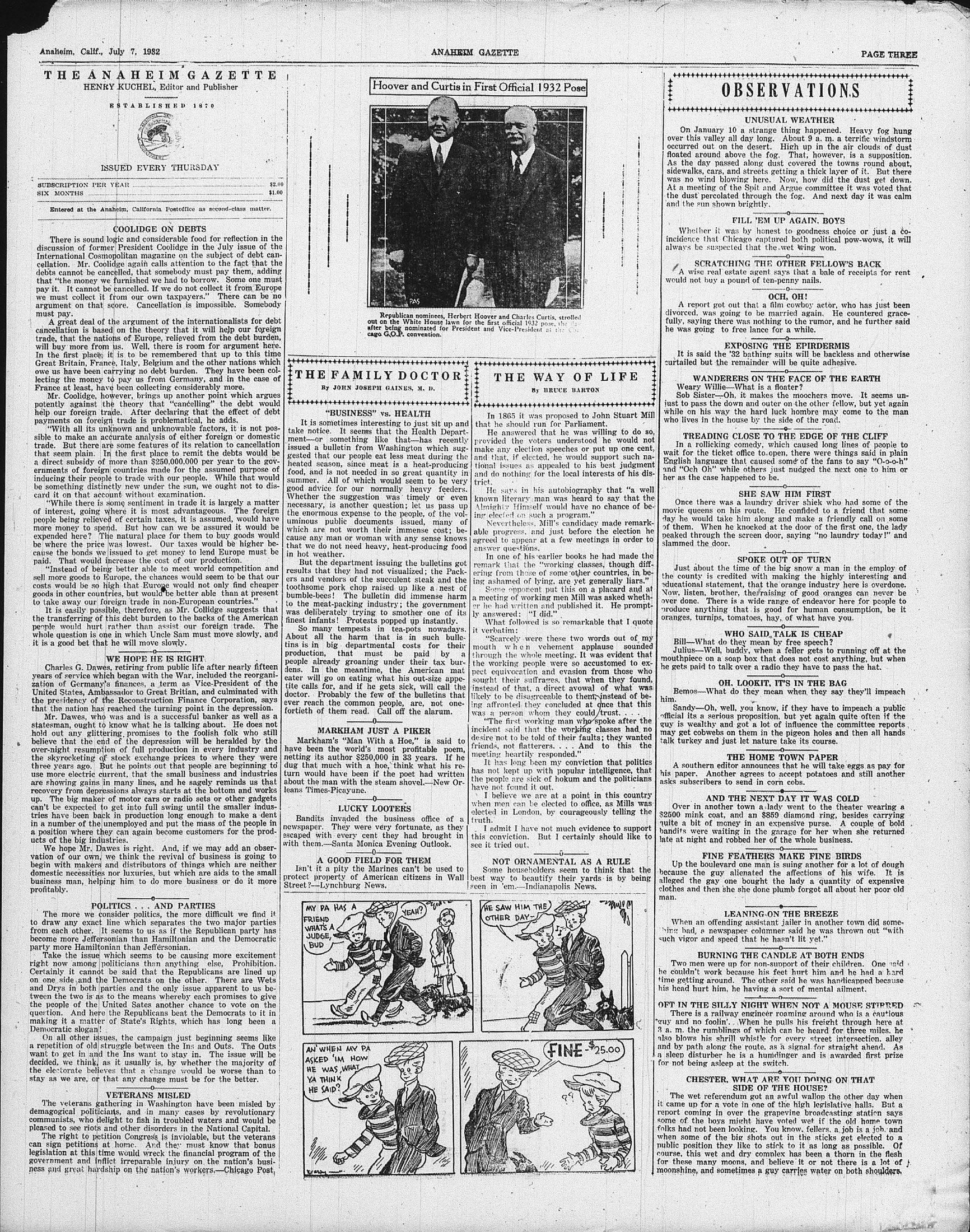
Searchable text
THE ANAHEIM GAZETTE
HENRY KUCHEL, Editor and Publisher
ESTABLISHED 1870
ISSUED EVERY THURSDAY
SUBSCRIPT PER YEAR $2.00
SIX MONTHS $1.00
Entered at the Anaheim, California Postoffice as second-class matter.
COOLIDGE ON DEBTS
There is sound logic and considerable food for reflection in the discussion of former President Coolidge in the July issue of the International Cosmopolitan magazine on the subject of debt cancellation. Mr. Coolidge again calls attention to the fact that the debts cannot be cancelled, that somebody must pay them, adding that "the money we furnished we had to borrow. Some one must pay it. It cannot be cancelled. If we do not collect it from Europe we must collect it from our own taxpayers." There can be no argument on that score. Cancellation is impossible. Somebody must pay.
A great deal of the argument of the internationalists for debt cancellation is based on the theory that it will help our foreign trade, that the nations of Europe, relieved from the debt burden, will buy more from us. Well, there is room for argument here. In the first place, it is to be remembered that up to this time Great Britain, France, Italy, Belgium and the other nations which owe us have been carrying no debt burden. They have been collecting the money to pay us from Germany, and in the case of France at least, have been collecting considerably more.
Mr. Coolidge, however, brings up another point which argues potently against the theory that "cancelling" the debt would help our foreign trade. After declaring that the effect of debt payments on foreign trade is problematical, he adds.
"With all its unknown and unknowable factors, it is not possible to make an accurate analysis of either foreign or domestic trade. But there are some features of its relation to cancellation that seem plain. In the first place to remit the debts would be
Great Britain, France, Italy, Belgium and the other nations which owe us have been carrying no debt burden. They have been collecting the money to pay us from Germany, and in the case of France at least, have been collecting considerably more.
Mr. Coolidge, however, brings up another point which argues potently against the theory that "cancelling" the debt would help our foreign trade. After declaring that the effect of debt payments on foreign trade is problematical, he adds.
"With all its unknown and unknowable factors, it is not possible to make an accurate analysis of either foreign or domestic trade. But there are some features of its relation to cancellation that seem plain. In the first place to remit the debts would be a direct subsidy of more than $250,000,000 per year to the governments of foreign countries made for the assumed purpose of inducing their people to trade with our people. While that would be something distinctly new under the sun, we ought not to discard it on that account without examination.
"While there is some sentiment in trade it is largely a matter of interest, going where it is most advantageous. The foreign people being relieved of certain taxes, it is assumed, would have more money to spend. But how can we be assured it would be expended here? The natural place for them to buy goods would be where the price was lowest. Our taxes would be higher because the bonds we issued to get money to lend Europe must be paid. That would increase the cost of our production.
"Instead of being better able to meet world competition and sell more goods to Europe, the chances would seem to be that our costs would be so high that Europe would not only find cheaper goods in other countries, but would be better able than at present to take away our foreign trade in non-European countries."
It is easily possible, therefore, as Mr. Collidge suggests that the transferring of this debt burden to the backs of the American people would hurt rather than assist our foreign trade. The whole question is one in which Uncle Sam must move slowly, and it is a good bet that he will move slowly.
WE HOPE HE IS RIGHT
Charles G. Dawes, retiring from public life after nearly fifteen years of service which began with the War, included the reorganization of Germany's finances, a term as Vice-President of the United States, Ambassador to Great Britian, and culminated with the presidency of the Reconstruction Finance Corporation, says that the nation has reached the turning point in the depression.
Mr. Dawes, who was and is a successful banker as well as a statesman, ought to know what he is talking about. He does not hold out any glittering promises to the foolish folk who still believe that the end of the depression will be heralded by the over-night resumption of full production in every industry and the skyrocketing of stock exchange prices to where they were three years ago. But he points out that people are beginning to use more electric current, that the small business and industries are showing gains in many lines, and he sagely reminds us that recovery from depressions always starts at the bottom and works up. The big maker of motor cars or radio sets or other gadgets can't be expected to get into full swing until the smaller industries have been back in production long enough to make a dent in a number of the unemployed and put the mass of the people in a position where they can again become customers for the products of the big industries.
We hope Mr. Dawes is right. And, if we may add an observation of our own, we think the revival of business is going to begin with makers and distributors of things which are neither...
use more electric current, that the small business and industries are showing gains in many lines, and he sagely reminds us that recovery from depressions always starts at the bottom and works up. The big maker of motor cars or radio sets or other gadgets can't be expected to get into full swing until the smaller industries have been back in production long enough to make a dent in a number of the unemployed and put the mass of the people in a position where they can again become customers for the products of the big industries.
We hope Mr. Dawes is right. And, if we may add an observation of our own, we think the revival of business is going to begin with makers and distributors of things which are neither domestic necessities nor luxuries, but which are aids to the small business man, helping him to do more business or do it more profitably.
POLITICS . . . AND PARTIES
The more we consider politics, the more difficult we find it to draw any exact line which separates the two major parties from each other. It seems to us as if the Republican party has become more Jeffersonian than Hamiltonian and the Democratic party more Hamiltonian than Jeffersonian.
Take the issue which seems to be causing more excitement right now among politicians than anything else, Prohibition. Certainly it cannot be said that the Republicans are lined up on one side and the Democrats on the other. There are Wets and Drys in both parties and the only issue apparent to us between the two is as to the means whereby each promises to give the people of the United States another chance to vote on the question. And here the Republicans beat the Democrats to it in making it a matter of State's Rights, which has long been a Democratic slogan!
On all other issues, the campaign just beginning seems like a repetition of old struggle between the Ins and Outs. The Ins want to get in and the Ins want to stay in. The issue will be decided, we think, as it usually is, by whether the majority of the electorate believes that a change would be worse than to stay as we are, or that any change must be for the better.
VETERANS MISLED
The veterans gathering in Washington have been misled by demagogical politicians, and in many cases by revolutionary communists, who delight to fish in troubled waters and would be pleased to see riots and other disorders in the National Capital.
The right to petition Congress is inviolable, but the veterans can sign petitions at home. And they must know that bonus legislation at this time would wreck the financial program of the government and inflict irreparable injury on the nation's business and great hardship on the nation's workers.—Chicago Post
Hoover and Curtis in First Official 1932 Pose
Republican nominees, Herbert Hoover and Charles Curtis, strolled out on the White House lawn for the first official 1932 pose, the last after being nominated for President and Vice-President at the Chicago G.O.P. convention.
THE FAMILY DOCTOR
By JOHN JOSEPH GAINES, M. D.
“BUSINESS” vs. HEALTH
It is sometimes interesting to just sit up and take notice. It seems that the Health Department—or something like that—has recently issued a bulletin from Washington which suggested that our people eat less meat during the
THE WAY OF LIFE
By BRUCE BARTON
In 1865 it was proposed to John Stuart Mill that he should run for Parliament.
He answered that he was willing to do so, provided the voters understood he would not make any election speeches or put up one cent, and that, if elected, he would support such na-
THE FAMILY DOCTOR
BY JOHN JOSEPH GAINES, M. D.
"BUSINESS" vs. HEALTH
It is sometimes interesting to just sit up and take notice. It seems that the Health Department—or something like that—has recently issued a bulletin from Washington which suggested that our people eat less meat during the heated season, since meat is a heat-producing food, and is not needed in so great quantity in summer. All of which would seem to be very good advice for our normally heavy feeders. Whether the suggestion was timely or even necessary, is another question; let us pass up the enormous expense to the people, of the voluminous public documents issued, many of which are not worth their immense cost; because any man or woman with any sense knows that we do not need heavy, heat-producing food in hot weather.
But the department issuing the bulletins got results that they had not visualized; the Packers and vendors of the succulent steak and the toothsome pork chop raised up like a nest of bumble-bees! The bulletin did immense harm to the meat-packing industry; the government was deliberately trying to smother one of its finest infants! Protests popped up instantly.
So many tempests in tea-pots nowadays. About all the harm that is in such bulletins is in big departmental costs for their production, that must be paid by a people already groaning under their tax burdens. In the meantime, the American mat eater will go on eating what his out-size appetite calls for, and if he gets sick, will call the doctor. Probably the few of the bulletins that ever reach the common people, are, not one-fortieth of them read. Call off the alarum.
MARKHAM JUST A PIKER
Markham's "Man With a Hoe," is said to have been the world's most profitable poem, netting its author $250,000 in 33 years. If he dug that much with a hoe, think what his return would have been if the poet had written about the man with the steam shovel.—New Orleans Times-Picayune.
LUCKY LOOTERS
Bandits invaded the business office of a newspaper. They were very fortunate, as they escaped with every cent they had brought in with them.—Santa Monica Evening Outlook.
A GOOD FIELD FOR THEM
Isn't it a pity the Marines can't be used to
THE WAY OF LIFE
By BRUCE BARTON
In 1865 it was proposed to John Stuart Mill that he should run for Parliament.
He answered that he was willing to do so, provided the voters understood he would not make any election speeches or put up one cent, and that, if elected, he would support such national issues as appealed to his best judgment and do nothing for the local interests of his district.
He says in his autobiography that "a well known literary man was heard to say that the Almighty Himself would have no chance of being elected on such a program."
Nevertheless, Mill's candidacy made remarkable progress, and just before the election he agreed to appear at a few meetings in order to answer questions.
In one of his earlier books he had made the remark that the "working classes, though differing from those of some other countries, in being ashamed of lying, are yet generally liars."
Some opponent put this on a placard and at a meeting of working men Mill was asked whether he had written and published it. He promptly answered: "I did."
What followed is so remarkable that I quote it verbatim:
"Scarcely were these two words out of my mouth when vehement applause sounded through the whole meeting. It was evident that the working people were so accustomed to expect equivocation and evasion from those who sought their suffrages, that when they found, instead of that, a direct avowal of what was likely to be disagreeable to them, instead of being affronted they concluded at once that this was a person whom they could trust.
"The first working man who spoke after the incident said that the working classes had no desire not to be told of their faults; they wanted friends, not flatterers. And to this the meeting heartily responded."
It has long been my conviction that politics has not kept up with popular intelligence, that the people are sick of hokum and the politicians have not found it out.
I believe we are at a point in this country when men can be elected to office, as Mills was elected in London, by courageously telling the truth.
I admit I have not much evidence to support this conviction. But I certainly should like to see it tried out.
NOT ORNAMENTAL AS A RULE
Some householders seem to think that
LUCKY LOOTERS
Bandits invaded the business office of a newspaper. They were very fortunate, as they escaped with every cent they had brought in with them.—Santa Monica Evening Outlook.
A GOOD FIELD FOR THEM
Isn't it a pity the Marines can't be used to protect property of American citizens in Wall Street?—Lynchburg News.
NOT ORNAMENTAL AS A RULE
Some householders seem to think that the best way to beautify their yards is by being seen in 'em.—Indianapolis News.
MY PA HAS A FRIEND WHAT'S A JUDGE, BUD
HE SAW HIM THE OTHER DAY-
AN WHEN MY PA ASKED 'IM HOW HE WAS, WHAT YA THINK HE SAID?
FINE-$25.00
OBSERVATIONS
UNUSUAL WEATHER
On January 10 a strange thing happened. Heavy fog hung over this valley all day long. About 9 a.m. a terrific windstorm occurred out on the desert. High up in the air clouds of dust floated around above the fog. That, however, is a supposition. As the day passed along dust covered the towns round about, sidewalks, cars, and streets getting a thick layer of it. But there was no wind blowing here. Now, how did the dust get down. At a meeting of the Spit and Argue committee it was voted that the dust percolated through the fog. And next day it was calm and the sun shown brightly.
FILL 'EM UP AGAIN. BOYS
Whether it was by honest to goodness choice or just a coincidence that Chicago captured both political pow-wows, it will always be suspected that the wet wing won.
SCRATCHING THE OTHER FELLOW'S BACK
A wise real estate agent says that a bale of receipts for rent would not buy a pound of ten-penny nails.
OCH, OH!
A report got out that a film cowboy actor, who has just been divorced, was going to be married again. He countered gracefully, saying there was nothing to the rumor, and he further said he was going to free lance for a while.
EXPOSING THE EPIRDERMIS
It is said the '32 bathing suits will be backless and otherwise curtailed but the remainder will be quite adhesive.
WANDERERS ON THE FACE OF THE EARTH
Weary Willie—What is a floater?
Sob Sister—Oh, it makes the moochers move. It seems unjust to pass the down and outer on the other fellow, but yet again while on his way the hard luck hombre may come to the man who lives in the house by the side of the road.
TREADING CLOSE TO THE EDGE OF THE CLIFF
In a rollicking comedy, which caused long lines of people to wait for the ticket office to open, there were things said in plain
WANDERERS ON THE FACE OF THE EARTH
Weary Willie—What is a floater?
Sob Sister—Oh, it makes the moochers move. It seems unjust to pass the down and outer on the other fellow, but yet again while on his way the hard luck hombre may come to the man who lives in the house by the side of the road.
TREADING CLOSE TO THE EDGE OF THE CLIFF
In a rollicking comedy, which caused long lines of people to wait for the ticket office to open, there were things said in plain English language that caused some of the fans to say "O-o-o-h" and "Och Oh" while others just nudged the next one to him or her as the case happened to be.
SHE SAW HIM FIRST
Once there was a laundry driver shiek who had some of the movie queens on his route. He confided to a friend that some day he would take him along and make a friendly call on some of them. When he knocked at the door of the first one, the lady peaked through the screen door, saying "no laundry today!" and slammed the door.
SPOKE OUT OF TURN
Just about the time of the big snow a man in the employ of the county is credited with making the highly interesting and educational statement, that the orange industry here is overdone. Now, listen, brother, the raising of good oranges can never be over done. There is a wide range of endeavor here for people to produce anything that is good for human consumption, be it oranges, turnips, tomatoes, hay, of what have you.
WHO SAID TALK IS CHEAP
Bill—What do they mean by free speech?
Julius—Well, buddy, when a feller gets to running off at the mouthpiece on a soap box that does not cost anything, but when he gets paid to talk over a radio they have to pass the hat.
OH. LOOKIT, IT'S IN THE BAG
Bemos—What do they mean when they say they'll impeach him.
Sandy—Oh, well, you know, if they have to impeach a public official its a serious proposition, but yet again quite often if the guy is wealthy and got a lot of influence the committee reports may get cobwebs on them in the pigeon holes and then all hands talk turkey and just let nature take its course.
THE HOME TOWN PAPER
A southern editor announces that he will take eggs as pay for his paper. Another agrees to accept potatoes and still another asks subscribers to send in corn cobs.
AND THE NEXT DAY IT WAS COLD
Over in another town a lady went to the theater wearing a $2500 mink coat, and an $859 diamond ring, besides carrying quite a bit of money in an expensive purse. A couple of bold bandits were waiting in the garage for her when she returned late at night and robbed her of the whole business.
FINE FEATHERS MAKE FINE BIRDS
Up the boulevard one man is suing another for a lot of dough
AND THE NEXT DAY IT WAS COLD
Over in another town a lady went to the theater wearing a $2500 mink coat, and an $859 diamond ring, besides carrying quite a bit of money in an expensive purse. A couple of bold bandits were waiting in the garage for her when she returned late at night and robbed her of the whole business.
FINE FEATHERS MAKE FINE BIRDS
Up the boulevard one man is suing another for a lot of dough because the guy alienated the affections of his wife. It is alleged the gay one bought the lady a quantity of expensive clothes and then she she done plumb forgot all about her poor old man.
LEANING ON THE BREEZE
When an offending assistant jailer in another town did something bad, a newspaper columner said he was thrown out "with such vigor and speed that he hasn't lit yet."
BURNING THE CANDLE AT BOTH ENDS
Two men were up for non-support of their children. One said he couldn't work because his feet hurt him and he had a hard time getting around. The other said he was handicapped because his head hurt him, he having a sort of mental ailment.
OFT IN THE SILLY NIGHT WHEN NOT A MOUSE STIPRED
There is a railway engineer roaming around who is a cautious guy and no foolin'. When he pulls his freight through here at 3 a.m. the rumblings of which can be heard for three miles, he also blows his shrill whistle for every street intersection, alley and by path along the route, as a signal for straight ahead. As a sleep disturber he is a humdinger and is awarded first prize for not being asleep at the switch.
CHESTER, WHAT ARE YOU DOING ON THAT SIDE OF THE HOUSE?
The wet referendum got an awful wallop the other day when it came up for a vote in one of the high legislative halls. But a report coming in over the grapevine broadcasting station says some of the boys might have voted wet if the old home town folks had not been looking. You know, fellers, a job is a job, and when some of the big shots out in the sticks get elected to a public position they like to stick to it as long as possible. Of course, this wet and dry complex has been a thorn in the flesh for these many moons, and believe it or not there is a lot of moonshine, and sometimes a guy carries water on both shoulders.