anaheim-gazette 1932-06-02
Scanned page
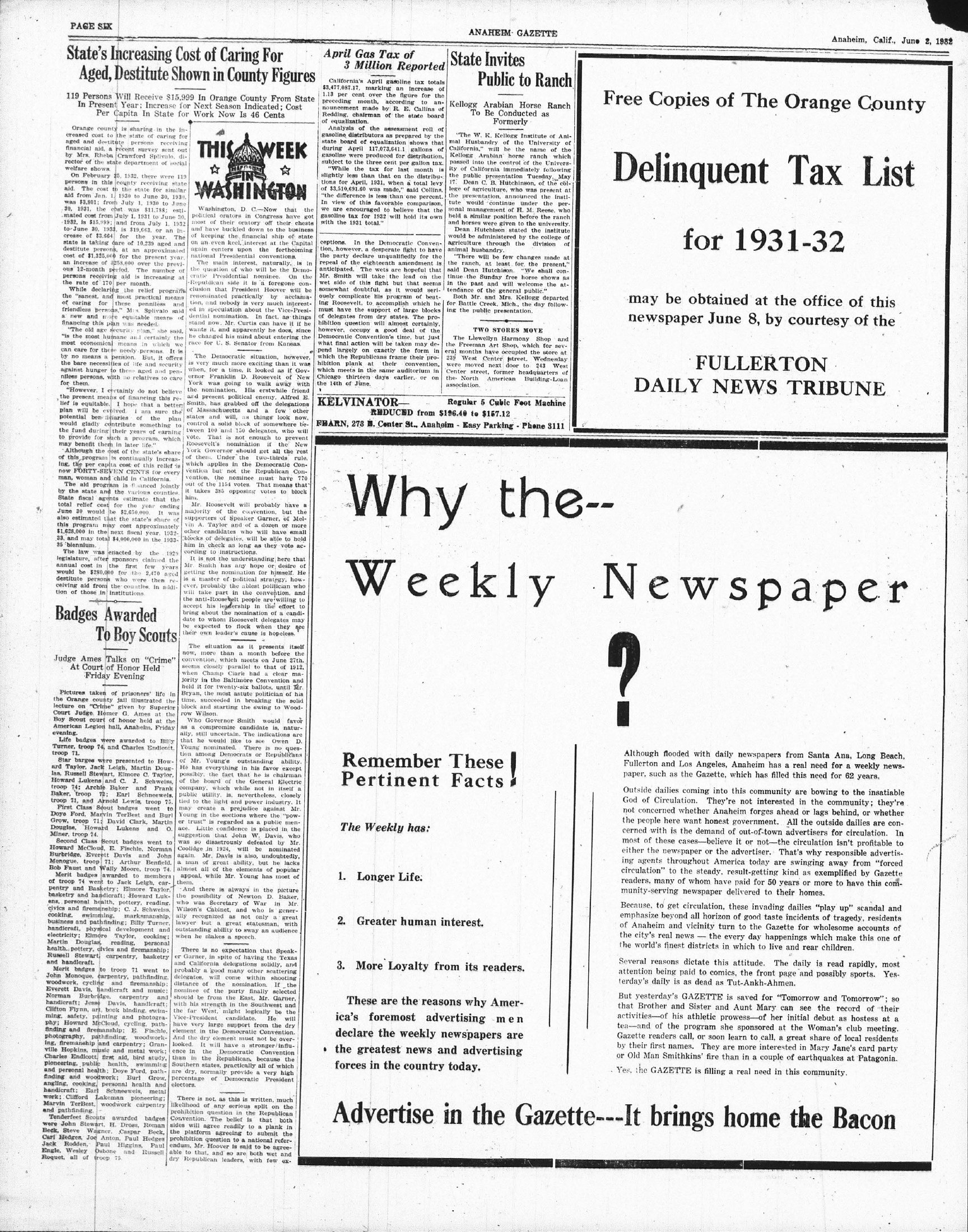
Searchable text
State’s Increasing Cost of Caring For Aged, Destitute Shown in County Figures
119 Persons Will Receive $15,999 In Orange County From State In Present Year; Increase for Next Season Indicated; Cost Per Capita In State for Work Now Is 46 Cents
Orange county is sharing in the increased cost to the state of caring for aged and destitute persons receiving financial aid, a recent survey sent out by Mrs. Rheba Crawford Splivalo, director of the state department of social welfare shows.
On February 25, 1932, there were 119 persons in this county receiving state aid. The cost to the state for similar aid from Jan. 1, 1930 to June 30, 1939, was $3,801; from July 1, 1930 to June 30, 1931, the cost was $11,788; estimated cost from July 1, 1931 to June 30, 1932, is $15,999; and from July 1, 1932 to June 30, 1933, is $19,663, or an increase of $3,664 for the year. The state is taking care of 10,239 aged and destitute persons, at an approximated cost of $1,325,000 for the present year, an increase of $258,000 over the previous 12-month period. The number of persons receiving aid is increasing at the rate of 170 per month.
While declaring the relief program the "sanest, and most practical means of caring for these penniless and friendless persons," Mrs. Splivalo said a new and more equitable means of financing this plan was needed.
"The old age security plan," she said, "is the most humane and certainly the most economical means in which we can care for these needy persons. It is by no means a pension. But, it offers the bare necessities of life and security against hunger to these aged and penniless persons, with no relatives to care for them."
However, I certainly do not believe the present means of financing this relief is equitable. I hope that a better plan will be evolved. I am sure the potential beneficiaries of the plan would gladly contribute something to the fund during their years of earning to provide for such a program, which may benefit them in later life."
Although the cost of the state's share of this program is continually increases,
Washington, D.C.—Now that the political orators in Congress have got most of their oratory off their chests and have buckled down to the business of keeping the financial ship of state on an even keel, interest at the Capital again centers upon the forthcoming national Presidential conventions.
The main interest, naturally, is in the question of who will be the Democratic Presidential nominee. On the Republican side it is a foregone conclusion that President Hoover will be renominated practically by acclaimation, and nobody is very much interested in speculation about the Vice-Presidential nomination. In fact, as things stand now, Mr. Curtis can have it if he wants it, and apparently he does, since he changed his mind about entering the race for U.S. Senator from Kansas.
The Democratic situation, however, is very much more exciting than it was when, for a time, it looked as if Governor Franklin D. Roosevelt of New York was going to walk away with the nomination. His erstwhile friend and present political enemy, Alfred E. Smith, has grabbed off the delegations of Massachusetts and a few other states and will, as things look now, control a solid block of somewhere between 100 and 150 delegates, who will vote. That is not enough to prevent Roosevelt's nomination if the New York Governor should get all the rest of them. Under the two-thirds rule.
the bare necessities of life and security against hunger to these aged and peniless persons, with no relatives to care for them.
"However, I certainly do not believe the present means of financing this relief is equitable. I hope that a better plan will be evolved. I am sure the potential beneficiaries of the plan would gladly contribute something to the fund during their years of earning to provide for such a program, which may benefit them in later life."
Although the cost of the state's share of this program is continually increasing, the per capita cost of this relief is now FORTY-SEVEN CENTS for every man, woman and child in California.
The aid program is financed jointly by the state and the various counties. State fiscal agents estimate that the total relief cost for the year ending June 30 would be $2,650,000. It was also estimated that the state's share of this program may cost approximately $1,628,000 in the next fiscal year, 1932-33, and may total $4,000,000 in the 1933-35 biennium.
The law was enacted by the 1929 legislature, after sponsors claimed the annual cost in the first few years would be $280,000 for the 2,470 aged destitute persons who were then receiving aid from the counties in addition of those in institutions.
Badges Awarded To Boy Scouts
Judge Ames Talks on "Crime"
At Court of Honor Held Friday Evening
Pictures taken of prisoners' life in the Orange county jail illustrated the lecture on "Crime" given by Superior Court Judge Homer G. Ames at the Boy Scout court of honor held at the American Legion hall, Anaheim, Friday evening.
Life badges were awarded to Billy Turner, troop 74, and Charles Endicott, troop 71.
Star barges were presented to Howard Taylor, Jack Leigh, Martin Douglas, Russell Stewart, Elmore C. Taylor, Howard Lukens and C. J. Schweiss, troop 74; Archie Baker and Frank Baker, troop 72; Earl Schneewels, troop 71, and Arnold Lewis, troop 75.
First Class Scout badges went to Doye Ford, Marvin TerBest and Burl Grow, troop 71; David Clark, Martin Douglas, Howard Lukens and O. Miner, troop 74.
Second Class Scout badges went to Howard McCloud, E. Fischle, Norman Burbridge, Everett Davis and John Monogue, troop 71; Arthur Benfield, Bob Faust and Wally Moore, troop 74.
The situation as it presents itself now, more than a month before the convention, which meets on June 27th, seems closely parallel to that of 1912, when Champ Clark had a clear majority in the Baltimore Convention and held it for twenty-six ballots, until Mr. Bryan, the most astute politician of his time, succeeded in breaking the solid block and starting the swing to Woodrow Wilson.
Who Governor Smith would favor as a compromise candidate is naturally still uncertain. The indications are that he would like to see Owen D. Young nominated. There is no question among Democrats or Republicans of Mr. Young's outstanding ability. He has everything in his favor except possibly, the fact that he is chairman of the board of the General Electric company, which while not in itself a public utility, is nevertheless closely tied to the light and power industry. It may create a prejudice against Mr. Young in the sections where the "power trust" is regarded as a public menace. Little confidence is placed in the suggestion that John W. Davis, who was so disastrously defeated by Mr. Coolidge in 1924, will be nominated again. Mr. Davis is also undoubtedly a man of great ability, but he lacks almost all of the elements of popular
First Class Scout badges went to Doye Ford, Marvin TerBest and Burl Grow, troop 71; David Clark, Martin Douglas, Howard Lukens and O. Miner, troop 74.
Second Class Scout badges went to Howard McCloud, E. Fischle, Norman Burbridge, Everett Davis and John Monogue, troop 71; Arthur Benfield, Bob Faust and Wally Moore, troop 74.
Merit badges awarded to members of troop 74 went to Jack Leigh, carpentry and Basketry; Elmore Taylor, basketry and handicraft; Howard Lukens, personal health, pottery, reading, civics and firemanship; C. J. Schweiss, cooking, swimming, marksmanship, business and pathfinding; Billy Turner, handicraft, physical development and electricity; Elmore Taylor, cooking; Martin Douglas, reading, personal health, pottery, civics and firemanship; Russell Stewart, carpentry, basketry and handicraft.
Merit badges to troop 71 went to John Monoque, carpentry, pathfinding, woodwork, cycling and firemanship; Everett Davis, handicraft and music; Norman Burbridge, carpentry and handicraft; Jesse Davis, handicraft; Clifton Flynn, art, book binding, swimming, safety, painting and photography; Howard McCloud, cycling, pathfinding and firemanship; E. Fischle, photography, pathfinding, woodworking, firemanship and carpentry; Granville Hopkins, music and metal work; Charles Endicott, first aid, bird study, pioneering, public health, swimming and personal health; Doye Ford, pathfinding and woodwork; Burl Grow, angling, cooking, personal health and handicraft; Earl Schneewels, metal work; Clifford Lakeman pioneering; Marvin TerBest, woodwork carpentry and pathfinding.
Tenderfeet Scouts awarded badges were John Stewart, H. Dross, Roman Beck, Steve Wagner, Caspar Beck, Carl Hedges, Joe Anton, Paul Hedges Jack Rodden, Paul Higgins, Paul Engle, Wesley Osborne and Russell Roquet, all of troop 75.
There is no expectation that Speaker Garner in spite of having the Texas and California delegations solidly, and probably a good many other scattering delegates will come within shooting distance of the nomination. If the nominee of the party finally selected should be from the East, Mr. Garner, with his strength in the Southwest and the far West might logically be the Vice-President candidate. He will have very large support from the dry element in the Democratic Convention. And the dry element must not be overlooked. It will have a stronger influence in the Democratic Convention than in the Republican because the Southern states practically all of which are dry normally provide a very high percentage of Democratic President electors.
There is not, as this is written, much likelihood of any serious split on the prohibition question in the Republican Convention. The belief is that both sides will agree readily to a plank in the platform agreeing to submit the prohibition question to a national referendum. Mr. Hoover is said to be agreeable to that, and so are both wet and dry Republican leaders, with few ex-
April Gas Tax of 3 Million Reported
California's April gasoline tax totals $3,477,087.17, marking an increase of 1.13 per cent over the figure for the preceding month, according to announcement made by R. E. Callins of Redding, chairman of the state board of equalization.
Analysis of the assessment roll of gasoline distributors as prepared by the state board of equalization shows that during April 117,073,641.1 gallons of gasoline were produced for distribution, subject to the three cent per gallon tax.
"While the tax for last month is slightly less than that on the distributions for April, 1931, when a total levy of $3,510,691.60 was made," said Collins, "the difference is less than one percent. In view of this favorable comparison, we are encouraged to believe that the gasoline tax for 1932 will hold its own with the 1931 total."
ceptions. In the Democratic Convention, however, a desperate fight to have the party declare unqualifiedly for the repeal of the eighteenth amendment is anticipated. The wets are hopeful that Mr. Smith will take the lead on the wet side of this fight but that seems somewhat doubtful, as it would seriously complicate his program of beating Roosevelt, to accomplish which he must have the support of large blocks of delegates from dry states. The prohibition question will almost certainly, however, occupy a good deal of the Democratic Convention's time, but just what final action will be taken may depend largely on exactly the form in which the Republicans frame their prohibition plank at their convention, which meets in the same auditorium in Chicago thirteen days earlier, or on the 14th of June.
State Invites Public to Ranch
Kellogg Arabian Horse Ranch To Be Conducted as Formerly
"The W. K. Kellogg Institute of Animal Husbandry of the University of California," will be the name of the Kellogg Arabian horse ranch which passed into the control of the University of California immediately following the public presentation Tuesday, May 17. Dean C. B. Hutchinson, of the college of agriculture, who was present at the presentation, announced the institute would continue under the personal management of H. M. Reese, who held a similar position before the ranch and horses were given to the university.
Dean Hutchison stated the institute would be administered by the college of agriculture through the division of animal husbandry.
"There will be few changes made at the ranch, at least for the present," said Dean Hutchison. "We shall continue the Sunday free horse shows as in the past and will welcome the attendance of the general public."
Both Mr. and Mrs. Kellogg departed for Battle Creek, Mich., the day following the public presentation.
TWO STORES MOVE
The Llewellyn Harmony Shop and the Freeman Art Shop, which for several months have occupied the store at 239 West Center street, Wednesday were moved next door to 243 West Center street, former headquarters of the North American Building-Loan association.
KELVINATOR— Regular 5 Cubic Foot Machine REDUCED from $196.40 to $157.12
FEARN, 273 E. Center St., Anaheim - Easy Parking - Phone 3111
Why the--
Weekly New?
Remember These
Pertinent Facts!
The Weekly has:
Pertinent Facts
The Weekly has:
1. Longer Life.
2. Greater human interest.
3. More Loyalty from its readers.
These are the reasons why America's foremost advertising men declare the weekly newspapers are
the greatest news and advertising forces in the country today.
Advertise in the Gazette---It brings
Free Copies of The Orange County
Delinquent Tax List
for 1931-32
may be obtained at the office of this
newspaper June 8, by courtesy of the
FULLERTON
DAILY NEWS TRIBUNE
Although flooded with daily newspapers from Santa Ana, Long Beach, Fullerton and Los Angeles, Anaheim has a real need for a weekly newspaper, such as the Gazette, which has filled this need for 62 years.
Outside dailies coming into this community are bowing to the insatiable God of Circulation. They're not interested in the community; they're not concerned whether Anaheim forges ahead or lags behind, or whether the people here want honest government. All the outside dailies are concerned with is the demand of out-of-town advertisers for circulation. In most of these cases—believe it or not—the circulation isn't profitable to either the newspaper or the advertiser. That's why responsible advertising agents throughout America today are swinging away from "forced circulation" to the steady result high on the list.
Outside dailies coming into this community are bowing to the insatiable God of Circulation. They're not interested in the community; they're not concerned whether Anaheim forges ahead or lags behind, or whether the people here want honest government. All the outside dailies are concerned with is the demand of out-of-town advertisers for circulation. In most of these cases—believe it or not—the circulation isn't profitable to either the newspaper or the advertiser. That's why responsible advertising agents throughout America today are swinging away from "forced circulation" to the steady, result-getting kind as exemplified by Gazette readers, many of whom have paid for 50 years or more to have this community-serving newspaper delivered to their homes.
Because, to get circulation, these invading dailies "play up" scandal and emphasize beyond all horizon of good taste incidents of tragedy, residents of Anaheim and vicinity turn to the Gazette for wholesome accounts of the city's real news — the every day happenings which make this one of the world's finest districts in which to live and rear children.
Several reasons dictate this attitude. The daily is read rapidly, most attention being paid to comics, the front page and possibly sports. Yesterday's daily is as dead as Tut-Ankh-Ahmen.
But yesterday's GAZETTE is saved for "Tomorrow and Tomorrow"; so that Brother and Sister and Aunt Mary can see the record of their activities—of his athletic prowess—of her initial debut as hostess at a tea—and of the program she sponsored at the Woman's club meeting. Gazette readers call, or soon learn to call, a great share of local residents by their first names. They are more interested in Mary Jane's card party or Old Man Smithkins' fire than in a couple of earthquakes at Patagonia.
Yes, the GAZETTE is filling a real need in this community.
--It brings home the Bacon