anaheim-gazette 1931-11-12
Scanned page
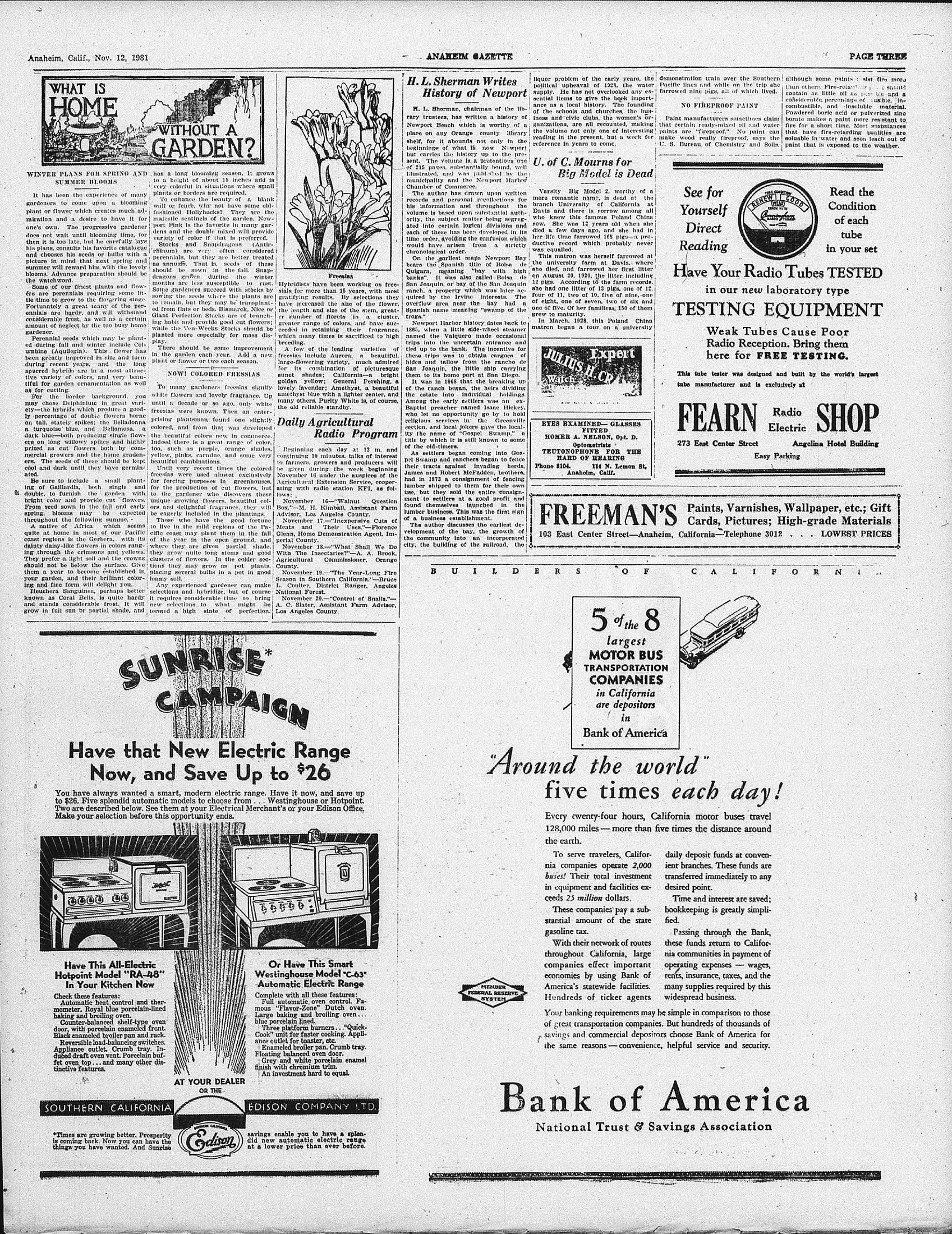
Searchable text
WHAT IS HOME
WITHOUT A GARDEN?
WINTER PLANS FOR SPRING AND SUMMER BLOOMS
It has been the experience of many gardeners to come upon a blooming plant or flower which creates much admiration and a desire to have it for one's own. The progressive gardener does not wait until blooming time, for then it is too late, but he carefully lays his plans, consults his favorite catalogue and chooses his seeds or bulbs with a picture in mind that next spring and summer will reward him with the lovely blooms. Advance preparation should be the watchword.
Some of our finest plants and flowers are perennials requiring some little time to grow to the flowering stage. Fortunately a great many of the perennials are hardy, and will withstand considerable frost, as well as a certain amount of neglect by the too busy home gardener.
Perennial seeds which may be planted during fall and winter include Columbine (Aquilegia). This flower has been greatly improved in size and form during recent years, and the long spurred hybrids are in a most attractive variety of colors, and very beautiful for garden ornamentation as well as for cutting.
For the border background, you may chose Delphinium in great variety—the hybrids which produce a goodly percentage of double flowers borne on tall, stately spikes; the Belladonna a turquoise blue, and Bellamosa, a dark blue—both producing single flowers on long willowy spikes and highly prized as cut flowers both by commercial growers and the home gradeners.
has a long blooming season. It grows to a height of about 18 inches and is very colorful in situations where small plants or borders are required.
To enhance the beauty of a blank wall or fence, why not have some old-fashioned Hollyhocks? They are the majestic sentinels of the garden. Newport Pink is the favorite in many gardens and the double mixed will provide variety of color if that is preferred.
Stocks and Snapdragons (Antirrhinum) are very often considered perennials, but they are better treated as annuals. That is, seeds of these should be sown in the fall. Snapdragons grown during the winter months are less susceptible to rust. Some gardeners succeed with stocks by sowing the seeds where the plants are to remain, but they may be transplanted from flats or beds. Bismarck, Nice or Giant Perfection Stocks are of branching habit and provide good cut flowers; while the Ten-Weeks Stocks should be planted more especially for mass display.
There should be some improvement in the garden each year. Add a new plant or flower or two each season.
NOW! COLORED FRESSIAS
To many gardeners freesias signify white flowers and lovely fragrance. Up until a decade or so ago, only white freesias were known. Then an enterprising plantman found one slightly colored, and from that was developed the beautiful colors now in commerce. Indeed there is a great range of color, too such as purple, orange shades, yellow, pinks, carnine, and some very beautiful colors.
Freesias Hybridists have been working sials for more than 15 years gratifying results. By having increased the size of the length and size of the er number of florets it greater range of colors, ceeded in retaining them which many times is sac breeding.
A few of the leading freesias include Aurora, large-flowering variety, for its combination of sunet shades; Californi golden yellow; General lovely lavender; Amethyst blue with a light many others. Purity White the old reliable standby.
Daily Agriculture Radio
Beginning each day at continuing 10 minutes, ta
during recent years, and the long spurred hybrids are in a most attractive variety of colors, and very beautiful for garden ornamentation as well as for cutting.
For the border background, you may chose Delphiniura in great variety—the hybrids which produce a goodly percentage of double flowers borne on tall, stately spikes; the Belladonna a turquoise blue, and Bellamosa, a dark blue—both producing single flowers on long willowy spikes and highly prized as cut flowers both by commercial growers and the home graders. The seeds of these should be kept cool and dark until they have germinated.
Be sure to include a small planting of Gallardia, both single and double, to furnish the garden with bright color and provide cut flowers. From seed sown in the fall and early spring, blooms may be expected throughout the following summer.
A native of Africa which seems quite at home in most of our Pacific coast regions is the Gerbera, with its daisy daisy-like flowers in colors ranging through the crimsons and yellows. They prefer a light soil and the crowns should not be below the surface. Give them a year to become established in your garden, and their brilliant coloring and fine form will delight you.
Heuchera Sanguinea, perhaps better known as Coral Bells, is quite hardy and stands considerable frost. It will grow in full sun or partial shade, and
NOW! COLORED FRESSIAS
To many gardeners freesias signify white flowers and lovely fragrance. Up until a decade or so ago, only white freesias were known. Then an enterprising plantman found one slightly colored, and from that was developed the beautiful colors now in commerce. Indeed there is a great range of color, too, such as purple, orange shades, yellow, pinks, carnine, and some very beautiful combinations.
Until very recent times the colored freesias were used almost exclusively for forcing purposes in greenhouses, for the production of cut flowers, but to the gardener who discovers these unique growing flowers, beautiful colors and delightful fragrance, they will be eagerly included in the plantings.
Those who have the good fortune to live in the mild regions of the Pacific coast may plant them in the fall of the year in the open ground, and where they are given partial shade, they grow quite long stems and good clusters of flowers. In the colder sections they may grow as pot plants, placing several bulbs in a pot in good loamy soil.
Any experienced gardener can make selections and hybridize, but of course it requires considerable time to bring new selections to what might be termed a high state of perfection.
SUNRISE*
CAMPAIGN
Have that New Electric Range Now, and Save Up to $26
You have always wanted a smart, modern electric range. Have it now, and save up to $26. Five splendid automatic models to choose from... Westinghouse or Hotpoint. Two are described below. See them at your Electrical Merchant's or your Edison Office. Make your selection before this opportunity ends.
You have always wanted a smart, modern electric range. Have it now, and save to $26. Five splendid automatic models to choose from... Westinghouse or Hotpoint. Two are described below. See them at your Electrical Merchant's or your Edison Office. Make your selection before this opportunity ends.
Have This All-Electric Hotpoint Model "RA-48" In Your Kitchen Now
Check these features:
Automatic heat control and thermometer. Royal blue porcelain-lined baking and broiling oven.
Counter-balanced shelf-type oven door, with porcelain enameled front. Black enameled broiler pan and rack.
Reversible load-balancing switches. Appliance outlet. Crumb tray. Induced draft oven vent. Porcelain buffet oven top...and many other distinctive features.
Or Have This Smart Westinghouse Model "C-A Automatic Electric Range"
Complete with all these features:
Full automatic oven control. Mous "Flavor-Zone" Dutch ovals. Large baking and broiling oven. Blue porcelain lined.
Three platform burners...“Quail Cook” unit for faster cooking. Appearance outlet for toaster, etc.
Enameled broiler pan. Crumb tuff Floating balanced oven door.
Grey and white porcelain enamel finish with chromium trim.
An investment hard to equal.
AT YOUR DEALER OR THE
SOUTHERN CALIFORNIA
EDISON COMPANY
*Times are growing better. Prosperity is coming back. Now you can have the things you have wanted. And Sunrise
savings enable you to have a spared new automatic electric range at a lower price than ever before
H. L. Sherman Writes History of Newport
H. L. Sherman, chairman of the library trustees, has written a history of Newport Beach which is worthy of a place on any Orange county library shelf, for it abounds not only in the beginnings of what is now Newport but carries the history up to the present. The volume is a pretentious one of 215 pages, substantially bound, well illustrated, and was published by the municipality and the Newport Harbor Chamber of Commerce.
The author has drawn upon written records and personal recollections for his information and throughout the volume is based upon substantial authority, the subject matter being segregated into certain logical divisions and each of these has been developed in its time order, avoiding the confusion which would have arisen from a strictly chronological order.
On the earliest maps Newport Bay bears the Spanish title of Bolsa de Quigara, meaning "bay with high banks". It was also called Bolsa de San Joaquin, or bay of the San Joaquin ranch, a property which was later acquired by the Irvine interests. The overflow area near the bay had a Spanish name meaning "swamp of the frogs."
Newport Harbor history dates back to 1865, when a little side-wheel steamer named the Valquero made occasional trips into the uncertain entrance and tied up to the bank. The incentive for these trips was to obtain cargoes of hides and tallow from the rancho de San Joaquin, the little ship carrying them to its home port at San Diego.
It was in 1868 that the breaking up of the ranch began, the heirs dividing the estate into individual holdings. Among the early settlers was an ex-Baptist preacher named Isaac Hickey, who let no opportunity go by to hold religious services in the Greenville section, and local jokers gave the locality the name of "Gospel Swamp," a title by which it is still known to some of the old-timers.
As settlers began coming into Gospel Swamp and ranchers began to fence liquor problem of the early years, the political upheaval of 1928, the water supply. He has not overlooked any essential items to give the book importance as a local history. The founding of the schools and churches, the business and civic clubs, the women's organizations, are all recounted, making the volume not only one of interesting reading in the present, but a work for reference in years to come.
U. of C. Mourns for Big Model is Dead
Varsity Big Model 2, worthy of a more romantic name, is dead at the branch University of California at Davis and there is sorrow among all who knew this famous Poland China sow. She was 12 years old when she died a few days ago, and she had in her life time farrewed 168 pigs—a productive record which probably never was equalled.
This matron was herself farrowed at the university farm at Davis, where she died, and farrowed her first litter on August 20, 1920, the litter including 12 pigs. According to the farm records, she had one litter of 13 pigs, one of 12 four of 11, two of 10, five of nine-one of eight, one of seven, two of six and one of five. Of her familless, 150 of them grew to maturity.
In March, 1928, this Poland China matron began a tour on a university...
Daily Agricultural Radio Program
Beginning each day at 12 m. and continuing 10 minutes, talks of interest to farmers, growers and producers will be given during the week beginning November 16 under the auspices of the Agricultural Extension Service, cooperating with radio station KFI, as follows:
November 16—"Walnut Question Box."—M. H. Kimball, Assistant Farm Advisor, Los Angeles County.
November 17—"Inexpensive Cuts of Meats and Their Uses."—Florence McIlenn, Home Demonstration Agent, Imperial County.
November 18—"What Shall We Do With The Insectaries?"—A. A. Brook, Agricultural Commissioner, Orange County.
November 19—"The Year-Long Fire Season in Southern California."—Bruce Coulter, District Ranger, Angeles National Forest.
November 20—"Control of Snails."—C. C. Slater, Assistant Farm Advisor, Los Angeles County.
EYES EXAMINED—GLASSES FITTED
HOMER A. NELSON, Opt. D.
Optomatrists
TEUTONOPHONE FOR THE HARD OF HEARING
Phone 8104. 114 N. Lemon St,
Anaheim, Calif.
FREEMAN'S
103 East Center Street—Anaheim,
BUILDERS OF
5 of the 8 largest MOTOR BUS TRANSPORTATION COMPANIES in California are depositors in Bank of America
"Around the world five times"
Every twenty-four hours, California 128,000 miles — more than five t the earth.
To serve travelers, California companies operate 2,000 ien
save it now, and save up
stinghouse or Hotpoint.
's or your Edison Office.
Have This Smart
Woodhouse Model "C-63"
Automatic Electric Range
with all these features:
automatic oven control. Faflavor-Zone" Dutch oven:
making and broiling oven...
ceelain lined.
platform burners... "Quickmit for faster cooking. Applilet for toaster, etc.
eled broiler pan. Crumb tray.
balanced oven door.
and white porcelain enamel
with chromium trim.
investment hard to equal.
N COMPANY LTD.
five times
Every twenty-four hours, California
128,000 miles — more than five t
the earth.
To serve travelers, California companies operate 2,000
buses! Their total investment
in equipment and facilities exceeds 25 million dollars.
These companies pay a substantial amount of the state
gasoline tax.
With their network of routes
throughout California, large
companies effect important
economies by using Bank of
America's statewide facilities.
Hundreds of ticket agents
Your banking requirements may be siof great transportation companies. B
savings and commercial depositors c
the same reasons — convenience,
Bank of A
National Trust & Savi
demonstration train over the Southern Pacific lines and while on the trip she farrowed nine pigs, all of which lived.
NO FIREPROOF PAINT
Paint manufacturers sometimes claim that certain ready-mixed oil and water paints are "fireproof." No paint can make wood really fireproof, says the U.S. Bureau of Chemistry and Soils, although some paints resist fire more than others. Fire-retardant should contain as little oil as possible and a cohederable percentage of insoluble, incombustible, and insoluble material. Powdered boric acid or pulverized zinc borate makes a paint more resistant to fire for a short time. Most substances that have fire-retarding qualities are soluable in water and soon leach out of paint that is exposed to the weather.
See for Yourself Direct Reading
Have Your Radio Tubes TESTED in our new laboratory type TESTING EQUIPMENT
Weak Tubes Cause Poor Radio Reception. Bring them here for FREE TESTING.
This tube tester was designed and built by the world's largest tube manufacturer and is exclusively at FEARN Radio Electric SHOP
273 East Center Street Angelina Hotel Building Easy Parking
This tube tester was designed and built by the world's largest tube manufacturer and is exclusively at FEARN Radio Electric SHOP
273 East Center Street Angelina Hotel Building
Easy Parking
MAN'S Paints, Varnishes, Wallpaper, etc.; Gift Cards, Pictures; High-grade Materials
Street—Anaheim, California—Telephone 3012 . . . LOWEST PRICES
5 of the 8 largest MOTOR BUS TRANSPORTATION COMPANIES in California are depositors in Bank of America
the world"
times each day!
four hours, California motor buses travel more than five times the distance around
travelers, Califoroperate 2,000 daily deposit funds at convenient branches. These funds are
times each day!
four hours, California motor buses travel
more than five times the distance around
travelers, Califoroperate 2,000
total investment
and facilities exmonds.
companies pay a subent of the state
network of routes
california, large
fect important
using Bank of
wide facilities.
ticket agents
daily deposit funds at convenient branches. These funds are
transferred immediately to any
desired point.
Time and interest are saved;
bookkeeping is greatly simplified.
Passing through the Bank,
these funds return to California communities in payment of
operating expenses — wages,
rents, insurance, taxes, and the
many supplies required by this
widespread business.
requirements may be simple in comparison to those
importation companies. But hundreds of thousands of
commercial depositors choose Bank of America for
ons — convenience, helpful service and security.
of America
Trust & Savings Association