anaheim-gazette 1931-09-10
Scanned page
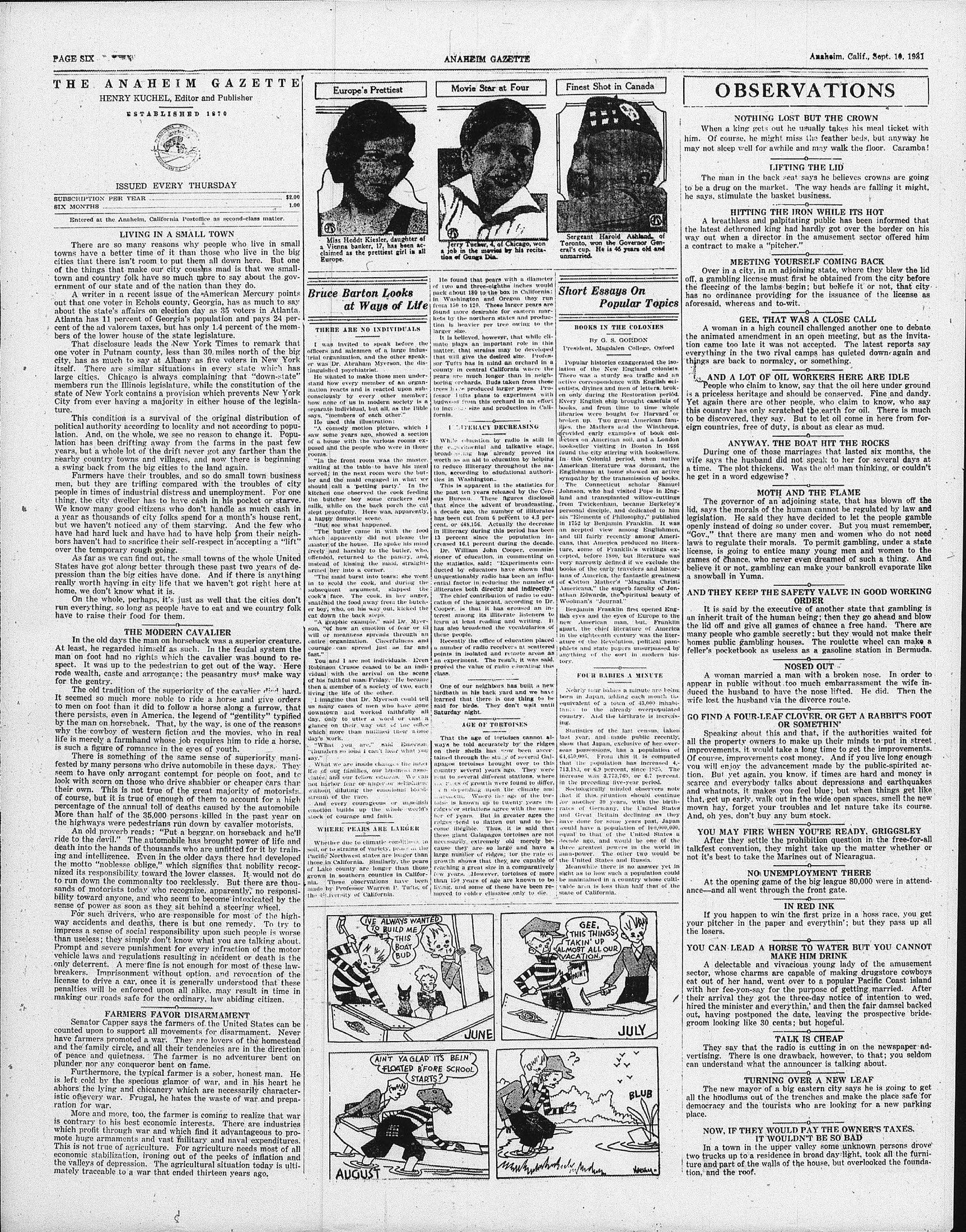
Searchable text
THE ANAHEIM GAZETTE
HENRY KUCHEL, Editor and Publisher
ESTABLISHED 1970
ISSUED EVERY THURSDAY
SUBSCRIPTION PER YEAR $2.00
SIX MONTHS 1.00
Entered at the Anaheim, California Postoffice as second-class matter.
LIVING IN A SMALL TOWN
There are so many reasons why people who live in small towns have a better time of it than those who live in the big cities that there isn't room to put them all down here. But one of the things that make our city cousins mad is that we small-town and country folk have so much more to say about the government of our state and of the nation than they do.
A writer in a recent issue of the American Mercury points out that one voter in Echols county, Georgia, has as much to say about the state's affairs on election day as 35 voters in Atlanta. Atlanta has 11 percent of Georgia's population and pays 24 percent of the ad valorem taxes, but has only 1.4 percent of the members of the lower house of the state legislature.
That disclosure leads the New York Times to remark that one voter in Putnam county, less than 30 miles north of the big city, has as much to say at Albany as five voters in New York itself. There are similar situations in every state which has large cities. Chicago is always complaining that "down-state" members run the Illinois legislature, while the constitution of the state of New York contains a provision which prevents New York City from ever having a majority in either house of the legislature.
This condition is a survival of the original distribution of political authority according to locality and not according to population. And, on the whole, we see no reason to change it. Population has been drifting away from the farms in the past few years, but a whole lot of the drift never got any farther than the nearby country towns and villages, and now there is beginning...
There are similar situations in every state which has large cities. Chicago is always complaining that "down-state" members run the Illinois legislature, while the constitution of the state of New York contains a provision which prevents New York City from ever having a majority in either house of the legislature.
This condition is a survival of the original distribution of political authority according to locality and not according to population. And, on the whole, we see no reason to change it. Population has been drifting away from the farms in the past few years, but a whole lot of the drift never got any farther than the nearby country towns and villages, and now there is beginning a swing back from the big cities to the land again.
Farmers have their troubles, and so do small town business men, but they are trifling compared with the troubles of city people in times of industrial distress and unemployment. For one thing, the city dweller has to have cash in his pocket or starve. We know many good citizens who don't handle as much cash in a year as thousands of city folks spend for a month's house rent, but we haven't noticed any of them starving. And the few who have had hard luck and have had to have help from their neighbors haven't had to sacrifice their self-respect in accepting a "lift" over the temporary rough going.
As far as we can find out, the small towns of the whole United States have got along better through these past two years of depression than the big cities have done. And if there is anything really worth having in city life that we haven't got right here at home, we don't know what it is.
On the whole, perhaps, it's just as well that the cities don't run everything, so long as people have to eat and we country folk have to raise their food for them.
THE MODERN CAVALIER
In the old days the man on horseback was a superior creature. At least, he regarded himself as such. In the feudal system the man on foot had no rights which the cavalier was bound to respect. It was up to the pedestrian to get out of the way. Here rode wealth, caste and arrogance; the peasantry must make way for the gentry.
The old tradition of the superiority of the cavalier died hard. It seemed so much more noble to ride a horse and give orders to men on foot than it did to follow a horse along a furrow, that there persists, even in America, the legend of "gentility" typified by the man on horseback. That, by the way, is one of the reasons why the cowboy of western fiction and the movies, who in real life is merely a farmhand whose job requires him to ride a horse, is such a figure of romance in the eyes of youth.
There is something of the same sense of superiority manifested by many persons who drive automobile in these days. They seem to have only arrogant contempt for people on foot, and to look with scorn on those who drive shabbier or cheaper cars than their own. This is not true of the great majority of motorists, of course, but it is true of enough of them to account for a high percentage of the annual toll of deaths caused by the automobile. More than half of the 35,000 persons killed in the past year on the highways were pedestrians run down by cavalier motorists.
An old proverb reads: "Put a beggar on horseback and he'll ride to the devil." The automobile has brought power of life and death into the hands of thousands who are unfitted for it by training and intelligence. Even in the older days there had developed the motto "noblesse oblige," which signifies that nobility recog-
seem to have only arrogant contempt for people on foot, and to look with scorn on those who drive shabbier or cheaper cars than their own. This is not true of the great majority of motorists, of course, but it is true of enough of them to account for a high percentage of the annual toll of deaths caused by the automobile. More than half of the 35,000 persons killed in the past year on the highways were pedestrians run down by cavalier motorists.
An old proverb reads: "Put a beggar on horseback and he'll ride to the devil." The automobile has brought power of life and death into the hands of thousands who are unfitted for it by training and intelligence. Even in the older days there had developed the motto "noblesse oblige," which signifies that nobility recognized its responsibility toward the lower classes. It would not do to run down the commonalty too recklessly. But there are thousands of motorists today who recognize, apparently, no responsibility toward anyone, and who seem to become intoxicated by the sense of power as soon as they sit behind a steering wheel.
For such drivers, who are responsible for most of the highway accidents and deaths, there is but one remedy. To try to impress a sense of social responsibility upon such people is worse than useless; they simply don't know what you are talking about. Prompt and severe punishment for every infraction of the motor vehicle laws and regulations resulting in accident or death is the only deterrent. A mere fine is not enough for most of these law-breakers. Imprisonment without option, and revocation of the license to drive a car, once it is generally understood that these penalties will be enforced upon all alike, may result in time in making our roads safe for the ordinary, law abiding citizen.
FARMERS FAVOR DISARMAMENT
Senator Capper says the farmers of the United States can be counted upon to support all movements for disarmament. Never have farmers promoted a war. They are lovers of the homestead and the family circle, and all their tendencies are in the direction of peace and quietness. The farmer is no adventurer bent on plunder nor any conqueror bent on fame.
Furthermore, the typical farmer is a sober, honest man. He is left cold by the specious glamor of war, and in his heart he abhors the lying and chicanery which are necessarily characteristic of every war. Frugal, he hates the waste of war and preparation for war.
More and more, too, the farmer is coming to realize that war is contrary to his best economic interests. There are industries which profit through war and which find it advantageous to promote huge armaments and vast military and naval expenditures. This is not true of agriculture. For agriculture needs most of all economic stabilization, ironing out of the peeks of inflation and the valleys of depression. The agricultural situation today is ultimately traceable to a war that ended thirteen years ago.
ANAHEIM GAZETTE
Europe's Prettiest
Miss Heddt Kiesler, daughter of a Vienna banker, 17, has been acclaimed as the prettiest girl in all Europe.
Movie Star at Four
Jerry Tucker, 4, of Chicago, won a job in the movies by his recitation of Gunga Dia.
Finest Shot in Canada
Sergeant Harold Ashland, of Toronto, won the Governor General's cup. He is 46 years old and unmarried.
Bruce Barton Looks at Ways of Life
THERE ARE NO INDIVIDUALS
I was invited to speak before the officers and salesmen of a large industrial organization, and the other speaker was Dr. Abraham Myerson, the distinguished psychiatrist.
He wanted to make those men understand how every member of an organization reacts and is reacted upon sub-consciously by every other member; how none of us in modern society is a separate individual, but all, as the Bible says, "members of each other."
He used this illustration:
"A comedy motion picture, which I saw some years ago, showed a section of a house with the various rooms exposed and the people who were in those rooms.
He found that pears with a diameter of two and three-eighths inches would pack about 180 to the box in California; in Washington and Oregon they run from 150 to 120. These larger pears are found more desirable for eastern markets by the northern states and production is heavier per tree owing to the larger size.
It is believed, however, that while climate plays an important role in this matter, that strains may be developed that will give the desired size. Professor Tufts has in mind an orchard in a county in central California where the pears are much longer than in neighboring orchards. Buds taken from these trees have produced larger pears. Professor Tufts plans to experiment with budworm from this orchard in an effort to increase size and production in California.
LITERACY DECREASING
While education by radio is still in the experimental and talkative stage, broadcasting has already proved its worth as an aid to education by helping book collectors on American soil, and a London bookseller visiting in Boston in 1868 found the city stirring with booksellers.
Short Essays On Popular Topics
BOOKS IN THE COLONIES
By G. S. GORDON
President, Magdalen College, Oxford
Popular histories exaggerated the isolation of the New England colonists. There was a sturdy sea traffic and an active correspondence with English scientists, diyines and men of letters, broken only during the Restoration period. Every English ship brought casefuls of books, and from time to time whole libraries were bought for Harvard or broken up. Two great American families, the Mathers and the Winthrops, provided early examples of book collectors on American soil, and a London bookseller visiting in Boston in 1868 found the city stirring with booksellers.
In this Colonial period when native
WHERE PEARS ARE LARGER
Whether due to climatic conditions, soil, or strains of variety, pears in the Pacific Northwest states are longer than those in California. Similarly, the pears of Lake County are longer than those in New York.
He wanted to make those men understand how every member of an organization reacts and is reacted upon subconsciously by every other member; how none of us in modern society is a separate individual, but all, as the Bible says, "members of each other."
He used this illustration:
"A comedy motion picture, which I saw some years ago, showed a section of a house with the various rooms exposed and the people who were in those rooms.
"In the front room was the master, waiting at the table to have his meal served; in the next room were the butter and the maid engaged in what we should call a 'petting party.' In the kitchen one observed the cook feeding the butcher boy some crackers and milk, while on the back porch the cat slept peacefully. Here was, apparently, a happy domestic scene.
"But see what happened.
"The butler came in with the food which apparently did not please the master of the house. He spoke his mind freely and harshly to the butter, who offended, returned to the panry, and instead of kissing the maid, straight-armed her into a corner.
"The maid burst into tears: she went in to scold the cook, and during the subsequent argument, slapped the cook's face. The cook, in her anger, snatched the food away from the butcher boy, who, on his way out, kicked the cat down the back steps.
"A graphic example," said Dr. Myerson, "of how an emotion of fear or will or meanness spreads through an entire organization. Cheerfulness and courage can spread just as far and fast."
You and I are not individuals. Even Robinson Crusoe ceased to be an individual with the arrival on the scene of his faithful man Friday. He became then a member of a society of two, each living the life of the other.
I imagine that Dr. Myerson could tell us many cases of men who have gone downtown and worked faithfully all day, only to utter a word or cast a glance on their way out of the office which more than nullified their whole day's work.
"What you are," said Emerson "thundered loud I can't hear what you say."
What we are inside changes the life of our families, our business associates and our fellow citizens. We can not harbor fear or anger or selfishness without diluting the emotional bloodstream of the race.
And every courageous or unselfish emotion builds up the whole world's stock of courage and faith.
WHERE PEARS ARE LARGER
Whether due to climatic conditions, soil, or strains of variety, pears in the Pacific Northwest states are longer than those in California. Similarly, the pears of Lake County are longer than those in New York.
He wanted to make those men understand how every member of an organization reacts and is reacted upon subconsciously by every other member; how none of us in modern society is a separate individual, but all, as the Bible says, "members of each other."
He used this illustration:
"A comedy motion picture, which I saw some years ago, showed a section of a house with the various rooms exposed and the people who were in those rooms.
"In the front room was the master, waiting at the table to have his meal served; in the next room were the butter and the maid engaged in what we should call a 'petting party.' In the kitchen one observed the cook feeding the butcher boy some crackers and milk, while on the back porch the cat slept peacefully. Here was, apparently, a happy domestic scene.
"But see what happened.
"The butler came in with the food which apparently did not please the master of the house. He spoke his mind freely and harshly to the butter, who offended, returned to the panry, and instead of kissing the maid, straight-armed her into a corner.
"The maid burst into tears: she went in to scold the cook, and during the subsequent argument, slapped the cook's face. The cook, in her anger, snatched the food away from the butcher boy, who, on his way out, kicked the cat down the back steps.
"A graphic example," said Dr. Myerson, "of how an emotion of fear or will or meanness spreads through an entire organization. Cheerfulness and courage can spread just as far and fast."
You and I are not individuals. Even Robinson Crusoe ceased to be an individual with the arrival on the scene of his faithful man Friday. He became then a member of a society of two, each living the life of the other.
I imagine that Dr. Myerson could tell us many cases of men who have gone downtown and worked faithfully all day, only to utter a word or cast a glance on their way out of the office which more than nullified their whole day's work.
"What you are," said Emerson "thundered loud I can't hear what you say."
What we are inside changes the life of our families, our business associates and our fellow citizens. We can not harbor fear or anger or selfishness without diluting the emotional bloodstream of the race.
And every courageous or unselfish emotion builds up the whole world's stock of courage and faith.
WHERE PEARS ARE LARGER
Whether due to climatic conditions, soil, or strains of variety, pears in the Pacific Northwest states are longer than those in California. Similarly, the pears of Lake County are longer than those in New York.
He wanted to make those men understand how every member of an organization reacts and is reacted upon subconsciously by every other member; how none of us in modern society is a separate individual, but all, as the Bible says, "members of each other."
He used this illustration:
"A comedy motion picture, which I saw some years ago, showed a section of a house with the various rooms exposed and the people who were in those rooms.
"In the front room was the master, waiting at the table to have his meal served; in the next room were the butter and the maid engaged in what we should call a 'petting party.' In the kitchen one observed the cook feeding the butcher boy some crackers and milk, while on the back porch the cat slept peacefully. Here was, apparently, a happy domestic scene.
"But see what happened.
"The butler came in with the food which apparently did not please the master of the house. He spoke his mind freely and harshly to the butter, who offended, returned to the panry, and instead of kissing the maid, straight-armed her into a corner.
"The maid burst into tears: she went in to scold the cook, and during the subsequent argument, slapped the cook's face. The cook, in her anger, snatched the food away from the butcher boy, who, on his way out, kicked the cat down the back steps.
"A graphic example," said Dr. Myerson, "of how an emotion of fear or will or meanness spreads through an entire organization. Cheerfulness and courage can spread just as far and fast."
You and I are not individuals. Even Robinson Crusoe ceased to be an individual with the arrival on the scene of his faithful man Friday. He became then a member of a society of two, each living the life of the other.
I imagine that Dr. Myerson could tell us many cases of men who have gone downtown and worked faithfully all day, only to utter a word or cast a glance on their way out of the office which more than nullified their whole day's work.
"What you are," said Emerson "thundered loud I can't hear what you say."
What we are inside changes the life of our families, our business associates and our fellow citizens. We can not harbor fear or anger or selfishness without diluting the emotional bloodstream of the race.
And every courageous or unselfish emotion builds up the whole world's stock of courage and faith.
WHERE PEARS ARE LARGER
Whether due to climatic conditions, soil, or strains of variety, pears in the Pacific Northwest states are longer than those in California. Similarly, the pears of Lake County are longer than those in New York.
He wanted to make those men understand how every member of an organization reacts and is reacted upon subconsciously by every other member; how none of us in modern society is a separate individual, but all, as the Bible says, "members of each other."
He used this illustration:
"A comedy motion picture, which I saw some years ago, showed a section of a house with the various rooms exposed and the people who were in those rooms.
"In the front room was the master, waiting at the table to have his meal served; in the next room were the butter and the maid engaged in what we should call a 'petting party.' In the kitchen one observed the cook feedingthe butcher boy some crackers and milk, while on his way out of the office which more than nullified their whole day's work.
"What you are," said Emerson "thundered loud I can't hear what you say."
What we are inside changes the life of our families, our business associates and our fellow citizens. We can not harbor fear or anger or selfishness without diluting the emotional bloodstream of the race.
And every courageous or unselfish emotion builds up the whole world's stock of courage and faith.
WHERE PEARS ARE LARGER
Whether due to climatic conditions, soil, or strains of variety, pears in the Pacific Northwest states are longer than those in California. Similarly, the pears of Lake County are longer than those in New York.
He wanted to make those men understand how every member of an organization reacts and is reacted upon subconsciously by every other member; how none of us in modern society is a separate individual, but all, as the Bible says, "members of each other."
He used this illustration:
"A comedy motion picture, which I saw some years ago, showed a section of a house with the various rooms exposed and the people who were in those rooms.
"In the front room was the master, waiting at the table to have his meal served; in the next room werethe butter andthe maidengagedinwhathestoriedationperiod.EveryEnglishshipbroughtcasefulsofbooks,andfromtimetwowhilibrarieswere boughtforHarvard'orbrokenup.TwogreatAmericanfamilys,theMathersandtheWinthropsprovidedearlyexamplesofbookcollectorsonAmericansoil,andaLondonbooksellervisitinginBoston1686foundthecitystirringwithbooksellers.InthisColonialperiod,whennativeAmericanliteraturewasdormant,theEnglishmanatathomeshowedanactivesympathybythetransmissionofbooks.TheConnecticutscholarSamuelJohnson,whohadvisitedPopeinEnglandandtransplantedWillow-cuttingsfromTwickenham,becameBerkeley'spersonaldisciple,anddedicatedtohimis"ElementsofPhilosophy,"publishedin1752byBenjaminFranklin。它wasanacceptedviewamongEnglishmen,andtillfairlyrecentlyamencians,theAmericaproducedno literature,someofFranklin'swritingexceptbefore1800,但literaturewasverynarrowdefinedifweexcludethebooksoftheearlytravelersand historiansofAmerica,thefantasticgreatnessofCottonMather's"MagnoliaChristianAmericana,"thesuperbfacultyofJonathanEdwards,thespiritualbeautyofWoolman's"Journal."
BenjaminFranklinfirstopenEnglisheyesandtheeyesofEuropetotheNewAmericanman,但Franklinapart,the chief literatureofAmericaintheeighteenthcenturywastheliteratureoftheRevolution,politicalpamphletsandstatepapersunsurpassedbyanythingofthesortinmodernhistory.
FOUR BABIES A MINUTE
Nearly four babies a minute are being borninJapan,addingeachmonththeequivalentofa townof43000inhabitantstothealreadyoverpopulatedcountry.Andthebirthrateisincreasing.
Statisticsofthelastcensus,takenlastyear,andmadepublicrecentlyshowthatJapan,exclusiveofheroversepossessions,hasa populationof6445000.Fromthisititiscomputedthatthepopulationhasincreased4713183,或69percent,since1925.Theincreasewas3773769,或67percent.intheprecedingfive-yearperiod.Sociologicallymindedobserversnoteifthatifthis situationshouldcontinueoranother30years.withthebirthratesofGermany,theUnitedStatesandGreatBritaindecliningastheyhavedonefordsomeyearspast.Japanwouldhavea populationof10000000,equaltothatoftheUnitedStatesadecadeago,andwouldbeoneofthethree greatestpowersintheworldinmain-power.TheothertwowouldbeTheUnitedStatesandRussia.MeanshowthereisnoansweryetinPopularhistoryexaggeratedtheisolationoftheNewEnglandcoloniesTherewasa sturdysea trafficandanactivecorrespondencewithEnglishscientists,diyinesandmenofletters.brokenonlyduringtheRestorationperiod.EveryEnglishshipbroughtcasefulsofbooks,andfromtimetwowhilibrarieswere boughtforHarvard'orbrokenup.TwogreatAmericanfamilys,theMathersandtheWinthropsprovidedearlyexamplesofbookcollectorsonAmericansoil,andaLondonbooksellervisitinginBoston1686foundthecitystirringwithbooksellers.InthisColonialperiod,whennativeAmericanliteraturewasdormant,theEnglishmanatathomeshowedanactivesympathybythetransmissionofbooks.TheConnecticutscholarSamuelJohnson,whohadvisitedPopeinEnglandandtransplantedWillow-cuttingsfromTwickenham,becameBerkeley'spersonaldisciple,anddedicatedtohimis"ElementsofPhilosophy,"publishedin1752byBenjaminFranklin.它wasanacceptedviewamongEnglishmen,andtillfairlyrecentlyamencians,theAmericaproducedno literature,someofFranklin'swritingexceptbefore1800,但literaturewasverynarrowdefinedifweexcludethebooksoftheearlytravelers和 historiansofAmerica,thefantasticgreatnessofCottonMather's"MagnoliaChristianAmericana,"thesuperbfacilityofJonathanEdwards,thespiritualbeautyofWoolman's"Journal."
WE can not harbor fear or anger or seismics without diluting the emotional bloodstream of the race.
And every courageous or unselfish emotion builds up the whole world's stock of courage and faith.
WHERE PEARS ARE LARGER
Whether due to climatic conditions to soil, or to strains of variety, pears in the Pacific Northwest states are longer than those in California. Similarly, the pears of Lake county are longer than those grown in southern counties in California. These observations have been made by Professor Warren P. Tufts, of the 45th university of California.
In several different stations, where races of growth were found to differ, on depending upon the climate and environment. Where the age of the tortoise is known up to twenty years the ridges or striations agree with the number of years. But in greater ages the ridges tend to flatten out and become illegible. Thus, it is said that these giant Galapagos tortoises are not necessarily extremely old merely because they are so large and have a large number of ridges; for the rate of growth shows that they are capable of reaching a great size in a comparatively few years. However, tortoises of more than 150 years of age are known to be living, and some of these have been removed to colder climates only to die.
Sociologically minded observers note that if this situation should continue for another 30 years, with the birth-rates of Germany, the United States and Great Britain declining as they have done for some years past, Japan would have a population of 100,000,000 equal to that of the United States a decade ago, and would be one of the three greatest powers in the world in main-power. The other two would be the United States and Russia.
Meanwhile there is no answer yet in sight as to how such a population could be maintained in a country whose cultivable area is less than half that of the state of California.
OBSERVATIONS
NOTHING LOST BUT THE CROWN
When a king gets out he usually takes his meal ticket with him. Of course, he might miss the feather beds, but anyway he may not sleep well for awhile and may walk the floor. Caramba!
LIFTING THE LID
The man in the back seat says he believes crowns are going to be a drug on the market. The way heads are falling it might, he says, stimulate the basket business.
HITTING THE IRON WHILE ITS HOT
A breathless and palpitating public has been informed that the latest dethroned king had hardly got over the border on his way out when a director in the amusement sector offered him a contract to make a "pitcher."
MEETING YOURSELF COMING BACK
Over in a city, in an adjoining state, where they blew the lid off, a gambling license must first be obtained from the city before the fleecing of the lambs begin; but believe it or not, that city has no ordinance providing for the issuance of the license as aforesaid, whereas and to-wit.
GEE, THAT WAS A CLOSE CALL
A woman in a high council challenged another one to debate the animated amendment in an open meeting, but as the invitation came too late it was not accepted. The latest reports say everything in the two rival camps has quieted down again and things are back to normalcy, or something.
AND A LOT OF OIL WORKERS HERE ARE IDLE
People who claim to know, say that the oil here under ground is a priceless heritage and should be conserved. Fine and dandy. Yet again there are other people, who claim to know, who say this country has only scratched the earth for oil. There is much to be discovered, they say. But to let oil come in here from foreign countries, free of duty, is about as clear as mud.
ANYWAY, THE BOAT HIT THE ROCKS
During one of those marriages that lasted six months, the wife says the husband did not speak to her for several days at
AND A LOT OF OIL WORKERS HERE ARE IDLE
People who claim to know, say that the oil here under ground is a priceless heritage and should be conserved. Fine and dandy. Yet again there are other people, who claim to know, who say this country has only scratched the earth for oil. There is much to be discovered, they say. But to let oil come in here from foreign countries, free of duty, is about as clear as mud.
ANYWAY, THE BOAT HIT THE ROCKS
During one of those marriages that lasted six months, the wife says the husband did not speak to her for several days at a time. The plot thickens. Was the old man thinking, or couldn't he get in a word edgewise?
MOTH AND THE FLAME
The governor of an adjoining state, that has blown off the lid, says the morals of the human cannot be regulated by law and legislation. He said they have decided to let the people gamble openly instead of doing so under cover. But you must remember, "Gov.," that there are many men and women who do not need laws to regulate their morals. To permit gambling, under a state license, is going to entice many young men and women to the games of chance, who never even dreamed of such a thing. And believe it or not, gambling can make your bankroll evaporate like a snowball in Yuma.
AND THEY KEEP THE SAFETY VALVE IN GOOD WORKING ORDER
It is said by the executive of another state that gambling is an inherit trait of the human being; then they go ahead and blow the lid off and give all games of chance a free hand. There are many people who gamble secretly; but they would not make their homes public gambling houses. The roulette wheel can make a feller's pocketbook as useless as a gasoline station in Bermuda.
NOSED OUT
A woman married a man with a broken nose. In order to appear in public without too much embarrassment the wife induced the husband to have the nose lifted. He did. Then the wife lost the husband via the divorce route.
GO FIND A FOUR-LEAF CLOVER, OR GET A RABBIT'S FOOT OR SOMETHIN'
Speaking about this and that, if the authorities waited for all the property owners to make up their minds to put in street improvements, it would take a long time to get the improvements. Of course, improvements cost money. And if you live long enough you will enjoy the advancement made by the public-spirited action. But yet again, you know, if times are hard and money is scarce and everybody talks about depressions and earthquakes and whatnots, it makes you feel blue; but when things get like that, get up early, walk out in the wide open spaces, smell the new mown hay, forget your troubles and let nature take its course. And, oh yes, don't buy any bum stock.
YOU MAY FIRE WHEN YOU'RE READY, GRIGGSLEY
After they settle the prohibition question in the free-for-all talkfest convention, they might take up the matter whether or not it's best to take the Marines out of Nicaragua.
YOU MAY FIRE WHEN YOU'RE READY, GRIGGSLEY
After they settle the prohibition question in the free-for-all talkfest convention, they might take up the matter whether or not it's best to take the Marines out of Nicaragua.
NO UNEMPLOYMENT THERE
At the opening game of the big league 80,000 were in attendance—and all went through the front gate.
IN RED INK
If you happen to win the first prize in a hoss race, you get your pitcher in the paper and everythin'; but they pass up all the losers.
YOU CAN LEAD A HORSE TO WATER BUT YOU CANNOT MAKE HIM DRINK
A delectable and vivacious young lady of the amusement sector, whose charms are capable of making drugstore cowboys eat out of her hand, went over to a popular Pacific Coast island with her fee-yon-say for the purpose of getting married. After their arrival they got the three-day notice of intention to wed, hired the minister and everythin,' and then the fair damsel backed out, having postponed the date, leaving the prospective bride-groom looking like 30 cents; but hopeful.
TALK IS CHEAP
They say that the radio is cutting in on the newspaper advertising. There is one drawback, however, to that; you seldom can understand what the announcer is talking about.
TURNING OVER A NEW LEAF
The new mayor of a big eastern city says he is going to get all the hoodlums out of the trenches and make the place safe for democracy and the tourists who are looking for a new parking place.
NOW, IF THEY WOULD PAY THE OWNER'S TAXES,
IT WOULDN'T BE SO BAD
In a town in the upper valley some unknown persons drove two trucks up to a residence in broad day light, took all the furniture and part of the walls of the house, but overlooked the foundation, and the roof.