anaheim-gazette 1931-08-20
Scanned page
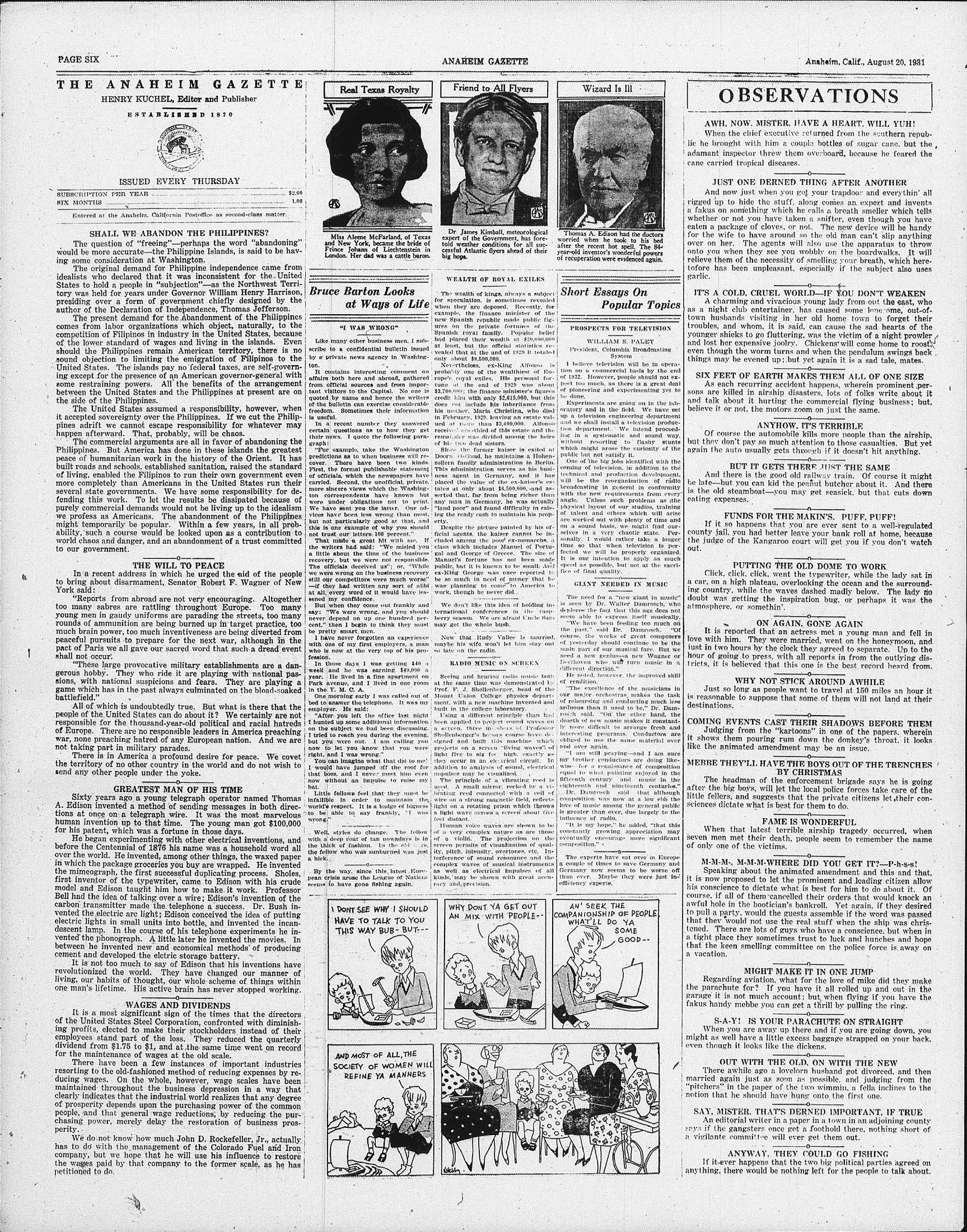
Searchable text
THE ANAHEIM GAZETTE
HENRY KUCHEL, Editor and Publisher
ESTABLISHED 1870
ISSUED EVERY THURSDAY
SUBSCRIPTION PER YEAR $2.00
SIX MONTHS 1.00
Entered at the Anaheim, California Postoffice as second-class matter.
SHALL WE ABANDON THE PHILIPPINES?
The question of "freeing"—perhaps the word "abandoning" would be more accurate—the Philippine Islands, is said to be having some consideration at Washington.
The original demand for Philippine independence came from idealists who declared that it was inconsistent for the United States to hold a people in "subjection"—as the Northwest Territory was held for years under Governor William Henry Harrison, presiding over a form of government chiefly designed by the author of the Declaration of Independence, Thomas Jefferson.
The present demand for the abandonment of the Philippines comes from labor organizations which object, naturally, to the competition of Filipinos in industry in the United States, because of the lower standard of wages and living in the islands. Even should the Philippines remain American territory, there is no sound objection to limiting the emigration of Filipinos to the United States. The islands pay no federal taxes, are self-governing except for the presence of an American governor-general with some restraining powers. All the benefits of the arrangement between the United States and the Philippines at present are on the side of the Philippines.
The United States assumed a responsibility, however, when it accepted sovereignty over the Philippines. If we cut the Philippines adrift we cannot escape responsibility for whatever may happen afterward. That, probably, will be chaos.
The commercial arguments are all in favor of abandoning the Philippines. But America has done in these islands the greatest peace of humanitarian work in the history of the Orient. It has
United States. The islands pay no federal taxes, are self-governing except for the presence of an American governor-general with some restraining powers. All the benefits of the arrangement between the United States and the Philippines at present are on the side of the Philippines.
The United States assumed a responsibility, however, when it accepted sovereignty over the Philippines. If we cut the Philippines adrift we cannot escape responsibility for whatever may happen afterward. That, probably, will be chaos.
The commercial arguments are all in favor of abandoning the Philippines. But America has done in these islands the greatest peace of humanitarian work in the history of the Orient. It has built roads and schools, established sanitation, raised the standard of living, enabled the Filipinos to run their own government even more completely than Americans in the United States run their several state governments. We have some responsibility for defending this work. To let the results be dissipated because of purely commercial demands would not be living up to the idealism we profess as Americans. The abandonment of the Philippines might temporarily be popular. Within a few years, in all probability, such a course would be looked upon as a contribution to world chaos and danger, and an abandonment of a trust committed to our government.
THE WILL TO PEACE
In a recent address in which he urged the aid of the people to bring about disarmament, Senator Robert F. Wagner of New York said:
"Reports from abroad are not very encouraging. Altogether too many sabres are rattling throughout Europe. Too many young men in gaudy uniforms are parading the streets, too many rounds of ammunition are being burned up in target practice, too much brain power, too much inventiveness are being diverted from peaceful pursuits to prepare for the next war, although in the pact of Paris we all gave our sacred word that such a dread event shall not occur.
"These large provocative military establishments are a dangerous hobby. They who ride it are playing with national passions, with national suspicions and fears. They are playing a game which has in the past always culminated on the blood-soaked battlefield."
All of which is undoubtedly true. But what is there that the people of the United States can do about it? We certainly are not responsible for the thousand-year-old political and racial hatreds of Europe. There are no responsible leaders in America preaching war, none preaching hatred of any European nation. And we are not taking part in military parades.
There is in America a profound desire for peace. We covet the territory of no other country in the world and do not wish to send any other people under the yoke.
GREATEST MAN OF HIS TIME
Sixty years ago a young telegraph operator named Thomas A. Edison invented a method of sending messages in both directions at once on a telegraph wire. It was the most marvelous human invention up to that time. The young man got $100,000 for his patent, which was a fortune in those days.
He began experimenting with other electrical inventions, and before the Centennial of 1876 his name was a household word all over the world. He invented, among other things, the waxed paper in which the package groceries you buy are wrapped. He invented the mimeograph.
GREATEST MAN OF HIS TIME
Sixty years ago a young telegraph operator named Thomas A. Edison invented a method of sending messages in both directions at once on a telegraph wire. It was the most marvelous human invention up to that time. The young man got $100,000 for his patent, which was a fortune in those days.
He began experimenting with other electrical inventions, and before the Centennial of 1876 his name was a household word all over the world. He invented, among other things, the waxed paper in which the package groceries you buy are wrapped. He invented the mimeograph, the first successful duplicating process. Sholes, first inventor of the typewriter, came to Edison with his crude model and Edison taught him how to make it work. Professor Bell had the idea of talking over a wire; Edison's invention of the carbon transmitter made the telephone a success. Dr. Bush invented the electric arc light; Edison conceived the idea of putting electric lights in small units into bottle, and invented the incandescent lamp. In the course of his telephone experiments he invented the phonograph. A little later he invented the movies. In between he invented new and economical methods of producing cement and developed the electric storage battery.
It is not too much to say of Edison that his inventions have revolutionized the world. They have changed our manner of living, our habits of thought, our whole scheme of things within one man's lifetime. His active brain has never stopped working.
WAGES AND DIVIDENDS
It is a most significant sign of the times that the directors of the United States Steel Corporation, confronted with diminishing profits, elected to make their stockholders instead of their employees stand part of the loss. They reduced the quarterly dividend from $1.75 to $1, and at the same time went on record for the maintenance of wages at the old scale.
There have been a few instances of important industries resorting to the old-fashioned method of reducing expenses by reducing wages. On the whole, however, wage scales have been maintained throughout the business depression in a way that clearly indicates that the industrial world realizes that any degree of prosperity depends upon the purchasing power of the common people, and that general wage reductions, by reducing the purchasing power, merely delay the restoration of business prosperity.
We do not know how much John D. Rockefeller, Jr., actually has to do with the management of the Colorado Fuel and Iron company, but we hope that he will use his influence to restore the wages paid by that company to the former scale, as he has petitioned to do.
ANAHEIM GAZETTE
Real Texas Royalty
Miss Aleene McFarland, of Texas and New York, became the bride of Prince Johann of Liechtenstein in London. Her dad was a cattle baron.
Friend to All Flyers
Dr James Kimball, meteorological expert of the Government, has foretold weather conditions for all successful Atlantic flyers ahead of their big hops.
Wizard Is Ill
Thomas A. Edison had the doctors worried when he took to his bed after the recent hot spell. The 84-year-old inventor's wonderful powers of recuperation were evidenced again.
Bruce Barton Looks at Ways of Life
"I WAS WRONG"
Like many other business men, I subscribe to a confidential bulletin issued by a private news agency in Washington.
It contains interesting comment on affairs both here and abroad, gathered from official sources and from important visitors to the Capital. No one is quoted by name and hence the writers of the bulletin can exercise considerable freedom. Sometimes their information is useful.
In a recent number they answered certain questions as to how they get their news. I quote the following paragraph:
"For example, take the Washington predictions as to when business will re-
WEALTH OF ROYAL EXILES
The wealth of kings, always a subject for speculation, is sometimes revealed when they are deposed. Recently, for example, the finance minister of the new Spanish republic made public figures on the private fortunes of the Spanish royal family. Popular belief had placed their wealth at $20,000,000 at least, but the official statistics revealed that at the end of 1929 it totaled only about $8,500,000.
Nevertheless, ex-King Alfonso is probably one of the wealthiest of Europe's royal exiles. His personal fortune at the end of 1929 was about $3,700,000; the finance minister's figures credit him with only $2,619,000, but this does not include his inheritance from his mother, Maria Christina, who died in February, 1929, leaving an estate valued at more than $3,400,000. Alfonso received one-third of this estate and the remainder was divided among the heirs of his two dead sisters.
Since the former kaiser is exiled at Doorn Holland, he maintains a Hohen-
Short Essays On Popular Topics
PROSPECTS FOR TELEVISION
WILLIAM S. PALEY
President, Columbia Broadcasting System
I believe television will be in operation on a commercial basis by the end of 1932. However, people should not expect too much, as there is a great deal of pioneering and experimenting yet to be done.
Experiments are going on in the laboratory and in the field. We have set up a television engineering department and we shall install a television production department. We intend proceeding in a systematic and sound way, without resorting to flashy stunts which might arose the curiosity of the public but not satisfy it.
It contains interesting comment on affairs both here and abroad, gathered from official sources and from important visitors to the Capital. No one is quoted by name and hence the writers of the bulletin can exercise considerable freedom. Sometimes their information is useful.
In a recent number they answered certain questions as to how they get their news. I quote the following paragraph:
"For example, take the Washington predictions as to when business will recover. There have been two kinds. First, the formal publishable statement of officials, which the newspapers have carried. Second, the unofficial, private, more sincere views which the Washington correspondents have known but were under obligations not to print. We have sent you the latter. Our advice have been less wrong than most, but not particularly good at that, and this is one example of why you should not trust our letters 100 percent."
That made a great hit with me. If the writers had said: "We misled you a little about the time of the business recovery, but we were not responsible. The officials deceived us"; or, "While we were wrong on the business recovery still our competitors were much worse"—if they had written any sort of alibi at all, every word of it would have lessened my confidence.
But when they come out frankly and say: "We were wrong, and you should never depend on up one hundred percent," then I begin to think they must be pretty smart men.
I have never forgotten an experience with one of my first employers, a man who is now at the very top of his profession.
In those days I was getting $40 a week and he was earning $40,000 a year. He lived in a fine apartment on Park avenue, and I lived in one room in the Y.M.C.A.
One morning early I was called out of bed to answer the telephone. It was my employer. He said:
"After you left the office last night I hunted up some additional information on the subject we had been discussing. I tried to reach you during the evening, but you were out. I am calling you now to let you know that you were right, and I was wrong."
You can imagine what that did to me! I would have jumped off the roof for that boss, and I never meet him even now without an impulse to raise my hat.
Little fellows feel that they must be infallible in order to maintain the world's respect. It is a badge of bigness to be able to say frankly, "I was wrong."
Well, styles do change. The fellow with a deep coat of tan nowadays is in the thick of fashion. In the old days, the fellow who was sunburned was just a hick.
Nevertheless, ex-King Alfonso is probably one of the wealthiest of Europe's royal exiles. His personal fortune at the end of 1929 was about $3,700,000; the finance minister's figures credit him with only $2,619,000, but this does not include his inheritance from his mother, Maria Christina, who died in February 1929, leaving an estate valued at more than $3,400,000. Alfonso received one-third of this estate and the remainder was divided among the heirs of his two dead sisters.
Since the former kaiser is exiled at Doorn Holland, he maintains a Hohenzollern family administration in Berlin. This administration serves as his business agent in Germany, and it has placed the value of the ex-kaiser's estates at only about $6,500,000, and asserted that, far from being richer than any man in Germany, he was actually "land poor" and found difficulty in raising the ready cash to maintain his property.
Despite the picture painted by his official agents, the kaiser cannot be included among the poor ex-monarchs, a class which includes Manuel of Portugal and George of Greece. The size of Manuel's fortune has not been made public, but it is known to be small. And ex-King George was once reported to be so much in need of money that he was planning to come to America to work, though he never did.
We don't like this idea of holding international conferences in the raspberry season. We are afraid Uncle Sam may get the whole bush.
Now that Rudy Vallee is married, maybe his wife won't let him stay out so late on the radio.
RADIO MUSIC ON SCREEN
Seeing and hearing radio music both at the same time was demonstrated by Prof. F. J. Shollenberger, head of the Mount Union College physics department, with a new machine invented and built in the college laboratory.
Using a different principle than had been applied to project sound waves on a screen, three members of Professor Shollenberger's honors course have designed and built this machine which projects on a screen "living waves" of light five to six feet high exactly as they occur in an electrical circuit. In addition to analysis of sound, electrical impulses may be visualized.
The principle of a vibrating reed is used. A small mirror, rocked by a vibrating reed connected with a coil of wire on a strong magnetic field, reflects light on a rotating prism which throws a light wave across a screen about five feet distant.
Human voice waves are shown to be of a very complex nature as are those of a violin. The projection on the screen permits visualization of quality, pitch, intensity, overtones, etc. Interference of sound resonance and the complex waves of musical instruments as well as electrical impulses of all
I believe television will be in operation on a commercial basis by the end of 1932. However, people should not expect too much, as there is a great deal of pioneering and experimenting yet to be done.
Experiments are going on in the laboratory and in the field. We have set up a television engineering department and we shall install a television production department. We intend proceeding in a systematic and sound way, without resorting to flashy stunts which might arise the curiosity of the public but not satisfy it.
One of the big jobs identified with the coming of television, in addition to the technical and production development, will be the reorganization of radio broadcasting in general in conformity with the new requirements from every angle. Unless such problems as the physical layout of our studios, training of talent and others which will arise are worked out with plenty of time and on a sound basis, we might find ourselves in a very chaotic state. Personally, I would rather take a longer time so that when television is perfected we will be properly organized. It is our intention to apply as much speed as possible, but not at the sacrifice of final quality.
GIANT NEEDED IN MUSIC
The need for a "new giant in music" is seen by Dr. Walter Damrosch, who deplores the fact that this age does not seem able to express itself musically.
"We have been feeding too much on the past," said Dr. Damrosch. "Of course, the works of great composers of yesterday should continue to be the main part of our musical fare. But we need a new genius—a new Wagner or Beethoven who will turn music in a different direction."
He noted, however, the improved skill of rendition.
"The excellence of the musicians in our major orchestras makes the task of rehearsing and conducting much less arduous than it used to be," Dr. Damrosch said. "On the other hand, the dearth of new music makes it constantly more difficult to arrange fresh and interesting programs. Conductors are obliged to use the same material over and over again."
"I am still praying—and I am sure my brother conductors are doing likewise—for a renaissance of composition equal to what painting enjoyed in the fifteenth century and music in the eighteenth and nineteenth centuries." Dr. Damrosch said that although composition was now at a low ebb the love of music among the general public is greater than ever, due largely to the influence of radio.
"It is my hope," he added, "that this constantly growing appreciation may eventually encourage more significant composition."
that boss, and I never meet him even now without an impulse to raise my hat.
Little fellows feel that they must be infallible in order to maintain the world's respect. It is a badge of bigness to be able to say frankly, "I was wrong."
Well, styles do change. The fellow with a deep coat of tan nowadays is in the thick of fashion. In the old days, the fellow who was sunburned was just a hick.
By the way, since this latest European crisis arose the League of Nations seems to have gone fishing again.
The principle of a vibrating reed is used. A small mirror, rocked by a vibrating reed connected with a coil of wire on a strong magnetic field, reflects light on a rotating prism which throws a light wave across a screen about five feet distant.
Human voice waves are shown to be of a very complex nature as are those of a violin. The projection on the screen permits visualization of quality, pitch, intensity, overtones, etc. Interference of sound resonance and the complex waves of musical instruments as well as electrical impulses of all kinds, may be shown with great accuracy and precision.
Dr. Damrosch said that although composition was now at a low ebb the love of music among the general public is greater than ever, due largely to the influence of radio.
"It is my hope," he added, "that this constantly growing appreciation may eventually encourage more significant composition."
The experts have sat over in Europe a couple of times to save Germany and Germany now seems to be worse off than ever. Maybe they were just inefficiency experts.
OBSERVATIONS
AWH, NOW, MISTER, HAVE A HEART, WILL YUH!
When the chief executive returned from the southern republic he brought with him a couple bottles of sugar cane, but the adamant inspector threw them overboard, because he feared the cane carried tropical diseases.
JUST ONE DERNED THING AFTER ANOTHER
And now just when you got your trapdoor and everythin' all rigged up to hide the stuff, along comes an expert and invents a fakus on something which he calls a breath smaller which tells whether or not you have taken a snifter, even though you have eaten a package of cloves, or not. The new device will be handy for the wife to have around so the old man can't slip anything over on her. The agents will also use the apparatus to throw onto you when they see you wobbly on the boardwalks. It will relieve them of the necessity of smelling your breath, which here-tofore has been unpleasant, especially if the subject also uses garlic.
IT'S A COLD, CRUEL WORLD—IF YOU DON'T WEAKEN
A charming and vivacious young lady from out the east, who as a night club entertainer, has caused some lonely one, out-of-town husbands visiting in her old home town to forget their troubles, and whom, it is said, can cause the sad hearts of the younger shieks to go fluttering, was the victim of a night prowler and lost her expensive joolry. Chickens will come home to roost, even though the worm turns and when the pendulum swings back things may be evened up; but yet again it is a sad tale, mates.
SIX FEET OF EARTH MAKES THEM ALL OF ONE SIZE
As each recurring accident happens, wherein prominent persons are killed in airship disasters, lots of folks write about it and talk about it hurting the commercial flying business; but, believe it or not, the motors zoom on just the same.
ANYHOW, IT'S TERRIBLE
Of course the automobile kills more people than the airship, but they don't pay so much attention to those casualties. But yet again the auto usually gets through if it doesn't hit anything.
SIX FEET OF EARTH MAKES THEM ALL OF ONE SIZE
As each recurring accident happens, wherein prominent persons are killed in airship disasters, lots of folks write about it and talk about it hurting the commercial flying business; but, believe it or not, the motors zoom on just the same.
ANYHOW, IT'S TERRIBLE
Of course the automobile kills more people than the airship, but they don't pay so much attention to those casualties. But yet again the auto usually gets through if it doesn't hit anything.
BUT IT GETS THERE JUST THE SAME
And there is the good old railway train. Of course it might be late—but you can kid the peanut butcher about it. And there is the old steamboat—you may get seasick, but that cuts down eating expenses.
FUNDS FOR THE MAKIN'S. PUFF, PUFF!
If it so happens that you are ever sent to a well-regulated county jail, you had better leave your bank roll at home, because the judge of the Kangaroo court will get you if you don't watch out.
PUTTING THE OLD DOME TO WORK
Click, click, click, went the typewriter, while the lady sat in a car, on a high plateau, overlooking the ocean and the surrounding country, while the waves dashed madly below. The lady no doubt was getting the inspiration bug, or perhaps it was the atmosphere, or somethin'.
ON AGAIN, GONE AGAIN
It is reported that an actress met a young man and fell in love with him. They were married, went on the honeymoon, and just in two hours by the clock they agreed to separate. Up to the hour of going to press, with all reports in from the outlying districts, it is believed that this one is the best record heard from.
WHY NOT STICK AROUND AWHILE
Just so long as people want to travel at 150 miles an hour it is reasonable to suppose that some of them will not land at their destinations.
COMING EVENTS CAST THEIR SHADOWS BEFORE THEM
Judging from the "kartoons" in one of the papers, wherein it shows them pouring rum down the donkey's throat, it looks like the animated amendment may be an issue.
MEBBE THEY'LL HAVE THE BOYS OUT OF THE TRENCHES BY CHRISTMAS
The headman of the enforcement brigade says he is going after the big boys, will let the local police forces take care of the little fellers, and suggests that the private citizens let their consciences dictate what is best for them to do.
FAME IS WONDERFUL
When that latest terrible airship tragedy occurred, when seven men met their death, people seem to remember the name of only one of the victims.
M-M-M-, M-M-M-WHERE DID YOU GET IT?—P-h-s-s!
Speaking about the animated amendment and its significance.
The headman of the enforcement brigade says he is going after the big boys, will let the local police forces take care of the little fellers, and suggests that the private citizens let their consciences dictate what is best for them to do.
FAME IS WONDERFUL
When that latest terrible airship tragedy occurred, when seven men met their death, people seem to remember the name of only one of the victims.
M-M-M-, M-M-M-WHERE DID YOU GET IT?—P-h-s-s!
Speaking about the animated amendment and this and that, it is now proposed to let the prominent and leading citizen allow his conscience to dictate what is best for him to do about it. Of course, if all of them cancelled their orders that would knock an awful hole in the bootician's bankroll. Yet again, if they desired to pull a party, would the guests assemble if the word was passed that they would not use the real stuff when the ship was christened. There are lots of guys who have a conscience, but when in a tight place they sometimes trust to luck and hunches and hope that the keen smelling committee on the police force is away on a vacation.
MIGHT MAKE IT IN ONE JUMP
Regarding aviation, what for the love of Mike did they make the parachute for? If you have it all rolled up and out in the garage it is not much account; but when flying if you have the fakus handy mebbe you can get a thrill by pulling the ring.
S-A-Y! IS YOUR PARACHUTE ON STRAIGHT
When you are away up there and if you are going down, you might as well have a little excess baggage strapped on your back, even though it looks like the dickens.
OUT WITH THE OLD, ON WITH THE NEW
There awhile ago a lovelorn husband got divorced, and then married again just as soon as possible, and judging from the "pitchers" in the paper of the two wimmin, a fella inclines to the notion that he should have hung onto the first one.
SAY, MISTER, THAT'S DERNED IMPORTANT, IF TRUE
An editorial writer in a paper in a town in an adjoining county says if the gangsters once get a soothold there, nothing short of a vigilante committee will ever get them out.
ANYWAY, THEY COULD GO FISHING
If it ever happens that the two big political parties agreed on anything, there would be nothing left for the people to talk about.