anaheim-gazette 1931-08-06
Scanned page
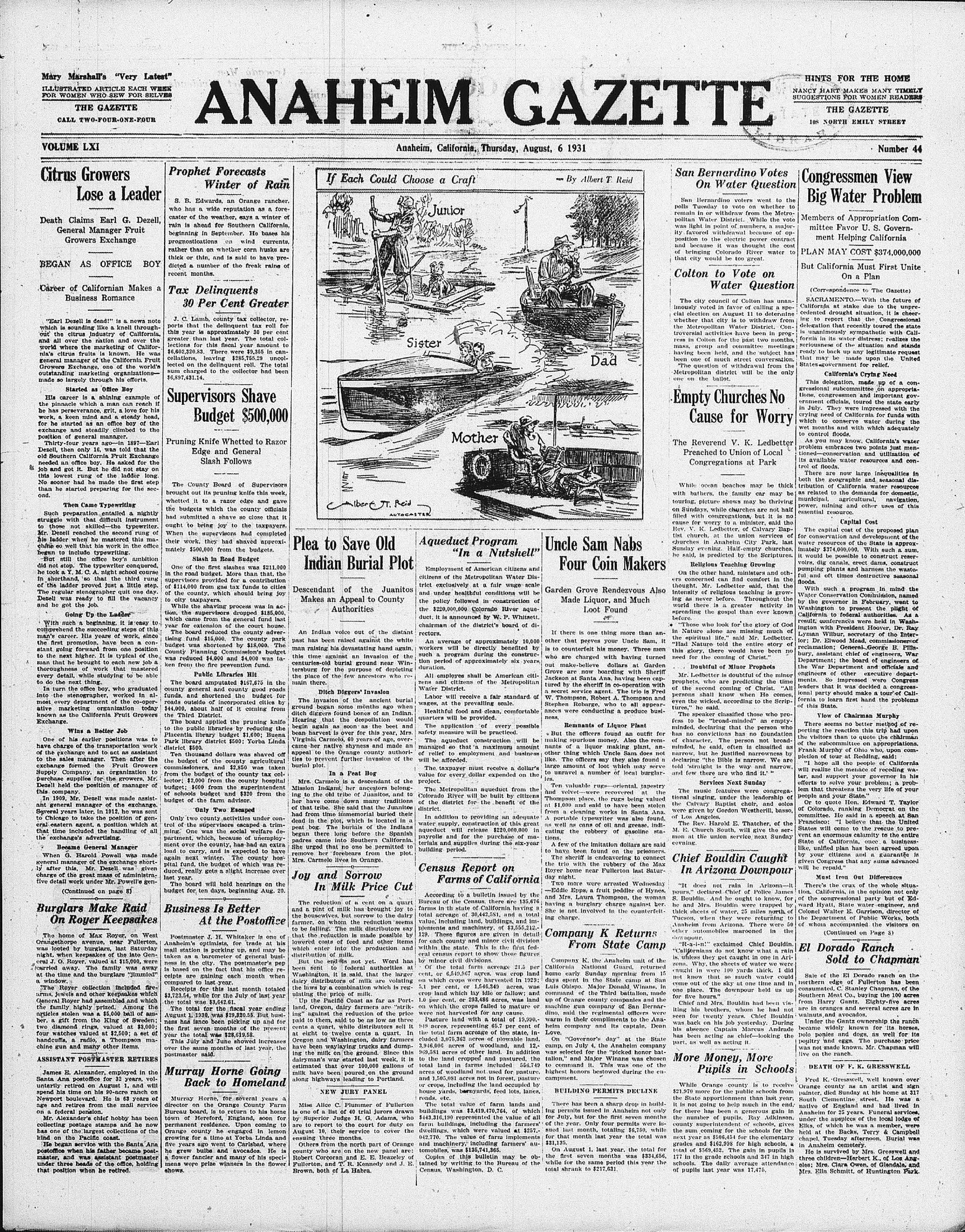
Searchable text
Mary Marshall's "Very Latest"
ILLUSTRATED ARTICLE EACH WEEK FOR WOMEN WHO SEW FOR SELVES
THE GAZETTE
CALL TWO-FOUR-ONE-FOUR
VOLUME LXI
Citrus Growers
Lose a Leader
Death Claims Earl G. Dezell,
General Manager Fruit
Growers Exchange
BEGAN AS OFFICE BOY
Career of Californian Makes a Business Romance
"Earl Dezell is dead!" is a news note which is sounding like a knell throughout the citrus industry of California, and all over the nation and over the world where the marketing of California's citrus fruits is known. He was general manager of the California Fruit Growers Exchange, one of the world's outstanding marketing organizations—made so largely through his efforts.
Started as Office Boy
His career is a shining example of the pinnacle which a man can reach if he has perseverance, grit, a love for his work, a keen mind and a steady head, for he started as an office boy of the exchange and steadily climbed to the position of general manager.
Thirty-four years ago—in 1897—Earl Dezell, then only 16, was told that the old Southern California Fruit Exchange Prophet Forecasts Winter of Rain
S. B. Edwards, an Orange rancher, who has a wide reputation as a forecaster of the weather, says a winter of rain is ahead for Southern California, beginning in September. He bases his prognostications on wind currents, rather than on whether corn husks are thick or thin, and is said to have predicted a number of the freak rains of recent months.
Tax Delinquents 30 Per Cent Greater
J. C. Lamb, county tax collector, reports that the delinquent tax roll for this year is approximately 30 per cent greater than last year. The total collections for this fiscal year amount to $6,502,320.83. There were $9,355 in cancellations, leaving $285,755.29 uncollected on the delinquent roll. The total sum charged to the collector had been $6,897,431.14.
Supervisors Shave Budget $500,000
Pruning Knife Whetted to Razor Edge and General Slow Follows
Started as Office Boy
His career is a shining example of the pinnacle which a man can reach if he has perseverance, grit, a love for his work, a keen mind and a steady head, for he started as an office boy of the exchange and steadily climbed to the position of general manager.
Thirty-four years ago—in 1897—Earl Dezell, then only 16, was told that the old Southern California Fruit Exchange needed an office boy. He asked for the job and got it. But he did not stay on this lowest rung of the ladder long. No sooner had he made the first step than he started preparing for the second.
Then Came Typewriting
Such preparation entailed a nightly struggle with that difficult instrument to those not skilled—the typewriter. Mr. Dezell reached the second rung of his ladder when he mastered this machine so well that his work in the office began to include typewriting.
But still the office boy's ambition did not stop. The typewriter conquered, he took a Y. M. C. A. night school course in shorthand, so that the third rung of the ladder proved just a little step. The regular stenographer quit one day. Dezell was ready to fill the vacancy and he got the job.
Going Up the Ladder
With such a beginning, it is easy to comprehend the succeeding steps of this man's career. His years of work, since the first promotion, have been a constant going forward from one position to the next higher. It is typical of the man that he brought to each new job a thoroughness of work that mastered every detail, while studying to be able to do the next thing.
In turn the office boy, who graduated into the stenographer, worked in almost every department of the co-operative marketing organization today known as the California Fruit Growers Exchange.
Wins a Better Job
One of his earlier positions was to have charge of the transportation work of the exchange and to act as assistant to the sales manager. Then after the exchange formed the Fruit Growers Supply Company, an organization to purchase supplies for the growers, Mr. Dezell held the position of manager of this company.
In 1909, Mr. Dezell was made assistant general manager of the exchange. Several years later, in 1912, he was sent to Chicago to take the position of general eastern agent, a position which at that time included the handling of all the exchange's advertising.
Became General Manager
When G. Harold Powell was made general manager of the exchange shortly after this, Mr. Dezell was given selected on the delinquent roll. The total sum charged to the collector had been $6,897,431.14.
Supervisors Shave Budget $500,000
Pruning Knife Whetted to Razor Edge and General Slash Follows
The County Board of Supervisors brought out its pruning knife this week, whetted it to a razor edge and gave the budgets which the county officials had submitted a shave so close that it ought to bring joy to the taxpayers. When the supervisors had completed their work, they had shaved approximately $500,000 from the budgets.
Slash in Road Budget
One of the first slashes was $211,000 in the road budget. More than that, the supervisors provided for a contribution of $114,000 from gas tax funds to cities of the county, which should bring joy to city taxpayers.
While the shaving process was in action, the supervisors dropped $185,000, which came from the general fund last year for extension of the court house.
The board reduced the county advertising fund $15,000. The county park budget was shortened by $18,000. The County Planning Commission's budget was reduced $4,000 and $4,000 was taken from the fire prevention fund.
Public Libraries Hit
The board amputated $167,675 in the county general and county good roads funds, and shortened the budget for roads outside of incorporated cities by $44,000, about half of it coming from the Third District.
The board applied the pruning knife to the public libraries by reducing the Placentia library budget $1,600; Buena Park library district $500; Yorba Linda district $500.
Ten thousand dollars was shaved off the budget of the county agricultural commissioners, and $2,850 was taken from the budget of the county tax collector; $2,000 from the county hospital budget; $600 from the superintendent of schools budget and $320 from the budget of the farm advisor.
Only Two Escaped
Only two county activities under control of the supervisors escaped a trimming. One was the social welfare department, which, because of unemployment over the county, has had an extra load to carry, and is expected to have again next winter. The county hospital fund, the budget of which was reduced really gets a slight increase over...
Supply Company, an organization to purchase supplies for the growers, Mr. Dezell held the position of manager of this company.
In 1909, Mr. Dezell was made assistant general manager of the exchange. Several years later, in 1912, he was sent to Chicago to take the position of general eastern agent, a position which at that time included the handling of all the exchange's advertising.
Became General Manager
When G. Harold Powell was made general manager of the exchange shortly after this, Mr. Dezell was given charge of the great mass of administrative detail work under Mr. Powell's gen-
(Continued on page 8)
Burglars Make Raid On Royer Keepsakes
The home of Max Royer, on West Orangethorpe avenue, near Fullerton, was looted by burglars, last Saturday night, when keepakes of the late General J. O. Royer, valued at $15,000, were carried away. The family was away at the time and the burglars "jimmed" a window.
"The Royer collection included firearms, jewels and other keepsakes which General Royer had assembled and which the family highly prized. Among the articles stolen was a $5,000 ball of amber, a gift from the King of Sweden; two diamond rings, valued at $3,000; four watches valued at $2,500; a set of handcuffs, a radio, a Thompson machine gun and many other items.
ASSISTANT POSTMASTER RETIRES
James E. Alexander, employed in the Santa Ana postoffice for 32 years, voluntarily retired on August 1, and will spend his time on his 90-acre ranch on Newport boulevard. He is 63 years of age and retires from the mail service on a federal pension.
Mr. Alexander's chief hobby has been collecting postage stamps and he now has one of the largest collections of the kind on the Pacific coast.
He began service with the Santa Ana postoffice when his father became postmaster, and was assistant postmaster under three heads of the office, holding that position when he retired.
Business Is Better At the Postoffice
Postmaster J. H. Whitaker is one of Anaheim's optimists, for trade at his mall station is perking up, and may be taken as a barometer of general business in the city. The postmaster's pop is based on the fact that his office receipts are gaining each month when compared to last year.
Receipts for this last month totaled $3,723.54, while for the July of last year the total was $3,642.61.
The total for the fiscal year ending August 1, 1930, was $29,320.55. But business has since been picking up and for the first seven months of the present year the total was $28,619.58.
This July and June showed increases over the same months of last year, the postmaster said.
Murray Horne Going Back to Homeland
Murray Horne, for several years a director on the Orange County Farm Bureau board, is to return to his home town of Hereford, England, soon for permanent residence. Upon coming to Orange county he engaged in lemon growing for a time at Yorba Linda and five years ago went to Carlsbad, where he grew bulbs and avocados. He is a flower fancier and many of his specimens were prize winners in the flower shows.
NEW JURY
Miss Alice C. Plummet is one of a list of 40 titles by Superior Judge Hale are to report to the court August 10, their services ensuing three months.
Others from the north county who are on the Robert Corcoran and T. R. K Brown, both of La Ha
AHEIM GAZET
Anaheim, California, Thursday, August, 6 1931
If Each Could Choose a Craft
By Albert T. Reid
Junior
Sister
Dad
Mother
Plea to Save Old Indian Burial Plot
Descendant of the Juanitos Makes an Appeal to County Authorities
An Indian voice out of the distant past has been raised against the white man raising his devastating hand again, this time against an invasion of the centuries-old burial ground near Wintersburg for the purpose of depleting the place of the few ancestors who remain there.
Ditch Diggers' Invasion
The invasion of the ancient burial ground began some months ago when ditch diggers found bones of an Indian. Hearing that the despilation would begin again as soon as the beet and bean harvest is over for this year, Mrs. Virginia Carmelo, 60 years of age, overcame her native shyness and made an appeal to the Orange county authorities to prevent further invasion of the burial plot.
In a Peat Bog
Mrs. Carmelo is a descendant of the Mission Indians, her ancestors belonging to the old tribe of Juanitos, and to her have come down many traditions of that tribe. She said that the Juanitos had from time immemorial buried their dead in the plot, which is located in a peat bog. The burials of the Indians began there long before the Spanish padres came into Southern California. She urged that no one be permitted to remove her forebears from the plot. Mrs. Carmelo lives in Orange.
Aqueduct Program "In a Nutshell"
Employment of American citizens and citizens of the Metropolitan Water District exclusively at a fair wage scale and under healthful conditions will be the policy followed in construction of the $220,000,000 Colorado River aqueduct, it is announced by W. P. Whitsett, chairman of the district's board of directors.
An average of approximately 10,000 workers will be directly benefited by such a program during the construction period of approximately six years duration.
All employees shall be American citizens and citizens of the Metropolitan Water District.
Labor will receive a fair standard of wages, at the prevailing scale.
Healthful food and clean, comfortable quarters will be provided.
The application of every possible safety measure will be practiced.
The aqueduct construction will be managed so that a maximum amount of relief to employment and business will be afforded.
The taxpayer must receive a dollar's value for every dollar expended on the project.
The Metropolitan aqueduct from the Colorado River will be built by citizens of the district for the benefit of the district.
In addition to providing an adequate water supply, construction of this great aqueduct will release $220,000,000 in payrolls and for the purchase of materials and supplies during the six-year building period.
Uncle Sam Nabs Four Coin Makers
Garden Grove Rendezvous Also Made Liquor, and Much Loot Found
If there is one thing more than another that peeves your Uncle Sam, it is to counterfeit his money. Three men who are charged with having turned out make-believe dollars at Garden Grove are now boarding with Sheriff Jackson at Santa Ana, having been captured by the sheriff in co-operation with a secret service agent. The trio is Fred W. Thompson, Robert A. Thompson and Stephen Robarge, who to all appearances were conducting a produce business.
Remnants of Liquor Plant
But the officers found an outfit for making spurious money. Also the remnants of a liquor making plant, another thing which Uncle Sam does not like. The officers say they also found a large amount of loot which may serve to unravel a number of local burglaries.
Ten valuable rugs—oriental, tapestry and velvet—were recovered at the Thompson place, the rugs being valued at $1,000 and said to have been stolen from a cleaning works in Santa Ana. A portable typewriter was also found, as well as cans of oil and grease, indicating the robbery of gasoline stations.
A few of the imitation dollars are said to have been found on the prisoners.
The sheriff is endeavoring to connect the trio with the robbery of the Max Royer home with Fullerton last Saturday.
Mrs. Carmelo is a descendant of the Mission Indians, her ancestors belonging to the old tribe of Juanitos, and to her have come down many traditions of that tribe. She said that the Juanitos had from time immemorial buried their dead in the plot, which is located in a peat bog. The burials of the Indians began there long before the Spanish padres came into Southern California. She urged that no one be permitted to remove her forebears from the plot. Mrs. Carmelo lives in Orange.
Joy and Sorrow In Milk Price Cut
The reduction of a cent on a quart and a pint of milk has brought joy to the housewives, but sorrow to the dairy farmer, on whom the reduction seems to be falling. The milk distributors say that the reduction is made possible by lowered costs of feed and other items which enter into the production and distribution of milk.
But the end is not yet. Word has been sent to federal authorities at Washington, it is said, that the larger dairy distributors of milk are volating the laws by a combination which is regulating the price of milk.
Up the Pacific Coast as far as Portland, Oregon, dairy farmers are "striking" against the reduction of the price paid to them, said to be as low as three cents a quart, while distributors sell it at eight to twelve cents a quart. In Oregon and Washington, dairy farmers have been waylaying trucks and dumping the milk on the ground. Since this dairyman's war started last week, it is estimated that over 100,000 gallons of milk have been poured on the ground along highways leading to Portland.
NEW JURY PANEL
Miss Alice C. Plummer of Fullerton is one of a list of 40 trial jurors drawn by Superior Judge H. G. Adams, who are to report to the court for duty on August 10, their service to cover the ensuing three months.
Others from the north part of Orange county who are on the new panel are: Robert Corcoran and E. E. Beazeley of Fullerton, and T. R. Kennedy and J. E. Brown, both of La Habra.
Census Report on Farms of California
According to a bulletin issued by the Bureau of the Census, there are 135,676 farms in th state of California having a total acreage of 30,442,581, and a total value, including land, buildings, and implements and machinery, of $3,555,212,129. These figures are given in detail for each county and minor civil division within the state. This is the first federal census report to show these figures by minor civil divisions.
Of the total farm acreage 21.5 per cent, or 6,549,967 acres, was crop land on which crops were harvested in 1929; 5.1 per cent, or 1,546,349 acres, was crop land which lay idle or fallow; and 1.0 per cent, or 293,486 acres, was land on which the crops failed to mature or were not harvested for any cause.
Pasture land with a total of 19,990,949 acres, representing 65.7 per cent of the total farm acreage of the state, included 3,075,362 acres of plowable land, 3,946,006 acres of woodland, and 12,969,581 acres of other land. In addition to the land cropped and pastured, the total land in farms included 556,749 acres of woodland not used for pasture and 1,505,081 acres not in forest, pasture or crops, including the land occupied by house yards, barnyards, feed lots, lanes, roads, etc.
The total value of farm lands and buildings was $3,419,470,764, of which $443,316,190 represented the value of all farm buildings, including the farmers' dwellings, which were valued at $257,-042,770. The value of farm implements and machinery, including farmers' automobiles, was $135,741,365.
Copies of this bulletin may be obtained by writing to the Bureau of the Census, Washington, D. C.
Ten valuable rugs—oriental, tapestry and velvet—were recovered at the Thompson place, the rugs being valued at $1,000 and sold to have been stolen from a cleaning works in Santa Ana. A portable typewriter was also found, as well as canes of oil and grease, indicating the robbery of gasoline stations.
A few of the imitation dollars are said to have been found on the prisoners.
The sheriff is endeavoring to connect the trio with the robbery of the Max Royer home near Fullerton last Saturday night.
Two more were arrested Wednesday—Eddie Epps, a fruit peddler of Hynes, and Mrs. Laura Thompson, the woman having a burglary charge against her. She is not involved in the counterfeiting charge.
Company K Returns From State Camp
Company K, the Anaheim unit of the California National Guard, returned home early Sunday morning from 15 days spent in the State camp at San Luis Obispo. Major Donald Winans, in command of the Third battalion, made up of Orange county companies and the machine gun company of San Bernardino, said the regimental officers were warm in their compliments to the Anaheim company and its captain, Dean Love.
On "Governor's day" at the State camp, on July 4, the Anaheim company was selected for the "plucked honor battalion," and Major Winans was chosen to command it. This was one of the highest honors bestowed during the encampment.
BUILDING PERMITS DECLINE
There has been a sharp drop in building permits issued in Anaheim not only for July, but for the first seven months of the year. Only four permits were issued last month, totaling $6,750, while for that month last year the total was $31,135.
On August 1, last year, the total for the first seven months was $334,656 while for the same period this year the total shrank to $217,631.
HINTS FOR THE HOME
NANCY HART MAKES MANY TIMELY SUGGESTIONS FOR WOMEN READERS
THE GAZETTE
108 NORTH EMILY STREET
Number 44
San Bernardino Votes On Water Question
San Bernardino voters went to the polls Tuesday to vote on whether to remain in or withdraw from the Metropolitan Water District. While the vote was light in point of numbers, a majority favored withdrawal because of opposition to the electric power contract and because it was thought the cost of bringing Colorado River water to that city would be too great.
Colton to Vote on Water Question
The city council of Colton has unanimously voted in favor of calling a special election on August 11 to determine whether that city is to withdraw from the Metropolitan Water District. Controversial activities have been in progress in Colton for the past two months, mass, group and committee meetings having been held, and the subject has been one of much street conversation.
The question of withdrawal from the Metropolitan district will be the only one on the ballot.
Empty Churches No Cause for Worry
The Reverend V. K. Ledbetter Preached to Union of Local Congressmen View Big Water Problem
Members of Appropriation Committee Favor U. S. Government Helping California
PLAN MAY COST $374,000,000
But California Must First Unite On a Plan
(Correspondence to The Gazette)
SACRAMENTO—With the future of California at stake due to the unprecedented drought situation, it is cheering to report that the Congressional delegation that recently toured the state is unanimously sympathetic with California in its water distress; realizes the seriousness of the situation and stands ready to back up any legitimate request that may be made upon the United States government for relief.
California's Crying Need
This delegation, made up of a congressional subcommittee on appropriations, congressmen and important government officials, toured the state early in July. They were impressed with the crying need of California for funds with which to conserve water during the wet months and with which adequately to control floods.
As you may know, California's water problem embraces two points just mentioned—conservation and utilization of its available water resources and
Empty Churches No Cause for Worry
The Reverend V. K. Ledbetter Preached to Union of Local Congregations at Park
While ocean beaches may be thick with bathers, the family car may be touring, picture shows may be thriving on Sundays, while churches are not half filled with congregations, but it is no cause for worry to a minister, said the Rev. V. K. Ledbetter, of Calvary Baptist church, at the union services of churches in Anaheim City Park, last Sunday evening. Half-empty churches, he said, is predicted by the Scriptures.
Religious Teaching Growing
On the other hand, ministers and others concerned can find comfort in the thought, Mr. Ledbetter said, that the intensity of religious teaching is growing as never before. Throughout the world there is a greater activity in spreading the gospel than ever known before.
"Those who look for the glory of God in Nature alone are missing much of the spiritual life," said Mr. Ledbetter. "Had Nature told the entire story of this glory, there would have been no need for the coming of Christ."
Doubtful of Minor Prophets
Mr. Ledbetter is doubtful of the minor prophets, who are predicting the time of the second coming of Christ. "All persons shall know when He comes, even the wicked, according to the Scriptures," he said.
The speaker classified those who profess to be "broad-minded" as empty-minded, declaring that the person who has no convictions has no foundation of character. The person not broad-minded, he said, often is classified as narrow, but he justified narrowness by declaring "the Bible is narrow. We are told 'straight' is the way and narrow, and few there are who find it.'"
Services Next Sunday
The music features were congregational singing, under the leadership of the Calvary Baptist choir, and solos were given by Gordon Westherill, basso, of Los Angeles.
The Rev. Harold E. Thatcher, of the M.E. Church South, will give the sermon at the union service next Sunday ceevning.
Chief Bouldin Caught In Arizona Downpour
California's Crying Need
This delegation, made up of a congressional subcommittee on appropriations, congressmen and important government officials, toured the state early in July. They were impressed with the crying need of California for funds with which to conserve water during the wet months and with which adequately to control floods.
As you may know, California's water problem embraces two points just mentioned—conservation and utilization of its available water resources and control of floods.
There are now large inequalities in both the geographic and seasonal distribution of California water resources as related to the demands for domestic, municipal, agricultural, navigation, power, mining and other uses of this essential resource.
Capital Cost
The capital cost of the proposed plan for conservation and development of the water resources of the State is approximately $374,000,000. With such a sum, it would be possible to construct reservoirs, dig canals, erect dams, construct pumping plants and harness the wasteful and oft times destructive seasonal floods.
With such a program in mind the Water Conservation Commission, named by the governor in February, went to Washington to present the plight of California to federal authorities. As a result, conferences were held in Washington with President Hoover, Dr. Ray Lyman Wilbur, secretary of the Interior; Dr. Elwood Mead, commissioner of reclamation; General George B. Pillsbury, assistant chief of engineers, War Department; the board of engineers of the War Department and officials and engineers of other executive departments.
So impressed were Congress leaders that it was decided a congressional party should make a tour of California to learn first hand the problems of this State.
View of Chairman Murphy
There seems no better method of reporting the reaction this trip had upon the visitors than to quote the chairman of the subcommittee on appropriations. Frank Murphy of Ohio who, upon completion of tour at Redding, said:
"I hope all the people of California will realize the menace of receding water, and support your governor in his efforts to solve your problem; a problem that threatens the very life of your people and your State."
Or to quote Hon. Edward T. Taylor of Colorado, ranking Democrat on the committee. He said in a speech at San Francisco: "I believe that the United States will come to the rescue to prevent an enormous calamity to the entire State of California, once a businesslike, unified plan has been agreed upon by your citizens and a guarantee is given Congress that any sums advanced will be repaid."
Services Next Sunday
The music features were congregational singing, under the leadership of the Calvary Baptist choir, and solos were given by Gordon Westerill, basso, of Los Angeles.
The Rev. Harold E. Thatcher, of the M.E. Church South, will give the sermon at the union service next Sunday evening.
Chief Bouldin Caught In Arizona Downpour
"It does not rain in Arizona—it pours," declared Chief of Police James S. Bouldin. And he ought to know, for he and Mrs. Bouldin were trapped by thick sheets of water, 25 miles north of Tucson, when they were returning to Anaheim from Arizona. There were 50 other automobiles marooned in the downpour.
"R-a-l-n!" exclaimed Chief Bouldin. "Californiaans do not know what a rain is, unless they get caught in one in Arizona. Why, the sheets of water we were caught in were 100 yards thick. I did not know that so much water could come out of the sky at one time and in one place. The downpour held us up for five hours."
Chief and Mrs. Bouldin had been visiting his brothers, whom he had not seen for twenty years. Chief Bouldin was back on his job yesterday. During his absence Captain Marcus Andrade has been acting as chief—looking the part, as well as acting it.
More Money, More Pupils in Schools
While Orange county is to receive $21,970 more for the public schools from the State apportionment than last year, it is not going to help much in the end; for there has been a generous gain in the number of pupils. Ray Adkinson, county superintendent of schools, gives the sum coming for the schools for the next year as $506,454 for the elementary grades and $162,938 for high schools, a total of $569,452. The gain in pupils is 177 in the grade schools and 347 in high schools. The daily average attendance of pupils last year was 17,475.
Or quote Hon. Edward T. Taylor of Colorado, ranking Democrat on the committee. He said in a speech at San Francisco: "I believe that the United States will come to the rescue to prevent an enormous calamity to the entire State of California, once a businesslike, unified plan has been agreed upon by your citizens and a guarantee is given Congress that any sums advanced will be repaid."
Must Iron Out Differences
There’s the crux of the whole situation. California, in the opinion not only of the congressional party but of Edward Hyatt, State water engineer, and Colonel Walter E. Garrison, director of the Department of Public Works, both of whom accompanied the visitors on (Continued on Page S)
El Dorado Ranch Sold to Chapman
Sale of the El Dorado ranch on the northern edge of Fullerton has been consumed, C. Stanley Chapman, of the Southern Meat Co., buying the 100 acres from Harry Gantz. Eighty-five acres are in oranges and several acres are in walnuts and avocados.
Under the Gantz ownership the ranch became widely known for its horses, polo ponies and dogs, as well for its poultry and eggs. The purchase price was not known. Mr. Chapman will live on the ranch.
DEATH OF F. K. GRESSWELL
Fred K. Gresswell, well known over Orange county as an artist and sign painter, died Sunday at his home at 317 South Clementine street. He was a native of England and had lived in Anaheim for 25 years. Funeral services, under the auspices of the local lodge of Elks, of which he was a member, were held at the Backs, Terry & Campbell chapel, Tuesday afternoon. Burial was in Anaheim cemetery.
He is survived by Mrs. Gresswell and three children—Herbert K., of Los Angeles; Mrs. Clara Owen, of Glendale; and Mrs. Ella Schmitt, of Huntington Park.