anaheim-gazette 1931-07-30
Scanned page
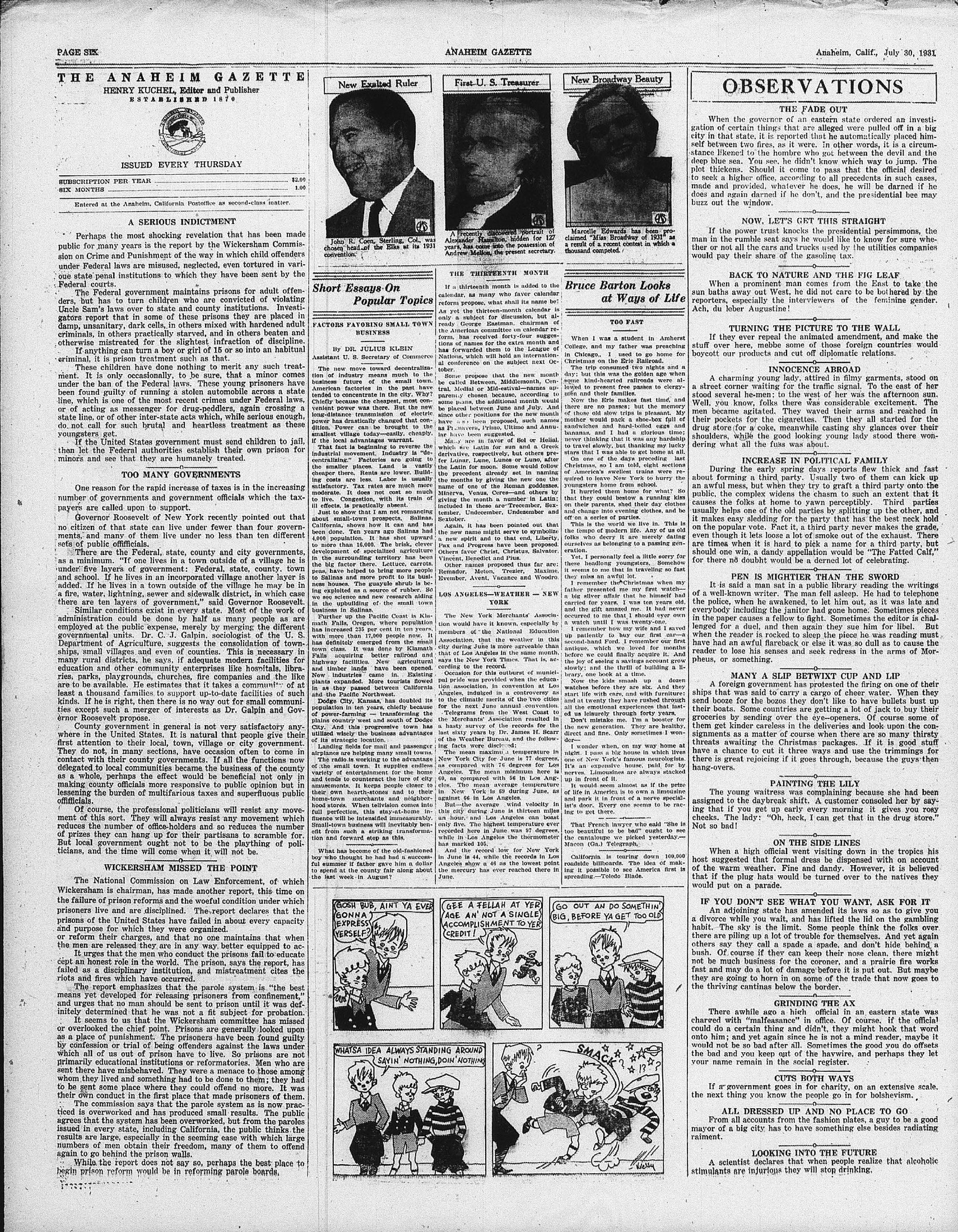
Searchable text
THE ANAHEIM GAZETTE
HENRY KUCHEL, Editor and Publisher
ESTABLISHED 1870
ISSUED EVERY THURSDAY
SUBSCRIPTION PER YEAR ... $2.00
SIX MONTHS ... 1.00
Entered at the Anaheim, California Postoffice as second-class matter.
A SERIOUS INDICTMENT
Perhaps the most shocking revelation that has been made public for many years is the report by the Wickersham Commission on Crime and Punishment of the way in which child offenders under Federal laws are misused, neglected, even tortured in various state penal institutions to which they have been sent by the Federal courts.
The Federal government maintains prisons for adult offenders, but has to turn children who are convicted of violating Uncle Sam's laws over to state and county institutions. Investigators report that in some of these prisons they are placed in damp, unsanitary, dark cells, in others mixed with hardened adult criminals, in others practically starved, and in others beaten and otherwise mistreated for the slightest infraction of discipline.
If anything can turn a boy or girl of 15 or so into an habitual criminal, it is prison treatment such as that.
These children have done nothing to merit any such treatment. It is only occasionally, to be sure, that a minor comes under the ban of the Federal laws. These young prisoners have been found guilty of running a stolen automobile across a state line, which is one of the most recent crimes under Federal laws, or of acting as messenger for drug-peddlers, again crossing a state line, or of other inter-state acts which, while serious enough, do not call for such brutal and heartless treatment as these youngsters get.
If the United States government must send children to jail, then let the Federal authorities establish their own prison for minors and see that they are humanely treated.
These children have done nothing to merit any such treatment. It is only occasionally, to be sure, that a minor comes under the ban of the Federal laws. These young prisoners have been found guilty of running a stolen automobile across a state line, which is one of the most recent crimes under Federal laws, or of acting as messenger for drug-peddlers, again crossing a state line, or of other inter-state acts which, while serious enough, do not call for such brutal and heartless treatment as these youngsters get.
If the United States government must send children to jail, then let the Federal authorities establish their own prison for minors and see that they are humanely treated.
TOO MANY GOVERNMENTS
One reason for the rapid increase of taxes is in the increasing number of governments and government officials which the taxpayers are called upon to support.
Governor Roosevelt of New York recently pointed out that no citizen of that state can live under fewer than four governments, and many of them live under no less than ten different sets of public officiials.
There are the Federal, state, county and city governments, as a minimum. "If one lives in a town outside of a village he is under five layers of government: Federal, state, county, town and school. If he lives in an incorporated village another layer is added. If he lives in a town outside of the village he may be in a fire, water, lightning, sewer and sidewalk district, in which case there are ten layers of government," said Governor Roosevelt.
Similar conditions exist in every state. Most of the work of administration could be done by half as many people as are employed at the public expense, merely by merging the different governmental units. Dr. C. J. Galpin, sociologist of the U.S. Department of Agriculture, suggests the consolidation of townships, small villages and even of counties. This is necessary in many rural districts, he says, if adequate modern facilities for education and other community enterprises like hospitals, libraries, parks, playgrounds, churches, fire companies and the like are to be available. He estimates that it takes a community of at least a thousand families to support up-to-date facilities of such kinds. If he is right, then there is no way out for small communities except such a merger of interests as Dr. Galpin and Governor Roosevelt propose.
County government in general is not very satisfactory anywhere in the United States. It is natural that people give their first attention to their local, town, village or city government. They do not, in many sections, have occasion often to come in contact with their county governments. If all the functions now delegated to local communities became the business of the county as a whole, perhaps the effect would be beneficial not only in making county officials more responsive to public opinion but in lessening the burden of multifarious taxes and superfluous public officiials.
Of course, the professional politicians will resist any movement of this sort. They will always resist any movement which reduces the number of office-holders and so reduces the number of prizes they can hang up for their partisans to scramble for. But local government ought not to be the plaything of politicians, and the time will come when it will not be.
WICKERSHAM MISSED THE POINT
as a whole, perhaps the effect would be beneficial not only in making county officials more responsive to public opinion but in lessening the burden of multifarious taxes and superfluous public officiials.
Of course, the professional politicians will resist any movement of this sort. They will always resist any movement which reduces the number of office-holders and so reduces the number of prizes they can hang up for their partisans to scramble for. But local government ought not to be the plaything of politicians, and the time will come when it will not be.
WICKERSHAM MISSED THE POINT
The National Commission on Law Enforcement, of which Wickersham is chairman, has made another report, this time on the failure of prison reforms and the woeful condition under which prisoners live and are disciplined. The report declares that the prisons of the United States have failed in about every capacity and purpose for which they were organized or reform their charges, and that no one maintains that when the men are released they are in any way better equipped to ac-
It urges that the men who conduct the prisons fail to educatecept an honest role in the world. The prison, says the report, has failed as a disciplinary institution, and mistreatment cites the riots and fires which have occurred.
The report emphasizes that the parole system is "the best means yet developed for releasing prisoners from confinement," and urges that no man should be sent to prison until it was definitely determined that he was not a fit subject for probation.
It seems to us that the Wickersham committee has missed or overlooked the chief point. Prisons are generally looked upon as a place of punishment. The prisoners have been found guilty by confession or trial of being offenders against the laws under which all of us out of prison have to live. So prisons are not primarily educational institutions or reformatories. Men who are sent there have misbehaved. They were a menace to those among whom they lived and something had to be done to them; they had to be sent some place where they could offend no more. It was their own conduct in the first place that made prisoners of them.
The commission says that the parole system as is now practiced is overworked and has produced small results. The public agrees that the system has been overworked, but from the paroles issued in every state, including California, the public thinks the results are large, especially in the seeming ease with which large numbers of men obtain their freedom, many of them to offend again to go behind the prison walls.
While the report does not say so, perhaps the best place to begin prison reform would be in reforming parole boards.
ANAHEIM GAZETTE
New Exalted Ruler
John R. Coen, Sterling, Col., was chosen head of the Elks at its 1931 convention.
First U. S. Treasurer
A recently discovered portrait of Alexander Hamilton, hidden for 127 years, has come into the possession of Andrew Mellon, the present secretary.
New Broadway Beauty
Marcelle Edwards has been proclaimed "Miss Broadway of 1931" as a result of a recent contest in which a thousand competed.
Short Essays On Popular Topics
FACTORS FAVORING SMALL TOWN BUSINESS
By DR. JULIUS KLEIN
Assistant U. S. Secretary of Commerce
The new move toward decentralization of industry means much to the business future of the small town. American factories in the past have tended to concentrate in the city. Why? Chiefly because the cheapest, most convenient power was there. But the new long-distance transmission of electric power has drastically changed that condition. Power can be brought to the smallest village today—easily, cheaply, if the local advantages warrant.
That fact is beginning to reverse the industrial movement. Industry is "decentralizing." Factories are going to
THE THIRTEENTH MONTH
If a thirteenth month is added to the calendar, as many who favor calendar reform propose, what shall its name be?
As yet the thirteen-month calendar is only a subject for discussion, but already George Eastman, chairman of the American committee on calendar reform, has received forty-four suggestions of names for the extra month and has forwarded them to the League of Nations, which will hold an international conference on the subject next October.
Some propose that the new month be called Between, Middlemonth, Central, Medial or Mid-estival—names apparently chosen because, according to some plans, the additional month would be placed between June and July. And since other positions for the new month have also been proposed, such names as Pinavera, Primo, Ultimo and Annular have been suggested.
Many are in favor of Sol or Helia, which are Latin for sun and a Greek derivative, respectively, but others prefer Luana Luana or Luna after
Bruce Barton Looks at Ways of Life
TOO FAST
When I was a student in Amher College, and my father was preaching in Chicago, I used to go home on Christmas on the Erie Railroad.
The trip consumed two nights and day; but this was the golden age when some kind-hearted railroads were allowed to present free passes to clergy men and their families.
Now the Erie makes fast time, and there are no passes; but the memory of those old slow trips is pleasant. My mother would pack a shoe-box full sandwiches and hard-bolled eggs at bananas, and I had a glorious time never thinking that it was any hardship to travel slowly, but thanking my lucky stars that I was able to get home at
The new move toward decentralization of industry means much to the business future of the small town. American factories in the past have tended to concentrate in the city. Why? Chiefly because the cheapest, most convenient power was there. But the long-distance transmission of electric power has drastically changed that condition. Power can be brought to the smallest village today—easily, cheaply, if the local advantages warrant.
That fact is beginning to reverse the industrial movement. Industry is "centralizing." Factories are going to the smaller places. Land is vastly cheaper there. Rents are lower. Building costs are less. Labor is usually satisfactory. Tax rates are much more moderate. It does not cost so much to live. Congestion, with its train of ill effects, is practically absent.
Just to show that I am not romancing about small-town prospects, Salinas, California, shows how it can and has been done. Ten years ago Salinas had 4,000 population. It has shot upward to more than 16,000. The brisk, clever development of specialized agriculture in the surrounding territory has been the big factor there. Lettuce, carrots, peas, have helped to bring more people to Salinas and more profit to its business houses. The guayule shrub is being exploited as a source of rubber. So we see science and new research aiding in the upbuilding of the small town business in Salinas.
Further up the Pacific Coast is Klamath Falls, Oregon, where population has increased 235 per cent in ten years, with more than 17,000 people now. It has definitely emerged from the small town class. It was done by Klamath Falls acquiring better railroad and highway facilities. New agricultural and timber lands have been opened. New industries came in. Existing plants expanded. More tourists flowed in as they passed between California and the Pacific Northwest.
Dodge City, Kansas, has doubled its population in ten years, chiefly because of power-farming — transforming the plains country west and south of Dodge City. And this progressive town has utilized wisely the business advantages of its strategic location.
Landing fields for mail and passenger airplanes are helping many small towns.
The radio is working to the advantage of the small town. It supplies endless variety of entertainment for the home and tends to counteract the lure of city amusements. It keeps people closer to their own hearth-stones and to their home-town merchants and neighborhood stores. When television comes into full perfection, this stay-at-home influence will be intensified immeasurably. Small-town business will inevitably benefit from such a striking transformation and forward step as this.
What has become of the old-fashioned boy who thought he had had a successful summer if father gave him a dollar to spend at the county fair along about
Some propose that the new month be called Between, Middlemonth, Central, Medial or Mid-estival—names apparently chosen because, according to some plans, the additional month would be placed between June and July. And since other positions for the new month have also been proposed, such names as Pimavera, Primo, Ultimo and Annular have been suggested.
Many are in favor of Sol or Helial, which are Latin for sun and a Greek derivative, respectively, but others prefer Lunar, Lune, Lunes or Luno, after the Latin for moon. Some would follow the precedent already set in naming the months by giving the new one the name of one of the Roman goddesses, Minerva, Venus, Ceres—and others by giving the month a number in Latin; included in these are Trecement, Sextember, Undecember, Undezember and Sextober.
Again, it has been pointed out that the new name might serve to symbolize a new spirit and to that end, Liberty, Pax and Progress have been proposed. Others favor Christ, Christus, Salvator, Vincent, Benedict and Plus.
Other names proposed thus far are: Remordan, Meton, Trezier, Maxime, Evember, Avent, Vacance and Woodroo.
LOS ANGELES—WEATHER — NEW YORK
The New York Merchants' Association would have it known, especially by members of the National Education Association, that the weather in this city during June is more agreeable than that of Los Angeles in the same month, says the New York Times. That is, according to the record.
Occasion for this outburst of muniel pal pride was provided when the education association, in convention at Los Angeles, indulged in a controversy as to the climatic merits of the two cities for the next June annual convention.
Telegrams from the West Coast to the Merchants' Association resulted in a hasty survey of the records for the last sixty years by Dr. James H. Scarr of the Weather Bureau, and the following facts were disclosed:
The mean maximum temperature in New York City for June is 77 degrees, as compared with 76 degrees for Los Angeles. The mean minimum here is 60, as compared with 56 in Los Angeles. The mean average temperature in New York is 69 during June, as against 66 in Los Angeles.
But—the average wind velocity in this city during June is thirteen miles an hour, and Los Angeles can boast only five. The highest temperature ever recorded here in June was 97 degrees, while in Los Angeles the thermometer has marked 105.
And the record low for New York in June is 44, while the records in Los Angeles show a 46 as the lowest point on mercury has ever reached there in al conference on the subject next October.
Now the Erie makes fast time, and there are no passes; but the memoir of those old slow trips is pleasant. My mother would pack a shoe-box full of sandwiches and hard-bolled eggs and bananas, and I had a glorious time never thinking that it was any hardness to travel slowly, but thanks my luck stars that I was able to get home at all.
On one of the days preceding Christmas, so I am told, eight sections of America's swellest trains were required to leave New York to hurry youngsters home from school.
It hurried them home for what? that they could bestow a running knee on their parents, shed their day clothes and change into evening clothes, and off on a series of parties.
This is the world we live in. This tempo of modern life. Any of us folks who decry it are merely dathous ourselves as belonging to a passing generation.
Yet, I personally feel a little sorry for these headlong youngsters. Some it seems to me that in traveling so far they miss an awful lot.
I remember the Christmas when my father presented me my first watch a big silver affair that he himself carried for years. I was ten years old and the gift amazed me. It had never occurred to me that I should ever owe a watch until I was twenty-one.
I remember how my wife and I save up patiently to buy our first car-second-hand Ford. I remember our first antique, which we loved for months before we could finally acquire it. At the joy of seeing a savings account grow slowly; and the thrill of building a library, one book at a time.
Now the kids smash up a door watches before they are six. And the start life with cars, and with furniture and at twenty they have rushed through all the emotional experiences that laid us leisurely through forty years.
Don't mistake me. I'm a booster of the new generation. They are healthy direct and fine. Only sometimes I weder—
I wonder when, on my way home night, I pass a big house in which lies one of New York's famous neurologists. It's an expensive house, paid for nerves. Limousines are always stacked up in front of it.
It would seem almost as if the price of life in America is to own a limousine and park it in front of a nerve specialist's door. Every one seems to be raining to get there.
That French lawyer who said "She too beautiful to be bad" ought to say the cantaloupe we picked yesterday Macon (Ga.) Telegraph,
California is tearing down 100,000 roadside billboards. The idea of making it possible to see America first...
What has become of the old-fashioned boy who thought he had had a successful summer if father gave him a dollar to spend at the county fair along about the last week in August?
The mean minimum here is 60, as compared with 56 in Los Angeles. The mean average temperature in New York is 69 during June, against 66 in Los Angeles.
But—the average wind velocity in this city during June is thirteen miles an hour, and Los Angeles can boast only five. The highest temperature ever recorded here in June was 97 degrees, while in Los Angeles the thermometer has marked 105.
And the record low for New York in June is 44, while the records in Los Angeles show a 46 as the lowest point the mercury has ever reached there in June.
That French lawyer who said "She too beautiful to be bad" ought to be the cantaloupe we picked yesterday Macon (Ga.) Telegraph.
California is tearing down 100,000 roadside billboards. The idea of making it possible to see America first spreading—Toledo Blade.
OBSERVATIONS
THE FADE OUT
When the governor of an eastern state ordered an investigation of certain things that are alleged were pulled off in a big city in that state, it is reported that he automatically placed himself between two fires, as it were. In other words, it is a circumstance likened to the hombre who got between the devil and the deep blue sea. You see, he didn't know which way to jump. The plot thickens. Should it come to pass that the official desired to seek a higher office, according to all precedents in such cases, made and provided, whatever he does, he will be darned if he does and again darned if he don't, and the presidential bee may buzz out the window.
NOW, LET'S GET THIS STRAIGHT
If the power trust knocks the presidential persimmons, the man in the rumble seat says he would like to know for sure whether or not all the cars and trucks used by the utilities companies would pay their share of the gasoline tax.
BACK TO NATURE AND THE FIG LEAF
When a prominent man comes from the East to take the sun baths away out West, he did not care to be bothered by the reporters, especially the interviewers of the feminine gender. Ach, du leber Augustine!
TURNING THE PICTURE TO THE WALL
If they ever repeal the animated amendment, and make the stuff over here, mebbe some of those foreign countries would boycott our products and cut off diplomatic relations.
INNOCENCE ABROAD
A charming young lady, attired in filmy garments, stood on a street corner waiting for the traffic signal. To the east of her stood several he-men; to the west of her was the afternoon sun. Well, you know, folks there was considerable excitement. The men became agitated. They waved their arms and reached in their pockets for the cigarettes. Then they all started for the drug store for a coke, meanwhile casting shy glances over their shoulders, while the good looking young lady stood there wondering what all the fuss was about.
INNOCENCE ABROAD
A charming young lady, attired in filmy garments, stood on a street corner waiting for the traffic signal. To the east of her stood several he-men; to the west of her was the afternoon sun. Well, you know, folks there was considerable excitement. The men became agitated. They waved their arms and reached in their pockets for the cigarettes. Then they all started for the drug store for a coke, meanwhile casting shy glances over their shoulders, while the good looking young lady stood there wondering what all the fuss was about.
INCREASE IN POLITICAL FAMILY
During the early spring days reports flew thick and fast about forming a third party. Usually two of them can kick up an awful mess, but when they try to graft a third party onto the public, the complex widens the chasm to such an extent that it causes the folks at home to yawn perceptibly. Third parties usually helps one of the old parties by splitting up the other, and it makes easy sledding for the party that has the best neck hold on the popular vote. Fact it, a third party never makes the grade, even though it lets loose a lot of smoke out of the exhaust. There are times when it is hard to pick a name for a third party, but should one win, a dandy appellation would be "The Fatted Calf," for there no doubt would be a derned lot of celebrating.
PEN IS MIGHTIER THAN THE SWORD
It is said a man sat in a public library reading the writings of a well-known writer. The man fell asleep. He had to telephone the police, when he awakened, to let him out, as it was late and everybody including the janitor had gone home. Sometimes pieces in the paper causes a fellow to fight. Sometimes the editor is challenged for a duel, and then again they sue him for libel. But when the reader is rocked to sleep the piece he was reading must have had an awful flareback or else it was so dull as to cause the reader to lose his senses and seek redress in the arms of Morpheus, or something.
MANY A SLIP BETWIXT CUP AND LIP
A foreign government has protested the firing on one of their ships that was said to carry a cargo of cheer water. When they send booze for the bozos they don't like to have bullets bust up their boats. Some countries are getting a lot of jack to buy their groceries by sending over the eye-openers. Of course some of them get kinder careless in the deliveries and look upon the consignments as a matter of course when there are so many thirsty threats awaiting the Christmas packages. If it is good stuff have a chance to cut it three ways and use the trimmings for there is great rejoicing if it goes through, because the guys then hang-overs.
PAINTING THE LILY
The young waitress was complaining because she had been assigned to the daybreak shift. A customer consoled her by saying that if you get up early every morning it gives you rosy cheeks. The lady: "Oh, heck, I can get that in the drug store." Not so bad!
ON THE SIDE LINES
When a high official went visiting down in the tropics his host suggested that formal dress be dispensed with on account of the warm weather. Fine and dandy. However, it is believed
PAINTING THE LILY
The young waitress was complaining because she had been assigned to the daybreak shift. A customer consoled her by saying that if you get up early every morning it gives you rosy cheeks. The lady: "Oh, heck, I can get that in the drug store." Not so bad!
ON THE SIDE LINES
When a high official went visiting down in the tropics his host suggested that formal dress be dispensed with on account of the warm weather. Fine and dandy. However, it is believed that if the plug hats would be turned over to the natives they would put on a parade.
IF YOU DON'T SEE WHAT YOU WANT, ASK FOR IT
An adjoining state has amended its laws so as to give you a divorce while you wait, and has lifted the lid on the gambling habit. The sky is the limit. Some people think the folks over there are piling up a lot of trouble for themselves. And yet again others say they call a spade a spade, and don't hide behind a bush. Of course if they can keep their nose clean, there might not be much business for the coroner, and a prairie fire works fast and may do a lot of damage before it is put out. But maybe they are going to horn in on some of the trade that now goes to the thriving cantinas below the border.
GRINDING THE AX
There awhile ago a high official in an eastern state was charged with "malfeasance" in office. Of course, if the official could do a certain thing and didn't, they might hook that word onto him; and yet again since he is not a mind reader, maybe it would not be so bad after all. Sometimes the good you do offsets the bad and you keep out of the haywire, and perhaps they let your name remain in the social register.
CUTS BOTH WAYS
If a government goes in for charity, on an extensive scale, the next thing you know the people go in for bolshevism.
ALL DRESSED UP AND NO PLACE TO GO
From all accounts from the fashion plates, a guy to be a good mayor of a big city has to have something else besides radiating raiment.
LOOKING INTO THE FUTURE
A scientist declares that when people realize that alcoholic stimulants are injurious they will stop drinking.