anaheim-gazette 1931-06-18
Scanned page
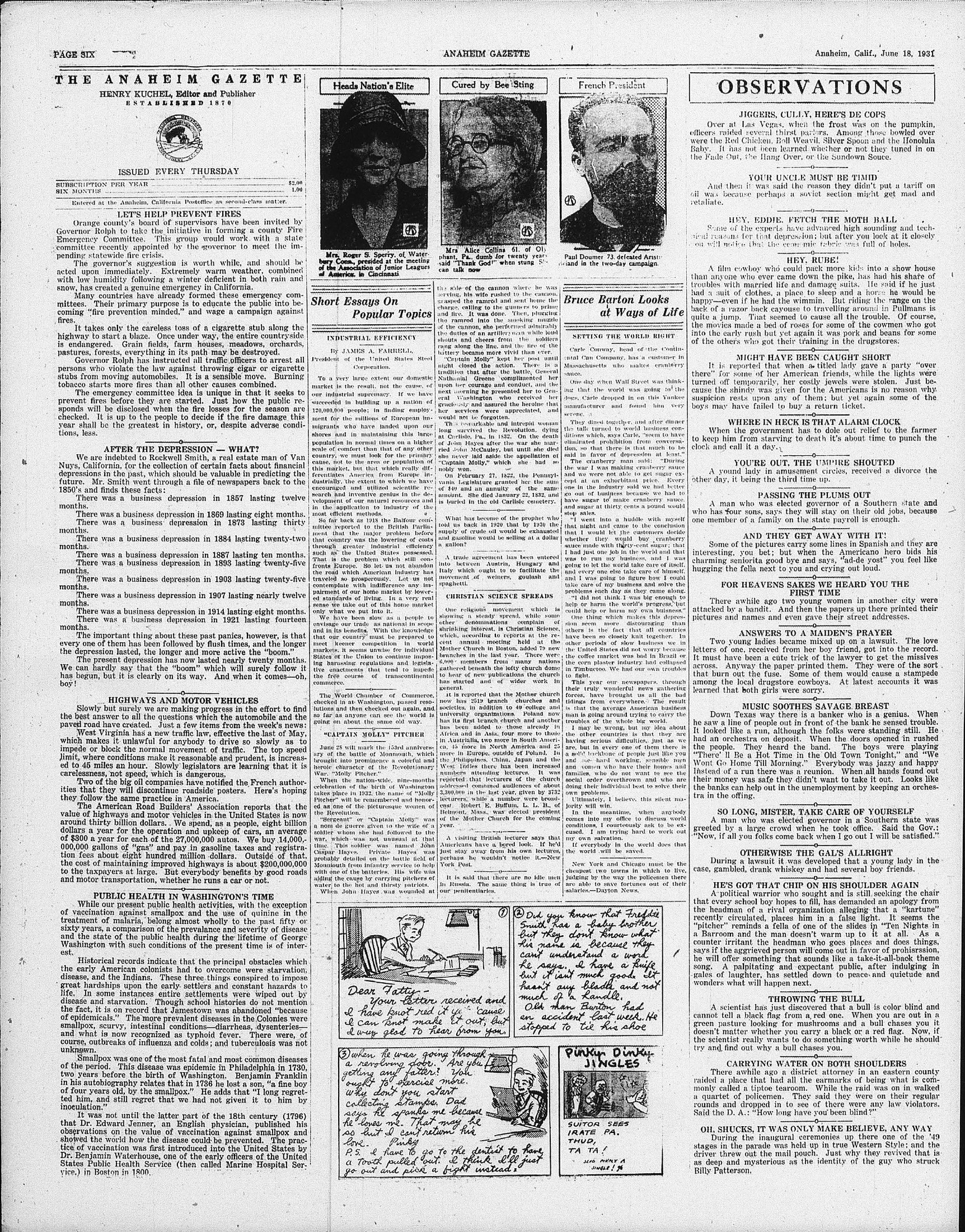
Searchable text
THE ANAHEIM GAZETTE
HENRY KUCHEL, Editor and Publisher
ESTABLISHED 1870
ISSUED EVERY THURSDAY
SUBSCRIPTION PER YEAR $2.00
SIX MONTHS 1.00
Entered at the Anaheim, California Postoffice as second-class matter.
LET'S HELP PREVENT FIRES
Orange county's board of supervisors have been invited by Governor Rolph to take the initiative in forming a county Fire Emergency Committee. This group would work with a state committee recently appointed by the governor to meet the impending statewide fire crisis.
The governor's suggestion is worth while, and should be acted upon immediately. Extremely warm weather, combined with low humidity following a winter deficient in both rain and snow, has created a genuine emergency in California.
Many countries have already formed these emergency committees. Their primary purpose is to educate the public into becoming "fire prevention minded," and wage a campaign against fires.
It takes only the careless toss of a cigarette stub along the highway to start a blaze. Once under way, the entire countryside is endangered. Grain fields, farm houses, meadows, orchards, pastures, forests, everything in its path may be destroyed.
Governor Rolph has instructed all traffic officers to arrest all persons who violate the law against throwing cigar or cigarette stubs from moving automobiles. It is a sensible move. Burning tobacco starts more fires than all other causes combined.
The emergency committee idea is unique in that it seeks to prevent fires before they are started. Just how the public responds will be disclosed when the fire losses for the season are checked. It is up to the people to decide if the fire damage this year shall be the greatest in history, or, despite adverse conditions, less.
AFTER THE DEPRESSION — WHAT?
We are indebted to Rockwell Smith, a real estate man of Van
AFTER THE DEPRESSION — WHAT?
We are indebted to Rockwell Smith, a real estate man of Van Nuys, California, for the collection of certain facts about financial depressions in the past, which should be valuable in predicting the future. Mr. Smith went through a file of newspapers back to the 1850's and finds these facts:
There was a business depression in 1857 lasting twelve months.
There was a business depression in 1869 lasting eight months.
There was a business depression in 1873 lasting thirty months.
There was a business depression in 1884 lasting twenty-two months.
There was a business depression in 1887 lasting ten months.
There was a business depression in 1893 lasting twenty-five months.
There was a business depression in 1903 lasting twenty-five months.
There was a business depression in 1907 lasting nearly twelve months.
There was a business depression in 1914 lasting eight months.
There was a business depression in 1921 lasting fourteen months.
The important thing about these past panics, however, is that every one of them has been followed by flush times, and the longer the depression lasted, the longer and more active the "boom."
The present depression has now lasted nearly twenty months. We can hardly say that the "boom" which will surely follow it has begun, but it is clearly on its way. And when it comes—oh, boy!
HIGHWAYS AND MOTOR VEHICLES
Slowly but surely we are making progress in the effort to find the best answer to all the questions which the automobile and the paved road have created. Just a few items from the week's news:
West Virginia has a new traffic law, effective the last of May, which makes it unlawful for anybody to drive so slowly as to impede or block the normal movement of traffic. The top speed limit, where conditions make it reasonable and prudent, is increased to 45 miles an hour. Slowly legislators are learning that it is carelessness, not speed, which is dangerous.
Two of the big oil companies have notified the French authorities that they will discontinue roadside posters. Here's hoping they follow the same practice in America.
The American Road Builders' Association reports that the value of highways and motor vehicles in the United States is now around thirty billion dollars. We spend, as a people, eight billion dollars a year for the operation and upkeep of cars, an average of $300 a year for each of the 27,000,000 autos. We buy 14,000,-000,000 gallons of "gas" and pay in gasoline taxes and registration fees about eight hundred million dollars. Outside of that, the cost of maintaining improved highways is about $200,000,000 to the taxpayers.
To a very large market is the rise our industrial sector experienced in 120,000,000 people for the migration of migrants who shores and in population in new scale of comfort country; we must cause, not to this market, but ferentiates Anadriatically, the encouragement and search and investment of our most efficient mills.
So far back a mittee reported that the country was through greater such as the U.S. That is the prefronts Europe. The road which traveled so profoundly with parment of our standards of sense we take only what we see.
We have been envisage our tractors and in its benefit that our countrymen meet keener markets. It seems States of the U.S. ing harassingive enactments the free courses commerce.
The World Checked in at Violations and so far as anyone going on about
"CAPTAIN"
June 28 will mark the celebration of Takes place in Pitcher" will be as one of the Revolutionaries.
"Sergeant" or a nom de guerre soldier whom war, which wintime. This sole Caspar Hayes probably details Monniouth from
Two of the big oil companies have notified the French authorities that they will discontinue roadside posters. Here's hoping they follow the same practice in America.
The American Road Builders' Association reports that the value of highways and motor vehicles in the United States is now around thirty billion dollars. We spend, as a people, eight billion dollars a year for the operation and upkeep of cars, an average of $300 a year for each of the 27,000,000 autos. We buy 14,000-000,000 gallons of "gas" and pay in gasoline taxes and registration fees about eight hundred million dollars. Outside of that, the cost of maintaining improved highways is about $200,000,000 to the taxpayers at large. But everybody benefits by good roads and motor transportation, whether he runs a car or not.
PUBLIC HEALTH IN WASHINGTON'S TIME
While our present public health activities, with the exception of vaccination against smallpox and the use of quinine in the treatment of malaria, belong almost wholly to the past fifty or sixty years, a comparison of the prevalence and severity of disease and the state of the public health during the lifetime of George Washington with such conditions of the present time is of interest.
Historical records indicate that the principal obstacles which the early American colonists had to overcome were starvation, disease, and the Indians. These three things conspired to impose great hardships upon the early settlers and constant hazards to life. In some instances entire settlements were wiped out by disease and starvation. Though school histories do not mention the fact, it is on record that Jamestown was abandoned "because of epidemicals." The more prevalent diseases in the Colonies were smallpox, scurvy, intestinal conditions—diarrheas, dysenteries—and what is now recognized as typhoid fever. There were, of course, outbreaks of influenza and colds; and tuberculosis was not unknown.
Smallpox was one of the most fatal and most common diseases of the period. This disease was epidemic in Philadelphia in 1730, two years before the birth of Washington. Benjamin Franklin in his autobiography relates that in 1736 he lost a son, "a fine boy of four years old, by the smallpox." He adds that "I long regretted him, and still regret that we had not given it to him by inoculation."
It was not until the latter part of the 18th century (1796) that Dr. Edward Jenner, an English physician, published his observations on the value of vaccination against smallpox and showed the world how the disease could be prevented. The practice of vaccination was first introduced into the United States by Dr. Benjamin Waterhouse, one of the early officers of the United States Public Health Service (then called Marine Hospital Service.) in Boston in 1800.
ANAHEIM GAZETTE
Heads Nation's Elite
Mrs. Roger S. Sperry, of Waterbury Conn., presided at the meeting of the Association of Junior Leagues of America, in Cincinnati.
Cured by Bee Sting
Mrs Alice Collins 61, of Olphant, Pa., dumb for twenty years said "Thank God!" when stung she can talk now.
French President
Paul Doumer 73, defeated Aristotle and in the two-day campaign.
Short Essays On Popular Topics
INDUSTRIAL EFFICIENCY
By JAMES A. FARRELL,
President of the United States Steel Corporation.
To a very large extent our domestic market is the result, not the cause, of our industrial supremacy. If we have succeeded in building up a nation of 120,000,000 people; in finding employment for the millions of European immigrants who have landed upon our shores and in maintaining this large population in normal times on a higher scale of comfort than that of any other country, we must look for the primary side of the cannon where he was serving, his wife rushed to the cannon, grasped the ramrod and sent home the charge, calling to the gunners to prime and fire. It was done. Then, plugging the ramrod into the smoking muzzle of the cannon, she performed admirably the duties of an artilleryman while loud shouts and cheers from the soldiers rang along the line, and the fire of the battery became more vivid than ever.
"Captain Molly" kept her post until night closed the action. There is a tradition that after the battle, General Nathanial Greene complimented her upon her courage and conduct, and the next morning he presented her to General Washington who received her graciously and assured the heroine that her services were appreciated, and would not be forgotten.
The remarkable and intrepid woman long survived the Revolution, dying at Carlisle, Pa., in 1832. On the death of John Hayes after the war she married John McCauley, but until she died she never laid aside the appellation of
Bruce Barton Looks at Ways of Life
SETTING THE WORLD RIGHT
Carle Conway, head of the Continental Can Company, has a customer in Massachusetts who makes cranberry sauce.
One day when Wall Street was thinking that the world was going to die dogs, Carle dropped in on this Yankee manufacturer and found him very serene.
They dined together, and after dinner the talk turned to world business conditions which says Carle, "seem to have eliminated prohibition from conversation, so that there is that much to be said in favor of depression at least."
Corporation.
To a very large extent domestic market is the result, not the cause, of our industrial supremacy. If we have succeeded in building up a nation of 120,000,000 people; in finding employment for the millions of European immigrants who have landed upon our shores and in maintaining this large population in normal times on a higher scale of comfort than that of any other country, we must look for the primary cause, not to the area or population of this market, but that which really differentiates America from Europe industrially, the extent to which we have encouraged and utilized scientific research and inventive genius in the development of our natural resources and in the application to industry of the most efficient methods.
So far back as 1918 the Balfour committee reported to the British Parliament that the major problem before that country was the lowering of costs through greater industrial efficiency such as the United States possessed. That is the problem which still confronts Europe. So let us not abandon the road which American industry has traveled so prosperously. Let us not contemplate with indifference any impairment of our home market by lowered standards of living. In a very real sense we take out of this home market only what we put into it.
We have been slow as a people to envisage our trade as national in scope and in its benefits. With the knowledge that our country must be prepared to meet keener competition in world markets, it seems unwise for individual States of the Union to continue imposing harassing regulations and legislative enactments that tend to impede the free course of transcontinental commerce.
The World Chamber of Commerce, checked in at Washington, passed resolutions and then checked out again, and so far as anyone can see the world is going on about the same old way.
"CAPTAIN MOLLY" PITCHER
June 28 will mark the 153rd anniversary of the battle of Monmouth, which brought into prominence a colorful and heroic character of the Revolutionary War. "Molly Pitcher."
When the nation-wide nine-months celebration of the birth of Washington takes place in 1832, the name of "Molly Pitcher" will be remembered and honored as one of the picturesque women of the Revolution.
"Sergeant" or "Captain Molly" was a nom de guerre given to the wife of a soldier whom she had followed to the war, which was not unusual at that time. This soldier was named John Caspar Hayes. Private Hayes was probably detailed on the battle field of Monniouth from infantry service to help night closed the action. There is a tradition that after the battle, General Nathanial Greene complimented her upon her courage and conduct, and the next morning he presented her to General Washington who received her graciously and assured the heroine that her services were appreciated, and would not be forgotten.
This remarkable and intrepid woman long survived the Revolution, dying at Carlisle, Pa., in 1832. On the death of John Hayes after the war she married John McCauley, but until she died she never laid aside the appellation of "Captain Molly," which she had so nobly won.
On February 27, 1822, the Pennsylvania Legislature granted her the sum of $40 and an annuity of the same amount. She died January 22, 1832, and is buried in the old Carlisle cemetery.
What has become of the prophet who told us back in 1920 that by 1930 the supply of crude oil would be exhausted and gasoline would be selling at a dollar a gallon?
A trade agreement has been entered into between Austria, Hungary and Italy which ought to facilitate the movement of weiners, goulash and spaghetti.
CHRISTIAN SCIENCE SPREADS
One religious movement which is showing a steady spread, while some other denominations complain of shrinking interest, is Christian Science, which according to reports at the recent annual meeting held at the Mother Church in Boston, added 79 new branches in the last year. There were 6,000 members from many nations gathered beneath the lofty church dome to hear of new publications the church has started and of wider work in general.
It is reported that the Mother church now has 2519 branch churches and societies, in addition to 40 college and university organizations. Poland now has its first branch church and another has been added to those already in Africa and in Asia, four more to those in Austria, two more in South America, 45 more in North America and 25 more in Europe, outside of Poland. In the Philippines, China, Japan and the West Indies there has been increased numbers attending lectures. It was reported that lecturers of the church addressed combined audiences of about 3,300,000 in the last year, given by 3732 lecturers, while a number were broadcast. Robert E. Buffum, L. L. B., of Belmont, Mass., was elected president of the Mother Church for the coming year.
A visiting British lecturer says that Americans have a bored look. If he'd just stay away from his own lectures, perhaps he wouldn't notice it—New York Post.
Massachusetts who makes cranberry sauce.
One day when Wall Street was thinking that the world was going to die dogs, Carle dropped in on this Yankee manufacturer and found him very serene.
They dined together, and after dinner they talked turned to world business conditions which, says Carle, "seem to have eliminated prohibition from conversation, so that there is that much to be said in favor of depression at least."
The cranberry man said: "During the war I was making cranberry sauce and we were not able to get sugar except at an exhilarant price. Every one in the industry said we had better go out of business because we had to have sugar to make cranberry sauce and sugar at thirty cents a pound would stop sales.
"I went into a huddle with myself that night and came to the conclusion that I would let the customers decide whether they would buy cranberry sauce made with thirty-cent sugar; that I had just one job in the world and that was to run my business, and I was going to let the world take care of itself and every one else take care of himself and I was going to figure how I could take care of my business and solve their problems each day as they came along."
"I did not think I was big enough to help or harm the world's progress, but could help or harm my own business."
One thing which makes this depression seem more discouraging than others is the fact that all countries have been so closely knit together. Other periods of slow business in the United States did not worry because the coffee market was bad in Brazil or the corn plaster industry had collapse in Timbucoe. We had our own trouble to fight.
This year our newspapers, through their truly wonderful news gathering forces, have brought us all the battildings from everywhere. The result is that the average American business man is going around trying to carry troubles of the whole big world.
I may be wrong, but my idea about the other countries is that they are having serious difficulties, just as we are, but in every one of them there is a solid backbone of people just like you and me hard working, sensible up and women who have their homes and families, who do not want to see social order overthrown and who are doing their individual best to solve their own problems.
Ultimately, I believe, this silent majority will win.
In the meantime, when anybody comes into my office to discuss work conditions, I courteously ask to be excused. I am trying hard to work out my own salvation.
If everybody in the world does that the world will be saved.
New York and Chicago must be thicker two towns in which to live.
When the nation-wide nine-months celebration of the birth of Washington takes place in 1932, the name of "Molly Pitcher" will be remembered and honored as one of the picturesque women of the Revolution.
"Sergeant" or "Captain Molly" was a nom de guerre given to the wife of a soldier whom she had followed to the war, which was not unusual at that time. This soldier was named John Caspar Hayes. Private Hayes was probably detailed on the battle field of Monniouth from infantry service to help with one of the batteries. His wife was adding the cause by carrying pitchers of water to the hot and thirsty patriots.
When John Hayes was wounded at numbers attending lectures, it was reported that lecturers of the church addressed combined audiences of about 3,300,000 in the last year, given by 3732 lecturers, while a number were broadcast. Robert E. Buffum, L. L. B., of Behnont, Mass., was elected president of the Mother Church for the coming year.
A visiting British lecturer says that Americans have a bored look. If he'd just stay away from his own lectures, perhaps he wouldn't notice it. New York Post.
It is said that there are no idle men in Russia. The same thing is true of our penitentiaries.
Dear Fatty,
Your letter received and I have knot red it ye' cause I can knot make it out, but I away glad to hear from you.
Did you know that Freddie Smith has a baby brother but they don't know what his name is because they can't understand a word he says. I have a knife but it isn't much good; it hasn't any bladdle and not much of a handle.
Old man Burton had an accident last week. He stopped to tie his shoe.
when he was going through a revolving door. Are you getting any fatter? You ought to exercise more. Why don't you start collecting stamps. Dad says he spanks me because he loves me. That may he so but I can't return his love. Pinky P.S. I have to go to the dentist to have a tooth pulled out. I think I'll just go out and pick a fight instead.
Pinky Dinky JINGLES
SUITOR SEES IRATE PA.
THUD,
TA TA!
JERO MENY A
JINGLE!
OBSERVATIONS
JIGGERS, CULLY, HERE'S DE COPS
Over at Las Vegas, when the frost was on the pumpkin, officers raided several thirst parlors. Among those bowled over were the Red Chicken, Boll Weavil, Silver Spoon and the Honolulu Baby. It has not been learned whether or not they tuned in on the Fade Out, the Hang Over, or the Sundown Souce.
YOUR UNCLE MUST BE TIMID
And then it was said the reason they didn't put a tariff on oil was because perhaps a soviet section might get mad and retaliate.
HEY, EDDIE. FETCH THE MOTH BALL
Some of the experts have advanced high sounding and technical reasons for that depression; but after you look at it closely you will notice that the economic fabric was full of holes.
HEY, RUBE!
A film cowboy who could pack more kids into a show house than anyone who ever came down the pike, has had his share of troubles with married life and damage suits. He said if he just had a suit of clothes, a place to sleep and a horse he would be happy—even if he had the wimmin. But riding the range on the back of a razor back cayouse to travelling around in Pullmans is quite a jump. That seemed to cause all the trouble. Of course, the movies made a bed of roses for some of the cowmen who got into the early rush but yet again it was pork and beans for some of the others who got their training in the drugstores.
MIGHT HAVE BEEN CAUGHT SHORT
It is reported that when a titled lady gave a party "over there" for some of her American friends, while the lights were turned off temporarily, her costly jewels were stolen. Just because the shindy was given for the Americans is no reason why suspicion rests upon any of them; but yet again some of the boys may have failed to buy a return ticket.
WHERE IN HECK IS THAT ALARM CLOCK
When the government has to dole out relief to the farmer to keep him from starving to death it's about time to punch the clock and call it a day.
It is reported that when a titled lady gave a party "over there" for some of her American friends, while the lights were turned off temporarily, her costly jewels were stolen. Just because the shindy was given for the Americans is no reason why suspicion rests upon any of them; but yet again some of the boys may have failed to buy a return ticket.
WHERE IN HECK IS THAT ALARM CLOCK
When the government has to dole out relief to the farmer to keep him from starving to death it's about time to punch the clock and call it a day.
YOU'RE OUT, THE UMPIRE SHOUTED
A young lady in amusement circles, received a divorce the other day, it being the third time up.
PASSING THE PLUMS OUT
A man who was elected governor of a Southern state and who has four sons, says they will stay on their old jobs, because one member of a family on the state payroll is enough.
AND THEY GET AWAY WITH IT!
Some of the pictures carry some lines in Spanish and they are interesting, you bet; but when the Americano hero bids his charming seniorita good bye and says, "ad-de yost" you feel like hugging the fella next to you and crying out loud.
FOR HEAVENS SAKES WE HEARD YOU THE FIRST TIME
There awhile ago two young women in another city were attacked by a bandit. And then the papers up there printed their pictures and names and even gave their street addresses.
ANSWERS TO A MAIDEN'S PRAYER
Two young ladies became mixed up on a lawsuit. The love letters of one, received from her boy friend, got into the record. It must have been a cute trick of the lawyer to get the missives across. Anyway the paper printed them. They were of the sort that burn out the fuse. Some of them would cause a stampede among the local drugstore cowboys. At latest accounts it was learned that both girls were sorry.
MUSIC SOOTHES SAVAGE BREAST
Down Texas way there is a banker who is a genius. When he saw a line of people out in front of the bank he sensed trouble. It looked like a run, although the folks were standing still. He had an orchestra on deposit. When the doors opened in rushed the people. They heard the band. The boys were playing "There'll Be a Hot Time in the Old Town Tonight," and "We Wont Go Home Till Morning." Everybody was jazzy and happy Instead of a run there was a reunion. When all hands found out their money was safe they didn't want to take it out. Looks like the banks can help out in the unemployment by keeping an orchestra in the offing.
SO LONG, MISTER, TAKE CARE OF YOURSELF
A man who was elected governor in a Southern state was greeted by a large crowd when he took office. Said the Gov.: "Now, if all you folks come back when I go out I will be satisfied."
OTHERWISE THE GAL'S ALLRIGHT
During a lawsuit it was developed that a young lady in the case, gambled drank whiskey and had several boy friends.
SO LONG, MISTER, TAKE CARE OF YOURSELF
A man who was elected governor in a Southern state was greeted by a large crowd when he took office. Said the Gov.: "Now, if all you folks come back when I go out I will be satisfied."
OTHERWISE THE GAL'S ALLRIGHT
During a lawsuit it was developed that a young lady in the case, gambled, drank whiskey and had several boy friends.
HE'S GOT THAT CHIP ON HIS SHOULDER AGAIN
A political warrior who sought and is still seeking the chair that every school boy hopes to fill, has demanded an apology from the headman of a rival organization alleging that a "kartune" recently circulated, places him in a false light. It seems the "pitcher" reminds a fella of one of the slides in "Ten Nights in a Barroom and the man doesn't warm up to it at all. As a counter irritant the headman who goes places and does things, says if the aggrieved person will come out in favor of prohisrssion, he will offer something that sounds like a take-it-all-back theme song. A palpitating and expectant public, after indulging in gales of laughter, has settled down to peace and quietude and wonders what will happen next.
THROWING THE BULL
A scientist has just discovered that a bull is color blind and cannot tell a black flag from a red one. When you are out in a green pasture looking for mushrooms and a bull chases you it doesn't matter whether you carry a black or a red flag. Now, if the scientist really wants to do something worth while he should try and find out why a bull chases you.
CARRYING WATER ON BOTH SHOULDERS
There awhile ago a district attorney in an eastern county raided a place that had all the earmarks of being what is commonly called a tiptoe tearoom. While the raid was on in walked a quartet of policemen. They said they were on their regular rounds and dropped in to see of there were any law violators. Said the D. A.: "How long have you been blind?"
OH, SHUCKS, IT WAS ONLY MAKE BELIEVE, ANY WAY
During the inaugural ceremonies up there one of the '49 stages in the parade was held up in true Western Style; and the driver threw out the mail pouch. Just why they revived that is as deep and mysterious as the identity of the guy who struck Billy Patterson.