anaheim-gazette 1931-05-21
Scanned page
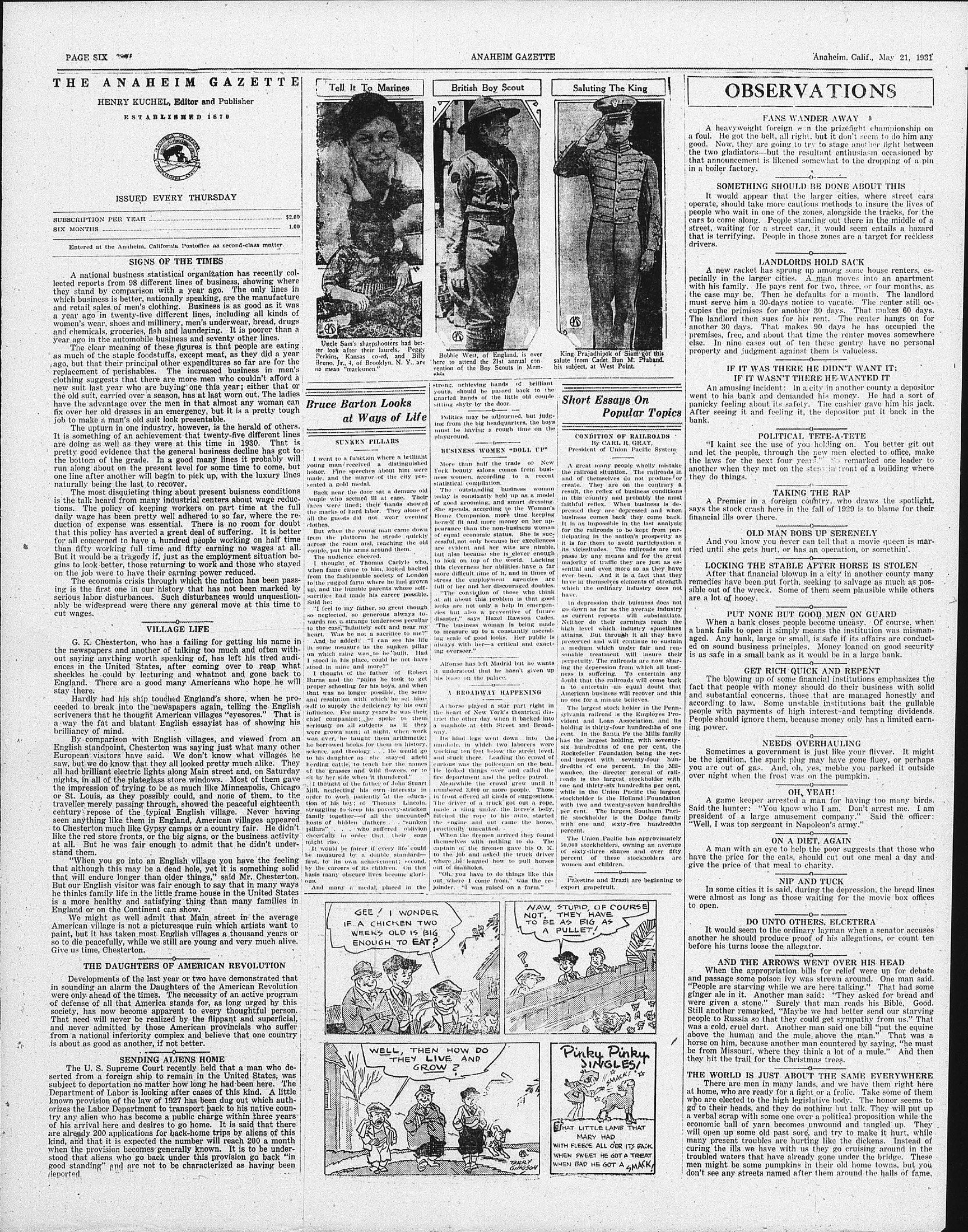
Searchable text
THE ANAHEIM GAZETTE
HENRY KUCHEL, Editor and Publisher
ESTABLISHED 1870
ISSUED EVERY THURSDAY
SUBSCRIPT PER YEAR ... $2.00
SIX MONTHS ... 1.00
Entered at the Anaheim, California Postoffice as second-class matter.
SIGNS OF THE TIMES
A national business statistical organization has recently collected reports from 98 different lines of business, showing where they stand by comparison with a year ago. The only lines in which business is better, nationally speaking, are the manufacture and retail sales of men's clothing. Business is as good as it was a year ago in twenty-five different lines, including all kinds of women's wear, shoes and millinery, men's underwear, bread, drugs and chemicals, groceries, fish and laundering. It is poorer than a year ago in the automobile business and seventy other lines.
The clear meaning of these figures is that people are eating as much of the staple foodstuffs, except meat, as they did a year ago, but that their principal other expenditures so far are for the replacement of perishables. The increased business in men's clothing suggests that there are more men who couldn't afford a new suit last year who are buying one this year; either that or the old suit, carried over a season, has at last worn out. The ladies have the advantage over the men in that almost any woman can fix over her old dresses in an emergency, but it is a pretty tough job to make a man's old suit look presentable.
The upturn in one industry, however, is the herald of others. It is something of an achievement that twenty-five different lines are doing as well as they were at this time in 1930. That is pretty good evidence that the general business decline has got to the bottom of the grade. In a good many lines it probably will
ago, but that their principal other expenditures so far are for the replacement of perishables. The increased business in men's clothing suggests that there are more men who couldn't afford a new suit last year who are buying one this year; either that or the old suit, carried over a season, has at last worn out. The ladies have the advantage over the men in that almost any woman can fix over her old dresses in an emergency, but it is a pretty tough job to make a man's old suit look presentable.
The upturn in one industry, however, is the herald of others. It is something of an achievement that twenty-five different lines are doing as well as they were at this time in 1930. That is pretty good evidence that the general business decline has got to the bottom of the grade. In a good many lines it probably will run along about on the present level for some time to come, but one line after another will begin to pick up, with the luxury lines naturally being the last to recover.
The most disquieting thing about present business conditions is the talk heard from many industrial centers about wage reductions. The policy of keeping workers on part time at the full daily wage has been pretty well adhered to so far, where the reduction of expense was essential. There is no room for doubt that this policy has averted a great deal of suffering. It is better for all concerned to have a hundred people working on half time than fifty working full time and fifty earning no wages at all. But it would be a tragedy if, just as the employment situation begins to look better, those returning to work and those who stayed on the job were to have their earning power reduced.
The economis crisis through which the nation has been passing is the first one in our history that has not been marked by serious labor disturbances. Such disturbances would unquestionably be widespread were there any general move at this time to cut wages.
VILLAGE LIFE
G. K. Chesterton, who has a failing for getting his name in the newspapers and another of talking too much and often without saying anything worth speaking of, has left his tired audiences in the United States, after coming over to reap what sheckles he could by lecturing and whatnot and gone back to England. There are a good many Americans who hope he will stay there.
Hardly had his ship touched England's shore, when he proceeded to break into the newspapers again, telling the English scriveners that he thought American villages "eyesores." That is a way the fat and blatant English essayist has of showing his brilliancy of mind.
By comparison with English villages, and viewed from an English standpoint, Chesterton was saying just what many other European visitors have said. We don't know what villages he saw, but we do know that they all looked pretty much alike. They all had brilliant electric lights along Main street and, on Saturday nights, in all of the plateglass store windows. Most of them gave the impression of trying to be as much like Minneapolis, Chicago or St. Louis, as they possibly could, and none of them, to the traveller merely passing through, showed the peaceful eighteenth century repose of the typical English village. Never having seen anything like them in England, American villages appeared to Chesterton much like Gypsy camps or a country fair. He didn't like the red store fronts, or the big signs, or the business activity at all. But he was fair enough to admit that he didn't understand them.
"When you go into an English village you have the feeling that although this may be a dead hole, yet it is something solid
nights, in all of the plateglass store windows. Most of them gave
the impression of trying to be as much like Minneapolis, Chicago
or St. Louis, as they possibly could, and none of them, to the
traveller merely passing through, showed the peaceful eighteenth
century repose of the typical English village. Never having
seen anything like them in England, American villages appeared
to Chesterton much like Gypsy camps or a country fair. He didn't
like the red store fronts, or the big signs, or the business activity
at all. But he was fair enough to admit that he didn't understand them.
"When you go into an English village you have the feeling
that although this may be a dead hole, yet it is something solid
that will endure longer than older things," said Mr. Chesterton.
But our English visitor was fair enough to say that in many ways
he thinks family life in the little frame house in the United States
is a more healthy and satisfying thing than many families in
England or on the Continent can show.
We might as well admit that Main street in the average
American village is not a picturesque ruin which artists want to
paint, but it has taken most English villages a thousand years or
so to die peacefully, while we still are young and very much alive.
Give us time, Chesterton.
THE DAUGHTERS OF AMERICAN REVOLUTION
Developments of the last year or two have demonstrated that
in sounding an alarm the Daughters of the American Revolution
were only ahead of the times. The necessity of an active program
of defense of all that America stands for, as long urged by this
society, has now become apparent to every thoughtful person.
That need will never be realized by the flippant and superficial,
and never admitted by those American provincials who suffer
from a national inferiority complex and believe that one country
is about as good as another, if not better.
SENDING ALIENS HOME
The U. S. Supreme Court recently held that a man who deserted from a foreign ship to remain in the United States, was subject to deportation no matter how long he had been here. The Department of Labor is looking after cases of this kind. A little known provision of the law of 1927 has been dug out which authorizes the Labor Department to transport back to his native country any alien who has become a public charge within three years of his arrival here and desires to go home. It is said that there are already 200 applications for back-home trips by aliens of this kind, and that it is expected the number will reach 200 a month when the provision becomes generally known. It is to be understood that aliens who go back under this provision go back "in good standing" and are not to be characterized as having been deported.
ANAHEIM GAZETTE
Tell It To Marines
Uncle Sam's sharpshooters had better look after their laurels. Peggy Perkins, Kansas co-ed, and Billy Bruno, Jr., 4, of Brooklyn, N. Y., are no mean "marksmen."
British Boy Scout
Bobbie West, of England, is over here to attend the 21st annual convention of the Boy Scouts in Memphis.
Saluting The King
King Prajadhipok of Siam got this salute from Cadet Bun M. Praband, his subject, at West Point.
Bruce Barton Looks at Ways of Life
SUNKEN PILLARS
Strong, achieving hands of brilliant youth, should be passed back to the garled hands of the little old couple sitting shyly by the door.
Politics may be adjourned, but judging from the big headquarters, the boys must be having a rough time on the playground.
BUSINESS WOMEN "DOLL UP"
Short Essays On Popular Topics
CONDITION OF RAILROADS
By CARL R. GRAY,
President of Union Pacific System
Bruce Barton Looks at Ways of Life
SUNKEN PILLARS
I went to a function where a brilliant young man received a distinguished honor. Fine speeches about him were made, and the mayor of the city presented a gold medal.
Back near the door sat a demure old couple who seemed ill at ease. Their faces were lined; their hands showed the marks of hard labor. They alone of all the guests did not wear evening clothes.
But when the young man came down from the plattform he strode quickly across the room and, reaching the old couple, put his arms around them.
The audience cheered.
I thought of Thomas Carlyle who, when fame came to him, looked backed from the fashionable society of London to the rugged farm where he had grown up, and the humble parents whose self-sacrifice had made his career possible. Said he:
"I feel to my father, so great though so neglected, so generous always towards me, a strange tenderness peculiar to the case. Infinitely soft and near my heart. Was he not a sacrifice to me?"
And he added: "I can see his life in some measure as the sunken pillar on which mine was to be built. Had I stood in his place, could he not have stood in mine and more?"
I thought of the father of Robert Burns and the "pains he took to get schooling for his boys, and when that was no longer possible, the sense and resolution with which he set himself to supply the deficiency by his own influence. For many years he was their chief companion; he spoke to them seriously on all subjects as if they were grown men; at night, when work was over, he taught them arithmetic; he borrowed books for them on history, science, and theology. He would go to his daughter as she stayed afield herding cattle; to teach her the names of the grasses and wild flowers, or to sit by her side when it thundered."
I thought of the father of John Stuart Mill, neglecting his own interests in order to work patiently at the education of his boy; of Thomas Lincoln, struggling to keep his poverty-stricken family together—of all the uncounted hosts of hidden fathers... "sunken pillars" who suffered oblivion cheerfully in order that their sons might rise.
It would be fairer if every life could be measured by a double standard—first, by its own achievement; second, by the careers of its children. On this strong, achieving hands of brilliant youth, should be passed back to the gnarled hands of the little old couple sitting shyly by the door.
Politics may be adjourned, but judging from the big headquarters, the boys must be having a rough time on the playground.
BUSINESS WOMEN "DOLL UP"
More than half the trade of New York beauty salons comes from business women, according to a recent statistical compilation.
The outstanding business woman today is constantly held up as a model of good grooming, and smart dressing. She spends, according to the Woman's Home Companion, more time keeping herself fit and more money on her appearance than the non-business woman of equal economic status. She is successful, not only because her excellences are evident and her wits are nimble, but also because she is clever enough to look on top of the world. Lacking this cleverness her abilities have a far more difficult time of it, and in times of stress the employment agencies are full of her and her discouraged doubles.
"The conviction of those who think at all about this problem is that good looks are not only a help in emergencies but also a preventive of future disaster," says Hazel Rawson Cades.
"The business woman is being made to measure up to a constantly ascending scale of good looks. Her public is always with her—a critical and exacting overseer."
Alfonso has left Madrid but he wants it understood that he hasn't given up his lease on the palace.
A BROADWAY HAPPENING
A horse played a star part right in the heart of New York's theatrical district the other day when it backed into a manhole at 44th Street and Broadway.
Its hind legs went down into the manhole, in which two laborers were working ten feet below the street level, and stuck there. Leading the crowd of curious was the policeman on the beat. He looked things over and called the fire department and the police patrol.
Meanwhile the crowd grew until it numbered 3,000 or more people. Those in front offered all kinds of suggestions. The driver of a truck got out a rope, made a sling under the horse's belly, hitched the rope to his auto, started the engine and out came the horse, practically unscathed.
When the firemen arrived they found themselves with nothing to do. The captain of the firemen gave his O.K. to the job and asked the truck driver where he learned how to pull horses out of manholes.
A great many people wholly mistake the railroad situation. The railroads in and of themselves do not produce or create. They are on the contrary a result, the reflex of business conditions in this country and probably the most faithful reflex. When business is depressed they are depressed and when business comes back they come back. It is as impossible in the last analysis for the railroads to be kept from participating in the nation's prosperity as it is for them to avoid participation in its virescitudes. The railroads are not passe by any means and for the great majority of traffic they are just as essential and even more so as they have ever been. And it is a fact that they have in themselves elements of strength which the ordinary industry does not have.
In depression their business does not go down as far as the average industry as current reports will substantiate. Neither do their earnings reach the high level which industry sometimes attains. But through it all they have preserved and will continue to sustain a medium which under fair and reasonable treatment will insure their perpetuity. The railroads are now sharing the depression from which all business is suffering. To entertain any doubt that the railroads will come back is to entertain an equal doubt that American business will recover and this no one for a minute believes.
The largest stock holder in the Pennsylvania railroad is the Employees Provident and Loan Association, and its holding is thirty-four hundredths of one cent. In the Santa Fe The Mills family has the largest holding, with seventy-six hundredths of one per cent, the Rockefeller Foundation being the second largest with seventy-four hundredths of one percent. In the Milwaukee, the director general of railroads is the largest stockholder with one and thirty-six hundredths per cent, while in the Union Pacific the largest stockholder is the Holland Foundation with two and twenty-seven hundredths per cent. The largest Southern Pacific stockholder is the Dodge family with one and sixty-five hundredths percent.
The Union Pacific has approximately 50,000 stockholders, owning an average of sixty-three shares and over fifty percent of these stockholders are women and children.
I thought of the father of John Stuart Mill, neglecting his own interests in order to work patiently at the education of his boy; of Thomas Lincoln, struggling to keep his poverty-stricken family together—of all the uncounted hosts of hidden fathers... "sunken pillars" who suffered oblivion cheerfully in order that their sons might rise.
It would be fairer if every life could be measured by a double standard—first, by its own achievement; second, by the careers of its children. On this basis many obscure lives become glorious.
And many a medal, placed in the fire department and the police patrol.
Meanwhile the crowd grew until it numbered 3,000 or more people. Those in front offered all kinds of suggestions. The driver of a truck got out a rope, made a sling under the horse's belly, hitched the rope to his auto, started the engine and out came the horse, practically unscathed.
When the firemen arrived they found themselves with nothing to do. The captain of the firemen gave his O. K. to the job and asked the truck driver where he learned how to pull horses out of manholes.
"Oh, you have to do things like this out where I come from," was the rejoinder. "I was raised on a farm."
The Union Pacific has approximately 50,000 stockholders, owning an average of sixty-three shares and over fifty percent of these stockholders are women and children.
Palestine and Brazil are beginning to export grapefruit.
OBSERVATIONS
FANS WANDER AWAY
A heavyweight foreign won the prizefight championship on a foul. He got the belt, all right, but it don't seem to do him any good. Now, they are going to try to stage another fight between the two gladiators—but the resultant enthusiasm occasioned by that announcement is likened somewhat to the dropping of a pin in a boiler factory.
SOMETHING SHOULD BE DONE ABOUT THIS
It would appear that the larger cities, where street cars operate, should take more cautious methods to insure the lives of people who wait in one of the zones, alongside the tracks, for the cars to come along. People standing out there in the middle of a street, waiting for a street car, it would seem entails a hazard that is terrifying. People in those zones are a target for reckless drivers.
LANDLORDS HOLD SACK
A new racket has sprung up among some house renters, especially in the larger cities. A man moves into an apartment with his family. He pays rent for two, three, or four months, as the case may be. Then he defaults for a month. The landlord must serve him a 30-days notice to vacate. The renter still occupies the premises for another 30 days. That makes 60 days. The landlord then sues for his rent. The renter hangs on for another 30 days. That makes 90 days he has occupied the premises, free, and about that time the renter moves somewhere else. In nine cases out of ten these gentry have no personal property and judgment against them is valueless.
IF IT WAS THERE HE DIDN'T WANT IT;
IF IT WASN'T THERE HE WANTED IT
An amusing incident: In a city in another county a depositor went to his bank and demanded his money. He had a sort of panicky feeling about its safety. The cashier gave him his jack. After seeing it and feeling it, the depositor put it back in the bank.
POLITICAL TETE-A-TETE
"I kaint see the use of you holding on. You better git out and let the people, through the new men elected to office, make
IF IT WAS THERE HE DIDN'T WANT IT;
IF IT WASN'T THERE HE WANTED IT
An amusing incident: In a city in another county a depositor went to his bank and demanded his money. He had a sort of panicky feeling about its safety. The cashier gave him his jack. After seeing it and feeling it, the depositor put it back in the bank.
POLITICAL TETE-A-TETE
"I kaint see the use of you holding on. You better git out and let the people, through the new men elected to office, make the laws for the next four years." So remarked one leader to another when they met on the steps in front of a building where they do things.
TAKING THE RAP
A Premier in a foreign country, who draws the spotlight, says the stock crash here in the fall of 1929 is to blame for their financial ills over there.
OLD MAN BOBS UP SERENELY
And you know you never can tell that a movie queen is married until she gets hurt, or has an operation, or somethin'.
LOCKING THE STABLE AFTER HORSE IS STOLEN
After that financial blowup in a city in another county many remedies have been put forth, seeking to salvage as much as possible out of the wreck. Some of them seem plausible while others are a lot of hooey.
PUT NONE BUT GOOD MEN ON GUARD
When a bank closes people become uneasy. Of course, when a bank fails to open it simply means the institution was mismanaged. Any bank, large or small, is safe if its affairs are conducted on sound business principles. Money loaned on good security is as safe in a small bank as it would be in a large bank.
GET RICH QUICK AND REPENT
The blowing up of some financial institutions emphasizes the fact that people with money should do their business with solid and substantial concerns, those that are managed honestly and according to law. Some unstable institutions bait the gullable people with payments of high interest and tempting dividends. People should ignore them, because money only has a limited earning power.
NEEDS OVERHAULING
Sometimes a government is just like your flivver. It might be the ignition, the spark plug may have gone fluey, or perhaps you are out of gas. And, oh, yes, mebbe you parked it outside over night when the frost was on the pumpkin.
OH, YEAH!
A game keeper arrested a man for having too many birds. Said the hunter: "You know who I am. Don't arrest me. I am president of a large amusement company." Said the officer: "Well, I was top sergeant in Napoleon's army."
ON A DIET, AGAIN
A man with an eye to help the poor suggests that those who have the price for the eats, should cut out one meal a day and give the price of that meal to charity.
OH, YEAH!
A game keeper arrested a man for having too many birds.
Said the hunter: "You know who I am. Don't arrest me. I am president of a large amusement company." Said the officer: "Well, I was top sergeant in Napoleon's army."
ON A DIET, AGAIN
A man with an eye to help the poor suggests that those who have the price for the eats, should cut out one meal a day and give the price of that meal to charity.
NIP AND TUCK
In some cities it is said, during the depression, the bread lines were almost as long as those waiting for the movie box offices to open.
DO UNTO OTHERS, ELCETERA
It would seem to the ordinary layman when a senator accuses another he should produce proof of his allegations, or count ten before his turns loose the allegator.
AND THE ARROWS WENT OVER HIS HEAD
When the appropriation bills for relief were up for debate and passage some poison ivy was strewn around. One man said, "People are starving while we are here talking." That had some ginger ale in it. Another man said: "They asked for bread and were given a stone." Surely that man reads his Bible. Good. Still another remarked, "Maybe we had better send our starving people to Russia so that they could get sympathy from us." That was a cold, cruel dart. Another man said one bill "put the equine above the human and the mule above the man." That was a horse on him, because another man countered by saying, "he must be from Missouri, where they think a lot of a mule." And then they hit the trail for the Christmas trees.
THE WORLD IS JUST ABOUT THE SAME EVERYWHERE
There are men in many lands, and we have them right here at home, who are ready for a fight or a frolic. Take some of them who are elected to the high legislative body. The honor seems to go to their heads, and they do nothing but talk. They will put up a verbal scrap with some one over a political proposition while the economic ball of yarn becomes unwound and tangled up. They will open up some old past sore, and try to make it hurt, while many present troubles are hurting like the dickens. Instead of curing the ills we have with us they go cruising around in the troubled waters that have already gone under the bridge. These men might be some pumpkins in their old home towns, but you don't see any streets named after them around the halls of fame.