anaheim-gazette 1931-04-02
Scanned page
Searchable text
THE ANAHEIM GAZETTE
HENRY KUCHEL, Editor and Publisher
ESTABLISHED 1870
ISSUED EVERY THURSDAY
SUBSCRIPTION PER YEAR $2.00
SIX MONTHS 1.00
Entered at the Anaheim, California Postoffice as second-class matter.
THE WEATHER
One subject on which everybody is always ready to talk is the weather. We don't like the weather, and never did, but as Mark Twain once remarked, it is one of those things everybody complains about but nobody ever does anything about it.
The commonest comment on winter weather, at least in northerly climates, is that we don't seem to have the cold winters we used to have. Until lately the weather sharps have dismissed this comment as an example of the fallibility of human memories. We remember the occasional deep snow of boyhood, they say, but forget the mild, open winters. Now, however, a careful study of the temperatures for every day in the year at 200 points in the United States, has convinced the Weather Bureau that the winters—and the summers, too—are actually getting warmer. The record for the past ten years shows this to be true.
From 1920 on there have have only two winters which were not definitely milder than what was regarded as normal. Spring has come earlier every year but 1925 and 1929, also, and has not been so chilly for so long.
Ten years is too short a period to lead to any general conclusions, but the Weather Bureau records go back sixty years and the past ten have been milder than the preceding fifty. That is an indication of a trend which may not continue; but behind the Weather Bureau's observation are records of terrific winters in America and Europe, far worse than any which the recent
EMPLOYMENT SITUATION IMPROVES
There were more men employed in January than there were in December, and still more in February than in January, the U.S. Department of Labor reports. The increase in payroll totals for February was 7½ percent.
That is encouraging news of the first order. It is the first upward trend in the industrial situation since the stockmarket crash of October, 1929. It signifies, it seems to us, that people are getting over their fear of the future and are realizing that the bottom hadn't actually dropped out.
To anybody who can remember clearly the conditions under which the average wage-earner worked and lived thirty years ago, how remote from his life were all of the things which he takes as his natural right—as they are—today, it is clear that the term "distress" has been used very loosely in the past year or so.
In the big cities, where people from all over the country went to get free food and lodging which the charitable were handing out there has been more of an appearance of poverty than in the smaller towns and the country districts. And, of course, there has been and still is a great deal of financial embarrassment among those who have been out of work. But outside of the drought-stricken regions we have heard of few cases where men habitually industrious and sober have had to turn beggars to keep their families from starving. On the other hand, we know of many persons who have not had regular work for a year or more who still have their telephones and electric lights, their radios
winters—and the summers, too—are actually getting warmer. The record for the past ten years shows this to be true.
From 1920 on there have have only two winters which were not definitely milder than what was regarded as normal. Spring has come earlier every year but 1925 and 1929, also, and has not been so chilly for so long.
Ten years is too short a period to lead to any general conclusions, but the Weather Bureau records go back sixty years and the past ten have been milder than the preceding fifty. That is an indication of a trend which may not continue; but behind the Weather Bureau's observation are records of terrific winters in America and Europe, far worse than any which the recent records show, while the record of geology proves clearly that it was not so many thousands of years ago, as time goes, when the year-round ice-cap covered the whole North American continent down to Ohio and New Jersey.
The Ice Age has not yet completely vanished. Before it came there was a time when plants which we now rgard as tropical grew in northern Greenland; the fossil remains have been found there under the ice. The ice formed at the poles and crept southward at the rate of, perhaps, a mile a year. It has been receding at a rate not quite so fast for twenty thousand years. Every year the northerly limit of vegetation gets a few yards nearer the North Pole. And every year, if this theory be true, the average annual temperature ought to be higher by a fraction of a degree. The difference between this year and last will hardly be noticeable, but there should be, and probably is, a great difference between 1931 and 1831. By 1971, when the Weather Bureau has been functioning for 100 years, there may be a very interesting set of facts available to indicate that our great-great-grandchildren may grow oranges in Michigan and go swimming in Lake Superior in January.
My question was: The waiter did indeed table last. But when Prince took one last over the glass with A few hours prevail in one of the English young man had been weeks before, charge crime of murdering space of a few days trial. The jury was of hours, the case wcluding the testimony perts, the verdict w murderer was senten
In our country then been a newspaper se while the trial drag through the maze of We are ahead of t ways. We do busi with more flexibility But when it comes law they have us We pass thousands gard them. The E but they certainly them. If you kill there you're hung.
And when the b king can't get a drin
In the big cities, where people from all over the country went to get free food and lodging which the charitable were handing out there has been more of an appearance of poverty than in the smaller towns and the country districts. And, of course, there has been and still is a great deal of financial embarrassment among those who have been out of work. But outside of the drought-stricken regions we have heard of few cases where men habitually industrious and sober have had to turn beggars to keep their families from starving. On the other hand, we know of many persons who have not had regular work for a year or more who still have their telephones and electric lights, their radios and phonographs, and who are still able to go to a movie once in a while. A good many of them are still running their cars.
Times have been hard, beyond doubt, but they were not so hard as many people imagined nor did they affect so many as some agitators would like to have us believe. And they are definitely getting better now.
BACK TO THE FARM
A farm-ward trek which increased the agrarian population in 1930 for the first time in ten years is attributed by the Department of Agriculture to the industrial employment situation. The number who left farms for towns and cities in 1930 was 1,548,000, compared with 1,876,000 in 1929 and a peak movement of 2,155,-000 in 1926. Last year 1,392,000 persons moved from cities to farms—the largest number since 1924, when a peak of 1,396,000 was reached. The total farm population as of Jan. 1 was estimated at 27,430,000, as compared with 27,222,000 a year ago.
Here is a reversal of trend which, if continued for another year or so will become decidedly significant. For years editors and public speakers have been pointing to the danger of the preponderance of our great cities and the decline of rural life. It is too early as yet of course to say that the cityward movement has been stopped and yet there are new elements entering the situation aside from the depression. Good roads have made the farm much nearer the city and with improved methods of transportation have made it much easier for the city man to live in the country if he so desires. And who wouldn't so desire, if he could do it without interfering with his daily business?
CONSERVE THAT WATER
The Mojave river which has its source in the San Bernardino mountains flows down into the desert, between Victorville and Barstow, and disappears out there in the sands. There is a considerable stream running there right now. Now the wonder is, why something is not done to save that water.
Some of the Activities of Farmer-Owned Cooperatives
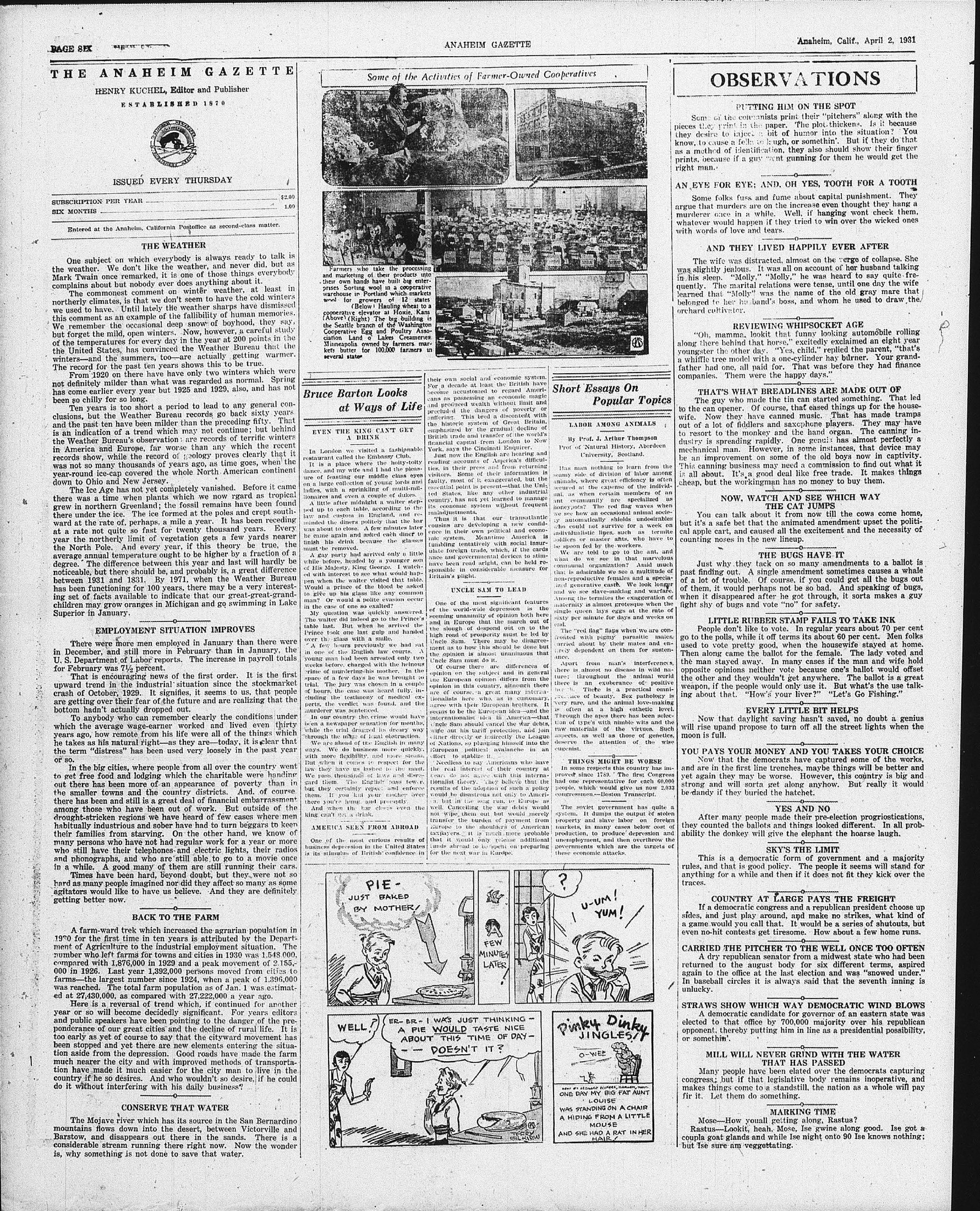
Farmers who take the processing and marketing of their products into their own hands have built big enterprises Sorting wool in a cooperative warehouse in Portland which markets wool for growers of 12 states (Below! Hauling wheat to a cooperative elevator at Hoxie, Kans (Above) (Right) The big building is the Seattle branch of the Washington Cooperative Egg and Poultry Association Land o Lakes Creameries. Minneapolis owned by farmers markets butter for 100,000 farmers in several states.
Bruce Barton Looks at Ways of Life
EVEN THE KING CAN'T GET A DRINK
In London we visited a fashionable their own social and economic system. For a decade at least the British have become accustomed to regard Americans as possessing an economic magic and produced wealth without limit and precluded the dangers of poverty or suffering. This breed a discontent with the historic system of Great Britain, emphasized by the gradual decline of British trade and transfer of the world's financial capital from London to New York, says the Cincinnati Enquirer.
Short Essays On Popular Topics
LABOR AMONG ANIMALS
By Prof. J. Arthur Thompson
Prof. of Natural History, Aberdeen
Bruce Barton Looks at Ways of Life
EVEN THE KING CAN'T GET A DRINK
In London we visited a fashionable restaurant called the Embassy Club.
It is a place where the holly-tolty dance, and my wife and I had the pleasure of feasting our middle class eyes on a large collection of young lords and ladies, with a sprinkling of multi-millionaires and even a couple of dukes.
A little after midnight a waiter stepped up to each table, according to the law and custom in England, and reminded the diners politely that the bar was about to close. A few minutes later he came again and asked each diner to finish his drink because the glasses must be removed.
A gay party had arrived only a little while before, headed by a younger son of His Majesty, King George. I watched with interest to see what would happen when the waiter visited that table. Would a prince of the blood be asked to give up his glass like any common man? Or would a polite evasion occur in the case of one so exalted?
My question was quickly answered. The waiter did indeed go to the Prince's table last. But when he arrived the Prince took one last gulp and handed over the glass with a smile.
A few hours previously we had sat in one of the English law courts. A young man had been arrested only two weeks before, charged with the heinous crime of murdering his mother. In the space of a few days he was brought to trial. The jury was chosen in a couple of hours, the case was heard fully, including the testimony of medical experts, the verdict was found, and the murderer was sentenced.
In our country the crime would have been a newspaper sensation for months, while the trial dragged its dreary way through the maze of legal obstruction.
We are ahead of the English in many ways. We do business more quickly, with more flexibility, and more steam. But when it comes to respect for the law they have us lashed to the mast. We pass thousands of laws and disregard them. The English pass fewer but they certainly respect and enforce them. If you kill your mother over there you're being, and promptly.
And when the bar closes even the king can't get a drink.
AMERICA SEEN FROM ABROAD
One of the most curious results of business depression in the United States is its stimulus of British confidence in their own social and economic system. For a decade at least the British have become accustomed to regard Americans as possessing an economic magic and produced wealth without limit and precluded the dangers of poverty or suffering. This bred a discontent with the historic system of Great Britain, emphasized by the gradual decline of British trade and transfer of the world's financial capital from London to New York, says the Cincinnati Enquirer.
Just now the English are hearing and reading accounts of America's difficulties, in their press and from returning visitors. Some of their information is faulty, most of it exaggerated, but the essential point is present—that the United States, like any other industrial country, has not yet learned to manage its economic system without frequent maladjustments.
Thus it is that our transatlantic cousins are developing a new confidence in their own political and economic system. Meantime America is tumbling tentatively with social insurmountable foreign trade, which, if the cards ance and governmental devices to stimulate have been read alright, can be held responsible in considerable measure for Britain's plight.
UNCLE SAM TO LEAD
One of the most significant features of the world-wide depression is the seeming unanimity of opinion both here and in Europe that the march out of the slough of despond out on to the high road of prosperity must be led by Uncle Sam. There may be disagreement as to how this should be done but the opinion is almost unanimous that Uncle Sam must do it.
Of course there are differences of opinion on the subject and in general European opinion differs from the opinion in this country, although there are of course: a great many internationalists here who, as is customary, agree with their European brothers. It seems to be the European idea—and the internationalist idea in America—that Uncle Sam should cancel the war debts, wipe out his tariff protection, and join either directly or indirectly the League of Nations, so plunging himself into the European political avalanche in an effort to stabilize it.
Needless to say Americans who have the real interest of their country at heart do not agree with this internationalist theory. They believe that the results of the adoption of such a policy would be disastrous not only to America but in the long run, to Europe as well. Cancelling the war debts would not wipe them out but would merely transfer the burden of payment from Europe to the shoulders of American taxpayers. It is much more probable that it would only release additional funds abroad to be spent on preparing for the next war in Europe.
LABOR AMONG ANIMALS
By Prof. J. Arthur Thompson
Prof of Natural History, Aberdeen University, Scotland.
Has man nothing to learn from the seamy side of division of labor among animals, where great efficiency is often secured at the expense of the individual, as when certain members of an ant community are specialized as honeypots? The red flag waves when we see how an occasional animal society automatically shields undesirables who could not survive for a week on individualistic lips, such as termite soldiers or master ants, who have to be spoon fed by the workers.
We are told to go to the ant, and what do we see in that marvelous communal organization? Anid much that admirable we see a multitude of non-reproductive females and a specialized generative castle. We look longer and we see slave-making and warfare. Among the termites the exaggeration of maternity is almost grotesque when the single queen lays eggs at the rate of sixty per minute for days and weeks on end.
The "red flag" flaps when we are confronted with pigmy parasitic males, carried about by their mates and entirely dependent on them for sustenance.
Apart from man's interferences, there is almost no disease in wild nature; throughout the animal world there is an exuberance of positive health. There is a practical omnience of beauty. Sex pathology is very rare, and the animal love-making is often at a high esthetic level. Through the apes there has been selection of type's with nimble wits and the raw materials of the wives. Such aspects, as well as those of genetics, deserve the attention of the wise eugenist.
THINGS MIGHT BE WORSE
In some respects this country has improved since 1789. The first Congress had one representative for each 60,000 people, which would give us now 2,033 congressmen—Boston Transcript.
The Soviet government has quite a system. It dumps the output of stolen property and slave labor on foreign markets, in many cases below cost of production, to produce depression and unemployment, and then overthrow the governments which are the targets of these economic attacks.
But when it comes to respect for the law they have us lashed to the mast. We pass thousands of laws and disregard them. The English pass few r. but they certainly repect and enforce them. If you kill your mother over there you're hung, and promptly.
And when the bar closes even the king can't get a drink.
AMERICA SEEN FROM ABROAD
One of the most curious results of business depression in the United States is its stimulus of British confidence in needless to say Americans who have the real interest of their country at rear, do not agree with this internationalist theory. They believe that the results of the adoption of such a policy would be disastrous not only to America, but in the long run, to Europe as well. Cancelling the war debts would not wipe them out but would merely transfer the burden of payment from Europe to the shoulders of American taxpayers. It is much more probable that it would only release additional funds abroad to be spent on preparing for the next war in Europe.
THINGS MIGHT BE WORSE
In some respects this country has improved since 1789. The first Congress had one representative for each 60,000 people, which would give us now 2,033 congressmen.—Boston Transcript.
The soviet government has quite a system. It dumps the output of stolen property and slave labor on foreign markets, in many cases below cost of production, to produce depression and unemployment, and then overthrow the governments which are the targets of these economic attacks.
PIE-JUST BAKED BY MOTHER!
FEW MINUTES LATER?
U-UM! YUM!
ER-BR-I WAS JUST THINKING-A PIEWOULD TASTE NICE ABOUT THIS TIME OF DAY-DOESN'T IT?
Pinky Dinky JINGLES!
ONE DAY MY BIG FAT AUNT LOUISE
WAS STANDING ON A CHAIR
A HIDING FROM A LITTLE MOUSE
AND SHE HAD A RAT IN HER HAIR!
OBSERVATIONS
PUTTING HIM ON THE SPOT
Some of the covertists print their "pitchers" along with the pieces they print in the paper. The plot thickens. Is it because they desire to inject a bit of humor into the situation? You know, to cause a fella to laugh, or somethin'. But if they do that as a method of identification, they also should show their finger prints, because if a guy went gunning for them he would get the right man.
AN EYE FOR EYE; AND, OH YES, TOOTH FOR A TOOTH
Some folks fuss and fume about capital punishment. They argue that murders are on the increase even thought they hang a murderer once in a while. Well, if hanging wont check them, whatever would happen if they tried to win over the wicked ones with words of love and tears.
AND THEY LIVED HAPPILY EVER AFTER
The wife was distracted, almost on the verge of collapse. She was slightly jealous. It was all on account of her husband talking in his sleep. "Molly," "Molly," he was heard to say quite frequently. The marital relations were tense, until one day the wife learned that "Molly" was the name of the old gray mare that belonged to her husband's boss, and whom he used to draw the orchard cultivator.
REVIEWING WHIPSOCKET AGE
"Oh, mamma, lookit that funny looking automobile rolling along there behind that horse," excitedly exclaimed an eight year youngster the other day. "Yes, child," replied the parent, "that's a whiffle tree model with a one-cylinder hay burner. Your grandfather had one, all paid for. That was before they had finance companies. Them were the happy days."
THAT'S WHAT BREADLINES ARE MADE OUT OF
The guy who made the tin can started something. That led to the can opener. Of course, that eased things up for the housewife. Now they have canned music. That has made tramps out of a lot of fiddlers and saxophone players. They may have to resort to the monkey and the hand organ. The canning industry is spreading rapidly. One genius has almost perfectly a mechanical man. However, in some instances, that device may
THAT'S WHAT BREADLINES ARE MADE OUT OF
The guy who made the tin can started something. That led to the can opener. Of course, that eased things up for the housewife. Now they have canned music. That has made tramps out of a lot of fiddlers and saxophone players. They may have to resort to the monkey and the hand organ. The canning industry is spreading rapidly. One genius has almost perfectly a mechanical man. However, in some instances, that device may be an improvement on some of the old boys now in captivity. This canning business may need a commission to find out what it is all about. It's a good deal like free trade. It makes things cheap, but the workingman has no money to buy them.
NOW, WATCH AND SEE WHICH WAY
THE CAT JUMPS
You can talk about it from now till the cows come home, but it's a safe bet that the animated amendment upset the political apple cart, and caused all the excitement and the necessity of counting noses in the new lineup.
THE BUGS HAVE IT
Just why they tack on so many amendments to a ballot is past finding out. A single amendment sometimes causes a whale of a lot of trouble. Of course, if you could get all the bugs out of them, it would perhaps not be so bad. And speaking of bugs, when it disappeared after he got through, it sorta makes a guy fight shy of bugs and vote "no" for safety.
LITTLE RUBBER STAMP FAILS TO TAKE INK
People don't like to vote. In regular years about 70 per cent go to the polls, while it off terms its about 60 per cent. Men folks used to vote pretty good, when the housewife stayed at home. Then along came the ballot for the female. The lady voted and the man stayed away. In many cases if the man and wife hold opposite opinions neither vote because one's ballot would offset the other and they wouldn't get anywhere. The ballot is a great weapon, if the people wouldn't only use it. But what's the use talking about that. "How's your liver?" "Let's Go Fishing."
EVERY LITTLE BIT HELPS
Now that daylight saving hasn't saved, no doubt a genius will rise up and propose to turn off all the street lights when the moon is full.
YOU PAYS YOUR MONEY AND YOU TAKES YOUR CHOICE
Now that the democrats have captured some of the works, and are in the first line trenches, maybe things will be better and yet again they may be worse. However, this country is big and strong and will sorta get along anyhow. But really it would be dandy if they buried the hatchet.
YES AND NO
After many people made their pre-election progrostications, they counted the ballots and things looked different. In all probability the donkey will give the elephant the hoarse laugh.
SKY'S THE LIMIT
YES AND NO
After many people made their pre-election prognostications,
they counted the ballots and things looked different. In all probability the donkey will give the elephant the hoarse laugh.
SKY'S THE LIMIT
This is a democratic form of government and a majority
rules, and that is good policy. The people it seems will stand for
anything for a while and then if it does not fit they kick over the traces.
COUNTRY AT LARGE PAYS THE FREIGHT
If a democratic congress and a republican president choose up
sides, and just play around, and make no strikes, what kind of
a game would you call that. It would be a series of shutouts, but
even no-hit contests get tiresome. How about a few home runs.
CARRIED THE PITCHER TO THE WELL ONCE TOO OFTEN
A dry republican senator from a midwest state who had been
returned to the august body for six different terms, aspired
again to the office at the last election and was "snowed under."
In baseball circles it is always said that the seventh inning is
unlucky.
STRAWS SHOW WHICH WAY DEMOCRATIC WIND BLOWS
A democratic candidate for governor of an eastern state was
elected to that office by 700,000 majority over his republican
opponent, thereby putting him in line as a presidential possibility,
or somethin'.
MILL WILL NEVER GRIND WITH THE WATER
THAT HAS PASSED
Many people have been elated over the democrats capturing
congress; but if that legislative body remains inoperative, and
makes things come to a standstill, the nation as a whole will pay
fir it. Let them do something.
MARKING TIME
Mose—How youall getting along, Rastus?
Rastus—Lookit, heah, Mose, Ise gwine along good. Ise got a
coupla goat glands and while Ise night onto 90 Ise knows nothing;
but Ise sure am veggettating.