anaheim-gazette 1931-02-26
Scanned page
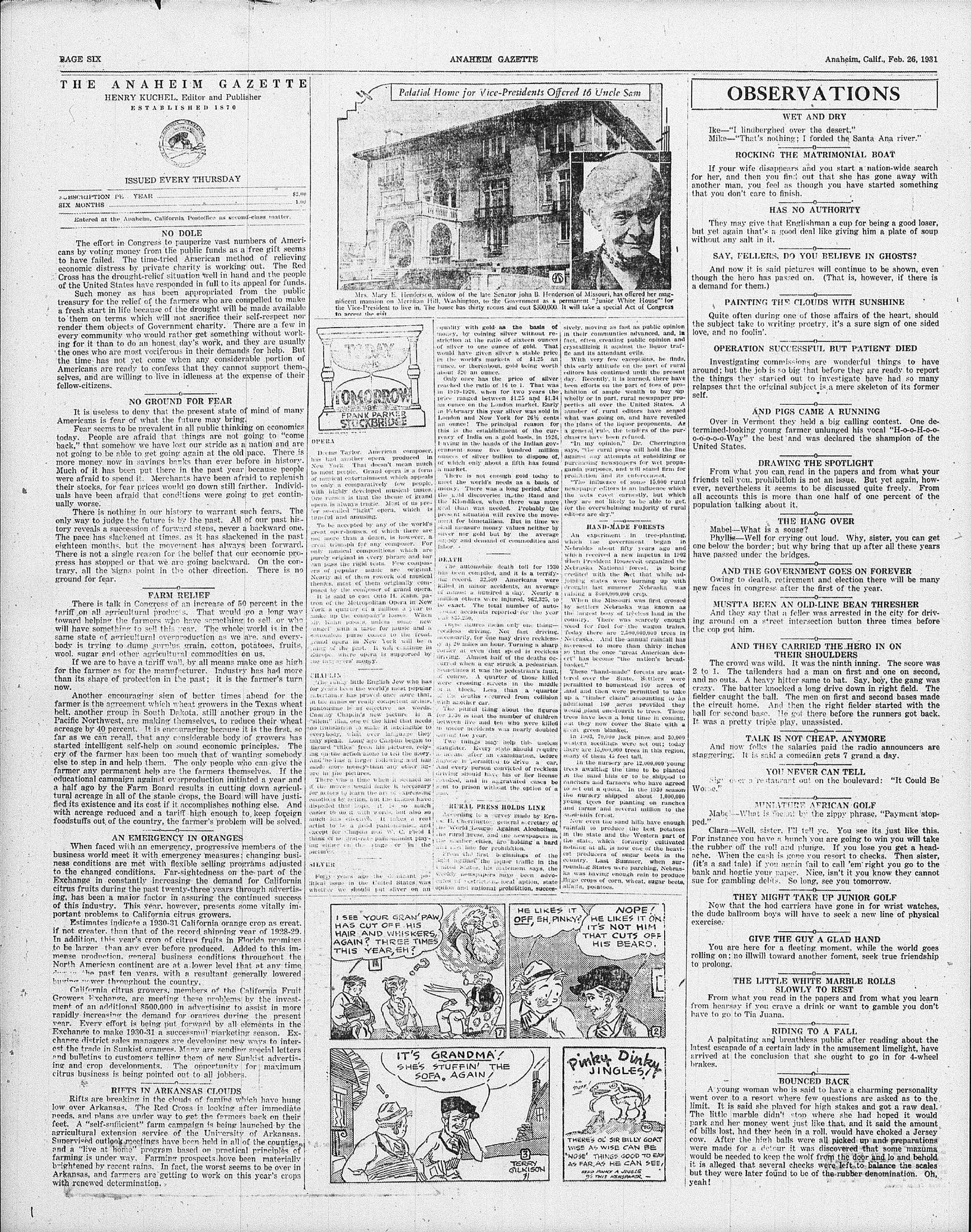
Searchable text
THE ANAHEIM GAZETTE
HENRY KUCHEL, Editor and Publisher
ESTABLISHED 1870
ISSUED EVERY THURSDAY
SUBSCRIPTION PE YEAR $2.00
SIX MONTHS 1.00
Entered at the Anaheim, California Postoffice as second-class matter.
NO DOLE
The effort in Congress to pauperize vast numbers of Americans by voting money from the public funds as a free gift seems to have failed. The time-tried American method of relieving economic distress by private charity is working out. The Red Cross has the drought-relief situation well in hand and the people of the United States have responded in full to its appeal for funds.
Such money as has been appropriated from the public treasury for the relief of the farmers who are compelled to make a fresh start in life because of the drought will be made available to them on terms which will not sacrifice their self-respect nor render them objects of Government charity. There are a few in every community who would rather get something without working for it than to do an honest day's work, and they are usually the ones who are most vociferous in their demands for help. But the time has not yet come when any considerable portion of Americans are ready to confess that they cannot support themselves, and are willing to live in idleness at the expense of their fellow-citizens.
NO GROUND FOR FEAR
It is useless to deny that the present state of mind of many Americans is fear of what the future may bring.
Fear seems to be prevalent in all public thinking on economics today. People are afraid that things are not going to "come back," that somehow we have lost our stride as a nation and are not going to be able to get going again at the old pace. There is
NO GROUND FOR FEAR
It is useless to deny that the present state of mind of many Americans is fear of what the future may bring.
Fear seems to be prevalent in all public thinking on economics today. People are afraid that things are not going to "come back," that somehow we have lost our stride as a nation and are not going to be able to get going again at the old pace. There is more money now in savings banks than ever before in history. Much of it has been put there in the past year because people were afraid to spend it. Merchants have been afraid to replenish their stocks, for fear prices would go down still farther. Individuals have been afraid that conditions were going to get continually worse.
There is nothing in our history to warrant such fears. The only way to judge the future is by the past. All of our past history reveals a succession of forward steps, never a backward one. The pace has slackened at times, as it has slackened in the past eighteen months, but the movement has always been forward. There is not a single reason for the belief that our economic progress has stopped or that we are going backward. On the contrary, all the signs point in the other direction. There is no ground for fear.
FARM RELIEF
There is talk in Congress of an increase of 50 percent in the tariff on all agricultural products. That would go a long way toward helping the farmers who have something to sell or who will have something to sell this year. The whole world is in the same state of agricultural overproduction as we are, and everybody is trying to dump surplus grain, cotton, potatoes, fruits, wool, sugar and other agricultural commodities on us.
If we are to have a tariff wall, by all means make one as high for the farmer as for the manufacturer. Industry has had more than its share of protection in the past; it is the farmer's turn now.
Another encouraging sign of better times ahead for the farmer is the agreement which wheat growers in the Texas wheat belt, another group in South Dakota, still another group in the Pacific Northwest, are making themselves, to reduce their wheat acreage by 40 percent. It is encouraging because it is the first, so far as we can recall, that any considerable body of growers has started intelligent self-help on sound economic principles. The cry of the farmer has been too much that of wanting somebody else to step in and help them. The only people who can give the farmer any permanent help are the farmers themselves. If the educational campaign against overproduction initinted a year and a half ago by the Farm Board results in cutting down agricultural acreage in all of the staple crops, the Board will have justified its existence and its cost if it accomplishes nothing else. And with acreage reduced and a tariff high enough to keep foreign foodstuffs out of the country, the farmer's problem will be solved.
AN EMERGENCY IN ORANGES
When faced with an emergency, progressive members of the business world meet it with emergency measures; changing business conditions are met with flexible selling programs adjusted
AN EMERGENCY IN ORANGES
When faced with an emergency, progressive members of the business world meet it with emergency measures; changing business conditions are met with flexible selling programs adjusted to the changed conditions. Far-sightedness on the part of the Exchange in constantly increasing the demand for California citrus fruits during the past twenty-three years through advertising, has been a major factor in assuring the continued success of this industry. This year, however, presents some vitally important problems to California citrus growers.
Estimates indicate a 1930-31 California orange crop as great, if not greater than that of the record shipping year of 1928-29. In addition, this year's crop of citrus fruits in Florida promises to be larger than any ever before produced. Added to this immense production, general business conditions throughout the North American continent are at a lower level that at any time during the past ten years, with a resultant generally lowered buying power throughout the country.
California citrus growers, members of the California Fruit Growers Exchange, are meeting these problems by the investment of an additional $500,000 in advertising to assist in more rapidly increasing the demand for oranges during the present year. Every effort is being put forward by all elements in the Exchange to make 1930-31 a successful marketing season. Exchange district sales managers are developing new ways to interest the trade in Sunkist oranges. Many are sending special letters and bulletins to customers telling them of new Sunkist advertising and crop developments. The opportunity for maximum citrus business is being pointed out to all jobbers.
RIFTS IN ARKANSAS CLOUDS
Rifts are breaking in the clouds of famine which have hung low over Arkansas. The Red Cross is looking after immediate needs, and plans are under way to get the farmers back on their feet. A "self-sufficient" farm campaign is being launched by the agricultural extension service of the University of Arkansas. Supervised outlook meetings have been held in all of the counties, and a "live at home" program based on practical principles of farming is under way. Farming prospects have been materially brightened by recent rains. In fact, the worst seems to be over in Arkansas, and farmers are getting to work on this year's crops with renewed determination.
ANAHEIM GAZETTE
Palatial Home for Vice-Presidents Offered to Uncle Sam
Mrs. Mary E. Henderson, widow of the late Senator John B. Henderson of Missouri, has offered her magnificent mansion on Meridian Hill, Washington, to the Government as a permanent "Junior White House" for the Vice-President to live in. The house has thirty rooms and cost $300,000. It will take a special Act of Congress to accept the gift.
Equality with gold as the basis of money, by coining silver without restriction at the ratio of sixteen ounces of silver to one ounce of gold. That would have given silver a stable price in the world's markets of $1.25 an ounce, or thereabout, gold being worth about $20 an ounce.
Only once has the price of silver reached the ratio of 16 to 1. That was in 1919-1920, when for two years the price ranged between $1.25 and $1.34 an ounce on the London market. Early in February this year silver was sold in London and New York for 26½ cents an ounce! The principal reason for this is the establishment of the currency of India on a gold basis, in 1926, having in the hands of the Indian government some five hundred million ounces of silver bullion to dispose of,
sively, moving as fast as public opinion in their communities advanced, and, in fact, often creating public opinion and crystallizing it against the liquor traffic and its attendant evils.
With very few exceptions, he finds, this early attitude on the part of rural editors has continued until the present day. Recently, it is learned, there have been efforts on the part of foes of prohibition of ample wealth to buy up wholly or in part, rural newspaper properties all over the United States. A number of rural editors have sensed what was going on, and have revealed the plans of the liquor proponents. As a general rule, the tenders of the purchasers have been refused.
"In my opinion," Dr. Cherrington says, "the rural press will hold the line against any attempts at subsidizing or
OPERA
Deems Taylor, American composer, has had another opera produced in New York. That doesn't mean much to most people. Grand opera is a form of musical entertainment which appeals to only a comparatively few people, with highly developed musical tastes. One reason is that the theme of grand opera is always tragic. Most of us prefer so-called "light" opera, which is tuneful and amusing.
To be accepted by any of the world's great oper-houses, of which there are not more than a dozen, is however, a great triumph for any composer. For only musical compositions which are purely original in every phrase and bar can pass the rigid tests. Few composers of popular music are original. Nearly all of them rework old musical themes, most of them originally composed by the composer of grand opera.
It is said to cost Otto H. Kahn, patron of the Metropolitan Opera in New York a quarter of a million a year to make up the company's losses. When Air Kahn passes, unless some new angel with a taste for music and a cottonless purse comes to the front, grand opera in New York will be a jungle of the past. It will continue in Europe, where opera is supported by one taxpayers' money.
CHAPLIN
The rainy little English Jew who has for years been the world's most popular entertainer has proved once more that, in the hands or really competent artists, pantomime is as effective as words. Charles Chapin's new picture is a "silent" film, one of the kind that needs no translation to make it intelligible to everybody, what ever language they may speak. Long ago Chapin began to discard "titles" from his pictures, relying on the action alone to tell the story. And he has a larger following and has made more money than any other figure in the pictures.
There was a time when it seemed as if the movies would make it necessary for actors to learn the art of expressing emotions by action, but the tactics have dispelled that hope. It is so much easier to do it with words, but also so much less effective. It takes a real artist to be a good pantomimist, and except for Chapin and W. C. Field I think of no first-rate pantomimist playing either on the stage or in the picture.
SILVER
ONCE AHEAD OF THE RIGHT AGAINST THE LIQUOR TRAffic IN THE UNITED STATES, his statement says, this early attitude on the part of rural editors has continued until the present day. Recently, it is learned, there have been efforts on the part of foes of prohibition of ample wealth to buy up wholly or in part, rural newspaper properties all over the United States. A number of rural editors have sensed what was going on, and have revealed the plans of the liquor proponents. As a general rule, the tenders of the purchasers have been refused.
"In my opinion," Dr. Cherrington says, "the rural press will hold the line against any attempts at subsidizing or purchasing newspapers for wet propaganda purposes, and will stand firm for prohibition and its enforcement.
"The influence of some 15,000 rural newspaper editors is an influence which the wets covet earnestly, but which they are not likely to be able to get, for the overwhelming majority of rural editors are dry."
HAND-MADE FORESTS
An experiment in tree-planting, which the government began in Nebraska about fifty years ago and which received a new impetus in 1902 when President Roosevelt organized the Nebraska National forest, is being credited with the fact that while adopting states were burning up with drought last summer Nebraska was raising a $600,000,000 crop.
When the Missouri was first crossed by settlers Nebraska was known as the largest body of treeless land in the country. There was scarcely enough wood for fuel for the wagon trains. Today there are 2,500,000,000 trees in Nebraska. And the annual rainfall has increased to more than thirty inches so that the once "great American desert" has become "the nation's breadbasket."
These "hand-made" forests are scattered over the State. Settlers were permitted to homestead 160 acres of land and then were permitted to take up a "timber claim" amounting to an additional 160 acres provided they would plant one-fourth to trees. These trees have been a long time in coming, but they now cover the State with a great green blanket.
In 1903, 70,000 jack pines and 30,000 western seedlings were set out; today there are 15,000,000 trees in this region, many of them 45 feet tall.
In the nursery are 12,000,000 young trees awaiting the time to be planted in the sand hills or to be shipped to ranchers and farmers who have agreed to set out a quota. In the 1930 season the nursery shipped about 1,000,000 young trees for planting on ranches and farms and several million to the sand-hills forest.
Now even the sand hills have enough rainfall to produce the best potatoes in the state and the Western part of the state, which formerly cultivated not at all, is now one of the heaviest producers of sugar beets in the country. Last Summer, when surrounding States were parching, Nebras-
There was a time when it seemed as if the movies would make it necessary for actors to learn the art of expressing emotions by action, but the tactics have dispelled that hope. It is so much easier to do it with words, but also so much less effective. It takes a real artist to be a good pantomimeist, and except for Chaplin and W. C. Field I think no first-rate pantomimist playing either on the stage or in the picture.
SILVER
For forty years ago the dominant political issue in the United States was whether we should put sliver on an driving should have his or her license revoked, and in aggravated cases sent to prison without the option of a fine.
RURAL PRESS HOLDS LINE
According to a survey made by Ernest H. Cherrington, general secretary of the World League Against Alcoholism, the rural press, and the newspapers in the smaller cities, are holding a hard line for prohibition.
From the first beginnings of the fight against the liquor traffic in the United States, his statement says, the weekly newspapers have been advocates of restriction, local action, state option and national prohibition, success.
I SEE YOUR GRAN' PAW HAS CUT OFF HIS HAIR AND WHISKERS, AGAIN? THREE TIMES THIS YEAR, EH?
HE LIKES IT OFF, EH, PINKY?
NOPE! HE LIKES IT ON! IT'S NOT HIM THAT CUTS OFF HIS BEARD.
IT'S GRANDMA! SHE'S STUFFIN' THE SOFA. AGAIN!
TERRY GILKISON
Pinky Dinky JINGLES!
THERE'S OL' SIR BILLY GOAT WISE AS WISE CAN BE 'NOSE' THINGS GOOD TO EAT AS FAR, AS HE CAN SEE,
SEED PINKY A JINGLE 90 THIS NEWSPAPER
OBSERVATIONS
WET AND DRY
Ike—“I lindberghed over the desert.”
Mike—“That’s nothing; I forded the Santa Ana river.”
ROCKING THE MATRIMONIAL BOAT
If your wife disappears and you start a nation-wide search for her, and then you find out that she has gone away with another man, you feel as though you have started something that you don’t care to finish.
HAS NO AUTHORITY
They may give that Englishman a cup for being a good loser, but yet again that’s a good deal like giving him a plate of soup without any salt in it.
SAY, FELLERS, DO YOU BELIEVE IN GHOSTS?
And now it is said pictures will continue to be shown, even though the hero has passed on. (That is, however, if there is a demand for them.)
PAINTING THE CLOUDS WITH SUNSHINE
Quite often during one of those affairs of the heart, should the subject take to writing proetry, it’s a sure sign of one sided love, and no foolin’.
OPERATION SUCCESSFUL BUT PATIENT DIED
Investigating commissions are wonderful things to have around; but the job is so big that before they are ready to report the things they started out to investigate have had so many relapses that the original subject is a mere skeleton of its former self.
AND PIGS CAME A RUNNING
Over in Vermont they held a big calling contest. One determined-looking young farmer unlunged his vocal “H-o-o-H-o-o-0-0-0-0-Way” the best and was declared the champion of the United States.
AND PIGS CAME A RUNNING
Over in Vermont they held a big calling contest. One determined-looking young farmer unlunged his vocal "H-o-o-H-o-o-o-o-o-Way" the best and was declared the champion of the United States.
DRAWING THE SPOTLIGHT
From what you can read in the papers and from what your friends tell you, prohibition is not an issue. But yet again, however, nevertheless it seems to be discussed quite freely. From all accounts this is more than one half of one percent of the population talking about it.
THE HANG OVER
Mabel—What is a souse?
Phyllis—Well for crying out loud. Why, sister, you can get one below the border; but why bring that up after all these years have passed under the bridges.
AND THE GOVERNMENT GOES ON FOREVER
Owing to death, retirement and election there will be many new faces in congress after the first of the year.
MUSTTA BEEN AN OLD-LINE BEAN THRESHER
And they say that a feller was arrested in the city for driving around on a street intersection button three times before the cop got him.
AND THEY CARRIED THE HERO IN ON
THEIR SHOULDERS
The crowd was wild. It was the ninth inning. The score was 2 to 1. The tailenders had a man on first and one on second, and no outs. A heavy hitter same to bat. Say, boy, the gang was crazy. The batter knocked a long drive down in right field. The fielder caught the ball. The men on first and second bases made the circuit home. And then the right fielder started with the ball for second base. He got there before the runners got back. It was a pretty triple play, unassisted.
TALK IS NOT CHEAP, ANYMORE
And now folks the salaries paid the radio announcers are staggering. It is said a comedian gets 7 grand a day.
YOU NEVER CAN TELL
Sign over a restaurant out on the boulevard: "It Could Be Worse."
MINIATURE AFRICAN GOLF
Mabe—What is meant by the zippy phrase, "Payment stopped."
Clara—Well, sister. I'll tell ye. You see its just like this. For instance you have a hunch you are going to win you will take the rubber off the roll and plunge. If you lose you get a headache. When the cash is gone you resort to checks. Then sister, (it's a sad tale) if you again fail to call 'em right you go to the
MINIATURE AFRICAN GOLF
Mabel—What is meant by the zippy phrase, "Payment stopped."
Clara—Well, sister, I'll tell ye. You see its just like this. For instance you have a hunch you are going to win you will take the rubber off the roll and plunge. If you lose you get a headache. When the cash is gone you resort to checks. Then sister, (it's a sad tale) if you again fail to call 'em right you go to the bank and hogtie your paper. Nice, isn't it you know they cannot sue for gambling debts. So long, see you tomorrow.
THEY MIGHT TAKE UP JUNIOR GOLF
Now that the hod carriers have gone in for wrist watches, the dude ballroom boys will have to seek a new line of physical exercise:
GIVE THE GUY A GLAD HAND
You are here for a fleeting moment, while the world goes rolling on; no illwill toward another foment, seek true friendship to prolong.
THE LITTLE WHITE MARBLE ROLLS
SLOWLY TO REST
From what you read in the papers and from what you learn from hearsay if you crave a drink or want to gamble you don't have to go to Tia Juana.
RIDING TO A FALL
A palpitating and breathless public after reading about the latest escapade of a certain lady in the amusement limelight, have arrived at the conclusion that she ought to go in for 4-wheel brakes.
BOUNCED BACK
A young woman who is said to have a charming personality went over to a resort where few questions are asked as to the limit. It is said she played for high stakes and got a raw deal. The little marble didn't stop where she had hoped it would park and her money went just like that, and it said the amount of bills lost, had they been in a roll, would have choked a Jersey cow. After the high balls were all picked up and preparations were made for a detour it was discovered that some mazuma would be needed to keep the wolf from the door and lo and behold it is alleged that several checks were left to balance the scales but they were later found to be of the rubber denomination. Oh, yeah!