anaheim-gazette 1931-01-22
Scanned page
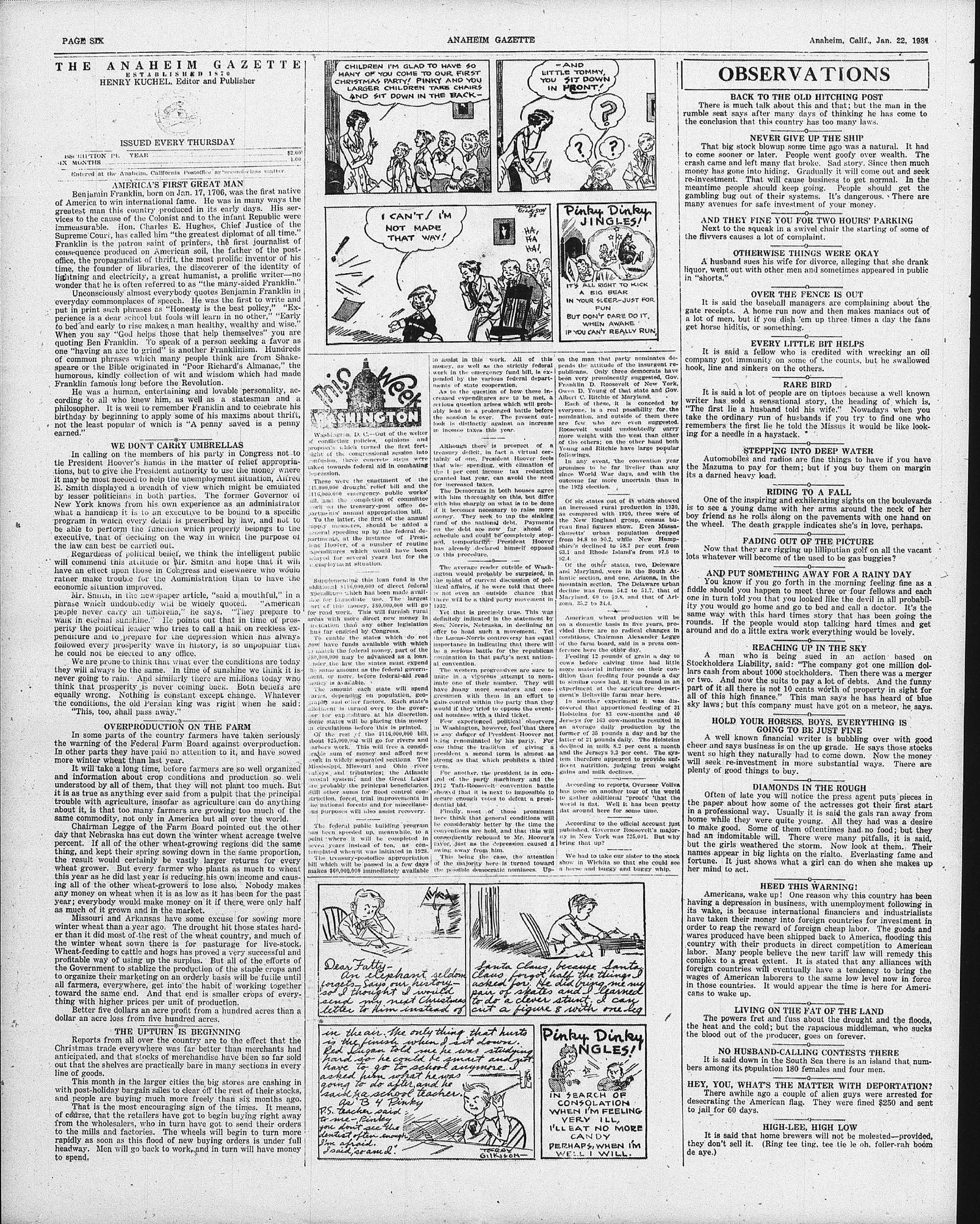
Searchable text
THE ANAHEIM GAZETTE
ESTABLISHED 1870
HENRY KUCHEL, Editor and Publisher
ISSUED EVERY THURSDAY
DESCRIPTION Pt. YEAR $2.00
SIX MONTHS 1.00
Entered at the Anaheim, California Postoffice as second-class matter.
AMERICA'S FIRST GREAT MAN
Benjamin Franklin, born on Jan. 17, 1706, was the first native of America to win international fame. He was in many ways the greatest man this country produced in its early days. His services to the cause of the Colonist and to the infant Republic were immeasurable. Hon. Charles E. Hughes, Chief Justice of the Supreme Court, has called him "the greatest diplomat of all time." Franklin is the patron saint of printers, the first journalist of consequence produced on American soil, the father of the post-office, the propagandist of thrift, the most prolific inventor of his time, the founder of libraries, the discoverer of the identity of lightning and electricity, a great humanist, a prolific writer—no wonder that he is often referred to as "the many-sided Franklin."
Unconsciously almost everybody quotes Benjamin Franklin in everyday commonplaces of speech. He was the first to write and put in print such phrases as "Honesty is the best policy," "Experience is a dear school but fools will learn in no other," "Early to bed and early to rise makes a man healthy, wealthy and wise." When you say "God helps those that help themselves" you are quoting Ben Franklin. To speak of a person seeking a favor as one "having an axe to grind" is another Franklinism. Hundreds of common phrases which many people think are from Shakespeare or the Bible originated in "Poor Richard's Almanac," the humorous, kindly collection of wit and wisdom which had made Franklin famous long before the Revolution.
He was a human, entertaining and lovable personality, according to all who knew him, as well as a statesman and a philosopher. It is well to remember Franklin and to celebrate his birthday by beginning to apply some of his maxims about thrift, not the least popular of which is "A penny saved is a penny earned."
WE DON'T CARRY UMBRELLAS
In calling on the members of his party in Congress not to
WE DON'T CARRY UMBRELLAS
In calling on the members of his party in Congress not to tie President Hoover's hands in the matter of relief appropriations, but to give the President authority to use the money where it may be most needed to help the unemployment situation, Alfred E. Smith displayed a breadth of view which might be emulated by lesser politicians in both parties. The former Governor of New York knows from his own experience as an administrator what a handicap it is to an executive to be bound to a specific program in which every detail is prescribed by law, and not to be able to perform the function which properly belongs to the executive, that of deciding on the way in which the purpose or the law can best be carried out.
Regardless of political belief, we think the intelligent public will commend this attitude or Mr. Smith and hope that it will have an effect upon those in Congress and elsewhere who would ratner make trouble for the Administration than to have the economic situation improved.
Mr. Smith, in the newspaper article, "said a mouthful," in a phrase which undoubtedly will be widely quoted. "American people never carry an umbrella," he says. "They prepare to walk in ectical sunshine." He points out that in time of prosperity the political leader who tries to call a halt on reckless expenditure and to prepare for the depression which has always followed every prosperity wave in history, is so unpopular that he could not be elected to any office.
We are prone to think that what ever the conditions are today they will always be the same. In time of sunshine we think it is never going to rain. And similarly there are millions today who think that prosperity is never coming back. Both beliefs are equally wrong. Nothing is constant except change. Whatever the conditions, the old Persian king was right when he said: "This, too, shall pass away."
OVERPRODUCTION ON THE FARM
In some parts of the country farmers have taken seriously the warning of the Federal Farm Board against overproduction. In other parts they have paid no attention to it, and have sowed more winter wheat than last year.
It will take a long time, before farmers are so well organized and information about crop conditions and production so well understood by all of them, that they will not plant too much. But it is as true as anything ever said from a pulpit that the principal trouble with agriculture, insofar as agriculture can do anything about it, is that too many farmers are growing too much of the same commodity, not only in America but all over the world.
Chairman Legge of the Farm Board pointed out the other day that Nebraska has cut down the winter wheat acreage twelve percent. If all of the other wheat-growing regions did the same thing, and kept their spring sowing down in the same proportion, the result would certainly be vastly larger returns for every
It will take a long time, before farmers are so well organized and information about crop conditions and production so well understood by all of them, that they will not plant too much. But it is as true as anything ever said from a pulpit that the principal trouble with agriculture, insofar as agriculture can do anything about it, is that too many farmers are growing too much of the same commodity, not only in America but all over the world.
Chairman Legge of the Farm Board pointed out the other day that Nebraska has cut down the winter wheat acreage twelve percent. If all of the other wheat-growing regions did the same thing, and kept their spring sowing down in the same proportion, the result would certainly be vastly larger returns for every wheat grower. But every farmer who plants as much to wheat this year as he did last year is reducing his own income and causing all of the other wheat-growers to lose also. Nobody makes any money on wheat when it is as low as it has been for the past year; everybody would make money on it if there were only half as much of it grown and in the market.
Missouri and Arkansas have some excuse for sowing more winter wheat than a year ago. The drought hit those states harder than it did most of the rest of the wheat country, and much of the winter wheat sown there is for pasturage for live-stock. Wheat-feeding to cattle and hogs has proved a very successful and profitable way of using up the surplus. But all of the efforts of the Government to stabilize the production of the staple crops and to organize their marketing on an orderly basis will be futile until all farmers, everywhere, get into the habit of working together toward the same end. And that end is smaller crops of everything with higher prices per unit of production.
Better five dollars an acre profit from a hundred acres than a dollar an acre loss from five hundred acres.
THE UPTURN IS BEGINNING
Reports from all over the country are to the effect that the Christmas trade everywhere was far better than merchants had anticipated, and that stocks of merchandise have been so far sold out that the shelves are practically bare in many sections in every line of goods.
This month in the larger cities the big stores are cashing in with post-holiday bargain sales to clear off the rest of their stocks, and people are buying much more freely than six months ago.
That is the most encouraging sign of the times. It means, of course, that the retailers have got to begin buying right away from the wholesalers, who in turn have got to send their orders to the mills and factories. The wheels will begin to turn more rapidly as soon as this flood of new buying orders is under full headway. Men will go back to work, and in turn will have money to spend.
CHILDREN I'M GLAD TO HAVE SO MANY OF YOU COME TO OUR FIRST CHRISTMAS PARTY! PINKY AND YOU LARGER CHILDREN TAKE CHAIRS AND SIT DOWN IN THE BACK-
-AND LITTLE TOMMY, YOU SIT DOWN IN FRONT!
I CAN'T/ I'M NOT MADE THAT WAY!
Pinky Dinky JINGLES!
IT'S ALL RIGHT TO KICK A BIG BEAR IN YOUR SLEEP--JUST FOR FUN BUT DON'T DARE DO IT, WHEN AWAKE IF YOU CAN'T REALLY RUN.
Washington, D.C.—Out of the welter of conflicting policies, opinions and proposals which turned the first fortnight of the congressional session into to assist in this work. All of this money, as well as the strictly federal work in the emergency fund bill, is expended by the various federal departments of state cooperation.
As to the question of how these increased expenditures are to be met, a serious question arises which will probably lead to a prolonged battle before the session is over. The present outlook is distinctly against an increase in income taxes this year.
Although there is prospect of a treasury deficit, in fact a virtual cor
on the man that party nominates depends the attitude of the insurgent republicans. Only three democrats have been very prominently suggested, Gov. Franklin D. Roosevelt of New York, Owen D. Young of that state and Gov. Albert C. Ritchie of Maryland.
Each of these, it is conceded by everyone, is a real possibility for the nomination, and outside of them there are few who are even suggested. Roosevelt would undoubtedly carry more weight with the west than either of the others; on the other hand both Young and Ritchie have large popular followings.
Washington, D.C.—Out of the welter of conflicting policies, opinions and proposals which turned the first fortight of the congressional session into confusion, three concrete steps were taken towards federal aid in combating depression.
These were the enactment of the $45,000,000 drought relief bill and the $116,000,000 emergency-public works' bill, and the completion of committee work on the treasury-post office departments' annual appropriation bill.
To the latter, the first of the annual supply measures, should be added a general speeding up by the federal departments, at the instance of President Hoover, of a number of routine expenditures which would have been delayed for several years but for the employment situation.
Supplementing this loan fund is the additional $116,000,000 of direct federal expenditure which has been made available for immediate use. The largest part of this money, $80,000,000 will go for road work. This will furnish rural areas with more direct new money in circulation than any other legislation has far enacted by Congress.
To enable the states which do not now have funds available with which to match the federal money, part of the $80,000,000 may be advanced as a loan under the law the states must expend the same amount as the federal government, or more, before federal-aid road money is available.
The amount each state will spend varies, depending on population, geography and other factors. Each state's allotment is turned over to the governor for expenditure at his discretion. Some states will be placing this money in circulations before this is printed.
Of the rest of the $116,000,000 bill, about $25,000,000 will go for rivers and harbors work. This will free a considerable sum of money and afford new work in widely separated sections. The Mississippi, Missouri and Ohio river valleys and tributaries; the Atlantic coastal system; and the Great Lakes are probably the principal beneficiaries. Still other sums for flood control construction, forest trial improvements in the national forests and for miscellaneous purposes will also assist recovery.
The federal public building program has been speeded up, meanwhile, to a point where it will be completed in seven years instead of ten, as contemplated when it was initiated in 1928.
The treasury-postoffice appropriation bill which will be passed in a few days
Although there is prospect of a treasury deficit, in fact a virtual certainly of one, President Hoover feels that wise spending, with elimination of the 1 per cent income tax reduction granted last year, can avoid the need for increased taxes.
The Democrats in both houses agree with him thoroughly on this, but differ with him sharply on what is to be done if it becomes necessary to raise more money. They seek to tap the sinking fund of the national debt. Payments on the debt are now far ahead of schedule and could be completely stopped, temporarily. President Hoover has already declared himself opposed to this procedure.
The average reader outside of Washington would probably be surprised, in midst of current discussion of political affairs, if he were told that there is not even an outside chance that there will be a third party movement in 1932.
Yet that is precisely true. This was definitely indicated in the statement by Sen. Norris, Nebraska, in declining an offer to head such a movement. Yet the Lucas-Norris controversy has equal importance in indicating that there will be a serious battle for the republican nomination in that party's next national convention.
The western progressives are sure to unite in a vigorous attempt to nominate one of their number. They will have many more senators and congressmen with them in an effort to gain control within the party than they would if they tried to oppose the eventual nominee with a third ticket.
Few experienced political observers in Washington, however, feel that there is any danger of President Hoover not being renominated by his party. For one thing the tradition of giving a president a second term is almost as strong as that which prohibits a third term.
For another, the president is in control of the party machinery and the 1912 Taft-Roosevelt convention battle showed that it is next to impossible to secure enough votes to defeat a presidential bid.
Finally, most of those prominent here think that general conditions will be considerably better by time the conventions are held, and that this will consequently rebound to Mr. Hoover's favor. Just as the depression caused a swing away from him.
This being the case, the attention of the majority here is turned toward on the man that pays nominates depends the attitude of the insurgent republicans. Only three democrats have been very prominently suggested, Gov. Franklin D. Roosevelt of New York, Owen D. Young of that state and Gov. Albert C. Ritchie of Maryland.
Each of these, it is conceded by everyone, is a real possibility for the nomination, and outside of them there are few who are even suggested. Roosevelt would undoubtedly carry more weight with the west than either of the others; on the other hand both Young and Ritchie have large popular followings.
In any event, the convention year promises to be far livelier than any since World War days, and with the outcome far more uncertain than in the 192$ election.
Of six states out of 48 which showed an increased rural production in 1930, as compared with 1920, three were of the New England group, census bureau final figures show. Even Massachusetts' urban population dropped from 94.8 to 90.2, while New Hampshire's declined to 58.7 per cent from 63.1 and Rhode Island's from 97.5 to 92.4.
Of the other states, two, Deleware and Maryland, were in the South Atlantic section, and one, Arizona, in the mountain section. The Delaware urban decline was from 54.2 to 51.7, that of Maryland, 60 to 59.8, and that of Arizona, 35.2 to 34.4.
American wheat production will be on a domestic basis in five years, provided there are no radical changes in conditions, Chairman Alexander Legge of the farm board, said in a press conference here other day.
Feeding 12 pounds of grain a day to cows before calving time had little more material influence on their condition than feeding four pounds a day to similar cows had it was found in an experiment at the agriculture department's Beltsville farm near here.
In another experiment it was discovered that apportioned feeding of 31 Holsteins for 83 cow-months and 40 Jerseys for 163 cow-months resulted in an average daily production by the former of 35 pounds a day and by the latter of 21 pounds daily. The Holsteins declined in milk 8.2 per cent a month and the Jerseys 9.3 per cent. The system therefore appeared to provide sufficient nutrition, judging from weight gains and milk declines.
According to reports, Overseer Volva has gone on another tour of the world to gather additional "proofs" that the world is flat. Well it has been pretty flat around here for some time.
According to the official account just published, Governor Roosevelt's majority in New York was 725,001. But why bring that up?
We had to take our sister to the stock show in Wichita so that she could see
The federal public building program has been speeded up, meanwhile, to a point where it will be completed in seven years instead of ten, as contemplated when it was initiated in 1928.
The treasury-postoffice appropriation bill which will be passed in a few days makes $60,000,000 immediately available.
For another, the president is in control of the party machinery and the 1912 Taft-Roosevelt convention battle showed that it is next to impossible to secure enough votes to defeat a presidential bid.
Finally, most of those prominent here think that general conditions will be considerably better by the time the conventions are held, and that this will consequently rebound to Mr. Hoover's favor, just as the depression caused a swing away from him.
This being the case, the attention of the majority here is turned toward the possible democratic nominees. Up-
Dear Fatty,
An elephant seldom forgets. Sayo our history—so I thought I would send my next Christmas letter to him instead of Santa Claus, because Santa Claus forgot half the things I asked for. He did bring me my pair of skates and I learned to do a clever stunt. I can cut a figure with one leg.
in the air. The only thing that hurts is the finish when I sit down.
Red Dugan told me he was studying hard so he could be smart and get have to go to school anymore. I asked him what he was going to do after, and he said a school teacher.
Go 'B 4 Pinky PS. teacher said: to me - Pinky you don't see the dentist often enough. I'm afraid. I said, "so am I."
Pinky, Dinky, NGLES!
IN SEARCH OF CONSOLATION WHEN I'M FEELING VERY ILL, I'LL EAT NO MORE CANDY PERHAPS, WHEN I'M WELL I WILL.
OBSERVATIONS
BACK TO THE OLD HITCHING POST
There is much talk about this and that; but the man in the rumble seat says after many days of thinking he has come to the conclusion that this country has too many laws.
NEVER GIVE UP THE SHIP
That big stock blowup some time ago was a natural. It had to come sooner or later. People went goofy over wealth. The crash came and left many flat broke. Sad story. Since then much money has gone into hiding. Gradually it will come out and seek re-investment. That will cause business to get normal. In the meantime people should keep going. People should get the gambling bug out of their systems. It's dangerous. There are many avenues for safe investment of your money.
AND THEY FINE YOU FOR TWO HOURS' PARKING
Next to the squeak in a swivel chair the starting of some of the flivvers causes a lot of complaint.
OTHERWISE THINGS WERE OKAY
A husband sues his wife for divorce, alleging that she drank liquor, went out with other men and sometimes appeared in public in "shorts."
OVER THE FENCE IS OUT
It is said the baseball managers are complaining about the gate receipts. A home run now and then makes maniacs out of a lot of men, but if you dish 'em up three times a day the fans get horse hiditis, or something.
EVERY LITTLE BIT HELPS
It is said a fellow who is credited with wrecking an oil company got immunity on some of the counts, but he swallowed hook, line and sinkers on the others.
RARE BIRD
It is said a lot of people are on tiptoes because a well known writer has sold a sensational story, the heading of which is, "The first lie a husband told his wife." Nowadays when you take the ordinary run of husbands if you try to find one who remembers the first lie he told the Missus it would be like looking for a needle in a haystack.
STEPPING INTO DEEP WATER
RARE BIRD
It is said a lot of people are on tiptoes because a well known writer has sold a sensational story, the heading of which is,
"The first lie a husband told his wife." Nowadays when you take the ordinary run of husbands if you try to find one who remembers the first lie he told the Missus it would be like looking for a needle in a haystack.
STEPPING INTO DEEP WATER
Automobiles and radios are fine things to have if you have the Mazuma to pay for them; but if you buy them on margin its a darned heavy load.
RIDING TO A FALL
One of the inspiring and exhilerating sights on the boulevards is to see a young dame with her arms around the neck of her boy friend as he rolls along on the pavements with one hand on the wheel. The death grapple indicates she's in love, perhaps.
FADING OUT OF THE PICTURE
Now that they are rigging up lilliputian golf on all the vacant lots whatever will become of the used to be gas buggies?
AND PUT SOMETHING AWAY FOR A RAINY DAY
You know if you go forth in the morning feeling fine as a fiddle should you happen to meet three or four fellows and each one in turn told you that you looked like the devil in all probability you would go home and go to bed and call a doctor. It's the same way with this hard times story that has been going the rounds. If the people would stop talking hard times and get around and do a little extra work everything would be lovely.
REACHING UP IN THE SKY
A man who is being sued in an action based on Stockholders Liability, said: "The company got one million dollars cash from about 1000 stockholders. Then there was a merger or two. And now the suits to pay a lot of debts. And the funny part of it all there is not 10 cents worth of property in sight for all of this high finance." This man says he has heard of blue sky laws; but this company must have got on a meteor, he says.
HOLD YOUR HORSES, BOYS, EVERYTHING IS GOING TO BE JUST FINE
A well known financial writer is bubbling over with good cheer and says business is on the up grade. He says those stocks went so high they naturally had to come down. Now the money will seek re-investment in more substantial ways. There are plenty of good things to buy.
DIAMONDS IN THE ROUGH
Often of late you will notice the press agent puts pieces in the paper about how some of the actresses got their first start in a professional way. Usually it is said the gals ran away from home while they were quite young. All they had was a desire to make good. Some of them oftentimes had no food; but they had an indomitable will. There were many pitfalls, it is said, but the girls weathered the storm. Now look at them. Their names appear in big lights on the rialto. Everlasting fame and fortune. It just shows what a girl can do when she makes up
DIAMONDS IN THE ROUGH
Often of late you will notice the press agent puts pieces in the paper about how some of the actresses got their first start in a professional way. Usually it is said the gals ran away from home while they were quite young. All they had was a desire to make good. Some of them oftentimes had no food; but they had an indomitable will. There were many pitfalls, it is said, but the girls weathered the storm. Now look at them. Their names appear in big lights on the rialto. Everlasting fame and fortune. It just shows what a girl can do when she makes up her mind to act.
HEED THIS WARNING!
Americans, wake up! One reason why this country has been having a depression in business, with unemployment following in its wake, is because international financiers and industrialists have taken their money into foreign countries for investment in order to reap the reward of foreign cheap labor. The goods and wares produced have been shipped back to America, flooding this country with their products in direct competition to American labor. Many people believe the new tariff law will remedy this complex to a great extent. It is stated that any alliances with foreign countries will eventually have a tendency to bring the wages of American laborers to the same low level now in force in those countries. It would appear the time is here for Americans to wake up.
LIVING ON THE FAT OF THE LAND
The powers fret and fuss about the drought and the floods, the heat and the cold; but the rapacious middleman, who sucks the blood out of the producer, goes on forever.
NO HUSBAND-CALLING CONTESTS THERE
It is said down in the South Sea there is an island that numbers among its population 180 females and four men.
HEY, YOU, WHAT'S THE MATTER WITH DEPORTATION?
There awhile ago a couple of alien guys were arrested for desecrating the American flag. They were fined $250 and sent to jail for 60 days.
HIGH-LEE, HIGH LOW
It is said that home brewers will not be molested—provided, they don't sell it. (Ring tee ting, tee tie le oh, foller-rah boom de aye.)