anaheim-gazette 1931-01-22
Scanned page
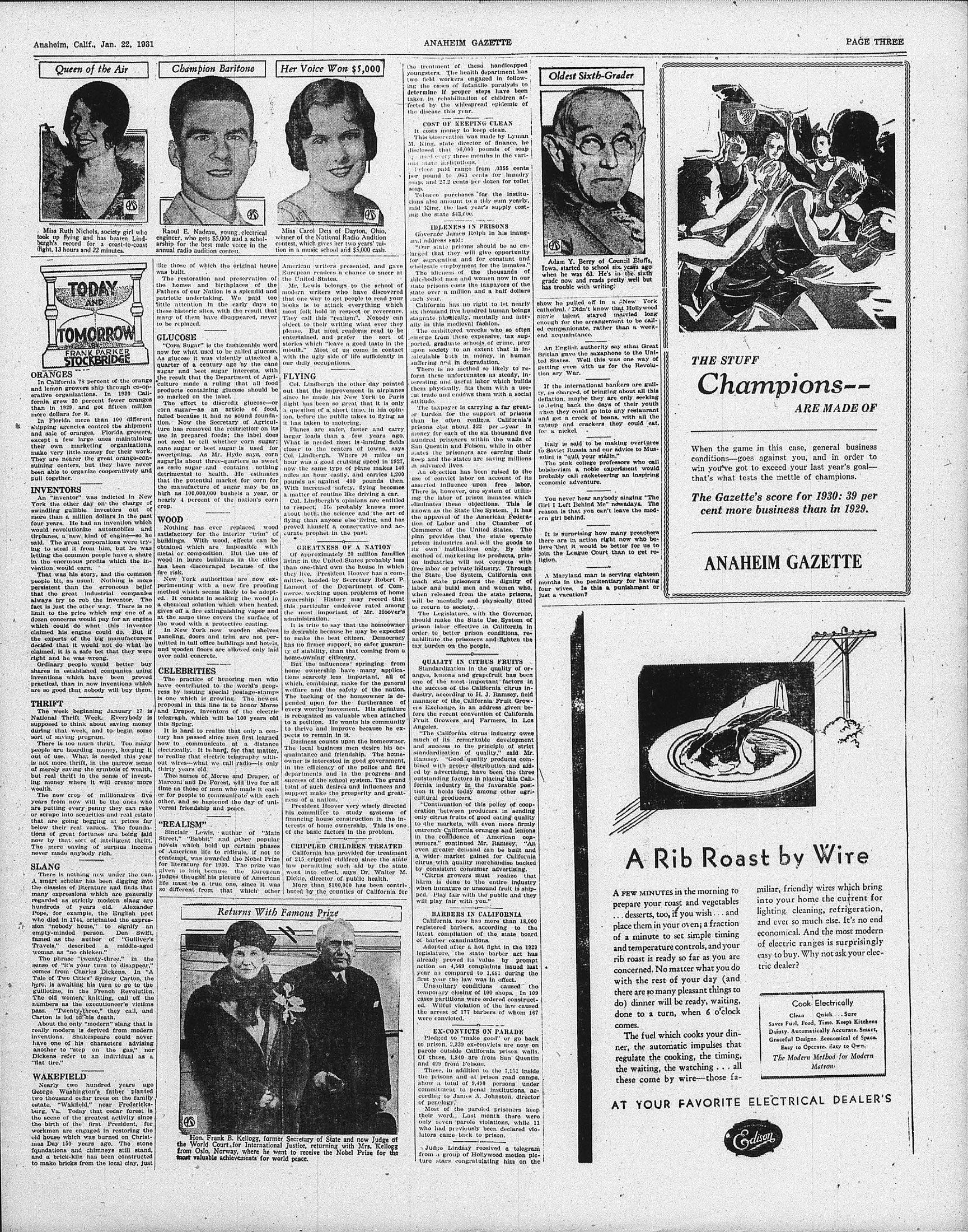
Searchable text
Anaheim, Calif., Jan. 22, 1931
Queen of the Air
Miss Ruth Nichols, society girl who took up flying and has beaten Lindbergh's record for a coast-to-coast flight, 13 hours and 22 minutes.
Champion Baritone
Raoul E. Nadeau, young electrical engineer, who gets $5,000 and a scholarship for the best male voice in the annual radio audition contest.
Her Voice Won $5,000
Miss Carol Deis of Dayton, winner of the National Radio contest, which gives her two yea-tion in a music school and $5,000.
TODAY AND TOMORROW FRANK PARKER STOCKBRIDGE
ORANGES
In California 78 percent of the orange and lemon growers ship through co-operative organizations. In 1930 California grew 30 percent fewer oranges than in 1929, and got fifteen million more dollars for it.
In Florida more than 100 different shipping agencies control the shipment and sale of oranges. Florida growers, except a few large ones maintaining their own marketing organizations, make very little money for their work.
They are nearer the great orange-con
like those of which the original house was built.
The restoration and preservation of the homes and birthplaces of the Fathers of our Nation is a splendid and patriotic undertaking. We paid too little attention in the early days to these historic sites, with the result that many of them have disappeared, never to be replaced.
GLUCOSE
"Corn Sugar" is the fashionable word now for what used to be called glucose. As glucose it was violently attacked a quarter of a century ago by the cane sugar and beet sugar interests, with the result that the Department of Agriculture made a ruling that all food products containing glucose should be so marked on the label.
The effort to discredit glucose—or corn sugar—as an article of food, failed because it had no sound foundation. Now the Secretary of Agriculture has removed the restriction on its use in prepared foods; the label does not need to tell whether corn sugar; cane sugar or beet sugar is used for sweetening. As Mr. Hyde says, corn American writers present European readers a chance the United States.
Mr. Lewis belongs to modern writers who have that one way to get people books is to attack every most folk hold in respect. They call this "realism", object to their writing style please. But most readers entertained, and prefer stories which "leave a good mouth." Most of us come with the ugly side of life our daily occupations.
FLYING
Col. Lindbergh the other out that the improvement since he made his New flight has been so great that a question of a short time, before the public take it has taken to motoring.
Planes are safer, faster larger loads than a few What is needed most is closer to the centers of Col. Lindbergh. Where
ORANGES
In California 78 percent of the orange and lemon growers ship through co-operative organizations. In 1930 California grew 30 percent fewer oranges than in 1929, and got fifteen million more dollars for it.
In Florida more than 100 different shipping agencies control the shipment and sale of oranges. Florida growers, except a few large ones maintaining their own marketing organizations, make very little money for their work. They are nearer the great orange-consuming centers, but they have never been able to organize cooperatively and pull together.
INVENTORS
An "inventor" was indicted in New York the other day on the charge of swindling gullible investors out of more than a million dollars in the past four years. He had an invention which would revolutionize automobiles and airplanes, a new kind of engine—so he said. The great corporations were trying to steal it from him, but he was letting the common people have a share in the enormous profits which the invention would earn.
That was his story, and the common people bit, as usual. Nothing is more persistent than the erroneous belief that the great industrial companies always try to rob the inventor. The fact is just the other way. There is no limit to the price which any one of a dozen concerns would pay for an engine which could do what this inventor claimed his engine could do. But if the experts of the big manufacturers decided that it would not do what he claimed, it is a safe bet that they were right and he was wrong.
Ordinary people would better buy shares in established companies using inventions which have been proved practical, than in new inventions which are so good that nobody will buy them.
THRIFT
The week beginning January 17 is National Thrift Week. Everybody is supposed to think about saving money during that week, and to begin some sort of saving program.
There is too much thrift. Too many people are hoarding money, keeping it out of use. What is needed this year is not more thrift, in the narrow sense of merely saving the symbols of wealth, but real thrift in the sense of investing money where it will create more wealth.
The now crop of millionaires five years from now will be the ones who are putting every penny they can rake or scrap into securities and real estate that are going begging at prices far below their real values. The foundations of great fortunes are being laid now by that sort of intelligent thrift. The mere saving of surplus income never made anybody rich.
SLANG
WOOD
Nothing has ever replaced wood satisfactory for the interior "trim" of buildings. With wood, effects can be obtained which are impossible with metal or composition. But the use of wood in large buildings in the cities has been discouraged because of the fire risk.
New York authorities are now experimenting with a new fire proofing method which seems likely to be adopted. It consists in soaking the wood in a chemical solution which when heated gives off a fire extinguishing vapor and at the same time covers the surface of the wood with a protective coating.
In New York now wooden shelves paneling, doors and trim are not permitted in tall office buildings and hotels, and wooden floors are allowed only laid over solid concrete.
CELEBRITIES
The practice of honoring men who have contributed to the world's progress by issuing special postage-stamps is one which is growing. The newest proposal in this line is to honor Morse and Draper, inventors of the electric telegraph, which will be 100 years old this Spring.
It is hard to realize that only a century has passed since men first learned how to communicate at a distance electrically. It is hard, for that matter, to realize that electric telegraphy without wires—what we call radio—is only thirty years old.
The names of Morse and Draper, of Marconi and De Forest, will live for all time as those of men who made it easier for people to communicate with each other, and so hastened the day of universal friendship and peace.
“REALISM”
Sinclair Lewis, author of "Main Street," "Babbit" and other popular novels which hold up certain phases of American life to ridicule, if not to contempt, was awarded the Nobel Prize for literature for 1930. The prize was given to high because of a century ago by the cane sugar and beet sugar interests, with the result that the Department of Agriculture made a ruling that all food products containing glucose should be so marked on the label.
The effort to discredit glucose—or corn sugar—as an article of food, failed because it had no sound foundation. Now the Secretary of Agriculture has removed the restriction on its use in prepared foods; the label does not need to tell whether corn sugar; cane sugar or beet sugar is used for sweetening. As Mr. Hyde says, corn sugar is about three-quarters as sweet as cane sugar and contains nothing detrimental to health. He estimates that the potential market for corn for the manufacture of sugar may be as high as 100,000,000 bushels a year, or nearly 4 percent of the nation's corn crop.
FLYING
Col. Lindbergh the other out that the improvement since he made his New flight has been so great that a question of a short time, before the public take it has taken to motoring.
Planes are safer, faster larger loads than a few What is needed most is closer to the centers of Col. Lindbergh. Where hour was a good cruising time now the same type of planes an hour easily, and pounds as against 400 With increased safety, if a matter of routine like Col. Lindbergh's opinion to respect. He probably about both the science and flying than anyone else proved himself a conservate prophet in the past.
GREATNESS OF A
Of approximately 20 million living in the United States than one-third own the they live. President Hoover mittee, headed by Secretary Lamont of the Department merce, working upon profit ownership. History may this particular endeavor be the most important of all administration.
It is trite to say that it is desirable because he must make the best citizen has no firmer support, not tying of stability, than that home-owning citizenry.
But the influences spared home ownership have nonscarcerease less impulse which, combining, makes welfare and the safety The backing of the home pended upon for the few every worthy movement. It is recognized as valuable to a petition. He wants to thrive and improve benefits to remain in it.
Business counts upon The local business men quaintance and friendship owner is interested in good in the efficiency of the departments and in the success of the school system total of such desires and support make the prosperity of a nation.
President Hoover very his committee to study financing house constructors of home ownership of the basic factors in th
CRIPPLED CHILDREN
California has provided 215 crippled children law permitting such al
but real thrift in the sense of investing money where it will create more wealth.
The new crop of millionaires five years from now will be the ones who are putting every penny they can rake or scrap into securities and real estate that are going begging at prices far below their real values. The foundations of great fortunes are being laid now by that sort of intelligent thrift. The mere saving of surplus income never made anybody rich.
SLANG
There is nothing new under the sun. A smart scholar has been digging into the classics of literature and finds that many expressions which are generally regarded as strictly modern slang are hundreds of years old. Alexander Pope, for example, the English poet who died in 1744, originated the expression "nobody home," to signify an empty-minded person. Den Swift, famed as the author of "Gulliver's Travels," described a middle-aged woman as "no chicken."
The phrase "twenty-three," in the sense of "it's your turn to disappear," comes from Charles Dickens. In "A Tale of Two Cities" Sydney Carton, the hero, is awaiting his turn to go to the guillotine, in the French Revolution. The old women, knitting, call off the numbers as the executioner's victims pass. "Twenty-three," they call, and Carton is led to his death.
About the only "modern" slang that is really modern is derived from modern inventions. Shakespeare could never have one of his characters advising another to "step on the gas," nor Dickens refer to an individual as a "flat tire."
WAKEFIELD
Nearly two hundred years ago George Washington's father planted two thousand cedar trees on the family estate. "Wakfield," near Fredericksburg, Va. Today that cedar forest is the scene of the greatest activity since the birth of the first President, for workmen are engaged in restoring the old house which was burned on Christmas Day 150 years ago. The stone foundations and chimneys still stand, and a brick-kiln has been constructed to make bricks from the local clay, just...
ANAHEIM GAZETTE
Her Voice Won $5,000
Miss Carol Deis of Dayton, Ohio, owner of the National Radio Audition test, which gives her two years' tuition in a music school and $5,000 cash.
American writers presented, and gave European readers a chance to sneer at the United States.
Mr. Lewis belongs to the school of modern writers who have discovered that one way to get people to read your books is to attack everything which most folk hold in respect or reverence. They call this "realism". Nobody can object to their writing what ever they please. But most readers read to be entertained, and prefer the sort of stories which "leave a good taste in the mouth." Most of us come in contact with the ugly side of life sufficiently in our daily occupations.
FLYING
Col. Lindbergh the other day pointed out that the improvement in airplanes since he made his New York to Paris flight has been so great that it is only a question of a short time, in his opinion, before the public takes to flying as it has taken to motoring.
Planes are safer, faster and carry larger loads than a few years ago. What is needed most is landing fields closer to the centers of towns, says Col. Lindbergh. Where 90 miles an hour treatment of these handicapped youngsters. The health department has two field workers engaged in following the cases of infantile paralysis to determine if proper steps have been taken in rehabilitation of children affected by the widespread epidemic of the disease this year.
COST OF KEEPING CLEAN
It costs money to keep clean.
This observation was made by Lyman M. King, state director of finance, he disclosed that 90,000 pounds of soap used every three months in the various state institutions.
Prices paid range from .0355 cents per pound to .063 cents for laundry soap, and 27.2 cents per dozen for toilet soap.
Tobacco purchases for the institutions also amount to a tidy sum yearly, said King, the last year's supply costing the state $43,000.
IDLENESS IN PRISONS
Governor James Rolph in his inaugural address said:
"Our state prisons should be so enlarged that they will give opportunity for segregation and for constant and wholesale employment for the inmates."
The idleness of the thousands of able-bodied men and women now in our state prisons costs the taxpayers of the state over a million and a half dollars each year.
California has no right to let nearly six thousand five hundred human beings stagnate physically, mentally and morally in this medieval fashion.
The embittered wrecks who so often emerge from these expensive, tax supported, graduate schools of crime, prey upon society to an extent that is incalculable both in money, in human suffering and in degradation.
There is no method so likely to reform these unfortunates as steady, interesting and useful labor which builds them physically, fits them with a useful trade and endows them with a social attitude.
The taxpayer is carrying a far greater burden for the support of prisons than he often realizes. California's prisons cost about $22 per year in money for each of the six thousand five hundred prisoners within the walls of San Quentin and Folsom, while in other states the prisoners are earning their keen and the states are saving millions.
Oldest Sixth-Grader
Adam Y. Berry of Council Bluffs, Iowa, started to school six years ago when he was 63. He's in the sixth grade now and reads pretty well but has trouble with writing.
An English authority say that Great British gave the saxophone to the United States. Well this was one way of getting even with us for the Revolution ary War.
If the international bankers are guilty, as charged, of bringing about all this deflation, maybe they are only seeking to bring back the days of their youth when they could go into any restaurant and get a crock of beans, with all the catsup and crackers they could eat, for a nickel.
Italy is said to be making overtures to Soviet Russia and our advice to Mussolini is "quit your stalin."
FLYING
Col. Lindbergh the other day pointed out that the improvement in airplanes since he made his New York to Paris flight has been so great that it is only a question of a short time, in his opinion, before the public takes to flying as it has taken to motoring.
Planes are safer, faster and carry larger loads than a few years ago. What is needed most is landing fields closer to the centers of towns, says Col. Lindbergh. Where 90 miles an hour was a good cruising speed in 1927, now the same type of plane makes 140 miles an hour easily, and carries 1,200 pounds as against 400 pounds then. With increased safety, flying becomes a matter of routine like driving a car.
Col. Lindbergh's opinions are entitled to respect. He probably knows more about both the science and the art of flying than anyone else living, and has proved himself a conservative and accurate prophet in the past.
GREATNESS OF A NATION
Of approximately 20 million families living in the United States probably less than one-third own the house in which they live. President Hoover has a committee, headed by Secretary Robert P. Lamont of the Department of Commerce, working upon problems of home ownership. History may record that this particular endeavor rated among the most important of Mr. Hoover's administration.
It is trite to say that the homeowner is desirable because he may be expected to make the best citizen. Democracy has no firmer support, no safer guaranty of stability, than that coming from a home-owning citizenry.
But the influences springing from home ownership have many applications scarcely less important, all of which, combining, make for the general welfare and the safety of the nation. The backing of the homeowner is depended upon for the furtherance of every worthy movement. His signature is recognized as valuable when attached to a petition. He wants his community to thrive and improve because he expects to remain in it.
Business counts upon the homeowner. The local business men desire his acquaintance and friendship. The homeowner is interested in good government, in the efficiency of the police and fire departments and in the progress and success of the school system. The grand total of such desires and influences and support make the prosperity and greatness of a nation.
President Hoover very wisely directed his committee to study systems of financing house construction in the interests of home ownership. This is one of the basic factors in the problem.
CRIPPLED CHILDREN TREATED
California has provided for treatment of 215 crippled children since the state law permitting such aid by the state suffering and in degradation.
There is no method so likely to reform these unfortunates as steady, interesting and useful labor which builds them physically, fits them with a useful trade and endows them with a social attitude.
The taxpayer is carrying a far greater burden for the support of prisons than he often realizes. California's prisons cost about $22 per year in money for each of the six thousand five hundred prisoners within the walls of San Quentin and Folsom, while in other states the prisoners are earning their keep and the states are saving millions in salvaged lives.
An objection has been raised to the use of convict labor on account of its asserted influence upon free labor. There is, however, one system of utilizing the labor of prison inmates which eliminates these objections. This is known as the State Use System. It has the approval of the American Federation of Labor and the Chamber of Commerce of the United States. The plan provides that the state operate prison industries and sell the goods to its own institutions only. By this method of marketing its products, prison industries will not compete with free labor or private industry. Through the State Use System, California can teach state prisoners the dignity of labor and build men and women who, when released from the state prisons, will be mentally and physically fitted to return to society.
The Legislature, with the Governor, should make the State Use System of prison labor effective in California in order to better prison conditions, rehabilitate the prisoners and lighten the tax burden on the people.
QUALITY IN CITRUS FRUITS
Standardization in the quality of oranges, lemons and grapefruit has been one of the most important factors in the success of the California citrus industry, according to H. J. Ramsey, field manager of the California Fruit Growers Exchange, in an address given before the recent convention of California Fruit Growers and Farmers, in Los Angeles.
"The California citrus industry owes much of its remarkable development and success to the principle of strict standardization of quality," said Mr. Ramsey. "Good quality products combined with proper distribution and added by advertising, have been the three outstanding factors in placing this California industry in the favorable position it holds today among other agricultural producers."
Continuation of this policy of cooperation between producers in sending only citrus fruits of good eating quality to the markets, will even more firmly entrench California oranges and lemons in the confidence of American consumers," continued Mr. Ramsey. "An even greater demand can be built and a wider market gained for California citrus with quality merchandise backed by consistent consumer advertising."
CRIPPLED CHILDREN TREATED
California has provided for treatment of 215 crippled children since the state law permitting such aid by the state went into effect, says Dr. Walter M. Dickle, director of public health.
More than $100,000 has been contributed by the counties of California for
BARBERS IN CALIFORNIA
California now has more than 18,000 registered barbers, according to the latest compilation of the state board of barber examinations.
Adopted after a hot fight in the 1929 legislature, the state barber act has already proved its value by prompt action on 4,569 complaints issued last year as compared to 1,681 during the first year the law was in effect.
Unsuitable conditions caused the temporary closing of 100 shops. In 109 cases partitions were ordered constructed. Wilful violation of the law caused the arrest of 177 barbers of whom 167 were convicted.
EX-CONVICTS ON PARADE
Pledged to "make good" or go back to prison, 2,339 ex-convicts are now on parole outside California prison walls. Of these, 1,840 are from San Quentin and 499 from Folsom.
There, in addition to the 7,151 inside the prisons and at prison road camps, show a total of 9,490 persons under commitment to penal institutions, according to James A. Johnston, director of penology.
Most of the paroled prisoners keep their word. Last month there were only seven parole violations, while 11 who had previously been declared violators came back to prison.
Judge Lindsay received a telegram from a group of Hollywood motion picture stars congratulating him on the
THE STUFF
Champions--
ARE MADE OF
When the game in this case, general business conditions—goes against you, and in order to
Champions--
ARE MADE OF
When the game in this case, general business conditions—goes against you, and in order to win you've got to exceed your last year's goal—that's what tests the mettle of champions.
The Gazette’s score for 1930: 39 per cent more business than in 1929.
ANAHEIM GAZETTE
A Rib Roast by Wire
A Rib Roast by Wire
A few minutes in the morning to prepare your roast and vegetables ... desserts, too, if you wish... and place them in your oven; a fraction of a minute to set simple timing and temperature controls, and your rib roast is ready so far as you are concerned. No matter what you do with the rest of your day (and there are so many pleasant things to do) dinner will be ready, waiting, done to a turn, when 6 o'clock comes.
The fuel which cooks your dinner, the automatic impulses that regulate the cooking, the timing, the waiting, the watching... all these come by wire—those familiar, friendly wires which bring into your home the current for lighting, cleaning, refrigeration, and ever so much else. It's no end economical. And the most modern of electric ranges is surprisingly easy to buy. Why not ask your electric dealer?
Cook Electrically
Clean Quick Sure
Saves Fuel, Food, Time. Keep Kitchens Dainty. Automatically Accurate. Smart, Graceful Designs. Economical of Space. Easy to Operate. Easy to Own.
The Modern Method for Modern Matrom.
AT YOUR FAVORITE ELECTRICAL DEALER'S