anaheim-gazette 1930-11-20
Scanned page
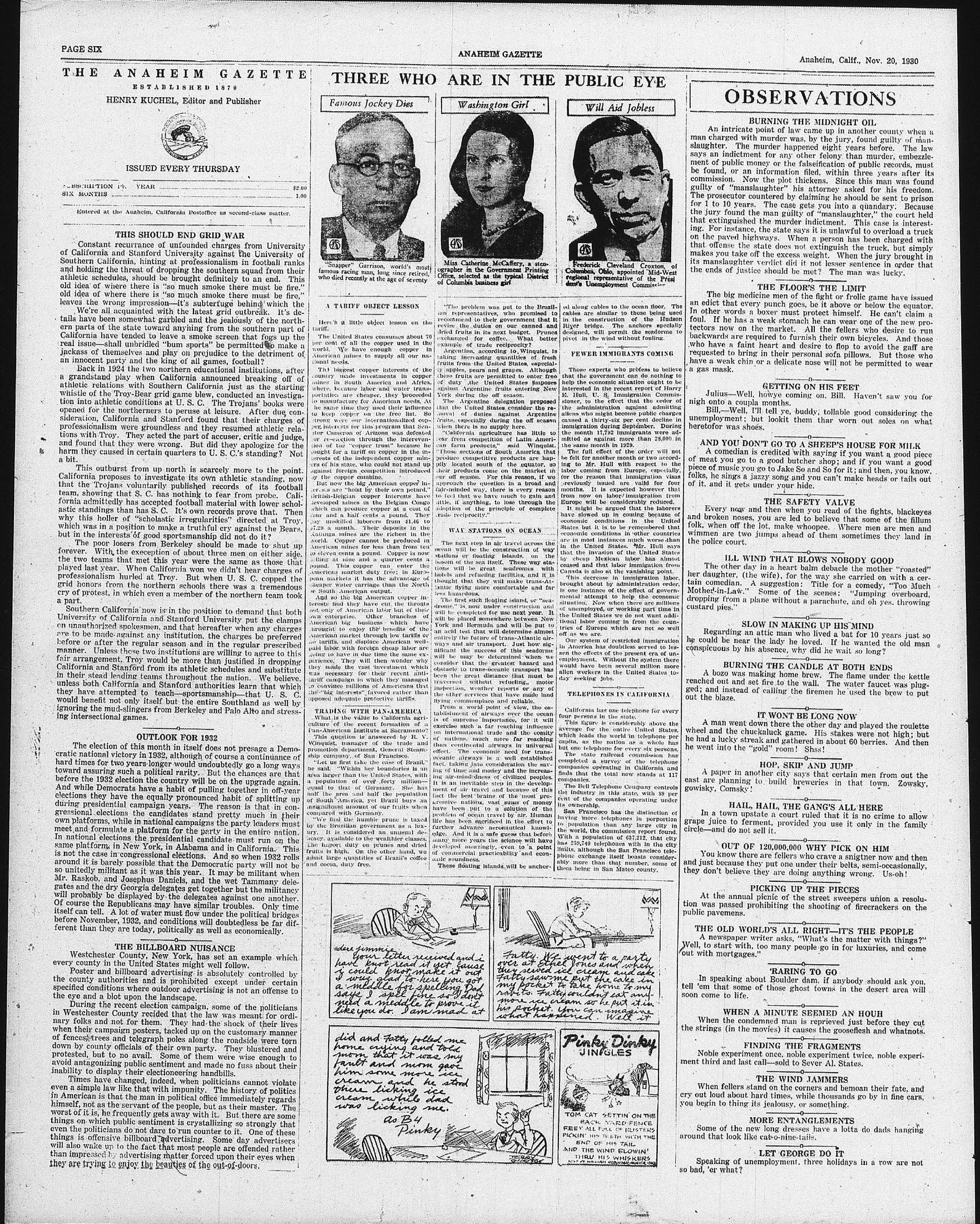
Searchable text
THE ANAHEIM GAZETTE
ESTABLISHED 1870
HENRY KUCHEL, Editor and Publisher
ISSUED EVERY THURSDAY
SUBSCRIPTION P. YEAR $2.00
SIX MONTHS 1.00
Entered at the Anaheim, California Postoffice as second-class matter.
THIS SHOULD END GRID WAR
Constant recurrence of unfounded charges from University of California and Stanford University against the University of Southern California, hinting at professionalism in football ranks and holding the threat of dropping the southern squad from their athletic schedules, should be brought definitely to an end. This old idea of where there is "so much smoke there must be fire," old idea of where there is "so much smoke there must be fire," leaves the wrong impression—it's subterfuge behind which the
We're all acquainted with the latest grid outbreak. It's details have been somewhat garbled and the jealously of the northern parts of the state toward anything from the southern part of California have tended to leave a smoke screen that fogs up the real issue—shall unbridled "bum sports" be permitted to make a jackass of themselves and play on prejudice to the detriment of an innocent party and the king of all games, football?
Back in 1924 the two northern educational institutions, after a grandstand play when California announced breaking off of athletic relations with Southern California just as the starting whistle of the Troy-Bear grid game blew, conducted an investigation into athletic conditions at U. S. C. The Trojans' books were opened for the northerners to peruse at leisure. After due consideration, California and Stanford found that their charges of professionalism were groundless and they resumed athletic relations with Troy. They acted the part of accuser, critic and judge, and found that they were wrong. But did they apologize for the harm they caused in certain quarters to U. S. C.'s standing? Not
Back in 1924 the two northern educational institutions, after a grandstand play when California announced breaking off of athletic relations with Southern California just as the starting whistle of the Troy-Bear grid game blew, conducted an investigation into athletic conditions at U.S.C. The Trojans' books were opened for the northerners to peruse at leisure. After due consideration, California and Stanford found that their charges of professionalism were groundless and they resumed athletic relations with Troy. They acted the part of accuser, critic and judge, and found that they were wrong. But did they apologize for the harm they caused in certain quarters to U.S.C.'s standing? Not a bit.
This outburst from up north is scarcely more to the point. California proposes to investigate its own athletic standing, now that the Trojans voluntarily published records of its football team, showing that S.C. has nothing to fear from probe. California admittedly has accepted football material with lower scholastic standings than has S.C. It's own records prove that. Then why this holler of "scholastic irregularities" directed at Troy, which was in a position to make a truthful cry against the Bears, but in the interests of good sportsmanship did not do it?
The poor losers from Berkeley should be made to shut up forever. With the exception of about three men on either side, the two teams that met this year were the same as those that played last year. When California won we didn't hear charges of professionalism hurled at Troy. But when U.S.C. copped the grid honors from the northern schools there was a tremendous cry of protest, in which even a member of the northern team took a part.
Southern California now is in the position to demand that both University of California and Stanford University put the clamps on unauthorized spokesmen, and that hereafter when any charges are to be made against any institution, the charges be preferred before or after the regular season and in the regular prescribed manner. Unless these two institutions are willing to agree to this fair arrangement, Troy would be more than justified in dropping California and Stanford from its athletic schedules and substitute in their stead leading teams throughout the nation. We believe, unless both California and Stanford authorities learn that which they have attempted to teach—sportsmanship—that U.S.C. would benefit not only itself but the entire Southland as well by ignoring the mud-slingers from Berkeley and Palo Alto and stressing intersectional games.
OUTLOOK FOR 1932
The election of this month in itself does not presage a Democratic national victory in 1932, although of course a continuance of hard times for two years longer would undoubtedly go a long way toward assuring such a political rarity. But the chances are that before the 1932 election the country will be on the upgrade again. And while Democrats have a habit of pulling together in off-year elections they have the equally pronounced habit of splitting up during presidential campaign years. The reason is that in congressional elections the candidates stand pretty much in their own platforms, while in national campaigns the party leaders must meet and formulate a platform for the party in the entire nation. In national elections the presidential candidate must run on the same platform, in New York, in Alabama and in California. This is not the case in congressional elections. And so when 1932 rolls around it is barely possible that the Democratic party will not be national needs.
The biggest concern country made in mines in South America, because labor portation are changed to manufacture for the same time they keep copper or strong were our larger interests for the actor Cameron of New York or re-election themion of the "copper sought for a tariff interest of the Indians of his state, which against foreign currency by the copper company.
But now the biggest concerns are "hoist British-Belgian co-developed mines in which can produce four and a half cent pay unskilled labor 7:29 a month." Kataranga mines are world. Copper can American mines for eleven cents a pound selling at nine and pound. This copper American market pean markets it cheaper water carriar South America.
And so the big interests find they have not only of American own enterprise. American big bush brought to enjoy American market so tariffs, and dispensed labor with force going to have in due experience. They will they made the vass was necessary for tariff campaign in so convince millions of the "big interests" opposed adequate pro-
toward assuring such a political rarity. But the chances are that before the 1932 election the country will be on the upgrade again. And while Democrats have a habit of pulling together in off-year elections they have the equally pronounced habit of splitting up during presidential campaign years. The reason is that in congressional elections the candidates stand pretty much in their own platforms, while in national campaigns the party leaders must meet and formulate a platform for the party in the entire nation. In national elections the presidential candidate must run on the same platform, in New York, in Alabama and in California. This is not the case in congressional elections. And so when 1932 rolls around it is barely possible that the Democratic party will not be so unitedly militant as it was this year. It may be militant when Mr. Raskob, and Josephus Daniels, and the wet Tammany delegates and the dry Georgia delegates get together but the militancy will probably be displayed by the delegates against one another. Of course the Republicans may have similar troubles. Only time itself can tell. A lot of water must flow under the political bridges before November, 1932, and conditions will doubtedless be far different than they are today, politically as well as economically.
THE BILLBOARD NUISANCE
Westchester County, New York, has set an example which every county in the United States might well follow.
Poster and billboard advertising is absolutely controlled by the county authorities and is prohibited except under certain specified conditions where outdoor advertising is not an offense to the eye and a blot upon the landscape.
During the recent election campaign, some of the politicians in Westchester County recided that the law was meant for ordinary folks and not for them. They had the shock of their lives when their campaign posters, tacked up on the customary manner of fences, trees and telegraph poles along the roadside were torn down by county officials of their own party. They blustered and protested, but to no avail. Some of them were wise enough to avoid antagonizing public sentiment and made no fuss about their inability to display their electioneering handbills.
Times have changed, indeed, when politicians cannot violate even a simple law like that with impunity. The history of politics in American is that the man in political office immediately regards himself, not as the servant of the people, but as their master. The worst of it is, he frequently gets away with it. But there are some things on which public sentiment is crystallizing so strongly that even the politicians do not dare to run counter to it. One of these things is offensive billboard advertising. Some day advertisers will also wake up to the fact that most people are offended rather than impressed by advertising matter forced upon their eyes when they are trying to enjoy the beauties of the out-of-doors.
THREE WHO ARE IN THE PUBLIC EYE
Famous Jockey Dies
"Snapper" Garrison, world's most famous racing man, long since retired, who died recently at the age of seventy
Washington Girl
Miss Catherine McCaffery, a stenographer in the Government Printing Office, selected as the typical District of Columbia business girl
Will Aid Jobless
Frederick Cleveland Croxton, of Columbus, Ohio, appointed Mid-West regional representative of the President's Unemployment Commission
A TARiff OBJECT LESSON
Here's a little object lesson on the tariff.
The United States consumes about 70 per cent of all the copper used in the world. We have enough copper in American mines to supply all our national needs.
The biggest copper interests of the country made investments in copper mines in South America and Africa, where, because labor and water transportation are cheaper, they proceeded to manufacture for American needs. At the same time they used their influence to keep copper on the free list. So strong were our internationalized copper interests for this program that Senator Cameron of Arizona was defeated or re-ejection through the intervection of the "copper trust" because he ought for a tariff on copper in the in-
"The problem was put to the Brazilian representatives, who promised to recommend to their government that it revise the duties on our canned and dried fruits in its next budget. Prunes exchanged for coffee. What better example of trade reciprocity?
Argentina, according to Winquist, is taking increasing quantities of fresh fruits from the United States, especially apples, pears and grapes. Although these fruits are permitted to enter free of duty, the United States imposes against Argentine fruits entering New York during the off season.
The Argentine delegation proposed that the United States consider the removal of duties against Argentine fruits, especially during the off season when there is no supply here.
"California agriculture has little to fear from competition of Latin American farm products," said Winquist.
"Those sections of South America that ed along cables to the ocean floor. The cables are similar to those being used in the construction of the Hudson River bridge. The anchors specially designed, will permit the seadorme to pivot in the wind without fouling."
FEWER IMMIGRANTS COMING
Those experts who profess to believe that the government can do nothing to help the economic situation ought to be interested in the recent report of Harry E. Hull, U. S. Immigration Commissioner, to the effect that the order of the administration against admitting aliens who might become public charges caused a thirty-six per cent decline in immigration during September. During the month 17,792 immigrants were admitted as against more than 28,000 in the same month in 1929.
The full effect of the order will not
The biggest copper interests of the country made investments in copper mines in South America and Africa, where, because labor and water transportation are cheaper, they proceeded to manufacture for American needs. At the same time they used their influence to keep copper on the free list. Strong were our internationalized copper interests for this program that Senator Cameron of Arizona was defeated or re-election through the intervention of the "copper trust" because he sought for a tariff on copper in the interests of the independent copper miners of his state, who could not stand up against foreign competition introduced by the copper combine.
But now the big American copper interests are "hoist by their own petard," British-Belgian copper interests have developed mines in the Belgian Congo which can produce copper at a cost of four and a half cents a pound. They mayuskilled laborers from $1.46 to $2.29 a month. Their deposits in the Katanga mines are the richest in the world. Copper cannot be produced in American mines for less than from ten to eleven cents a pound. Copper is now selling at nine and a quarter cents a pound. This copper can enter the American market duty free; in European markets it has the advantage of cheaper water carriage than the North or South American output.
And so the big American copper interests find they have cut the throats not only of American labor but of their own enterprise. Other branches of American big business which have brought to enjoy the benefits of the American market through low tariffs or so tariffs, and displace American wellpaid labor with foreign cheap labor are going to be due time the same experience. They will then wonder why they made the vast investment which was necessary for their recent anti-tariff campaign in which they managed to convince millions of Americans that the "big interests" favored rather than opposed adequate protective tariffs.
TRADING WITH PAN-AMERICA
What is the value to California agriculture of the recent formation of a Pan-American Institute at Sacramento?
This question is answered by R. V. Winquist, manager of the trade and promotion department, General Steamship company, of San Francisco.
"Let us first take the case of Brazil," he said. "Within her boundaries is an area larger than the United States, with a population of over forty million—equal to that of Germany. She has half the area and half the population of South America, yet Brazil buys an insignificant amount of our fruits when compared with Germany."
"We find the humble prune is taxed by the Brazilian government as a luxury. It is considered an unusual decay, available to the wealthier classes. The import duty on prunes and dried fruits is high. On the other hand, we admit large quantities of Brazil's coffee and cocoa duty free."
WAY STATIONS ON OCEAN
The next step in air travel across the ocean will be the construction of way stations or floating islands, on the bosom of the sea itself. These way stations will be great seadromes with hotels and refueling facilities, and it is thought that they will make trans-Antarctic flying more comfortable and far less hazardous.
The first such floating island, or "seadrome," is now under construction and will be completed for use next year. It will be placed somewhere between New York and Bermuda and will be put to an acid test that will determine almost entirely the future of trans-Atlantic airways and air transport. Just how significant the success of this seadrome will be may be determined when we consider that the greatest hazard and obstacle to trans-oceanic transport has been the great distance that must be traversed without refuelling, motor inspection, weather reports or any of the other services that have made land flying commonplace and reliable.
From a world point of view, the establishment of airways over the ocean is of supreme importance, for it will exercise such a far reaching influence on international trade and the comity of nations, much more far reaching than continental airways in universal effect. The economic need for trans-oceanic airways is a well established fact, taking into consideration the saving of time and money and the increasing air-mindedness of civilized peoples. It is an inevitable step in the development of air travel and because of this fact the best brains of the most progressive nations, vast sums of money have been put to a solution of the problem of ocean travel by air. Human life has been sagrified in the effort to further advance aeronautical knowledge. And it is a safe guess that before many more years the science will have developed amazingly, even to a point of commercial practicability and economic soundness.
Those experts who profess to believe that the government can do nothing to help the economic situation ought to be interested in the recent report of Harry E. Hull, U. S. Immigration Commissioner, to the effect that the order of the administration against admitting aliens who might become public charges caused a thirty-six per cent decline in immigration during September. During the month 17,792 immigrants were admitted as against more than 28,000 in the same month in 1929.
The full effect of the order will not be felt for another month or two according to Mr. Hull with respect to the labor coming from Europe, especially, for the reason that immigration visas previously issued are valid for four months. It is expected however that from now on labor immigration from Europe will be considerably reduced.
It might be argued that the laborers have slowed up in coming because of economic conditions in the United States but it is to be remembered that economic conditions in other countries are in most instances much worse than in the United States. Mr. Hull says that the invasion of the United States by cheap Mexican labor has almost ceased and that labor immigration from Canada is also at the vanishing point.
This decrease in immigration labor, brought about by administration order, is one instance of the effect of government attempt to help the economic situation. Now when there are millions of unemployed, or working part time in the United States we do not want additional labor coming in from the countries of Europe which are not so well off as we are.
Our system of restricted immigration in America has doubtless served to lesson the effects of the present era of unemployment. Without the system there would have been several million more allen workers in the United States today seeking jobs.
TELEPHONES IN CALIFORNIA
California has one telephone for every four persons in the state.
This figure is considerably above the average for the entire United States, which leads the world in telephone per capita, as the nation as a whole has but one telephone for every six persons.
The state railroad commission has completed a survey of the telephone companies operating in California and finds that the total now stands at 117 companies.
The Bell Telephone Company controls the industry in this state, with 59 percent of the companies operating under its ownership.
San Francisco has the distinction of having more telephones in porportion to population than any large city in the world, the commission report found. With a population of 637,212, that city has 259,740 telephones with in the city limits, although the San Francisco telephone exchange itself boasts considerably more than that number, some of
Within her boundaries is an area larger than the United States, with a population of over forty million—equal to that of Germany. She has half the area and half the population of South America, yet Brazil buys an insignificant amount of our fruits when compared with Germany.
"We find the humble prune is taxed by the Brazilian government as a luxury. It is considered an unusual delicacy, available to the wealthier classes. The import duty on prunes and dried fruits is high. On the other hand, we admit large quantities of Brazil's coffee and cocoa, duty free.
We find the humble prune is taxed by the Brazilian government as a luxury. It is considered an unusual delicacy, available to the wealthier classes. The import duty on prunes and dried fruits is high. On the other hand, we admit large quantities of Brazil's coffee and cocoa, duty free.
Our letter received and I have knot read it yet cause it could not make it out. Wug glad to here you got a middle for spelling Dad says I spell fine so I don't need a middle to prove it like you do. I am mad at Fatty. We went to a party over at Ethel Jones and when they served ice cream and cake Fatty saw me put the cake in my pocket to take home to my rabbit. Fatty couldn't eat any more ice cream so he put it in his pocket. You can imagine what happened. Well it did and Fatty rolled me home crying and told mom that it was my fault and mom gave him some ice cream and he stood there licking ice cream while dad was licking me.
As B4 Pinky
Pinky Dinky JINGLES
TOM CAT SETTIN ON THE BACK YARD FENCE FEET ALL FULL OF CLUSTERS PICKIN' HIS TEETH WITH THE END OF HIS TAIL AND THE WIND GLOWIN' THRU HIS WHiskers
OBSERVATIONS
BURNING THE MIDNIGHT OIL
An intricate point of law came up in another county when a man charged with murder was, by the jury, found guilty of manslaughter. The murder happened eight years before. The law says an indictment for any other felony than murder, embezzlement of public money or the falseification of public records, must be found, or an information filed, within three years after its commission. Now the plot thickens. Since this man was found guilty of "manslaughter" his attorney asked for his freedom. The prosecutor countered by claiming he should be sent to prison for 1 to 10 years. The case gets you into a quandary. Because the jury found the man guilty of "manslaughter," the court held that extinguished the murder indictment. This case is interesting. For instance, the state says it is unlawful to overload a truck on the paved highways. When a person has been charged with that offense the state does not extinguish the truck, but simply makes you take off the excess weight. When the jury brought in its manslaughter verdict did it not lesser sentence in order that the ends of justice should be met? The man was lucky.
THE FLOOR'S THE LIMIT
The big medicine men of the fight or frolic game have issued an edict that every punch goes, be it above or below the equator. In other words a boxer must protect himself. He can't claim a foul. If he has a weak stomach he can wear one of the new protectors now on the market. All the fellers who desire to run backwards are required to furnish their own bicycles. And those who have a faint heart and desire to flop to avoid the gaff are requested to bring in their personal sofa pillows. But those who have a weak chin or a delicate nose will not be permitted to wear a gas mask.
GETTING ON HIS FEET
Julius—Well, howye coming on, Bill. Haven't saw you for nigh onto a coupla months.
Bill,—Well, I'll tell ye, buddy, tollable good considering the unemployment; but lookit them thar worn out soles on what heretofor was shoes.
AND YOU DON'T GO TO A SHEEP'S HOUSE FOR MILK
A comedian is credited with saying if you want a good piece
GETTING ON HIS FEET
Julius—Well, howye coming on, Bill. Haven't saw you for nigh onto a coupla months.
Bill,—Well, I'll tell ye, buddy, tollable good considering the unemployment; but lookit them thar worn out soles on what heretofor was shoes.
AND YOU DON'T GO TO A SHEEP'S HOUSE FOR MILK
A comedian is credited with saying if you want a good piece of meat you go to a good butcher shop; and if you want a good piece of music you go to Jake So and So for it; and then, you know, folks, he sings a jazzy song and you can't make heads or tails out of it, and it gets under your hide.
THE SAFETY VALVE
Every now and then when you read of the fights, blackeyes and broken noses, you are led to believe that some of the fillum folk, when off the lot, make whoopee. Where men are men and wimmen are two jumps ahead of them sometimes they land in the police court.
ILL WIND THAT BLOWS NOBODY GOOD
The other day in a heart balm debacle the mother "roasted" her daughter, (the wife), for the way she carried on with a certain comedian. A suggestion: Title for a comedy, "Too Much Mother-in-Law." Some of the scenes: "Jumping overboard, dropping from a plane without a parachute, and oh yes, throwing custard pies."
SLOW IN MAKING UP HIS MIND
Regarding an attic man who lived a bat for 10 years just so he could be near the lady he loved. If he wanted the old man conspicuous by his absence, why did he wait so long?
BURNING THE CANDLE AT BOTH ENDS
A bozo was making home brew. The flame under the kettle reached out and set fire to the wall. The water faucet was plugged; instead of calling the firemen he used the brew to put out the blaze.
IT WONT BE LONG NOW
A man went down there the other day and played the roulette wheel and the chuckaluck game. His stakes were not high; but he had a lucky streak and gathered in about 60 berries. And then he went into the "gold" room! Shss!
HOP, SKIP AND JUMP
A paper in another city says that certain men from out the east are planning to build breweries in that town. Zowsky, gowisky, Comsky!
HAIL, HAIL, THE GANG'S ALL HERE
In a town upstate a court ruled that it is no crime to allow grape juice to ferment, provided you use it only in the family circle—and do not sell it.
OUT OF 120,000,000 WHY PICK ON HIM
You know there are fellers who crave a snigtner now and then and just because they put one under their belts, some occasionally.
HAIL, HAIL, THE GANG'S ALL HERE
In a town upstate a court ruled that it is no crime to allow grape juice to ferment, provided you use it only in the family circle—and do not sell it.
OUT OF 120,000,000 WHY PICK ON HIM
You know there are fellers who crave a snigtner now and then and just because they put one under their belts, semi-occasionally, they don't believe they are doing anything wrong. Us-oh!
PICKING UP THE PIECES
At the annual picnic of the street sweepers union a resolution was passed prohibiting the shooting of firecrackers on the public pavements.
THE OLD WORLD'S ALL RIGHT—IT'S THE PEOPLE
A newspaper writer asks, "What's the matter with things?" Well, to start with, too many people go in for luxuries, and come out with mortgages."
RARING TO GO
In speaking about Boulder dam, if anybody should ask you, tell 'em that some of those ghost towns in the desert area will soon come to life.
WHEN A MINUTE SEEMED AN HOUH
When the condemned man is reprieved just before they cut the strings (in the movies) it causes the gooseflesh and whatnots.
FINDING THE FRAGMENTS
Noble experiment once, noble experiment twice, noble experiment third and last call—sold to Sever Al. States.
THE WIND JAMMERS
When fellers stand on the corners and bemoan their fate, and cry out loud about hard times, while thousands go by in fine cars, you begin to thing its jealousy, or something.
MORE ENTANGLEMENTS
Some of the new long dresses have a lotta do dads hanging around that look like cat-o-nine-tails.
LET GEORGE DO IT
Speaking of unemployment, three holidays in a row are not so bad, 'er what?