anaheim-gazette 1930-08-28
Scanned page
Searchable text
THE ANAHEIM GAZETTE
ESTABLISHED 1870
HENRY KUCHEL, Editor and Publisher
ISSUED EVERY THURSDAY
SUBSCRIPTION PER YEAR $2.00
SIX MONTHS 1.00
Entered at the Anaheim, California Postoffice as second-class matter.
FARM RELIEF PLAN
President Hoover approaches the drought situation relief problem after the fashion characteristic of modern military scientific genius. He is moving to marshal the essential forces with mathematical perception and precision. There will be no haphazard guesses as to methods; no involvement of agencies contributive to the purpose sought—imminent, immediate relief for drought-stricken areas and their rehabilitation.
The details of the proposed measures will be worked out this week. Organization and cooperation constitute the essence of the plan, competent team work between federal and state authorities and those to be assisted to rise above the crushing weight of a vast and untoward calamity.
Red tape is to be cut away. Emergency provisions are to be promptly employed.
One of the most commendable features of the President's program is that which gives quiet but sufficient warning that food profiteering will be sternly "scanned." This means that the cor-morants who proverbially take opportunity to feed upon public calamity in peace as they do in times of war will be halted and dealt with at the outset if they make effort to follow their usual routine.
A cheering feature also in this consideration is the voluntary proffer on the part of the great railway companies to make drastic freight rate cuts and the creation of a transportation board to direct the transportation of feed, food and water where they so desperately at present are needed.
One of the most commendable features of the President's program is that which gives quiet but sufficient warning that food profiteering will be sternly "scanned." This means that the corormants who proverbially take opportunity to feed upon public calamity in peace as they do in times of war will be halted and dealt with at the outset if they make effort to follow their usual routine.
A cheering feature also in this consideration is the voluntary proffer on the part of the great railway companies to make drastic freight rate cuts and the creation of a transportation board to direct the transportation of feed, food and water where they so desperately at present are needed.
In the work of rehabilitation and present service the federal government, the states' governments, the Red Cross and the great transportation companies will be joined in scientific effort, and cooperation.
The President recognizes in the extended drought a calamity to the nation, not a "blessing in disguise," not an affliction by "God's will," or a visitation engineered by "the powers of evil," but a cyclical emergency which must be met by the ablest human effort and intelligence.
No calamity is a blessing. To say so is to approve the optimism of silliness. If they serve to benefit a group of other people's disasters. The entire world is poorer by reason of the American drought.
WHAT THE WAR COST US
From an American standpoint the most damaging delusion ever put over on the people of the United States and of the world was that the United States was enriched by the World War. Persistently preached by the internationalist this falsehood took hold in Europe, and made America the target of the world's hatred. We were called Shylocks because we demanded repayment of a part of the billions we loaned Europe during and after the war.
In the United States this preposterous misrepresentation was made the basis of demands that our excessive wealth, coined out of the world's misfortune, justified us in becoming the world's good thing, and warranted us in ceasing to look out for the interests of the American people and in spending our time and putting the rest of the world on its feet.
The figures which tell the real story of the cost to America of the World War are staggering. The direct cost of the World War to the United States, official figures recently released show, was $52,000,000,000, or nearly thirty per cent of our total national wealth in 1912. But we are still spending nearly a billion dollars a year on soldier relief, and it seems probable that before we have paid the last pension to World War soldiers and their widows, and the last interest on the last bond, the direct cost of the World War to the United States will, as predicted by President Harding, amount to one hundred billion dollars!
But this by no means tell all the story. During the eight years 1904-1912 preceding the World War, our average annual rate of increase in national wealth was 9 per cent, and this rate of increase was greater than that which prevailed during the period 1900-1904, showing that nothing but the World War could have halted this swift rate of growth. But between 1912-1922, the decade which included the World War, our national wealth, measured in dollars of equal value, increased, according to figures printed in the World Almanac, only from approximately one hundred and eighty-six billions to two hundred and six billions. The
But this by no means tell all the story. During the eight years 1904-1912 preceding the World War, our average annual rate of increase in national wealth was 9 per cent, and this rate of increase was greater than that which prevailed during the period 1900-1904, showing that nothing but the World War could have halted this swift rate of growth. But between 1912-1922, the decade which included the World War, our national wealth, measured in dollars of equal value, increased, according to figures printed in the World Almanac, only from approximately one hundred and eighty-six billions to two hundred and six billions. The Federal Trade Commission fixes the growth of national wealth in dollars of equal value in that ten years at 16 yer cent, while our population grew fifteen per cent.
So that if our pre-war rate of growth in wealth had continued, instead of our being slowed down during the war decade, our increase of wealth from 1912-22 would have been ninety per cent instead of fifteen per cent. In other words, we would have been more than a hundred and forty billion dollars richer but for the war.
Now while the allied powers divided up territory at the close of the World War equal to the area of continental United States, and imposed billions in indemnities, we not only did not receive an acre of soil or a dollar of indemnity, but forgave billions of dollars in debts to Europe.
With no asset gained to offset our losses, in other words, the World War cost the United States an amount equivalent to the entire national wealth of the United States two years before the World War began!
Yet we have been going along as if we had really got rich out of the World War! We are beginning to realize that the cost was such as never before was imposed upon even a defeated nation, and that it would be much better if we would begin to look after the economic welfare of the United States, without seeing to it that our conduct is directed with a view to pleasing the rest of the world rather than ta the preservation of the economic interests of the American people.
And we still have with us, as we had before the World War, the pacifist who declares that adequate preparedness is an invitation to rather than a preventative of war; and that the mere pious wish for peace would keep us out of war. If we had invested in preparedness before the World War five per cent of the amount we lost in the World War, Uncle Sam could have stopped the World War by a mere threat to throw the weight of his power into it. Our coat-tails would not have been stepped on by the combatants because of worldwide belief in our unwillingness and inability to right until we were backed into the conflict under the leadership of a President who was a sincere pacifist and internationalist. We have paid heavily for chasing dreams instead of facing realities; and judging from the influence still exerted by internationalists and pacifists, the end is not yet.
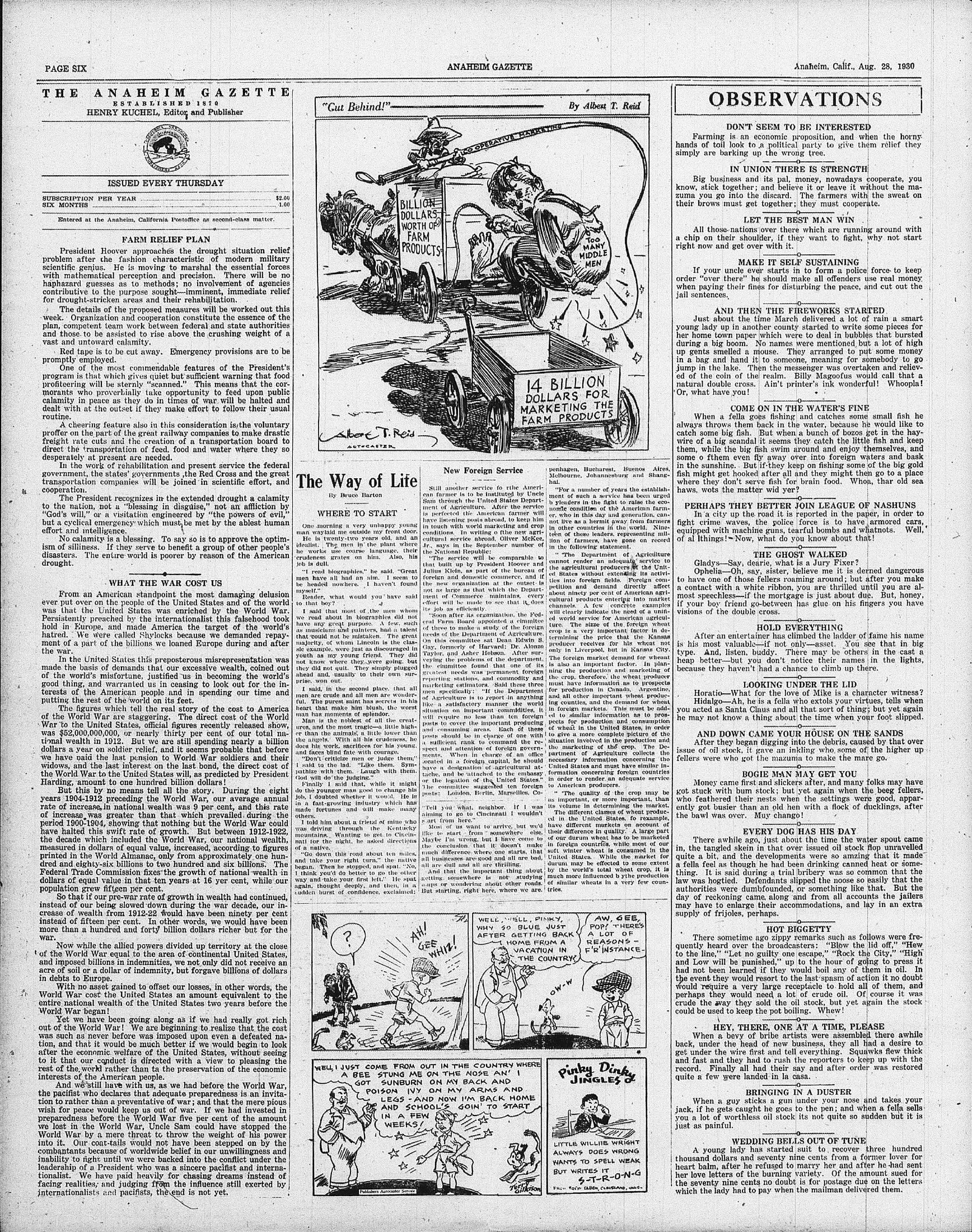
"Cut Behind!" By Albert T. Reid
7 BILLION DOLLARS WORTH OF FARM PRODUCTS
TOO MANY MIDDLE MEN
14 BILLION DOLLARS FOR MARKETING THE FARM PRODUCTS
Albert T. Reid
AUTOCAETER
The Way of Life
By Bruce Barton
WHERE TO START
One morning a very unhappy young man waylaid me outside my front door.
He is twenty-two years old, and an idealist. The men in the plant where he works use course language, their crudeness grates on him. Also, his job is dull.
"I read biographies," he said. "Great men have all had an aim. I seem to be headed nowhere. I haven't found myself."
Reader, what would you have said to that boy?
I said that most of the men whom we read about in biographies did not have any great purpose. A few, such as musicians and painters, had a talent that could not be mistaken. The greatest majority, of whom Lincoln is the classic example, were just as discouraged in youth as my young friend. They did not know where they were going, but they did not quit. They simply plugged ahead and, usually to their own surprise, won out.
I said, in the second place, that all men are crude and all men are wonderful. The purest saint has secrets in his heart that make him blush, the worst man has moments of splendor.
Man is the noblest of all the creatures, and the most tragic—a little higher than the animals, a little lower than the angels. With all his crudeness, he does his work, sacrifices for his young, and faces blind fate with courage.
"Don't criticize men or judge them." I said to the lad. "Like them. Sympathize with them. Laugh with them. God will do the judging."
Finally I said that, while it might do the younger man good to change his job, I doubted whether it would. He is in a fast-growing industry which has made fortunes and will make many others.
I told him about a friend of mine who was driving through the Kentucky mountains. Wanting to get to Cincinnati for the night, he asked directions of a native.
"Go down this road about ten miles, and take your right turn," the native began. Then he stopped, and spat. "No.
New Foreign Service
Still another service for rthe American farmer is to be instituted by Uncle Sam through the United States Department of Agriculture. After the service is perfected the American farmer will have listening posts abroad, to keep him in touch with world marketing and crop conditions. In writing o fthe new agricultural service abroad, Oliver McKee, Jr., says in the September number of the National Republic:
"The service will be comparable to that built up by President Hoover and Julius Klein, as part of the bureau of foreign and domestic commerce, and if the new organization at the outset is not as large as that which the Department of Commerce maintains, every effort will be made to see that it does its job as efficiently.
"Soon after its organization, the Federal Farm Board appointed a committee of three to make a study of the foreign needs of the Department of Agriculture. On this committee sat Dean Edwin S. Gay, formerly of Harvard; Dr. Alonzo Taylor, and Asher Hobson. After surveying the problems of the department, the committee found that one of its greatest needs was permanent foreign reporting stations, and commodity and marketing estimators. Said these three men specifically: "If the Department of Agriculture is to report in anything like a satisfactory manner the world situation on important commodities, it will require no less than ten foreign posts to cover the important producing and consuming areas. Each of these posts should be in charge of one with a sufficient rank to command the respect and attention of foreign governments. When in charge of an office located in a foreign capital, he should have a designation of agricultural attache, and be attached to the embassy or the legation of the United States."
The committee suggested ten foreign posts: London, Berlin, Marselles, Coenhagen, Bucharest, Buenos Aires, Melbourne, Johannesburg and Shanghai.
"For a number of years the establishment of such a service has been urged by yleaders in the fight to raise the economic condition of the American farmer, who in this day and generation cannot live as a hermit away from farmers in other countries in the world. Nineteen of these leaders, representing million of farmers, have gone on record in the following statement.
"The Department of Agriculture cannot render an adequate service to the agricultural producers of the United States without extending its activities into foreign fields. Foreign competition and demand directly affect about ninety per cent of American agricultural products entering into market channels. A few concrete examples will clearly indicate the need of a unified world service for American agriculture. The size of the foreign wheat crop is a very important factor in determining the price that the Kansas producer receives for his wheat not only in Liverpool, but in Kansas City. The foreign market demand for wheata is also an important factor. In planning the production and marketing of the crop, therefore, the wheat producer must have information as to prospects for production in Canada, Argentina, and all other important wheat producing counties, and the demand for wheat in foreign markets. This must be added to similar information as to prospects for production and consumption of wheat in the United States, in order to give a more complete picture of the situation involved in the production and the marketing of the crop. The Department of Agriculture collects the necessary information concerning the United States and must have similar information concerning foreign countries in order to render an adequate service to American producers."
"The quality of the crop may be as important, or more important, than its volume in determining the market.
The different classes of wheat produced in the United States, so rexample, have different markets on account of their difference in quality. A large part of our durum wheat has to be marketed in foreign countries, while most of our soft winter wheat is consumed in the United States. While the market for durum may be effected to some extent by the world's total wheat crop, it is
Finally I said that, while it might do the younger man good to change his job, I doubted whether it would. He is in a fast-growing industry which has made fortunes and will make many others.
I told him about a friend of mine who was driving through the Kentucky mountains. Wanting to get to Cincinnati for the night, he asked directions of a native.
"Go down this road about ten miles, and take your right turn," the native began. Then he stopped, and spat. "No, I think you'd do better to go the other way and take your first left." He spat again, thought deeply, and then, in a sudden burst of confidence, exclaimed:
"Tell you what, neighbor. If I was aiming to go to Cincinnati I wouldn't start from here."
Most of us want to arrive, but we'd like to start from somewhere else. Maybe I'm wrong, but I have come to the conclusion that it doesn't make much difference where one starts, that all businesses are good and all are bad, all are dull and all are thrilling.
And that the important thing about getting somewhere is not studying maps or wondering about other roads. But starting, right here, where we are.
"The quality of the crop may be as important, or more important than its volume in determining the market. The different classes of wheat produced in the United States, so rexample, have different markets on account of their difference in quality." A large part of our durum wheat has to be marketed in foreign countries, while most of our soft winter wheat is consumed in the United States. While the market for durum may be effected to some extent by the world's total wheat crop, it is much more influenced by the production of similar wheats in a very few countries.
OBSERVATIONS
DON'T SEEM TO BE INTERESTED
Farming is an economic proposition, and when the horny hands of toil look to a political party to give them relief they simply are barking up the wrong tree.
IN UNION THERE IS STRENGTH
Big business and its pal, money, nowadays cooperate, you know, stick together; and believe it or leave it without the mazuma you go into the discard. The farmers with the sweat on their brows must get together; they must cooperate.
LET THE BEST MAN WIN
All those nations over there which are running around with a chip on their shoulder, if they want to fight, why not start right now and get over with it.
MAKE IT SELF SUSTAINING
If your uncle ever starts in to form a police force to keep order "over there" he should make all offenders use real money when paying their fines for disturbing the peace, and cut out the jail sentences.
AND THEN THE FIREWORKS STARTED
Just about the time March delivered a lot of rain a smart young lady up in another county started to write some pieces for her home town paper which were to deal in bubbles that bursted during a big boom. No names were mentioned but a lot of high up gents smelled a mouse. They arranged to put some money in a bag and hand it to someone, meaning for somebody to go jump in the lake. Then the messenger was overtaken and relieved of the coin of the realm. Billy Magoofus would call that a natural double cross. Ain't printer's ink wonderful! Whoopla!
Or, what have you!
COME ON IN THE WATER'S FINE
When a fella goes fishing and catches some small fish he always throws them back in the water, because he would like to catch some big fish. But when a bunch of bozos get in the haywire of a big scandal it seems they catch the little fish and keep them, while the big fish swim around and enjoy themselves, and some o fthem even fly away over into foreign waters and bask
COME ON IN THE WATER'S FINE
When a fella goes fishing and catches some small fish he always throws them back in the water, because he would like to catch some big fish. But when a bunch of bozos get in the haywire of a big scandal it seems they catch the little fish and keep them, while the big fish swim around and enjoy themselves, and some o fthem even fly away over into foreign waters and bask in the sunshine. But if they keep on fishing some of the big gold fish might get hooked after all and they might then go to a place where they don't serve fish for brain food. Whoa, thar old sea haws, wots the matter wid yer?
PERHAPS THEY BETTER JOIN LEAGUE OF NASHUNS
In a city up the road it is reported in the paper, in order to fight crime waves, the police force is to have armored cars, equipped with machine guns, tearful bombs and whatnots. Well, of al lthings! Now, what do you know about that!
THE GHOST WALKED
Gladys—Say, dearie, what is a Jury Fixer?
Ophelia—Oh, say, sister, believe me it is derned dangerous to have one of those fellers roaming around; but after you make a contact with a white ribbon, you are thrilled until you are almost speechless—if the mortgage is just about due. But, honey, if your boy friend go-between has glue on his fingers you have visions of the double cross.
HOLD EVERYTHING
After an entertainer has climbed the ladder of fame his name is his most valuable—if not only—asset. You see that in big type. And, listen, buddy. There may be others in the cast a heap better—but you don't notice their names in the lights, because they haven't had a chance to climb up there.
LOOKING UNDER THE LID
Horatio—What for the love of Mike is a character witness?
Hidalgo—Ah, he is a fella who extols your virtues, tells when you acted as Santa Claus and all that sort of thing; but yet again he may not know a thing about the time when your foot slipped.
AND DOWN CAME YOUR HOUSE ON THE SANDS
After they began digging into the debris, caused by that over issue of oil stock, it gave an inkling who some of the higher up fellers were who got the mazuma to make the mare go.
BOGIE MAN MAY GET YOU
Money came first and slickers after, and many folks may have got stuck with bum stock; but yet again when the beeg fellers, who feathered their nests when the settings were good, apparently got busier than an old hen with a flock of ducklings, after the bawl was over. Muy chango!
EVERY DOG HAS HIS DAY
There awhile ago, just about the time the water spout came in, the tangled skein in that over issued oil stock flop unravelled quite a bit, and the developments were so amazing that it made a fella feel as though he had been drinking canned heat or some-
BOGIE MAN MAY GET YOU
Money came first and slickers after, and many folks may have got stuck with bum stock; but yet again when the beeg fellers, who feathered their nests when the settings were good, apparently got busier than an old hen with a flock of ducklings, after the bawl was over. Muy chango!
EVERY DOG HAS HIS DAY
There awhile ago, just about the time the water spout came in, the tangled skein in that over issued oil stock flop unravelled quite a bit, and the developments were so amzing that it made a fella feel as though he had been drinking canned heat or something. It is said during a trial bribery was so common that the law was hogtied. Defendants slipped the noose so easily that the authorities were dumbfounded, or something like that. But the day of reckoning came along and from all accounts the jailers may have to enlarge their accommodations, and lay in an extra supply of frijoles, perhaps.
HOT BIGGETTY
There sometime ago zippy remarks such as follows were frequently heard over the broadcasters: "Blow the lid off," "Hew to the line," "Let no guilty one escape," "Rock the City," "High and Low will be punished," up to the hour of going to press it had not been learned if they would boil any of them in oil. In the event they would resort to the last spasm of action it no doubt would require a very large receptacle to hold all of them, and perhaps they would need a lot of crude oil. Of course it was crude the way they sold the oil stock, but yet again the stock could be used to keep the pot boiling. Whew!
HEY, THERE, ONE AT A TIME, PLEASE
When a bevy of bribe artists were assembled there awhile back, under the head of new business, they all had a desire to get under the wire first and tell everything. Squawks flew thick and fast and they had to rush the reporters to keep up with the record. Finally all had their say and after order was restored quite a few were landed in la casa.
BRINGING IN A DUSTER
When a guy sticks a gun under your nose and takes your jack, if he gets caught he goes to the pen; and when a fella sells you a lot of worthless oil stock its not quite so sudden but it is just as painful.
WEDDING BELLS OUT OF TUNE
A young lady has started suit to recover three hundred thousand dollars and seventy nine cents from a former lover for heart balm, after he refused to marry her and after he had sent her love letters of the burning variety. Of the amount sued for the seventy nine cents no doubt is for postage due on the letters which the lady had to pay when the mailman delivered them.