anaheim-gazette 1930-07-17
Scanned page
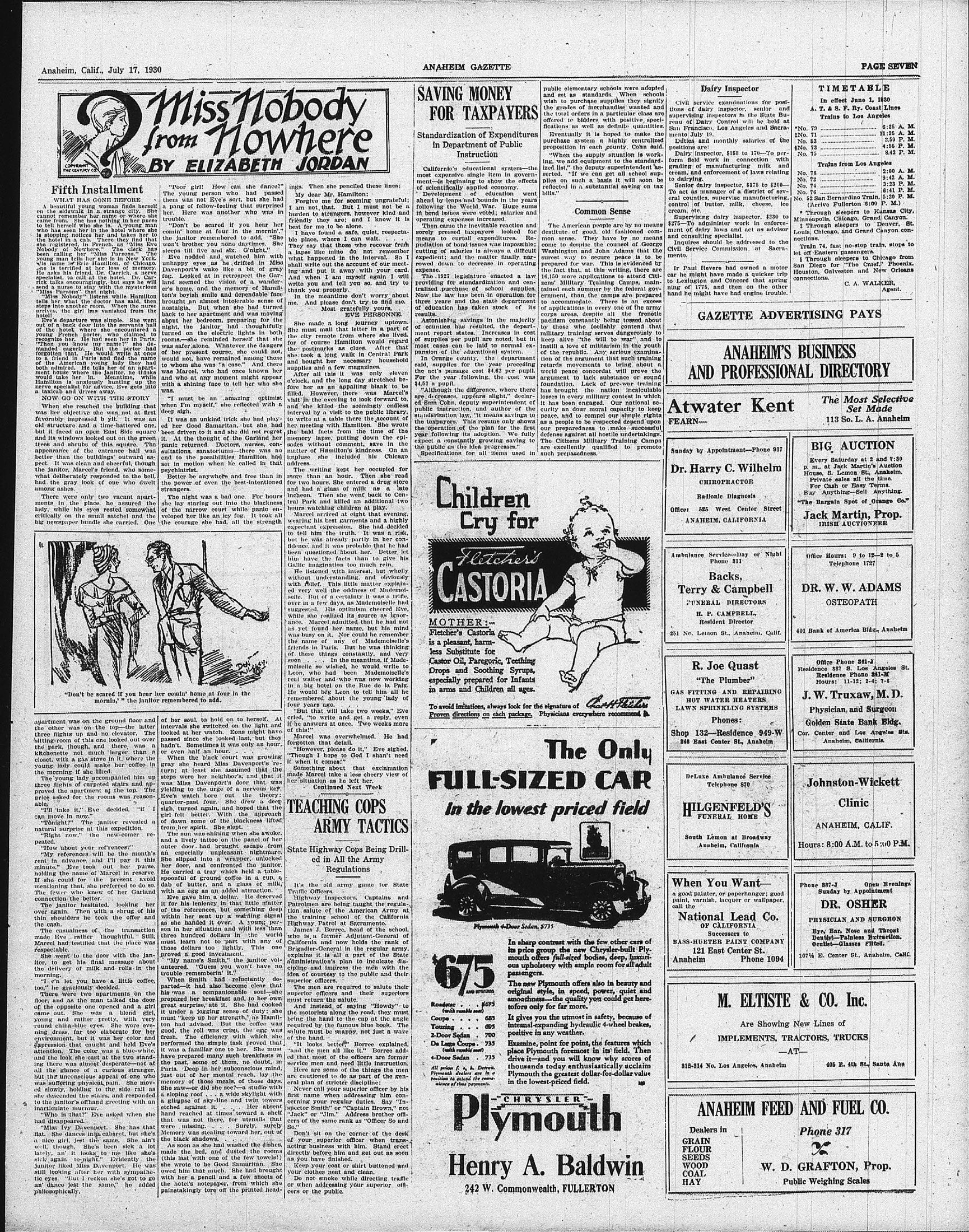
Searchable text
A beautiful young woman finds herself on the sidewalk in a strange city. She cannot remember her name or where she came from. She has nothing in her purse to tell herself who she is. A young man who has seen her in the hotel where she is stopping noceb her and takes her to the hotel in a cab. There they find that she registered in French, as "Miss Eve Nobody of Nowhere." The clerk has been calling her "Miss Parsons." The young man tells her she is in New York. His name is Eric Hamilton, of Chicago. He is terrified at her loss of memory. He asks his friend, Carrie, a nurse specialist, to call at the hotel. Dr. Carrie talks encouragingly, but says he will send a nurse to stay with the mysterious "Miss Parsons" that night.
Miss Nobody listens while Hamilton tells her what the doctor has said, then steps into another room. When the nurse arrives, the girl has vanished from the hotel.
Eve's departure was simple. She went out of a back door into the servants hall of the hotel, where she encountered a young French porter, who claimed to recognize her. He had seen her in Paris. Then you know my name? she demanded eagerly. But the porter had forgotten that. He would write at once to a friend in Paris and find the name of the American young lady they both admired. He tells her of an apartment house where the janitor, he thinks would take her in. Meantime, while Hamilton is anxiously hunting up the nerve specialist for advice, Eve gets into a taxicab and drives away.
NOW GO ON WITH THE STORY
When she reached the building that was her objective she was not at first favorably impressed by it. It was an old structure and a time-battered one, but it faced an open East Side square and its windows looked out on the green trees and shrubs of this square. The appearance of the entrance hall was better than the buildings' outward as-
"Poor girl! How can she dance?" The young person who had passed them was not Eve's sort, but she had a pang of fellow-feeling that surprised her. Here was another who was in trouble.
"Don't be scared if you hear her comin' home at four in the mornin'" the janitor remembered to add. "She won't brother you none daytimes. She sleeps till five and six. G'night."
Eve nodded and watched him with unhappy eyes as he drifted in Miss Davenport's wake like a bit of gray fog. Looked at in retrospect the Garland seemed the vision of a wanderer's home, and the memory of Hamilton's boyish smile and dependable face brought an almost intolerable sense of nostalgia. But when she had turned back to her apartment and was moving about her bedroom, preparing for the night, the janitor had thoughtfully turned on the electric lights in both rooms—the she reminded herself that she was safer alone. Whatever the dangers of her present course, she could not, would not, have remained among those to whom she was "a case." And there was Marcel, who had once known her and who at any moment might appear with a shining face to tell her who she was.
"I must be an amazing optimist when I'm myself," she reflected with a deep sigh.
It was an unkind trick she had played her Good Samaritan, but she had been driven to it and she did not regret it. At the thought of the Garland her panic returned. Doctors, nurses, consultations, sanatoriums—there was no end to the possibilities Hamilton had
ings. Then she penciled My dear Mr. Hamilton Forgive me for seem I am not that. But I burden to strangers, how friendly they are; and best for me to be alone I have found a safe place, where I can They say that those who what happened in the shall write out the account and put it away And when I am myse write you and tell you thank you properly.
In the meantime done me. And please don't t Most grateful EVE
She made a long jot She must mail that letter the city remote from w for of course Hamilton the postmarks as clue she took a long walk in and bought her necess supplies and a few mag After all this it was o'clock, and the long day fore her as an appallin filled. However, there visit in the evening to lo and she killed the see interval by a visit to tho to write at a table there her meeting with Hamilton the bald facts from the memory lapse, putting sodes without comment matter of Hamilton's kin impluse she included
NOW GO ON WITH THE STORY
When she reached the building that was her objective she was not at first favorably impressed by yit. It was an old structure and a time-battered one, but it faced an open East Side square and its windows looked out on the green trees and shrubs of this square. The appearance of the entrance hall was better than the buildings' outward aspect. It was clean and cheerful, though the janitor, Marcel's friend, who somewhat deliberately responded to the bell, had the gray look of one who dwelt among ashes.
There were only two vacant apartments in the place, he assured the lady, while his eyes rested somewhat critically on the small satchel and the big newspaper bundle she carried. One apartment was on the ground floor and the other was on the top—the latter three flights up and no elevator. The sitting-room of this one looked out over the park, though, and there, was a kitchenette not much larger than a closet, with a gas stove in it, where the young lady could make her coffee in the morning if she liked.
The young lady accompanied him up three flights of carpeted stairs and approved the apartment at the top. The price asked for the rooms was reasonable.
"I'll take it," Eve decided, "if I can move in now."
"Tonight?" The janitor revealed a natural surprise at this expedition.
"Right now," the new-comer repeated.
"How about your references?"
"My references will be the month's rent in advance, and I'll pay it this minute." Eve took out her purse, to whom she was "a case." And there was Marcel, who had once known her and who at any moment might appear with a shining face to tell her who she was.
"I must be an amazing optimist when I'm myself," she reflected with a deep sigh.
It was an unkind trick she had played her Good Samaritan, but she had been driven to it and she did not regret it. At the thought of the Garland her panic returned. Doctors, nurses, consultations, sanatoriums—there was no end to the possibilities Hamilton had set in motion when he called in that psychiatrist.
Better be anywhere and free than in the power of even the best-intentioned strangers.
The night was a bad one. For hours she lay starring out into the blackness of the narrow court while panic enveloped her like an icy fog. It took all the courage she had, all the strength
"Don't be scared if you hear her comin' home at four in the mornin'," the janitor remembered to add.
apartment was on the ground floor and the other was on the top—the latter three flights up and no elevator. The sitting-room of this one looked out over the park, though, and there, was a kitchenette not much larger than a closet, with a gas stove in it, where the young lady could make her coffee in the morning if she liked.
The young lady accompanied him up three flights of carpeted stairs and approved the apartment at the top. The price asked for the rooms was reasonable.
"I'll take it," Eve decided, "if I can move in now."
"Tonight?" The janitor revealed a natural surprise at this expedition.
"Right now," the new-comer repeated.
"How about your references?"
"My references will be the month's rent in advance, and I'll pay it this minute." Eve took out her purse, to whom she was "a case." And there was Marcel, who had once known her and who at any moment might appear with a shining face to tell her who she was.
"I must be an amazing optimist when I'm myself," she reflected with a deep sigh.
It was an unkind trick she had played her Good Samaritan, but she had been driven to it and she did not regret it. At the thought of the Garland her panic returned. Doctors, nurses, consultations, sanatoriums—there was no end to the possibilities Hamilton had set in motion when he called in that psychiatrist.
Better be anywhere and free than in the power of even the best-intentioned strangers.
The night was a bad one. For hours she lay starring out into the blackness of the narrow court while panic enveloped her like an icy fog. It took all the courage she had, all the strength
"The writing kept her more than an hour." For two hours. She entered and had a glass of milk incheon. Then she went to a central Park and killed an hour watching children.
Marcel arrived at eight wearing his best garment expectant expression. So to tell him the truth, but he was already帕帕帕帕帕帕帕帕帕帕帕帕帕帕帕帕帕帕帕帕帕帕帕帕帕帕帕帕帕帕帕帕帕帕帕帕帕帕帕帕帕帕帕帕帕帕帕帕帕帕帕帕帕帕帕帕帕帕帕帕帕帕帕帕帕帕帕帕帕帕帕帕帕帕帕帕帕帕帕帕帕帕帕帕帕帕帕帕帕帕帕帕帕帕帕帕帕帕啪啪啪啪啪啪啪啪啪啪啪啪啪啪啪啪啪啪啪啪啪啪啪啪啪啪啪啪啪啪啪啪啪啪啪啪啪啪啪啪啪啪啪啪啪啪啪啪啪啪啪啪啪啪啪啪啪啪啪啪啪啪啪啪啪啪啪啪啪啪啪啪啪啪啪啪啪啪啪啪啪啪哩哩哩哩哩哩哩哩哩哩哩哩哩哩哩哩哩哩哩哩哩哩哩哩哩哩哩哩哩哩哩哩哩哩哩哩哩哩哩哩哩哩哩哩哩哩哩哩哩哩哩哩哩哩哩哩哩哯哩哯哯哯哯哯哯哯哯哯哯哯哯哯哯哯哯哯哯哯u唆唆唆唆唆唆唆唆唆唆唆唆唆唆唆唆唆唆唆唆唆唆唆唆唆唆唆唆唆唆唆唆唆唆唆唆唆唆唆唆唆唁唆唆唆唆唖唖唖唖唖唖唖唖唖唖唖唖唖唖唖唖唖唖唖唖唖唖唖唖唖唖唖唖唖唖唖唖唖唖唖唖唖唖唖唖唖唖唖唖唖唖唖唖唖咀咀咀咀咀咀咀咀咀咀咀咀咀咀咀咀咀咀咀咀咀咀咀咀咀咀咀咀咀咀咀咀咀咀咀咀咀咀咀咀咀咀咀咀咀咀咀咀咀咀咀咀咀咀咀咀咀咀咀咀咀咀咀咀咀咀咀咀咀咀咀咀咀咀咀呛呛呛呛呛呛呛呛呛呛呛呛呛呛呛呛呛呛呛呛呛呛呛呛呛呛呛呛呛呛呛呛呛呛呛呛呛呛呛呛呛呛呛呛呛呛呛呛呛呛呤呤呤呤呤呤呤呤呤呤呤呤呤呤呤呤呤呤呤呤呤呤呤呤呤呤呤呤呤呤呤呤呤呤呤呤呤呤呤呤呤呤呤呤呤呤呤呤呤呤呤呤呤呤呤呤呤呤呤呤呤呤呤呤呤呕呚吜吜吜吜吜吜吜吜吜吜吜吜吜吜吜吜吜吜吜吜吜吜吜吜吜吜吜吜吜吜吜吜吜吜吜吜吜吞吜吞吞吞吞吞吞吞吞吞吞吞吞吞吞吞吞吞吞吞吞吞吞吞吞吞吞吞吞吞吞吞吞吞吞吞吞吞吞吞吞吞吞吞吞吞吞吞吞吞吞吞吞吞吞吞吞吞吞吞吞吝吝吝吝吝吝吝吝吝吝吝吝吝吝吝吝吝吝吝吝吝吝吝吝吝吝吝吝眺眺眺眺眺眺眺眺眺眺眺眺眺眺眺眺眺眺眺眺眺眺眺眺眺眺眺眙眺眙眙眙眙眙眙眙眙眙眙眙眙眙眙眙眙眙眙眙眙眙眙眙眙眙眙眙眙眙眙眙眙眙眙眙眙眙眙眙眙眙昇昇昇昇昇昇昇昇昇昇昇昇昇昇昇昇昇昇昇昇昇昇昇昇昇昇昇昇昇昇昇昇昇昦昦昦昦昦昦昦昦昦昦昦昦昦昦昦昦昦昦昦昦昦昦昦昦昦昦昦昦昦昦昦昦昦昦昦昦昦昦昦昦昦昦昦昦昦昦昦昦昦昦昦昦昦昦昦昦昦昦昦昦昦昦昦昦昦昦昦昦昦昦昦昦昦昦昦昷昷昷昷昷昷昷昷昷昷昷昷昷昷昷昷昷昷昷昷昷昷昷昷昷旹旸旸旵旵旵旵旵旵旵旵旵旵旵旵旵旵旵旵旵旵旵旵旵旵旵旵旵旵旵旵旵旵旵旵旵旵旵旵旵旵旵旵旵旵旵旵旵旵旵旵旵旵旵旵旵旵旵旵旵旵旵旵旵旵旵旵旵旵旵旵旵旵旵旵旵旵旵旵旵旵旵旵茬茬茬茬茬茬茬茬茬茬茬茬茬茬茬茬茬茬茬茬茬茬茬茬茬茬茬茬茬茬茬茬茬茬茬茬茬茬茬茬茬茬茬茬茬茬茬茬茬茬茬茬茬茬茬茬茬茬茬茬茬茬茬茑茬茑茑茑茑茑茑茑茑茑茑茑茑茑茑茑茑茑茑茑茑茑茑茑茑茑茑茑茑茑茑茑茑茑茑茑茑茑茑茑茑茑茑茑茑茑茑茑茑茑茑茑茑茑茑茑茑茑茑荏荏荏荏荏荏荏荏荏荏荏荏荏荏荏荏荏荏荏荏荏荏荏荏荏荏荏荏荏荏荏荏荏荏荍荍荍荍荍荍荍荍荍荍荍荍荍荍荍荍荍荍荍荍荍荍荍荍荍荍荍荍荍荍荍荍荍荍荍荍荍荍荍荍荍荍荍荍荍荍荍荍荍荍荍荍荍荍荍荍荍荓荍荓荍荓荓荓荓荓荓荓荓荓荓荓荓荓荓荓荓荓荓荓荓荓荓荓荓荓荓荓荓荓荓荓荓荓荓荓荓荓荓荓荓荓荓荓荓荓荓荓荓荓荓荓荓荓荓荓荓荓莅莅莅莅莅莅莅莅莅莅莅莅莅莅莅莅莅莅莅莅莅莅莅莅莅莅莅莅莅莅莅莅莅莅莅莅莅莅莅莅莅莅莅莅莅莅莅莅莅莅莅莅莅莅莅莅莅莅莳莳莳莳莳莳莳莳莳莳莳莳莳莳莳莳莳莳莳莳莳莳莳莳莳莳莳莳莳莊莊莊莊莊莊莊莊莊莊莊莊莊莊莊莊莊莊莊莊莊莊莊莊莊莊莊莊莊莊莊莊莊莊莊莊莊莊莊莊莊莊莊莊莊莊莊莊莊莘苫苫苫苫苫苫苫苫苫苫苫苫苫苫苫苫苫苫苫苫苫苫苫苫苫苫苫苫a苫a苫a苫a苫a苫a苫a苫a苫a苫a苫a苫a苫a苫a苫a苫a苫a苫a苫a苫a苫a苫a苫a苫a苫a苫a苫a苫a苫a苫a苫a苫a苫a苫a苫a苫a苫a苫a苫a苫a苫a苫a苫a苫a苫a苫a苫a苫a苫a苫a芼芥芥芥芥芥芥芥芥芥芥芥芥芥芥芥芥芥芥芥芥芥芥芥芥芥芥芥芥芥芥芥芥芥芥芥芥芥芥芥芥芥芥芥芥芥芥芥芥芥芥芥芥芥芥芥芥芥芥芥芥芥芥芥芥芥芥芥芥芥芥芥芥芥芥葶葶葶葶葶葶葶葶葶葶葶葶葶葶葶葶葶葶葶葶葶葶葶葶葶葶葶葶葶葶葶葶葶葶葶葶葶葶葶葶葶葶葶葶葶葶葶葶葶葶葶葶葶葶葶葶葶葶葶葶葶葶葶葶葶葶葶葶葸葶葸葸葸葸葸葸葸葸葸葸葸葸葸葸葸葸葸葸葸葸葸葸蒾蒿蒿蒿蒿蒿蒿蒿蒿蒿蒿蒿蒿蒿蒿蒿蒿蒿蒿蒿蒿蒿蒿蒿蒿蒿蒿蒿蒿蒿蒿蒿蒿蒿蒿蒿蒿蒿蒿蒿蒿蒿蒿蒿蒿蒿蒿蒿蒿蒿蒿蒿蒿蒿蒿蒿蒿蒿蒿蒿蒿蒿蒿蒿蔷蔷蔷蔷蔷蔷蔷蔷蔷蔷蔷蔷蔷蔷蔷蔷蔷蔷蔷蔷蔷蔷蔷蔷蔷蔷蔷蔷蔷蔷蔷蔷蔷蔷蔷蔷蔷蔷蔷蔷蔷蔷蔷蔷蔷蔷蔷蔷蔷蔷蔷蔷蔧蔻蔧蔧蔧蔧蔧蔧蔧蔧蔧蔧蔧蔧蔧蔧蔧蔧蔧蔧蔧蔧蔧蔧蔧蔧蔧蔧蔧蔧蔧蔧蔧蔧蔧蔧蔧蔧蔧蔧蔧蔧蔧蔧蔧蔧蔧蔧蔧蔧蔧蔧蔧蔧蔧蔧蔡蔃薔薔薔薔薔薔薔薔薔薔薔薔薔薔薔薔薔薔薔薔薔薔薔薔薔薔薔薔薔薔薔薔薔薌薌薌薌薌薌薌薌薌薌薌薌薌薌薌薌薌薌薌薌薌薌薌薌薌薌薌薌薋薋薋薋薋薋薋薋薋薋薋薋薋薋薋薋薋薋薋薋薋薋薋薋薋薋薋薋薋薋薋薋薋薋薋薹果果果果果果果果果果果果果果果果果果果果果果果果果果果果果果果果果果果果果果果果果果果果果果果果果果果果果果果果果果果果果果果果果果果果果果果果果果果果果果果果果果果果果果果果果果果果果果果果果果果实果实果实果实果实果实果实果实果实果实果实果实果实果实果实果实果实果实果实果实果实果实果实果实果实果实果实果实果实果实果实果实果实果实果实果实果实果实果实果实果实果实果实果实果实果实果实果实果实果实果实果实果实果实果实果实果实果实果实果实果实果实果实果实果实果实果实果实果实果实果实果实果实果实果实果实果实果实果实果实果实果实果实果实果实果实果实果实果实果实果实果实果实果实果实果实果实果实果实果实果实果实果实果实果实真实真实真实真实真实真实真实真实真实真实真实真实真实真实真实真实真实真实真实真实真实真实真实真实真实真实真实真实真实真实真实真实真实真实真实真实真实真实真实真实真实真实真实真实真实真实真实真实真实真实真实真实真实真实真实真实真实真实真实真实真实真实真实真实真实真实真实真实真实真实真实真实真实真实完全完全完全完全完全完全完全完全完全完全完全完全完全完全完全完全完全完全完全完全完全完全完全完全完全完全完全完全完全完全完全完全完全完全完全完全完全完全完全全部全部全部全部全部全部全部全部全部全部全部全部全部全部全部全部全部全部全部全部全部全部全部全部全部全部全部全部全部全部全部全部全部全部全部全部全部全部全部全部全部全部全部全部全部全部全部全部全部全部全部全部全部全部全部全部全部全部全部全部全部全部,全部,全部,全部,全部,全部,全部,全部,全部,全部,全部,全部,全部,全部,全部,全部,全部,全部,全部,全部,全部,全部,全部,全部,全部,全部,全部,全部,全部,全部,全部,全部,全部,全部,全部,全部,全部,全部,全部,全部,全部,全部,全部,全部,全部,全部,全部,全部,全面全面全面全面全面全面全面全面全面全面全面全面全面全面全面全面全面全面全面全面全面全面全面全面全面全面全面全面全面全面全面全面全面全面全面全面全面全面全面正面正面正面正面正面正面正面正面正面正面正面正面正面正面正面正面正面正面正面正面正面正面正面正面正面正面正面正面正面正面正面正面正面正面正面正面正面正面正面正面正面正面正面正面正面正面正面正面正面反正反正反正反正反正反正反正反正反正反正反正反正反正反正反正反正反正反正反正反正反正反正反正反正反正反正反正反正反正反正反正反正反正反正反正反正反正反正反正反正反正反正反正反正反正反正反正反正反正反正反正反正反正反正反正反正反正正正正正正正正正正正正正正正正正正正正正正正正正正正正正正正正正正正正正正正正正正正正正正正正正正正正正正正正正正正正正正正正正正正正正正正正正正正正正正正正正正正正正正正正正正正正正正正全全全全全全全全全全全全全全全全全全全全全全全全全全全全全全全全全全全全全全全全全全全全全全全全全全全全全全全全全全全全全全全全全全全全全全全全全全全全全全全全全全全全全全全全全全全全全全全全 全 全 全 全 全 全 全 全 全 全 全 全 全 全 全 全 全 全 全 全 全 全 全 全 全 全 全 全 全 全 全 全 全 全 全 全 全 全 全 全 全 全 全 全 全 全 全 全 全 全 全 全 全 全 全 全 全 全 全 全 全 全 全、全、全、全、全、全、全、全、全、全、全、全、全、全、全、全、全、全、全、全、全、全、全、全、全、全、全、全、全、全、全、全、全、全、全、全、全、全、全、全、全、全、全、全、全、全、全、全、全、全、全、全、全、全、全、全、全、全、全、全、全、全、全、全、全、全、全、全、全体全体全体全体全体全体全体全体全体全体全体全体全体全体全体全体全体全体全体全体全体全体全体全体全体全体全体全体全体全体全体全体全体全体全体全体全体全体全体全体全体全体全体全体全体全体全体全体全体全体全体全体全体全体全体全体群体群体群体群体群体群体群体群体群体群体群体群体群体群体群体群体群体群体群体群体群体群体群体群体群体群体群体群体群体群体群体群体群体群体群体群体群体群体群体群体群体群体群体群体群体群体群体群体团体群体团体群体团体团体团体团体团体团体团体团体团体团体团体团体团体团体团体团体团体团体团体团体团体团体团体团体团体团体团体团体团体团体团体团体团体团体团体团体团体团体团体团体团体团体团体团体团体团体团体团体集体集体集体集体集体集体集体集体集体集体集体集体集体集体集体集体集体集体集体集体集体集体集体集体集体集体集体集体集体集体集体集体集体集体集体集体集体集体集体集体集体集体集体集体集体集体集体集体集体集体集体集体集体集体集体集体集体集体集体集体集体集体集体集体集合集合集合集合集合集合集合集合集合集合集合集合集合集合集合集合集合集合集合集合集合集合集合集合集合集合集合集合集合集合集合集合集合集合集合集合集合集合集合集合集合集合集合集合集合集合集合集合集合集合集合集合集合集合集合集合集合集合集合集合集合集合集合集合集合集合集合集合集合集合集合集合集合集合集合集合集合集合集合集合集合集合集合集合集合集合 Collection Collection Collection Collection Collection Collection Collection Collection Collection Collection Collection Collection Collection Collection Collection Collection Collection Collection Collection Collection Collection Collection Collection Collection Collection Collection Collection Collection Collection Collection Collection Collection Collection Collection Collection Collection Collection Collection Collection Collection Collection Collection Collection Collection Collection Collection Collection Collection Collection Collection Collection Collection Collection Collections Collections Collections Collections Collections Collections Collections Collections Collections Collections Collections Collections Collections Collections Collections Collections Collections Collections Collections Collections Collections Collections Collections Collections Collections Collections Collections Collections Collections Collections Collections Collections Collections Collections Collections Collections Collections Collections Collections Collections Collections Collections Collections Collections Collections Collections Collections Collections Collections Collections Collections Collections Collections Collections Collections Collections Collections Collections Collections Collections Collections Collections Collections Collections Collections Collections Collections Collections Collections Collections Collections Collections Collections Collections Collections Collections Collections Collections Records Records Records Records Records Records Records Records Records Records Records Records Records Records Records Records Records Records Records Records Records Records Records Records Records Records Records Records Records Records Records Records Records Records Records Records Records Records Records Records Records Records Records Records Records Records Records Records Records Records Records Records Records Records Records Records Records Records Records Records Records Records Records Records RecordsRecordsRecordsRecordsRecordsRecordsRecordsRecordsRecordsRecordsRecordsRecordsRecordsRecordsRecordsRecordsRecordsRecordsRecordsRecordsRecordsRecordsRecordsRecordsRecordsRecordsRecordsRecordsRecordsRecordsRecordsRecordsRecordsRecordsRecordsRecordsRecordsRecordsRecordsRecordssRecordssRecordssRecordssRecordssRecordssRecordssRecordssRecordssRecordssRecordssRecordssRecordssRecordssRecordssRecordssRecordssRecordssRecordssRecordssRecordssRecordssRecordssRecordssRecordssRecordssRecordssRecordssRecordssRecordssRecordssRecordssRecordssRecordssRecordssRecordssRecordssRecordssRecordssRecordssRecordssRecordssRecordssRecordssRecordssRecordssRecordssRecordss RecordssRecordssRecordssRecordssRecordss
The young lady accompanied him up three flights of carpeted stairs and approved the apartment at the top. The price asked for the rooms was reasonable.
"I'll take it," Eve decided, "if I can move in now."
"Toight?" The janitor revealed a natural surprise at this expedition.
"Right now," the new-comer repeated.
"How about your refrences?"
"My references will be the month's rent in advance, and I'll pay it this minute." Eve took out her purse, holding the name of Marcel in reserve. If she could for the present avoid mentioning that, she preferred to do so. The fewer who knew of her Garland connection the better.
The janitor hesitated, looking her over again. Then with a shrug of his thin shoulders he took the offer and the cash.
The casualness of the transaction made Eve rather thoughtful. Still, Marcel had testified that the place was respectable.
She went to the door with the janitor, to get his final message about the delivery of milk and rolls in the morning.
"I can let you have a little coffee, too," he graciously decided.
There were two apartments on the floor, and as the man talked the door of the opposite one opened and a girl came out. She was a blond girl, young and rather pretty, with very round china-blue eyes. She wore evening dress, far too elaborate for her environment, but it was her color and expression that caught and held Eve's attention. The color was a blue-white, and the look she cast at the two standing there was almost desperate—not at all the glance of a curious stranger, but the unconscious appeal of one who was suffering physical pain. She moved slowly, holding to the side rail as she descended the stairs, and responded to the janitor's offhand greeting with an inarticulate murmur.
"Who is that?" Eve asked when she had disappeared.
"Miss Ivy Davenport. She has that flat. She dances in its cabaret, but she's a nice girl, jests the same. She ain't well though. She's been sick a lot lately, an' looks to me like she's sick again to night." Evidently the janitor liked Miss Davenport. He was still looking after her with sympathetic eyes. But I reckon she's got to go an' dance just the same," he added philosophically.
As soon as she had washed the dishes, made the bed, and dusted the rooms (this last with one of the few towels!) she wrote to her Good Samaritan. She owed him that much. She had brought with her a pencil and a few sheets of the hotel's notepaper, from which she painstakingly tore off the printed head-steps were her neighbor's, and that it was Miss Davenport's door that was yielding to the urge of a nervous key. Eve's watch bore out the theory: quarter-past four. She drew a deep sigh, turned again, and hoped that the girl felt better. With the approach of dawn some of the blackness lifted from her spirit. She slept.
The sun was shining when she awoke, and a lively tattoo on the panel of her outer door had brought escape from an especially unpleasant nightmare. She slipped into a wrapper, unlocked her door, and confronted the janitor. He carried a tray which held a table-spoonful of ground coffee in a cup, a dab of butter, and a glass of milk, with an egg as an added attraction.
Eve gave him a dollar. He deserved it for his leniency in that little matter of the references, but something deep within her sent up a warning signal as she handed it over. A young person in her situation and with less than three hundred dollars in the world must learn not to part with any of those dollars too lightly. This one proved a good investment.
"My name's Smith," the janitor volunteered. "Guess you won't have no trouble rememberin' it."
When Smith had reluctantly departed—it had also become clear that his was a companionable soul—she prepared her breakfast and, to her own great surprise, ate it. She had cooked it under a jogging sense of duty; she must "keep up her strength," as Hamilton had advised. But the coffee was good, the roll was crisp, the egg was fresh. The efficiency with which she performed the simple task proved that it was a familiar one to her. She must have prepared many such breakfasts in the past, some of them, no doubt, in Paris. Deep in her subconscious mind, just out of her mental reach, lay the memory of those meals, of those days. She saw—or did she see?—a studio with a sloping roof...a wide skylight with a glimpse of sky-line and twin towers etched against it.
Her absent hand reached at times toward a shelf that was not there, for utensils that were missing. Surely, surely Memory was stealing toward her, out of the black shadows.
As soon as she had washed the dishes, made the bed, and dusted the rooms (this last with one of the few towels!) she wrote to her Good Samaritan. She owed him that much. She had brought with her a pencil and a few sheets of the hotel's notepaper, from which she painstakingly tore off the printed head-steps were her neighbor's, and that it was Miss Davenport's door that was yielding to the urge of a nervous key. Eve's watch bore out the theory: quarter-past four. She drew a deep sigh, turned again, and hoped that the girl felt better. With the approach of dawn some of the blackness lifted from her spirit. She slept.
The sun was shining when she awoke, and a lively tattoo on the panel of her outer door had brought escape from an especially unpleasant nightmare. She slipped into a wrapper, unlocked her door, and confronted the janitor. He carried a tray which held a table-spoonful of ground coffee in a cup, a dab of butter, and a glass of milk, with an egg as an added attraction.
Eve gave him a dollar. He deserved it for his leniency in that little matter of the references, but something deep within her sent up a warning signal as she handed it over. A young person in her situation and with less than three hundred dollars in the world must learn not to part with any of those dollars too lightly. This one proved a good investment.
"My name's Smith," the janitor volunteered. "Guess you won't have no trouble rememberin' it."
When Smith had reluctantly departed—it had also become clear that his was a companionable soul—she prepared her breakfast and, to her own great surprise, ate it. She had cooked it under a jogging sense of duty; she must "keep up her strength," as Hamilton had advised. But the coffee was good, the roll was crisp, the egg was fresh. The efficiency with which she performed the simple task proved that it was a familiar one to her. She must have prepared many such breakfasts in the past, some of them, no doubt, in Paris. Deep in her subconscious mind, just out of her mental reach, lay the memory of those meals, of those days. She saw—or did she see?—a studio with a sloping roof...a wide skylight with a glimpse of sky-line and twin towers etched against it.
Her absent hand reached at times toward a shelf that was not there, for utensils that were missing. Surely, surely Memory was stealing toward her, out of the black shadows.
As soon as she had washed the dishes, made the bed, and dusted the rooms (this last with one of the few towels!) she wrote to her Good Samaritan. She owed him that much. She had brought with her a pencil and a few sheets of the hotel's notepaper, from which she painstakingly tore off the printed head-steps were her neighbor's, and that it was Miss Davenport's door that was yielding to the urge of a nervous key. Eve's watch bore out the theory: quarter-past four. She drew a deep sigh, turned again, and hoped that the girl felt better. With the approach of dawn some of the blackness lifted from her spirit. She slept.
The sun was shining when she awoke, and a lively tattoo on the panel of her outer door had brought escape from an especially unpleasant nightmare. She slipped into a wrapper, unlocked her door, and confronted the janitor. He carried a tray which held a table-spoonful of ground coffee in a cup, a dab of butter, and a glass of milk, with an egg as an added attraction.
Eve gave him a dollar. He deserved it for his leniency in that little matter of the references, but something deep within her sent up a warning signal as she handed it over. A young person in her situation and with less than three hundred dollars in the world must learn not to part with any of those dollars too lightly. This one proved a good investment.
"My name's Smith," the janitor volunteered. "Guess you won't have no trouble rememberin' it."
When Smith had reluctantly departed—it had also become clear that his was a companionable soul—she prepared her breakfast and, to her own great surprise, ate it. She had cooked it under a jogging sense of duty; she must "keep up her strength," as Hamilton had advised. But the coffee was good, the roll was crisp, the egg was fresh. The efficiency with which she performed the simple task proved that it was a familiar one to her. She must have prepared many such breakfasts in the past, some of them, no doubt, in Paris. Deep in her subconscious mind, just out of her mental reach, lay the memory of those meals, of those days. She saw—or did she see?—a studio with a sloping roof...a wide skylight with a glimpse of sky-line and twin towers etched against it.
Her absent hand reached at times toward a shelf that was not there, for utensils that were missing. Surely, surely Memory was stealing toward her, out of the black shadows.
As soon as she had washed the dishes, made the bed, and dusted the rooms (this last with one of the few towels!) she wrote to her Good Samaritan. She owed him that much. She had brought with her a pencil and a few sheets of the hotel's notepaper, from which she painstakingly tore off the printed head-steps were her neighbor's, and that it was Miss Davenport's door that was yielding to the urge of a nervous key. Eve's watch bore out the theory: quarter-past four. She drew a deep sigh, turned again, and hoped that the girl felt better. With the approach of dawn some of the blackness lifted from her spirit. She slept.
The sun was shining when she awoke, and a lively tattoo on the panel of her outer door had brought escape from an especially unpleasant nightmare. She slipped into a wrapper, unlocked her door, and confronted the janitor. He carried a tray which held a table-spoonful of ground coffee in a cup, a dab of butter, and a glass of milk, with an egg as an added attraction.
Eve gave him a dollar. He deserved it for his leniency in that little matter of the references, but something deep within her sent up a warning signal as she handed it over. A young person in her situation and with less than three hundred dollars in the world must learn not to part with any of those dollars too lightly. This one proved a good investment.
"My name's Smith," the janitor volunteered. "Guess you won't have no trouble rememberin' it."
When Smith had reluctantly departed—it had also become clear that his was a companionable soul—she prepared her breakfast and, to her own great surprise, ate it. She had cooked it under a jogging sense of duty; she must "keep up her strength," as Hamilton had advised. But the coffee was good, the roll was crisp, the egg was fresh. The efficiency with which she performed the simple task proved that it was a familiar one to her. She must have prepared many such breakfasts in the past, some of them, no doubt, in Paris. Deep in her subconscious mind, just out of her mental reach, lay the memory of those meals, of those days. She saw—or did she see?—a studio with a sloping roof...a wide skylight with a glimpse of sky-line and twin towers etched against it.
Her absent hand reached at times toward a shelf that was not there,for utensils that were missing. Surely,surely Memory was stealing toward her,out oftheblackshadows
As soon as she had washed the dishes,madethebed,anddustdedtherooms(thislastwithoneofthefewtowels!)shewroteトheGoodSamaritan.Sheowedhimthatmuch.Shehadbroughtwithherapencilandafewsheetsofthehotel'snotepaper,从whichshepainstakinglytoreofftheprinthead-stepswereherneighbor's,andthatitwasMissDavenport'sdoorthatwasyieldingtotheurgentofanervouskey.(teachingcoacharmytraveloffice)
body where JORDAN
ings. Then she penciled these lines:
My dear Mr. Hamilton;
Forgive me for seeming ungrateful; I am not that. But I must not be a burden to strangers, however kind and friendly they are; and I know it is best for me to be alone.
I have found a safe, quiet, respectable place, where I can wait. They say that those who recover from a lapse like mine do not remember what happened in the interval. So I shall write out the account of our meeting and put it away with your card. And when I am myself again I will write you and tell you so, and try to thank you properly.
In the meantime don't worry about me. And please don't try to find me. Most gratefully yours,
EVE PERSONNE.
She made a long journey uptown. She must mail that letter in a part of the city remote from where she lived, for of course Hamilton would regard the postmarks as clues. After that she took a long walk in Central Park and bought her necessary household supplies and a few magazines.
After all this it was only eleven o'clock, and the long day stretched before her as an appalling blank to be filled. However, there was Marcel's visit in the evening to look forward to, and she killed the seemingly endless interval by a visit to the public library, to write at a table there the account of her meeting with Hamilton. She wrote the bald facts from the time of the memory lapse, putting down the episodes without comment, save in the matter of Hamilton's kindness. On an impluse she included his Chicago
SAVING MONEY FOR TAXPAYERS
Standardization of Expenditures in Department of Public Instruction
California's educational system—the most expensive single item in government—is beginning to show the effects of scientifically applied economy.
Development of education went ahead by teaps and bounds in the years following the World War. Huge sums in bond issues were voted; salaries and operating expenses increased.
Then came the inevitable reaction and sorely pressed taxpayers looked for means to curtail expenditures. Repudiation of bond issues was impossible; cutting of salaries is always a difficult expedient; and the matter finally narrowed down to decrease in operating expense.
The 1927 legislature enacted a law providing for standardization and centralized purchase of school supplies. Now the law has been in operation for three years and the state department of education has taken stock of its results.
Astonishing savings in the majority of counties has resulted, the department report states. Increases in cost of supplies per pupil are noted, but in most cases can be laid to normal expansion of the educational system.
In Orange county, the department said, supplies for the year preceding the act's passage cost $4.62 per pupil. For the year following, the cost was $4.52 a pupil.
"Although the difference, where there are decreases, appears slight," declared Sam Cohn, deputy superintendent of public instruction, and author of the standardization law. "It means savings to the taxpayers. This resume only shows the operation of the plan for the first year following its adoption. We fully expect a constantly growing saving to the public as the idea progresses."
Specifications for all items used in public elementary schools were adopted and set as standards. When schools wish to purchase supplies they signify the grades of merchandise wanted and the total orders in a particular class are offered to bidders with positive specifications as well as definite quantities.
Eventually it is hoped to make the purchase system a highly centralized proposition in each county, Cohn said.
"When the supply situation is working, we add equipment to the standardized list," the deputy superintendent asserted. "If we can get all school supplies on such a basis it will soon be reflected in a substantial saving on tax bills."
Common Sense
The American people are by no means destitute of good, old fashioned common sense. They have by no means come to despise the counsel of George Washington and John Adams that the surest way to secure peace is to be prepared for war. This is evidenced by the fact that, at this writing, there are 16,150 more applications to attend Citizens' Military Training Camps; maintained each summer by the federal government, than the camps are prepared to accommodate. There is an excess of applications in every one of the army corps areas, despite all the frenetic pacifism constantly being tossed about by those who foolishly contend that military training serves dangerously to keep alive "the will to war" and to instill a love of militarism in the youth of the republic. Any serious examination of the argument that such training retards movements to bring about a world peace concordat will prove the argument to lack substance or sound foundation. Lack of pre-war training has brought the nation incalculable losses in every military contest in which it has been engaged. Our national security an dour moral capacity to keep peace, and to compel our simple rights as a people to be respected depend upon our preparedness to make successful defense against all hostile undertakings. The Citizens Military Training Camps are excellently qualified to promote such preparedness.
After all this it was only eleven o'clock, and the long day stretched before her as an appalling blank to be filled. However, there was Marcel's visit in the evening to look forward to, and she killed the seemingly endless interval by a visit to the public library, to write at a table there the account of her meeting with Hamilton. She wrote the bald facts from the time of the memory lapse, putting down the episodes without comment, save in the matter of Hamilton's kindness. On an impluse she included his Chicago address.
The writing kept her occupied for more than an hour. Then she read for two hours. She entered a drug store and had a glass of milk as a late incheon. Then she went back to Central Park and killed an additional two hours watching children at play.
Marcel arrived at eight that evening, wearing his best garments and a highly expectant expression. She had decided to tell him the truth. It was a risk, but he was already partly in her confidence, and it was probable that he had been questioned about her. Better let him have the facts than to give his Gallic imagination too much rein.
He listened with interest, but wholly without understanding, and obviously with relief. This little matter explained very well the oddness of Mademoiselle. But of a certainty it was a trifle, over in a few days, as Mademoiselle had suggested. His optimism cheered Eve, while she realized its source as ignorance. Marcel admitted that he had not as yet found her name, but his mind was busy on it. Nor could he remember the name of any of Mademoiselle's friends in Paris. But he was thinking of these things constantly, and very soon... In the meantime, if Mademoiselle so wished, he would write to Leon, who had been Mademoiselle's real waiter and who was now working in a big hotel on the Rue de la Palx. He would beg Leon to tell him all he remembered about the young lady of four years ago.
"But that will take two weeks," Eve cried, "to write and get a reply, even if he answers at once. Two weeks more of this!"
Marcel was overwhelmed. He had forgotten that detail.
"However, please do it," Eve sighed. "Though I hope to God I shan't need it when it comes!"
Something about that exclamation made Marcel take a less cheery view of her situation as he left her.
Continued Next Week
TEACHING COPS ARMY TACTICS
State Highway Cops Being Drilled in All the Army Regulations
Although the difference, where there are decreases, appears slight," declared Sain Cohn, deputy superintendent of public instruction, and author of the standardization law, "it means savings to the taxpayers. This resume only shows the operation of the plan for the first year following its adoption. We fully expect a constantly growing saving to the public as the idea progresses."
Specifications for all items used in retards movements to bring about a world peace concordat will prove the argument to lack substance or sound foundation. Lack of pre-war training has brought the nation incalculable losses in every military contest in which it has been engaged. Our national security an dour moral capacity to keep peace, and to compel our simple rights as a people to be respected depend upon our preparedness to make successful defense against all hostile undertakings. The Citizens Military Training Camps are excellently qualified to promote such preparedness.
Children Cry for Hatcher's Castoria
MOTHER:—Fletcher's Castoria is a pleasant, harmless Substitute for Castor Oil, Paregoric, Teething Drops and Soothing Syrups, especially prepared for Infants in arms and Children all ages.
To avoid limitations, always look for the signature of Proven directions on each package. Physicians everywhere recommend
The Only FULL-SIZED CAR in the lowest priced field
TEACHING COPS ARMY TACTICS
State Highway Cops Being Drilled in All the Army Regulations
It's the old army game for State Traffic Officers.
Highway Inspectors, Captains and Patrolmen are being taught the regulation salute of the American Army at the training school of the California Highway Patrol at Sacramento.
James J. Borree, head of the school, who is a former Adjutant-General of California and now holds the rank of Brigadier-General in the regular army, explains it is all a part of the State administration's plan to inculcate discipline and impress the men with the idea of courtesy to the public and their superior officers.
The men are required to salute their superior officers and their superiors must return the salute.
And instead of saying "Howdy" to the motorists along the road, they must bring the hand to the cap at the angle required by the famous blue book. The salute must be snappy, not just a wave of the hand.
"It looks better," Borree explained, "and the men all like it." Borree added that most of the officers are former service men and need little instruction.
Here are some of the things the men are cautioned to do as part of the general plan of stricter discipline:
Never call your superior officer by his first name when addressing him concerning your regular duties. Say "Inspector Smith" or "Captain Brown," not "Jack" or "Jim."
Address brother officers of the same rank as "Officer So and So."
Don't sit on the corner of the desk of your superior officer when transacting business with him. Stand erect directly before him and get out as soon as you have finished.
Keep your coat or shirt buttoned and your clothes neat and clean.
Do not smoke while directing traffic or when addressing your superior officers or the public.
FULL-SIZED CAR
In the lowest priced field
Plymouth 4-Door Sedan, $735
675 AND UPGRADES
Roadster . . . $675 (with rumble seat)
Coupe . . . $685
Touring . . . $695
2-Door Sedan . . 700
De Largo Coupa. 735 (with rumble seat)
4-Door Sedan . . 735
All prices f. e. b. Detroit. Plymouth dealers are in a position to extend the convenience of time payments.
In sharp contrast with the few other cars of its price group the new Chrysler-built Plymouth offers full-sized bodies, deep luxurious upholstery with ample room for all adult passengers.
The new Plymouth offers also in beauty and original style, in speed, power, quiet and smoothness—the quality you could get here-toore only for far more.
It gives you the utmost in safety, because of internal-expanding hydraulic 4-wheel brakes, positive in any weather.
Examine, point for point, the features which place Plymouth foremost in its field. Then drive it—and you will know why scores of thousands today enthusiastically acclaim Plymouth the greatest dollar-for-dollar value in the lowest-priced field.
CHRYSLER
Plymouth
Henry A. Baldwin
242 W. Commonwealth, FULLERTON
Dairy Inspector
Civil service examinations for positions of dairy inspector, senior and supervising inspectors in the State Bureau of Dairy Control will be held at San Francisco, Los Angeles and Sacramento July 19.
Duties and monthly salaries of the positions are:
Dairy inspector, $150 to $170—To perform field work in connection with grading of manufacturing milk and cream, and enforcement of laws relating to dairying.
Senior dairy inspector, $175 to $200—To act as manager of a district of several counties, supervise manufacturing, control of butter, milk, cheese, ice cream, etc.
Supervising dairy inspector, $230 to $275—To administer work in enforcement of dairy laws and act as advisor and consulting specialist.
Inquires should be addressed to the Civil Service Commission at Sacramento.
Ir Paul Revere had owned a motor car he might have made a quicker trip to Lexington and Concord that springing of 1775, and then on the other hand he might have had engine trouble.
TIMETABLE
In effect June 1, 1830
A. T. & S. F. Ry. Coast Lines
Trains to Los Angeles
*No. 79 ... 6:35 A.M.
‡No. 71 ... 11:25 A.M.
No. 53 ... 2.59 P.M.
$No. 73 ... 4:55 P.M.
No. 75 ... 8.43 P.M.
Trains from Los Angeles
No. 78 ... 2:00 A.M.
No. 72 ... 9:42 A.M.
No. 74 ... 3:23 P.M.
No. 76 ... 6:41 P.M.
No. 52 San Bernardino Train, 5:20 P.M.
(Arrive Fullerton 6:00 P.M.)
*Through sleepers to Kansas City, Minneapolis, Chicago, Grand Canyon.
‡Through sleepers to Denver, St Louis, Chicago, and Grand Canyon connections.
Train 74, fast no-stop train, stops to let off Eastern passengers.
§ Through sleepers to Chicago from San Diego for "The Cnief," Phoenix, Houston, Galveston and New Orleans connections.
C. A. WALKER,
Agent.
GAZETTE ADVERTISING PAYS
ANAHEIM'S BUSINESS AND PROFESSIONAL DIRECTORY
Atwater Kent
FEARN—
The Most Selective Set Made
113 So. L. A. Anaheim
Sunday by Appointment—Phone 917
AND PROFESSIONAL DIRECTORY
Atwater Kent
FEARN—
The Most Selective Set Made
113 So. L. A. Anaheim
Sunday by Appointment—Phone 917
Dr. Harry C. Wilhelm
CHIROPRACTOR
Radionic Diagnosis
Office: 525 West Center Street
ANAHEIM, CALIFORNIA
BIG AUCTION
Every Saturday at 2 and 7:30 p.m., at Jack Martin's Auction House, S. Lemon St., Anaheim.
Private sales all the time.
For Cash or Easy Terms.
Buy Anything—Sell Anything.
"The Bargain Spot of Orange Co."
Jack Martin, Prop.
IRISH AUCTIONEER
Ambulance Service—Day or Night
Phone 811
Backs,
Terry & Campbell
FUNERAL DIRECTORS
H. P. CAMPDELL,
Resident Director
251 No. Lemon St., Anaheim, Calif.
Office Hours: 9 to 12—2 to 5
Telephone 1727
DR. W. W. ADAMS
OSTEOPATH
401 Bank of America Bldg., Anaheim
R. Joe Quast
“The Plumber”
GAS FITTING AND REPAIRING
HOT WATER HEATERS
LAWN SPRINKLING SYSTEMS
Phones:
Shop 132—Residence 949-W
246 East Center St., Anaheim
Office Phone 841-J
Residence 887 S. Los Angeles St.
Residence Phone 841-M
Hours: 11-12; 2-4; 7-8
J. W. Truxaw, M. D.
Physician and Surgeon
Golden State Bank Bldg.
Cor. Center and Los Angeles Sta.
Anaheim, California
DeLuxe Ambulance Service
Telephone 870
HILGENFELD'S
FUNERAL HOME
South Lomon at Broadway
Anaheim, California
Johnston-Wickett Clinic
ANAHEIM, CALIF.
Hours: 8:00 A.M. to 5:00 P.M.
DeLuxe Ambulance Service
Telephone 870
HILGENFELD'S
FUNERAL HOME
South Lemon at Broadway
Anaheim, California
Johnston-Wickett
Clinic
ANAHEIM, CALIF.
Hours: 8:00 A.M. to 5:00 P.M.
When You Want—
a good painter, or paperhanger; good paint, varnish, lacquer or wallpaper,
call the
National Lead Co.
OF CALIFORNIA
Successors to
BASS-HUETER PAINT COMPANY
121 East Center St.
Anaheim Phone 1094
Phone 837-J Open Evenings
Sunday by Appointment
DR. OSHER
PHYSICIAN AND SURGEON
Eye, Ear, Nose and Throat
Dentist—Painless Extraction.
Oculist—Glasses Fitted.
107½ E. Center St., Anaheim, Calif.
M. ELTISTE & CO. Inc.
Are Showing New Lines of
IMPLEMENTS, TRACTORS, TRUCKS
—AT—
312-314 No. Los Angeles, Anaheim 405 E. 4th St. Santa Ana
ANAHEIM FEED AND FUEL CO.
Dealers in
GRAIN
FLOUR
SEEDS
WOOD
COAL
HAY
Phone 317
W. D. GRAFTON, Prop.
Public Weighing Scales