anaheim-gazette 1930-06-05
Scanned page
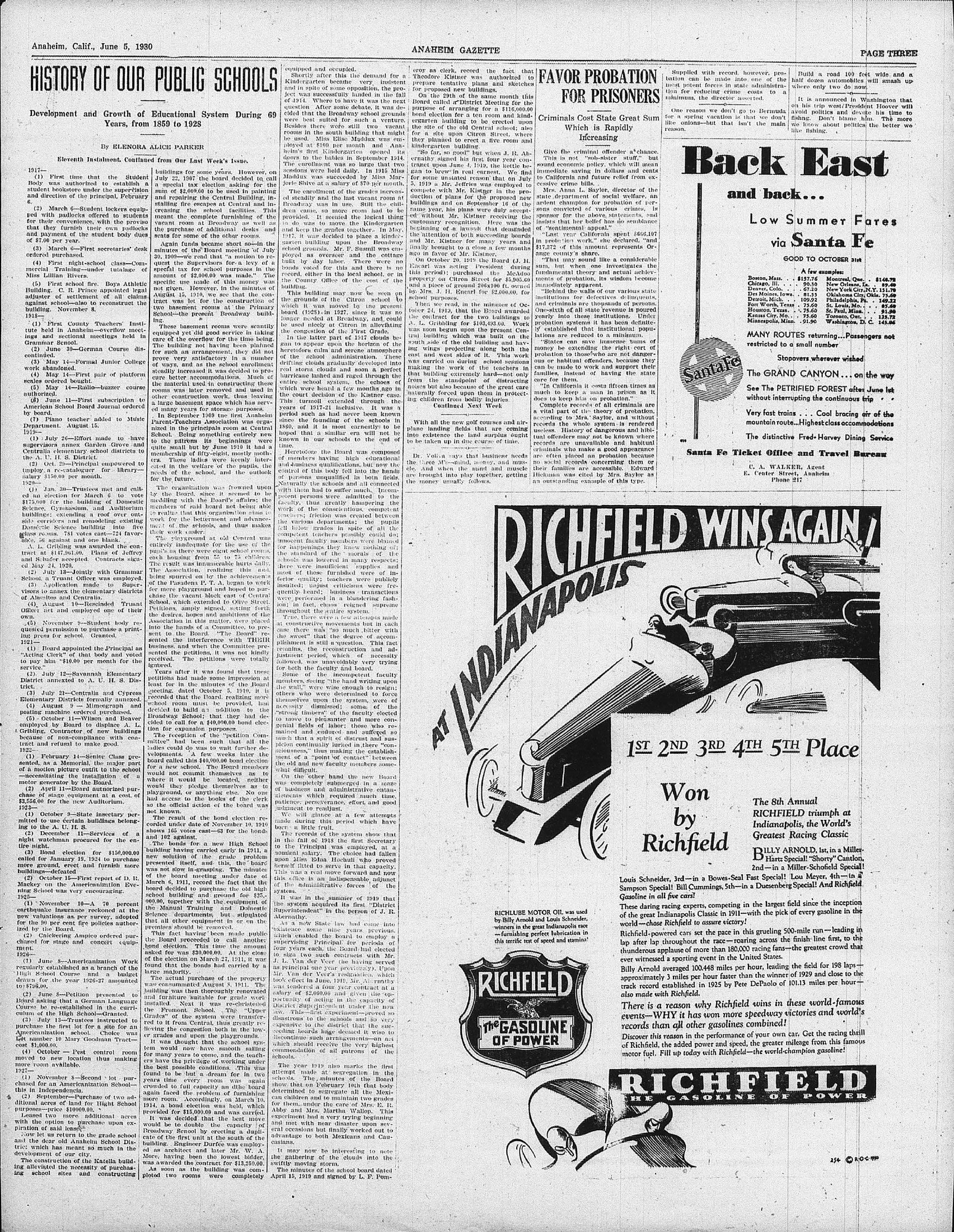
Searchable text
HISTORY OF OUR PUBLIC SCHOOLS
Development and Growth of Educational System During 69 Years, from 1859 to 1928
By ELENORA ALICE PARKER
Eleventh Instalment. Continued from Our Last Week's Issue.
1917—
(1) First time that the Student Body was authorized to establish a student bookstore under the supervision and direction of the principal, February 6.
(2) March 6—Student lockers equipped with padlocks offered to students for their convenience, with the proviso that they furnish their own padlocks and payment of the student body dues of $7.00 per year.
(3) March 6—First secretaries' desk ordered purchased.
(4) First night-school class—Commercial Training—under tutalage of Miss Lillian Rivers.
(5) First school fire. Boys Athletic Building. C. R. Prince appointed legal adjuster of settlement of all claims against school—also to reconstruct the building. November 8, 1918—
(1) First County Teachers' Institute held in Anaheim—overflow meetings and sectional meetings held in Grammar School.
(2) June 30—German Course discontinued.
(3) May 14—Formal Junior College work abandoned.
(4) May 14—First pair of platform scales ordered bought.
(5) May 14—Radio-buzzer course authorized.
(6) June 11—First subscription to American School Board Journal ordered by board.
(7) Plano teacher added to Music Department. August 15, 1919—
(1) July 26—Effort made to have supervisors annex Garden Grove and Centralia elementary school districts to the A. U. H. S. District.
buildings for some years. However, on July 22, 1907 the board decided to call a special tax election asking for the sum of $2,000.00 to be used in painting and repairing the Central Building, installing fire escapes at Central and increasing the school facilities. This meant the complete furnishing of the vacant room at Broadway as well as the purchase of additional desks and seats for some of the other rooms.
Again funds became short so—in the minutes of the Board meeting of July 30, 1909—we read that "a motion to request the Supervisors for a levy of a special tax for school purposes in the amount of $2,000.00 was made." The specific use made of this money was not given. However, in the minutes of August 15, 1910, we see that the contract was let for the construction of two basement rooms at the Primary School—the present Broadway building.
These basement rooms were scantily equipped yet did good service in taking care of the overflow for the time being. The building not having been planned for such an arrangement, they did not prove very satisfactory in a number of ways, and as the school enrollment steadily increased it was decided to procure better accommodations. Much of the material used in constructing these rooms was later removed and used in other construction work, thus leaving a large basement space which has served many years for storage purposes.
In September 1909 the first Anaheim Parent-Teachers Association was organized in the principals room at Central School. Being something entirely new to the pitrows its beginnings were quite small but by June 1910 it had a membership of fifty-eight, mostly mothers. These ladies were keenly interested and occupied.
Shortly after this time Kindergarten became an end in spite of some oppressive question After some decided that the Broadway were best suited for schools in the south built rooms in the south built used. Miss Elise Mployed at $100 per month heim's first Kindergarten doors to the babies in The enrollment was so sessions were held daily Maddux was succeeded Jorle Shive at a salary o
The enrollment of the garden building upon school grounds. Mr. F. E. employed as overseer and built by day labor. The bonds voted for this record, either in the local County Office or the building.
This building may now be grounded of the Citrus which it was moved to board (1928). In 1927, she longer needed at Broadway be used nicely at Citron's congestion of the F.
In the latter part of January to appear upon her heretofore calm and serene of the school administration drifting clouds gradually real storm clouds and a hurricane lashed and raged entire school system, which were heard a few days before the court decision of this turnover extended years of 1917-21 inclusive period such as had never since the founding of the 1860, and it is most likely hoped that a similar event known in our schools time.
Heretofore the Board members having high
(3) May 14—Formal Junior College work abandoned.
(4) May 14—First pair of platform scales ordered bought.
(5) May 14—Radio—buzzer course authorized.
(6) June 11—First subscription to American School Board Journal ordered by board.
(7) Piano teacher added to Music Department. August 15, 1919—
(1) July 26—Effort made to have supervisors annex Garden Grove and Centralia elementary school districts to the A. U. H. S. District.
(2) Oct. 29—Principal empowered to employ a re-cataloguer for library—salary $150.00 per month.
1920—
(1) Jan. 30—Trustees met and called an election for March 6 to vote $175,000 for the building of Domestic Science, Gymnasium, and Auditorium buildings; extending a roof over outside corridors and remodeling existing Domestic Science building into five glass rooms. 781 votes cast—724 favorable, 56 against and one blank.
A. L. Gribling was awarded the contract at $147,961.00. Plans of Jeffrey and Safer accepted. Contracts signed May 24, 1920.
(2) July 13—Jointly with Grammar School, a Truant Officer was employed.
(3) Application made to Supervisors to annex the elementary districts of Alamitos and Centralia.
(4) August 10—Rescinded Truant Officer act and employed one of their own.
(5) November 9—Student body requested permission to purchase a printing press for school. Granted.
1921—
(1) Board appointed the Principal as "Acting Clerk" of that body and voted to pay him "$10.00 per month for the service."
(2) July 12—Savannah Elementary District annexted to A. U. H. S. District.
(3) July 21—Centralla and Cypress Elementary Districts formally annexed.
(4) August 9 — Mimeograph and posting machine ordered purchased.
(5) October 11—Wilson and Beaver employed by Board to displace A. L. Gribling, Contractor of new buildings because of non-compliance with contract and refusal to make good.
1922—
(1) February 14—Senior Class presented, as a Memorial, the major part of a motion picture outfit to the school—necessitating the installation of a motor generator by the Board.
(2) April 11—Board authorized purchase of stage equipment at a cost of $3,556.00 for the new Auditorium.
1923—
(1) October 9—State insectary permitted to use certain buildings belonging to the A. U. H. S.
(2) December 11—Services of a night watchman procured for the entire night.
(3) Bond election for $150,000.00 called for January 19, 1924 to purchase more ground, erect and furnish more buildings.
The organization was frowned upon by the Board, since it seemed to be meddling with the Board's affairs; the members of said board not being able to realize that this organization aims to work for the betterment and advancement of the schools, and thus makes their work easier.
The playground at old Central was entirely inadequate for the use of the pupils as there were eight school rooms, each housing from 55 to 75 children. The result was innumerable hurts daily. The Association, realizing this and being spurred on by the achievements of the Pasadena P. T. A., began to work for more playground and hoped to purchase the vacant block east of Central School, which extended to Olive Street. Petitions, amply signed, setting forth the desires, hopes and ambitions of the Association in this matter, were placed into the hands of a Committee, to present to the Board. "The Board" presented the interference with THEIR business, and when the Committee presented the petitions, it was not kindly received. The petitions were totally ignored.
Years after it was found that these petitions had made some impression at least for in the minutes of the Board meeting, dated October 5, 1910, it is recorded that the Board, realizing more school room must be provided, had decided to build an addition to the Broadway School; that they had decided to call for a $40,000.00 bond election for expansion purposes.
The reception of the "petition Committee" had been such that all the ladies could do was to wait further developments. A few weeks later the board called this $40,000.00 bond election for a new school. The Board members would not commit themselves as to where it would be located, neither would they pledge themselves as to playground, or anything else. No one had access to the books of the clerk so the official action of the board was not known.
The result of the bond election recorded under date of November 10, 1916 shows 165 votes cast—63 for the bonds and 102 against.
The bonds for a new High School building having carried early in 1911, a new solution of the grade problem presented itself, and this, the board was not slow in grassembling.
Driving clouds gradually formed a storm cloud and raged entirely school system, which were heard a few days before the court decision of the trial.
This turmoil extended for years 1917-21 inclusive period such as had never since the founding of the 1890, and it is most likely hoped that a similar error known in our schools time.
Heretofore the Board of members having high business qualifications control of this body fell in love with persons unqualified in Naturally the schools and with them had to suffer patient persons were admired faculty, thus greatly hated work of the conscience teachers; friction was created in various departments; fell below grades in spain competent teachers possible innocent faculty members for happenings they knew the standard of the new schools was lowered in many there were insufficient most of those furnished inferior quality; teachers insulted; unjust criticisms frequently heard; businesses were performed in a bluish; in fact, chaos religion throughout the entire system.
True, there were a few at constructive movement case there was "so much the sweet" that the degree plishment is still a question remains, the reconstruction justement period, which followed, was unavoidably for both the faculty and labor.
Some of the incompetent members seeing "the hand wall," were wise enough others who were determined themselves upon the system necessity dismissed; so "strong timbers" of the faction move to pleasen an genial fields of labor; theyained and endured and much that a spirit of distiction continually lurked in sinousness," thus making management of a "point of contend with old and new faculty more what difficult.
On the other hand that was completely submerged of business and administrients which required patience, perseverance, effort judgment to readjust.
We will glance at a frame made during this period born a little fruit.
The records of the system in the fall of 1918 the first to the Principal was eminently salaried. The choice upon Miss Edna Hochul herself fitted to serve in thereloading
— necessitating the installation of a motor generator by the Board.
(2) April 11—Board authorized purchase of stage equipment at a cost of $3,556.00 for the new Auditorium. 1923—
(1) October 9—State insectary permitted to use certain buildings belonging to the A. U. H. S.
(2) December 11—Services of a night watchman procured for the entire night.
(3) Bond election for $150,000.00 called for January 19, 1824 to purchase more ground, erect and furnish more buildings—defecated.
(2) October 15—First report of D. R. Mackey on the Americanization Evening School was very encouraging. 1925—
(1) November 10—A 70 percent earthquake insurance reckoned at the new valuations as per survey, adopted for the 90 per cent fire policies authorized by the Board.
(2) Cnickering Ampco ordered purchased for stage and concert equipment. 1926—
(1) June 8—Americanization Work regularly established as a branch of the High School Course and a budget drawn for the year 1926-27 amounted to $796.00.
(2) June 8—Petition presented to Board asking that a German Language Course be re-established in the curriculum of the High School—Granted.
(3) July 13—Trustees instructed to purchase the first lot for a site for an Americanization school. Choice was Lot number 10 Mary Goodman Tract—cost $1,000.00.
(4) October — Pest control room moved to new location thus making more room available. 1927—
(1) November 8—Second lot purchased for an Americanization School—this in Independencia.
(2) September—Purchase of two additional acres of land for High School purposes—price $10000.00.
Leased two more additional acres with the option to purchase upon expiration of said lease.
Now let us return to the grade school and the dear old Anaheim School District which has meant so much in the development of our city.
The construction of the Katella building alleviated the necessity of purchasing school sites and constructing would not commit themselves as to where it would be located, neither would they pledge themselves as to playground, or anything else. No one had access to the books of the clerk so the official action of the board was not known.
The result of the bond election recorded under date of November 10, 1910 shows 165 votes cast—63 for the bonds and 102 against.
The bonds for a new High School building having carried early in 1911, a new solution of the grade problem presented itself, and this, the board was not slow in grasping. The minutes of the board meeting under date of March 6, 1911, record the fact that the board decided to purchase the old high school building and ground for $25,000.00, together with the equipment of the Manual Training and Domestic Science departments, but stipulated that all other equipment in or on the premises should be removed.
This fact having been made public the Board proceeded to call another bond election. This time the amount asked for was $30,000.00. At the close of the election on March 27, 1911, it war found that the bonds had carried by a large majority.
The actual purchase of the property was consummated August 8, 1911. The building was then thoroughly renovated and furniture suitable for grade work installed. Next it was re-christened the Fremont School. The "Upper Grades" of the system were transferred to it from Central, thus greatly relieving the congestion both in the lower grades and upon the playgrounds.
It was thought that the school system would now have smooth sailing for many years to come, and the teachers have the privilege of working under the best possible conditions. This was found to be but a dream for in two years time every room was again crowded to full capacity an dthe board again faced the problem of furnishing more room. Accordingly, on March 10, 1914, a bond election was held, which provided for $15,000.00 and was carried.
It was decided that the best move would be to double the capacity of Broadway School by erecting a duplicate of the first unit at the south of the building. Engineer Durfee was employed as architect and later Mr. W. A. More, having been the lowest bidder, was awarded the contract for $13,250.00.
As soon as the building was completed two rooms were completely would not commit themselves as to where it would be located, neither would they pledge themselves as to playground, or anything else. No one had access to the books of the clerk so the official action of the board was not known.
The result of the bond election recorded under date of November 10, 1910 shows 165 votes cast—63 for the bonds and 102 against.
The bonds for a new High School building having carried early in 1911, a new solution of the grade problem presented itself, and this, the board was not slow in grasping. The minutes of the board meeting under date of March 6, 1911, record the fact that the board decided to purchase the old high school building and ground for $25,000.00, together with the equipment of the Manual Training and Domestic Science departments, but stipulated that all other equipment in or on the premises should be removed.
This fact having been made public the Board proceeded to call another bond election. This time the amount asked for was $30,000.00. At the close of the election on March 27, 1911, it war found that the bonds had carried by a large majority.
The actual purchase of the property was consummated August 8, 1911. The building was then thoroughly renovated and furniture suitable for grade work installed. Next it was re-christened the Fremont School. The "Upper Grades" of the system were transferred to it from Central, thus greatly relieving the congestion both in the lower grades and upon the playgrounds.
It was thought that the school system would now have smooth sailing for many years to come, and the teachers have the privilege of working under the best possible conditions. This was found to be but a dream for in two years time every room was again crowded to full capacity an dthe board again faced the problem of furnishing more room. Accordingly, on March 10, 1914, a bond election was held, which provided for $15,000.00 and was carried.
It was decided that the best move would be to double the capacity of Broadway School by erecting a duplicate of the first unit at the south of the building. Engineer Durfee was employed as architect and later Mr. W. A. More, having been the lowest bidder, was awarded the contract for $13,250.00.
As soon as the building was completed two rooms were completely would not commit themselves as to where it would be located, neither would they pledge themselves as to playground, or anything else. No one had access to the books of the clerk so the official action of the board was not known.
The result of the bond election recorded under date of November 10, 1910 shows 165 votes cast—63 for the bonds and 102 against.
The bonds for a new High School building having carried early in 1911, a new solution of the grade problem presented itself, and this, the board was not slow in grasping. The minutes of the board meeting under date of March 6, 1911, record the fact that the board decided to purchase the old high school building and ground for $25,000.00, together with the equipment of the Manual Training and Domestic Science departments, but stipulated that all other equipment in or on the premises should be removed.
This fact having been made public the Board proceeded to call another bond election. This time the amount asked for was $30,000.00. At the close of the election on March 27, 1911, it war found that the bonds had carried by a large majority.
The actual purchase of the property was consummated August 8, 1911. The building was then thoroughly renovated and furniture suitable for grade work installed. Next it was re-christened the Fremont School. The "Upper Grades" of the system were transferred to it from Central, thus greatly relieving the congestion both in the lower grades and upon the playgrounds.
It was thought that the school system would now have smooth sailing for many years to come, and the teachers have the privilege of working under the best possible conditions. This was found to be but a dream for in two years time every room was again crowded to full capacity an dthe board again faced the problem of furnishing more room. Accordingly, on March 10, 1914, a bond election was held, which provided for $15,000.00 and was carried.
It was decided that the best move would be to double the capacity of Broadway School by erecting a duplicate of the first unit at the south of the building. Engineer Durfee was employed as architect and later Mr. W. A. More, having been the lowest bidder, was awarded the contract for $13,250.00.
As soon as the building was completed two rooms were completely would not commit themselves as to where it would be located, neither would they pledge themselves as to playground, or anything else. No one had access to the books of the clerk so the official action of the board was not known.
The result of the bond election recorded under date of November 10, 1910 shows 165 votes cast—63 for the bonds and 102 against.
The bonds for a new High School building having carried early in 1911, a new solution of the grade problem presented itself, and this, the board was not slow in grasping. The minutes of the board meeting under date of March 6, 1911, record the fact that the board decided to purchase the old high school building and ground for $25,000.00, together with the equipment of the Manual Training and Domestic Science departments, but stipulated that all other equipment in or on the premises should be removed.
This fact having been made public the Board proceeded to call another bond election. This time the amount asked for was $30,000.00. At the close of the election on March 27, 1911, it war found that the bonds had carried by a large majority.
The actual purchase of the property was consummated August 8, 1911. The building was then thoroughly renovated and furniture suitable for grade work installed. Next it was re-christened the Fremont School. The "Upper Grades" of the system were transferred to it from Central, thus greatly relieving the congestion both in the lower grades and upon the playgrounds.
It was thought that the school system would now have smooth sailing for many years to come, and the teachers havethe privilegeofworkingunderthebestpossibleconditions.这将导致该学校系统需要重新调整,以适应不断发展的市场需求。这将导致该学校系统需要重新调整,以适应不断发展的市场需求。
Ontheotherhand,thesysteminthefalloftheprincipalwaseminemalnal salary.ThechoiceuponMissEdnaHochullinherselffittoserveintotheofficeThiswasarealmoveformewiththisofficeisanindispensableoftheadministrativeformystem.
ItwainthesummerofthesystemacquireditsfirmSuperintendent”intheper Abernathy.
AsanewStatelawhasexistedsome nineyearswhichenabledtheboardtosupervisePrincipalforfouryearseach,theBoardtosigntwosuchcontributions.J.L.Van derVeer{hehadas principaloneyearprevMr.Van derVeer’sresign took effect in June,1919.Miswas tendereda fouryearcousalaryof$2,oooandgirlportunityofactingintheDistrictSuperintendentunlawThisfirstexperimentdisastroustotheschoolsaexpensivetothedistrictseedingboardslargedeachdiscontinue-sucharrangementwhichshouldreceivethevcommissionofallpatricyschools.
Theyear1919alsomattemptmadeatsegregarschools.TheminutesofshowthatonFebruary19thdeterminedtosegregatealscanchildrenandtomaintainfors them UnderthecareofAbbyandMrs.MarthaWexperimenthadaverytryingandmetwithneardisastereraloccasionsbutinallywereadvantagebothMexicancasians.
Itmaynowbeinterestedthe gatheringofthecloudswiftlymovingstorm.TheminutesoftheschoolApril十五,1919and signedby
ANAHEIM GAZETTE
equipped and occupied.
Shortly after this the demand for a Kindergarten became very insistent and in spite of some opposition, the project was successfully landed in the fall of 1914. Where to have it was the next question. After some debate, it was decided that the Broadway school grounds were best suited for such a venture. Besides there were still two vacant rooms in the south building that might be used. Miss Elise Maddux was employed at $100 per month and Anaheim's first Kindergarten opened its doors to the babies in September 1914. The enrollment was so large that two sessions were held daily. In 1915 Miss Maddux was succeeded by Miss Marjorie Shive at a salary of $70 per month.
The enrollment of the grades increased steadily and the last vacant room at Broadway was in use. Still the children came, so more room had to be provided. It seemed the logical thing to do was to move the Kindergarten and keep the grades together. In May, 1917, it was decided to place a kindergarten building upon the Broadway school grounds. Mr. F. Susnul was employed as overseer and the cottage built by day labor. There were no bonds voted for this and there is no record, either in the local school, or in the County Office of the cost of the building.
This building may now be seen on the grounds of the Citron school to which it was moved by the present board (1928) in 1927, since it was no longer needed at Broadway, and could be used nicely at Citron in alleviating the congestion of the First Grade.
In the latter part of 1917 clouds began to appear upon the horizon of the heretofore calm and serene atmosphere of the school administration. These drifting clouds gradually developed into real storm clouds and soon a perfect hurricane lashed and raged through the entire school system, the echoes of which were heard a few months ago in the court decision of the Kistner case. This turmoil extended through the years of 1917-21 inclusive. It was a period such as had never been known since the founding of the schools in 1860, and it is most earnestly to be hoped that a similar era will not be known in our schools to the end of time.
Heretofore the Board was composed of members having high educational eroy as clerk, record the fact that Theodore Kistner was authorized to prepare tentative plans and sketches for proposed new buildings.
On the 29th of the same month this Board called a District Meeting for the purpose of arranging for a $116,000.00 bond election for a ten room and kindergarten building to be erected upon the site of the old Central school; also for a site upon Citron Street, where they planned to erect a five room and kindergarten building.
"So far, so good" but when J. R. Abernathy signed his first four year contract upon June 4, 1919, the kettle began to brew in real earnest. We find for some unstated reason that on July 5, 1919 a Mr. Jeffries was employed to compete with Mr. Kistner in the production of plans for the proposed new buildings and on September 10 of the same year, his plans were duly accepted without Mr. Kistner receiving the customary recognition. Here was the beginning of a lawsuit that demanded the attention of both succeeding boards and Mr. Kistner for many years and finally brought to a close a few months ago in favor of Mr. Kistner.
On October 20, 1919 the Board (J. H. Encairl was acting President during this period); purchased the McAdoo property on Citron Street for $5,905.60 and a piece of ground 206x100 ft. owned by Mrs. J. H. Encairl for $2,000.00, for school purposes.
Then we read, in the minutes of October 24, 1919, that the Board awarded the contract for the two buildings to A. L. Gribbling for $103,493.00. Work was soon begun upon the present Central building which was built on the south side of the old building and having wings projecting along both the east and west sides of it. This work was carried on during school sessions making the work of the teachers in that building extremely hard—not only from the standpoint of distracting noises but also because of the great care naturally forced upon them in protecting children from bodily injuries.
Continued Next Week
With all the new golf courses and airplane landing fields that are coming into existence the land surplus ought to be taken up in due course of time.
Dr. Volta says that business needs
FAVOR PROBATION FOR PRISONERS
Criminal Cost State Great Sum Which is Rapidly Increasing
Give the criminal offender a chance.
This is not "sob-sister stuff," but sound economic policy, which will mean immediate saving in dollars and cents to California and future relief from excessive crime bills.
Mrs. Anna L. Saylor, director of the state department of social welfare, an ardent champion for probation of persons convicted of various crimes, is sponsor for the above statements, and insists that her belief has no semblance of "sentimental appeal."
"Last year California spent $666,107 in probation work," she declared, "and $17,372 of this amount represents Orange county's share.
That may sound like a considerable sum, but when one investigates the fundamental theory and actual achievements of probation, its wisdom become immediately apparent.
Behind the walls of our various state institutions for defectives delinquents, and criminals are thousands of persons. One-sixth of all state revenue is poured yearly into these institutions. Under probation systems it has been definitely established that institutional populations are reduced to a minimum.
"States can save immense sums of money by extending the right cort of probation to those who are not dangerous or habitual offenders, because they can be made to work and support their families, instead of having the state care for them.
"In California it costs fifteen times as much to keep a man in prison as it does to keep him on probation."
Complete records of all criminals are a vital part of the theory of probation, according to Mrs. Saylor, and without records the whole system is rendered useless. History of dangerous and habitual offenders may not be known where records are unavailable and habitual criminals who make a good appearance are often placed in probation because
driving clouds gradually developed into real storm clouds and soon a real hurricane hasashed and raged through the entire school system, the echoes of which were heard a few months ago in the court decision of the Kistner case. This turmoil extended through the years of 1917-21 inclusive. It was a period such as had never been known since the founding of the schools in 1860, and it is most earnestly to be hoped that a similar era will not be known in our schools to the end of time.
Heretofore the Board was composed of members having high educational and business qualifications, but now the control of this body fell into the hands of persons unqualified in both fields. Naturally the schools and all connected with them had to suffer much. Incompetent persons were admitted to the faculty, thus greatly hampering the work of the conscientious, competent teachers; friction was created between the various departments; the pupils will below grades in spite of all the competent teachers possibly could do; innocent faculty members were blamed or happenings they knew nothing of; the standard of the morals of the schools was lowered in many respects; there were insufficient supplies and most of those furnished were of inferior quality; teachers were publicly insulted; unjust criticisms were frequently heard; business transactions were performed in a blundering fashion; in fact, chaos reigned supreme throughout the entire system.
True, there were a few attempts made at constructive movements but in each case there was "so much bitter with the sweet" that the degree of accomplishment is still a question. This fact remains, the reconstruction and adjustment period, which of necessity followed, was unavoidably very trying for both the faculty and board.
Some of the incompetent faculty members, seeing "the hand writing upon the wall," were wise enough to resign; others who were determined to force themselves upon the system, were ofccessity dismissed; some of the strongest timbers" of the faculty elected to move to pleasanter and more conenial fields of labor; those who remained and endured and suffered so much that a spirit of distrust and suspicion continually lurked in there "conciousness," thus making the establishment of a "point of contact" between old and new faculty members somewhat difficult.
On the other hand the new Board was completely submerged in a maze business and administrative entanglements which required much time, patience, perseverance, effort and good judgment to readjust.
We will glance at a few attempts made during this period which have served a little fruit.
The records of the system show that the fall of 1918 the first Secretary the Principal was employed, at a nominal salary. The choice had fallen on Miss Edna Hochuli who proved herself fitted to serve in that capacity.
On the other hand the new Board was completely submerged in a maze business and administrative entanglements which required much time, patience, perseverance, effort and good judgment to readjust.
We will glance at a few attempts made during this period which have proved a little fruit.
The records of the system show that the fall of 1918 the first Secretary of the Principal was employed, at a nominal salary. The choice had fallen upon Miss Edna Hochull who proved herself fitted to serve in that capacity. This was a real move forward and now its office is an indispensable adjunct to the administrative forces of the system.
It was in the summer of 1919 that the system acquired its first "District Superintendent" in the person of J. R. Pernathy.
As a new State law had come into existence some nine years previous, which enabled the board to employ a supervising Principal for periods of four years each, the Board had elected two such contracts with Mr. L. Van der Veer (he having served principal one year previously). Upon Mr. Van der Veer's resignation, which took effect in June, 1919, Mr. Atermathy was tendered a four year contract at a salary of $2,000.00 and given the opportunity of acting in the capacity of District Superintendent under the new law. This—first experiment—proved so astrous to the schools and so very expensive to the district that the succeeding boards have deemed it wise to continue such arrangements—an act which should receive the very highest recommendation of all patrons of the schools.
The year 1919 also marks the first attempt made at segregation in the schools. The minutes of the Board now that on February 10th that body determined to segregate all the Mexican children and to maintain two grades them, under the care of Mrs. E. R. Boyy and Mrs. Martha Wallop. This experiment had a very trying beginning met with near disaster upon several occasions but finally worked out to advantage to both Mexicans and Caucasians.
It may now be interesting to note the gathering of the clouds into the softly moving storm.
The minutes of the school board dated April 15, 1919 and signed by L. F. Pom-
PROBATION PRISONERS
State Great Sum
Rapidly
leasing
Supplied with record, however, probation can be made into one of the most potent forces in state administration for reducing crime costs to a minimum, the director asserted.
One reason we don't go to Bermuda for a spring vacation is that we don't like onions—but that isn't the main reason.
Build a road 100 feet wide and a half dozen automobiles will smash up where only two do now.
It is announced in Washington that on his trip west President Hoover will avoid politics and devote his time to fishing. Don't blame him. The more we know about politics, the better we like fishing.
Back East
and back...
Low Summer Fares
via Santa Fe
GOOD TO OCTOBER 31st
A few examples:
Boston, Mass. $157.76 Montreal, Que. $148.72
Chicago, Ill. 90.30 New Orleans, La. 89.40
Denver, Colo. 67.20 New York City, N.Y. 151.70
Des Moines, Iowa. 81.55 Oklahoma City, Okla. 75.60
Detroit, Mich. 100.92 Philadelphia, Pa. 149.22
Port Worth, Texas 75.60 St. Louis, Mo. 85.60
Houston, Texas 75.60 St. Paul, Minn. 91.90
Kansas City, Mo. 75.60 Toronto, Ont. 125.72
Minneapolis, Minn. 91.90 Washington, D.C. 145.86
MANY ROUTES returning...Passengers not restricted to a small number
Stopovers wherever wished
The GRAND CANYON...on the way
See The PETRIFIED FOREST after June 1st without interrupting the continuous trip
Very fast trains ...Cool bracing air of the mountain route...Highest class accommodations
The distinctive Fred+Harvey Dining Service
Santa Fe Ticket Office and Travel Bureau
The GRAND CANYON... on the way
See The PETRIFIED FOREST after June 1st without interrupting the continuous trip
Very fast trains ... Cool bracing air of the mountain route... Highest class accommodations
The distinctive Fred Harvey Dining Service
Santa Fe Ticket Office and Travel Bureau
C. A. WALKER, Agent
E. Center Street, Anaheim
Phone 217
FIELD WINS AGAIN!
1ST 2ND 3RD 4TH 5TH Place
Won by Richfield
The 8th Annual RICHFIELD triumph at Indianapolis, the World's Greatest Racing Classic
BILLY ARNOLD, 1st, in a Miller-Hartz Special! "Shorty" Cantlon,
2nd—in a Miller-Schofield Special!
Won by Richfield
The 8th Annual RICHFIELD triumph at Indianapolis, the World's Greatest Racing Classic
BILLY ARNOLD, 1st, in a Miller-Hartz Special! "Shorty" Cantlon, 2nd—in a Miller-Schofield Special!
Louis Schneider, 3rd—in a Bowes-Seal Fast Special! Lou Meyer, 4th—in a Sampson Special! Bill Cummings, 5th—in a Duesenberg Special! And Richfield Gasoline in all five cars!
These daring racing experts, competing in the largest field since the inception of the great Indianapolis Classic in 1911—with the pick of every gasoline in the world—chose Richfield to assure victory!
Richfield-powered cars set the pace in this grueling 500-mile run—leading in lap after lap throughout the race—roaring across the finish line first, to the thunderous applause of more than 180,000 racing fans—the greatest crowd that ever witnessed a sporting event in the United States.
Billy Arnold averaged 100.448 miles per hour, leading the field for 198 laps—approximately 3 miles per hour faster than the winner of 1929 and close to the track record established in 1925 by Pete DePaolo of 101.13 miles per hour—also made with Richfield.
There is a reason why Richfield wins in these world-famous events—WHY it has won more speedway victories and world's records than all other gasolines combined!
Discover this reason in the performance of your own car. Get the racing thrill of Richfield, the added power and speed, the greater mileage from this famous motor fuel. Fill up today with Richfield—the world-champion gasoline!