anaheim-gazette 1930-04-24
Scanned page
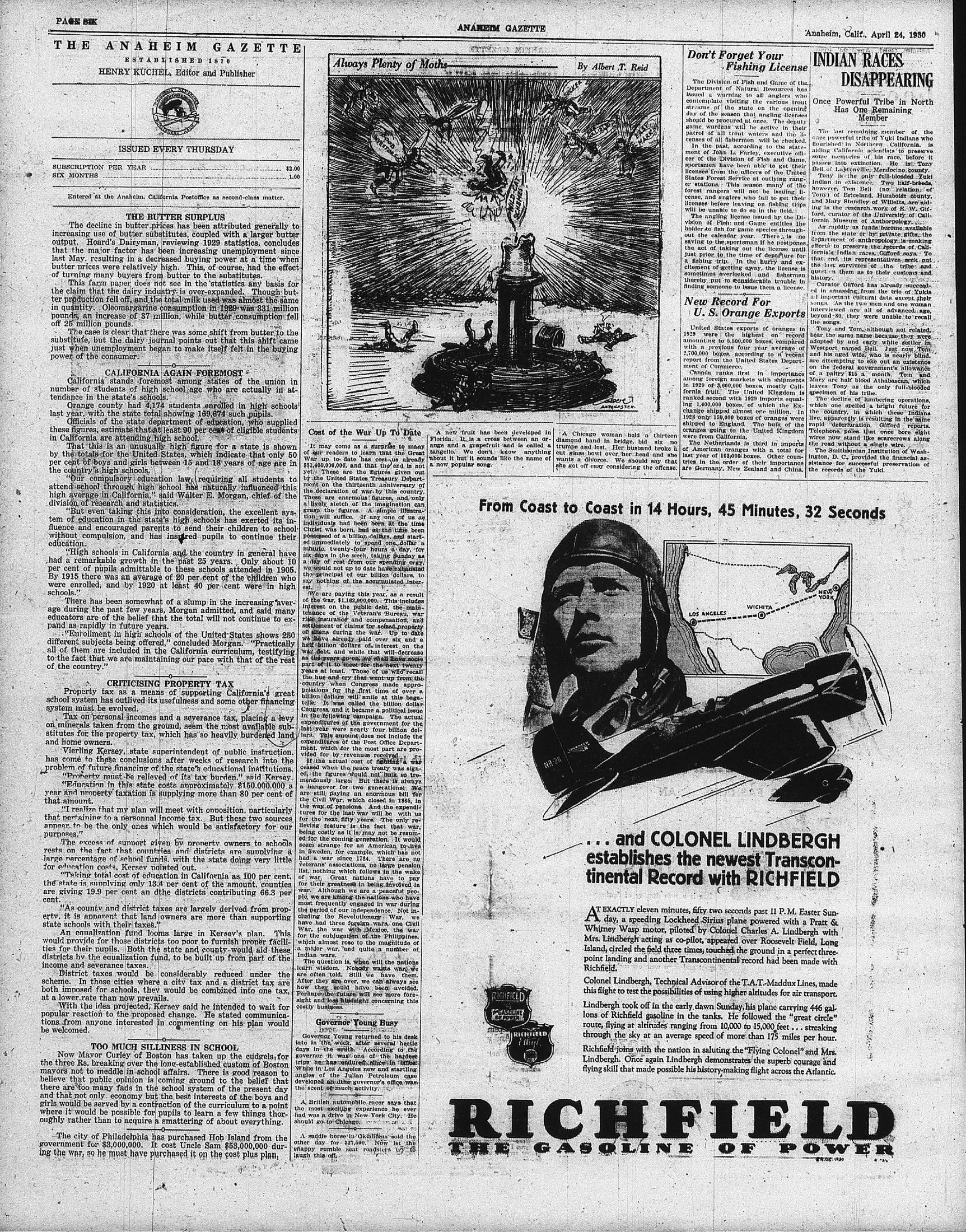
Searchable text
THE ANAHEIM GAZETTE
ESTABLISHED 1870
HENRY KUCHEL, Editor and Publisher
ISSUED EVERY THURSDAY
SUBSCRIPTION PER YEAR ... $2.00
SIX MONTHS ... 1.00
Entered at the Anaheim, California Postoffice as second-class matter.
THE BUTTER SURPLUS
The decline in butter prices has been attributed generally to increasing use of butter substitutes, coupled with a larger butter output. Hoard's Dairyman, reviewing 1929 statistics, concludes that the major factor has been increasing unemployment since last May, resulting in a decreased buying power at a time when butter prices were relatively high. This, of course, had the effect of turning many buyers from butter to the substitutes.
This farm paper does not see in the statistics any basis for the claim that the dairy industry is over-expanded. Though butter production fell off, and the total milk used was almost the same in quantity. Oleomargarine consumption in 1929 was 331 million pounds, an increase of 37 million, while butter consumption fell off 25 million pounds.
The case is clear that there was some shift from butter to the substitute, but the dairy journal points out that this shift came just when unemployment began to make itself felt in the buying power of the consumer.
CALIFORNIA AGAIN FOREMOST
California stands foremost among states of the union in number of students of high school age who are actually in attendance in the state's schools.
Orange county had 4,174 students enrolled in high schools last year, with the state total showing 169,674 such pupils.
Officials of the state department of education, who supplied these figures, estimate that at least 90 per cent of eligible students in California are attending high school.
That this is an unusually high figure for a state is shown by the totals for the United States, which indicate that only 50
CALIFORNIA AGAIN FOREMOST
California stands foremost among states of the union in number of students of high school age who are actually in attendance in the state's schools.
Orange county had 4,174 students enrolled in high schools last year, with the state total showing 169,674 such pupils.
Officials of the state department of education, who supplied these figures, estimate that at least 90 per cent of eligible students in California are attending high school.
That this is an unusually high figure for a state is shown by the totals for the United States, which indicate that only 50 per cent of boys and girls between 15 and 18 years of age are in the country's high schools.
"Our compulsory education law, requiring all students to attend school through high school has naturally influenced this high average in California," said Walter E. Morgan, chief of the division of research and statistics.
"But even taking this into consideration, the excellent system of education in the state's high schools has exerted its influence and encouraged parents to send their children to school without compulsion, and has inspired pupils to continue their education."
"High schools in California and the country in general have had a remarkable growth in the past 25 years. Only about 10 per cent of pupils admittable to these schools attended in 1905. By 1915 there was an average of 20 per cent of the children who were enrolled, and by 1920 at least 40 per cent were in high schools."
There has been somewhat of a slump in the increasing average during the past few years, Morgan admitted, and said many educators are of the belief that the total will not continue to expand as rapidly in future years.
"Enrollment in high schools of the United States shows 250 different subjects being offered," concluded Morgan. "Practically all of them are included in the California curriculum, testifying to the fact that we are maintaining our pace with that of the rest of the country."
CRITICISING PROPERTY TAX
Property tax as a means of supporting California's great school system has outlived its usefulness and some other financing system must be evolved.
Tax on personal incomes and a severance tax, placing a levy on minerals taken from the ground, seem the most available substitutes for the property tax, which has so heavily burdened land and home owners.
Vierling Kersey, state superintendent of public instruction, has come to these conclusions after weeks of research into the problem of future financing of the state's educational institutions.
"Property must be relieved of its tax burden." said Kersey.
"Education in this state costs approximately $150,000,000 a year and property taxation is supplying more than 80 per cent of that amount.
"I realize that my plan will meet with opposition, particularly that pertaining to a personnel income tax. But these two sources appear to be the only ones which would be satisfactory for our purposes."
The excess of support given by property owners to schools rests on the fact that countries and districts are supplying a large percentage of school funds, with the state doing very little for education costs, Kersey pointed out.
"Property must be relieved of its tax burden." said Kersey.
"Education in this state costs approximately $150,000,000 a year and property taxation is supplying more than 80 per cent of that amount.
"I realize that my plan will meet with opposition, particularly that pertaining to a personal income tax. But these two sources appear to be the only ones which would be satisfactory for our purposes."
The excess of support given by property owners to schools rests on the fact that countries and districts are supplying a large percentage of school funds, with the state doing very little for education costs. Kersey pointed out.
"Taking total cost of education in California as 100 per cent, the state is supplying only 13.4 per cent of the amount. counties are giving 19.9 per cent an dthe districts contributing 66.3 per cent.
"As county and district taxes are largely derived from property, it is apparent that land owners are more than supporting state schools with their taxes."
An equalization fund looms large in Kersey's plan. This would provide for those districts too poor to furnish proper facilities for their pupils. Both the state and county would aid these districts by the equalization fund, to be built up from part of the income and severance taxes.
District taxes would be considerably reduced under the scheme. In those cities where a city tax and a district tax are both imposed for schools, they would be combined into one tax, at a lower rate than now prevails.
With the idea projected, Kersey said he intended to wait for popular reaction to the proposed change. He stated communications from anyone interested in commenting on his plan would be welcomed.
TOO MUCH SILLINESS IN SCHOOL
Now Mayor Curley of Boston has taken up the cudgels for the three Rs, breaking over the long-established custom of Boston mavors not to meddle in school affairs. There is good reason to believe that public opinion is coming around to the belief that there are too many fads in the school system of the present day and that not only economy but the best interests of the boys and girls would be served by a contraction of the curriculum to a point where it would be possible for pupils to learn a few things thoroughly rather than to acquire a smattering of about everything.
The city of Philadelphia has purchased Hob Island from the government for $3,000,000. It cost Uncle Sam $53,000,000 during the war, so he must have purchased it on the cost plus plan.
Always Plenty of Moths
By Albert T. Reid
Cost of the War Up To Date
It may come as a surprise to many of our readers to learn that the Great War up to date has cost us already.
A new fruit has been developed in Florida. It is a cross between an orange and a grapefruit and is called a tangello. We don't know anything about it but it sounds like the name of A Chicago woman held a thirteen diamond hand in bridge, bid six no trumps and lost. Her husband broke a cut glass bowl over her head and she wants a divorce.
Cost of the War Up To Date
It may come as a surprise to many of our readers to learn that the Great War up to date has cost us already $51,400,000,000, and that the end is not yet. These are the figures given out by the United States Treasury Department on the thirteenth anniversary of the declaration of war by this country. These are enormous figures, and only a lively stetch of the imagination can grasp the figures. A simple illustration will suffice. If any one of us as individuals had been born at the time Christ was born, had at the time been possessed of a billion dollars, and started immediately to spend one dollar a minute, twenty-four hours a day, for six days in the week, taking Sunday as a day of rest from our spending orgy, we would not up to date have exhausted the principal of our billion dollars, to say nothing of the accumulated interest.
We are paying this year, as a result of the war, $1,162,000,000. This includes interest on the public debt, the maintenance of the Veteran's Bureau, war risk insurance and compensation, and settlement of claims for seized property of citizens during the war. Up to date we have already paid over six and a half billion dollars of interest on the war debt, and while that will decrease as the years go on, we shall have some part of it to meet for the next twenty years at least. Those of us who recall the hue and cry that went up from the country when Congress made appropriations for the first time of over a billion dollars will smile at this bagatelle. It was called the billion dollar Congress, and it became a political issue in the following campaign. The actual expenditures of the government for the last year were nearly four billion dollars. This amount does not include the expenditures of the Post Office Department, which for the most part are provided for by revenues received.
If the actual cost of fighting a war ceased when the peace treaty was signed, the figures would not bulk so tremendously large. But there is always a hangover for two generations. We are still paying an enormous bill for the Civil War, which closed in 1865, in the way of pensions. And the expenditures for the last war will be with us for the next fifty years. The only relieving feature is the fact that war, being costly as it is, may not be resumed for the coming generation. It would seem strange for an American to live in Sweden, for example, which has not had a war since 1784. There are no veterans' associations, no large pension list, nothing which follows.
A new fruit has been developed in Florida. It is a cross between an orange and a grapefruit and is called a tangelo. We don't know anything about it but it sounds like the name of a new popular song.
A Chicago woman held a thirteen diamond hand in bridge, bid six no trumps and lost. Her husband broke a cut glass bowl over her head and she wants a divorce. We should say that she got off easy considering the offense.
From Coast to Coast in 14 Hours...and COLIestablishes t
ed, the figures would not bulk so tremendously large. But there is always a hangover for two generations. We are still paying an enormous bill for the Civil War, which closed in 1865, in the way of pensions. And the expenditures for the last war will be with us for the next fifty years. The only relieving feature is the fact that war, being costly as it is, may not be resumed for the coming generation. It would seem strange for an American to live in Sweden, for example, which has not had a war since 1784. There are no veterans' associations, no large pension list, nothing which follows in the wake of war. Great nations have to pay for their greatness in being involved in war. Although we are a peaceful people, we are among the nations who have most frequently engaged in war during the period of our independence. Not including the Revolutionary War, we have had three foreign wars, one Civil War, the war with Mexico, the war for the subjugation of the Philippines, which almost rose to the magnitude of a major war, and quite a number of Indian wars.
The question is, when will the nations learn wisdom. Nobody wants war, we are often told. Still we have them. After they are over, we can always see how they could have been avoided. Perhaps the future will see more foreseeing and less hindsight concerning this costly business.
Governor Young Busy
Governor Young returned to his desk late in the week, after several hectic days in the south. According to the governor it was one of the hardest trips he has endured since in Buffalo. While in Los Angeles new and startling angles of the Julian Petroleum case developed an dthe governor's office was the scent of much activity.
A British automobile racer says that the most exciting experience he ever had was a drive in New York City. He should go to Chicago.
A saddle horse in Okkifiona sold the other day for $27,500. Now let the snappy rumble seat roadsters try to laugh this off.
Don't Forget Your Fishing License
The Division of Fish and Game of the Department of Natural Resources has issued a warning to all anglers who contemplate visiting the various trout streams of the state on the opening day of the season that angling licenses should be procured at once. The deputy game wardens will be active in their patrol of all trout waters and the licenses of all fishermen will be checked.
In the past, according to the statement of John L. Farley, executive officer of the Division of Fish and Game, sportsmen have been able to get their licenses from the officers of the United States Forest Service at outlying ranger stations. This season many of the forest rangers will not be issuing license, and anglers who fail to get their licenses before leaving on fishing trips will be unable to do so in the field.
The angling license issued by the Division of Fish and Game entitles the holder to fish for game species throughout the calendar year. There is no saving to the sportsman if he postpones the act of taking out the license until just prior to the time of departure for a fishing trip. In the hurry and excitement of getting away, the license is sometimes overlooked and fishermen thereby put to considerable trouble in finding someone to issue them a license.
New Record For U. S. Orange Exports
United States exports of oranges in 1928 were the highest on record amounting to 5,500,000 boxes, compared with a previous four year average of 2,700,000 boxes, according to a recent report from the United States Department of Commerce.
Canada ranks first in importance among foreign markets with shipments in 1929 of 3,600,000 boxes, mostly California fruit. The United Kingdom is ranked second with 1929 imports equalizing 1,400,000 boxes, of which the Exchange shipped almost one million. In 1928 only 150,000 boxes of oranges were shipped to England. The bulk of the oranges going to the United Kingdom were from California.
The Netherlands is third in imports of American oranges with a total for last year of 103,000 boxes. Other countries...
Canada ranks first in importance among foreign markets with shipments in 1929 of 3,600,000 boxes, mostly California fruit. The United Kingdom is ranked second with 1929 imports equal to 1,400,000 boxes, of which the Exchange shipped almost one million. In 1928 only 150,000 boxes of oranges were shipped to England. The bulk of the oranges going to the United Kingdom were from California.
The Netherlands is third in imports of American oranges with a total for last year of 103,000 boxes. Other countries in the order of their importance are Germany, New Zealand and China.
The decline of lumbering operations, which one spelled a bright future for the country, in which these Indians live, apparently is resulting in the same rapid deterioration. Gifford reports. Telephone poles that once bore eight wires now stand like scarecrows along the road without a single wire.
The Smithsonian Institution of Washington, D.C., provided the financial assistance for successful preservation of the records of the Yuki.
Fast in 14 Hours, 45 Minutes, 32 Seconds
and COLONEL LINDBERGH establishes the newest Transcon-
and COLONEL LINDBERGH establishes the newest Transcontinental Record with RICHFIELD
EXACTLY eleven minutes, fifty two seconds past 11 P.M. Easter Sunday, a speeding Lockheed Sirius plane powered with a Pratt & Honey Wasp motor, piloted by Colonel Charles A. Lindbergh with Lindbergh acting as co-pilot, appeared over Roosevelt Field, Long Island, circled the field three times, touched the ground in a perfect three-landing and another Transcontinental record had been made with field.
Lindbergh, Technical Advisor of the T.A.T.-Maddux Lines, made right to test the possibilities of using higher altitudes for air transport.
Lindbergh took off in the early dawn Sunday, his plane carrying 446 galf of Richfield gasoline in the tanks. He followed the "great circle" flying at altitudes ranging from 10,000 to 15,000 feet ... streaking through the sky at an average speed of more than 175 miles per hour.
Field joins with the nation in saluting the "Flying Colonel" and Mrs. Lindbergh. Once again Lindbergh demonstrates the superb courage and skill that made possible his history making flight across the Atlantic.