anaheim-gazette 1930-04-17
Scanned page
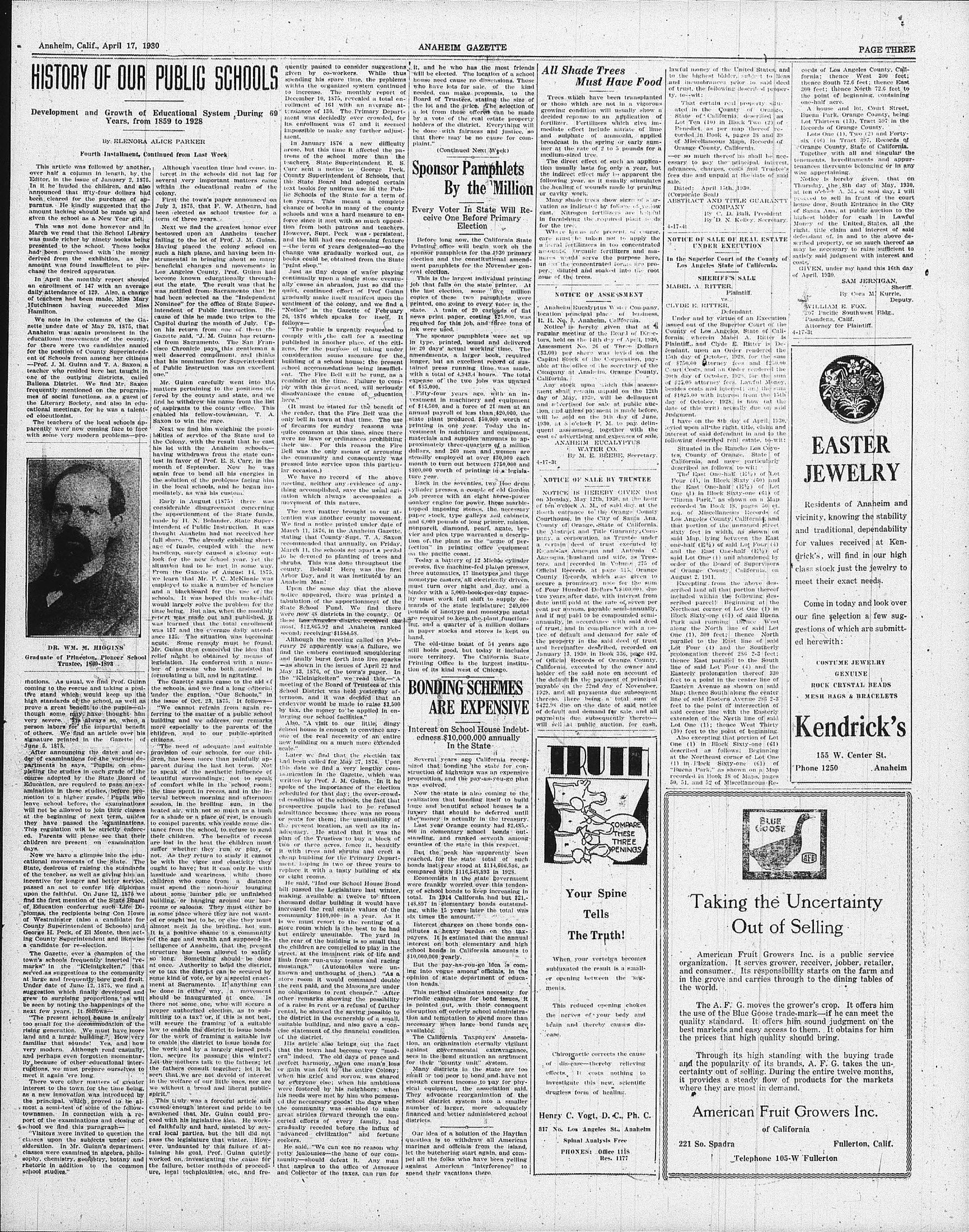
Searchable text
HISTORY OF OUR PUBLIC SCHOOLS
Development and Growth of Educational System During 69 Years, from 1859 to 1928
By ELENORA ALICE PARKER
Fourth Installment, Continued from Last Week
This article was followed by another, over half a column in length, by the Editor, in the issue of January 2, 1875. In it he lauded the children, and also announced that fifty-four dollars had been cleared for the purchase of apparatus. He kindly suggested that the amount lacking should be made up and given the school as a New Year gift.
This was not done however and in March we read that the School Library was made richer by ninety books being presented to the school. These books had been purchased with the money derived from the exhibition, as the amount was found insufficient to purchase the desired apparatus.
In April the monthly report showed an enrollment of 147 with an average daily attendance of 129. Also, a change of teachers had been made, Miss Mary Hutchinson having succeeded Miss Hamilton.
We note in the columns of the Gazette under date of May 20, 1875, that Anaheim was again prominent in the educational movements of the county, for there were two candidates named for the position of County Superintendent of Schools from among her citizens—Prof. J. M. Guinn and T. A. Saxon, a teacher who resided here but taught in one of the outlying districts, called Ballina District. We find Mr. Saxon frequently mentioned on the programmes of social functions, as a guest of the Literary Society, and also in educational meetings, for he was a talented elocutionist.
The teachers of the local schools apparently were now coming face to face with some very modern problems—pro-
Although vacation time had come, interest in the schools did not lag for several very important matters came within the educational realm of the colony.
First the town's paper announced on July 3, 1875, that F. W. Athearn, had been elected as school trustee for a term of three years.
Next we find the greatest honor ever bestowed upon an Anaheim teacher falling to the lot of Prof. J. M. Guinn. Having placed the colony school on such a high plane, and having been instrumental in bringing about so many beneficial changes and movements in Los Angeles County, Prof. Guinn had become known educationally throughout the state. The result was that he was notified from Sacramento that he had been selected as the "Independent Nominee" for the office of State Superintendent of Public Instruction. Because of this he made two trips to the Capitol during the month of July. Upon his return from one of them the Gazette said, "J. M. Guinn has returned from Sacramento. The San Francisco Chronicle pays, this gentleman a well deserved compliment, and thinks that his nomination for Superintendent of Public Instruction was an excellent one."
Mr. Guinn carefully went into the matters pertaining to the positions offered by the county and state, and we find he withdrew his name from the list of aspirants to the county office. This enabled his fellow-townsman, T. A. Saxon to win the race.
Next we find him weighing the possibilities of service of the State and to the Colony, with the result that he cast his lot with the Anaheim schools—having withdrawn from the state consequently paused to consider given by co-workers spending his spare time within the organized system to increase. The month December 10, 1875, revealed enrollment of 161 with an attendance of 130. The President was decidedly over its enrollment was 67 and impossible to make any further action.
In January 1876 a newrose, but this time it affords trons of the school motions teachers. State Superintendent Carr sent a notice to County Superintendent of the State Board had added text books for uniform use. Schools of the State ten years. This meant a change of books in many schools and was a hard force since it met with so much action from both patrons However, Supt. Peck was and the bill had one reed—the term of years designation was gradually made books could be obtained for "paint shop."
Just as tiny drops of water continually upon a single nail cause an abrasion, quiet continued effort on gradually make itself main sentiment of the colony, and "Notice" in the Gazette for 26, 1876 which speaks for follows—
"The public is urgently comply with the call for published in another place zenis, for the purpose of consideration some means building of a school house school accommodations beent. The Fire Bell will be reminder at the time. Fairly with this great need disadvantage the cause here."
(It must be stated for the reader that the Fire Bell only bell in town at that time were no laws or ordinances their use. For this reason Bell was the only means to the community and consi-
DR. WM. M. HIGGINS
Graduate of Princeton, Pioneer School Trustee, 1869-1893
motions. As usual, we find Prof. Guinn coming to the rescue and taking a positive stand which would keep up the high standards of the school, as well as prove a great benefit to the pupils—although some may have thought him very severe. He always so, when a person labors for the impartial benefit of others. We find an article over his signature printed in the Gazette of June 5, 1875.
After announcing the dates and order of examinations for the various departments he says, "Pupils, on completing the studies in each grade of the course adopted by the State Board of Education, are required to pass an examination in these studies, before promotion to a higher grade. Pupils who leave school before, the examinations will not be allowed to join their classes at the beginning of next term, unless they have passed the examinations. This regulation will be strictly enforced. Parents will please see that their children are present on examination days."
Now we have a glimpse into the educational movements of the State. The State, desirous of raising the standards that its nomination for Superintendent of Public Instruction was an excellent one."
Mr. Guinn carefully went into the matters pertaining to the positions offered by the county and state, and we find he withdrawn his name from the list of aspirants to the county office. This enabled his fellow-townsman, T. A. Saxon to win the race.
Next we find him weighing the possibilities of service of the State and to the Colony, with the result that he cast his lot with the Anaheim schools—having withdrawn from the state contest in favor of Prof. E. S. Carr, in the month of September. Now he again free to bend all his energies in the solution of the problems facing him in the local schools, and he began immediately, as was his custom.
Early in August (1875) there was considerable disagreement concerning the apportionment of the State funds, made by H. N. Bolander, State Superintendent of Public Instruction. It was thought Anaheim had not received her full share. The already existing shortage of funds, coupled with the new handicap, surely caused a gloomy outlook for the new school year, yet the situation had to be met in some way. From the Gazette of August 14, 1875, we learn that Mr. P. C. McKinnie was employed to make a number of benches and a blackboard for the use of the schools. It was hoped this make-shift would largely solve the problem for the time being. But alas, when the monthly report was made out and published, it was learned that the total enrollment was 157 and the average daily attendance 135. The situation was becoming acute. Some remedy must be found. Mr. Guinn then conceived the idea that relief might be obtained by means of legislation. He conferred with a number of persons who both assisted in formulating a bill, and in agitating.
The Gazette again came to the aid of the schools, and we find a long editorial under the caption, "Our Schools," in the issue of Oct. 23, 1875. It follows—"We cannot refrain from again referring to the matter of a public school building and we address our remarks more especially to the parents of the children, and to our public-spirited citizens."
"The need of adequate and suitable provision of our schools, for our children, has been more than painfully apparent during the last hot term. Not to speak of the aesthetic influence of beautiful surroundings; not to speak of comfort while in the school room; the time spent in recess, and in the interval between morning and afternoon session, in the broiling sun, in the heated air, with not so much as a bush for a shade or a place of rest, is enough to compel parents, who reside some distance from the school, to refuse to send their children. The benefits of recess are lost in the heat children must suffer whether they run or play, or not. As they return to study it cannot be with the vigor and elasticity they ought to have; but it can only be with buildings of a school house or school accommodations beent. The Fire Bell will be reminder at the time. Fully with this great need, disadvantage the cause here."
(It must be stated for us the reader, that the Fire Bell is only bell in town at that time of firearms for sundry quite common at this time were no laws or ordinance their use. For this reason Bell was the only means to the community and consec pressed into service upon lar occasion.)
Now we have a glimpse into the educational movements of the State. The State, desirous of raising the standards of the teacher, as well as giving him an incentive for longer and better service, passed an act to confer life diplomas upon the faithful. On June 12, 1875 we find the first mention of the State Board of Education conferring such Life Diplomas, the recipients being Con Howe of Westminster (also a candidate for County Superintendent of Schools) and George H. Peck, of El Monte, then acting County Superintendent and likewise a candidate for re-election.
The Gazette, ever a champion of the town's schools frequently inserted "remarks" in the "Kleinigkelten," that served as suggestions to the community at large and frequently bore good fruit. Under date of June 12, 1875, we find a suggestion which finally developed and grew to surprising proportions, as will be seen by noting the happenings of the next few years. It follows—
"The present school house is entirely too small for the accommodation of the rising generation. We must have more land and a larger building." How very familiar that sounds! Yes, and how very modern. Although read casually, and perhaps even forgotten momentarily because of other educational interruptions, we must prepare ourselves to meet it again 're long.
There were other matters of greater interest to the town for the time being, as a new innovation was introduced by the principal, which proved to be almost a semi-test of some of the fellow-townsmen. In connection with a report of the examinations and closing of school we find this paragraph—
"Visitors were invited to question the classes upon the subjects under consideration. In Mr. Guinn's department classes were examined in algebra, philosophy, chemistry, geometry, botany and rhetoric in addition to the common school studies."
This truly was a forceful article and caused enough interest and pride to be awakened that Mr. Guinn could proceed with his legislative idea. He worked faithfully and hard, assisted by several local parties, but the bill did not pass the legislature that winter. However, undaunted by this failure attaining his goal, Prof. Guinn quietly worked on investigating the cause for the failure, better methods of procedure, legal technicalities, etc., and fre-
inspiration in the Gazette written by Prof. J. M. Gulick spoke of the importance of scheduled for that day; the admittance because there was or seats for them; the unmet present location, as we adequately. He stated that plan of the Trustees to buy two or three acres, fence it with trees and shrubs; cheap building for the Principal, hoping in two or three replace it with a tasty bus or eight rooms.
He said, "Had our School bill passed the Legislature making available a twelve thousand dollar building it increased the real estate value community $100,000 in a year we must resort to the store room which is the best but entirely unsuitable." The rear of the building is the children are compelled to street; at the imminent risk limb from run-away teams mustangs." (Automobiles known and unthought of the store room it would commute the rent paid, and the Mass no obligations to rent cash other remarks showing that he raised in rent or a refusal rental, he showed the saving the district in the ownership suitable building, and also close statement of the finance of the district.
His article also brings out that the town had become arn" indeed. The old days perfect harmony, when one or gain was felt by the enmil when his grief and sorrow by everyone else; when he were fostered by his neighbor his needs were met by him he added the necessary goods! The community was enable great strides forward through certed efforts of every gradually receded before the "advanced civilization" as seekers.
He said, "We can see no petty jealousies—the ban munity—should defeat it that aspires to the office and Collector of the taxes,
quently paused to consider suggestions given by co-workers. While thus spending his spare time, the problems within the organized system continued to increase. The monthly report of December 10, 1875, revealed a total enrollment of 161 with an average attendance of 130. The Primary Department was decidedly over crowded, for its enrollment was 67 and it seemed impossible to make any further adjustment.
In January 1876 a new difficulty arose, but this time it affected the patrons of the school more than the teachers. State Superintendent E. S. Curr sent a notice to George Peck, County Superintendent of Schools, that the State Board had adopted certain text books for uniform use in the Public Schools of the State for a term of ten years. This meant a complete change of books in many of the county schools and was a hard measure to enforce since it met with so much opposition from both patrons and teachers. However, Supt. Peck was persistent, and the bill had one redeeming feature—the term of years designated—so the change was gradually worked out, as books could be obtained from the State print shop."
Just as tiny drops of water play continually upon a single stone eventually cause an abrasion, just so did the quiet, continued effort of Prof Guinn gradually make itself manifest upon the sentiment of the colony, and we find a "Notice" in the Gazette of February 16, 1876 which speaks for itself. It follows—
"The public is urgently requested to comply with the call for a meeting published in another place of the citizens, for the purpose of taking under consideration some measure for the building of a school house; the present school accommodations being insufficient. The Fire Bell will be rung, as a reminder at the time. Failure to comply with this great need, will seriously disadvantage the cause of education here."
(It must be stated for the benefit of the reader, that the Fire Bell was the only bell in town at that time. The use of firearms for sundry reasons was quite common at this time, since there were no laws or ordinances prohibiting their use. For this reason the Fire Bell was the only means of arousing the community and consequently was it, and who has the most friends will be elected. The location of a school house need cause no dissensions. Those who have lots for sale, of the kind needed, can make proposals, to the Board of Trustees, stating the size of the lot and the price. The selection of a lot from those offered can be made by a vote of the real estate property holders of the district. Everything will be done with fairness and justice, so that there may be no cause for complaint."
(Continued Next Week)
Sponsor Pamphlets By the Million
Every Voter In State Will Receive One Before Primary Election
Before long now, the California State Printing office will begin work on the sponsor pamphlets for the 1930 primary election and the constitutional amendment pamphlets for the November general election.
This is the largest individual printing job that falls on the state printer. At the last election, some five million copies of these two pamphlets were printed, one going to every voter in the state. A train of 20 carloads of that news print paper, costing $25,000, was required for this job, and three tons of ink were used.
The sponsor pamphlets were set up in type, printed, bound and delivered in 20 days' actual working time. The amendments, a larger book, required longer, but an excellent record of sustained press running time was made, with a total of 4,943.4 hours. The total expense of the two jobs was upward of $85,000.
Fifty-four years ago, with an investment in machinery and equipment of $14,500, and a force of 21 men at an annual payroll of less than $20,000, the state plant produced $50,000 worth of printing in one year. Today the investment in machinery and equipment, materials and supplies amounts to approximately three-quarters of a million dollars, and 260 men and women are steadily employed at over $50,000 each.
All Shade Trees Must Have Food
Trees which have been transplanted or those which are not in a vigorous growing condition will usually show a decided response to an application of fertilizer. Fertilizers which give immediate effect include nitrate of lime and sulphate of ammonia, applied broadcast in the spring or early summer at the rate of 2 to 5 pounds for a medium-sized tree.
The direct effect of such an application usually lasts for only a year, but the indirect effect may be apparent the following year, as it usually stimulates the healing of wounds made by pruning or cavity work.
Many shade trees show signs of starvation as indicated by foliage yellow cast. Nitrogen fertilizers are helpful in furnishing the required plant needs for the tree.
Where lawns are present, course care must be taken not to apply the mineral fertilizers in too concentrated amounts. Organic fertilizers and manures would serve the purpose here, unless the concentrated forms are properly diluted and soaked into the root zone of the trees.
NOTICE OF ASSESSMENT
Anaheim Eucalyptus Water Company, location principal place of business, R. R. No. 3, Anaheim, California.
Notice is hereby given that at regular meeting of the Board of Directors held on the 14th day of April, 1930, Assessment No. 26 of Three Dollars ($3.00) per share was levied on the Capital Stock of the Corporation, payable at the office of the secretary of the Company at Anaheim, Orange County, California.
Any stock upon which this assessment shall remain unpaid on the 12th day of May, 1930, will be delinquent and advertised for sale at public auction, and unless payment is made before will be sold on the 9th day of June, 1930, at 8 o'clock P.M. to pay delinquent assessment together with the cost of advertising and expenses of sale.
ANAHEIM EUCALYPTUS
WATER CO.
By M. E. BEEBE, Secretary
It must be stated for the benefit of the reader, that the Fire Bell was the only bell in town at that time. The use of firearms for sundry reasons was common at this time, since there were no laws or ordinances prohibiting their use. For this reason the Fire Bell was the only means of arousing the community and consequently was pressed into service upon this particular occasion.
We have no record of the above meeting, neither any evidence of anything accomplished, save the usual agitation which always accompanies a movement of this nature.
The next matter brought to our attention was another county movement. We find a notice printed under date of March 11, 1876, in the Anaheim Gazette, stating that County-Supt. T. A. Saxon recommended that annually, on Friday, March 11, the schools set apart a period to be devoted to planting of trees and shrubs. This was done throughout the county. Behold! Here was the first arbor Day, and it was instituted by an Anaheim Man!
Upon the same day that the above notice appeared, there was printed a publication of the apportionment of the State School Fund. We find there were now 48 districts in the county. Of these Los Angeles district received the most, $12,865.92 and Anaheim ranked second; receiving $154.58.
Although the meeting called on February 26 apparently was a failure, we and the embers continued smouldering and finally burst forth into live sparks as shown in the issues of April 22 and May 13, 1876, of the town's paper. In "Kleinigkeiten" we read this: "A meeting of the Board of Trustees of this School District was held yesterday afternoon, and it was decided that an indexor would be made to raise $3,500 per tax, the money to be applied in engrising our school facilities."
Also, "A visit to our little, dingy school house is enough to convince anyone of the real necessity of an entire new building on a much more extended sale."
Later we find that the election tax and been called for May 27, 1876. Upon its date we find a very lengthy communication in the Gazette, which was written by Prof. J. M. Guinn. In it he spoke of the importance of the election scheduled for that day; the over-crowd condition of the schools, the fact that prospective pupils had to be refused immittance because there was no room seats for them; the unsuitability of the present location, as well as its inadequacy. He stated that it was the aim of the Trustees to buy a block of two or three acres, fence it, beautify with trees and shrubs and erect a building for the Primary Department, hoping in two or three years to place it with a tasteful building of six.
Fifty-four years ago, with an investment in machinery and equipment of $14,500, and a force of 21 men at an annual payroll of less than $20,000, the state plant produced $50,000 worth of printing in one year. Today the investment in machinery and equipment, materials and supplies amounts to approximately three-quarters of a million dollars, and 260 men and women are steadily employed at over $30,000 each month to turn out between $750,000 and $800,000 worth of printing in a legislature year.
Back in the seventies, two Hoe drum cylinder presses, a couple of old Gordon job presses with an eight horse-power donkey engine for power, three marble-topped imposing stones, the necessary paper stock, type galleys and cabinets, and 6,000 pounds of long primer, minion, nonpareil, diamond, pearl, agate, brever and pica type warranted a description of the plant as the "acme of perfection" in printing office equipment on the pacific coast.
Today a battery of 12 Miehle cylinder presses, five machine-fed platon presses, three automatics, 17 linotypes and three monotype casters, all electrically driven, must turn over night and day, and a binder with a 5,000-book-per-day capacity must work full shift to supply demands of the state legislature; 240,000 pounds of linetype and monotype metal are required to keep the plant functioning, and a quarter of a million dollars in paper stocks and stores is kept on hand.
The old-time boast of 54 years ago still holds good, but today it includes more territory. The California State Printing Office is the largest institution of its kind west of Chicago.
BONDING SCHEMES ARE EXPENSIVE
Interest on School House Indebtedness $10,000,000 annually In the State
Several years ago California recognized that bonding the state for construction of highways was an expensive proposition, and the pay-as-you-go plan was evolved.
Now the state is also coming to the realization that bonding itself to build huge and beautiful school houses is a luxury that should be deferred until the money is actually in the treasury.
Last year Orange county had $2,485,000 in elementary school bonds outstanding, and ranked seventh among counties of the state in this respect.
But the peak has apparently been reached, for the state total of such bonds last year stood at $114,606,586 as able at the office of the secretary of the Company at Anaheim, Orange County, California.
Any stock upon which this assessment shall remain unpaid on the 12th day of May 1930 will be delinquent and advertised for sale at public auction, and unless payment is made before will be sold on the 9th day of June 1930 at 8 o'clock P.M. to pay delinquent assessment together with the cost of advertising and expenses of sale.
ANAHEIM EUCALYPTUS WATER CO.
By M. E. BEEBSE Secretary.
4-17-3t
NOTICE OF SALE BY TRUSTEE
NOTICE IS HEREBY GIVEN that on Monday, May 12th, 1930, at the hour ten o'clock A.M., of said day, at the South entrance to the Orange County Courthouse. In the City of Santa Ana, County of Orange,-State of California, The Abstract and Title Guaranty Company, a corporation, as Trustee under a certain deed of trust executed by Ecanisias Amesqua and Antonia C. Amesqun husband and wife, as Trustors,and recorded in Volume 275 of Official Records.at page 315.Orange County Recordswhich was given to secure a promissory note for the sum of Four Hundred Dollars ($400.00),due two years after datewith interest from date until paid at the rate of seven per cent per annum,payable semi-annually,and if not paid to be compounded semi-annually.in accordance with said deedof trust,and in compliance with a noticeof defaultand demandfor saleofthe propertyinthesaiddeedoftrustandhereafterdescribed.recordedonJanuary13.1930.inBook336.page492.ofOfficialRecordsofOrangeCountyCalifornia.executedbytheownerandholderofthesaidnoteonaccountofthedefaultinthepaymentprincipalpayableonthe22nddayofNovember1929,andallpaymentsducedsubsequentthereoTHERebeingatotalsumof$422.98dueonthedateofsaidnoticeofdefaultanddemandforsale,andallpaymentsducedsubsequentlythereto-willsellatpublicauction.forcash.
Communication in the Gazette, which was written by Prof. J. M. Guinn. In it he spoke of the importance of the election scheduled for that day; the over-crowded condition of the schools, the fact that prospective pupils had to be refusedmittance because there was no roomseats for them; the unsuitability ofthe present location, as well as its inadequacy. He stated that it was theman of the Trustees to buy a blockof two or three acres, fence it, beautifywith trees and shrubs and erecta steep building for the Primary Department,hoping in two or three years toplace it with a tasty building of sixeight rooms.
He said, "Had our School House Bondwill passed the Legislature last winter,making available a twelve to fifteen thousand dollar building it would haveincreased the real estate values of thecommunity $100,000 in a year. As itwould resort to the renting of amore room which is the best to be hadbut entirely unsuitable. The yard inthe rear of the building is so small thatthe children are compelled to play in the street, at the imminent risk of life andamb from run-away teams and racingmustangs." (Automobiles wereunknown and unthought of then.) "As amore room it would command doublethe rent paid, and the Masons are underthe obligations to rent cheaper." Afterher remarks showing the possibilityof a raise in rent or a refusal of furthermental, he showed the saving possible tothe district in the ownership of a small,attractive building, and also gave a consolete statement of the financial conditionofthe district.
His article also brings out thefact that the town had become very "modernd" indeed. The old days of peaceand perfect harmony, when one man's lossgain was felt by the entire Colony;when his grief and sorrow, was sharedby everyone else; when his ambitionswere fostered by his neighbors; whenits needs were met by him who possessedthe necessary goods! the days whenthe community was enabled to makepeat strides forward through the concerted efforts of every family,had gradually receded before the influx ofadvanced civilization" and fortune seekers.
He said, "We can see no reason whytty feoulouses—the bane of our community—should defeat it. Any manint aspires to the office of Assessorand Collector of the taxes, can run for
Now the state is also coming to buildrealization that bonding itself to buildhuge and beautiful school houses is a luxury that should be deferred untilthe money is actually in the treasury.
Last year Orange county had $2,485,-000 in elementary school bonds outstanding, and ranked seventh amongcounties of the state in this respect.
But the peak has apparently beenreached, for the state total of suchbonds last year stood at $114,606,586, ascompared with $116,548,893 in 1928.
Economists in the state governmentwere frankly worried over this tendencyof school bonds to keep increasing intotal. In 1914 California had but $21,-148,897 in elementary bonds outstanding, while 15 years later the total wassix times the amount.
Interest charges on these bondsconstitutes a heavy burden on the taxpayers. It is estimated that the annualinterest on both elementary and highschool bonds in California amounts to$10,000,000 yearly.
But the pay-as-you-go idea iscoming into vogue among officials, in theopinion of state department of educationheads.
This method eliminates necessity forperiodic campaigns for bond issues, itis pointed out, with their consequentdisruption off orderly school administrationand temptation to spend more thannecessary when large bond funds areavailable.
The California Taxpayers' Association, an organization eternally vigilantagainst governmental extravagance, sees in the bond situation an argumentfor their "county unit" system.
Many districts in the state are toosmall or too poor to bond and have notenough current income to pay for physical equipment, the association said. They advocate reorganization ofthe school district system into a smallernumber of larger, more adequatelyfinanced and better administered schooldistricts.
Our idea of a solution of the Haytianquestion is to withdraw all Americanmarines and officials from the island,let the butchering start again,and compel all the folks who have been yellingagainst American "interference"to spend their vacations there.
PAGE THREE
trees Have Food
been transplanted not in a vigorous
well usually show a
application of
which give imnate nitrate of lime
mmonia, applied
ing or early sumto 5 pounds for a
such an application only a year, but
may be apparent the
usually stimulates
made by pruning
now signs of starfoliage of yellow
zizers are helpful
suired plant foods
present, of course,
not to apply the
too concentrated
fertilizers and mane purpose here,
and forms are proced into the root
ASSESSMENT
Water Company,
of business,
California.
Given that at
the Court of Discvey of April, 1930,
of Three Dollars
levied on the
Corporation, paysecretary of the
Orange County,
which this assesspaid on the 12th
will be delinquent
at public aucut is made before,
th day of June,
M. to pay delingether with the
expenses of sale.
CALYPTUS
CO.
EBE, Secretary.
NOTICE OF SALE OF REAL ESTATE UNDER EXECUTION
In the Superior Court of the County of Los Angeles State of California.
SHERIFF'S SALE
MABEL A. RITTER,
Plaintiff.
vs.
CLYDE E. RITTER,
Defendant.
Under and by virtue of an Execution issued out of the Superior Court of the County of Los Angeles State of California, wherein Mabel A. Ritter is Plaintiff, and Clyde E. Ritter is Defendant, upon an Order rendered the 15th day of October, 1928, for the sum of $750,000 attorney fees and $250,000 Court Costs, and an Order rendered the 30th day of October, 1928, for the sum of $25,000 attorney fees. Lawful Money, besides costs and interest; and the sum of $1025,000 with interest from the 15th day of October, 1928, is now (at the date of this writ) actually due on said Judgment.
I have on the 8th day of April, 1930, levied upon all the right, title, claim and interest of said defendant in and to the following described real estate, to-wit:
Situated in the Rancho Los Coyotes, County of Orange, State of
cords of Los Angeles County, California; thence West 300 feet;
thence South 72.6 feet; thence East 300 feet; thence North 72.6 feet to
the point of beginning, containing one-half acre.
A house and lot, Court Street,
Buena Park, Orange County, being Lot Thirteen (13), Tract 397 in the Records of Orange County.
Lots One (1), Two (2) and Forty-six (46) in Tract 397, Records of Orange County.
Together with all and singular the tenements, hereditaments and appurtenances thereunto belonging or in any wise appertaining.
Notice is hereby given that on Thursday, the 8th day of May, 1930,
at ten o'clock A.M., of said day, I will proceed to sell in front of the court house door. South Entrance in the City of Santa Ana, at public auction to the highest bidder for cash in Lawful Money of the United States, all the right, title claim and interest of said defendant in, and to the above described property, or so much thereof as may be necessary to raise sufficient to satisfy said judgment with interest and costs.
GIVEN, under my hand this 16th day of April, 1930.
SAM JERNIGAN,
Sheriff.
By Cora M. Kurrle,
Deputy.
WILLIAM E. FOX,
207 Pacific Southwest Bldg..
Pasadena, Calif.
Attorney for Plaintiff.
4-17-31
EASTER JEWELRY
Residents of Anaheim and vicinity, knowing the stability and traditional dependability for values received at Kendrick's, will find in our high class stock just the jewelry to meet their exact needs.
Come in today and look over our fine selection a few suggestions of which are submitted herewith:
COSTUME JEWELRY
GENUINE
ROCK CRYSTAL BEADS
MESH BAGS & BRACELETS
Kendrick’s
155 W. Center St.
Phone 1250 Anaheim
Taking the Uncertainty Out of Selling
American Fruit Growers Inc. is a public service organization. It serves grower, receiver, jobber, retailer, and consumer. Its responsibility starts on the farm and in the grove and carries through to the dining tables of the world.
The A. F. G. moves the grower's crop. It offers him the use of the Blue Goose trade-mark—if he can meet the quality standard. It offers him sound judgment on the best markets and easy access to them. It obtains for him the prices that high quality should bring.
Through its high standing with the buying trade and the popularity of its brands, A. F. G. takes the uncertainty out of selling. During the entire twelve months, it provides a steady flow of products for the markets where they are most in demand.
American Fruit Growers Inc.
of California
221 So. Spadra
Fullerton, Calif.
Telephone 105-W Fullerton