anaheim-gazette 1930-04-03
Scanned page
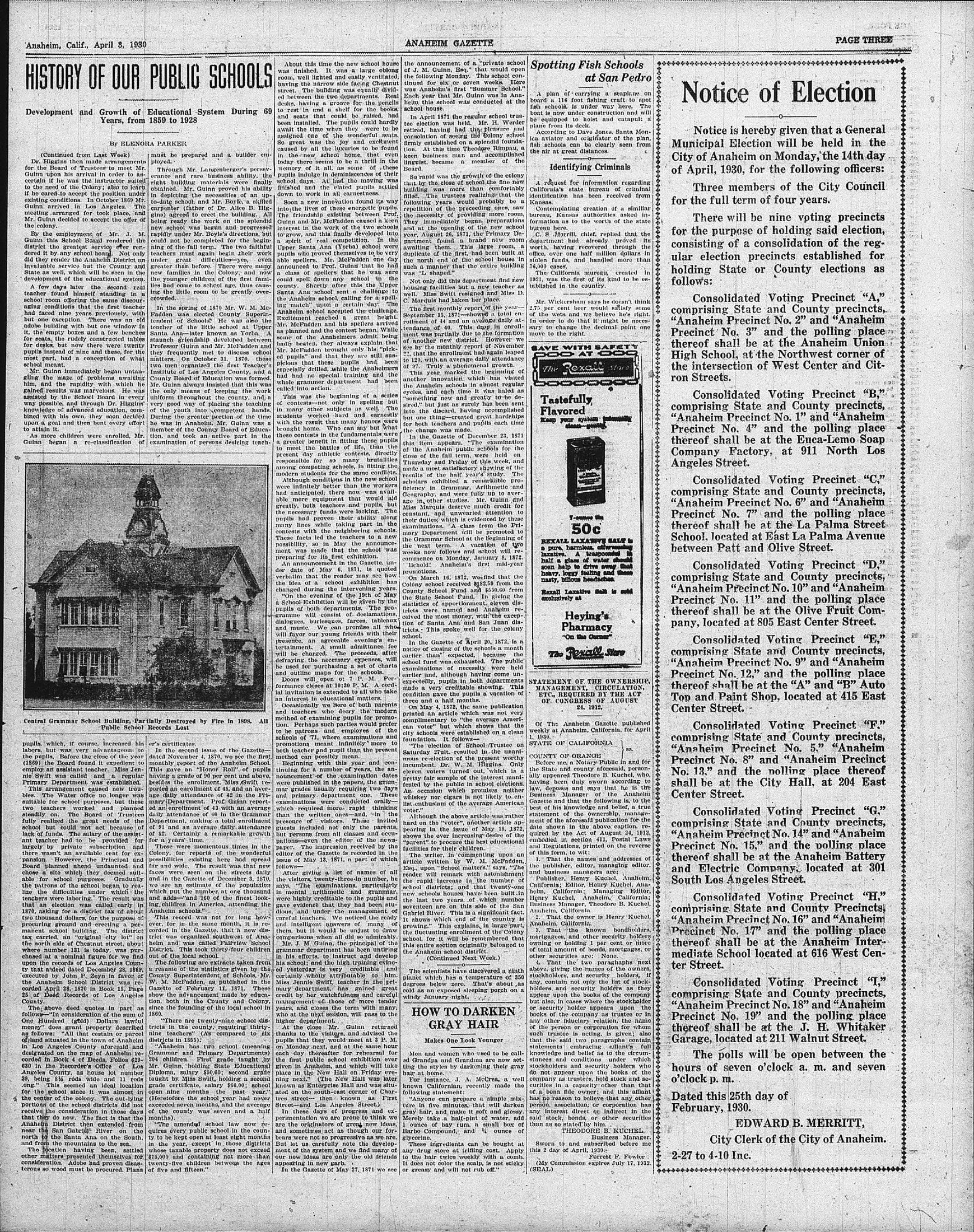
Searchable text
HISTORY OF OUR PUBLIC SCHOOLS
Development and Growth of Educational System During 69 Years, from 1859 to 1928
By ELENORA PARKER
(Continued from Last Week)
Dr. Higgins then made arrangements for the Board of Trustees to meet Mr. Guinn upon his arrival in order to ascertain if he was the instructor suited to the need of the Colony; also to learn if he cared to accept the position under existing conditions. In October 1869 Mr. Guinn arrived in Los Angeles. The meeting arranged for took place, and Mr. Guinn decided to accept the offer of the colony.
By the employment of Mr. J. M. Guinn this School Board rendered the district the greatest service offered it by any school board. Not only did they render the Anaheim District an invaluable service but the County and State as well, which will be seen in the development of the educational system.
A few days later the second real teacher found himself standing in a school room offering the same discouraging conditions that the first teacher had faced nine years previously, with but one exception. There was an old adobe building with but one window in it, the empty boxes and a few benches for seats, the rudely constructed tables for desks, but now there were twenty pupils instead of nine and these, for the most part, had a conception of what school meant.
Mr. Guinn immediately began untangling the maze of problems awaiting him, and the rapidity with which he gained results was marvelous. He was assisted by the School Board in every way possible, and through Dr. Higgins' knowledge of advanced education, combined with his own, they soon decided upon a goal and then bent every effort to attain it.
As more children were enrolled, Mr. Guinn began a re-classification of must be prepared and a builder employed.
Through Mr. Langemberger's perseverance and rare business ability, the right building materials were finally obtained. Mr. Guinn proved his ability in depicting the necessities of an up-to-date school, and Mr. Boyle, a skilled carpenter (father of Dr. Alice B. Higgins) agreed to erect the building. All being ready the work on the splendid new school was begun and progressed rapidly under Mr. Boyle's directions, but could not be completed for the beginning of the fall term. The two faithful teachers must again begin their work under great difficulties—yes, even greater than before. There were many new families in the Colony, and now the younger children of the first families had come to school age, thus causing the little room to be greatly overcrowded.
In the spring of 1870 Mr. W. M. McFadden was elected County Superintendent of Schools. He was also the teacher of the little school at Upper Santa Ana—later known as Yorba. A staunch friendship developed between Professor Guinn and Mr. McFadden and they frequently met to discuss school matters. On October 31, 1870, these two men organized the first Teacher's Institute of Los Angeles County, and a County Board of Education was formed. Mr. Guinn always insisted that this was the only means of keeping the work uniform throughout the county, and a very good way of placing the teaching of the youth into competent hands. During the greater portion of the time he was in Anaheim, Mr. Guinn was a member of the County Board of Education, and took an active part in the examination of persons desiring teach-
About this time the new school was finished. It was a large room, well lighted and easily having the narrow side facing street. The building was equated between the two departments desks, having a groove for rest in and a shelf for and seats that could be been installed. The pupils awaited the time when they assigned one of the wonders. So great was the joy and caused by all the luxuries that in the new school home, today there seems to be a memory of it all, as some pupils indulge in demisexcitement school days. At last she finished and the clated pupil down to work in all earnestness.
Soon a new innovation for into the lives of these energies The friendship existing between Guinn and Mr. McFadden can interest in the work of them to grow, and this finally devise a spirit of real competition Upper Santa Ana (Yorba) a pupils who proved themselves able spellers. Mr. McFadden announced to Prof. Gulnir that a class of spellers that he could spell down any school county. Shortly after this Santa Ana school sent a call to Anaheim school, calling "match" upon a certain Anaheim school accepted the Excitement reached a great Mr. McFadden and his spell as planned and the contest be some of the Anaheimmers as badly beaten, they always enjoyed Mr. McFadden brought only ed pupils" and that they are plecious that these pupils especially drilled, while they had had no special training whole grammar department called into action.
This was the beginning of contests—not only in schools in many other subjects as students worked hard and with the result that many had brought home. Who can say these contests in the funda greater benefit in fitting to meet the battles of life present day athletic contests?
Mr. Guinn immediately began untangling the maze of problems awaiting him, and the rapidity with which he gained results was marvelous. He was assisted by the School Board in every way possible, and through Dr. Higgins' knowledge of advanced education, combined with his own, they soon decided upon a goal and then bent every effort to attain it.
As more children were enrolled, Mr. Guinn began a re-classification of two men organized the first Teacher's Institute of Los Angeles County, and a County Board of Education was formed. Mr. Guinn always insisted that this was the only means of keeping the work uniform throughout the county, and a very good way of placing the teaching of the youth into competent hands. During the greater portion of the time he was in Anaheim, Mr. Guinn was a member of the County Board of Education, and took an active part in the examination of persons desiring teachers.
Central Grammar School Building, Partially Destroyed by Fire in 1898. All Public School Records Lost
pupils, which, if course, increased his labors, but was very advantageous to the pupils. Before the close of the year (1869) the Board found it expedient to employ an assistant teacher. Miss Jennie Swift was called and a regular Primary Department was established.
This arrangement caused new troubles. The Water office no longer was suitable for school purposes, but these two teachers worked and planned steadily on. The Board of Trustees fully realized the great needs of the school but could not act because of lack of funds. The salary of the assistant teacher had to be provided for largely by private subscription and there wasn't an available cent for expansion. However, the Principal and Board planned ahead undaunted and erer's certificates.
In the second issue of the Gazette—dated November 4, 1870, we see the first monthly report of the Anaheim School. This gave an "Honor Roll" of pupils having a grade of 90 per cent and above, besides the enrollment. Miss Swift reported an enrollment of 48, and an average daily attendance of 42 in the Primary Department. Prof. Guinn reported an enrollment of 43 with an average daily attendance of 40 in the Grammar Department, making a total enrollment of 91 and an average daily attendance of 82. Certainly a remarkable growth for a years' time.
These were momentous times in the Colony, for reports of the wonderful possibilities existing here had spread far and wide. The result was that new pleiosis that these pupils especially drilled, while the one had had no special training whole grammar department called into action.
This was the beginning of contests—not only in schools other subjects as students worked hard and with the result that many had brought home. Who can save these contests in the fundam, a greater benefit in fitting them to meet the battles of life present day athletic contest responsible for so many among competing schools, in modern students for the same.
Although conditions in the were infinitely better than they had anticipated, there now able more equipment that greatly, both teachers and the necessary funds were lack pupils had proven their ability many lines while taking contests with the neighborhood. These facts led the teachers possibility, so in May the ment was made that she preparing for its first exhibit.
An announcement in the Guardian date of May 6, 1871, verbatim that the reader must the idea of a school exhibited during the interview.
"On the evening of the 19th a School Exhibition will be given pupils of both departments. Grame will consist of de- dialogues, burlesques, farces and music. We can promise will favor our young friends presence, an agreeable event tertainment. A small admiral will be charged. The process defraying the necessary expo be used for purchasing a set and outline maps for the se.
Doors will open at 7 P.m. performance closes at 10:30 P.M. invitation is extended to all an interest in educational matters.
Occasionally we here of boys and teachers who decry the method of examining pupils'训. Perhaps such parties would be to patrons and employees schools of 71, where examin promotions meant infinitely both teacher and pupil than method can possibly mean.
Beginning with this year timing for a number of years' nouncement of the examinations were published in the papers mar grades usually requiring and primary department or examinations were conducted which required more rapid than the written ones—and presence of visitors. The guests included not only those but persons from all classes pations—even the editor of paper. The impression received editor of the Gazette is reco issue of May 13, 1871, a par follows—
The Water office no longer was suitable for school purposes, but these two teachers worked and planned steadily on. The Board of Trustees fully realized the great needs of the school but could not act because of lack of funds. The salary of the assistant teacher had to be provided for largely by private subscription and there wasn't an available cent for expansion. However, the Principal and Board planned ahead undaunted and chose a site which they deemed suitable for school purposes. Gradually the patrons of the school began to realize the difficulties under which the teachers were laboring. The result was that an election was called early in 1870, asking for a district tax of about two thousand dollars, for the purpose of procuring ground and erecting a permanent school building. The district tax carried, an "original city lot" on the north side of Chestnut street, about where number 131 is today, was purchased at a nominal figure for we find upon the records of Los Angeles County that a deed dated December 28, 1869, executed by John P. Zeyn in favor of the Anaheim School District was recorded April 28, 1870 in Book 15, Page 25 of Deed Records of Los Angeles County.
The above deed quotes in part as follows—"In consideration of the sum of One Hundred (gold) Dollars lawful money" does grant property described as follows: "All that certain or parcel of land situated in the town of Anaheim in Los Angeles County aforesaid and designated on the map of Anaheim recorded in Book 4 of Deeds, Follos 629-630 in the Recorder's Office of Los Angeles County, as house lot number 39, being 8½ rods wide and 11 rods long." This seemed an ideal location for the school since it was almost in the center of the colony. The outlying portions of the school districts did not receive the consideration in those days that they do now. The fact is that the Anaheim District then extended from near the San Gabriel River on the north to the Santa Ana on the South, and from the mountains to the sea.
The location having been settled other matters presented themselves for consideration. Adobe had proven disastrous so wood must be procured. Plans having a grade of 90 per cent and above, besides the enrollment, Miss Swift reported an enrollment of 48, and an average daily attendance of 42 in the Primary Department. Prof. Guinn reported an enrollment of 43 with an average daily attendance of 40 in the Grammar Department, making a total enrollment of 91 and an average daily attendance of 82. Certainly a remarkable growth for a years' time.
These were momentous times in the Colony, for reports of the wonderful possibilities existing here had spread far and wide. The result was that new faces were seen on the streets daily and in the Gazette of December 3, 1870, we see an estimate of the population which put the number at one thousand and adds—and 160 of the finest looking children in America, attending the Anaheim schools."
This record was not for long however, for in the same month, it is recorded in the Gazette, that a new district was organized southwest of Anaheim and was called Fullview School District. This took thirty-four children out of the local school.
The following are extracts taken from a resume of the statistics given by the County Superintendent of Schools, Mr. W. M. McFadden, as published in the Gazette of February 11, 1871. These show the advancement made by education, both in the County and Colony, since the founding of the local school in 1860.
"There are twenty-nine school districts in the county, requiring thirty-nine teachers" (As compared to six districts in 1855):
"Anaheim has two school (meaning Grammar and Primary Departments) 204 children. First grade taught by Mr. Guinn, holding State Educational Diploma, salary $90.00; second grade taught by Miss Swift, holding a second grade certificate, salary $60.00; school open nine months the past year." (Heretofore the school year had never exceeded seven months, and the average of the county was seven and a half months).
"The amended school law now requires every public school in the county to be kept open at least eight months in the year, except in those districts whose taxable property does not exceed $75,000 and containing not more than twenty-five children between the ages of five and fifteen."
At the close Mr. Guinn thanks to the visitors, and his pupils that they would meet on Monday next, and at that each day thereafter for reel the first public school exhibit given in Anaheim, and while place in the New Hall on Friday next." (The New Hall known as Enterprise Hall and on the south-east corner tres street—then known Street—and Los Angeles St.
In these days of progress perimentation we are prone to are the originators of great and sometimes act as though bears were not so progressive. But let us carefully note that ment of the system and we find our new ideas are only the appearing in new garb.
In the Gazette of May 27,
About this time the new school house was finished. It was a large oblong room, well lighted and easily ventilated, giving the narrow side facing Chestnut Street. The building was equally divided between the two departments. Real skins, having a groove for the pencils rest in and a shelf for the books, and seats that could be raised, had been installed. The pupils could hardly wait the time when they were to be assigned one of the wonderful seats. Great was the joy and excitement used by all the luxuries to be found in the new school home, that even day there seems to be a thrill in the memory of it all, as some of these pupils indulge in deminiscences of their school days. At last the moving was finished and the clated pupils settled down to work in all carnestness.
Soon a new innovation found its way into the lives of these energetic pupils, the friendship existing between Prof. Finn and Mr. McFadden caused a keen interest in the work of the two schools grow, and this finally developed into spirit of real competition. In the upper Santa Ana (Yorba) school were pupils who proved themselves to be very spellers. Mr. McFadden one day announced to Prof. Gulniar that he had class of spellers that he was sure would spell down any school in the county. Shortly after this the Upper Santa Ana school sent a challenge to Anaheim school, calling for a spell-match" upon a certain day. The Anaheim school accepted the challenge, settlement reached a great height, Mr. McFadden and his spellers arrived planned and the contest began. While one of the Anaheimers admit being fully beaten, they always explain that Mr. McFadden brought only his "pick-pupils" and that they are still suspicious that these pupils had been specially drilled, while the Anaheimers had no special training and the pole grammar department had been led into action.
This was the beginning of a series contests—not only in spelling but many other subjects as well. The students worked hard and earnest in the result that many honors were caught home. Who can say but what are contests in the fundamentals were greater benefit in fitting these pupils meet the battles of life, than the sent day athletic contests, directly against them?
the announcement of a "private school of J. M. Guinn, Esq." that would open the following Monday. This school continued for six or seven weeks. Here was Anahelm's first "Summer School." Each year that Mr. Guinn was in Anahelm this school was conducted at the school house.
In April 1871 the regular school trustee election was held. Mr. H. Werder retired, having had the pleasure and consolation of seeing the Colony school firmly established on a splendid foundation. At this time Theodore Rimpau, a keen business man and accomplished linguist, became a member of the Board.
So rapid was the growth of the colony that by the close of school the fine new building was more than comfortably filled. The trustees realizing that the following years would probably be a repetition of the preceding ones, saw the necessity of providing more room. They immediately began preparations and at the opening of the new school year, August 26, 1871, the Primary Department found a brand new room awaiting them. This large room, a duplicate of the first, had been built at the north end of the school house in such a manner that the entire building was "L shaped."
Not only did this department find new housing facilities but a new teacher as well. Miss Swift resigned and Miss D. C. Marquis had taken her place.
The first monthly report of the year—September 15, 1871—showed a total enrollment of 44 and an average daily attendance of 40. This drop in enrollment was partially due to the formation of another new district. However we see by the monthly report of November 22, that the enrollment had again leaped to 120, with an average daily attendance of 97. Truly a phenomenal growth.
This year marked the beginning of another innovation which has visited the Anaheim schools in almost regular cycles, and each time it was halved as "something new and greatly to be desired," but just as surely has been sent into the discard, having accomplished but one thing—created great hardships for both teachers and pupils each time the change was made.
In the Gazette of December 23, 1871 this item appears, "The examination of the Anaheim public schools for the close of the fall term, were held on..."
Spotting Fish Schools at San Pedro
A plan of carrying a seaplane on board a 116 foot fishing craft to spot fish schools, is under way here. The boat is now under construction and will be equipped to hoist and catapult a plane from its deck.
According to Dave Jones, Santa Monica aviator and originator of the plan, fish schools can be clearly seen from the air at great distances.
Identifying Criminals
A request for information regarding California's state bureau of criminal identification has been received from Kansas.
Contemplating creation of a similar bureau, Kansas authorities asked information as to the worth of the state bureau here.
C. S. Morrill, chief, replied that the department had already proved its worth, having recovered through the office, over one half million dollars in stolen funds, and handled more than 76,000 cases.
The California mureau, created in 1921, was the first of its kind to be established in the country.
Mr. Wickersham says he doesn't think 275 per cent beer would satisfy some of the wets and we believe he's right. In order to do that it might be necessary to change the decimal point one move to the right.
Save With Safety
The Rexall Store
This was the beginning of a series of contests—not only in spelling but many other subjects as well. The students worked hard and earnestly with the result that many honors were brought home. Who can say but what these contests in the fundamentals were greater benefit in fitting these pupils meet the battles of life, than the present day athletic contests, directly responsible for so many brutalities long competing schools, in fitting the modern students for the same conflicts. Although conditions in the new school are infinitely better than the workers anticipated, there now was available more equipment that would aid both teachers and pupils, but necessary funds were lacking. Theills had proven their ability along any lines while taking part in the tests with the neighboring schools. These facts led the teachers to a new possibility, so in May the announcement was made that the school was preparing for its first exhibition.
An announcement in the Gazette, undated of May 6, 1871, is quoted below that the reader may see how idea of a school exhibition has engaged during the intervening years. On the evening of the 10th of May School Exhibition will be given by the staff of both departments. The programme will consist of declarations,ogues, burlesques, farces, tableaux and music. We can promise all who favor our young friends with their essence, an agreeable evening's enamment. A small admittance fee be charged. The proceeds, after praying the necessary expenses, will used for purchasing a set of charts on outline maps for the schools. Doors will open at 7 P.M. Performance closes at 10:30 P.M. A cord-invitation is extended to all who take interest in educational matters. Occasionally we here of both parents teachers who decry the modern method of examining pupils for promotion. Perhaps such parties would prefer patrons and employees of the schools of '71, where examinations and motions meant infinitely more to both teacher and pupil than the present school can possibly mean.
Beginning with this year and continuing for a number of years, the announcement of the examination dates published in the papers, the grammar grades usually requiring two days of primary department one. These examinations were conducted orally—which required more rapid thinking on the written ones—and, in the presence of visitors. These invited posts included not only the parents, persons from all classes and occupations—even the editor of the newsletter. The impression received by the editor of the Gazette is recorded in the issue of May 13, 1871, a part of which follows—
This year marked the beginning of another innovation, which has visited the Anaheim schools in almost regular cycles, and each time it was halled as "something new and greatly to be desired," but just as surely has been sent into the discard, having accomplished but one thing—created great hardships for both teachers and pupils each time the change was made.
In the Gazette of December 23, 1871 this item appears. "The examination of the Anaheim public schools for the close of the fall term, were held on Thursday and Friday of this week, and made a most satisfactory showing of the results of the half-year's study. The scholars exhibited a remarkable proficiency in Grammar, Arithmetic and Geography, and were fully up to average in other studies. Mr. Guinn and Miss Marquis deserve much credit for constant, and unwearied attention to their duties, which is evidenced by these examinations." A class from the Primary Department will be promoted to the Grammar School at the beginning of the next term. A vacation of two weeks now follows and school will recommence on Monday, January 8, 1872.
Behold! Anaheim's first mid-year promotions.
On March 16, 1872, we find that the Colony school received $82.59 from the County School Fund and $550.60 from the State School Fund. In giving the statistics of apportionment, eleven districts were named and Anaheim received the most money, with the exception of Santa Ana and San Juan districts. This spoke well for the colony school.
In the Gazette of April 20, 1872, is a notice of closing of the schools a month earlier than expected, because the school fund was exhausted. The public examinations of necessity were held earlier and, although having come unexpectedly, pupils in both departments made a very creditable showing. This condition gave the pupils a vacation of three and a half months.
On May 4, 1872, the same publication printed an article which was not very complimentary to "the average American voter" but which shows that the city schools were established on a clean foundation. It follows—
"The election of School Trustee on Saturday 27ult resulted in the unanimous re-election of the present worthy incumbent, Dr. W. M. Higgins. Only eleven voters turned out, which is a pretty fair sample of the interest manifested by the public in school elections. An occasion which promises neither whiskey nor cigars is not likely to entail enthusiasm of the average American voter."
Although the above article was rather hard on the "voter", another article appearing in the issue of May 18, 1872, shows the ever increasing desire of the "parent" to procure the best educational facilities for their children.
The writer, in commenting upon an article written by W. M. McPadden, Esq., upon "School matters," says, "The
STATEMENT OF THE OWNERSHIP MANAGEMENT, CIRCULATION, ETC., REQUIRED BY THE ACT OF CONGRESS OF AUGUST 24, 1912.
Of The Anaheim Gazette published weekly at Anaheim, California, for April 1, 1930.
STATE OF CALIFORNIA
COUNTY OF ORANGE
Before me, a Notary Public in and for the State and county aforesaid, personally appeared Theodore B. Kuchel, who having been duly sworn according to law, deposes and says that he is the Business Manager of the Anaheim Gazette and that the following is, to the best of his knowledge and belief, a true statement of the ownership management of the aforesaid publication for the date shown in the above caption, required by the Act of August 24, 1912, embodied in section 411, Postal Laws and Regulations, printed on the reverse of this form; to wit:
1. That the names and addresses of the publisher, editor, managing editor,
2.
enforcement of the examination dates were published in the papers, the grammar grades usually requiring two days primary department one. These examinations were conducted orally—which required more rapid thinking on the written ones—and, in the presence of visitors. These invited tests included not only the parents, persons from all classes and occupations—even the editor of the newsletter. The impression received by the editor of the Gazette is recorded in the issue of May 13, 1871, a part of which shows after giving a list of names of all visitors, twenty-three-in number, he says, "The examinations, particularlyimental arithmetic and grammar, are highly creditable to the pupils and evidence that they had been students, and under the management of useful teachers. We noticed the ready intelligent answers of many of them, but it would be unjust to draw comparisons when all did so admirably. Mr. J. M. Guinn, the principal of theummar department has been untiring his efforts, to instruct and develop school; and the high training evinereyesterday is very creditable and mainly wholly attributable to him." Jennie Swift, teacher in the primary department, has gained great credit by her watchfulness and careful management of those of more tender persons, and closes the term with many, so at the next session, will pass to the other department.
At the close Mr. Guinn returnedanks to the visitors, and advised the calls that they would meet at 3 P. M. Monday next, and at the same hour this day thereafter for rehearsal for first public school exhibition ever seen in Anaheim, and which will take place in the New Hall on Friday evening.next." (The New Hall was later known as Enterprise Hall and was situated on the south-east corner of Charleston street—then known as First Street—and Los Angeles Street.) On these days of progress and experimentation we are prone to think we are originators of great new ideas, sometimes act as though our followers were not so progressive as we are. Let us carefully note the development of the system and we find many of our new ideas are only the old friends bearing in new garb.
In the Gazette of May 27, 1871 we see pretty fair sample of the interest manifested by the public in school elections. An occasion which promises neither whiskey nor cigars is not likely to enlist enthusiasm of the average American voter."
Although the above article was rather hard on the "voter," another article appearing in the issue of May 18, 1872, shows the ever increasing desire of the "parent" to procure the best educational facilities for their children.
The writer, in commenting upon an article written by W. M. McPadden, Esq., upon "School matters," says, "The reader will remark with astonishment the rapid increase in the number of school districts; and that twenty-one new schools houses have been built in the last two years, of which number seventeen are on this side of the San Gabriel River. This is a significant fact. It shows which end of the country is growing." This explains, in large part, the fluctuating enrollment of the Colony school, for it will be remembered that this entire section originally belonged to Anaheim school district.
(Continued Next Week.)
The scientists have discovered a ninth planet which has a temperature of 350 degrees below zero. That's about as cold as an exposed sleeping porch on a windy January night.
HOW TO DARKEN GRAY HAIR
Makes One Look Younger
Men and women who used to be called Grandpa and Grandma are now setting the styles by darkening their gray hair at home.
For instance, J. A. McCrea, a well-known Californiaan, recently made the following statement:
"Anyone can prepare a simple mixture in five minutes, that will darken gray hair, and make it soft and glossy. Merely take a half-pint of water, add 1 ounce of bay rum, a small box of Barbo Compound, and ¼ ounce of glycerine.
These ingredients can be bought at any drug store at trifling cost. Apply to the hair twice weekly with a comb. It does not color the scalp, is not sticky or greasy and will not rub off."
Theodore B. Kuchel,
Business Manager.
Sworn to and subscribed before me this 2 day of April, 1930.
Forrest F. Fowler
My Commission expires July 17, 1932.(SEAL)
Notice of Election
Notice is hereby given that a General Municipal Election will be held in the City of Anaheim on Monday, the 14th day of April, 1930, for the following officers:
Three members of the City Council for the full term of four years.
There will be nine voting precincts for the purpose of holding said election, consisting of a consolidation of the regular election precincts established for holding State or County elections as follows:
Consolidated Voting Precinct “A,” comprising State and County precincts, "Anaheim Precinct No. 2" and "Anaheim Precinct No. 3" and the polling place thereof shall be at the Anaheim Union High School, at the Northwest corner of the intersection of West Center and Citron Streets.
Consolidated Voting Precinct “B,” comprising State and County precincts, "Anaheim Precinct No. 1" and "Anaheim Precinct No. 4" and the polling place thereof shall be at the Euca-Lemo Soap Company Factory, at 911 North Los
Consolidated Voting Precinct "B," comprising State and County precincts,
"Anaheim Precinct No. 1" and "Anaheim Precinct No. 4" and the polling place thereof shall be at the Euca-Lemo Soap Company Factory, at 911 North Los Angeles Street.
Consolidated Voting Precinct "C," comprising State and County precincts,
"Anaheim Precinct No. 6" and "Anaheim Precinct No. 7" and the polling place thereof shall be at the La Palma Street School, located at East La Palma Avenue between Patt and Olive Street.
Consolidated Voting Precinct "D," comprising State and County precincts,
"Anaheim Precinct No. 10" and "Anaheim Precinct No. 11" and the polling place thereof shall be at the Olive Fruit Company, located at 805 East Center Street.
Consolidated Voting Precinct "E," comprising State and County precincts,
"Anaheim Precinct No. 9" and "Anaheim Precinct No. 12," and the polling place thereof shall be at the "A" and "B" Auto Top and Paint Shop, located at 415 East Center Street.
Consolidated Voting Precinct "F," comprising State and County precincts,
"Anaheim Precinct No. 5," "Anaheim Precinct No. 8" and "Anaheim Precinct No. 13," and the polling place thereof shall be at the City Hall, at 204 East Center Street.
Consolidated Voting Precinct "G," comprising State and County precincts,
"Anaheim Precinct No. 14" and "Anaheim Precinct No. 15," and the polling place thereof shall be at the Anaheim Battery and Electric Company, located at 301
Consolidated Voting Precinct "G," comprising State and County precincts,
"Anaheim Precinct No. 14" and "Anaheim Precinct No. 15," and the polling place thereof shall be at the Anaheim Battery and Electric Company, located at 301 South Los Angeles Street.
Consolidated Voting Precinct "H," comprising State and County Precincts,
"Anaheim Precinct No. 16" and "Anaheim Precinct No. 17" and the polling place thereof shall be at the Anaheim Intermediate School located at 616 West Center Street.
Consolidated Voting Precinct "I," comprising State and County precincts,
"Anaheim Precinct No. 18" and "Anaheim Precinct No. 19" and the polling place thereof shall be at the J. H. Whitaker Garage, located at 211 Walnut Street.
The polls will be open between the hours of seven o'clock a.m. and seven o'clock p.m.
Dated this 25th day of February, 1930.
EDWARD B. MERRITT,
City Clerk of the City of Anaheim.
2-27 to 4-10 Inc.