anaheim-gazette 1930-03-27
Scanned page
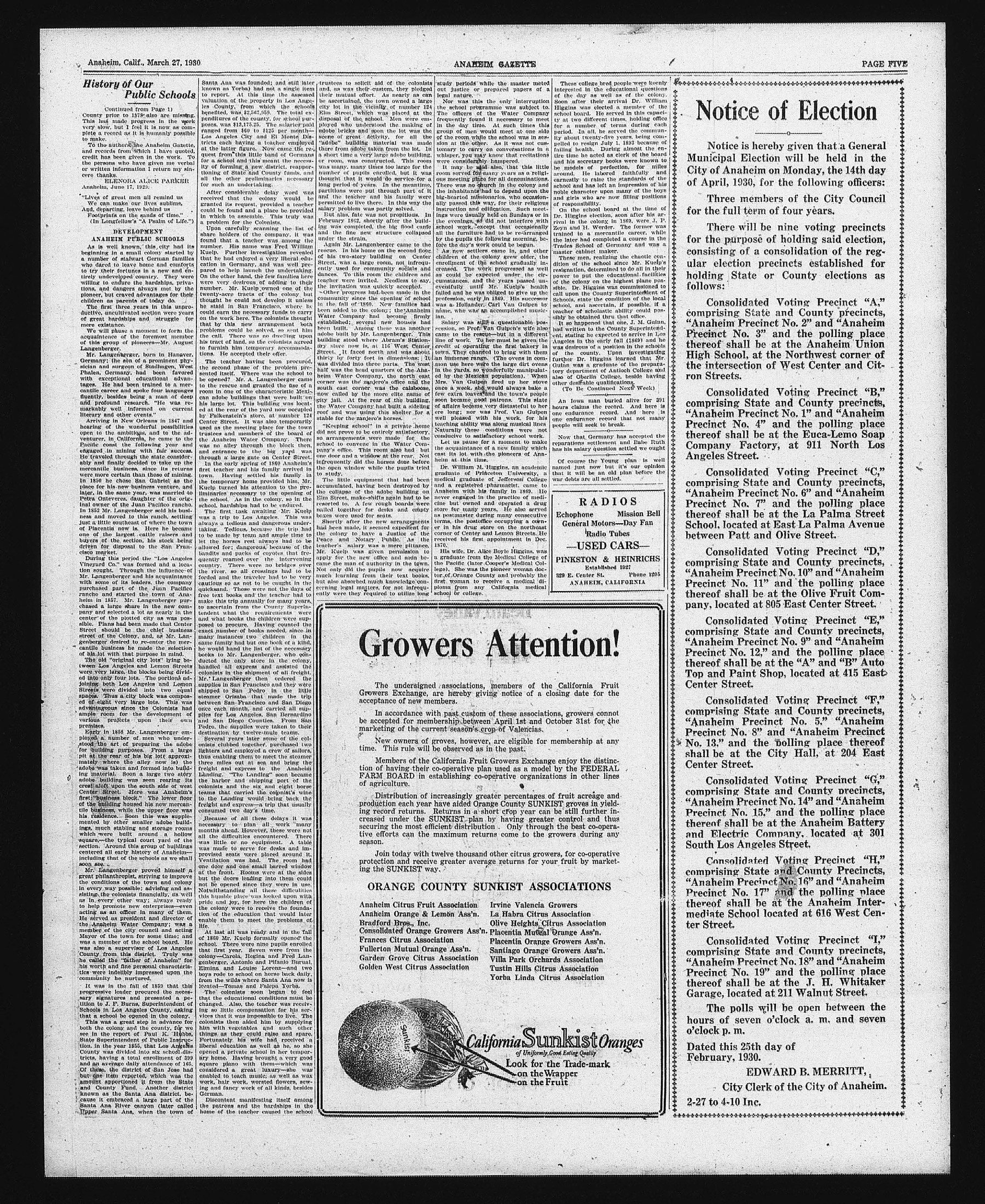
Searchable text
History of Our Public Schools
Continued from Page 1)
County prior to 1878 also are missing. This has made progress in the work very slow, but I feel it is now as complete a record as it is humanly possible to make.
To the authors, the Anaheim Gazette, and records from which I have quoted, credit has been given in the work. To the persons who have given me verbal or written information I return my sincere thanks.
ELENORA ALICE PARKER
Anaheim, June 17, 1929:
"Lives of great men all remind us
We can make our lives sublime,
And, departing, leave behind us
Footprints on the sands of time."
(In Longfellow's "A Psalm of Life.")
DEVELOPMENT
ANAHEIM PUBLIC SCHOOLS
As is well known, this city had its beginning in a small colony started by a number of stalwart German families who dared to leave home and comforts to try their fortunes in a new and entirely undeveloped country. They were willing to endure the hardships, privations, and dangers always met by the pioneer, but craved advantages for their children as parents of today do.
The first three years in this productive, uncultivated section were years of great hardships and struggle for more existence.
We will pause a moment to form the acquaintance of the foremost member of this group of pioneers—Mr. August Langenberger.
Mr. Langenberger, born in Hanover, Germany; the son of a prominent physician and surgeon of Stadthagen, West Phalen, Germany, had been favored with exceptional educational advantages. He had been trained to a mercantile career and spoke four languages fluently, besides being a man of deep and profound research. "He was remarkably well informed on current literary and other events."
Arriving in New Orleans in 1847 and hearing of the wonderful possibilities open to the ambitious, and to the adventurer, in California, he came to the Pacific coast the following year and Santa Ana was founded; and still later known as Yorba) had not a single item to report. At this time the assessed valuation of the property in Los Angeles County, from which the schools benefited, was $2,567,950. The total expenditures of the county, for school purposes, was $13,175.25. The salaries paid ranged from $60 to $125 per month—Los Angeles City and El Monte Districts each having a teacher employed at the latter figure. Now came the request from this little band of Germans for a school and this meant the necessity of forming a new district, reapportioning of State and County funds, and all the other preliminaries necessary for such an undertaking.
After considerable delay word was received that the colony would be granted its request, provided a teacher could be found and a place be provided in which to assemble. This truly was a problem for the Colonists.
Upon carefully scanning the list of share holders of the company, it was found that a teacher was among the number. His name was Fred William Kuelp. Further investigation revealed that he had enjoyed a very liberal education in Germany, and was well prepared to help launch the undertaking. On the other hand, the few families here were very desirous of adding to their number. Mr. Kuelp owned one of the twenty-acre tracts of the colony but thought he could not develop it unless he staid in San Francisco, where he could earn the necessary funds to carry on the work here. The colonists thought that by this new arrangement both problems could be solved, so sent him the call. There was no dwelling upon his tract of land, so the colonists agreed to furnish him temporary accommodations. He accepted their offer.
The teacher having been procured, the second phase of the problem presented itself. Where was the school to be opened? Mr. A. Langenberger came to the rescue and granted the use of a room in one of the characteristic Mexican adobe buildings that were built on his large lot. This building was located at the rear of the yard now occupied by Falkenstein's store, at number 124 Center Street. It was also temporarily used as the meeting place for the town trustees and members of the board of Anaheim Water Company. There was no alley through the block then, trustees to solicit and, as was their mutual effort be ascertained, the city lot in the west Elm Street, while employed who under adobe bricks and scene of great adobe building there from adobe a short time a vero or room, was co-was many many many number of pupils thought that it was long period of year partitions were piled and the teacher permitted to live a salary problem ww.
But alas, fate ww February 1862, selling was completed and the fine new under the strain.
Again Mr. Lang rescue. In his house of his two-story street, was a largeently used for co-dances. To this teacher were invited invitation wa- Other progress community since in the fall of 1868 been added to the Water Company established; seven been built. Amon adobe built by Mr. building stood wide store now is Street. It faced thirty by forty feet was divided into half was the head heim Water Com- corner was the south cast corner now called by the city jail. At the time the Water Company roof and was usable for the zanzibar.
“Keeping school did not prove to be so arrangements’s school to convene parish office.”
Mr. Langenberger, born in Hanover, Germany; the son of a prominent physician and surgeon of Stadthagen, West Phalen, Germany, had been favored with exceptional educational advantages. He had been trained to a mercantile career and spoke four languages fluently, besides being a man of deep and profound research. "He was remarkably well informed on current literary and other events."
Arriving in New Orleans in 1847 and hearing of the wonderful possibilities open to the ambitions, and to the adventurer, in California, he came to the Pacific coast the following year and engaged in mining with fair success. He traveled through the state considerably and finally decided to take up the mercantile business, since its returns were more certain than those of mining. In 1850 he chose San Gabriel as the place for his new business venture, and later, in the same year, was married to Petra Ontheveres, daughter of the original owner of the Juan Pacifico ranch. In 1852 Mr. Langenberger sold his business and moved to this ranch, settling just a little southeast of where the town of Placentia now is. Here he became one of the largest cattle raisers and buyers of the section, his stock being driven for disposal to the San Francisco market.
During this period the "Los Angeles Vineyard Co." was formed and a location sought. Through the influence of Mr. Langenberger and his acquaintance with some of its leaders, the company purchased part of the Juan Pacifico ranch and started the town of Anaheim in 1857. Mr. Langenberger purchased a large share in the new company and selected a lot as nearly in the center of the plotted city as was possible. Plans had been made that Center Street should be the chief business street of the Colony, and, as Mr. Langenberger desired to re-enter the mercantile business he made the selection of his lot with that purpose in mind.
The old "original city lots" lying between Los Angeles and Lemon Streets were very large, the blocks being divided into only four lots. The portions adjoining both Los Angeles and Lemon Streets were divided into two equal spaces. Thus a city block was composed of eight very large lots. This was advantageous since the Colonists had ample room for the development of various projects upon their own premises.
Early in 1858 Mr. Langenberger employed a number of men who understood the art of preparing the adobe for building purposes. From a large pit at the rear of his big lot (approximately where the alley now is) the adobe was taken and formed into building material. Soon a large two story adobe building was seen rearing its crest aloft upon the south side of west Center Street. Here was Anaheim's first "business block." The lower floor of the building housed his new mercantile business, while the upper floor was his residence. Soon this was supplemented by other smaller adobe buildings, much stabling and storage rooms which were built around a hollow square—the typical court yard of the section. Around this group of buildings
The teacher having been procured, the second phase of the problem presented itself. Where was the school to be opened? Mr. A. Langenberger came to the rescue and granted the use of a room in one of the characteristic Mexican adobe buildings that were built on his large lot. This building was located at the rear of the yard now occupied by Falkenstein's store, at number 124 Center Street. It was also temporarily used as the meeting place for the town trustees and members of the board of the Anahelm Water Company. There was no alley through the block then, and entrance to the big yard was through a large gate on Center Street.
In the early spring of 1860 Anaheim's first teacher and his family arrived in town. Having settled his family in the temporary home provided him, Mr. Kuelp turned his attention to the preliminaries necessary to the opening of the school. As in the colony, so in the school, hardships had to be endured.
The first task awaiting Mr. Kuelp was a trip to Los Angeles. This was always a tedious and dangerous undertaking. Tedious, because the trip had to be made by team and ample time to let the horses rest always had to be allowed for; dangerous, because of the bandits and packs of coyotes that frequently roamed over the intervening country. There were no bridges over the river, so all crossings had to be forded and the traveler had to be very cautious so as not to be caught in the quicksand. Those were not the days of free text books and the teacher had to make this trip annually for many years, to ascertain from the County Superintendent what the requirements were and what books the children were supposed to procure. Having counted the exact number of books needed, since in many instances two children in the same family had but one book of a kind, he would hand the list of the necessary books to Mr. Langenberger, who conducted the only store in the colony, handled all express and assisted the colonists in the shipment of all freight. Mr.' Langenberger then ordered the supplies in San Francisco and they were shipped to San Pedro in the little steamer Orizaba that made the trip between San Francisco and San Diego once each month, and carried all supplies for Los Angeles, San Bernardino and San Diego Counties. From San Pedro, the supplies were taken to their destination by twelve-mule teams.
Several years later some of the colonists clubbed together, purchased two lighters and employed a crew of sailors, thus enabling them to meet the steamer three miles out at sea and bring the freight and express to the Anaheim Landing. "The Landing" soon became the harbor and shipping port of the colonists and the six and eight horse teams that carried the colonist's wine to the Landing would bring back the freight and express—a trip that usually consumed two day's time.
Because of all these delays it was necessary to plan all work many months ahead. However, these were not all the difficulties encountered. There was little or no equipment. A table was made to serve for desks and im-
Mr. Langenberger proved himself a great philanthropist, striving to improve the conditions of the town and colony in every way possible; advising and assisting the colonists financially, as well as in every other way; always ready to help promote new enterprises—even acting as an officer in many of them. He served as president and director of the Anaheim Water Company; was a member of the city council and acting Mayor of the town for some time; and was a member of the school board. He was also a supervisor of Los Angeles County from this district. Truly was he called the "father of Anaheim" for his worth and fine personal characteristics were indelibly impressed upon the community he nurtured.
It was in the fall of 1859 that this progressive leader procured the necessary signatures and presented a petition to J. F. Burns, Superintendent of Schools in Los Angeles County, asking that a school be opened in the colony.
This was a great step in advance for both the colony and the county, for we see in the report of Paul K. Hubbs, State Superintendent of Public Instruction. In the year 1855, that Los Angeles County was divided into six school districts, having a total enrollment of 399 and an average daily attendance of 165. Of these, the district of San Jose had but one item reported, which was the amount apportioned it from the State and County Fund. Another district known as the Santa Ana district, because it embraced a large part of the Santa Ana River canyon (later called Upper Santa Ana), when the town of
thus enabling them to meet the steamer three miles out at sea and bring the freight and express to the Anaheim Landing. "The Landing" soon became the harbor and shipping port of the colonists and the six and eight horse teams that carried the colonist's wine to the Landing would bring back the freight and express—a trip that usually consumed two day's time.
Because of all these delays it was necessary to plan all work many months ahead. However, these were not all the difficulties encountered. There was little or no equipment. A table was made to serve for desks and improvised seats were placed around it. Ventilation was bad. The room had one door and one small barred window at the front. Rooms were at the sides but the doors leading into them could not be opened since they were in use. Notwithstanding all these difficulties this humble place was looked upon with pride and joy, for here the children of the colony were to receive the foundation of the education that would later enable them to meet the problems of life.
At last all was ready and in the fall of 1860 Mr. Kuelp formally opened the school. There were nine pupils enrolled that first year. Seven were from the colony—Carola, Regina and Fred Langenberger, Antonio and Pifanio Burual, Elmina and Louise Lorenz—and two boys rode to school on horse back daily, from the wilds where Santa Ana now is located—Tomas and Falepa Yorba.
The colonists soon began to feel that the educational conditions must be changed. Also, the teacher was receiving so little compensation for his services that it was impossible to live. The colonists then alided him by supplying him with vegetables and such other things as they could raise and spare. Fortunately his wife had received a liberal education as well as he, so she opened a private school in her temporary home. Having brought a very good square piano with them—which was considered a great luxury—she was enabled to teach music; as well as wax work, hair work, worsted flowers, sewing and fancy work of all kinds, besides German.
Discontent manifesting itself among the patrons and the hardships in the home of the teacher caused the school
ANAHEIM GAZETTE
still later the item assessed was Angela schools total ex- school pur- laries paid month— mente Dis- employed the re- Germans the neces- reappar- ands, and necessary word was should be a teacher provided fully was the list of it was along the William re- revealed rural edu- well pre- pertaking, alles here to their use of the cony but not unless there he to carry thought both sent him upon is agreed commoda- procured, even pre- school to her came use of a de Mexi- built on us locat- occupied rubber 124 temporarily the town board of There thenkek them.
trustees to solicit aid of the colonists and, as was their custom, they pledged their mutual effort. As nearly as can be ascertained, the town owned a large city lot in the vicinity, of number 124 Elm Street, which was placed at the disposal of the school. Men were employed who understood the making of adobe bricks and soon the lot was the scene of great activity, for all the "adobe" building material was made there from adobe taken from the lot. In a short time a very large adobe building, or room, was constructed. This room was many, many times too large for the number of pupils enrolled, but it was thought that it would do service for a long period of years. In the meantime, partitions were put through part of it and the teacher and his family were permitted to live there. In this way the salary problem was partly solved.
But alas, fate was not propitious. In February 1862, shortly after the建- ing was completed, the big flood cante and the fine new structure collapsed under the strain.
Againn Langenberger came to the rescue. In his home on the second floor of his two-story building on Center Street, was a large room, not infrequently used for community socials and dances. To this room the children and teacher were invited. Needless to say, the invitation was quickly accepted. Other progress had been made in the community since the opening of school in the fall of 1869. New families had been added to the colony; The Anaheim Water Company had become firmly established; several new houses had been built. Among these was another abuse by Mr. Langenberger. This building stood where Abram's Stationary store now is, at 116 West Center Street. It faced north and was about thirty by forty feet in dimensions: It was divided into three parts. The west half was the head quarters of the Anaheim Water Company, the north east corner was the zanjero's office and the south east corner was the calaboose, now called by the more elite name of city jail. At the rear of the building, the Water Company had built a sideling roof and was using this shelter for a stable for the zanjero's horses.
"Keeping school" in a private home did not prove to be entirely satisfactory, so arrangements were made for the school to convene in the Water Company's office. This also had bad study periods while the master meted out justice or prepared papers of legal nature.
Nor was this the only interruption the school programme was subject to. The officers of the Water Company frequently found it necessary to meet in the day time. At such times this group of men would meet at one side of the room while the school was in session at the other. As it was not customary to carry on conversations in a whisper, you may know that recitations were considerably hampered.
It may be said also, that this little room served for many years as a religious meeting place for all denominations. There was no church in the colony and the inhabitants had to depend upon the big-hearted missionaries, occasionally passed this way, for their religious instruction and edification. Such meetings were usually held on Sundays or in the evenings, so did not interfere with school work, except that occasionally all the furniture had to be re-arranged by the pupils following morning, before the day's work could be begun.
As now settlers came in, and other children of the colony grew older, the enrollment of the school gradually increased. The work progressed as well as could be expected under the circumstances, and the years passed uneventfully until Mr. Kuelp's health failed and he was obliged to give up the profession, early in 1869. His successor was a Hollander, Carl Van Gulpen by name, who was an accomplished musician.
Salary was still a questionable possession, so Prof. Van Gulpen's wife also came to the rescue—but in a different line of work. To her must be given the credit of operating the first bakery in town. They chanced to bring with them an immense range. (The ovens in common use here were the large dirt ovens in the yards, so wonderfully manipulated by the Mexican population). When Mrs. Van Gulpen fired up her stove once a week, she would always bake a few extra loaves and the town's people soon became good patrons. This state of affairs became very distasteful to her ere long; nor was Prof. Van Gulpen well pleased with his work, for his teaching ability was along musical lines Naturally these conditions were not conducive to satisfactory school work.
Let us pause for a moment to make the acquaintance of a new family which These college bred people were keenly interested in the educational questions of the day as well as of the colony. Soon after their arrival Dr. William Higgins was elected a member of the school board. He served in this capacity at two different times, holding office for a number of terms during each period. In all he served the community about twenty-five years, being compelled to resign July 1, 1893 because of falling health. During almost the entire time he acted as clerk of the board and his secretary books were known to be models of perfection, for miles around. He labored faithfully and earnestly to raise the standards of the school and has left an impression of his noble character upon many of the boys and girls who are now filling positions of responsibility.
On the school board at the time of Dr. Higgins election, soon after his arrival in the colony, in 1869, were J. P. Zeyn and H. Werder. The former was trained to a mercantile career, while the latter had completed a course in the Trades School of Germany and was a master cabinet maker.
These men, realizing the chaotic condition of the school since Mr. Kuelp's resignation, determined to do all in their power to put the educational facilities of the colony on the highest plane possible. Dr. Higgins was commissioned to call upon the County Superintendent of Schools, state the condition of the local school, and ascertain if possible, if a teacher of scholastic ability could possibly be obtained thru that office.
It so happened that one, J. M. Guinn, had written to the County Superintendent, stating he expected to arrive in Los Angeles in the early fall (1869) and he was desirous of a position in the schools of county. Upon investigating further Dr. Higgins learned that Mr. Guinn was a graduate of the preparatory department of Antioch College and also of Oberlin College, beside having other desirable qualifications.
(To Be Continued Next Week)
An Iowa man buried alive for 391 hours claims the record. And here is one endurance record. And here is one endurance record that not many people will seek to break.
Now that Germany has accepted the reparations settlement and Babe Ruth has his salary question settled we ought
Growers Attention!
The undersigned associations, members of the California Fruit Growers Exchange, are hereby giving notice of a closing date for the acceptance of new members.
In accordance with past custom of these associations, growers cannot be accepted for membership between April 1st and October 31st for the marketing of the current season's crop of Valencias.
New owners of groves, however, are eligible for membership at any time. This rule will be observed as in the past.
Members of the California Fruit Growers Exchange enjoy the distinction of having their co-operative plan used as a model by the FEDERAL FARM BOARD in establishing co-operative organizations in other lines of agriculture.
Distribution of increasingly greater percentages of fruit acreage and production each year have aided Orange County SUNKIST groves in yielding record returns. Returns in a short crop year can be still further increased under the SUNKIST plan by having greater control and thus securing the most efficient distribution. Only through the best co-operative efforts can the maximum returns come to the growers during any season.
Members of the California Fruit Growers Exchange enjoy the distinction of having their co-operative plan used as a model by the FEDERAL FARM BOARD in establishing co-operative organizations in other lines of agriculture.
Distribution of increasingly greater percentages of fruit acreage and production each year have aided Orange County SUNKIST groves in yielding record returns. Returns in a short crop year can be still further increased under the SUNKIST plan by having greater control and thus securing the most efficient distribution. Only through the best co-operative efforts can the maximum returns come to the growers during any season.
Join today with twelve thousand other citrus growers, for co-operative protection and receive greater average returns for your fruit by marketing the SUNKIST way.
ORANGE COUNTY SUNKIST ASSOCIATIONS
Anaheim Citrus Fruit Association Irvine Valencia Growers
Anaheim Orange & Lemon Ass'n. La Habra Citrus Association
Bradford Bros., Inc. Olive Heights Citrus Association
Consolidated Orange Growers Ass'n. Placentia Mutual Orange Ass'n.
Frances Citrus Association Placentia Orange Growers Ass'n.
Fullerton Mutual Orange Ass'n. Santiago Orange Growers Ass'n.
Garden Grove Citrus Association Villa Park Orchards Association
Golden West Citrus Association Tustin Hills Citrus Association
Yorba Linda Citrus Association
California Sunkist Oranges
of Uniformly Good Eating Quality
Look for the Trade-mark
on the Wrapper
on the Fruit
Notice of Election
Notice is hereby given that a General Municipal Election will be held in the City of Anaheim on Monday, the 14th day of April, 1930, for the following officers:
Three members of the City Council for the full term of four years.
There will be nine voting precincts for the purpose of holding said election, consisting of a consolidation of the regular election precincts established for holding State or County elections as follows:
Consolidated Voting Precinct "A," comprising State and County precincts, "Anaheim Precinct No. 2" and "Anaheim Precinct No. 3" and the polling place thereof shall be at the Anaheim Union High School, at the Northwest corner of the intersection of West Center and Citron Streets.
Consolidated Voting Precinct "B," comprising State and County precincts, "Anaheim Precinct No. 1" and "Anaheim Precinct No. 4" and the polling place thereof shall be at the Euca-Lemo Soap Company Factory, at 911 North Los
Consolidated Voting Precinct "B," comprising State and County precincts,
"Anaheim Precinct No. 1" and "Anaheim Precinct No. 4" and the polling place thereof shall be at the Euca-Lemo Soap Company Factory, at 911 North Los Angeles Street.
Consolidated Voting Precinct "C," comprising State and County precincts,
"Anaheim Precinct No. 6" and "Anaheim Precinct No. 7" and the polling place thereof shall be at the La Palma Street School, located at East La Palma Avenue between Patt and Olive Street.
Consolidated Voting Precinct "D," comprising State and County precincts,
"Anaheim Precinct No. 10" and "Anaheim Precinct No. 11" and the polling place thereof shall be at the Olive Fruit Company, located at 805 East Center Street.
Consolidated Voting Precinct "E," comprising State and County precincts,
"Anaheim Precinct No. 9" and "Anaheim Precinct No. 12," and the polling place thereof shall be at the "A" and "B" Auto Top and Paint Shop, located at 415 East Center Street.
Consolidated Voting Precinct "F," comprising State and County precincts,
"Anaheim Precinct No. 5," "Anaheim Precinct No. 8" and "Anaheim Precinct No. 13," and the polling place thereof shall be at the City Hall, at 204 East Center Street.
Consolidated Voting Precinct "G," comprising State and County precincts,
"Anaheim Precinct No. 14" and "Anaheim Precinct No. 15," and the polling place thereof shall be at the Anaheim Battery and Electric Company, located at 301 South Los Angeles Street.
Consolidated Voting Precinct "G," comprising State and County precincts,
"Anaheim Precinct No. 14" and "Anaheim Precinct No. 15," and the polling place thereof shall be at the Anaheim Battery and Electric Company, located at 301 South Los Angeles Street.
Consolidated Voting Precinct "H," comprising State and County Precincts,
"Anaheim Precinct No. 16" and "Anaheim Precinct No. 17," and the polling place thereof shall be at the Anaheim Intermediate School located at 616 West Center Street.
Consolidated Voting Precinct "I," comprising State and County precincts,
"Anaheim Precinct No. 18" and "Anaheim Precinct No. 19," and the polling place thereof shall be at the J. H. Whitaker Garage, located at 211 Walnut Street.
The polls will be open between the hours of seven o'clock a.m. and seven o'clock p.m.
Dated this 25th day of February, 1930.
EDWARD B. MERRITT,
City Clerk of the City of Anaheim.
2-27 to 4-10 Inc.