anaheim-gazette 1930-03-13
Scanned page
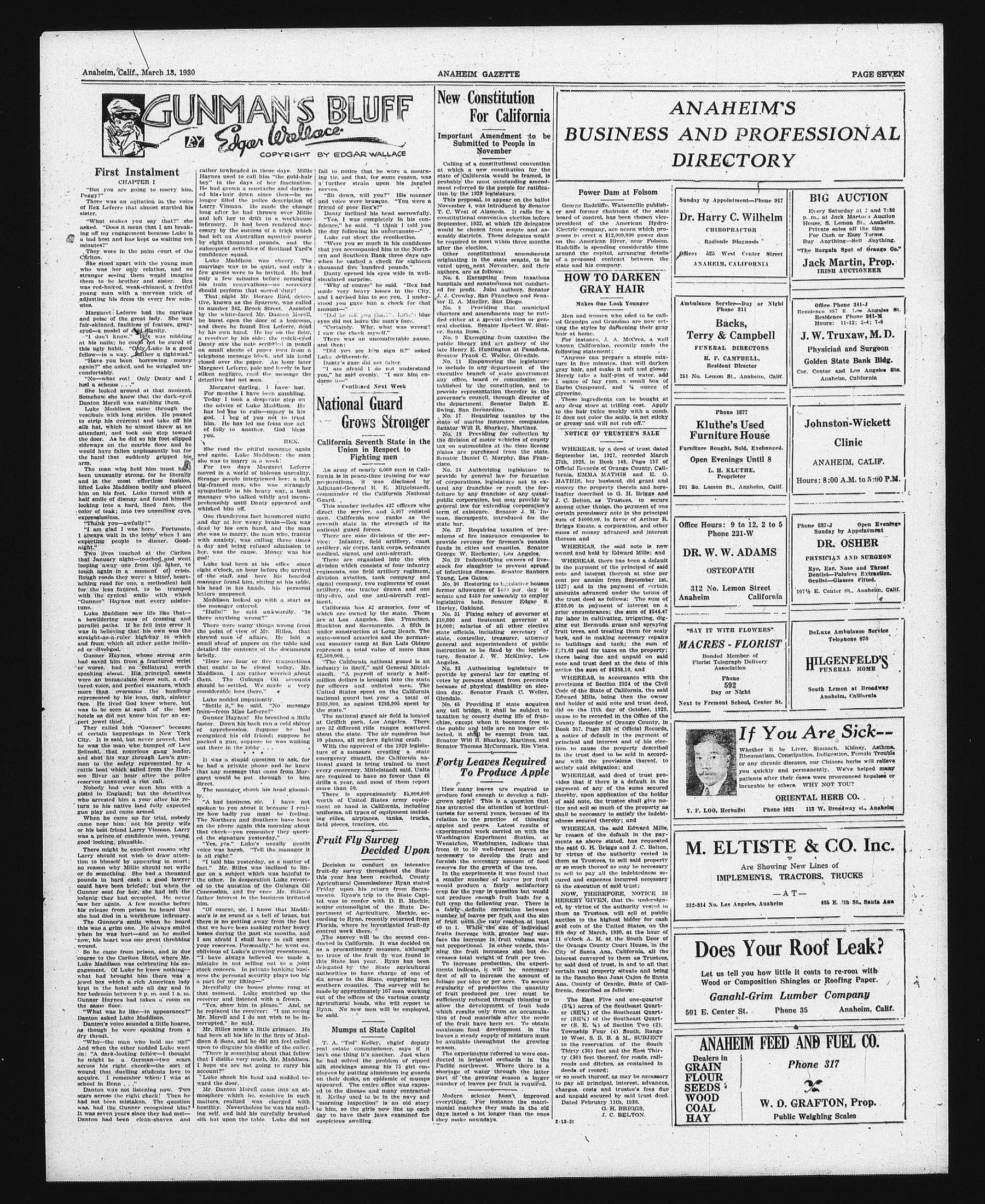
Searchable text
First Instalment
CHAPTER I
"But you are going to marry him, Peggy?"
There was an agitation in the voice of Rex Leferre that almost startled his sister.
"What makes you say that?" she asked. "Does it mean that I am breaking off my engagement because Luke is a bad host and has kept us waiting ten minutes?"
They were in the palm court of the Carlton.
She stood apart with the young man who was her only relation, and no stranger seeing them would imagine them to be brother and sister. Rex was red-haired, weak-chinned, a fretful young man with a nervous trick of adjusting his dress to every few minutes.
Margaret Leferre had the carriage and poise of the great lady. She was fair-skinned, faultless of feature, gray-eyed—a model of child dignity.
"I don't know," Rex was nibbling at his nails; he could not be cured of this ugly habit. "Only Luke is a good fellow—in a way, rather a tightwad."
"Have you been borrowing money again?" she asked, and he wriggled uncomfortably.
"No—what rot! Only Danty and I had a scheme..."
She looked around at that moment. Somehow she knew that the dark-eyed Danton Morell was watching them.
Luke Maddison came through the vestibule with long strides. He paused to strip his overcoat and take off his silk hat, which he almost threw at an attendant, and took one step toward the door. As he did so his foot slipped sideways on the marble floor and he rather towheaded in those days. Millie Haynes used to call him "the gold-hair boy" in the days of her fascination. He had grown a mustache and darkened his hair down since then—the no longer filled the police description of Larry Vinman. He made the change long after he had thrown over Millie and left her to drift to a workhouse infirmary. It had been rendered necessary by the success of a trick which had left an Australian squatter poorer by eight thousand pounds, and the subsequent activities of Scotland Yard's confidence squad.
Luke Maddison was cheery. The marriage was to be quiet, and only a few guests were to be invited. He had only a few minutes before arranging his train reservations—no secretary should perform that sacred duty!
That night Mr. Horace Bird, detective, known as the Sparrow, was called to number 342, Brook Street. Assisted by the white-faced Mr. Danton Morell, he burst open the door of a bedroom, and there he found Rex Leferre, dead by his own hand. He lay on the floor, a revolver by his side; the quick-c eyed Danty saw the note scribbled in pencil on small sheets of paper torn from a telephone message block, and his hand closed over the paper. An hour later Margaret Leferre, pale and lovely in her silken negligence, read the message the detective had not seen.
Margaret darling. I have lost. For months I have been gambling. Today I took a desperate step on the advice of Luke Maddison. He has led me to ruin—money is his god. I beg of you not to trust him. He has led me from one act of folly to another. God bless you.
REX.
She read the pitiful message again fail to notice that ing tie, and that, a further strain nerves.
"Sit down, will and voice were b friend of poor Re Danty inclined?
"Yes, I was coidence," he said. the day following Luke cut short.
"Were you so r that you accompany and Southern when he cashed thousands five hu Danty opened simulated surprise?
"Why of course made very heavy and I advised him stood you gave amount—"
"Did he tell you eyes did not leave Certainly. When I saw the check There was an and then:
"Did you see Luke deliberately Danty's gaze die? I am afraid you," he said even dorse it—"
Continu
"Have you been borrowing money again?" she asked, and he wriggled uncomfortably.
"No—what rot! Only Danty and I had a scheme..." She looked around at that moment. Somehow she knew that the dark-eyed Danton Morell was watching them.
Luke Maddison came through the vestibule with long strides. He paused to strip his overcoat and take off his silk hat, which he almost threw at an attendant, and took one step toward the door. As he did so his foot slipped sideways on the marble floor and he would have fallen unpleasantly but for the hand that suddenly gripped his arm.
The man who held him must have been unusually strong, for he literally and in the most effortless fashion, lifted Luke Maddison bodily and placed him on his feet. Luke turned with a half smile of dismay and found himself looking into a hard, lined face, the color of teak; into two unsmilling eyes, expressionless.
"Thank you—awfully!"
"I am glad I was here. Fortunate, I always wait in the lobby when I am expecting people to dinner. Good-night."
Two lives touched at the Carlton that January night—touched and went looping away one from the other, to touch again in a moment of crisis. Rough roads they were: a bitter, heartaching road for one, a methodical hell for the less favored, to be tramped with the cynical smile with which "Gunner" Haynes met every misfortune.
Luke Maddison saw life like that—a bewildering mass of crossing and parallel paths. If he fell into error it was in believing that his own was the straight-as-a-ruler highway to which and from which all other paths inclined or diverged.
Gunner Haynes, whose strong arm had saved him from a fractured wrist or worse, had no collateral worth speaking about. His principal assets were an immaculate dress suit, a cultured voice, and perfect manners, which more than overcame the handicap represented by his lean, dark, sinister face. He lived God knew where, but was to be seen at such of the best hotels as did not know him for an expert jowel thief.
They called him "Gunner" because of certain happenings in New York City. It is said, but never proved, that he was the man who bumped off Lew Selinski, that notorious gang leader, and shot his way through Lew's gunmen to the safety represented by a cattle boat which sailed from the Hudson River an hour after the police reserves answered a riot call.
Nobody had ever seen him with a pistol in England; but the detectives who arrested him a year after his return to his native land fully expected gun play and came armed.
When he came up for trial, nobody came near him; not his pretty wife or his best friend Larry Vinman. Larry was a prince of confidence men, young, good-looking, plausible.
There might be excellent reason why telephone message block, and his hand closed over the paper. An hour later Margaret Leferre, pale and lovely in her silken negligence, read the message the detective had not seen.
Margaret darling. I have lost. For months I have been gambling. Today I took a desperate step on the advice of Luke Maddison. He has led me to ruin—money is his god. I beg of you not to trust him. He has led me from one act of folly to another. God bless you.
REX.
She read the pitiful message again and again. Luke Maddison: the man she was to marry in a week!
For two days Margaret Leferre moved in a world of hideous unreality. Strange people interlewed her: a tall, big-framed man, who was strangely sympathetic in his heavy way, a bank manager who talked wildly and inconprehensibly until Danty appeared and whisked him off.
One thunderous fact hammered night and day at her weary brain—Rex was dead by his own hand, and the man she was to marry, the man who, frantle with anxiety, was calling three times a day and being refused admission to her, was the cause. Money was his god!
Luke had been at his office since eight o'clock, an hour before the arrival of the staff, and here his bearded manager found him, sitting at his table, his head in his hands, his personal letters unopened.
Maddison looked up with a start as the manager entered.
"Hullo!" he said awkwardly. "Is there anything wrong?"
There were many things wrong from the point of view of Mr. Stiles, that shrewd man of affairs. He laid a small sheaf of papers on the table and detailed the contents of the documents briefly.
"Here are four or five transactions that ought to be closed today. Mr. Maddison. I am rather worried about them. The Gulanga Oil accounts should be settled. We made a very considerable loss there."
Luke nodded impatiently.
"Settle it," he said. "No message from—from Miss Leferre?"
Gunner Haynes! He breathed a little faster. Down his back ran a cold shiver of apprehension. Suppose he had recognized his old friend; suppose he packed a gun, suppose he was waiting out there in the lobby.
It was a stupid question to ask, for he had a private phone and he knew that any message that came from Margaret would be put through to him direct.
The manager shook his head gloomily.
"A bad business, sir. I have not spoken to you about it because I realize how badly you must be feeling. The Northern and Southern have been on the phone again this morning about that check—you remember they queried the signature yesterday."
"Yes, yes." Luke's usually gentle voice was harsh. "Tell the manager it...
and shot his way through Lew's gunmen to the safety represented by a cattle boat which sailed from the Hudson River an hour after the police reserves answered a riot call.
Nobody had ever seen him with a pistol in England; but the detectives who arrested him a year after his return to his native land fully expected gun play and came armed.
When he came up for trial, nobody came near him; not his pretty wife or his best friend Larry Vinman. Larry was a prince of confidence men, young, good looking, plausible.
There might be excellent reason why Larry should not wish to draw attention to himself by appearing in court; no reason why Millie should not write or do something. She had a thousand pounds in hard cash; a good lawyer could have been briefed; but when the Gunner sent for her, she had left the lodgnig they had occupied. He never saw her again. A few months before his release from prison he heard that she had died in a workhouse infirmary.
The Gunner's smile when he heard this was a grim one. He always smiled when he was hurt—and as he smiled now, his heart was one great throbbing wound.
So he came from prison, and in due course to the Carlton Hotel, where Mr. Luke Maddison was celebrating his engagement. Of Luke he knew nothing—what had brought him there was a jewel box which a rich American lady kept in the hotel safe all day and in her bedroom between 9 p.m. and 1 a.m. Gunner Haynes had taken a room on the same floor.
"What was he like—in appearance?" Danton asked Luke Maddison.
Danton's voice sounded a little hoarse, as though he were speaking from a dry throat.
"Who—the man who held me up?" And when the other nodded Luke went on: "A dark-looking fellow—I thought he might be a German—two scars across his right cheek—the sort of wound that duelling students love to acquire. I remember when I was at school in Bonn . . .
Danton was not listening now. Two scars across the right cheek! Then he had not been mistaken. The question was, had the Gunner recognized him? It was seven years since they had met—Danton had been clean-shaven and it was a stupid question to ask, for he had a private phone and he knew that any message that came from Margaret would be put through to him direct.
The manager shook his head gloomily.
"A bad business, sir. I have not spoken to you about it because I realize how badly you must be feeling. The Northern and Southern have been on the phone again this morning about that check—you remember they queried the signature yesterday."
"Yes, yes." Luke's usually gentle voice was harsh. "Tell the manager it is all right."
"I told him yesterday, as a matter of fact." Mr. Stiles was inclined to linger on a subject which was hateful to the other. In desperation Luke reverted to the question of the Guangla Oil Concession, and for once Mr. Stiles's father interest in the business irritated him.
"Of course, sir, I know that Maddison's is as sound as a bell of brass, but there is no getting away from the fact that we have been making rather heavy losses during the past six months, and I am afraid I shall have to call upon your reserves. Personally," he went on, oblivious of Luke's growing resentment.
"I have always believed we made a mistake in not selling out to a joint stock concern. In private banking business the personal security plays too big a part for my liking—"
Mercifully the house phone rang at that moment. Luke snatched up the receiver and listened with a frown.
"Yes, show him in please." And, as he replaced the receiver: "I am seeing Mr. Morell and I do not wish to be interrupted," he said.
Mr. Stiles made a little grimace. He had been all his life in the firm of Maddison & Sons, and he did not feel called upon to disguise his dislike of the caller.
"There is something about that fellow that I dislike very much, Mr. Maddison. I hope we are not going to carry his account?"
Luke shook his head and nodded toward the door.
Mr. Danton Morell came into an atmosphere which he, sensitive in such matters, realized was charged with hostility. Nevertheless he was his smiling self, and laid his carefully brushed silk hat upon the table. Luke did not
ANAHEIM GAZETTE
New Constitution For California
Important Amendment to be Submitted to People in November
Calling of a constitutional convention at which a new constitution for the state of California would be framed, is probably the most outstanding amendment referred to the people for ratification by the 1029 legislature.
This proposal, to appear on the ballot November 4, was introduced by Senator T. C. West of Alameda. It calls for a constitutional convention election before September, 1932, at which 120 delegates would be chosen from senate and assembly districts. These delegates would be required to meet within three months after the election.
Other constitutional amendments originating in the state Senate, to be voted upon next November, and their authors, are as follows:
No. 6. Exempting from taxations hospitals and sanatoriums not conducted for profit. Joint authors, Senator J. J. Crowley, San Francisco and Senator E. A. Mueller, San Diego.
No. 8. Providing that municipal charters and amendments may be ratified either at a special election or general election. Senator Herbert W. Slater, Santa Rosa.
No. 9. Exempting from taxation the public library and art gallery of the late Henry E. Huntington at Pasadena. Senator Frank C. Weller, Glendale.
No. 11. Empowering the legislature to include in any department of the executive branch of state government any office, board or commission established by the constitution, and to provide representation therefor in the governor's council, through director of the department. Senator Ralph E. Swing, San Bernardino.
No. 17. Requiring taxation by the state of marine insurance companies. Senator Will R. Sharkey, Martinez.
No. 18. Providing for collection by the division of motor vehicles of county tax on automobiles at the time license.
Power Dam at Folsom
George Radcliffe, Watsonville publisher and former chairman of the state board of control, has been chosen vice-president of the American Hydro-Electric company, aco necern which proposes to erect a $12,000,000 power dam on the American River, near Folsom. Radcliffe is spending considerable time around the capitol, arranging details of a proposed contract between the state and his company.
HOW TO DARKEN GRAY HAIR
Makes One Look Younger
Men and women who used to be called Grandpa and Grandma are now setting the styles by darkening their gray hair at home.
For instance, J. A. McCrea, a well known Californian, recently made the following statement:
"Anyone can prepare a simple mixture in five minutes, that will darken gray hair, and make it soft and glossy. Merely take a half-pint of water, add 1 ounce of bay rum, a small box of Barbo Compound, and ¼ ounce of glycerine.
These ingredients can be bought at any drug store at trifling cost. Apply to the hair twice weekly with a comb. It does not color the scalp, is not sticky or greasy and will not rub off."
NOTICE OF TRUSTEE'S SALE
National Guard Grows Stronger
California Seventh State in the Union in Respect to Fighting men
An army of nearly 6,000 men in California is in peace-time training for war preparations. It was disclosed by Adjutant-General R. E. Mittelstaedt, commander of the California National Guard.
This number includes 437 officers who direct the service, and 5,407 enlisted men. California now ranks as the seventh state in the strength of its national guard forces.
There are nine divisions of the service: Infantry, field artillery, coast artillery, air corps, tank corps, ordnance medical, signal, and anti-aircraft.
These are organized into the 40th division which consists of four infantry regiments, one field artillery regiment, division aviation, tank company and signal company, two regiments of coast artillery, one tractor drawn and one fifty-five, and one anti-aircraft regiment.
California has 42 armories, four of which are owned by the state. These are at Los Angeles, San Francisco, Stockton and Sacramento. A fifth is under son construction at Long Beach. The state-owned armories and the permanent summer camp at San Luis Obispo represent a total value of more than $2,500,000.
"The California national guard is an industry in itself," said General Mittelstaedt. "A payroll of nearly a half-million dollars is brought into the state for officers and enlisted men. The United States spent on the California national guard last year a total of $938,000, as against $288,905 spent by the state."
The national guard air field is located at Griffith park, Los Angeles. There are 32 different rifle ranges scattered about the state. The air squadron has 10 planes, all modern fighting craft.
With the approval of the 1929 legislation of a measure creating a state emergency council, the California national guard is being trained to meet every emergency Mittelstaedt said. Units are required to have no fewer than 48 drills a year, and most of them report more than 50.
There is approximately $5,000,000 worth of United States army equipment on hand in California, including uniforms, all types of equipment including rifles, airplanes, tanks, trucks, field pieces, tractors, etc.
Fruit Fly Survey Decided Upon
Senator Frank C. Weller, Glendale.
No. 11 Empowering the legislature to include in any department of the executive branch of state government any office, board or commission established by the constitution, and to provide representation therein in the governor's council, through director of the department. Senator Ralph E. Swing, San Bernardino.
No. 17 Requiring taxation by the state of marine insurance companies. Senator Will R. Sharkey, Martinez.
No. 18 Providing for collection by the division of motor vehicles of county tax on automobiles at the time license plates are purchased from the state. Senator Daniel C. Murphy, San Francisco.
No. 24 Authorizing legislature to provide by general law for formation of corporations, legislature not to extend any franchise or remit the forfeiture by any franchise of any quasipublic corporation, but may provide by general law for extending corporation's term of existence. Senator J. M. Iman, Sacramento, introduced for the state bar.
No. 27 Requiring taxation of premiums of fire insurance companies to provide revenue for firemen's pension funds in cities and counties. Senator George W. Rochester, Los Angeles.
No. 29 Indemnifying owners of livestock for slaughter to prevent spread of infectious disease. Senator Sanborn Young, Los Gatos.
No. 30 Restoring to legislative houses former allowance of $100 per day to senate and $450 for assembly to employ legislative help. Senator Edgar S. Hurley, Oakland.
No. 31 Fixing salary of governor at $10,000 and leutenant governor at $4,000; salaries of all other elective state officials, including secretary of state, controller, treasurer, attorney general and superintendent of public instruction to be fixed by the legislature. Senator J. W. McKinney, Los Angeles.
No. 33 Authorizing legislature to provide by general law for casting of votes by persons absent from precincts because of physical disability on election day. Senator Frank C. Weller, Glendale.
No. 45 Providing if state acquires any toll bridge, it shall be subject to taxation by county during life of franchise, except when it becomes free to the public and tolls are no longer collected; it shall be exempt from tax. Senator Will R. Sharkey, Martinez, and Senator Thomas McCormack Rio Vista.
Forty Leaves Required To Produce Apple
How many leaves are required to produce food enough to develop a full-grown apple? This is a question that has attracted the attention of horticulturists for several years, because of its relation to the practice of thinning apples and pears. Latest results of experimental work carried on with the Washington Experiment Station, at Wenatchee, Washington indicate that from 40 to 50 well-formed leaves are "Anyone can prepare a simple mixture in five minutes, that will darken gray hair, and make it soft and glossy. Merely take a half-pint of water, add one ounce of bury rum, a small box of Barbo Compound, and¼ ounce of glycerine.
These ingredients can be bought at any drug store at trilling cost. Apply to the hair twice weekly with a comb. It does not color the scalp, is not sticky or greasy and will not rub off."
NOTICE OF TRUSTEE'S SALE
WHEREAS, by a deed of trust dated September 1st, 1927, recorded March 27th, 1928, in Book 148, Page 157 of Official Records of Orange County, California, EMMA MATHIS and E.O.MATHIS, her husband, did grant and convey the property therein and hereinafter described to G.H.Briggs and J.C.Belton, as Trustees, to secure among other thinnings the payment of one certain promissory note in the principal sum of $4000.00 in favor of Arthur R.Briggs Estate, a corporation,and other sums of money advanced and interest thereon and
WHEREAS,the said note is now owned and held by Edward Mills;and
WHEREAS,the has been a default in the payment of the principal of said note and interest thereon at nine per cent per annum from September 1st, 1927;and in the payment of certain amounts advanced under the terms of the trust deed as follows: The sum of $700.00 in payment of interest on a prior encumbrance;the sum of $546.47 for labor in cultivating,iirrigating,digging out Bermuda grass and spraying fruit trees,and treating them for scaly bark,and in making necessary repairs to buildings and tank;the sum of $711.63 paid for taxes on the property;there being due and unpaid on said note and trust deed at the date of this notice the sum of $6388.10,and
WHEREAS,在 accordance with the provisions Of Section 2924 of the Civil Code-of-the State-ofCalifornia,the said Edward Mills,belong then the owner and holder of said note and trust deed,did on the 17th day of October,1929,cause to be recorded in the Office of the County Recorder of Orange County.In Book 307,Page 338 Of Official Records,a notice of default in the payment of principal and interest and of his electionto cause the property described in the trust deed to be sold in accordance with the provisions thereof,tosatisfy obligation;and
WHEREAS,said deedof trust provides that if there is a default in the payment of any of the sums secured thereby,pupil applicationofthe holderof said note,the trustee shall give notice and sell so muchofthe propertyasshallbe necessarytosatisfythe indebtednesssecuredthereby;and
Forty Leaves Required To Produce Apple
How many leaves are required to produce food enough to develop a full-grown apple? This is a question that has attracted the attention of horticulturists for several years, because of its relation to the practice of thinning apples and pears. Latest results of experimental work carried on with the Washington Experiment Station, at Wenatchee, Washington, indicate that from 40 to 50 well-formed leaves are necessary to develop the fruit and furnish the necessary amount of food reserve for the growth of the tree.
In the experiments it was found that a smaller number of leaves per fruit would produce a fairly satisfactory crop for the year in question but would not produce enough fruit buds for a full crop the following year. There is a fairly definite correlation between number of leaves per fruit and the size of fruit until the rate reaches at least 40 to 1. While the size of individual fruits increase with greater leaf surface the increase in fruit volume was not proportional. In other words, thinning the fruit increases size but decreases total weight of fruit per tree.
To increase production, the experiments indicate, it will be necessary first of all to increase the amount of foliage per tree or per acre. To secure regularity of production the quantity of fruit produced per tree must be sufficiently reduced through thinning to allow the development of fruit buds which results only from an accumulation of food materials after the needs of the fruit have been set. To obtain maximum food development in the leaves a steady supply of moisture must be available throughout the growing season.
The experiments referred to were conducted in irrigated orchards in the Pacific northwest. Where there is a shortage of water through the latter part of the growing season a larger number of leaves per fruit is required.
Modern science hasn't improved everything. For instance the matrimonial matches they made in the old days lasted a lot longer than the ones they make nowadays.
WHEREAS, said deed of trust provides that if there is a default in the payment of any of the sums secured thereby, upon application of the holder of said note, the trustee shall give notice and sell so much of the property as shall be necessary to satisfy the indebtedness secured thereby; and
WHEREAS, the said Edward Mills, by reason of the default in the payments as above stated, has requested the said G. H. Briggs and J. C. Belton, by virtue of the authority vested in them as Trustees, to sell said property or so much thereof as may be necessary to sell to pay all the indebtedness secured and expenses incurred necessary to the execution of said trust;
NOW, THEREFORE, NOTICE IS HEREBY GIVEN, that the undersigned, by virtue of the authority vested in them as Trustees, will sell at public auction to the highest bidder for cash gold coin of the United States, on the 8th day of March, 1930, at the hour of 11 o'clock A.M. at the South Door of the Orange County Court House, in the City of Santa Ana, California, all the interest conveyed to them as Trustees, by said deed of trust, in and to all that certain real property situate and being in the Rancho San Juan Cajon de Santa Ana, County of Orange, State of California, described as follows:
The East Five and one-quarter (5½) acres of the Southeast Quarter (SE¼) of the Southeast Quarter (SE¼) of the Southeast Quarter (S.E.¼) of Section Two (2), Township Four (4) South, Range 10 West, S.B.B. & M., SUBJECT to the reservation of the South Thirty (30) feet and the East Thirty (30) feet thereof, for roads, railroads and ditches, as contained in deeds of record; or so much thereof, as may be necessary to pay all principal, interest, advances, charges, costs and trustee's fees due and unpaid secured by said trust deed.
Dated February 11th, 1930.
G. H. BRIGGS,
J. C. BELTON.
ANAHEIM'S
NESS AND PROFESSIONAL
DIRECTORY
Sunday by Appointment—Phone 917
Dr. Harry C. Wilhelm
CHIROPRACTOR
Radionic Diagnosis
Office: 525 West Center Street
ANAHEIM, CALIFORNIA
BIG AUCTION
Every Saturday at 2 and 7:30
p.m., at Jack Martin's Auction
House, S. Lemon St., Anaheim.
Private sales all the time.
For Cash or Easy Terms.
Buy Anything—Sell Anything.
"The Bargain Spot of Orange Co."
Jack Martin, Prop.
IRISH AUCTIONEER
Ambulance Service—Day or Night
Phone 311
Backs,
Terry & Campbell
FUNERAL DIRECTORS
H. P. CAMPBELL,
Resident Director
251 No. Lemon St., Anaheim, Calif.
Office Phone 341-J
Residence 887 S. Los Angeles St.
Residence Phone 841-M
Hours: 11-12; 2-4; 7-8
J. W. Truxaw, M.D.
Physician and Surgeon
Golden State Bank Bldg.
Cor. Center and Los Angeles Sts.
Anaheim, California
Phone 1877
Kluthe's Used
Furniture House
Furniture Bought, Sold, Exchanged.
Johnston-Wickett
Clinic
H. P. CAMPBELL,
Resident Director
251 No. Lemon St., Anaheim, Calif.
Golden State Bank Bldg.
Cor. Center and Los Angeles Sts.
Anaheim, California
Phone 1877
Kluthe's Used Furniture House
Furniture Bought, Sold, Exehanged.
Open Evenings Until 8
L. H. KLUTHE,
Proprietor
201 So. Lemon St., Anaheim, Calif.
Johnston-Wickett Clinic
ANAHEIM, CALIF.
Hours: 8:00 A.M. to 5:00 P.M.
Office Hours: 9 to 12, 2 to 5
Phone 221-W
DR. W. W. ADAMS
OSTEOPATH
312 No. Lemon Street
Anaheim, California
Phone 837-J Open Evenings
Sunday by Appointment
DR. OSHER
PHYSICIAN AND SURGEON
Eye, Ear, Nose and Throat
Dentist—Painless Extraction.
Oculist—Glasses Fitted.
107½ E. Center St., Anaheim, Calif.
"SAY IT WITH FLOWERS"
MACRES - FLORIST
Bonded Member of Florist Telegraph Delivery Association
Phone 592
Day or Night
Next to Fremont School, Center St.
DeLuxe Ambulance Service
Telephone 870
HILGENFELD'S
FUNERAL HOME
South Lemon at Broadway
Anaheim, California
If You Are Sick--
Whether it be Liver, Stomach, Kidney, Asthma,
Rheumatism, Constipation, Indigestion, Female Trouble
or any chronic diseases, our Chinese herbs will relieve
you quickly and permanently. We've helped many
patients after their cases were pronounced hopeless or
incurable by others. WHY NOT YOU?
ORIENTAL HERB CO.
Y. F. LOO, Herballist
Phone 1621 113 W. Broadway st., Anaheim
REED OF TRUST PROA DEFAULT IN THE
SUMS SECURED
TION OF THE HOLDER
TEE SHALL GIVE NOOF THE PROPERTY AS
SATISFY THE INDEBTY; AND
OLD EDWARD MILLS,
FAULT IN THE PAYED, HAS REQUESTED
AND J. C. BELTON,
Authority Vested IN
SHE SAID PROPERTY
MAY BE NECESSARY
INDEBTEDNESS SECURRED NECESSARY
AND TRUST:
RE, NOTICE IS
ATTENTION TO THE UNDERSIGNAUTHORITY VESTED IN
ILL SELL AT PUBLIC
BIDDER FOR CASH
ED STATES, ON THE
30, AT THE HOUR OF
THE SOUTH DOOR OF
BOURTH HOUSE, IN THE
CALIFORNIA, ALL THE
THEM AS TRUSTEES,
IN AND TO ALL THAT
SITUATE AND BEING
MAN CAJON DE Santa
KE, STATE OF CALIFLOWS:
AND ONE-QUARTER
SOUTHEAST QUARTSOUTHEAST QUARTSOUTHEAST QUARTSECTION TWO (2).
SOUTH, RANGE
& M., SUBJECT
OF THE SOUTH
THE EAST THRIRFOR ROADS, RAILAS CONTAINED IN
ORIENTAL HERB CO.
Y. F. LOO, Herballist Phone 1621 113 W. Broadway st., Anaheim
M. ELTISTE & CO. Inc.
Are Showing New Lines of
IMPLEMENTS, TRACTORS, TRUCKS
— AT —
312-314 No. Los Angeles, Anaheim 405 E. 4th St., Santa Ana
Does Your Roof Leak?
Let us tell you how little it costs to re-roof with
Wood or Composition Shingles or Roofing Paper.
Ganahl-Grim Lumber Company
501 E. Center St. Phone 35 Anaheim, Calif.
ANAHEIM FEED AND FUEL CO.
Dealers in
GRAIN
FLOUR
SEEDS
WOOD
COAL
HAY
Phone 317
W. D. GRAFTON, Prop.
Public Weighing Scales