anaheim-gazette 1930-03-06
Scanned page
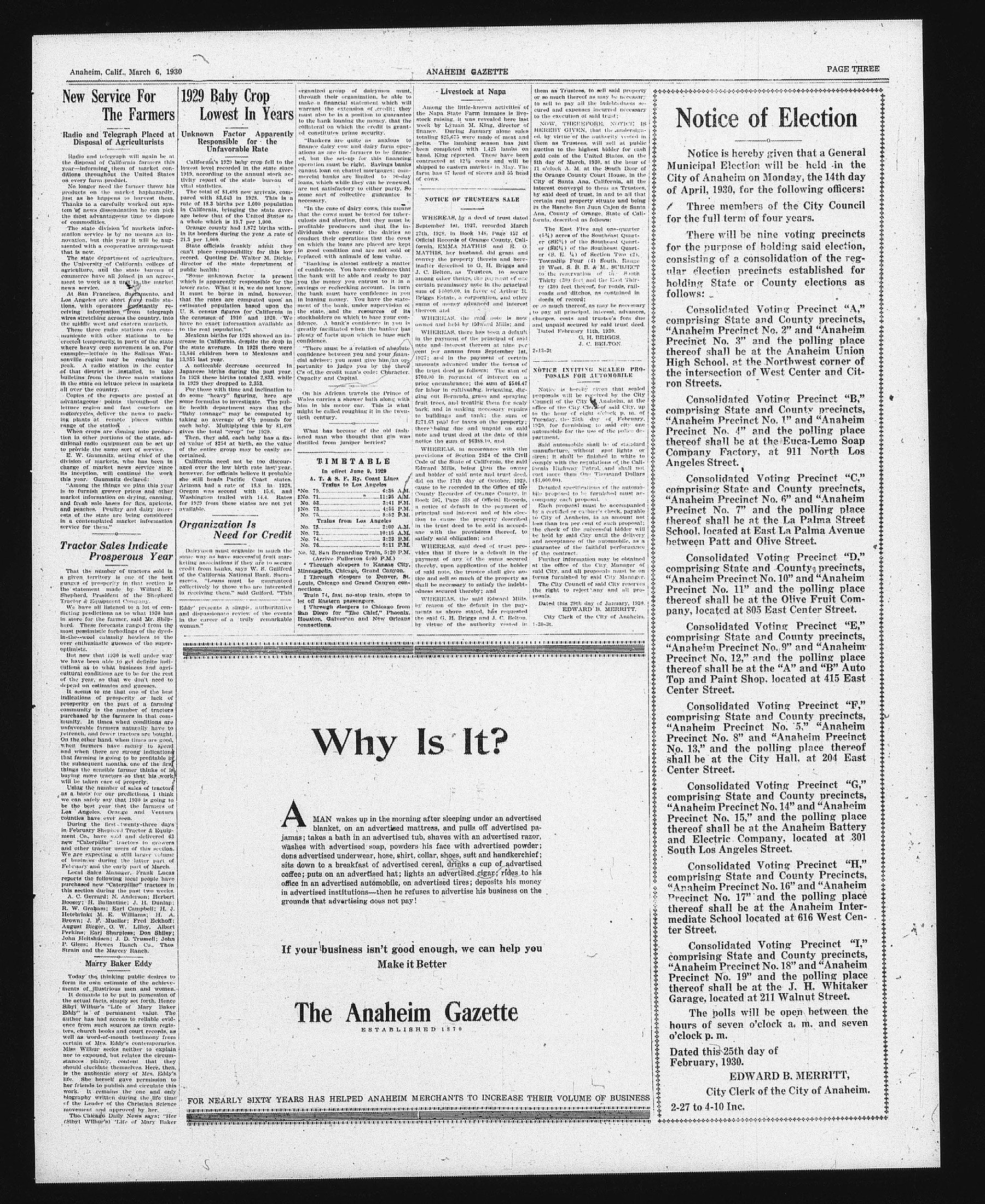
Searchable text
New Service For The Farmers
Radio and Telegraph Placed at Disposal of Agriculturists
Radio and telegraph will again be at the disposal of California farmers this year—informing them of market conditions throughout the United States on every farm product.
No longer need the farmer throw his products on the market haphazardly, just as he happens to harvest them. Thanks to a carefully worked out system of news dissemination he can pick the most advantageous time to dispose of commodities.
The state division of markets information service is by no means an innovation, but this year it will be augmented with a cooperative arrangement that is new.
The state department of agriculture, the University of California college of agriculture, and the state bureau of commerce have all joined in an agreement to work as a unit in the market news service.
At San Francisco, Sacramento, and Los Angeles are short wave radio stations, with operators constantly receiving information from telegraph wires stretching across the country, into the middle west and eastern markets.
These three radio stations can communicate with other stations to be erected temporarily, in parts of the state where heavy crop movement is on. For example—lettuce in the Salinas Watsonville region may be reaching its peak. A radio station in the center of that district is installed, to take bulletins from the three main stations in the state on lettuce prices in markets all over the country.
Copies of the reports are posted at advantageous points throughout the lettuce region and fast courlers on motorcycles deliver the news to packing plants at remote places within range of the station.
When crops are coming into production in other portions of the state, additional radio equipment can be set up to provide the same sort of service.
1929 Baby Crop Lowest In Years
Unknown Factor Apparently Responsible for the Unfavorable Rate
California's 1929 baby crop fell to the lowest level recorded in the state since 1919, according to the annual stork activity report of the state bureau of vital statistics.
The total of $8,498 new arrivals, compared with $3,643 in 1928. This is a rate of 18.3 births per 1,000 population in California, bringing the state average below that of the United States as a whole which is 19.7 per 1,000.
Orange county had 1,872 births within its borders during the year, a rate of 21.3 per 1,000.
State officials frankly admit they can't place responsibility for this low record. Quoting Dr. Walter M. Dickle, director of the state department of public health:
"Some unknown factor is present which is apparently responsible for the lower rate. What it is, we do not know. It must be borne in mind, however, that the rates are computed upon an estimated population based upon the U.S. census figures for California in the censuses of 1910 and 1920. We have no exact information available as to the real population."
Mexican births for 1928 showed an increase in California, despite the drop in the state average. In 1928 there were 13,846 children born to Mexicans and 13,955 last year.
A noticeable decrease occurred in Japanese births during the past year. In 1928 these births totaled 2,833, while in 1929 they dropped to 2,353.
For those with time and inclination to do some "heavy" figuring, here are some formulas to investigate. The public health department says that the "baby tonnage" may be computed by taking an average of 6½ pounds for each baby. Multiplying this by $8,498 gives the total "crop" for 1929.
Then, they add, each baby has a fixed value of $254 at birth, so the value of the entire group may be easily organized group of data through their organization to make a financial statement warrant the extension of operation must also be in a position to the bank loaning the collateral on which the ed constitutes prime secur.
"Bankers are quite aware finance dairy cow and dairies as are the farmers ed, but the set-up for operation must be right. cannot loan on chattel mercial banks are limited loans, which while they can are not satisfactory to co some sort of collective necessary.
"In the case of dairy cow that the cows must be cultosis and abortion, that profitable producers and dividuals who operate conduct their operations on which the loans are in good condition and replaced with animals ed."
"Banking is almost end of confidence. You have ed the bank will be able and you the money you enter savings or rechecking acced the bank must have cash in loaning money. You ment of the bank, under the state, and the resse stockholders on which to估idence. A bank's could greatly facilitated when plenty of facts upon which confidence.
"There must be a relat confidence between you andCIAL adviser; you must g opportunity to judge you Cs of the credit man's capacity and Capital."
Tractor Sales Indicate Prosperous Year
That the number of tractors sold in a given territory is one of the best guages of prosperity in that section is the statement made by Willard E. Shepherd, President of the Shepherd Tractor & Equipment Company.
We have all listened to a lot of conflicting predictions as to what 1930 has in store for the farmer, said Mr. Shepherd. These forecasts ranged from the most pessimistic forbodings of the dryd-in-the--wool calamity howlers to the over enthusiastic guesses of the super-optimists.
But now that 1930 is well under way we have been able to get definite indications as to what business and agricultural conditions are to be for the rest of the year, so that we don't need to depend on estimates and guesses.
It seems to me that one of the best indications of prosperity or lack of prosperity on the part of a farming community is the number of tractors purchased by the farmers in that community. In times when conditions are unfavorable farmers naturally have to retrench, and fewer tractors are bought. On the other hand, when times are good, when farmers have money to spend and when there are strong indications that farming is going to be profitable in the subsequent months, one of the first things the sensible farmer thinks of is buying more tractors so that his work will be taken care of properly.
Using the number of sales of tractors as a basis for our predictions, I think we can safely say that 1930 is going to be the best year that the farmers of Los Angeles, Orange and Ventura counties have ever seen.
During the first twenty-three days in February Shepherd Tractor & Equipment Co., have sold and delivered 63 new "Caterpillar" tractors to growers and other tractor users of this section.
Organization Is Need for Credit
Dairymen must organize in much the same way as have successful fruit marketing associations if they are to secure credit from banks, says W. S. Guilford of the California National Bank. Saeramento, "Loans must be guaranteed collectively by those who are interested in receiving them," said Guilford. "This Eddy' presents a simple, authoritative and dispassionate review of the events in the career of a truly remarkable woman."
that farming is going to be profitable in the subsequent months, one of the first things the sensible farmer thinks of is buying more tractors so that his work will be taken care of properly.
Using the number of sales of tractors as a basis for our predictions, I think we can safely say that 1930 is going to be the best year that the farmers of Los Angeles, Orange and Ventura counties have ever seen.
During the first twenty-three days in February Shepherd Tractor & Equipment Co., have sold and delivered 63 new "Caterpillar" tractors to growers and other tractor users of this section. We are expecting a still larger volume of business during the latter part of February and the early part of March.
Local Sales Manager, Frank Lucas reports the following local people have purchased new "Caterpillar" tractors in this section during the past two weeks.
A. C. Gerrard; N. Anderson; Herbert Boosey; H. Ballantine; J. H. Dunlap; R. W. Graham; Earl Campbell; H. J. Heteebrinks M. E. Williams; H. A. Brown; J. F. Mueller; Fred Eckhoff; August Bieger, O. W. Lilley, Albert Perkins; Earl Sharpless; Don Shiley; John Heitshusen; J. D. Trussell; John P. Gless; Hewes Ranch Co., Thos Strain and the Marcey Ranch.
Marry Baker Eddy
Today the thinking public desires to form its own estimate of the achievements of illustrious men and women.
It demands to be put in possession of the actual facts, simply set forth. Hence Sibyl Wilbur's "Life of Mary Baker Eddy" is of permanent value. The author has had access to reliable evidence from such sources as town registers, church books and court records, as well as word-of-mouth testimony from certain of Mrs. Eddy's contemporaries.
Miss Wilbur seeks neither to explain nor to expound, but relates the circumstances plainly, content that they should elucidate themselves. Here, then, is the authentic story of Mrs. Eddy's life. She herself gave permission to her friends to publish and circulate this work. It remains the one and only biography written during the life time of the Leader of the Christian Science movement and approved by her.
The Chicago Daily News says: "Her (Sibyl Wilbur's) 'Life of Mary Baker
organized group of dairymen must, through their organization, be able to make a financial statement which will warrant the extension of credit; they must also be in a position to guarantee to the bank loaning the money, that the collateral on which the credit is granted constitutes prime security.
"Bankers are quite as anxious to finance dairy cow and dairy farm operations as are the farmers to be financed, but the set-up for this financing operation must be right. Savings banks cannot loan on chattel mortgages; commercial banks are limited to 90-day loans, which they can be renewed, are not satisfactory to either party. So some sort of collective guarantee is necessary.
"In the case of dairy cows, this means that the cows must be tested for tuberculosis and abrotion, that they must be profitable producers and that the individuals who operate the dairies so conduct their operations that the cows on which the loans are placed are kept in good condition and are not sold or replaced with animals of less value.
"Banking is almost entirely a matter of confidence. You have confidence that the bank will be able and ready to pay you the money you entrust to it in a savings or rechecking account. In turn the bank must have confidence in you in loaning money. You have the statement of the bank, under supervision of the state, and the resources of its stockholders on which to base your confidence. A bank's confidence in you is greatly facilitated when the banker has plenty of facts upon which to base such confidence.
"There must be a relation of absolute confidence between you and your financial adviser; you must give him an opportunity to judge you by the three Cs of the credit man's code: Character, Capacity and Capital.
On his African travels the Prince of Wales carries a shower bath along with him in his motor car. This is what might be called roughing it in the twentieth century.
What has become of the old fashioned man who thought that gin was distilled from Juniper berries?
Livestock at Napa
Among the little-known activities of the Napa State Farm inmates is livestock raising, it was revealed here last week by Lyman M. King, director of finance. During January alone sales totaling $25,675 were made of meat and pelts. The lambing season has just been completed with 1,425 lambs on hand. King reported. These have been contracted at 12½ cents and will be shipped to eastern markets in May. The farm has 67 head of steers and 55 head of cows.
NOTICE OF TRUSTEE'S SALE
WHEREAS, by a deed of trust dated September 1st, 1927, recorded March 27th, 1928, in Book 148, Page 157 of Official Records of Orange County, California, EMMA MATHS and E. O. MATHS, her husband, did grant and convey the property therein and hereafter described to G. H. Briggs and J. C. Belton, as Trustees, to secure among other things, the payment of one certain promissory note in the principal sum of $4000.00, in favor of Arthur R. Briggs Estate, a corporation, and other sums of money advanced and interest thereon and
WHEREAS, the said note is now owned and held by Edward Mills; and
WHEREAS, there has been a default in the payment of the principal of said note and interest thereon at nine percent per annum from September 1st, 1927; and in the payment of certain amounts advanced under the terms of the trust deed as follows: The sum of $700.00 in payment of interest on a prior encumbrance; the sum of $546.47 for labor in cultivating, irrigating, digging out Bermuda grass and spraying fruit trees, and treating them for scaly back, and in making necessary repairs to buildings and tank; the sum of $271.63 paid for taxes on the property; there being due and unpaid on said note and trust deed at the date of this notice the sum of $6388.10, and
them as Trustees, to sell said property or so much thereof as may be necessary to sell to pay all the indebtedness secured and expenses incurred necessary to the execution of said trust;
NOW, THEREFORE, NOTICE IS HEREBY GIVEN, that the auditors signed by virtue of the authority vested in them as Trustees, will sell at public auction to the highest bidder for cash gold coin of the United States, on the 5th day of March, 1930, at the hour of 11 o'clock A.M. at the South Door of the Orange County Court House, in the City of Santa Ana, California, all the interest conveyed to them as Trustees, by said deed of trust, in and to all that certain real property situate and being in the Rancho San Juan Cajon de Santa Ana, County of Orange, State of California, described as follows:
The East Five and one-quarter (5¼) acres of the Southeast Quarter (SE¾) of the Southeast Quarter (SE¾) of the Southeast Quarter (S.E.¾) of Section Two (2), Township Four (4) South Range 10 West, S. B. B. & M., SUBJECT TO the reservation of the South Thirty (30) feet and the East Thirty (30) feet thereof, for roads, railroads and ditches, as contained in deeds of record; or so much thereof, as may be necessary to pay all principal interest advances charges costs and trustee's fees due and unpaid secured by said trust deed.
Dated February 11th, 1930.
G. H. BRIGGS,
J. C. BELTON.
NOTICE INVITING SEALED PROPOSALS FOR AUTO-MOBILE
Notice is hereby given that sealed proposals will be received by the City Council of the City Of Anaheim, at the office of the City Council of said City, up to the hour of eight o'clock p.m. of Tuesday, the 25th day of February, 1930, for furnishing to said city one automobile for the use of the police department.
Said automobile shall be of standard "Anahh Precinct thereo High St inron Str."
TIMETABLE
In effect June 9, 1929
A. T. & S. F. Ry. Coast Lines
Trains to Los Angeles
*No. 79 ..... 6:35 A.M.
$No. 71 ..... 11:25 A.M.
$No. 53 ..... 3:41 P.M.
$No. 73 ..... 4:55 P.M.
No. 75 ..... 8:52 P.M.
Trains from Los Angeles
No. 78 ..... 2:00 A.M.
No. 72 ..... 10:15 A.M.
No. 74 ..... 3:23 P.M.
No. 76 ..... 8:11 P.M.
No. 52, San Bernardino Train, 5:20 P.M.
(Arrive Fullerton 6:00 P.M.)
*Through sleepers to Kansas City, Minneapolis, Chicago, Grand Canyon.
*Through sleepers to Denver, St. Louis, Chicago and Grand Canyon connections.
Train 74, fast no-stop train, stops to let off Eastern passengers.
*Through sleepers to Chicago from San Diego for "The Chief," Phoenix, Houston, Galveston and New Orleans connections.
WHEREAS, in accordance with the provisions of Section 2924 of the Civil Code of the State of California, the said Edward Mills, being then the owner and holder of said note and trust deed, did on the 17th day of October, 1929, cause to be recorded in the Office of the County Recorder of Orange County, in Book 507, Page 338 of Official Records, a notice of default in the payment of principal and interest and of his election to cause the property described in the trust deed to be sold in accordance with the provisions thereof, to satisfy said obligation; and
WHEREAS, said deed of trust provides that if there is a default in the payment of any of the sums secured thereby, upon application of the holder of said note, the trustee shall give notice and sell so much of the property as shall be necessary to satisfy the indebtedness secured thereby; and
WHEREAS, the said Edward Mills, by reason of the default in the payments as above stated, has requested the said G. H. Briggs and J. C. Bolton, by virtue of the authority vested in
NOTICE INVITING SEALED PROPOSALS FOR AUTO-MOBILE
Notice is hereby given that sealed proposals will be received by the City Council of the City of Anaheim, at the office of the City Clerk of said City, up to the hour of eight o'clock p.m. of Tuesday, the 25th day of February, 1930, for furnishing to said city one automobile for the use of the police department.
Said automobile shall be of standard manufacture, without spot lights or siren; it shall be finished in white to comply with the regulations of the California Highway Patrol, and shall not cost more than One Thousand Dollars ($1,000.00).
Detailed specifications of the automobile proposed to be furnished must accompany each proposal.
Each proposal must be accompanied by a certified or cashier's check, payable to City of Anaheim, in an amount not less than ten per cent of such proposal; the check of the successful bidder will be held by said City until the delivery and acceptance of the automobile, as a guarantee of the faithful performance of the contract.
Further information may be obtained at the office of the City Manager of said City, and all proposals must be on forms furnished by said City Manager.
The City Council of said City reserves the right to reject any and all proposals.
Dated this 29th day of January, 1930.
EDWARD B. MERRITT,
City Clerk of the City of Anaheim.
1-30-3t.
MAN wakes up in the morning after sleeping under an advertised blanket, on an advertised mattress, and pulls off advertised pamas; takes a bath in an advertised tub, shaves with an advertised razor, washes with advertised soap, powders his face with advertised powder; runs advertised underwear, hose, shirt, collar, shoes, suit and handkerchief; goes down to a breakfast of advertised cereal, drinks a cup of advertised coffee; puts on an advertised hat; lights an advertised cigar; rides to his office in an advertised automobile, on advertised tires; deposits his money in advertised institutions—then he refuses to advertise his business on the grounds that advertising does not pay!
If your business isn't good enough, we can help you
Make it Better
The Anaheim Gazette
ESTABLISHED 1870
ARS HAS HELPED ANAHEIM MERCHANTS TO INCREASE THEIR VOLUME OF BUSINESS
Notice of Election
Notice is hereby given that a General Municipal Election will be held in the City of Anaheim on Monday, the 14th day of April, 1930, for the following officers:
Three members of the City Council for the full term of four years.
There will be nine voting precincts for the purpose of holding said election, consisting of a consolidation of the regular election precincts established for holding State or County elections as follows:
Consolidated Voting Precinct "A," comprising State and County precincts, "Anaheim Precinct No. 2" and "Anaheim Precinct No. 3" and the polling place thereof shall be at the Anaheim Union High School, at the Northwest corner of the intersection of West Center and Citron Streets.
Consolidated Voting Precinct "B," comprising State and County precincts, "Anaheim Precinct No. 1" and "Anaheim Precinct No. 4" and the polling place thereof shall be at the Euca-Lemo Soap
High School, at the Northwest corner of the intersection of West Center and Citron Streets.
Consolidated Voting Precinct "B," comprising State and County precincts, "Anaheim Precinct No. 1" and "Anaheim Precinct No. 4" and the polling place thereof shall be at the Euca-Lemo Soap Company Factory, at 911 North Los Angeles Street.
Consolidated Voting Precinct "C," comprising State and County precincts, "Anaheim Precinct No. 6" and "Anaheim Precinct No. 7" and the polling place thereof shall be at the La Palma Street School, located at East La Palma Avenue between Patt and Olive Street.
Consolidated Voting Precinct "D," comprising State and County precincts, "Anaheim Precinct No. 10" and "Anaheim Precinct No. 11" and the polling place thereof shall be at the Olive Fruit Company, located at 805 East Center Street.
Consolidated Voting Precinct "E," comprising State and County precincts, "Anaheim Precinct No. 9" and "Anaheim Precinct No. 12," and the polling place thereof shall be at the "A" and "B" Auto Top and Paint Shop, located at 415 East Center Street.
Consolidated Voting Precinct "F," comprising State and County precincts, "Anaheim Precinct No. 5," "Anaheim Precinct No. 8" and "Anaheim Precinct No. 13," and the polling place thereof shall be at the City Hall, at 204 East Center Street.
Consolidated Voting Precinct "G," comprising State and County precincts, "Anaheim Precinct No. 14" and "Anaheim Precinct No. 15," and the polling place thereof shall be at the Anaheim Battery and Electric Company, located at 301 South Los Angeles Street.
shall be at the City Hall, at 204 East Center Street.
Consolidated Voting Precinct "G," comprising State and County precincts,
"Anaheim Precinct No. 14" and "Anaheim Precinct No. 15," and the polling place thereof shall be at the Anaheim Battery and Electric Company, located at 301 South Los Angeles Street.
Consolidated Voting Precinct "H," comprising State and County Precincts,
"Anaheim Precinct No. 16" and "Anaheim Precinct No. 17" and the polling place thereof shall be at the Anaheim Intermediate School located at 616 West Center Street.
Consolidated Voting Precinct "I," comprising State and County precincts,
"Anaheim Precinct No. 18" and "Anaheim Precinct No. 19" and the polling place thereof shall be at the J. H. Whitaker Garage, located at 211 Walnut Street.
The polls will be open between the hours of seven o'clock a.m. and seven o'clock p.m.
Dated this 25th day of February, 1930.
EDWARD B. MERRITT,
City Clerk of the City of Anaheim.
2-27 to 4-10 Inc.