anaheim-gazette 1930-02-27
Scanned page
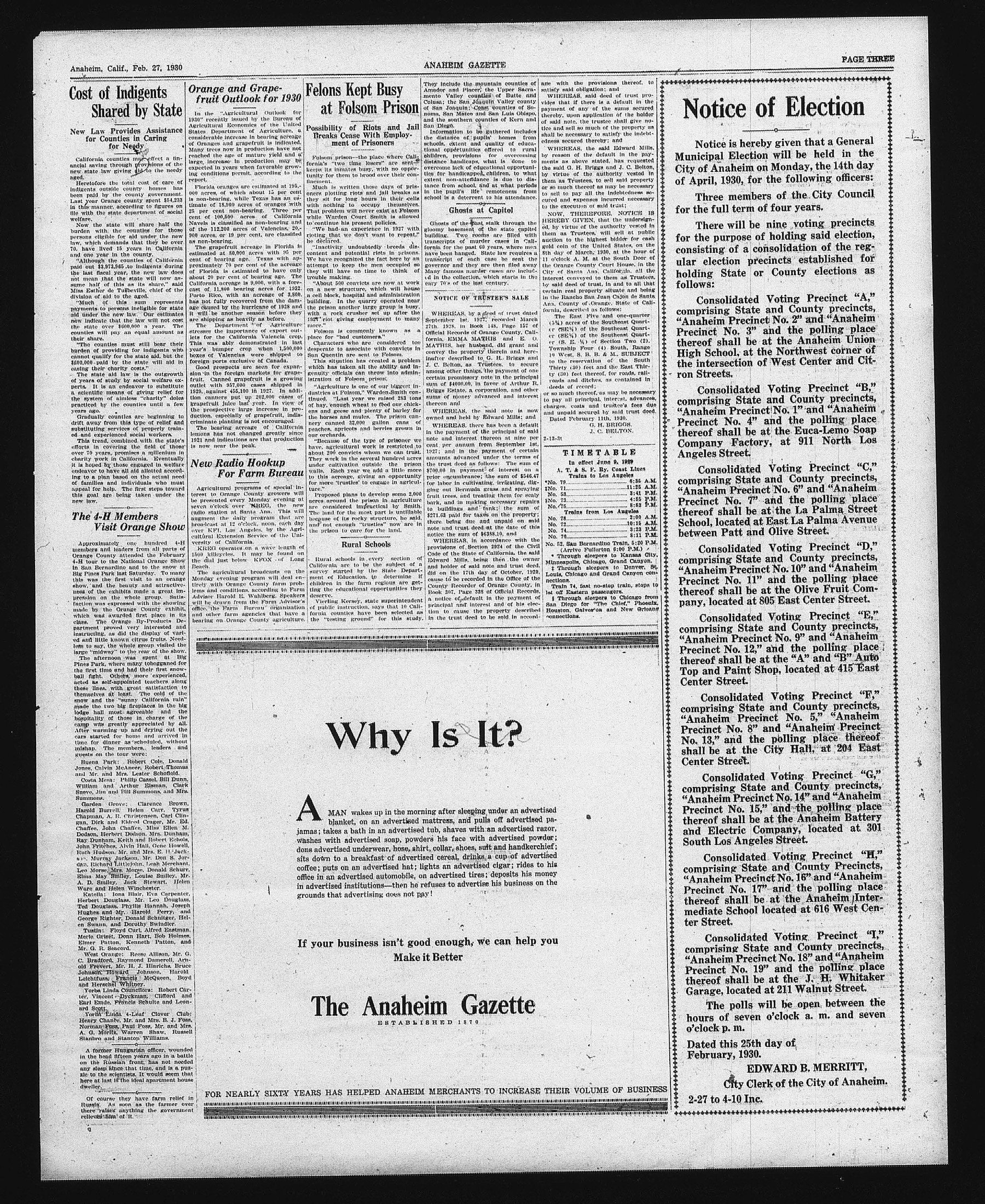
Searchable text
Cost of Indigents Shared by State
New Law Provides Assistance for Counties in Caring for Needy
California counties may affect a financial saving through provisions of the new state law giving aid to the needy aged.
Heretofore the total cost of care of indigents outside county homes has been paid by the county government. Last year Orange county spent $54,233 in this manner, according to figures on file with the state department of social welfare.
Now the state will share half the burden with the counties for those persons eligible for aid under the new law, which demands that they be over 70, have lived 15 years in California and one year in the county.
"Although the counties of California paid out $3,973,965 to indigents during the last fiscal year, the new law does not mean that the state will now assume half of this as its share," said Miss Esther de Tulbeville, chief of the division of aid to the aged.
"Much of this sum represents payments to persons ineligible for state aid under the new law. Our estimates now indicate that the law will not cost the state over $600,000 a year. The counties will pay an equal amount as their share."
"The counties must still bear their burden of providing for indigents who cannot qualify for the state aid, but the $500,000 paid by the state will aid in easing their charity costs."
The state aid law is the outgrowth of years of study by social welfare experts. It is an endeavor to substitute a scientific means of giving relief for the system of alimless "charity" dozes practiced by the counties until a few years ago.
Gradually counties are beginning to drift away from this type of relief and substituting services of properly trained and experienced social workers.
This trend, combined with the state's efforts in covering the field of those orange and grapefruit Outlook for 1930
In the "Agricultural Outlook for 1930" recently issued by the Bureau of Agricultural Economics of the United States Department of Agriculture, a considerable increase in bearing acreage of Oranges and grapefruit is indicated. Many trees now in production have not reached the age of mature yield and a large increase in production may be expected in years when favorable growing conditions permit, according to the report.
Florida oranges are estimated at 195,000 acres, of which about 15 per cent is non-bearing, while Texas has an estimate of 18,900 acres of oranges with 25 per cent non-bearing. Three per cent of 100,500 acres of California Navels is classified as non-bearing and of the 112,200 acres of Valenclas, 20,900 acres, or 19 per cent, are classified as non-bearing.
The grapefruit acreage in Florida is estimated at 80,000 acres with 95 per cent of bearing age. Texas with approximately 70 per cent of the acreage of Florida is estimated to have only about 20 per cent of bearing age. The California acreage is 9,000, with a forecast of 11,800 bearing acres for 1932. Porto Rico, with an acreage of 3,800, has not fully recovered from the damage caused by the hurricane of 1928 and it will be another season before they are shipping as heavily as before.
The Department of Agriculture stresses the importance of export outlets for the California Valencia crop. This was ably demonstrated in last year's bumper crop when 1,500,000 boxes of Valencias were shipped to foreign ports exclusive of Canada.
Good prospects are seen for expansion in the foreign markets for grapefruit. Canned grapefruit is a growing outlet with 957,000 cases shipped in 1929, against 455,100 in 1927. In addition canners put up 202,000 cases of grapefruit juice last year. In view of the prospective large increase in production, especially of grapefruit, indiscriminate planting is not encouraged.
The bearing acreage of California lemons has not changed greatly since 1921 and indications are that production is now near the peak.
Felons Keep at Folsom
Possibility of Red Breaks Cease Went of Prey
Folsom prison—the formia's "two time lice keeps its inmates busy until for them to break infinement.
Much is written there oners plotting riots and they sit for long hours with nothing to occupy. That problem will now while Warden Court continues his present "We had an expert rioting that we don't he declared.
"Inactivity undoubted content and potential We have recognized that attempt to keep them they will have no trouble making.
"About 500 convicts on a new structure, a cell block, hospital building. In the qua the prison another lair with a rock crusher 1927 riot giving emore."
Folsom is common place for "bad custo characters who are desperate to associate San Quentin are sent. This situation has which has taken all genuity officials cannulation of Folsom.
"Agriculture is one dustries at Folsom," titued."Last year of hay, enough wheat ens and geese and pheasant horses and mules nery canned 32,000 peaches, apricots and our orchards."
"Because of the ty have, agricultural we..."
The state aid law is the outgrowth of years of study by social welfare experts. It is an endeavor to substitute a scientific means of giving relief for the system of aimless "charity" doles practiced by the counties until a few years ago.
Gradually counties are beginning to drift away from this type of relief and substituting services of properly trained and experienced social workers.
This trend, combined with the state's efforts in covering the field of those over 70 years, promises a millennium in charity work in California. Eventually it is hoped by those engaged in welfare endeavor to have all aid allotted according to a plan based on the actual need of families and individuals who must appeal for help. The first steps toward this goal are being taken under the new law.
The 4-H Members Visit Orange Show
Approximately one hundred 4-H members and leaders from all parts of Orange County attended the February 4-H tour to the National Orange Show in San Bernardino and to the snow at Big Pines Park last Saturday. To many this was the first visit to an orange show, and the beauty and attractiveness of the exhibits made a great impression on the whole group. Satisfaction was expressed with the showing made by the Orange County exhibit, which was awarded first place in its class. The Orange By-Products Department proved very interested and instructing, as did the display of varied and little known citrus fruits. Needless to say, the whole group visited the large "midway" to the rear of the show.
The afternoon was spent at Big Pines Park, where many tobogganed for the first time and had their first snowball fight. Others, more experienced, acted as self-appointed teachers along these lines, with great satisfaction to themselves at least. The cold of the snow and the "sunny California rain" made the two big fireplaces in the big lodge hall most agreeable and the hospitality of those in charge of the camp was greatly appreciated by all. After warming up and drying out the cars started for home and arrived in time for dinner as scheduled, without mishap. The members, leaders and guests on the tour were:
Buena Park: Robert Cole, Donald Jones, Calvin McAneer, Robert Thomas and Mr. and Mrs. Lester Schofield.
Costa Mesa: Philip Cassel, Bill Dunn, William and Arthur Elsman, Clark Sneeve, Jim and Bill Summons, and Mrs. Summons.
Garden Grove: Clarence Brown, Harold Burrell, Helen Carr, Tyrus Chapman, A. R. Christensen, Carl Clingan, Dick and Eldred Crager, Mr. Ed. Chaffee, John Chaffee, Miss Ellen M. Dodson, Herbert Dodson, Mrs. Dunham, Ray Dunham, Keith and Robert Echols, John Fritches, Alvin Hall, Gene Howell.
New Radio Hookup For Farm Bureau
Agricultural programs of special interest to Orange County growers will be presented every Monday evening at seven o'clock over KREG, the new radio station at Santa Ana. This will augment the daily program that are broadcast at 12 o'clock, noon each day over KFI, Los Angeles, by the Agricultural Extension Service of the University of California.
KREG operates on a wave length of 1500 kilocycles. It may be found on the dial just below KFOX of Long Beach.
The agricultural broadcasts on the Monday evening program will deal entirely with Orange County farm problems and conditions, according to Farm Advisor Harold E. Waltberg. Speakers will be drawn from the Farm Advisor's office, the Farm Bureau organization and other farm agencies that have a bearing on Orange County agriculture.
Rural Schools in California are to be survey started by ment of Education, children in the farming educational deserve.
Vierling Kersey, s of public instruction formia counties have the "testing ground."
Buena Park: Robert Cole, Donald Jones, Calvin McAneer, Robert Thomas and Mr. and Mrs. Lester Schofield.
Costa Mesa: Philip Cassel, Bill Dunn, William and Arthur Elsman, Clark Sneve, Jim and Bill Summons, and Mrs. Summons.
Garden Grove: Clarence Brown, Harold Burrell, Helen Carr, Tyrus Chapman, A. R. Christensen, Carl Clingann, Dick and Eldred Crager, Mr. Ed. Chaffee, John Chaffee, Miss Ellen M. Dodson, Herbert Dodson, Mrs. Dunham, Ray Dunham, Keith and Robert Echols, John Fritches, Alvin Hall, Gene Howell, Ruth Hudson, Mr. and Mrs. E. H. Jackson, Murray Jackson, Mr. Don S. Jordan, Richard Littlejohn, Leah Merchant, Leo Morse, Mrs. Morse, Donald Schurr, Elma May Smiley, Louise Smiley, Mr. A. D. Smiley, Jack Stewart, Helen Ware and Helen Winchester.
Katella: Iona Blair, Eva Carpenter, Herbert Douglass, Mr. Leo Douglass, Ted Douglass, Phyllis Hannah, Joseph Hughes and Mr. Harold Perry, and George Righter, Donald Schnitger, Helen Swann, and Dorothy Swindler.
Tustin: Floyd Curl, Alfred Eastman, Merle Griset, Donn Hart, Bob Holmes, Elmer Patton, Kenneth Patton, and Mr. G. R. Seacord.
West Orange: Reese Allison, Mr. G. C. Bradford, Raymond Damerell, Arnold Frevert, Mr. H. J. Hinrichs, Bruce Johnson Howard Johnson, Harold Lochtfuss, Francis McQueen, Boyd and Herschel Whitney.
Yorba Linda Councillors: Robert Carter, Vincent Dyckman, Clifford and Earl Emde, Francis Schulte and Leonard Scott.
Yorba Linda 4-Leaf Clover Club: Henry Chance, Mr. and Mrs. B. J. Foss, Norman Foss, Paul Foss, Mr. and Mrs. A. G. Moritz, Warren Shaw, Russell Stanbro and Stanton Williams.
A former Hungarian officer wounded in the head fifteen years ago in a battle on the Russian front has not needed any sleep since that time, and is a puzzle to the scientists. It would seem that here at last is the ideal apartment house dweller.
Of course they have farm relief in Russia. As soon as the farmer over there raises anything the government relieves him of it.
ANAHEIM GAZETTE
Felons Kept Busy at Folsom Prison
Possibility of Riots and Jail Breaks Cease With Employment of Prisoners
Folsom prison—the place where California's "two time losers" are sent—keeps its inmates busy, with no opportunity for them to brood over their confinement.
Much is written these days of prisoners plotting riots and jail breaks as they sit for long hours in their cells with nothing to occupy themselves. That problem will never exist at Folsom while Warden Court Smith is allowed to continue his present policies.
"We had an experience in 1927 with rioting that we don't want to repeat," he declared.
"Inactivity undoubtedly breeds discontent and potential riots in prisons. We have recognized the fact here by an attempt to keep the men occupied so they will have no time to think of trouble making."
"About 500 convicts are now at work on a new structure, which will house a cell block, hospital and administration building. In the quarry operated near the prison another large group is busy, with a rock crusher set up after the 1927 riot giving employment to many more."
Folsom is commonly known as a place for "bad customers."
Characters who are considered too desperate to associate with convicts in San Quentin are sent to Folsom.
This situation has created a problem which has taken all the ability and ingenuity officials can throw into administration of Folsom prison.
"Agriculture is one of our biggest industries at Folsom," Warden-Smith continued.
"Last year we raised 233 tons of hay, enough wheat to feed our chickens and geese and plenty of barley for the horses and mules. The prison cannery canned 32,000 gallon cans of peaches, apricots and berries grown in our orchards."
Because of the type of prisoner we have, agricultural work is restricted to
They include the mountain counties of Amador and Placer, the Sacramento Valley counties of Butte and Colusa; the San Joaquin Valley county of San Joaquin; Coast counties of Sonoma, San Matee and San Luis Obispo, and the southern counties of Kern and San Diego.
Information to be gathered includes the distance of pupils' homes from schools, extent and quality of educational opportunities offered to rural children, provisions for overcoming distance handicaps, what is done to overcome lack of educational opportunities for handicapped children, to what extent non-attendance is due to distance from school, and at what periods in the pupil's life remoteness from school is a deterrent to his attendance.
Ghosts at Capitol
Ghosts of the past stalk through the gloomy basement of the state capitol building. Two rooms are filled with transcripts of murder cases in California for the past 60 years, where men have been hanged. State law requires a transcript of each case be sent the governor and they are then filed away. Many famous murder cases are included in the collection, which starts in the early 70s of the last century.
NOTICE OF TRUSTEE'S SALE
WHEREAS, by a good of trust dated September 1st, 1927, recorded March 27th, 1928, in Book 148, Page 157 of Official Records of Orange County, California, EMMA MATHIS and E. O. MATHIS, her husband, did grant and convey the property therein and hereafter described to G. H. Briggs and J. C. Belton, as Trustees, to secure among other things, the payment of one certain promissory note in the principal sum of $4000.00, in favor of Arthur R. Briggs Estate, a corporation, and other sums of money advanced and interest thereon and
WHEREAS, the said note is now owned and held by Edward Mills; and
WHEREAS, there has been a default in the payment of the principal of said note and interest thereon at nine per cent per annum from September 1st,
are with the provisions thereof, to satisfy said obligation; and
WHEREAS, said deed of trust provides that if there is a default in the payment of any of the sums secured thereby, upon application of the holder of said note, the trustee shall give notice and sell so much of the property as shall be necessary to satisfy the indebtedness secured thereby; and
WHEREAS, the said Edward Mills, by reason of the default in the payments as above stated, has requested the said G. H. Briggs and J. C. Belton, by virtue of the authority vested in them as Trustees, to sell said property or so much thereof as may be necessary to sell to pay all the indebtedness secured and expenses incurred necessary to the execution of said trust;
NOW, THEREFORE, NOTICE IS HEREBY GIVEN, that the undersigned, by virtue of the authority vested in them as Trustees, will sell at public auction to the highest bidder for cash gold coin of the United States, on the 3rd day of March, 1930, at the hour of 11 o'clock A.M. at the South Door of the Orange County Court House, in the City of Santa Ana, California, all the interest conveyed to them as Trustees, by said deed of trust, in and to all that certain real property situate and being in the Rancho San Juan Cajon de Santa Ana, County of Orange, State of California, described as follows:
The East Five and one-quarter (5¼) acres of the Southeast Quarter (SE¼) of the Southeast Quarter (SE¼) of the Southeast Quarter (S.E.¼) of Section Two (2). Township Four (4). South Range 10 West, S. B. B. & M., SUBJECT to the reservation of the South Thirty (30) feet and the East Thirty (30) feet thereof, for roads, railroads and ditches, as contained in deeds of record;
or so much thereof, as may be necessary to pay all principal, interest, advances, charges, costs and trustee's fees due and unpaid secured by said trust deed.
Dated February 11th, 1930.
G. H. BRIGGS,
J. C. BELTON.
2-13-3t
Why Is It?
A MAN wakes up in the morning after sleeping under an advertised blanket, on an advertised mattress, and pulls off advertised pajamas; takes a bath in an advertised tub, shaves with an advertised razor, washes with advertised soap, powders his face with advertised powder; dons advertised underwear, hose, shirt, collar, shoes, suit and handkerchief;
A MAN wakes up in the morning after sleeping under an advertised blanket, on an advertised mattress, and pulls off advertised pajamas; takes a bath in an advertised tub, shaves with an advertised razor, washes with advertised soap, powders his face with advertised powder; dons advertised underwear, hose, shirt, collar, shoes, suit and handkerchief; sits down to a breakfast of advertised cereal, drinks a cup of advertised coffee; puts on an advertised hat; lights an advertised cigar; rides to his office in an advertised automobile, on advertised tires; deposits his money in advertised institutions—then he refuses to advertise his business on the grounds that advertising does not pay!
If your business isn't good enough, we can help you
Make it Better
The Anaheim Gazette
ESTABLISHED 1870
YEARS HAS HELPED ANAHEIM MERCHANTS TO INCREASE THEIR VOLUME OF BUSINESS
Notice of Election
Notice is hereby given that a General Municipal Election will be held in the City of Anaheim on Monday, the 14th day of April, 1930, for the following officers:
Three members of the City Council for the full term of four years.
There will be nine voting precincts for the purpose of holding said election, consisting of a consolidation of the regular election precincts established for holding State or County elections as follows:
Consolidated Voting Precinct “A,” comprising State and County precincts, "Anaheim Precinct No. 2" and "Anaheim Precinct No. 3" and the polling place thereof shall be at the Anaheim Union High School, at the Northwest corner of the intersection of West Center and Citron Streets.
Consolidated Voting Precinct “B,” comprising State and County precincts, "Anaheim Precinct No. 1" and "Anaheim Precinct No. 4" and the polling place thereof shall be at the Euca-Lemo Soap Company Factory, at 911 North Los
Consolidated Voting Precinct “B,” comprising State and County precincts,
“Anaheim Precinct No. 1” and “Anaheim Precinct No. 4” and the polling place thereof shall be at the Euca-Lemo Soap Company Factory, at 911 North Los Angeles Street.
Consolidated Voting Precinct “C,” comprising State and County precincts,
“Anaheim Precinct No. 6” and “Anaheim Precinct No. 7” and the polling place thereof shall be at the La Palma Street School, located at East La Palma Avenue between Patt and Olive Street.
Consolidated Voting Precinct “D,” comprising State and County precincts,
“Anaheim Precinct No. 10” and “Anaheim Precinct No. 11” and the polling place thereof shall be at the Olive Fruit Company, located at 805 East Center Street.
Consolidated Voting Precinct “E,” comprising State and County precincts,
“Anaheim Precinct No. 9” and “Anaheim Precinct No. 12,” and the polling place thereof shall be at the “A” and “B” Auto Top and Paint Shop, located at 415 East Center Street.
Consolidated Voting Precinct “F,” comprising State and County precincts,
“Anaheim Precinct No. 5,” “Anaheim Precinct No. 8” and “Anaheim Precinct No. 13,” and the polling place thereof shall be at the City Hall, at 204 East Center Street.
Consolidated Voting Precinct “G,” comprising State and County precincts,
“Anaheim Precinct No. 14” and “Anaheim Precinct No. 15,” and the polling place thereof shall be at the Anaheim Battery and Electric Company, located at 301 South Los Angeles Street.
Consolidated Voting Precinct "G," comprising State and County precincts,
"Anaheim Precinct No. 14" and "Anaheim Precinct No. 15," and the polling place thereof shall be at the Anaheim Battery and Electric Company, located at 301 South Los Angeles Street.
Consolidated Voting Precinct "H," comprising State and County Precincts,
"Anaheim Precinct No. 16" and "Anaheim Precinct No. 17" and the polling place thereof shall be at the Anaheim Intermediate School located at 616 West Center Street.
Consolidated Voting Precinct "I," comprising State and County precincts,
"Anaheim Precinct No. 18" and "Anaheim Precinct No. 19" and the polling place thereof shall be at the J. H. Whitaker Garage, located at 211 Walnut Street.
The polls will be open between the hours of seven o'clock a.m. and seven o'clock p.m.
Dated this 25th day of February, 1930.
EDWARD B. MERRITT,
City Clerk of the City of Anaheim.
2-27 to 4-10 Inc.