anaheim-gazette 1930-02-20
Scanned page
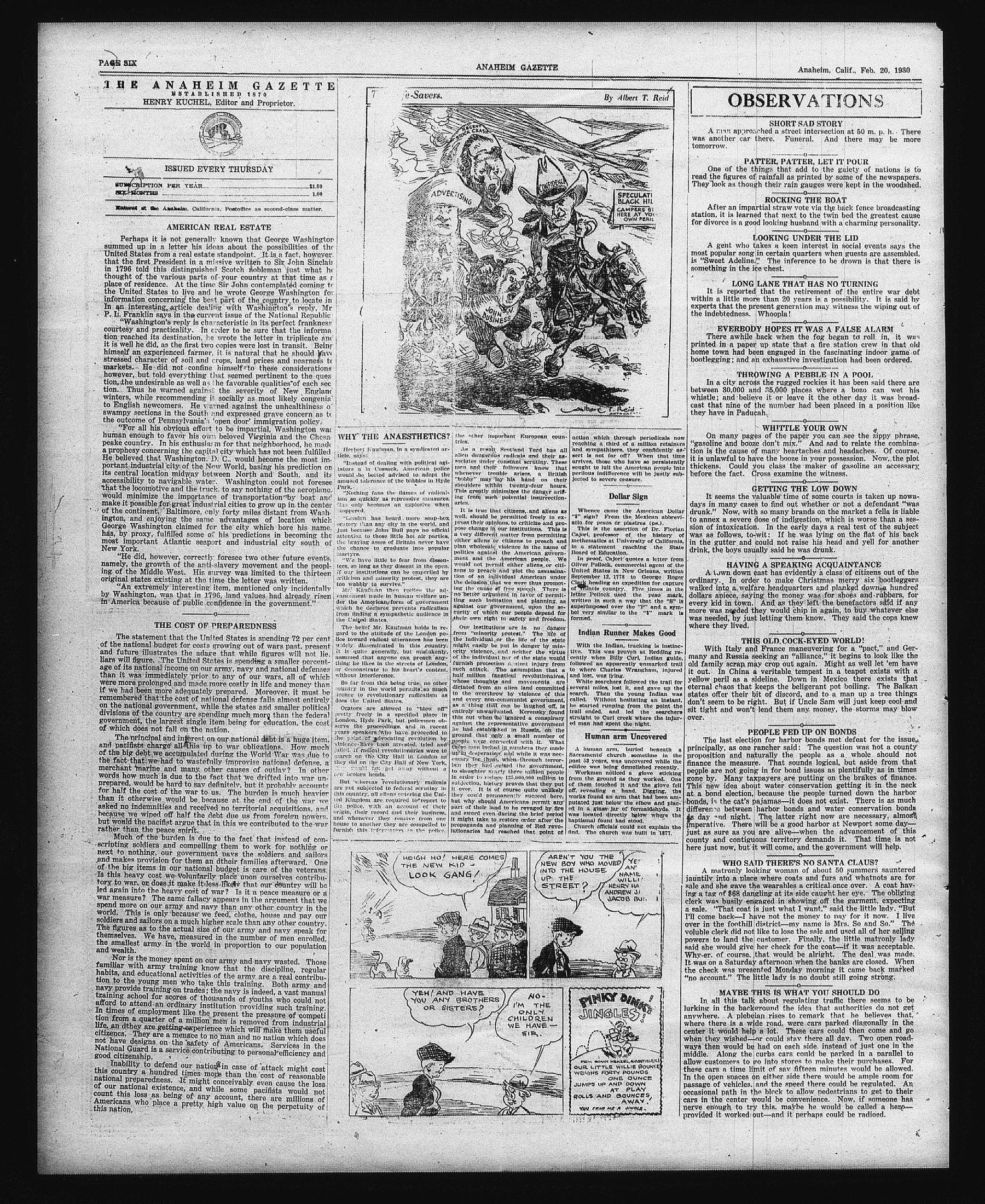
Searchable text
THE ANAHEIM GAZETTE
ESTABLISHED 1870
HENRY KUCHEL, Editor and Proprietor.
ISSUED EVERY THURSDAY
SUBSCRIPTION PER YEAR.....$1.50
SIX MONTHS.....1.00
Enclosed at the Anahalm, California, Postoffice as second-class matter.
AMERICAN REAL ESTATE
Perhaps it is not generally known that George Washington summed up in a letter his ideas about the possibilities of the United States from a real estate standpoint. It is a fact, however, that the first President in a missive written to Sir John Sinclair in 1796 told this distinguished Scotch nobleman just what he thought of the various parts of your country at that time as a place of residence. At the time Sir John contemplated coming to the United States to live and he wrote George Washington for information concerning the best part of the country to locate in. In an interesting article dealing with Washington's reply, Mr. P. L. Franklin says in the current issue of the National Republic:
"Washington's reply is characteristic in its perfect frankness courtesy and practicality. In order to be sure that the information reached its destination, he wrote the letter in triplicate and it is well he did, as the first two copies were lost in transit. Being himself an experienced farmer, it is natural that he should have stressed character of soil and crops, land prices and nearness to markets. He did not confine himself to these considerations however, but told everything that seemed pertinent to the question, the undesirable as well as the favorable qualities of each section. Thus he warned against the severity of New England winters, while recommending it socially as most likely congenial to English newcomers. He warned against the unhealthiness of swampy sections in the South and expressed grave concern as to the outcome of Pennsylvania's 'open door' immigration policy."
For all his obvious effort to be impartial, Washington was human enough to favor his own beloved Virginia and the Chesapeake country. In his enthusiasm for that neighborhood, he made
THE COST OF PREPAREDNESS
The statement that the United States is spending 72 per cent of the national budget for costs growing out of wars past, present and future illustrates the adage that while figures will not lie, liars will figure. The United States is spending a smaller percentage of its national income on our army, navy and national defenses than it was immediately prior to any of our wars, all of which were more prolonged and made more costly in life and money than if we had been more adequately prepared. Moreover, it must be remembered that the cost of national defense falls almost entirely on the national government, while the states and smaller political divisions of the country are spending much more than the federal government, the largest single item being for education, the cost of which does not fall on the nation.
The principal and interest on our national debt is a huge item, and pacifists charge all this up to war obligations. How much of the big debt we accumulated during the World War was due to the fact that we had to wastefully improvise national defense, a merchant marine and many other causes of outlay? In other words how much is due to the fact that we drifted into war unprepared, would be hard to say definitely, but it probably accounts for half the cost of the war to us. The burden is much heavier than it otherwise would be because at the end of the war we asked no indemnities and received no territorial acquisitions, and because we wiped off half the debt due us from foreign powers, but would the pacifist argue that in this we contributed to the war rather than the peace spirit.
Much of the burden is due to the fact that instead of conscripting soldiers and compelling them to work for nothing or markets. He did not confine himself to these considerations however, but told everything that seemed pertinent to the question, the undesirable as well as the favorable qualities of each section. Thus he warned against the severity of New England winters, while recommending it socially as most likely congenial to English newcomers. He warned against the unhealthiness of swampy sections in the South and expressed grave concern as to the outcome of Pennsylvania's 'open door' immigration policy.
"For all his obvious effort to be impartial, Washington was human enough to favor his own beloved Virginia and the Chesapeake country. In his enthusiasm for that neighborhood, he made a prophesy concerning the capital city which has not been fulfilled. He believed that Washington, D.C., would become the most important industrial city of the New World, basing his prediction on its central location midway between North and South, and its accessibility to navigable water. Washington could not foresee that the locomotive and the truck, to say nothing of the aeroplane, would minimize the importance of transportation by boat and make it possible for great industrial cities to grow up in the center of the continent. Baltimore, only forty miles distant from Washington, and enjoying the same advantages of location which George Washington claimed for the city which bore his name, has, by proxy, fulfilled some of his predictions in becoming the most important Atlantic seaport and industrial city south of New York.
"He did, however, correctly foresee two other future events, namely, the growth of the anti-slavery movement and the peopling of the Middle West. His survey was limited to the thirteen original states existing at the time the letter was written.
"An extremely interesting item, mentioned only incidentally by Washington, was that in 1796, land values had already risen in America because of public confidence in the government."
the fact that we had to wastefully improvise national defense, a merchant marine and many other causes of outlay? In other words how much is due to the fact that we drifted into war unprepared, would be hard to sav definitely, but it probably accounts for half the cost of the war to us. The burden is much heavier than it otherwise would be because at the end of the war we asked no indemnities and received no territorial acquisitions, and because we wiped off half the debt due us from foreign powers, but would the pacifist argue that in this we contributed to the war rather than the peace spirit.
Much of the burden is due to the fact that instead of conscripting soldiers and compelling them to work for nothing or next to nothing, our government navs the soldiers and sailors and makes provision for them an dtheir families afterward. One of the big items in our national budget is care of the veterans. Is this heavy cost we voluntarily place upon ourselves contributory to war, or does it make it less likely that our country will be led again into the heavy cost of war? Is it a peace measure or a war measure? The same fallacy appears in the argument that we spend more on our army and navy than any other country in the world. This is only because we feed, clothe, house and pay our soldiers and sailors on a much higher scale than any other country. The figures as to the actual size of our army and navy speak for themselves. We have, measured in the number of men enrolled, the smallest army in the world in proportion to our population and wealth.
Nor is the money spent on our army and navy wasted. Those familiar with army training know that the discipline, regular habits, and educational activities of the army are a real contribution to the young men who take this training. Both army and navy provide training on trades; the navy is indeed, a vast manual training school for scores of thousands of youths who could not afford to attend an ordinary institution providing such training. In times of employment like the present the pressure of competition from a quarter of a million men is removed from industrial life, an dthey are getting experience which will make them useful citizens. They are a menace to no man and no nation which does not have designs on the safety of Americans. Services in the National Guard is a service contributing to personal efficiency and good citizenship.
Inability to defend our nation in case of attack might cost this country a hundred times more than the cost of reasonable national preparedness. It might conceivably even cause the loss of our national existence, and while some pacifists would not count this loss as being of any account, there are millions of Americans who place a pretty high value on the perpetuity of this nation.
ANAHEIM GAZETTE
The Savers. By Albert T. Reid
RECENT STOCK CRASH
ADVERTISING
CONFIDENCE
SPECULATING BLACK HILL CAMPERS ST HERE AT YOUR OWN PERIL
WHY THE ANAESTHETICS?
WHY THE ANAESTHETICS?
Herbert Kaufman, in a syndicated article, says:
"Instead of dealing with political agitators a la Cossack, American police would be betted advised to adopt the amused tolerance of the bobbies in Hyde Park.
Nothing fans the flames of radicalism so quickly as repressive measures. Gas only becomes an explosive when stopped.
London has heard more soap-box oratory than any city in the world, and just because John Bull pays no official attention to these little hot air parties, the braying asses of Britain never have the chance to graduate into popular martyrs.
"We have little to fear from dissenters, so long as they dissect in the open if our institutions can be emperiled by criticism and minority protest, they are too wabby to survive."
Mr. Kaufman then recites the advancement made in human welfare under the American form of government which he declares prevents radicalism from finding a sympathetic audience in the United States.
The belief Mr. Kaufman holds in regard to the attitude of the London police toward radical utterances has been widely disseminated in this country. It is quite generally, but mistakenly, assumed that anyone can preach anything he likes in the streets of London, or demonstrate to his heart's content, without interference.
So far from this being true, no other country in the world permits so much license to revolutionary radicalism as does the United States.
Orators are allowed to "blow off" pretty freely in a specified place in London, Hyde Park, but policemen observe the proceedings, and in recent years speakers who have proceeded to the point of advocating revolution by violence have been arrested, tried and jailed. If radical revolutionsaries were to march on the City Hall in London as they did on the City Hall of New York, they would not get away without a few broken heads.
But whereas revolutionary radicals are not subjected to federal scrutiny in this country, all aliens entering the United Kingdom are required to report to the police, with an account of their origin, their record and their business, and whenever they remove from one house to another they are compelled to furnish this information to the police.
the other important European countries.
As a result Scotland Yard has all alien dangerous radicals and their associates under constant scrutiny. These men and their followers know that whenever trouble arises, a British "bobby" may lay his hand on their shoulders within twenty-four hours. This greatly minimizes the danger arising from such potential insurrectionaries.
It is true that citizens, and aliens as well, should be permitted freely to express their opinions, to criticize and propose change in our institutions. This is a very different matter from permitting either aliens or citizens to preach and plan wholesale violence in the name of politics against the American government and the American people. We would not permit either aliens or citizens to preach and plot the assassination of an individual American under the delusion that we were thus promoting the cause of free speech. There is no better argument in favor of permitting such incitation and planning as against our government, upon the security of which our people depend for their own right to safety and freedom.
Our institutions are in no danger from "minority protest." The life of the individual or the life of the state might easily be put in danger by minority violence, and neither the virtue of the individual nor of the state would furnish protection against injury from such attack. The assumption that a half million fanatical revolutionaires, whose thoughts and movements are dictated from an alien land committed to the overthrow by violence of this and every non-communist government, as a thing that can be laughed off, is entirely unwarranted. Kerensky found this out when he ignored a conspiracy against the representative government he had established in Russia, on the ground that only a small number of people were connected with it. What these men lacked in numbers they made up in desperation, and while it was necessary for them, when through terrorism they had seized the government, to slaughter nearly three million people in order to reduce 125,000,000 million to subjection, history proves that they put it over. It is of course quite unlikely they could permanently succeed here, but why should Americans permit any part of their land to he revoked by fire and sword even during the brief period it might take to restore order after the propoganda and planning of Red revolutionaries had reached that point of action which through periodicals now reaching a third of a million retailers and sympathizers, they confidently assert is not far off? When that time arrives, those who have so persistently sought to lull the American people into perilous indifference will be justly subjected to severe censure.
Dollar Sign
Whence came the American Dollar "$" sign? From the Mexican abbreviation for pesos or plasters (ps.).
This is the assertion of Dr. Florian Cajori, professor of the history of mathematics at University of California, in a statement reaching the State Board of Education.
In proof, Cajori quotes a letter from Oliver Pollock, commercial agent of the United States in New Orleans, written September 12, 1778 to George Roger Clark heading an expedition for capture of Illinois country. Five times in the letter Pollock used the peso mark, written in such a way that the "$" is superimposed over the "P" and a symbol very similar to the "$" mark is formed.
Indian Runner Makes Good
With the Indian, tracking is instinctive. This was proven at Redding recently when Billy Curl, Indian guide, followed an apparently unmarked trail to where Charles Wrangham, injured and lost, was lying.
White searchers followed the trail for several miles, lost it, and gave up the search. Then the young Indian was called. Without hesitating an instant, he started running from the point the trail ended, and led the searchers straight to Curl creek where the injured man had spent the night.
Human arm Uncovered
A human arm, buried beneath a Sacramento church sometime in the past 53 years, was uncovered while the edifice was being demolished recently.
Workmen noticed a glove sticking from the ground as they worked. One of them touched it and the glove fell off, revealing a hand. Digging, the works found an arm that had been amputated just below the elbow and placed in a glass jar of formaldehyde. It was located directly below where the baptism fount had stood.
Church officials could not explain the find. The church was built in 1877.
march on the City Hall in London as they did on the City Hall of New York, would not get away without a new broken heads.
But whereas revolutionary radicals are not subjected to federal scrutiny in this country, all aliens entering the United Kingdom are required to report to the police, with an account of their origin, their record and their business, and whenever they remove from one house to another they are compelled to furnish this information to the police.
Workmen noticed a glove sticking from the ground as they worked. One of them touched it and the glove fell off, revealing a hand. Digging, the works found an arm that had been amputated just below the elbow and placed in a glass jar of formaldehyde. It was located directly below where the baptismal fount had stood.
Church officials could not explain the find. The church was built in 1877.
HEIGH HO! HERE COMES THE NEW KID - LOOK GANG!
AREN'T YOU THE NEW BOY WHO MOVED INTO THE HOUSE UP THE STREET?
YEH! AND HAVE YOU ANY BROTHERS OR SISTERS?
NO- I'M THE ONLY CHILDREN WE HAVE—SIR.
PINKY DINK JINGLES!
FROM BONNY HENXEL, RUPERTFIELD,
OUR LITTLE WILLIE BOUNCE
WEIGHTS FORTY POUNDS
ONE OUNCE
JUMPS UP AND DOWN
AT PLAY
ROLLS AND BOUNCES,
AWAY!
YOU READ ME A WINOLE.
OBSERVATIONS
SHORT SAD STORY
A man approached a street intersection at 50 m. p. h. There was another car there. Funeral. And there may be more tomorrow.
PATTER, PATTER, LET IT POUR
One of the things that add to the gaiety of nations is to read the figures of rainfall as printed by some of the newspapers. They look as though their rain gauges were kept in the woodshed.
ROCKING THE BOAT
After an impartial straw vote via the back fence broadcasting station, it is learned that next to the twin bed the greatest cause for divorce is a good looking husband with a charming personality.
LOOKING UNDER THE LID
A gent who takes a keen interest in social events says the most popular song in certain quarters when guests are assembled, is "Sweet Adeline." The inference to be drown is that there is something in the ice chest.
LONG LANE THAT HAS NO TURNING
It is reported that the retirement of the entire war debt within a little more than 20 years is a possibility. It is said by experts that the present generation may witness the wiping out of the indebtedness. Whoopla!
EVERBODY HOPES IT WAS A FALSE ALARM
There awhile back when the fog began to roll in, it was printed in a paper up state that a fire station crew in that old home town had been engaged in the fascinating indoor game of bootlegging; and an exhaustive investigation had been ordered.
THROWING A PEBBLE IN A POOL
In a city across the rugged rockies it has been said there are between 30,000 and 35,000 places where a bozo can wet his whistle; and believe it or leave it the other day it was broadcast that nine of the number had been placed in a position like they have in Paducah.
WHITTLE YOUR OWN
On many pages of the paper you can see the zippy phrase, "gasoline and booze don't mix." And sad to relate the combina-
THROWING A PEBBLE IN A POOL
In a city across the rugged rockies it has been said there are between 30,000 and 35,000 places where a bozo can wet his whistle; and believe it or leave it the other day it was broadcast that nine of the number had been placed in a position like they have in Paducah.
WHITTLE YOUR OWN
On many pages of the paper you can see the zippy phrase, "gasoline and booze don't mix." And sad to relate the combination is the cause of many heartaches and headaches. Of course, it is unlawful to have the booze in your possession. Now, the plot thickens. Could you class the maker of gasoline an accessary before the fact. Cross examine the witness.
GETTING THE LOW DOWN
It seems the valuable time of some courts is taken up nowadays in many cases to find out whether or not a defendant "was drunk." Now, with so many brands on the market a fella is liable to annex a severe dose of indigestion, which is worse than a session of intoxication. In the early days a real test of the subject was as follows, to-wit: If he was lying on the flat of his back in the gutter and could not raise his head and yell for another drink, the boys usually said he was drunk.
HAVING A SPEAKING ACQUAINTANCE
A town down east has evidently a class of citizens out of the ordinary. In order to make Christmas merry six bootleggers walked into a welfare headquarters and planked down a hundred dollars apiece, saying the money was for shoes and rubbers, for every kid in town. And as they left the benefactors said if any more was needed they would chip in again, to buy whatever else was needed, by just letting them know. They said the cops knew where they lived.
THIS OLD COCK-EYED WORLD!
With Italy and France maneuvering for a "pact," and Germany and Russia seeking an "alliance," it begins to look like the old family scrap may crop out again. Might as well let 'em have it out. In China a veritable tempest in a teapot exists with a yellow peril as a sideline. Down in Mexico there exists that eternal chaos that keeps the beligerant pot boiling. The Balkan states offer their bit of discord, and to a man up a tree things don't seem to be right. But if Uncle Sam will just keep cool and sit tight and won't lend them any money, the storms may blow over.
PEOPLE FED UP ON BONDS
The last election for harbor bonds met defeat for the issue principally, as one rancher said: The question was not a county proposition and naturally the people as a whole should not finance the measure. That sounds logical, but aside from that people are not going in for bond issues as plentifully as in times gone by. Many taxpayers are putting on the brakes of finance. This new idea about water conservation getting it in the neck at a bond election, because the people turned down the harbor bonds, is the cat's pajamas—it does not exist. There is as much difference between harbor bonds and water conservation bonds as day and night. The latter right now are necessary, almost imperative. There will be a good harbor at Newport some day—just as sure as you are alive—when the advancement of this county and contiguous territory demands it. That time is not here just now, but it will come, and the government will help.
WHO SAID THERE'S NO SANTA CLAUS?
A matronly looking woman of about 50 summers sauntered jauntily into a place where coats and furs and whatnots are for sale and she gave the wearables a critical once over. A coat having a tag of $68 dangling at its side caught her eye. The obliging clerk was busily engaged in showing off the garment, expecting a sale. "That coat is just what I want," said the little lady. "But I'll come back—I have not the money to pay for it now. I live over in the foothill district—my name is Mrs. So and So." The voluble clerk did not like to lose the sale and used all of her selling powers to land the customer. Finally, the matronly lady said she would give her check for the coat—if it was acceptable. Why-er, of course, that would be alright. The deal was made: It was on a Saturday afternoon when the banks are closed. When the check was presented Monday morning it came back marked "no account." The little lady is no doubt still going strong.
MAYBE THIS IS WHAT YOU SHOULD DO
In all this talk about regulating traffic there seems to be lurking in the background the idea that authorities do not get anywhere. A plebeian rises to remark that he believes that, where there is a wide road, were cars parked diagonally in the center it would help a lot. These cars could then come and go when they wished—or could stay there all day. Two open roads then would be had on each side, instead of just one in the middle. Along the curbs cars could be parked in a parallel to allow customers to go into stores to make their purchases. For these cars a time limit of say fifteen minutes would be allowed. In the open spaces on either side there would be ample room for passage of vehicles, and the speed there could be regulated. An occasional path in the block to allow pedestrians to get to their cars in the center would be convenience. Now, if someone has nerve enough to try this, maybe he would be called a hero—provided it worked out—and it perhaps could be radioed.