anaheim-gazette 1930-02-13
Scanned page
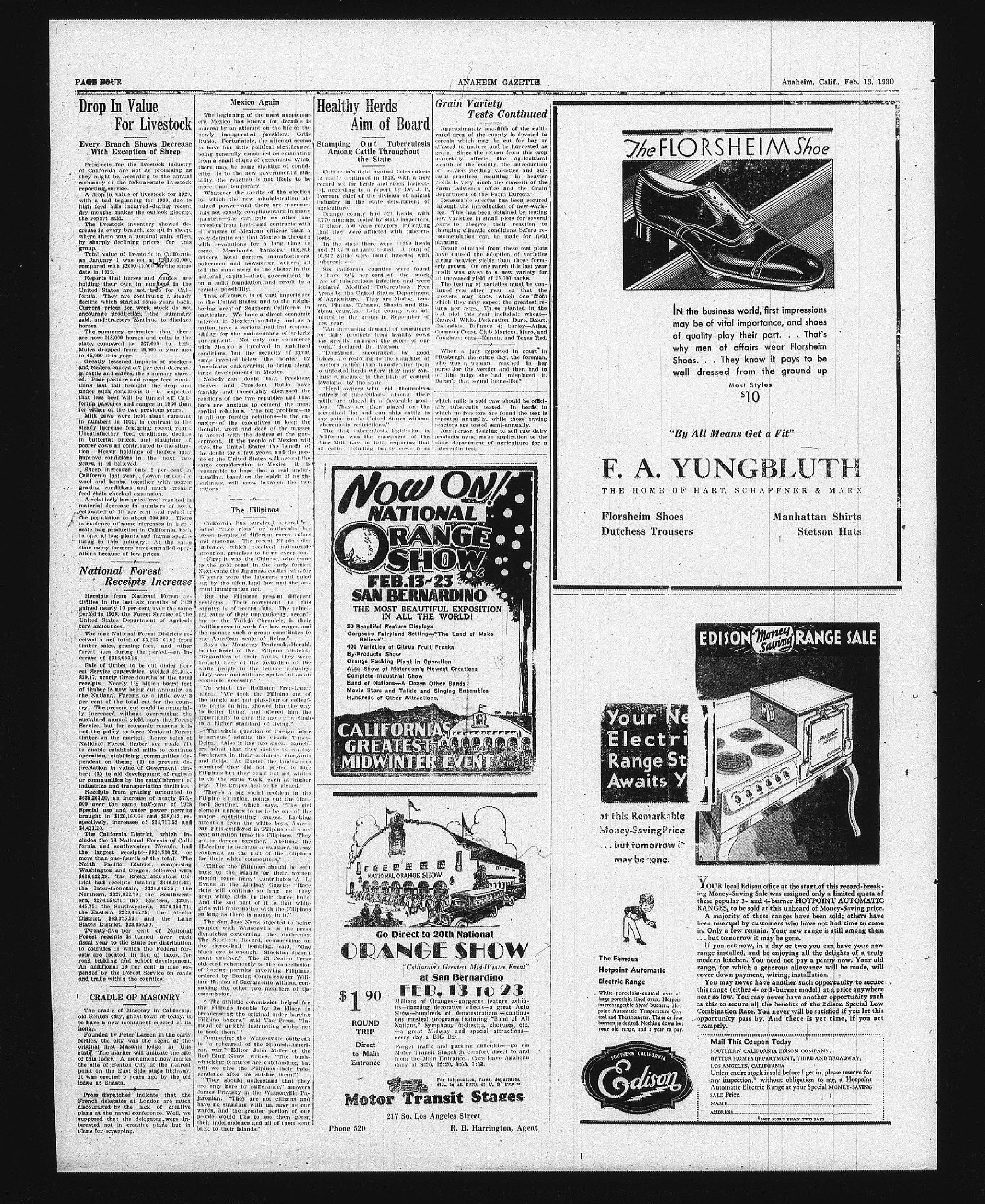
Searchable text
Drop In Value For Livestock
Every Branch Shows Decrease With Exception of Sheep
Prospects for the livestock industry of California are not as promising as they might be, according to the annual summary of the federal-state livestock reporting service.
A drop in value of livestock for 1929, with a bad beginning for 1930, due to high feed bills incurred during recent dry months, makes the outlook gloomy, the report said.
The livestock inventory showed decrease in every branch, except in sheep, where there was a nominal gain, offset by sharply declining prices for this group.
Total value of livestock in California on January 1 was set at $260,041,000, compared with $260,041,000 for the same date in 1929.
Reports that horses and mules are holding their own in numbers in the United States are not true for California. They are continuing a steady decline which started some years back. Current prices for work stock do not encourage production, the summary said, and tractors continue to displace horses.
The summary estimates that there are now 248,000 horses and colts in the state, compared to 267,000 in 1929. Mules dropped from 49,000 a year ago to 45,000 this year.
Greatly lessened imports of stockers and feeders caused a 7 per cent decrease in cattle and calves, the summary showed. Poor pasture and range feed conditions last fall brought the drop and under such conditions it is expected that less beef will be turned off California pastures and ranges in 1930 than for either of the two previous years.
Milk cows were held about constant in numbers in 1929, in contrast to the steady increase featuring recent years. Unsatisfactory feed conditions, decline in butterfat prices, and slaughter of poorer cows all contributed to the situation.
Mexico Again
The beginning of the most auspicious era Mexico has known for decades is marred by an attempt on the life of the newly inaugurated president. Ortis Rubio. Fortunately, the attempt seems to have but little political significance, being generally construed as emanating from a small clique of extremists. While there may be some shaking of confidence is to the new government's stability, the reaction is not likely to be more than temporary.
Whatever the merits of the election by which the new administration attained power—and there are murmurings not exactly complimentary in many quarters—one can gain on other impressions from first-hand contracts with all classes of Mexican citizens than a very definite one that Mexico is through with revolutions for a long time to come. Merchants, bankers, taxicab drivers, hotel porters, manufacturers, policemen and newspaper writers all tell the same story to the visitor in the national capital—that government is on a solid foundation and revolt is a remote possibility.
This, of course, is of vast importance to the United States, and to the neighboring area of Southern California in particular. We have a direct economic interest in Mexican stability and as a nation have a serious political responsibility for the maintenance of orderly government. Not only our commerce with Mexico is involved in stabilized conditions, but the security of great sums invested below the border by Americans endeavoring to bring about large developments in Mexico.
Nobody can doubt that President Hoover and President Rubio have frankly and thoroughly discussed the relations of the two republics and that both are anxious to cement the most cordial relations. The big problem—as in all our foreign relations—is the capacity of the executives to keep the thought, word and deed of the masses in accord with the desires of the government. If the people of Mexico will give the United States the benefit of...
Greatly lessened imports of stockers and feeders caused a 7 per cent decrease in cattle and calves, the summary showed. Poor pasture and range feed conditions last fall brought the drop and under such conditions it is expected that less beef will be turned off California pastures and ranges in 1930 than for either of the two previous years.
Milk cows were held about constant in numbers in 1929, in contrast to the steady increase featuring recent years. Unsatisfactory feed conditions, decline in butterfat prices, and slaughter of poorer cows all contributed to the situation. Heavy holdings of heifers may improve conditions in the next two years, it is believed.
Sheep increased only 2 per cent in California last year. Lower prices for wool and lambs, together with poorer grazing conditions and much greater feed costs checked expansion.
A relatively low price level resulted in material decrease in numbers of hogs estimated at 10 per cent and reducing the population to about 500,000. There is evidence of some increases in large-scale hog production in California, both in special hog plants and farms specialized in this industry. At the same time many farmers have curtailed operations because of low prices.
National Forest Receipts Increase
Receipts from National Forest activities in the last six months of 1929 gained nearly 10 per cent over the same period in 1928, the Forest Service of the United States Department of Agriculture announces.
The nine National Forest Districts received a net total of $3,245,164.03 from timber sales, grazing fees, and other forest uses during the period—an increase of $316,053.98.
Sale of timber to be cut under Forest Service supervision, yielded $2,405,829.17, nearly three-fourths of the total receipts. Nearly 1½ billion board feet of timber is now being cut annually on the National Forests or a little over 3 per cent of the total cut for the country. The present cut could be materially increased without overcutting the sustained annual yield, says the Forest Service, but for economic reasons it is not the policy to force National Forest timber on the market. Large sales of National Forest timber are made (1) to enable established mills to continue operation, stabilizing communities dependent on them; (2) to prevent depreciation in value of Government timber; (3) to aid development of regions or communities by the establishment of industries and transportation facilities.
Receipts from grazing amounted to $625,267.99, an increase of nearly $75,000 over the same half-year of 1928 Special use and water power permits brought in $120,168.64 and $58,042 respectively, increases of $24,711.52 and $4,431.20.
The California District, which includes the 18 National Forests of California and southwestern Nevada, had greatly lessened imports of stockers and feeders caused a 7 per cent decrease in cattle and calves, the summary showed. Poor pasture and range feed conditions last fall brought the drop and under such conditions it is expected that less beef will be turned off California pastures and ranges in 1930 than for either of the two previous years.
Milk cows were held about constant in numbers in 1929, in contrast to the steady increase featuring recent years. Unsatisfactory feed conditions, decline in butterfat prices, and slaughter of poorer cows all contributed to the situation. Heavy holdings of heifers may improve conditions in the next two years, it is believed.
Sheep increased only 2 per cent in California last year. Lower prices for wool and lambs, together with poorer grazing conditions and much greater feed costs checked expansion.
A relatively low price level resulted in material decrease in numbers of hogs estimated at 10 per cent and reducing the population to about 500,000. There is evidence of some increases in large-scale hog production in California, both in special hog plants and farms specialized in this industry. At the same time many farmers have curtailed operations because of low prices.
National Forest Receipts Increase
Receipts from National Forest activities in the last six months of 1929 gained nearly 10 per cent over the same period in 1928, the Forest Service of the United States Department of Agriculture announces.
The nine National Forest Districts received a net total of $3,245,164.03 from timber sales, grazing fees, and other forest uses during the period—an increase of $316,053.98.
Sale of timber to be cut under Forest Service supervision, yielded $2,405,829.17, nearly three-fourths of the total receipts. Nearly 1½ billion board feet of timber is now being cut annually on the National Forests or a little over 3 per cent of the total cut for the country. The present cut could be materially increased without overcutting the sustained annual yield, says the Forest Service, but for economic reasons it is not the policy to force National Forest timber on the market. Large sales of National Forest timber are made (1) to enable established mills to continue operation, stabilizing communities dependent on them; (2) to prevent depreciation in value of Government timber; (3) to aid development of regions or communities by the establishment of industries and transportation facilities.
Receipts from grazing amounted to $625,267.99, an increase of nearly $75,000 over the same half-year of 1928 Special use and water power permits brought in $120,168.64 and $58,042 respectively, increases of $24,711.52 and $4,431.20.
The California District, which includes the 18 National Forests of California and southwestern Nevada, had greatly lessened imports of stockers and feeders caused a 7 per cent decrease in cattle and calves, the summary showed. Poor pasture and range feed conditions last fall brought the drop and under such conditions it is expected that less beef will be turned off California pastures and ranges in 1930 than for either of the two previous years.
Milk cows were held about constant in numbers in 1929, in contrast to the steady increase featuring recent years. Unsatisfactory feed conditions, decline in butterfat prices, and slaughter of poorer cows all contributed to the situation. Heavy holdings of heifers may improve conditions in the next two years, it is believed.
Sheep increased only 2 per cent in California last year. Lower prices for wool and lambs, together with poorer grazing conditions and much greater feed costs checked expansion.
A relatively low price level resulted in material decrease in numbers of hogs estimated at 10 per cent and reducing the population to about 500,000. There is evidence of some increases in large-scale hog production in California, both in special hog plants and farms specialized in this industry. At the same time many farmers have curtailed operations because of low prices.
National Forest Receipts Increase
Receipts from National Forest activities in the last six months of 1929 gained nearly 10 per cent over the same period in 1928, the Forest Service of the United States Department of Agriculture announces.
The nine National Forest Districts received a net total of $3,245,164.03 from timber sales, grazing fees, and other forest uses during the period—an increase of $316,053.98.
Sale of timber to be cut under Forest Service supervision, yielded $2,405,829.17, nearly three-fourths of the total receipts. Nearly 1½ billion board feet of timber is now being cut annually on the National Forests or a little over 3 per cent of the total cut for the country. The present cut could be materially increased without overcutting the sustained annual yield, says the Forest Service, but for economic reasons it is not the policy to force National Forest timber on the market. Large sales of National Forest timber are made (1) to enable established mills to continue operation, stabilizing communities dependent on them; (2) to prevent depreciation in value of Government timber; (3) to aid development of regions or communities by the establishment of industries and transportation facilities.
Receipts from grazing amounted to $625,267.99, an increase of nearly $75,000 over the same half-year of 1928 Special use and water power permits brought in $120,168.64 and $58,042 respectively, increases of $24,711.52 and $4,431.20.
The California District, which includes the 18 National Forests of California and southwestern Nevada, had greatly lessened imports of stockers and feeders caused a 7 per cent decrease in cattle and calves, the summary showed. Poor pasture and range feed conditions last fall brought the drop and under such conditions it is expected that less beef will be turned off California pastures and ranges in 1930 than for either of the two previous years.
Milk cows were held about constant in numbers in 1929, in contrast to the steady increase featuring recent years. Unsatisfactory feed conditions, decline in butterfat prices, and slaughter of poorer cows all contributed to the situation. Heavy holdings of heifers may improve conditions in the next two years, it is believed.
Sheep increased only 2 per cent in California last year. Lower prices for wool and lambs, together with poorer grazing conditions and much greater feed costs checked expansion.
A relatively low price level resulted in material decrease in numbers of hogs estimated at 10 per cent and reducing the population to about 500,000. There is evidence of some increases in large-scale hog production in California, both in special hog plants and farms specialized in this industry. At the same time many farmers have curtailed operations because of low prices.
National Forest Receipts Increase
Receipts from National Forest activities in the last six months of 1929 gained nearly 10 per cent over the same period in 1928, the Forest Service of the United States Department of Agriculture announces.
The nine National Forest Districts received a net total of $3,245,164.03 from timber sales, grazing fees, and other forest uses during the period—an increase of $316,053.98.
Sale of timber to be cut under Forest Service supervision, yielded $2,405,829.17, nearly three-fourths of the total receipts. Nearly 1½ billion board feet of timber is now being cut annually on the National Forests or a little over 3 per cent of the total cut for the country. The present cut could be materially increased without overcutting the sustained annual yield, says the Forest Service, but for economic reasons it is not the policy to force National Forest timber on the market. Large sales of National Forest timber are made (1) to enable established mills to continue operation, stabilizing communities dependent on them; (2) to prevent depreciation in value of Government timber; (3) to aid development of regions or communities by the establishment of industries and transportation facilities.
Receipts from grazing amounted to $625,267.99, an increase of nearly $75,000 over the same half-year of 1928 Special use and water power permits brought in $120,168.64 and $58,042 respectively,increases of $24,711.52和$4,431.20.
The California District,which includes the 18 National ForestsofCaliforniaand southwesternNevada,had greatly lessenedimportssofstockersandfeedconditionslastfallbroughtthedropandundersuchconditionsitisexpectedthatrealunderstandingbasedonthespiritofneighborhoodwillgrowbetweenthetwonations.
National Forest Receipts Increase
Receipts from National Forest activities in the last six months of 1929 gained nearly 10 per cent over the same period in 1928 Special use and water power permits brought in $120,168.64和$58,042 respectively,increasesof$24,711.52和$4,431.20.
The California District,which includesthe 18NationalForestsofCaliforniaand southwesternNevada,had greatly lessenedimportssofstockersandfeedconditionslastfallbroughtthedropandundersuchconditionsitisexpectedthatrealunderstandingbasedonthespiritofneighborhoodwillgrowbetweenthetwonations.
National Forest Receipts Increase
Receipts from National Forest activities in the last six months of 1929 gained nearly 10 per cent over the same period in 1928 Special use and water power permits brought in $120,168.64和$58,042 respectively,increasesof$24,711.52和$4,431.20.
The California District,which includesthe 18NationalForestsofCaliforniaand southwesternNevada,had greatly lessenedimportssofstockersandfeedconditionslastfallbroughtthedropandundersuchconditionsitisexpectedthatrealunderstandingbasedonthespiritofneighborhoodwillgrowbetweenthetwonations.
National Forest Receipts Increase
Receipts from National Forest activities in the last six months of 1929 gained nearly 10 per cent over the same period in 1928 Special use and water power permits brought in $120,168.64和$58,042 respectively,increasesof$24,711.52和$4,431.20.
The California District,which includesthe 18NationalForestsofCaliforniaand southwesternNevada,had greatly lessenedimportssofstockersandfeedconditionslastfallbroughtthedropandundersuchconditionsitisexpectedthatrealunderstandingbasedonthespiritofneighborhoodwillgrowbetweenthetwonations.
National Forest Receipts Increase
Receipts from National Forest activities in the last six months of 1929 gained nearly 10 per cent over the same period in 1928 Special use and water power permits brought in $120,168.64和$58,042 respectively,increasesof$24,711.52和$4,431.20.
The California District,which includesthe 18NationalForestsofCaliforniaand southwesternNevada,had greatly lessenedimportssofstockersandfeedconditionslastfallbroughtthedropandundersuchconditionsitisexpectedthatrealunderstandingbasedonthespiritofneighborhoodwillgrowbetweenthetwonations.
National Forest Receipts Increase
Receipts from National Forest activities in the last six months of 1929 gained nearly 10 per cent over the same period in 1928 Special use and water power permits brought in $120,168.64和$58,042 respectively,increasesof$24,711.52和$4,431.20.
The California District,which includesthe 18NationalForestsofCaliforniaand southwesternNevada,had greatly lessenedimportssofstockersandfeedconditionslastfallbroughtthedropandundersuchconditionsitisexpectedthatrealunderstandingbasedonthespiritofneighborhoodwillgrowbetweenthetwonations.
National Forest Receipts Increase
Receipts from National Forest activities in the last six months of 1929 gained nearly 10 per cent over the same period in 1928 Special use and water power permits brought in $120,168.64和$58,042 respectively,increasesof$24,711.52和$4,431.20.
The California District,which includesthe 18NationalForestsofCaliforniaand southwesternNevada,had greatly lessenedimportssofstockersandfeedconditionslastfallbroughtthedropandundersuchconditionsitisexpectedthatrealunderstandingbasedonthespiritofneighborhoodwillgrowbetweenthetwonations.
National Forest Receipts Increase
Receipts from National Forest activities in the last six months of 1929 gained nearly 10 per cent over the same period in 1928 Special use and water power permits brought in $120,168.64和$58,042 respectively,increasesof$24,711.52和$4,431.20.
The California District,which includesthe 18NationalForestsofCaliforniaand southwesternNevada,had greatly lessenedimportssofstockersandfeedconditionslastfallbroughtthedropandundersuchconditionsitisexpectedthatrealunderstandingbasedonthespiritofneighborhoodwillgrowbetweenthetwonations.
National Forest Receipts Increase
Receipts from National Forest activities in the last six months of 1929 gained nearly 10 per cent over the same period in 1928 Special use and water power permits brought in $120,168.64和$58,042 respectively,increasesof$24,711.52和$4,431.20.
The California District,which includesthe 18NationalForestsofCaliforniaand southwesternNevada,had greatly lessenedimportssofstockersandfeedconditionslastfallbroughtthedropandundersuchconditionsitisexpectedthatrealunderstandingbasedonthespiritofneighborhoodwillgrowbetweenthetwonations.
National Forest Receipts Increase
Receipts from National Forest activities in the last six months of 1929 gained nearly 10 per cent over the same period in 1928 Special use and water power permits brought in $120,I68.64和$58,O42 respectively,increasesof$24,7IJL.SI.Zand$4 ,43I.LZ.
The California District,which includesthe 18NationalForestsofCaliforniaand southwesternNevada,had greatly lessenedimportssofstockersandfeedconditionslastfallbroughtthedropandundersuchconditionsitisexpectedthatrealunderstandingbasedonthespiritofneighborhoodwillgrowbetweenthetwonations.
National Forest Receipts Increase
Receipts from National Forest activities in the last six months of 1929 gained nearly 10 per cent over the same period in 1928 Special use and water power permits brought in $I2O.I68..GAI.Zand$4 ,43I.LZ.
The California District,which includesthe 18NationalForestsofCaliforniaand southwesternNevada,had greatly lessenedimportssofstockersandfeedconditionslastfallbroughtthedropandundersuchconditionsitisexpectedthatrealunderstandingbasedonthespiritofneighborhoodwillgrowbetweenthetwonables."
The California District,which includesthe 18NationalForestsofCaliforniaand southwesternNevada,had greatly lessenedimportssofstockersandfeedconditionslastfallbroughtthedropandundersuchconditionsitisexpectedthatrealunderstandingbasedonthespiritofneighborhoodwillgrowbetweenthetwonables."
CRADLE OF MASONRY
The cradle of Masonry in California, old Benton City, ghost town of today, is to have a new monument erected in its honor.
Founded by Peter Lassen in the early forties, the city was the scene of the original first Masonic lodge in this state. The marker will indicate the site of this lodge. A monument now marks the site of Benton City at the nearest point on the East Side state highway. It was erected 9 years ago by the old lodge at Shasta.
Press dispatches indicate that the French delegates at London are much discouraged by the lack of creative plans at the naval conference. Well, we supposed that the delegates were interested not in creative plans but in plans for scrapping.
Healthy Herds
Aim of Board
Stamping Out Tuberculosis Among Cattle Throughout the State
California's fight against tuberculosis in cattle continued in 1926, with a new record set for herds and stock inspected, according to a report by Dr. J. P. Iverson, chief of the division of animal industry in the state department of agriculture.
Orange county had 521 herds, with 3,770 animals tested by state inspectors. Of these, 550 were reactors, indicating that they were afflicted with tuberculosis.
In the state there were 10,299 herds and 213,790 animals tested. A total of 10,842 cattle were found infected with tuberculosis.
Six California counties were found to have 99% per cent of the stock of tuberculosis infection and were declared Modified Tuberculosis Free Areas by the United States Department of Agriculture. They are Modoc, Lassen, Plumas, Tchama, Shasta and Siskiyou counties. Lake county was admitted to the group in September of last year.
"An increasing demand of consumers for dairy products from healthy cows has greatly enlarged the score of our work," declared Dr. Iverson.
"Dairymen, encouraged by good prices, are restoring to the slaughter of reactors rather than transferring them to untested herds where they may continue a menace to the plan of control developed by the state."
"Herd owners who rid themselves entirely of tuberculosis among their cattle are placed in a favorable position. They are then placed on the accredited list and can ship cattle to any point in the United States without tuberculosis restrictions."
The first tuberculosis legislation in California was the enactment of the Pure Milk Law in 1915, requiring that all cattle including family cows from which milk is sold raw should be officially tuberculin tested. In herds in which no reactors are found the test is repeated annually, while those having reactors are tested semi-annually.
Any person desiring to sell raw dairy products must make application to the state department of agriculture for a tuberculin test.
Now On! NATIONAL ORANGE SHOW
FEB.13-23
SAN BERNARDINO
THE MOST BEAUTIFUL EXPOSITION IN ALL THE WORLD!
20 Beautiful Feature Displays
Gorgeous Fairyland Setting—"The Land of Make Believe"
400 Varieties of Citrus Fruit Freaks
By Products Show
Orange Packing Plant in Operation
Auto Show of Motordom's Newest Creations
Complete Industrial Show
Band of Nations—A Dozen Other Bands
Movie Stars and Talkle and Singing Ensembles
Hundreds of Other Attractions.
CALIFORNIA'S GREATEST MIDWINTER EVENT
MIDWINTER EVENT
NATIONAL ORANGE SHOW
Go Direct to 20th National
ORANGE SHOW
"California's Greatest Mid-Winter Event"
at San Bernardino
FEB. 13 to 23
$1.90
ROUND TRIP
Direct to Main Entrance
Millions of Oranges—gorgeous feature exhibits—dazzling decorative effects—a great Auto Show—hundreds of demonstrations—continuous musical programs featuring "Band of All Nations," Symphony orchestra, choruses, etc.—a great Midway and special attractions—every day a BIG Daw.
Forget traffic and parking difficulties—go via Motor Transit Stages in comfort direct to and from the Main Entrance. Cars leave Anaheim daily at 8:26, 12:20, 3:53, 7:13.
For information, fares, departures, etc., to all parts of U. S. Inquire
Motor Transit Stages
217 So. Los Angeles Street
Phone 520 R. B. Harrington, Agent
The FLORSHEIM Shoe
IN the business world, first impressions may be of vital importance, and shoes of quality play their part. . . That's why men of affairs wear Florsheim Shoes. . . They know it pays to be well dressed from the ground up
Most Styles
$10
"By All Means Get a Fit"
Shoes... They know it pays to be well dressed from the ground up
Most Styles
$10
"By All Means Get a Fit"
E. A. YUNGBLUTH
HOME OF HART, SCHAFFNER & MARX
Parsheim Shoes
Butchess Trousers
Manhattan Shirts
Stetson Hats
EDISON Money Saving Range Sale
Your New Electric Range Stove Waits You
This Remarkable Money-Saving Price Out Tomorrow!
YOUR local Edison office at the start of this record-breaking Money-Saving Sale was assigned only a limited quota of these popular 3- and 4-burner HOTPOINT AUTOMATIC RANGES, to be sold at this unheard of Money-Saving price.
A majority of those ranges have been sold; others have been reserved by customers who have not had time to come in. Only a few remain. Your new range is still among them... but tomorrow it may be gone.
If you act now, in a day or two you can have your new range installed, and be enjoying all the delights of a truly modern kitchen. You need not pay a penny now. Your old range, for which a generous allowance will be made, will cover down payment, wiring, installation.
You may never have another such opportunity to secure this range (either 4- or 3-burner model) at a price anywhere near so low. You may never have another opportunity such as this to secure all the benefits of the Edison Special Low Combination Rate. You never will be satisfied if you let this opportunity pass by. And there is yet time, if you act promptly.
Mail This Coupon Today
SOUTHERN CALIFORNIA EDISON COMPANY,
BETTER HOMES DEPARTMENT, THIRD AND BROADWAY,
LOS ANGELES, CALIFORNIA
Unless entire stock is sold before I get in, please reserve for any inspection, without obligation to me, a Hotpoint Automatic Electric Range at your Special MONEY-SAVING SALE Price.
NAME.....
ADDRESS.....
*NOT MORE THAN TWO DAYS