anaheim-gazette 1930-01-16
Scanned page
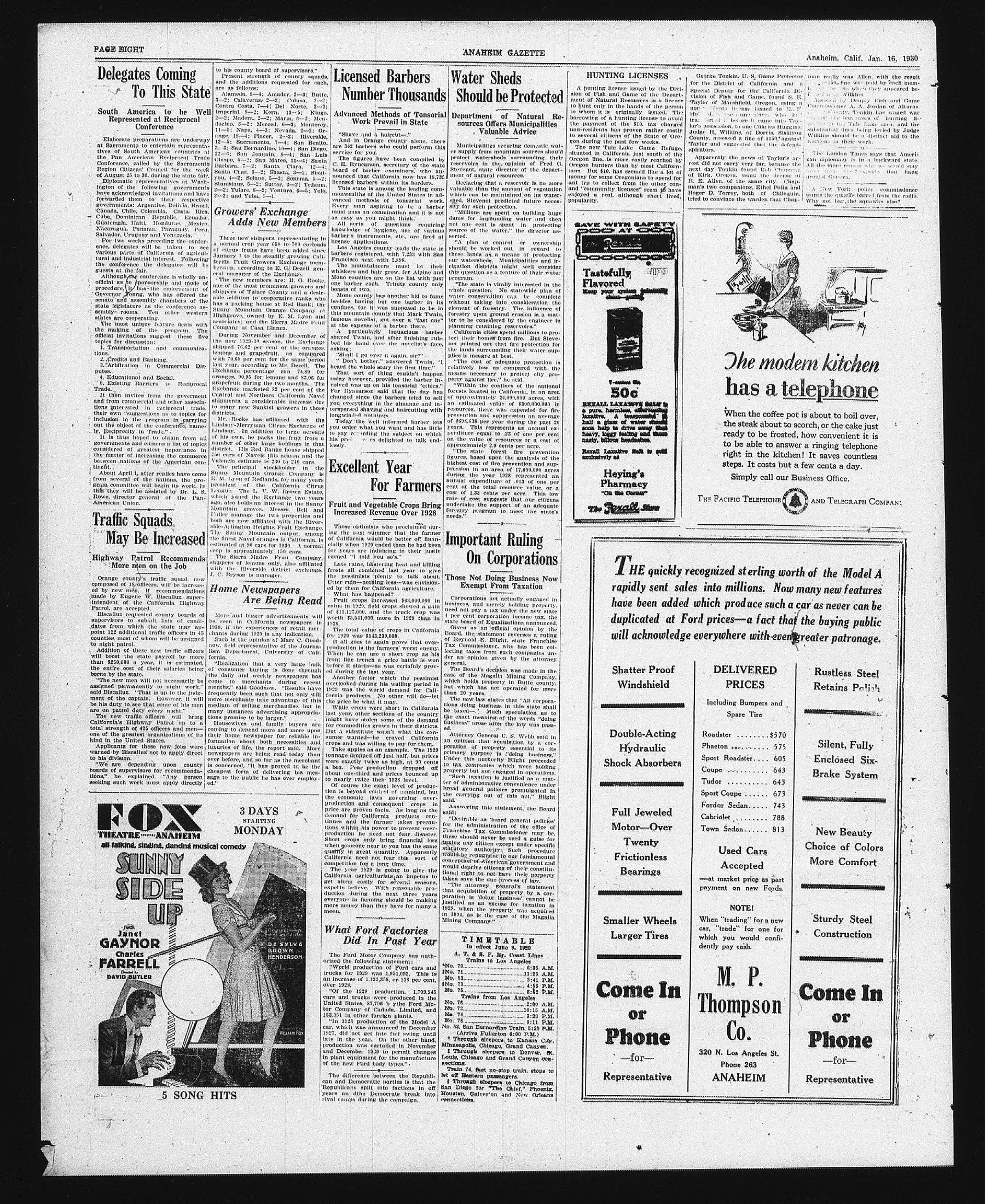
Searchable text
Delegates Coming To This State
South America to be Well Represented at Reciprocal Conference
Elaborate preparations are underway at Sacramento to entertain representatives of South American countries at the Pan American Reciprocal Trade Conference, called by the Sacramento Region Citizens' Council for the week of August 25 to 30, during the state fair.
Diplomatic representatives at Washington of the following governments have acknowledged invitations and have forwarded them to their respective governments: Argentine, Bolivia, Brazil, Canada, Chile, Colombia, Costa Rica, Cuba, Dominican Republic, Ecuador, Guatemala, Haiti, Honduras, Mexico, Nicaragua, Panama, Paraguay, Peru, Salvador, Uruguay and Venezuela.
For two weeks preceding the conference, delegates will be taken to see various parts of California of agricultural and industrial interest. Following the conference the delegates will be guests at the fair.
Although the conference is wholly unofficial as to sponsorship and mode of procedure, it has the endorsement of Governor Young, who has offered the senate and assembly chambers of the state legislature as the conference assembly rooms. Ten other western states are cooperating.
The most unique feature deals with the making of the program. The official invitations suggest these five topics for discussion:
1. Transportation and communications.
2. Credits and Banking.
3. Arbitration in Commercial Disputes.
4. Educational and Social.
5. Existing Barriers to Reciprocal Trade.
It then invites from the government and from commercial and other associations interested in reciprocal trade, their own "suggestions as to topics for inclusion in the program in carrying out the object of the conference, namely, Reciprocity in Trade."
It is thus hoped to obtain from all governments and citizens a list of topics considered of greatest importance to his county board of supervisors."
Present strength of county squads, and the additions requested for each, are as follows:
Alameda, 8—4; Amador, 2—3; Butte, 3—2; Calaveras, 2—2; Colusa, 2—2; Contra Costa, 7—4; Del Norte, 2—2; Imperial, 8—2; Kern, 13—5; Kings, 2—2; Maderna, 2—2; Marin, 6—2; Mendocino, 3—2; Merced, 6—3; Monterey, 11—5; Napa, 4—3; Nevada, 2—2; Orange, 18—4; Placer, 2—2; Riverside, 12—5; Sacramento, 7—4; San Benito, 3—3; San Bernardino, 10—4; San Diego, 22—6; San Joaquin, 8—4; San Luis Obispo, 5—2; San Mateo, 11—4; Santa Barbara, 7—2; Santa Clara, 12—4; Santa Cruz, 5—2; Shasta, 3—2; Siskiyou, 4—2; Solano, 5—2; Sonoma, 5—2; Stanislaus, 5—2; Sutter, 3—2; Tedama, 2—2; Tulare, 8—2; Ventura, 6—5; Yolo, 2—2; and Yuba, 1—1.
Growers' Exchange Adds New Members
Three new shippers representing in a normal crop year 650 to 700 carloads of citrus fruits have been added since January 1 to the steadily growing California Fruit Growers Exchange membership, according to E. G. Dezell, general manager of the Exchange.
The new members are: B. G. Rooke, one of the most prominent growers and shippers of Tulare County and a desirable addition to cooperative ranks who has a packing house at Red Bank; the Sunny Mountain Orange Company at Highgrove, owned by E. M. Lyon and associates; and the Sierra Madre Fruit Company at Casa Blanca.
During November and December of the new 1929-30 season, the Exchange shipped 76.62 per cent of the oranges, lemons and grapefruit, as compared with 70.68 per cent for the same period last year, according to Mr. Dezell. The Exchange percentage ran 74.89 for oranges, 90.95 for lemons and 83.06 for grapefruit during the two months. The Exchange marketed $2 per cent of the Central and Northern California Navel shipments, a considerable increase due to many new Sunkist growers in those districts.
Mr. Rooke has affiliated with the Lindsay-Merryman Citrus Exchange of Lindsay. In addition to large acreage of his own, he packs the fruit from a number of other holdings in that district. His Red Bank house obtained to his county board of supervisors."
Licenses Numbers Advanced World
"Shave an And in O are 342 barber service for you.
The figure C. E. Rynear board of barbarian nounced that licensed barber This state monwealths vanced meth Every man must pass an easy as y All sorts knowledge o barber's institute license appliance Los Angeles barbers register Francisco ne The mountain whiskers and Mono counties one barber boasts of two Mono counties besides having confines for this mountain famous novel at the expense A particular shaved Twain bed his hands asking: "Shall I go Don't bother heard the white That sort today however volved was us For Rynear changed since you everything terspersed share longwinded m Today they order you to say record his pre- lessly."
Traffic Squads May Be Increased
Highway Patrol Recommends More men on the Job
Orange county's traffic squad, now composed of 18 officers, will be increased by new men. If recommendations made by Eugene W. Biscalluz, superintendent of the California Highway Patrol, are accepted.
Biscalluz requested county boards of supervisors to submit lists of candidates from which the state may appoint 122 additional traffic officers in 45 counties, most of whom will be assigned to night patrol.
Addition of these new traffic officers will boost the state payroll by more than $250,000 a year, it is estimated, the entire cost of their salaries being borne by the state.
"The new men will not necessarily be assigned permanently to night work," said Biscalluz. "That is up to the judgment of the captain. However, it will be his duty to see that some of his men are on patrol duty every night."
The new traffic officers will bring California's Highway Patrol up to a total strength of 425 officers and men—one of the greatest organizations of its kind in the United States.
Applicants for these new jobs were warned by Biscalluz not to apply direct to his division.
"We are depending upon county boards of supervisors for recommendations," he explained. "Any person seeking such work must apply directly with 70.68 per cent for the same period last year, according to Mr. Dezell. The Exchange percentage ran 74.89 for oranges, 90.95 for lemons and 83.06 for grapefruit during the two months. The Exchange marketed $2 per cent of the Central and Northern California Navel shipments, a considerable increase due to many new Sunkist growers in those districts.
Mr. Rooke has affiliated with the Lindsay-Merryman Citrus Exchange of Lindsay. In addition to large acreage of his own, he packs the fruit from a number of other large holdings in that district. His Red Banks house shipped 250 cars of Navels this season and the Valencia estimate is 230 to 240 cars.
The principal stockholder in the Sunny Mountain Orange Company is E. M. Lyon of Redlands, for many years president of the California Citrus League. The L. V. W. Brown Estate, which joined the Exchange two years ago, also holds an interest in the Sunny Mountain groves. Messrs. Bell and Fuller manage the two properties and both are now affiliated with the Riverside-Arlington Heights Fruit Exchange. The Sunny Mountain output, among the finest Navel oranges in California, is estimated at 90 cars for 1930. A normal crop is approximately 150 cars.
The Sierra Madre Fruit Company, shippers of lemons only, also affiliated with the Riverside district exchange, J. C. Bryson is manager.
Home Newspapers Are Being Read
More and bigger advertisements will be seen in California newspapers in 1930, if the experiences of retail merchants during 1929 is any indication.
Such is the opinion of Marc C. Goodnow, field representative of the Journalism Department, University of California.
"Realization that a very large bulk of consumer buying is done through the daily and weekly newspapers has come to merchants during recent months," said Goodnow. "Results have frequently been such that not only will more merchants take advantage of this medium of selling merchandise, but in many instances advertising appropriations promise to be larger."
Housewives and family buyers are coming to depend more and more upon their home newspaper for reliable information about both necessities and luxuries of life, the report said. More newspapers are being read today than ever before, and so far as the merchant is concerned, "it has proved to be the cheapest form of delivering his message to the public he has ever employed."
FOX
THEATRE...ANAHEIM
3 DAYS
STARTING
MONDAY
all talkin', singin', dancin' musical comedy
SUNNY
SIDE
UP
with
Janet
GAYNOR
Charles
FARRELL
Directed by
DAVID BUTLER
DE Sylva
BROWN
HENDERSON
5 SONG HITS
Licensed Barbers Number Thousands
Advanced Methods of Tonsorial Work Prevail in State
"Shave and a haircut—"
And in Orange county alone, there are 342 barbers who could perform this service for you.
The figures have been compiled by C. E. Rynearson, secretary of the state board of barber examiners, who announced that California now has 18,735 licensed barbers within its borders.
This state is among the leading commonwealths of the United States in advanced methods of tonsorial work. Every man aspiring to be a barber must pass an examination and it is not as easy as you might think.
All sorts of questions requiring knowledge of hygiene, use of various barber's instruments, etc., are fired at license applications.
Los Angeles county leads the state in barbers registered, with 7,233 with San Francisco next with 2,898.
The mountainers must let their whiskers and hair grow, for Alpine and Mono counties are on the list with just one barber each. Trinity county only boasts of two.
Mono county has another bid to fame besides having but one barber in its confines, for it was supposed to be in this mountain county that Mark Twain, famous novelist, got over a "fast one" at the expense of a barber there.
A particularly loquacious barber shaved Twain, and after finishing rubbed his hand over the novelist's face, asking:
"Shall I go over it again, sir?"
"Don't bother," answered Twain, "I heard the whole story the first time."
That sort of thing couldn't happen today however, provided the barber involved was up on his tonsorial "ethics." For Rynearson said that the day has changed since the barbers tried to sell you everything in the almanac and interspersed shaving and haircutting with longwinded notions.
Today the well informed barber lets you order what you want and has little to say regarding the subject on which his presidents delighted to talk endlessly.
Water Sheds Should be Protected
Department of Natural Resources Offers Municipalities Valuable Advice
Municipalities securing domestic water supply from mountain sources should protect watersheds surrounding their reservoirs in the opinion of Fred G. Stevenot, state director of the department of natural resources.
Declaring that a reservoir is no more valuable than the amount of vegetation which can be maintained on its watershed, Stevenot predicted future necessity for such protection.
"Millions are spent on building huge dams for impounding water and then not one cent is spent in protecting source of the water," the director asserted.
"A plan of control or ownership should be worked out in regard to these lands as a means of protecting our watersheds. Municipalities and irrigation districts might well consider this question as a feature of their water program.
"The state is vitally interested in the whole question. No statewide plan of water conservation can be complete without taking into consideration the element of forestry. The influence of forestry upon ground erosion is a matter to be considered by the engineer in planning retaining reservoirs."
California cities spend millions to protect their homes from fire. But Stevenot pointed out that fire protection for the lands surrounding their water supplies is meagre at best.
"The cost of adequate protection is relatively low as compared with the means necessary to protect city property against fire," he stild.
Within the confines of the national forests located in California, in an area of approximately 24,000,000 acres, with an estimated value of $300,000,000 in resources, there was expended for fire prevention and suppression an average of $698,638 per year during the past 20 years. This represents an annual expenditure equal to .23 of one per cent on the value of resources or a cost of approximately 2.9 cents per acre.
HUNTING LICENSES
A hunting license issued by the Division of Fish and Game of the Department of Natural Resources is a license to hunt only in the hands of the person to whom it is originally issued. The borrowing of a hunting license to avoid the payment of the $10. tax charged non-residents has proven rather costly to several citizens of the State of Oregon during the past few weeks.
The new Tule Lake Game Refuge, situated in California just south of the Oregon line, is more easily reached by Oregon hunters than by most Californians. But $10 has seemed like a lot of money for some Oregonians to spend for ant trp to collect from the other con- and "community licenses" seem to have enjoyed a real, although short lived, popularity.
Excellent Year For Farmers
Fruit and Vegetable Crops Bring Increased Revenue Over 1928
Those optimists who proclaimed during the past summer that the farmer of California would be better off financially when 1929 ended than he had been for years are indulging in their justly earned "1 told you so's."
Late rains, blistering heat and killing frosts all combined last year to give the pessimists plenty to talk about. Utter ruin—nothing less—was envisioned by them for California agriculture.
What has happened?
Fruit crops increased $43,000,000 in value in 1929, field crops showed a gain of $11,127,000, and the truck crop was worth $5,541,000 more in 1929 than in 1928.
The total value of crops in California for 1929 was $543,239,000.
It all goes to again prove that overproduction is the farmers' worst enemy. When he can use a short crop as his front line trench a price battle is won before it starts—as was certainly proved during the last year.
Another factor which the pessimist overlooked during his wailing period in 1929 was the world demand for California products. No other will do—let the price be what it may.
While crops were short in California last year; other sections of the country might have stolen some of the demand for commodities grown in their districts. But a substitute wasn't what the consumer wanted—the craved California crops and was willing to pay for them.
Take apples as an example. The 1929 tonnage dropped off just half, but prices were exactly twice as high, at 90 cents a box. Pear production dropped off about one-third and prices bounced up to nearly twice their 1928 level.
Of course the exact level of production is beyond control of mankind, but the economic laws governing over-production and consequent crops in price are proven facts. As long as the demand for California products continues and the farmer takes precautions within his power to prevent over-production he need not fear disaster. Short crops only bring financial loss when someone near to you has the same plies is meagre at best.
"The cost of adequate protection is relatively low as compared with the means necessary to protect city property against fire," he stid.
"Within the confines of the national forests located in California, in an area of approximately 24,000,000 acres, with an estimated value of $300,000,000 in resources, there was expended for fire prevention and suppression an average of $698,638 per year during the past 20 years. This represents an annual expenditure equal to .23 of one per cent on the value of resources or a cost of approximately 2.9 cents per acre."
"The state forest fire prevention figures, based upon the analysis of the highest cost of fire prevention and suppression in an area of 17,000,000 acres during the year 1928 represented an annual expenditure of .913 of one per cent of the total resource value, or a cost of 1.33 cents per acre. This low rate of cost suggests that our citizens undertake the support of an adequate forestry program to meet the state's needs."
Important Ruling On Corporations
Those Not Doing Business Now Exempt From Taxation
Corporations not actually engaged in business, and merely holding property, need not pay a tax under the new state 4 per cent corporation income tax, the state board of Equalizations announced.
Given as an official opinion by the Board, the statement reverses a ruling of Reynold E. Blight, state Franchise Tax Commissioner, who has been collecting taxes from such companies under an opinion given by the attorney general.
The Board's decision was made in the case of the Magallia Mining Company, which holds property in Butte county; but which has not operated for more than 20 years.
The new law states that "All corporations doing business in this state shall be taxed—". Much speculation as to the exact meaning of the words "doing business" arose after the law was passed.
Attorney General U.S. Webb said in an opinion that acquisition by a corporation of property essential to its primary purpose is "doing business." Under this authority Blight proceeded to tax companies which were holding property but not engaged in operations.
"Such taxation is justified as a matter of administrative convenience under broad general policies promulgated in the carrying out of this act," Blight said.
Answering this statement, the Board said:
"Desirable as 'board general policies' for the administration of the office of Franchise Tax Commissioner may be, these should never be used a guise for taxing any citizen except under specific statutory authorities. Such procedures..."
What Ford Factories Did In Past Year
The Ford Motor Company has authorized the following statement:
"World production of Ford cars and trucks for 1929 was 1,951,092. This is an increase of 1,132,358, or 138 per cent, over 1928.
'Of the 1929 production, 1,709,945 cars and trucks were produced in the United States, 87,796 b y the Ford Motor Company of Carinda, Limited, and 153,351 in other foreign plants.
'In 1928 production of the Model A car, which was announced in December 1927, did not get into full swing until late in the year. On the other hand, production was curtailed in November and December 1929 to permit changes in plant equipment for the manufacture of the new Ford body types.'"
The difference between the Republican and Democratic parties is that the Republicans split into factions in off years an d the Democrats break into rival camps during the campaign.
George Tonkin, U. S. Game Protector for the District of California and a Special Deputy for the California Division of Fish and Game, found S. E. Taylor of Marshfield, Oregon, using a non-confidential license issued to E. F. Holden, the same person, who had trained it before it came into Taylor's possession, to one Charles Huggins, Judge H. Wilkins, of Dorris, Siskiyou County, assessed a fine of $150 against Taylor and suggested that the defendant spirators.
Apparently the news of Taylor's arrest did not carry very far, because the next day Tonkin found Bob Chapman of Kirk, Oregon, using the license of R. E. Allen, of the same city. Chapman's two companions, Ethel Polin and Roger D. Torrey, both of Chillequin, tried to convince the warden that Chapman really was Allen, with the result being 50 fine was paid by each member when they appeared before Wilkins.
Assisted by Doupy Fish and Game Commissioner A. A Jordan of Alturas County, Tonkin has waged war against the borrowers of hunting lodge in the Tule Lake area, and the substantial fines being levied by Judge Wilkins should be a distinct aid to the warriors in their work.
The London Times says that American diplomacy is in a backward state. All the more reason why we would stay away from the experts that hang around Geneva.
A New York police commissioner wants the quacks barred from the radio. Why not ban the squawks also?
The modern kitchen has a telephone
When the coffee pot is about to boil over, the steak about to scorch, or the cake just ready to be frosted, how convenient it is to be able to answer a ringing telephone
The modern kitchen has a telephone
When the coffee pot is about to boil over, the steak about to scorch, or the cake just ready to be frosted, how convenient it is to be able to answer a ringing telephone right in the kitchen! It saves countless steps. It costs but a few cents a day.
Simply call our Business Office.
THE PACIFIC TELEPHONE AND TELEGRAPH COMPANY
THE quickly recognized sterling worth of the Model A rapidly sent sales into millions. Now many new features have been added which produce such a car as never can be duplicated at Ford prices—a fact that the buying public will acknowledge everywhere with even greater patronage.
DELIVERED PRICES
Including Bumpers and Spare Tire
Roadster $570
Phaeton 575
Sport Roadster 605
Coupe 643
Tudor 643
Sport Coupe 673
Fordor Sedan 743
Cabriolet 788
Town Sedan 813
Silent, Fully Enclosed Six-Brake System
New Beauty Choice of Colors
Sport Roadster... 605
Coupe ... 643
Tudor ... 643
Sport Coupe ... 673
Fordor Sedan... 743
Cabriolet ... 788
Town Sedan... 813
Used Cars Accepted
at market price as part payment on new Fords.
NOTE!
When "trading" for a new car, "trade" for one for which you would confidently pay cash.
M. P. Thompson Co.
320 N. Los Angeles St.
Phone 263
ANAHEIM
Come In or Phone
for
Representative