anaheim-gazette 1930-01-09
Scanned page
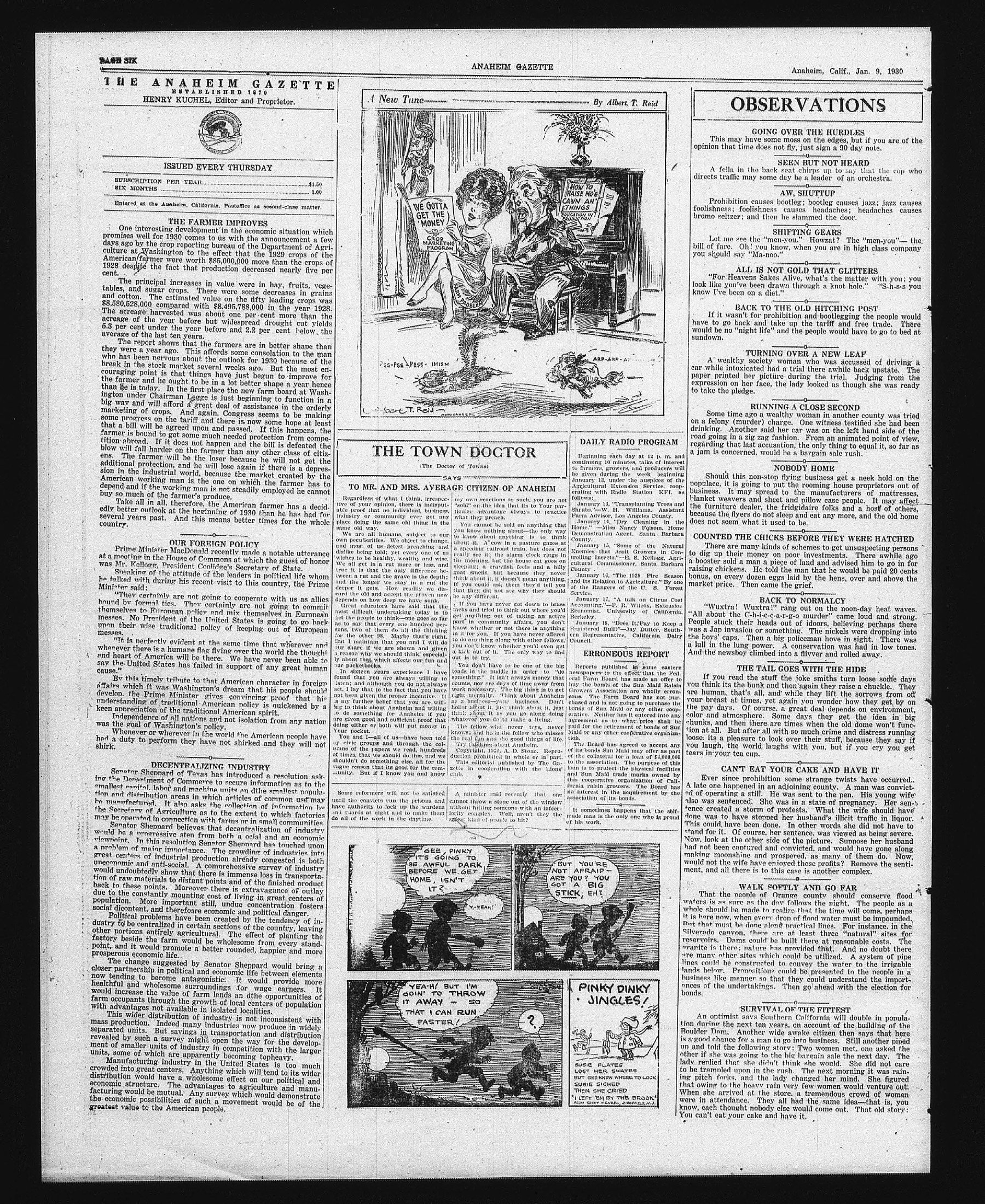
Searchable text
THE ANAHEIM GAZETTE
ESTABLISHED 1870
HENRY KUCHEL, Editor and Proprietor.
ISSUED EVERY THURSDAY
SUBSCRIPTION PER YEAR.....$1.50
SIX MONTHS.....1.00
Entered at the Anaheim, California, Postoffice as second-class matter.
THE FARMER IMPROVES
One interesting development in the economic situation which promises well for 1930 comes to us with the announcement a few days ago by the crop reporting bureau of the Department of Agriculture at Washington to the effect that the 1929 crops of the American farmer were worth $85,000,000 more than the crops of 1928 despite the fact that production decreased nearly five per cent.
The principal increases in value were in hay, fruits, vegetables, and sugar crops. There were some decreases in grains and cotton. The estimated value on the fifty leading crops was $8,580,528,000 compared with $8,495,788,000 in the year 1928. The acreage harvested was about one per cent more than the acreage of the year before but widespread drought cut yields 5.3 per cent under the year before and 2.2 per cent below the average of the last ten years.
The report shows that the farmers are in better shape than they were a year ago. This affords some consolation to the man who has been nervous about the outlook for 1930 because of the break in the stock market several weeks ago. But the most encouraging point is that things have just begun to improve for the farmer and he ought to be in a lot better shape a year hence than he is today. In the first place the new farm board at Washington under Chairman Legge is just beginning to function in a big wav and will afford a great deal of assistance in the orderly marketing of crops. And again. Congress seems to be making some progress on the tariff and there is now some hope at least that a bill will be agreed upon and passed. If this happens, the farmer is bound to get some much needed protection from competition abroad. If it does not happen and the bill is defeated the blow will fall harder on the farm.
who has been nervous about the outlook for 1930 because of the break in the stock market several weeks ago. But the most encouraging point is that things have just begun to improve for the farmer and he ought to be in a lot better shape a year hence than he is today. In the first place the new farm board at Washington under Chairman Legge is just beginning to function in a big wav and will afford a great deal of assistance in the orderly marketing of crops. And again, Congress seems to be making some progress on the tariff and there is now some hope at least that a bill will be agreed upon and passed. If this happens, the farmer is bound to get some much needed protection from competition abroad. If it does not happen and the bill is defeated the blow will fall harder on the farmer than any other class of citizens. The farmer will be the loser because he will not get the additional protection, and he will lose again if there is a depression in the industrial world, because the market created by the American working man is the one on which the farmer has to depend and if the working man is not steadily employed he cannot buy so much of the farmer's produce.
Take all in all, therefore, the American farmer has a decidedly better outlook at the beginning of 1930 than he has had for several years past. And this means better times for the whole country.
OUR FOREIGN POLICY
Prime Minister MacDonald recently made a notable utterance at a meeting in the House of Commons at which the guest of honor was Mr. Kellogg, President Coolidge's Secretary of State.
Speaking of the attitude of the leaders in political life whom he talked with during his recent visit to this country, the Prime Minister said:
"They certainly are not going to cooperate with us as allies bound by formal ties. They certainly are not going to commit themselves to European policy and mix themselves in European messes. No President of the United States is going to go back union their wise traditional policy of keeping out of European messes.
"It is perfectly evident at the same time that wherever and whenever there is a humane flag flying over the world the thought and heart of America will be there. We have never been able to say the United States has failed in support of any great human cause."
By this timely tribute to that American character in foreign affairs which it was Washington's dream that his people should develop, the Prime Minister gives convincing proof that his understanding of traditional American policy is quickened by a keen appreciation of the traditional American spirit.
Independence of all nations and not isolation from any nation was the goal of Washington's policy.
Whenever or wherever in the world the American people have had a duty to perform they have not shirked and they will not shirk.
DECENTRALIZING INDUSTRY
Senator Sheppard of Texas has introduced a resolution asking the Department of Commerce to secure information as to the smallest capital, labor and machine units an dthe smallest population and distribution areas in which articles of common use may be manufactured. It also asks the collection of information by the Secretary of Agriculture as to the extent to which factories may be operated in connection with farms or in small communities.
Senator Sheppard believes that decentralization of industry would be a progressive step from both a social and an economic viewpoint. In this resolution Senator Sheppard has touched upon a problem of major importance.
DECENTRALIZING INDUSTRY
Senator Sheppard of Texas has introduced a resolution asking the Department of Commerce to secure information as to the smallest capital, labor and machine units on dthe smallest population and distribution areas in which articles of common use may be manufactured. It also asks the collection of information by the Secretary of Agriculture as to the extent to which factories may be operated in connection with farms or in small communities.
Senator Sheppard believes that decentralization of industry would be a progressive step from both a ocial and an economic viewpoint. In this resolution Senator Sheppard has touched upon a problem of major importance. The crowding of industries into great centers of industrial production already congested is both uneconomic and anti-social. A comprehensive survey of industry would undoubtedly show that there is immense loss in transportation of raw materials to distant points and of the finished product back to these points. Moreover there is extravagance of outlay due to the constantly mounting cost of living in great centers of population. More important still, undue concentration fosters social discontent, and therefore economic and political danger.
Political problems have been created by the tendency of industry to be centralized in certain sections of the country, leaving other portions entirely agricultural. The effect of planting the factory beside the farm would be wholesome from every standpoint, and it would promote a better rounded, happier and more prosperous economic life.
The change suggested by Senator Sheppard would bring a closer partnership in political and economic life between elements now tending to become antagonistic. It would provide more healthful and wholesome surroundings for wage earners. It would increase the value of farm lands an dthe opportunities of farm occupants through the growth of local centers of population with advantages not available in isolated localities.
This wider distribution of industry is not inconsistent with mass production. Indeed many industries now produce in widely separated units. But savings in transportation and distribution revealed by such a survey might open the way for the development of smaller units of industry in competition with the larger units, some of which are apparently becoming topheavy.
Manufacturing industry in the United States is too much crowded into great centers. Anything which will tend to its wider distribution would have a wholesome effect on our political and economic structure. The advantages to agriculture and manufacturing would be mutual. Any survey which would demonstrate the economic possibilities of such a movement would be of the greatest value to the American people.
ANAHEIM GAZETTE
A New Tune By Albert T. Reid
WE GOTTA GET THE MONEY
CROP MARKETING PROGRAM
HOW TO RAISE MOE CAWN AN' THINGS
EDUCATION IN PRODUCTION
PSS-PSS-PESS-IMISM
Albert T. Reid
DAILY RADIO PROGRAM
THE TOWN DOCTOR
(The Doctor of Towns)
SAYS
TO MR. AND MRS. AVERAGE CITIZEN OF ANAHEIM
Regardless of what I think, irrespective of your opinion, there is indisputable proof that no individual, business, industry or community ever got any place doing the same old thing in the same old way.
We are all humans, subject to our own peculiarities. We object to change, and most of us detest preaching and dislike being told; yet every one of us wishes to be healthy, wealthy and wise. We all get in a rut more or less, and true it is that the only difference between a rut and the grave is the depth; and the longer we stay in a rut the deeper it gets. How readily we discard the old and accept the proven new depends on how deep we have sunk.
Great educators have said that the most difficult undertaking today is to get the people to think—one goes so far as to say that every one hundred persons, two of them do all the thinking for the other 98. Maybe that's right. But I maintain that you and I will do our share if we are shown and given a reason why we should think, especially about that which affects our fun and our pocketbooks.
In sixteen years experience I have found that you are always willing to listen; and although you do not always act, I lay that to the fact that you have not been given the proper incentive. It is my further belief that you are willing to think about Anaheim and willing to do something for Anaheim if you are given good and sufficient proof that doing either or both will put money in Your pocket.
You and I—all of us—have been told by civic groups and through the columns of the papers we read, hundreds of times, that we should do this, and we shouldn't do something else, all for the vague reason that its good for the community. But if I know you and know my own reactions to such, you are not "sold" on the idea that its to Your particular advantage always to practice what they preach.
You cannot be sold on anything that you know nothing about—the only way to know about anything is to think about it. A cow in a pasture gazes at a speeding railroad train, but does not really see it; the alarm clock rings in the morning, but the house cat goes on sleeping; a crawfish feels and a billy goat smells, but because they never think about it, it doesn't mean anything. If you could ask them they'd tell you that they did not see why they should be any different.
If you have never got down to brass nicks and tried to think out where you'd get anything out of taking an active part in community affairs, you don't know whether or not there is anything in it for you. If you have never offered to do anything along with other fellows, you don't know whether you'd even get a kick out of it. The only way to find out is to try.
You don't have to be one of the big loads in the puddle in order to "do something." It isn't always money that counts, nor are days of time away from work necessary. The big thing is to get right mentally. Think about Anaheim as a business—your business. Don't holler about it, just think about it. Just think about it as you go along doing whatever you do to make a living.
The fellow who never tries, never knows; and he is the follow who misses the real fun and the good things of life.
Try thinking about Anaheim.
Copyright, 1930. A. D. Stone. Reproduction prohibited in whole or in part. This editorial published by The Gazette in cooperation with the Lions club.
A minister said recently that one cannot throw a stone out of the window without hitting someone with an inferiority complex. Well, aren't they the safest kind of people to hit?
DAILY RADIO PROGRAM
Beginning each day at 12 p.m. and continuing 10 minutes, talks of interest to farmers, growers, and producers will be given during the week beginning January 13, under the auspices of the Agricultural Extension Service, cooperating with Radio Station KFI, as follows:
January 13, "Transplanting Trees and Shrubs."—W. H. Williams, Assistant Farm Advisor, Los Angeles County.
January 14, "Dry Cleaning in the Home."—Miss Nancy Folsom, Home Demonstration Agent, Santa Barbara County.
January 15, "Some of the Natural Enemies that Assit Growers in Controlling Insects."—E. S. Kellogg, Agricultural Commissioner, Santa Barbara County.
January 16, "The 1929 Fire Season and Its Relation to Agriculture." By one of the Rangers of the U. S. Forest Service.
January 17, "A talk on Citrus Cost Accounting."—F. R. Wilcox, Extension Economist, University of California, Berkeley.
January 18, "Does It Pay to Keep a Registered Bull?"—Jay Dutter, Southern Representative, California Dairy Council.
ERRONEOUS REPORT
Reports published in some eastern newspapers to the effect that the Federal Farm Board has made an offer to buy the bonds of the Sun Mald Raisin Growers Association are wholly erroneous. The Farm Board has not purchased and is not going to purchase the bonds of Sun Mald or any other cooperative. Neither has it entered into any agreement as to what price shall be paid for the retirement of bonds of Sun Mald or any other cooperative organization.
The Board has agreed to accept any of its bonds Mald may offer as part of the collateral for a loan of $4,000,000 to the association. The purpose of this loan is to protect the physical facilities and Sun Mald trade marks owned by this cooperative organization of California raisin growers. The Board has no interest in the acquirement by the association of its bonds.
It sometimes happens that the self-made man is the only one who is proud of his work.
Some reformers will not be satisfied until the convicts run the prisons and have authority to lock up the wardens and guards at night and to make them do all of the work in the daytime.
A minister said recently that one cannot throw a stone out of the window without hitting someone with an infeeriority complex. Well, aren't they the rarest kind of people to hit?
GEE, PINKY IT'S GOING TO BE AWFUL DARK BEFORE WE GET HOME, ISN'T IT?
Y-YEAH!
BUT YOU'RE NOT AFRAID ARE YOU? YOU GOT A BIG STICK, EH?
YEA-H! BUT I'M GOIN' TO THROW IT AWAY - SO THAT I CAN RUN FASTER!
PINKY DINKY JINGLES!
SUSIE PLATES LOST HER SKATES BUT SHE KNEW WHERE TO LOOK SUSIE SIGNED THEN SHE CRIED I LEFT EM BY THE BROOK
This is a newspaper page from a historical period. The text is in English and uses standard fonts. There are no images or illustrations except for the comic strips. The layout is typical of newspapers from the early 20th century.
OBSERVATIONS
GOING OVER THE HURDLES
This may have some moss on the edges, but if you are of the opinion that time does not fly, just sign a 90 day note.
SEEN BUT NOT HEARD
A fella in the back seat chirps up to say that the cop who directs traffic may some day be a leader of an orchestra.
AW, SHUTTUP
Prohibition causes bootleg; bootleg causes jazz; jazz causes foolishness; foolishness causes headaches; headaches causes bromo seltzer; and then he slammed the door.
SHIFTING GEARS
Let me see the "men-you." Howzat? The "men-you"—the bill of fare. Oh! you know, when you are in high class company you should say "Ma-noo."
ALL IS NOT GOLD THAT GLITTERS
"For Heavens Sakes Alive, what's the matter with you; you look like you've been drawn through a knot hole." "S-h-s-s you know I've been on a diet."
BACK TO THE OLD HITCHING POST
If it wasn't for prohibition and bootlegging the people would have to go back and take up the tariff and free trade. There would be no "night life" and the people would have to go to bed at sundown.
TURNING OVER A NEW LEAF
A wealthy society woman who was accussed of driving a car while intoxicated had a trial there awhile back upstate. The paper printed her picture during the trial. Judging from the expression on her face, the lady looked as though she was ready to take the pledge.
RUNNING A CLOSE SECOND
Some time ago a wealthy woman in another county was tried on a felony (murder) charge. One witness testified she had been drinking. Another said her car was on the left hand side of the road going in a zig zag fashion. From an animated point of view, regarding that last accusation, the only thing to equal it, so far as
A wealthy society woman who was accused of driving a car while intoxicated had a trial there awhile back upstate. The paper printed her picture during the trial. Judging from the expression on her face, the lady looked as though she was ready to take the pledge.
RUNNING A CLOSE SECOND
Some time ago a wealthy woman in another county was tried on a felony (murder) charge. One witness testified she had been drinking. Another said her car was on the left hand side of the road going in a zig zag fashion. From an animated point of view, regarding that last accusation, the only thing to equal it, so far as a jam is concerned, would be a bargain sale rush.
NOBODY HOME
Should this non-stop flying business get a neck hold on the populace, it is going to put the rooming house proprietors out of business. It may spread to the manufacturers of mattresses, blanket weavers and sheet and pillow case people. It may affect the furniture dealer, the fridgidaire folks and a host of others, because the flyers do not sleep and eat any more, and the old home does not seem what it used to be.
COUNTED THE CHICKS BEFORE THEY WERE HATCHED
There are many kinds of schemes to get unsuspecting persons to dig up their money on poor investments. There awhile ago a booster sold a man a piece of land and advised him to go in for raising chickens. He told the man that he would be paid 20 cents bonus, on every dozen eggs laid by the hens, over and above the market price. Then came the grief.
BACK TO NORMALCY
"Wuxtra! Wuxtra!" rang out on the noon-day heat waves. "All about the C-h-i-c-c-a-r-g-o murder" came loud and strong. People stuck their heads out of idoors, believing perhaps there was a Jap invasion or something. The nickels were dropping into the boys' caps. Then a big policeman hove in sight. There was a lull in the lung power. A conservation was had in low tones. And the newsboy climbed into a flivver and rolled away.
THE TAIL GOES WITH THE HIDE
If you read the stuff the joke smiths turn loose some days you think its the bunk and then again they raise a chuckle. They are human, that's all, and while they lift the sorrows from off your breast at times, yet again you wonder how they get by on the pay days. Of course, a great deal depends on environment, color and atmosphere. Some days they get the idea in big chunks, and then there are times when the old dome won't function at all. But after all with so much crime and distress running loose, its a pleasure to look over their stuff, because they say if you laugh, the world laughs with you, but if you cry you get tears in your tea cup.
CAN'T EAT YOUR CAKE AND HAVE IT
Ever since prohibition some strange twists have occurred.. A late one happened in an adjoining county. A man was convicted of operating a still. He was sent to the pen. His young wife also was sentenced. She was in a state of pregnancy. Her sentence created a storm of protests. What the wife should have done was to have stopped her husband's illicit traffic in liquor. This could have been done. In other words she did not have to stand for it. Of course, her sentence, was viewed as being severe. Now, look at the other side of the picture. Suppose her husband had not been captured and convicted, and would have gone along
CAN'T EAT YOUR CAKE AND HAVE IT
Ever since prohibition some strange twists have occurred.
A late one happened in an adjoining county. A man was convicted of operating a still. He was sent to the pen. His young wife also was sentenced. She was in a state of pregnancy. Her sentence created a storm of protests. What the wife should have done was to have stopped her husband's illicit traffic in liquor. This could, have been done. In other words she did not have to stand for it. Of course, her sentence, was viewed as being severe. Now, look at the other side of the picture. Suppose her husband had not been captured and convicted, and would have gone along making moonshine and prospered, as many of them do. Now, would not the wife have enjoyed those profits? Remove the sentiment, and all there is to this case is another complex.
WALK SOFTLY AND GO FAR
That the people of Orange county should conserve flood waters is as sure as the day follows the night. The people as a whole should be made to realize that the time will come, perhaps it is here now, when every drop of flood water must be impounded. But that must be done along practical lines. For instance, in the Silverado canyon, there are at least three "natural" sites for reservoirs. Dams could be built there at reasonable costs. The granite is there; nature has provided that. And no doubt there are many other sites which could be utilized. A system of pipe lines could be constructed to convey the water to the irrigable lands below. Propositions could be presented to the people in a business like manner so that they could understand the importance of the undertakings. Then go ahead with the election for bonds.
SURVIVAL OF THE FITTEST
An optimist says Southern California will double in population during the next ten years, on account of the building of the Boulder Dam. Another wide awake citizen then says that here is a good chance for a man to go into business. Still another piped up and told the following story: Two women met, one asked the other if she was going to the big bargain sale the next day. The lady replied that she didn't think she would. She did not care to be trampled upon in the rush. The next morning it was raining pitch forks, and the lady changed her mind. She figured that owing to the heavy rain very few women would venture out. When she arrived at the store, a tremendous crowd of women were in attendance. They all had the same idea—that is, you know, each thought nobody else would come out. That old story: You can't eat your cake and have it.