anaheim-gazette 1929-11-28
Scanned page
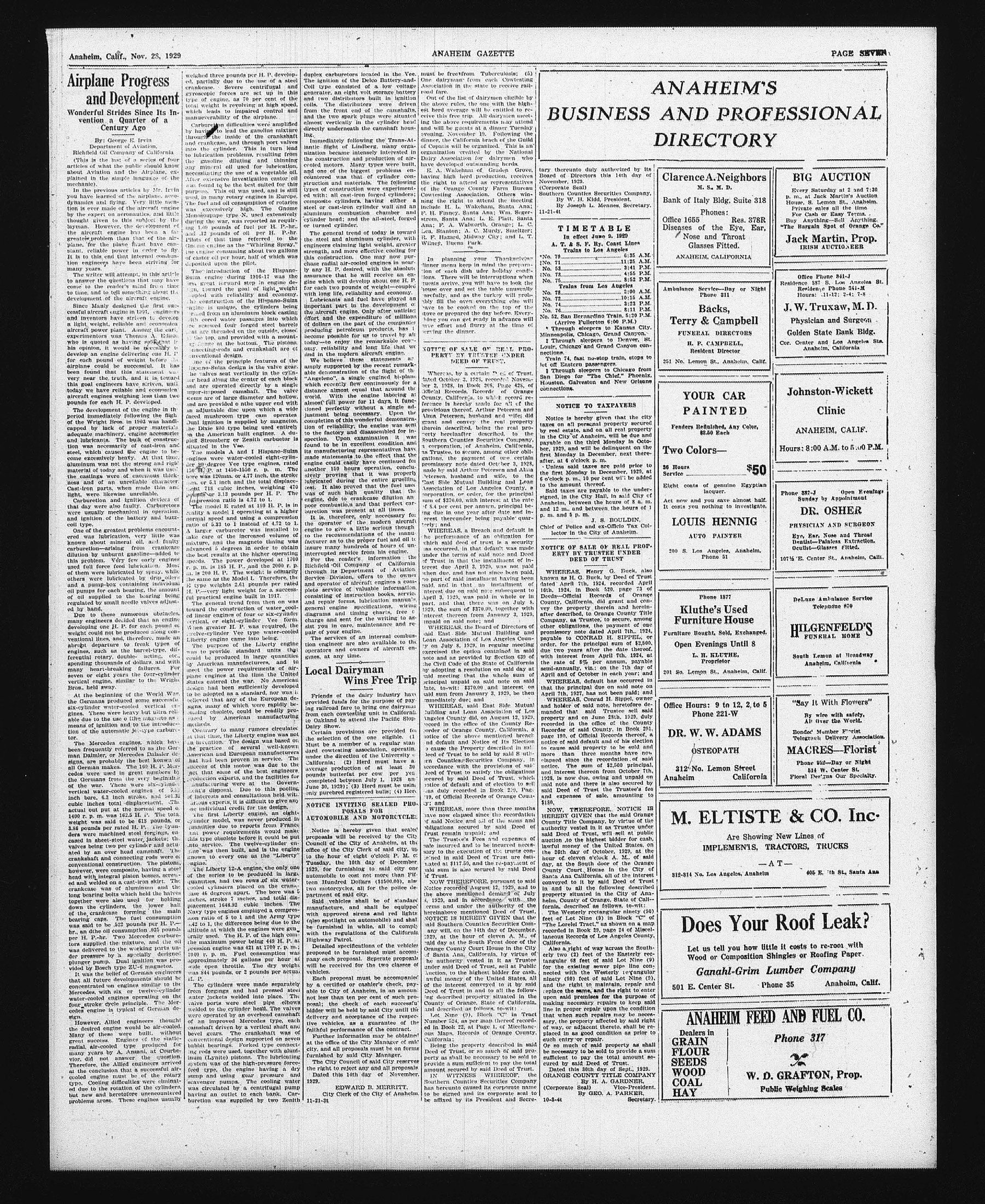
Searchable text
Airplane Progress and Development
Wonderful Strides Since Its Invention a Quarter of a Century Ago
By: George E. Irvin
Department of Aviation,
Richfield Oil Company of California
(This is the last of a series of four articles of what the public should know about Aviation and the Airplane, explained in the simple language of the mechanic).
In the previous articles by Mr. Irvin you have learned of the airplane, aerodynamics and flying. Very little mention is ever made of the aircraft engine by the expert on aeronautics, and little thought given to this subject by the layman. However, the development of the aircraft engine has been a far greater problem than that of the airplane, for the plane must have constant, reliable power in order to fly. It is to this end that internal combustion engineers have been striving for many years.
The writer will attempt, in this article to answer the questions that may have come to the reader's mind from time to time, and to tell something about the development of the aircraft engine.
Since Manly designed the first successful aircraft engine in 1901, engineers and inventors have striven to develop a light weight, reliable and economical aircraft power plant. Among the early experimenters was Thomas A. Ellison who is quoted as having said that his opinion, it would be necessary to develop an engine delivering one H.P. for each pound of weight before the airplanes could be successful. It has been found that this statement was very near the truth, and it is toward this goal engineers have striven, until today we have reliable and economical aircraft engines weighing less than two pounds for each H.P. developed.
The development of the engine in the period immediately following the flight of the Wright Bros. in 1903 was handled by lack of proper materials adequate machinery, engine accessories and lubricants. The bulk of construction was necessarily of cast-iron and welded three pounds per H.P. developed, partially due to the use of a steel crankcase. Severe centrifugal and gyroscopic forces are set up in this type of engine, as 70 per cent of the total weight is revolving at high speed, which leads to impaired control and maneuverability of the airplane.
Carbureation difficulties were amplified by having to lead the gasoline mixture through the inside of the crankshaft and crankcase, and through port valves into the cylinder. This in turn lead to lubrication problems, resulting from the gasoline diluting and thinning any mineral oil used for lubrication, necessitating the use of a vegetable oil. After extensive investigation castor oil was found to be the best suited for this purpose. This oil was used, and is still used, in many rotary engines in Europe. The fuel and oil consumption of rotaries was excessively high. The Gnome Monosoupape type N, used extensively during the war, was reported as requiring 1.09 pounds of fuel per H.P., hr., and 1.2 pounds of oil per H.P. Pilots of that time referred to the Gnome engine as the "Whirling Spray," the engine consuming about two gallons of castor oil per hour, half of which was deposited upon the pilot.
The introduction of the Hispano-Suiza engine during 1916-17 was the first great forward step in engine design, toward the goal of light weight coupled with reliability and economy. The construction of the Hispano-Suiza engine is unique, the cylinders being formed from an aluminum block casting with coated water passages into which are screwed four forged steel barrels that are threaded on the outside, closed at the top, and provided with a mounting flange at the bottom. The pistons connecting rods and crankshaft are all conventional design.
One of the principle features of the Hispano-Suiza design is the valve gear. The valves seat vertically in the cylinder head along the center of each block and are operated directly by a single super-imposed camshaft. The valve items are of large diameter and hollow, and are provided on the upper end with an adjustable disc upon which a wide faced mushroom type cam operates. Dual ignition is supplied by magnetos, the Dixie 800 type being entirely in the American built engines. A duplex Stromberg or Zenith carburetor is situated in the Vee.
Duplex carburetors located The ignition of the Deutz Coil type consisted of generator, an eight volt and two distributors coils. The distributors from the front end oval and the two spark plug almost vertically in this directly underneath thong.
Immediately following lantle flight of Lindberghization became intensive construction and produced motors. Many yachts and one of the biggest countered was that construction and material types of construction ed with; all cast-iron composite cylinders, he steel or cast-iron cylindrical cylinder head; and they or turned cylinder.
The general trend of the steel and aluminum engineers claiming light strength, and more efficient construction. One chase radial air-cooled by any H.P. desired, with assurance that he will gine which will develop for each two pounds of with long life, reliabilis.
Lubricants and fuels important part in the aircraft engine. On effort and the expenditure of dollars on the parts producing petroleum become possible for us today—to enjoy the new omy, reliability and longevity in modern air.
We believe these amply supported by their able demonstration of "Angeleno", a single which recently flew distance almost equal world. With the en almost full power for justed perfectly with justment being neces completion of this wond erelation of reliability, there to the factory and dissection. Upon exam found to be in excellent
develop an engine delivering one H.P. for each pound of weight before the airplane could be successful. It has been found that this statement was very near the truth, and it is toward this goal engineers have striven, until today we have reliable and economical aircraft engines weighing less than two pounds for each H.P. developed.
The development of the engine in the period immediately following the flight of the Wright Bros. in 1903 was handicapped by lack of proper materials adequate machinery, engine accessories and lubricants. The bulk of construction was necessarily of cast-iron and steel, which caused the engine to become excessively heavy. At that time, aluminum was not the strong and rigid material of today and when it was used the castings were of enormous thickness and of an unreliable character. Cast-iron parts, when made thin and light, were likewise unreliable.
Carburetion and ignition devices of that day were also faulty. Carburetors were usually mechanical in operation and ignition of the battery and buzzcoil type.
One of the greatest problems encountered was lubrication, very little was known about mineral oil, and faulty carburetion—arising from crankcase dilution by unburnt gasoline—added to this problem. Very few early engines used full force feed lubrication. Most of them were lubricated by spray, while others were lubricated by drill oilers and a pump-box containing individual oil pumps for each bearing, the amount of oil supplied to the bearing being regulated by small needle valves adjusted by hand.
Due to these numerous obstacles, many engineers decided that an engine developing one H.P. for each pound of weight could not be produced along conventional lines, and, therefore, made an abrupt departure to freak types of engines, such as the barrel-type, differential rotary, double-acting, etc., spending thousands of dollars, and with many heart-breaking failures. For seven or eight years the four-cylinder vertical engine, similar to the Wright Bros., held sway.
At the beginning of the World War, the Germans produced some successful six-cylinder water-cooled vertical engines. These were heavy but ultra reliable due to the use of the magneto as means of ignition and to the introduction of the automatic jet-type carburetor.
The Mercedes engines, which have been frequently referred to as the German Daimler, or Mercedes Daimler designs, are probably the best known of all German makes. The 160 H.P. Mercedes were used in great numbers by the Germans from the very beginning of the war. These were six-cylinder vertical water-cooled engines of 5.82 inch bore, 6.3 inch stroke, and 501.32 cubic inches total displacement. The actual out put at the normal speed o 1400 r.p.m. was 162.5 H.P. The total weight was said to be 618 pounds, or 3.85 pounds per rated H.P. The cylinders were machined steel forgings, enclosed in sheet-st Steel water jackets; the valves being two per cylinder and actuated by a carbine shaft.
One of the principle features of the Hispano-Sulza design is the valve gear. The valves seat vertically in the cylinder head along the center of each block and are operated directly by a single super-imposed camshaft. The valve items are of large diameter and hollow, and are provided on the upper end with an adjustable disc upon which a wide faced mushroom type cam operates. Dual ignition is supplied by magnetos, the Dixie 800 type being entirely on the American built engines. A duplex Stromberg or Zenith carbuector is situated in the Vee.
The models A and I Hispano-Sulza engines were water-cooled eight-cylinder 90-degree Vee type engines, rated 150 H.P. at 1450-1550 r.p.m. The bore was 120mm or 4.77 inch, the stroke mm or 5.1 inch and the total displacement 718 cubic inches, weighing 470 pounds or 3.13 pounds per H.P. The impression ratio is 4.72 to 1.
The model E rated at 180 H.P. is in reality a model I operating at a higher normal speed and using a compression ratio of 5.33 to I instead of 4.72 to I.
A larger carburetor was installed to take care of the increased volume of mixture, and the magneto timing was advanced 5 degrees in order to obtain the best results at the higher operating speeds. The power developed at 1700 r.p.m. is 185 H.P., and the 2000 r.p.m. is 200 H.P. The weight is odmarly the same as the Model I. Therefore, the E type weights 2.61 pounds per rated H.P.-very light weight for a successful practical engine built in 1917.
The general trend from then on was toward the construction of water-cooled linear engines of four or six-cylinder vertical, or eight-cylinder Vee form. When greater H.P. was required, the twelve-cylinder Vee type water-cooled Liberty engine came into being.
The purpose of the Liberty engine was to provide standard units that could be produced in large quantities by American manufacturers, and to meet the power requirements of airplane engines at the time the United States entered the war. No American design had been sufficiently developed to be adopted as a standard, nor was it believed that any of the European designs, many of which were rapidly becoming obsolete, could be readily produced by American manufacturing methods.
Contrary to many rumors circulated at that time, the Liberty engine was not an invention. The design was based on the practice of several well-known American and European manufacturers that had been proven in service. The success of this motor was due to the fact that some of the best engineers production experts, and the facilities for manufacturing were at the Government's disposal. Due to this pooling of interests and consultations held with various experts, it is difficult to give any individual credit for the design.
The first Liberty engine, an eight-cylinder model, was never produced in quantities due to reports from France that power requirements would make this type obsolete before it could be put into service. The twelve-cylinder engine was then built, and is the engine
We believe these simply supported by the able demonstration of "Angeleno", a single which recently flew close distance almost equal world. With the almost full power for completion this wondrous achievement in the factory and dissection. Upon examination found to be in excellent its manufacturing reputation made statements to the engine could easily hit another 150 hours or sively proving that it lubricated during the test. It also proved that was of such high quality due to crank-poor combustion and burection was present.
It is, therefore, on the operator of the engine to give a little to the recommendation factorer as to the prop insure many hundreds interrupted service free.
For the reader's Richfield Oil Company through its Department Service Division, officer and operator of aeronautic plate service of value consisting of instruction and repair forms, lubricant general engine spec diagrams and timing charge and sent for t list you in care, mail pair of your engine.
The services of an engineer are also operators and owners at any time.
Local Dairyman Wins
Friends of the daily provided funds for their ing railroad fare to bring from each cowtesting to Oakland to attend Dairy Show.
Certain provisions the selection of the Must be a member o dard cowtesting assoc under direction o California; (2) Here average production o pounds butterfat per completed between J June 30, 1929); (3) He only purebred registere
NOTICE INVITING POSALS AUTOMOBILE AND
Notice is hereby hereby proposals will be received Council of City office of City Clerk
man Daimler, or Mercedes Daimler signs, are probably the best known of all German makes. The 160 H.P. Mercedes were used in great numbers by the Germans from the very beginning of the war. These were six-cylinder vertical water-cooled engines of 5.8 inch bore, 6.3 inch stroke, and 90.32 cubic inches total displacement. The actual out put at the normal speed of 1400 r.p.m. was 162.5 H.P. The total weight was said to be 615 pounds, or 3.86 pounds per rated H.P. The cylinders were machined steel forgings, enclosed in sheet-steel water jackets; the valves being two per cylinder and actuated by an over head camshaft. The crankshaft and connecting rods were of conventional construction. The pistons, however, were composite, having a steel head with integral piston bosses, screwed and welded on a cast-iron skirt. The crankcase was of aluminum and the long bearing bolts which held the halves together were also used for holding down the cylinders, the lower half of the crankcase forming the main bearing caps. The fuel consumption was said to be .522 pounds per H.P.—hr., an dthe oil consumption .035 pounds per H.P.-hr. Two Mercedes carburetors supplied the mixture, and the oil was delivered to the working parts under pressure by a specially designed plunger pump. Dual ignition was provided by Bosch type ZU-6 magnetos.
It was the belief of German engineers that all future developments should be concentrated on engines similar to the Mercedes, with six or twelve-cylinder water-cooled engines operating on the four-stroke cycle principle. The Mercedes engine is typical of German design.
However, Allied engineers thought the desired engine would be air-cooled. Many of these were built, without great success. Engines of the static radial, air-cooled type produced for many years by A. Anzani, at Courbevier, did not answer the question. Therefore, the Allied engineers arrived at the conclusion that a successful air-cooled engine must be of the rotary type. Cooling difficulties were eliminated due to the rotation of the cylinders, but new and heretofore unencountered problems arose. These engines usually
duplex carburetors located in the Vee. The ignition of the Delco Battery-and-Coll type consisted of a low voltage generator, an eight volt storage battery and two distributors built in ignition coils. The distributors were driven from the front end of the camshafts, and the two spark plugs were situated almost vertically in the cylinder head directly underneath the camshaft housing.
Immediately following the Trans-Atlantic flight of Lindberg, many organization became intensely interested in the construction and production of air-cooled motors. Many types were built, and one of the biggest problems encountered was that of cylinder construction and materials. The following types of construction were experimented with; all cast-iron forged cylinders; composite cylinders, having either a steel or cast-iron cylinder wall and an aluminum combustion chamber and cylinder head; and the all-steel, forged or turned cylinder.
The general trend of today is toward the steel and aluminum cylinder, with engineers claiming light weight, greater strength, and more effective cooling for this construction. One may now purchase radial air-cooled engines in nearly any H. P. desired, with the absolute assurance that he will receive an engine which will develop about one H. P. for each two pounds of weight—coupled with long life, reliability and economy.
Lubricants and fuel have played an important part in the development of the aircraft engine. Only after untiring effort and the expenditure of millions of dollars on the part of the companies producing petroleum products, has it become possible for us to travel by air today—to enjoy the remarkable economy, reliability and long life that we find in the modern aircraft engine.
We believe these statements amply supported by the recent remarkable demonstration of the flight of the "Angeleno", a single engine bi-plane which recently flew continuously for a distance almost equal that around the world. With the engine laboring at almost full power for 11 days, it functioned perfectly without a single adjustment being necessary. Upon completion of this wonderful demonstration of reliability, the engine was sent to the factory and disassembled for inspection. Upon examination it was found to be in excellent condition and capable of performing its duties.
ANAHEIM GAZETTE
One dairyman from each Cowtesting Association in the state to receive railroad fare.
Out of the list of dairymen eligible by the above rules, the one with the highest herd average will be entitled to receive this free trip. All dairymen meeting the above requirements may attend and will be guests at a dinner Tuesday evening, November 19. Following the dinner, the California brach of the Guild of Copatis will be organized. This is an organization created by the National Dairy Association for dairymen who have developed outstanding herds.
E. A. Wakeham of Graden Grove, having high herd production, receives the right to attend as representatives of the Orange County Farm Bureau Cowtesting Association. Others winning the right to attend the meeting include H. L. Wakeham, Santa Ana; F. H. Finney, Santa Ana; Wm. Segerstrom, Santa Ana; L. E. Platt, Santa Ana; F. A. Walworth, Orange; L. C. Lea, Stanton; A. C. Murdy, Smeltzer; R. F. Hazard, Midway City; and L. T. Wilney, Buena Park.
In planning your Thanksgiving dinner menu keep in mind the preparation of each dish under holiday conditions. There will be interruptions when guests arrive, you will have to look the house over and set the table unusually carefully, and as the turkey will probably fill the oven everything else will have to be cooked on the top of the stove or prepared the day before. Everything you can get ready in advance will have effort and flurry at the time of serving the dinner.
NOTICE OF SALE OF REAL PROPERTY BY TRUSTEE UNDER DEED OF TRUST.
Whereas, by a certain Deed of Trust dated October 3, 1928, recorded November 2, 1928, in Book 208, Page 428, of Official Records, Records of Orange County, California, to which record reference is hereby made for all of the provisions thereof, Arthur Petersen and Alma Petersen, husband and wife, did grant and convey the real property therein described, being the real property hereinafter described, to the Southern Counties Securities Company, a corporation of Anaheim, California,
TIMETABLE
In effect June 9, 1929
A. T. & S. F. By Coast Lines Trains to Los Angeles
* No. 79 6:35 A.M.
* No. 71 11:25 A.M.
* No. 53 3:41 P.M.
* No. 78 4:55 P.M.
* No. 75 8:52 P.M.
Trains from Los Angeles
No. 78 2:00 A.M.
No. 72 10:15 A.M.
No. 74 3:23 P.M.
No. 76 8:11 P.M.
No. 52 San Bernardino Train 5:20 P.M.
(Arrive Fullerton 6:00 P.M.)
* Through sleepers to Kansas City, Minneapolis, Chicago, Grand Canyon.
* Through sleepers to Denver, St Louis, Chicago and Grand Canyon connections.
Train 74, fast no-stop train, stops to let off Eastern passengers.
$ Through sleepers to Chicago from San Diego for "The Chief," Phoenix, Houston, Galveston and New Orleans connections.
NOTICE TO TAXPAYERS
Notice is hereby given that the city taxes on all personal property secured by real estate, and on all real property in the City of Anaheim, will be due and payable on the third Monday in October 1929, and will be delinked on the
We believe these statements are simply supported by the recent remarkable demonstration of the flight of the "Angeleno", a single engine bi-plane which recently flew continuously for a distance almost equal that around the world. With the engine laboring at almost full power for 11 days, it functioned perfectly without a single adjustment being necessary. Upon the completion of this wonderful demonstration of reliability, the engine was sent to the factory and disassembled for inspection. Upon examination it was found to be in excellent condition and its manufacturing representatives have made statements to the effect that the engine could easily have continued for another 150 hours operation, conclusively proving that it was properly lubricated during the entire gruelling test. It also proved that the fuel used was of such high quality that the engine, due to crankcase dilution and poor combustion, and that perfect carburation was present at all times.
It is, therefore, only necessary for the operator of the modern aircraft engine to give a little serious thought to the recommendations of the manufacturer as to the proper fuel and oil to insure many hundreds of hours of uninterrupted service from his engine.
For the reader's information the Richfield Oil Company of California through its Department of Aviation Service Division, offers to the owner and operator of aircraft engines a complete service of valuable information, consisting of instruction books, service and repair forms, lubrication manuals, general engine specifications, wiring diagrams and timing charts, free charge and sent for the writing to assist you in care, maintenance and repair of your engine.
The services of an internal combustion engineer are also available to the operators and owners of aircraft engines, at any time.
Local Dairyman Wins Free Trip
Friends of the dairy industry have provided funds for the purpose of paying railroad fare to bring one dairyman from each cowtesting unit in California to Oakland to attend the Pacific Slop Dairy Show.
Certain provisions are provided for the selection of the one eligible. (1) Must be a member of a regular standard cowtesting association, operating under the direction of the University of California; (2) Herd must have average production of at least 30 pounds butterfat per cow per year completed between July 1, 1928 and June 30, 1929); (3) Herd must be using only purebred registered bulls; (4) Here
NOTICE INVITING SEALED PROPOSALS FOR AUTOMOBILE AND MOTORCYCLES:
Notice is hereby given that sealed proposals will be received by the City Council of the City of Anaheim, at the office of the City Clerk of said city, up
PERTY BY TRUSTEE UNDER DEED OF TRUST.
Whereas, by a certain Deed of Trust, dated October 3, 1928, recorded November 2, 1928, in Book 208, Page 428, of Official Records, Records of Orange County, California, to which record reference is hereby made for all of the provisions thereof, Arthur Petersen and Alma Petersen, husband and wife did grant and convey the real property therein described, being the real property hereinafter described, to Southern Counties Securities Company, a corporation, of Anaheim, California, as Trustee, to secure, among other obligations, the payment of one certain promissory note dated October 3, 1928, made by said Arthur Petersen and Alma Petersen, husband and wife, to the East Side Mutual Building and Loan Association of Los Angeles County, a corporation, or order, for the principal sum of $370.00, with interest at the rate of 8.4 per cent per annum, principal being due in one year after date and interest thereunder being payable quarterly; and
WHEREAS, a Breach and default in the performance of an obligation for which said deed of trust is a security has occurred, in that default was made under the terms of said note and Deed of Trust in that the installment of interest due April 3, 1929, was not paid when due, and has not since been paid, no part of said installation having been paid, and in that no installment of interest due on said note subsequent to April 3, 1929, was paid in whole or in part, and that there was on July 8, 1929, the sum of $370.00, together with interest thereon from January 3, 1929, impaid on said note; and
WHEREAS, the Board of Directors of East Side Mutual Building and Loan Association of Los Angeles County on July 8, 1929, in regular meeting exercised the option contained in said note and as provided by Section 639 of the Civil Code of the State of California by adopting a resolution on said day at meeting that the whole sum of principal unpaid on said note on said date; to-wit: $370.00 and interest on said sum from January 3, 1929, be then immediately due; and
WHEREAS, said East Side Mutual Building and Loan Association of Los Angeles County did not in accordance with the provisions of said Deed of Trust to satisfy the obligations secured by said Deed of Trust, which notice of default and election to sell was duly recorded in Book 229, Page 19, of Official Records of Orange County; and
WHEREAS, more than three months have now elapsed since the recording of said Notice and all of the sums and obligations secured by said Deed of Trust remain unpaid; and
The Trustee's Fees and expenses of sale incurred and to be incurred necessitate in connection with the trustee's con-
Train 74, fast no-stop train, stops to let off Eastern passengers.
$ Through sleepers to Chicago from San Diego for "The Chief," Phoenixx Houston, Galveston and New Orleans connections.
NOTICE TO TAXPAYERS
Notice is hereby given that the city taxes on all personal property secured by real estate, and on all real property in the City'of Anaheim will be due and payable on the third Monday in October, 1929,and will be delinquent on the first Monday in December,next thereafter.at 6 o'clock p.m.
Unless said taxes are paid prior to the first Monday in December,1929.at 6 o'clock p.m.,10 per cent will be added to the amount thereof.
Sald taxes are payable to the undersigned,在City Hall,在said City Of Anaheim,betweenthehoursof8a.m.and12m.,andbetweenthehoursof1p.m.and5p.m.
J.S.BOULDIN,
Chief of Police and ex-Officio Tax Collector in the City of Anaheim.
NOTICE OF SALE OF REAL PROPERTY BY TRUSTEE UNDER DEED OF TRUST
WHEREAS,Henry G.Buck,也 known as H.G.Buck,由DeedOfTrust datedApril7th,1924,recordedApril16th,1924,在Book520,page73于Deeds-OfficialRecordsofOrangeCounty,didgrantandconveythepropertythereinandhereinafterdescribed.toOrangeCountyTitleCompany.asTrustee,tosecure,amongotherobligations,thepaymentofonepromissorynotedatedApril7th,1924,payabletoCONRADH.SIPPEL,或order.fortheprincipalsumof$2,500,duetwo yearsafterthedatethereof.withinterestfromApril7th,1924,a rateof8%perannum,payablesemi-annually,viz.:onthe7thdayofAprilandOctoberineachyear;and
WHEREASdefaulthasoccurredinthattheprincipaldueonsaidnoteonApril7th,1927,hassotnotbeenpaid;and
WHEREAS.ConradH.SippelOwnerandholderofsaidnote,theheretoforedemandedthatsaidTrusteesellsaidpropertyandonJune28th,1929,dulyrecordedintheofficeoftheCountyRecorderofsaidCounty.InBook291.page190.ofOfficialRecordsthereof.a noticeofsaiddefaultandofhiselectiontouse萨Idpropertytobecoldandmorethanthreemonthshavenowclapsedsincetherecordation.ofsaidnotice.Thesumof$2,500principal,andinterestthereonfromOctober7th,1928.isnowdue.owingandunpaidonsaidnoteandthereisalsosecuredbysaidDeedofTrusttheTrustee'sfeeandexpensesofsaleamountingto$180.
NOW,THEREFORE.NOTICEISHEREBYGIVENthatthesaidOrangeCountyTitleCompany,bvictuetheauthorityvestedinItasTrusteeundersaidDeedofTrust.willsaltatpublicauction,tothehighestbladderforcash,fawfulmoneyoftheUnitedStates.on
NOTICE INVITING SEALED PROPOSALS FOR AUTOMOBILE AND MOTORCYCLES:
Notice is hereby given that sealed proposals will be received by the City Council of the City of Anaheim, at the office of the City Clerk of said city, up to the hour of eight o'clock P.M. on Tuesday, the 10th day of December, 1929, for furnishing to said city one automobile to cost not more than Fifteen Hundred Dollars ($1500.00), also two motorcycles, all for the police department of said city.
Said vehicles shall be of standard manufacture, and shall be equipped with approved sirens and red lights (also spotlight on automobile) and shall be furnished in white, all to comply with the regulations of the California Highway Patrol.
Detailed specifications of the vehicles proposed to be furnished must accompany each proposal. Separate proposals will be received for the two classes of vehicles.
Each proposal must be accompanied by a certified or cashier's check, payable to City of Anaheim, in an amount not less than ten per cent of such proposal; the check of each successful bidder will be held by said City until the delivery and acceptance of the respective vehicles, as a guarantee of the faithful performance of the contract.
Further information may be obtained at the office of the City Manager of said city, and all proposals must be on forms furnished by said City Manager.
The City Council of said City reserves the right to reject any and all proposals. Dated this 14th day of November, 1929.
EDWARD B. MERRITT,
City Clerk of the City of Anaheim.
11-21-3t
WHEREAS, more than three months have now elapsed since the recordation of said Notice and all of the sums and obligations secured by said Deed of Trust remain unpaid; and
The Trustee's Fees and expenses of sale incurred and to be incurred necessary to the execution of the trusts contained in said Deed of Trust are estimated at $117.50, and the re-payment of said sum is also secured by said Deed of Trust.
NOW THEREFORE, pursuant to said Notice recorded August 12, 1929, and in accordance with the terms and under the authority of the hereinabove mentioned Deed of Trust,
NOTICE IS HEREBY GIVEN that the said Southern Counties Securities Company will, on the 14th day of December, 1929, at the hour of eleven A.M., of said day at the South Front door of the Orange County Court House in the City of Santa Ana, California, by virtue of the authority vested in it as Trustee under said Deed of Trust, sell at Public Auction, to the highest bidder for cash, lawful money of the United States, all of the interest conveyed to it by said Deed of Trust in and to all the following described property situated in the City of Anaheim, County of Orange, State of California, described as follows, to-wit:
Lot Nine (9). Block "C" in Tract Number 524, as per map thereof recorded in Book 22, at Page 1, of Miscellaneous Maps, Records of Orange County, California;
Being the property described in said Deed of Trust, or so much of said property as shall be necessary to be sold to provide a sum sufficient to pay the total amount secured by said Deed of Trust.
IN WITNESS WHEREOF, the Southern Counties Securities Company has hereunto caused its corporate name to be signed and its corporate seal to be affixed by its President and Secretary.
NOW, THEREFORE, NOTICE IS HEREBY GIVEN that the said Orange County Title Company, by virtue of the authority vested in it as Trustee under said Deed of Trust, will sell at public auction to the highest bidder for cash, lawful money of the United States, on the 26th day of October, 1929, at the hour of eleven o'clock A.M., of said day, at the South door of the Orange County Court House in the City of Santa Ana California, all of the interest conveyed to it by said Deed of Trust in and to all the following described property situated in the City of Anaheim, County of Orange, State of California, described as follows, to-wit:
The Westerly rectangular ninety (90) feet of Lot Nine (9) in Block "C" of "The Lorelel Tract," as shown on a map recorded in Book 29, page 24 of Miscellaneous Records of Los Angeles County, California.
Also a right of way across the Southly two (2) feet of the Easterly rectangular 68 feet of said Lot Nine (9) for the existing sewer pipe line connected with the Westerly rectangular ninety (90) feet of said Lot Nine (9), and the right to maintain, repair and replace the same, and the right to enter upon said premises for the purpose of making necessary repairs to keep said line in proper repair upon the condition that when such repairs may be necessary, the property affected by said right of way, or adjacent thereto, shall be replaced in as good condition as prior to such entry or repair.
Or so much of said property as shall be necessary to be sold to provide a sum sufficient to pay the total amount secured by said Deed of Trust.
Dated this 30th day of Sept., 1929.
ORANGE COUNTY TITLE COMPANY
By H. A. GARDNER,
(Corporate Seal)
Vice-President.
By GEO. A. PARKER,
Secretary.
ANAHEIM'S
ESS AND PROFESSIONAL
DIRECTORY
Clarence A. Neighbors
M. S., M. D.
Bank of Italy Bldg. Suite 318
Phones:
Office 1655 Res. 378R
Diseases of the Eye, Ear,
Nose and Throat
Glasses Fitted.
ANAHEIM, CALIFORNIA
BIG AUCTION
Every Saturday at 2 and 7:30
p.m., at Jack Martin's Auction
House, S. Lemon St., Anaheim.
Private sales all the time
For Cash or Easy Terms.
Buy Anything—Sell Anything.
"The Bargain Spot of Orange Co."
Jack Martin, Prop.
IRISH AUCTIONEER
Ambulance Service—Day or Night
Phone 311
Backs,
Terry & Campbell
FUNERAL DIRECTORS
H. P. CAMPBELL,
Resident Director
251 No. Lemon St., Anaheim, Calif.
Office Phone 341-J
Residence $87 S. Los Angeles St.
Residence Phone 341-M
Hours: .11-12; 2-4; 7-8
J. W. Truxaw, M. D.
Physician and Surgeon
Golden State Bank Bldg.
Cor. Center and Los Angeles St.
Anaheim, California
YOUR CAR PAINTED
Fenders Refinished, Any Color,
$2.50 Each
Johnston-Wickett
Clinic
ANAHEIM, CALIF.
Hours: 8:00 A.M. to 5:00 P.M.
YOUR CAR PAINTED
Fenders Refinished, Any Color,
$2.50 Each
Two Colors—
$6 Hours
Service $50
Eight coats of genuine Egyptian lacquer.
Act now and you save almost half.
It costs you nothing to investigate.
LOUIS HENNIG
AUTO PAINTER
200 S. Los Angeles, Anaheim,
Phone 51
Johnston-Wickett Clinic
ANAHEIM, CALIF.
Hours: 8:00 A.M. to 5:40 P.M.
Phone 357-J Open Evenings
Sunday by Appointment
DR. OSHER
PHYSICIAN AND SURGEON
Eye, Ear, Nose and Throat
Dentist—Painless Extraction.
Oculist—Glasses Fitted.
107½ E. Center St., Anaheim, Calif.
Phone 1877
Kluthe's Used Furniture House
Furniture Bought, Sold, Exchanged.
Open Evenings Until 8
L. H. KLUTHE,
Proprietor
201 So. Lemon St., Anaheim, Calif.
DeLuxe Ambulance Service
Telephone 870
HILGENFELD'S
FUNERAL HOME
South Lemon at Broadway
Anaheim, California
Office Hours: 9 to 12, 2 to 5
Phone 221-W
DR. W. W. ADAMS
OSTEOPATH
312 No. Lemon Street
Anaheim California
"Say It With Flowers"
By wire with safety,
All Over the World.
Bonded Member Florist
Telegraph Delivery Association.
MACRES—Florist
Phone 952—Day or Night
514 W. Center St.
Floral Designs Our Specialty.
M. ELTISTE & CO. Inc.
Are Showing New Lines of
IMPLEMENTS, TRACTORS, TRUCKS
M. ELTISTE & CO. Inc.
Are Showing New Lines of IMPLEMENTS, TRACTORS, TRUCKS
—AT—
312-314 No. Los Angeles, Anaheim 405 E. 7th St, Santa Ana
Does Your Roof Leak?
Let us tell you how little it costs to re-root with Wood or Composition Shingles or Roofing Paper.
Ganahl-Grim Lumber Company
501 E. Center St. Phone 35 Anaheim, Calif.
ANAHEIM FEED AND FUEL CO.
Dealers in
GRAIN
FLOUR
SEEDS
WOOD
COAL
HAY
Phone 317
W. D. GRAFTON, Prop.
Public Weighing Scales