anaheim-gazette 1929-11-14
Scanned page
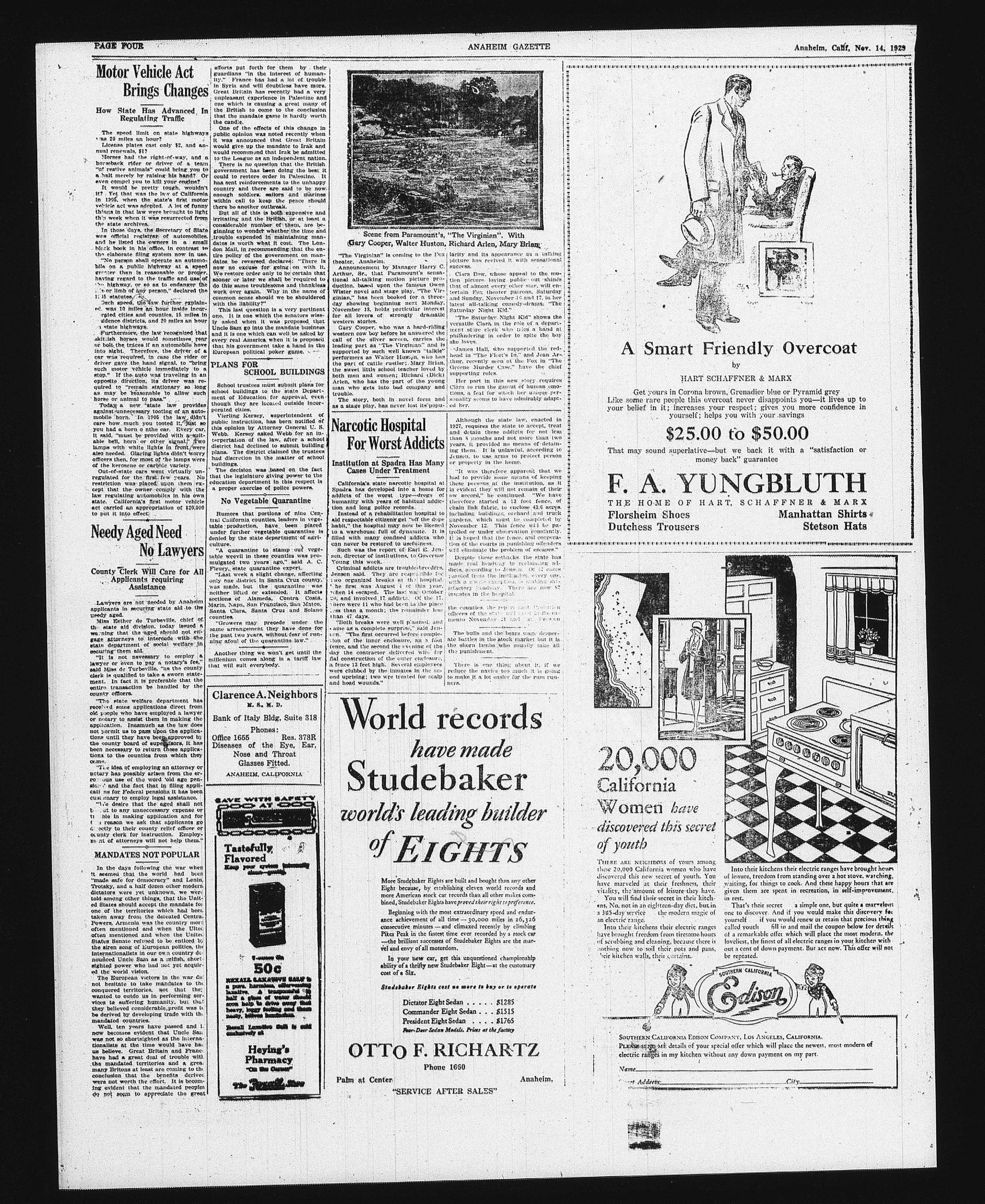
Searchable text
Motor Vehicle Act Brings Changes
How State Has Advanced In Regulating Traffic
The speed limit on state highways was 20 miles an hour?
License plates cast only $2, and annual renewals, $1?
Horses had the right-of-way, and a horseback rider or driver of a team "of restive animals" could bring you to a halt merely by raising his hand? Or even compel you to kill your engine?
It would be pretty tough, wouldn't it? Yet that was the law of California in 1905, when the state's first motor vehicle act was adopted. A lot of funny things in that law were brought to light this week when it was resurrected from the state archives.
In those days, the Secretary of State was official registrar of automobiles, and he listed the owners in a small block book in his office, in contrast to the elaborate filing system now in use.
"No person shall operate an automobile on a public highway at a speed greater than is reasonable or proper, having regard to the traffic and use of the highway, or so as to endanger the life or limb of any person," declared the 135 statutes.
Such speed, the law further explained, was 10 miles an hour inside incorporated cities and counties, 15 miles in evidence districts, and 20 miles an hour in state highways.
Furthermore, the law recognized that British horses would sometimes rear or bolt, the traces if an automobile hove into sight. Therefore, the driver of a car was required, in case the rider or driver gave the hand signal, to "bring such motor vehicle immediately to a stop." If the auto was traveling in an opposite direction, its driver was required to "remain stationary so long as may be reasonable to allow such horse or animal to pass."
Today a new state law provides against unnecessary tooting of an automobile horn. In 1905 the law didn't care how much you tooted it, just so you had a horn on the car. Every car, it said, "must be provided with a suitable bell, horn or other signal." Two lamps with white lights in front were efforts put forth for them by their guardians "in the interest of humanity." France has had a lot of trouble in Syria and will doubtless have more. Great Britain has recently had a very unpleasant experience in Palestine and one which is causing a great many of the British to come to the conclusion that the mandate game is hardly worth the candle.
One of the effects of this change in public opinion was noted recently when it was announced that Great Britain would give up the mandate to Irak and would recommend that Irak be admitted to the League as an independent nation.
There is no question that the British government has been doing the best it could to restore order in Palestine. It has sent reinforcements to the unhappy country and there are said to be now enough soldiers, sailors and marines within call to keep the peace should there be another outbreak.
But all of this is both expensive and irritating and the British, or at least a considerable number of them, are beginning to wonder whether the time and trouble expended in maintaining mandates is worth what it cost. The London Mail, in recommending that the entire policy of the government on mandates be reversed declared: "There is now no excuse for going on with it. We restore order only to be certain that sooner or later we shall be required to do this same troublesome and thankless work over again. Why in the name of common sense should we be shouldered with the liability?"
This last question is a very pertinent one. It is one which the senators wisely asked when it was proposed that Uncle Sam go into the mandate business and it is one which can well be asked by every real America when it is proposed that his government take a hand in the European political poker game.
PLANS FOR SCHOOL BUILDINGS
School trustees must submit plans for school buildings to the state Department of Education for approval, even though they are located outside incorporated cities.
Vierling Kersey, superintendent of public instruction, has been notified of this opinion by Attorney General U. S. Webb. Kersey asked Webb for an interpretation of the law, after a school district had declined to submit building
car was required, in case the rider or driver gave the hand signal, to "bring such motor vehicle immediately to a stop." If the auto was traveling in an opposite direction, its driver was required to "remain stationary so long as may be reasonable to allow such horse or animal to pass."
Today a new state law provides against unnecessary tooting of an automobile horn. In 1905 the law didn't care how much you tooted it, just so you had a horn on the car. Every car, it said, "must be provided with a suitable bell, horn or other signal." Two lamps with white lights in front were also needed. Glaring lights didn't worry officers then, for most of the lamps were of the kerosene or carbide variety.
Out-of-state cars went virtually unregulated for the first few years. No restriction was placed upon them except that the owner comply with the law regulating automobiles in his own state. California's first motor vehicle act carried an appropriation of $20,000 to put it into effect.
Needy Aged Need No Lawyers
County Clerk Will Care for All Applicants requiring Assistance
Lawyers are not needed by Anahiem applicants in securing state aid to the needy aged.
Miss Esther de Turbeville, chief of the state aid division, today issued a warning that the aged should not engage attorneys to intercede with the state department of social welfare in securing them aid.
"It is not necessary to employ a lawyer or even to pay a notary's fee," said Miss de Turbeville, "as the county clerk is qualified to take a sworn statement. In fact it is preferable that the entire transaction be handled by the county officers.
"The state welfare department has received some applications direct from old people who have employed a lawyer or notary to assist them in making the application. Inasmuch as the law does not permit us to pass upon the applications until they have been approved by the county board of supervisors, it has been necessary to return these applications to the counties from which they come."
"The idea of employing an attorney or notary has possibly arisen from the erroneous use of the word 'old age pension' and the fact that in filling applications for Federal pensions it has been customary to employ legal assistance.
"We desire that the aged shall not be put to any unnecessary expense or trouble in making application and for this reason we ask that applicants go directly to their county relief officer or county clerk for instruction. Employment of attorneys will not help them."
"The idea of employing an attorney or notary has possibly arisen from the erroneous use of the word 'old age pension' and the fact that in filling applications for Federal pensions it has been customary to employ legal assistance.
"We desire that the aged shall not be put to any unnecessary expense or trouble in making application and for this reason we ask that applicants go directly to their county relief officer or county clerk for instruction. Employment of attorneys will not help them."
MANDATES NOT POPULAR
In the days following the war when it seemed that the world had been "made safe for democracy" and Lenin, Trotsky, and a half dozen other modern dictators were yet unknown, we were told among other things, that the United States should accept the mandate for one of the territories which had been taken away from the defeated Central Powers. Armenia was the country more often mentioned and when the Uitede often mentioned and when the United States Senate refused to be enticed by the siren song of European politics, the internationalists in our own country denounced Uncle Sam as a selfish, short-sighted power who had not yet acquired the world vision.
The European victors in the war did not hesitate to take mandates to the conquered territories, not that they wanted to outdo us in performing services to suffering humanity, but that they believed considerable profit was to be derived by developing trade with the mandated countries.
Well, ten years have passed and it now becomes evident that Uncle Sam was not so shortsighted as the internationalists at the time would have had us believe. Great Britain and France have had a great deal of trouble with the mandated territories and a great many Britons at least are coming to the conclusion that the benefits derived were not worth the effort. It is becoming evident that the mandated peoples do not seem to appreciate the great
Scene from Paramount's, "The Virginian". With Gary Cooper, Walter Huston, Richard Arlen, Mary Brian
"The Virginian" is coming to the Fox theater, Anaheim.
Announcement by Manager Harry C. Arthur, Sr., that Paramount's sensational all-talking motion picture production, based upon the famous Owen Wister novel and stage play, "The Virginian," has been booked for a three-day showing beginning next Monday, November 18, holds particular interest for all lovers of strongly dramatic western stories.
Gary Cooper, who was a hard-riding western cow boy before he answered the call of the silver screen, carries the leading part as "The Virginian" and is supported by such well known "talkie" performers as Walter Huston, who has the part of cattle rusher; Mary Brian, the sweet little school teacher loved by both men and women; Richard (Dick) Arlen, who has the part of the young man who gets into bad company and trouble.
The story, both in novel form and as a stage play, has never lost its popularity and its appearance as a talking picture has revived it with sensational success.
Clara Dow, whose appeal to the motion picture loving public outshines that of almost every other star, will entertain Fox theater patrons, Saturday and Sunday, November 16 and 17, in her latest all-talking comedy-drama, "The Saturday Night Kid."
"The Saturday Night Kid" shows the versatile Clara in the role of a department store clerk who tries a hand at philandering in order to spite the boy she loves.
James Hall, who supported the redhead in "The Fleet's In," and Jean Arthur, recently seen at the Fox in "The Greene Murder Case," have the chief supporting roles.
Her part in this new story requires Clara to run the gamut of human emotions, a feat for which her unique personality seems to have admirably adapted her.
Narcotic Hospital For Worst Addicts
Although the state law, enacted in 1927, requires the state to accept, treat and detain these addicts for not less than 8 months and not more than two years, it provided no means of detainment.
Narcotic Hospital For Worst Addicts
Institution at Spadra Has Many Cases Under Treatment
California's state narcotic hospital at Spadra has developed into a home for addicts of the worst type—dregs of humanity with years of habitual addiction and long police records.
Instead of a rehabilitation hospital to aid respectable citizens get "off the dope habit," the hospital may now be likened to a warehouse full of dynamite. It is filled with many confined addicts who can never be restored to usefulness.
Such was the report of Earl E. Jensen, director of institutions, to Governor Young this week.
Criminal addicts are trouble-breeders. Jensen said. They are responsible for two organized breaks at the hospital: the first was August 4 of this year, when 14 escaped. The last was October 20, and involved 17 addicts. Of the 17 there were 11 who had been in the place less than a month; the remainder less than 47 days.
"Both breaks were well planned, and came as a complete surprise," said Jensen. "The first occurred before completion of the inner enclosure, an 8 foot fence, and the second the evening of the day the contractor delivered wire for final construction of the outer enclosure, a fence 13 feet high. Several employees were clubbed by the inmates in the second uprising; two were treated for scalp and head wounds."
Although the state law, enacted in 1927, requires the state to accept, treat and detain these addicts for not less than 8 months and not more than two years, it provided no means of detaining them. It is unlawful, according to Jensen, to use arms to protect person or property in the home.
"It was therefore apparent that we had to provide some means of keeping these persons at the institution, as it is evident they will not remain of their ow accord," he continued. "We have therefore started a 13 foot fence, of chain link fabric, to enclose 43.6 acres including buildings, orchard and truck gardens, which must be completed by November 12. This fence will be patrolled or under observation constantly. It is hoped that the fence, and cooperation of the courts in punishing offenders will eliminate the problem of escapes."
Despite these setbacks, the state has made real headway in reclaiming addicts, according to Jensen. Of 47 cases paroled from the institution, every one with a guilty exception is making satisfactory roadway. There are now 87 inmates in the hospital.
The counties, the report said, Protection officers of the state will assist in Saratoga November 21 and at Fresno.
The bulls and the bears wage desperate battles in the stock market but it is the shorn lambs who usually take all the punishment.
There is one thing about it, if we reduce the navies too much it is going to make it a lot easier for the rum runners.
World records have made Studebaker world's leading builder of FIGHTS
Studebaker world's leading builder of EIGHTS
More Studebaker Eights are built and bought than any other Eight because, by establishing eleven world records and more American stock car records than all other makes combined, Studebaker Eights have proved their right to preference.
Beginning with the most extraordinary speed and endurance achievement of all time — 30,000 miles in 26,326 consecutive minutes — and climaxed recently by climbing Pikes Peak in the fastest time ever recorded by a stock car—the brilliant successes of Studebaker Eights are the marvel and envy of all motordom.
In your new car, get this unquestioned championship ability of a thrifty new Studebaker Eight—at the customary cost of a Six.
Studebaker Eights cost no more to buy or to operate
Dictator Eight Sedan . . . $1285
Commander Eight Sedan . . . $1515
President Eight Sedan . . . $1765
Four-Door Sedan Models. Prices at the factory
OTTO F. RICHARTZ
Phone 1660
Palm at Center Anaheim,
"SERVICE AFTER SALES"
A Smart Friendly Overcoat
by
HART SCHAFFNER & MARX
Get yours in Corona brown, Grenadier blue or Pyramid grey
take some rare people this overcoat never disappoints you—it lives up to
our belief in it; increases your respect; gives you more confidence in
yourself; helps you with your savings
$25.00 to $50.00
by
HART SCHAFFNER & MARX
Get yours in Corona brown, Grenadier blue or Pyramid grey
take some rare people this overcoat never disappoints you—it lives up to
your belief in it; increases your respect; gives you more confidence in
yourself; helps you with your savings
$25.00 to $50.00
that may sound superlative—but we back it with a “satisfaction or
money back” guarantee
F. A. YUNGBLUTH
THE HOME OF HART, SCHAFFNER & MARX
Horsheim Shoes
Manhattan Shirts
Butchess Trousers
Stetson Hats
0,000
california
women have
covered this secret
youth
ARE NEIGHBORS of yours among 10,000 California women who have covered this secret youth.
Into their kitchens their electric ranges have brought hours of leisure, freedom from standing over a hot stove, watching, waiting, for things to cook. And these happy hours that are given them are spent in recreation, in self-improvement, in rest.
That's their secret a simple one, but quite a marvel: one to discover. And if you would make this discovery for yourself if you would renew or retain that precious thing called youth fill in and mail the coupon below for details of a remarkable offer which will place the most modern, the loveliest, the finest of all electric ranges in your kitchen without a cent of down payment. But act now. This offer will not be repeated.
SOUTHERN CALIFORNIA
Edison
SOUTHERN CALIFORNIA EDISON COMPANY, LOS ANGELES, CALIFORNIA.
PLEASE SEND ME details of your special offer which will place the newest, most modern of electric ranges in my kitchen without any down payment on my part.
Name
Street Address City