anaheim-gazette 1929-11-07
Scanned page
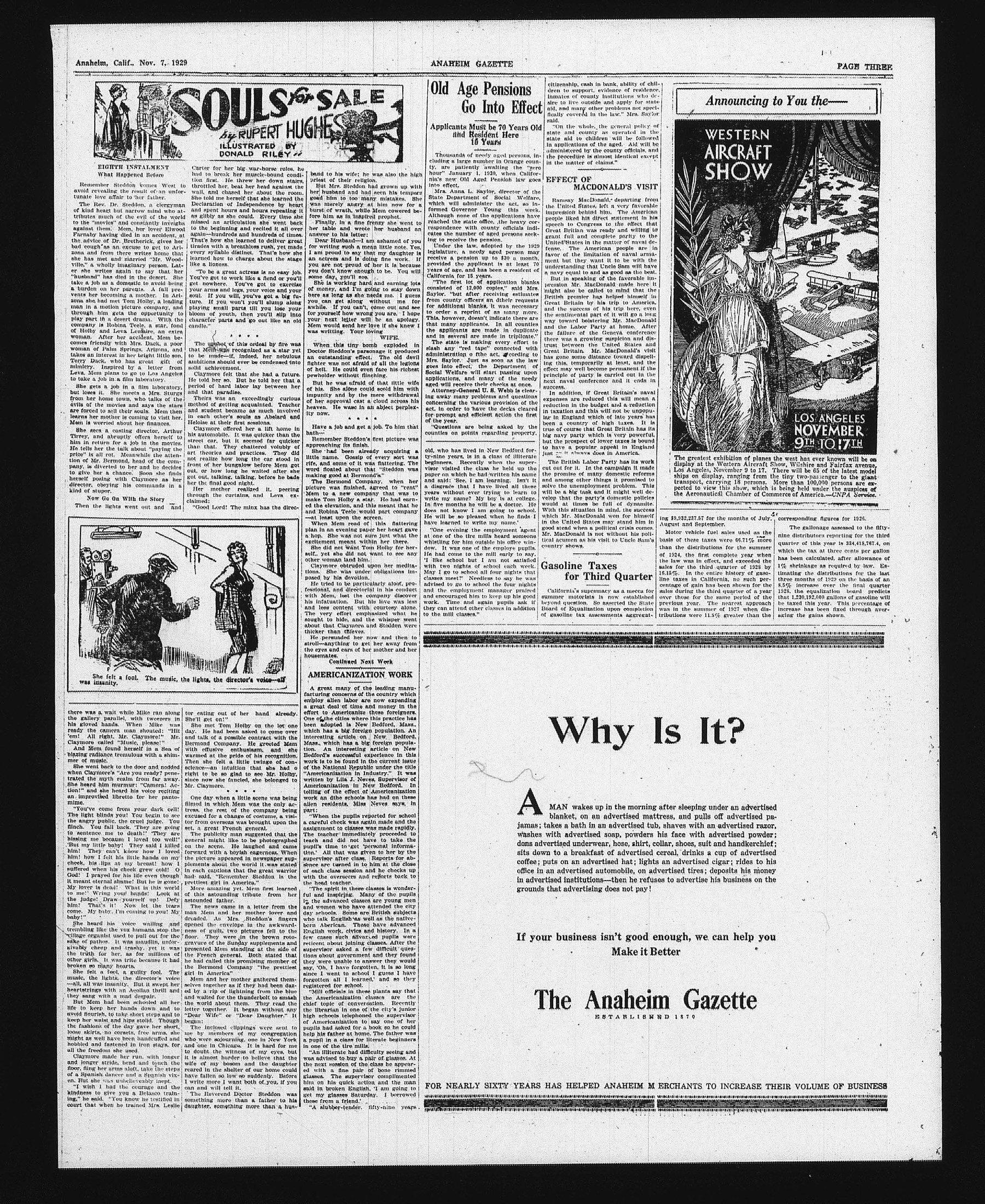
Searchable text
Anaheim, Calif., Nov. 7, 1929
EIGHTH INSTALMENT
What Happened Before
Remember Steddon comes West to avoid revealing the result of an unfortunate love affair to her father.
The Rev. Dr. Steddon, a clergyman of kind heart but narrow mind who attributes much of the evil of the world to the "movies" and constantly inveighs against them. Mem, her lover Elwood Farnaby having died in an accident, at the advice of Dr. Bretherick, gives her bad cough as an excuse to get to Arizona and from there writes home that she has met and married "Mr. Woodville," a wholly imaginary person. Later she writes again to say that her "husband" has died in the desert. She take a job as a domestic to avoid being a burden on her parents. A fall prevents her becoming a mother. In Arizona she had met Tom Holby, a leading man in a motion picture company, and through him gets the opportunity to play part in a desert drama. With the company is Robina Teele, a star, fond of Holby and Leva Lemaire, an extra woman. After her accident, Mem becomes friendly with Mrs. Dack, a poor woman of Palm Springs, Arizona, and takes an interest in her bright little son, Terry Dack, who has great gift of mimicry. Inspired by a letter from Leva, Mem plans to go to Los Angeles to take a job in a film laboratory.
She gets a job in a film laboratory, but loses it. She meets a Mrs. Sturgs from her home town, who talks of the evils of the movies and says the stars are forced to sell their souls. Mem then learns her mother is coming to visit her. Mem is worried about her finances.
She sees a casting director, Arthur Thirrey, and abruptly offers herself to him in return for a job in the movies. He tells her the way to saying the Carter for her big war-horse roles, he had to break her muscle-bound condition first. He threw her down stairs, throttled her, beat her head against the wall, and chased her about the room. She told me herself that she learned the Declaration of Independence by heart and spent hours and hours repeating it as glibly as she could. Every time she missed an articulation she went back to the beginning and recited it all over again—hundreds and hundreds of times. That's how she learned to deliver great tirades with a breathless rush, yet made every syllable distinct. That's how she learned how to charge about the stage like a lioness.
"To be a great actress is no easy job. You've got to work like a fiend or you'll get nowhere. You've got to exercise your arms and legs, your voice and your soul. If you will, you've got a big future. If you won't you'll slump along playing small parts till you lose your bloom of youth, then you'll slip into character parts and go out like an old candle."
The upshot of this ordeal by fire was that Mem was recognized as a star yet to be made—if, indeed, her nebulous ambitions should ever be condensed into solid achievement.
Claymore felt that she had a future. He told her so. But he told her that a period of hard labor lay between her and that paradise.
Theirs was an exceedingly curious method of getting acquainted. Teacher and student became as much involved in each other's souls as Abelard and Heloise at their first sessions.
Claymore offered her a lift home in his automobile. It was quicker than the street car, but it seemed far quicker than that. They chattered volubly of band to his wife; he priest of their religion.
But Mrs. Steeddon her husband and had good him to too many was merely angry burst of wrath, while fore him as in Inspil.
Finally, in a fine ear table and wrote answer to his letter:
Dear Husband—I am for writing such a maid I am proud to say that an actress and is do you not know enough some day you'll see.
She is working hard of money, and I'm going here as long as she will you can get along awhile. If you can't, for yourself how wrong your next letter will Mem would send her was writting. Your life.
When this tiny boy Doctor Steeddon's part an outstanding effect fighter was not afraid of hell. He could save pewholder without filing.
But he was afraid of his. She alone could impunity and by the end of her approval cast heaven. He was in itsity now.
Have a job and get hath—
Remember Steeddon approaching its finish
takes an interest in her bright little son, Terry Dack, who has great gift of mimicry. Inspired by a letter from Leva, Mem plans to go to Los Angeles to take a job in a film laboratory.
She gets a job in a film laboratory, but loses it. She meets a Mrs. Sturgs from her home town, who talks of the evils of the movies and says the stars are forced to sell their souls. Mem then learns her mother is coming to visit her. Mem is worried about her finances.
She sees a casting director, Arthur Thirrey, and abruptly offers herself to him in return for a job in the movies. He tells her the talk about "paying the price" is all rot. Meanwhile the attention of Mr. Bermond, head of the company, is diverted to her and he decides to give her a chance. Soon she finds herself posing with Claymore as her director, obeying his commands in a kind of stupor.
Now Go On With the Story
Then the lights went out and and
She felt a fool. The music, the lights, the director's voice—all was insanity.
there was a wait while Mike ran along the gallery parallel, with tweezers in his gloved hands. When Mike was ready the camera man shouted: "Hit 'em! All right, Mr. Claymore!" Mr. Claymore called "Music, please!"
And Mem found herself in a Sea of blazing radiance tremulous with a shimmer of music.
She went back to the door and nodded when Claymore's "Are you ready? penetrated the myth realm from far away. She heard him murmur: "Camera! Action!" and she heard his voice reciting an improvised libretto for her pantomime.
"We've come from your dark cell! The light blinds you! You begin to see the angry public, the cruel judge. You filnch. You fall back. They are going to sentence me to death!' They are missing me because I loved too well!' But my little baby! They said I killed tor eating out of her hand already. She'll get on!
She met Tom Holby on the lot one day. He had been asked to come over and talk of a possible contract with the Bermond Company. He greeted Mem with effusive enthusiasm, and she warmed at the pride of his recognition. Then she felt a little twinge of conscience—an intuition that she had o right to be so glad to see Mr. Holby, since now she fancied, she belonged to Mr. Claymore.
One day when a little scene was being filmed in which Mem was the only actress, the rest of the company being excused for a change of costume, a visitor from overseas was brought upon the set, a great French general.
The publicity man suggested that the general might like to be photographed on the scene. He laughed and came to be made—if indeed, her nebulous ambitions should ever be condensed into solid achievement.
Claymore felt that she had a future. He told her so. But he told her that a period of hard labor lay between her and that paradise.
Theirs was an exceedingly curious method of getting acquainted. Teacher and student became as much involved in each other's souls as Abelard and Heloise at their first sessions.
Claymore offered her a lift home in his automobile. It was quicker than the street car, but it seemed far quicker than that. They chattered volubly of art theories and practices. They did not realize how long the car stood in front of her bungalow before Mem got out, or how long he waited after she got out, talking, talking, before he bade her the final good night.
Her mother realized it, peering through the curtains, and Leva exclaimed:
"Good Lord! The minx has the direc-
A great many of the facturing concerns of the employ allen labor are a great deal of time and effort to Americanize One of the cities where been adopted is New which has a big foreign interesting article on Mass., which has a big tion. An interesting Bedford's successful e work is to be found in of the National Republic "Americanization in In written by Lila J. New Americanization in N telling of the effect of work on dne schools alien residents, Miss part:
"When the pupils rea careful cheek was ag assignment to classes w The teacher immediate teach and did not h pupil's time to get 'p
She went back to the door and nodded when Claymore's "Are you ready? penetrated the myth realm from far away. She heard him murmur: 'Camera! Action!' and she heard his voice reciting an improvised libretto for her pantomime.
"You've come from your dark cell! The light blinds you! You begin to see the angry public, the cruel judge. You filinch. You fall back. They are going to sentence me to death!' They are hissing because I loved too well! But my little baby! They said I killed him! They can't know how I loved him! how I felt his little hands on my cheek, his lips at my breast! how I suffered when his cheek grew cold! God! I prayed for his life even though it meant eternal shame! But he is gone! My lover is dead! What is this world to me! Wring your hands! Look at the judge! Draw yourself up! Defy him! That's it! Now let the tears come. My baby, I'm coming to you! My baby!"
She heard his voice wailing and trembling like the vox humana stop the village organist used to pull out for the sake of pathos. It was maudlin, unforgivably cheap and trashy, yet it was the truth for her, as for millions of other girls. It was trite because it had broken so many hearts.
She felt a fool, a guilty fool. The music, the lights, the director's voice—all, all was insanity. But it swept her heartstrings with an Aeolian thrill and they sang with a mad despair.
But Mem had been schooled all her life to keep her hands down and to avoid flourish, to take short steps and to keep her waist and hips stolid. Though the fashions of the day gave her short, loose skirts, no corsets, free arms, she might as well have been handcuffed and hobbled and fastened in iron stays, for all the freedom she used.
Claymore made her run, with longer and longer stride, bend and touch the floor, fling her arms aloft, take the steps of a Spanish dancer and a Spanish vixen. But she was unbelievably inept.
"I wish I had the courage and the kindness to give you a Belasco training," he said. "You know he testified in court that when he trained Mrs. Lealle warmed at the pride of his recognition. Then she felt a little twinge of conscience—an intuition that she had o right to be so glad to see Mr. Holby, since now she fancied, she belonged to Mr. Claymore.
One day when a little scene was being filmed in which Mem was the only actress, the rest of the company being excused for a change of costume, a visitor from overseas was brought upon the set, a great French general.
The publicity man suggested that the general might like to be photographed on the scene. He laughed and came forward with a boyish eagerness. When the picture appeared in newspaper supplements about the world it was stated in each captions that the great warrior had said, "Remember Steddon is the prettiest girl in America."
More amazing yet. Mem first learned of this astounding tribute from her astounded father.
The news came in a letter from the man Mem and her mother lover and dreaded. As Mrs. Steddon's fingers opened the envelope in the awkwardness of guilt, two pictures fell to the floor. They were in the brown rot-gravure of the Sunday supplements and presented Mem standing at the side of the French general. Both stated that he had called this promising member of the Bermond Company "the prettiest girl in America."
Mem and her mother gathered themselves together as if they had been dazed by a rip of lightning from the blue and waited for the thunderbolt to smash the world about them. They read the letter together. It began without any "Dear Wife" or "Dear Daughter." It began:
The inclosed clippings were sent to me by members of my congregation who were sojourning, one in New York and one in Chicago. It is hard for me to doubt the witness of my eyes, but it is almost harder to believe that the wife of my bosom and the daughter reared in the shelter of our home could have fallen so low so suddenly. Before I write more I want both of you, if you can and will tell it.
The Reverend Doctor Steddon was something more than a father to his daughter, something more than a husband at the pride of his recognition. Then she felt a little twinge of conscience—an intuition that she had o right to be so glad to see Mr. Holby, since now she fancied, she belonged to Mr. Claymore.
One day when a little scene was being filmed in which Mem was the only actress, the rest of the company being excused for a change of costume, a visitor from overseas was brought upon the set, a great French general.
The publicity man suggested that the general might like to be photographed on the scene. He laughed and came forward with a boyish eagerness. When the picture appeared in newspaper supplements about the world it was stated in each captions that the great warrior had said, "Remember Steddon is the prettiest girl in America."
More amazing yet. Mem first learned of this astounding tribute from her astounded father.
The news came in a letter from the man Mem and her mother lover and dreaded. As Mrs. Steddon's fingers opened the envelope in the awkwardness of guilt, two pictures fell to the floor. They were in the brown rot-gravure of the Sunday supplements and presented Mem standing at the side of the French general. Both stated that he had called this promising member of the Bermond Company "the prettiest girl in America."
Mem and her mother gathered themselves together as if they had been dazed by a rip of lightning from the blue and waited for the thunderbolt to smash the world about them. They read the letter together. It began without any "Dear Wife" or "Dear Daughter." It began:
The inclosed clippings were sent to me by members of my congregation who were sojourning, one in New York and one in Chicago. It is hard for me to doubt the witness of my eyes, but it is almost harder to believe that the wife of my bosom and the daughter reared in the shelter of our home could have fallen so low so suddenly. Before I write more I want both of you, if you can and will tell it.
The Reverend Doctor Steddon was something more than a father to his daughter, something more than a husband at the pride of his recognition. Then she felt a little twinge of conscience—an intuition that she had o right to be so glad to see Mr. Holby, since now she fancied, she belonged to Mr. Claymore.
One day when a little scene was being filmed in which Mem was the only actress, the rest of the company being excused for a change of costume, a visitor from overseas was brought upon the set, a great French general.
The publicity man suggested that the general might like to be photographed on the scene. He laughed and came forward with a boyish eagerness. When the picture appeared in newspaper supplements about the world it was stated in each captions that the great warrior had said, "Remember Steddon is the prettiest girl in America."
More amazing yet. Mem first learned of this astounding tribute from her astounded father.
The news came in a letter from the man Mem and her mother lover and dreaded. As Mrs. Steddon's fingers opened the envelope in the awkwardness of guilt, two pictures fell to the floor. They were in the brown rot-gravure of the Sunday supplements and presented Mem standing at the side of the French general. Both stated that he had called this promising member of the Bermond Company "the prettiest girl in America."
Mem and her mother gathered themselves together as if they had been dazed by a rip of lightning from the blue and waited for the thunderbolt to smash the world about them. They read the letter together. It began without any "Dear Wife" or "Dear Daughter." It began:
The inclosed clippings were sent to me by members of my congregation who were sojourning, one in New York and one in Chicago. It is hard for me to doubt the witness of my eyes, but it is almost harder to believe that the wife of my bosom and the daughter reared in the shelter of our home could have fallen so low so suddenly. Before I write more I want both of you, if you can and will tell it.
The Reverend Doctor Steddon was something more than a father to his daughter, something more than a husband at the pride of his recognition. Then she felt a little twinge of conscience—an intuition that she had o right to be so glad to see Mr. Holby, since now she fancied, she belonged to Mr. Claymore.
One day when a little scene was being filmed in which Mem was the only actress, the rest of the company being excused for a change of costume, a visitor from overseas was brought upon the set, a great French general.
The publicity man suggested that the general might like to be photographed on the scene. He laughed and came forward with a boyish eagerness. When the picture appeared in newspaper supplements about the world it was stated in each captions that the great warrior had said, "Remember Steddon is the prettiest girl in America."
More amazing yet. Mem first learned of this astounding tribute from her astounded father.
The news came in a letter from the man Mem and her mother lover and dreaded. As Mrs. Steddon's fingers opened the envelope in the awkwardness of guilt, two pictures fell to the floor. They were in the brown rot-gravure of the Sunday supplements and presented Mem standing at the side of the French general. Both stated that he had called this promising member of the Bermond Company "the prettiest girl in America."
Mem and her mother gathered themselves together as if they had been dazed by a rip of lightning from the blue and waited for the thunderbolt to smash the world about them. They read the letter together. It began without any "Dear Wife" or "Dear Daughter." It began:
The inclosed clippings were sent to me by members of my congregation who were sojourning, one in New York and one in Chicago. It is hard for me to doubt the witness of my eyes, but it is almost harder to believe that the wife of my bosom and the daughter reared in the shelter of our home could have fallen so low so suddenly. Before I write more I want both of you, if you can and will tell it.
The Reverend Doctor Steddon was something more than a father to his daughter, something more than a husband at the pride of his recognition. Then she felt a little twinge of conscience—an intuition that she had o right to be so glad to see Mr. Holby, since now she fancied, she belonged to Mr. Claymore.
One day when a little scene was being filmed in which Mem was the only actress, the rest of the company being excused for a change of costume, a visitor from overseas was brought upon the set, a great French general.
The publicity man suggested that the general might like to be photographed on the scene. He laughed and came forward with a boyish eagerness. When the picture appeared in newspaper supplements about the world it was stated in each captions that the great warrior had said, "Remember Steddon is the prettiest girl in America."
More amazing yet. Mem first learned of this astounding tribute from her astounded father.
The news came in a letter from the man Mem and her mother lover and dreaded. As Mrs. Steddon's fingers opened the envelope in the awkwardness of guilt, two pictures fell to the floor. They were in the brown rot-gravure of the Sunday supplements and presented Mem standing at the side of the French general. Both stated that he had called this promising member of the Bermond Company "the prettiest girl in America."
Mem and her mother gathered themselves together as if they had been dazed by a rip of lightning from the blue and waited for the thunderbolt to smash the world about them. They read their letter together. It began without any "Dear Wife" or "Dear Daughter." It began:
The inclosed clippings were sent to me by members of my congregation who were sojourning, one in New York and one in Chicago. It is hard for me to doubt the witness of my eyes, but it is almost harder to believe that the wife of my bosom and the daughter reared in their shelter of our home could have fallen so low so suddenly. Before I write more I want both of you, if you can and will tell it.
The Reverend Doctor Steddon was something more than a father to his daughter, something more than a husband at their effect on work is to be found in India.
"The spirit in these olds careful check was agressive assignment to classes we taught at Mem's school. Some are who talk English as well as born Aberican. These English work civics are few cases such as relevant about joining supervisor asked a few questions about government they were unable to answer." Oh! I have forgot since I went to school forgotten all I learn registered for school.
"Mill officials in these Americanization chief topic of conversions librarian in one high schools telephone of Americanization took pupils had asked for advice help his father at home a pupil in a class for him in one of their tire mills."
"An illiterate had diffused was advised to buy a paper next session of those with fine pair glasses." The supervisor him on his quick action said my glasses Saturdays these from a friend."
"A slubber-tender."
Old Age Pensions Go Into Effect
Applicants Must be 70 Years Old and Resident Here 15 Years
Thousands of needy aged persons, including a large number in Orange county, are patiently awaiting the "zero hour" January 1, 1930, when California's new Old Aged Pension law goes into effect.
Mrs. Anna L. Saylor, director of the State Department of Social Welfare, which will administer the act, so informed Governor Young this week. Although none of the applications have reached the state office, the heavy correspondence with county officials indicates the number of aged persons seeking to receive the pension.
Under the law, adopted by the 1920 legislature, a needy aged person may receive a pension up to $30 a month, provided the applicant is at least 70 years of age, and has been a resident of California for 15 years.
"The first lot of application blanks consisted of 12,000 copies," said Mrs. Saylor, "but after receiving estimates from county officers an d their requests for additional blanks, it was necessary to order a reprint of as many more. This, however, doesn't indicate there are that many applicants. In all counties the applicants are made in duplicate and in several are made in triplicate."
The state is making every effort to slash any "red tape" connected with administration o f the act, cording to Mrs. Saylor. Just as soon as the law goes into effect, the Department of Social Welfare will start passing upon applications, and many of the needy aged will receive their checks at once.
Attorney-General U. S. Webb is clearing away many problems and questions concerning the various provisions of the act. In order to have the decks cleared for prompt and efficient action the first of the year.
"Questions are being asked by the counties on points regarding property."
an outstanding effect. The old devil fighter was not afraid of all the legions of hell. He could even face his richest pewholder without finching.
But he was afraid of that little wife of his. She alone could scold him with impunity and by the mere withdrawal of her approval cast a cloud across his heaven. He was in an abject perplexity now.
Have a job and get a job. To him that hath—
Remember Steddon's first picture was approaching its finish.
She had been already acquiring a little name. Gossip of every sort was rife, and some of it was flattering. The word floated about that "Steddon was making good at Bermond's."
The Bermond Company, when her picture was finished, agreed to "rent" Mem to a new company that was to make Tom Holby a star. He had earned the elevation, and this meant that he and Robina Teele would part company—at least upon the screen.
When Mem read of this flattering plan in an evening paper her heart gave a hop. She was not sure just what the excitement meant within her there.
She did not want Tom Holby for herself, yet she did not want to see any other woman land him.
Claymore obtruded upon her meditations. She was under obligations imposed by his devotion.
He tried to be particularly aloof, professional, and directorial in his conduct with Mem, lost the company discover his infatuation. But his love was less and less content with courtesy alone. The very effort emphasized what he sought to hide, and the whisper went about that Claymore and Steddon were thicker than thieves.
He persuaded her now and then to stroll—anything to get her away from the eyes and ears of her mother and her housemates.
Continued Next Week
AMERICANIZATION WORK
A great many of the leading manufacturing concerns of the country which employ alien labor are now expending a great deal of time and money in the effort to Americanize these foreigners. One of the cities where this practice has been adopted is New Bedford, Mass., which has a big foreign population. An interesting article on New Bedford, Mass., which has a big foreign population. An interesting article on New Bedford's successful experience in this work is to be found in the current issue of the National Republic under the title "Americanization in Industry." It was written by Lilia J. Neves, Supervisor of Americanization in New Bedford. In telling of the effect of Americanization work an dthe schools has had on these alien residents, Miss Neves says, in part:
"When the pupils reported for school a careful check was again made and the assignment to classes was made rapidly. The teacher immediately proceeded to teach and did not have to take the pupil's time to get 'personal informa-
administration or the act, according to Mrs. Saylor. Just as soon as the law goes into effect, the Department of Social Welfare will start passing upon applications, and many of the needy aged will receive their checks at once.
Attorney-General U. S. Webb is clearing away many problems and questions concerning the various provision of the act. In order to have the decks cleared for prompt and efficient action the first of the year.
'Questions are being asked by the counties on points regarding property,
old, who has lived in New Bedford forty-nine years, is in a class of illiterate beginners. Recently when the supervisor visited the class he held up the paper on which he had written his name and said: 'See, I am learning. Isn't it a disgrace that I have lived all these years without ever trying to learn to write my name? My boy is at college. In five months he will be a doctor. He does not know I am going to school. He will be so pleased when he finds I have learned to write my name.'"
"One evening the employment agent at one of the tire mills heard someone whistling for him outside his office window. It was one of the employee pupils. He had come to the mill early to say, 'I like school but I am not satisfied with two nights of school each week. May I go to school all four nights that classes meet?' Needless to say he was advised to go to school the four nights and the employment manager praised and encouraged him to keep up his good work. Time and again pupils ask if they can attend other classes in addition to the mill classes."
Gasoline Taxes for Third Quarter
California's supremacy as a mecca for summer motorists is now established beyond question. So asserted the State Board of Equalization upon completion of gasoline tax assessments aggregat-
ING $9,932,237 August and September 16,15%. In line taxes in percentage of gas sales during previous year was in the same tributions we
MAN wakes up in the morning after sleeps blanket, on an advertised mattress, and p jamas; takes a bath in an advertised tub, shaves with washes with advertised soap, powders his face with dons advertised underwear, hose, shirt, collar, shoes, sits down to a breakfast of advertised cereal, drinks coffee; puts on an advertised hat; lights an advertise office in an advertised automobile, on advertised tire in advertised institutions—then he refuses to advertise grounds that advertising does not pay!
If your business isn’t good enough, you make it Better
The Anaheim G
ESTABLISHED 1870
FOR NEARLY SIXTY YEARS HAS HELPED ANAHEIM MERCHANTS
PAGE THREE
Announcing to You the—
WESTERN AIRCRAFT SHOW
LOS ANGELES
NOVEMBER
9TH TO 17TH
The greatest exhibition of planes the west has ever known will be on display at the Western Aircraft Show, Wilshire and Fairfax avenue, Los Angeles, November 9 to 17. There will be 65 of the latest model ships on display, ranging from the tiny two-passenger to the giant transport, carrying 18 persons. More than 100,000 persons are expected to view this show, which is being held under the auspices of the Aeronautical Chamber of Commerce of America.—CNPA Service.
ing $9,932,237.57 for the months of July, August and September.
Motor vehicle fuel sales used as the basis of these taxes were 66.71% more than the distributions for the summer of 1924, the first complete year when the law was in effect, and exceeded the sales for the third quarter of 1928 by 16.15%. In the entire history of gasoline taxes in California, no such percentage of gain has been shown for the sales during the third quarter of a year over those for the same period of the previous year. The nearest approach was in the summer of 1927 when distributions were 11.8% greater than the corresponding figures for 1926.
The gallonage assessed to the fifty-nine distributors reporting for the third quarter of this year is 334,418,767.4, on which the tax at three cents per gallon has been calculated, after allowance of 1% shrinkage as required by law. Estimating the distributions for the last three months of 1929 on the basis of an 8.5% increase over the final quarter 1928, the equalization board predicts that 1,230,192,000 gallons of gasoline will be taxed this year. This percentage of increase has been fixed through averaging the gains shown.
the morning after sleeping under an advertised
vertised mattress, and pulls off advertised pavertised tub, shaves with an advertised razor,
powders his face with advertised powder;
rose, shirt, collar, shoes, suit and handkerchief;
advertised cereal, drinks a cup of advertised
hat; lights an advertised cigar; rides to his
mobile, on advertised tires; deposits his money
when he refuses to advertise his business on the
not pay!
at good enough, we can help you
Make it Better
AHEIM Gazette
ESTABLISHED 1870
AHEIM M ERCHANTS TO INCREASE THEIR VOLUME OF BUSINESS