anaheim-gazette 1929-09-19
Scanned page
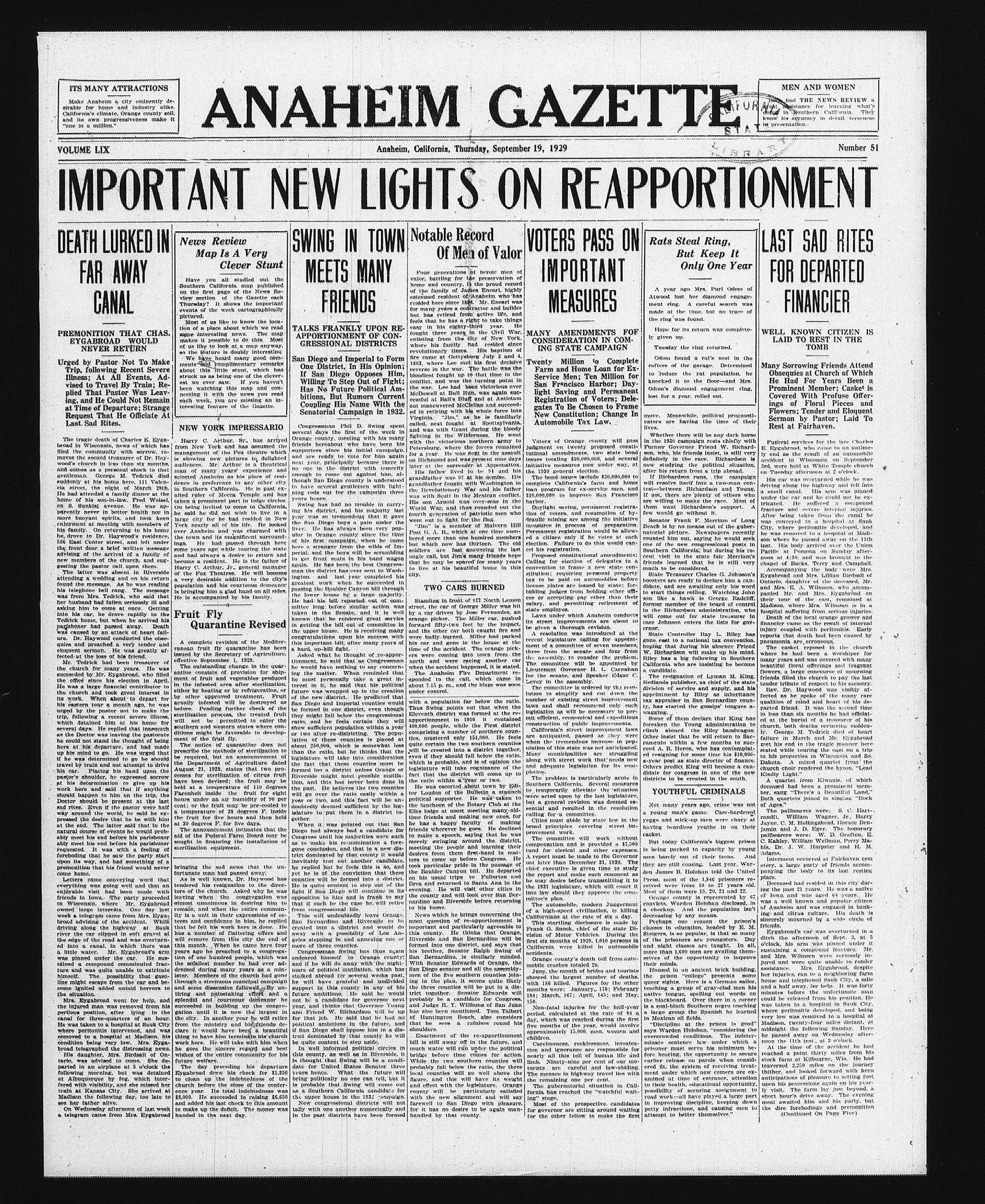
Searchable text
ITS MANY ATTRACTIONS
Make Anaheim a city eminently desirable for home and industry alike. California's climate, Orange county soil, and its own progressiveness make it "one in a million."
VOLUME LIX
IMPORTANT NEW LIST
DEATH LURKED IN FAR AWAY CANAL
PREMONITION THAT CHAS. EYGABROAD WOULD NEVER RETURN
Urged by Pastor Not To Make Trip, following Recent Severe Illness; At All Events, Advised to Travel By Train; Replied That Pastor Was Leaving, and He Could Not Remain at Time of Departure; Strange Request That He Officiate At Last Sad Rites.
The tragic death of Charles E. Eygabroad in Wisconsin, news of which has
News Review
Map Is A Very Clever Stunt
Have you all studied out the Southern California map published on the first page of the News Review section of the Gazette each Thursday? It shows the important events of the week cartographically pictured.
Most of us like to know the location of a place about which we read some interesting news. The map makes it possible to do this. Most of us like to look at a map anyway, so the feature is doubly interesting.
We have heard many good comments and complimentary remarks about this little stunt, which has struck us as being one of the clearest we ever saw. If you haven't been watching this map and connecting it with the news you read each week, you are missing an interesting feature of the Gazette.
NEW YORK IMPRESSARIO
Harry C. Arthur, Sr., has arrived from New York and has assumed the
The tragic death of Charles E. Eygabroad in Wisconsin, news of which has filled the community with sorrow, removes the second treasurer of Dr. Haywood's church in less than six months, and comes as a personal shock to that gentleman. George M. Tedrick died suddenly at his home here, 111 Valencia street, the night of March 28th. He had attended a family dinner at the home of his son-in-law, Fred Weisel, on S. Sunkist avenue. He was apparently never in better health nor in more buoyant spirits, and took keen enjoyment at meeting with members of his family. On returning to his home he drove to Dr. Haywood's residence, 506 East Center street, and left under the front door a brief written message advising of the arrival of a family of new members of the church, and suggesting the pastor call upon them.
The latter was absent in Riverside attending a wedding and on his return found the message. As he was reading his telephone bell rang. The message was from Mrs. Tedrick, who said that her husband had fallen seriously ill and asking him to come at once. Getting into his car, he drove rapidly to the Tedrick home, but when he arrived his parishoner had passed away. Death was caused by an attack of heart failure. Dr. Haywood conducted the obsequies and preached a very tender and eloquent sermon. He was greatly affected at the loss of his friend.
Mr. Tedrick had been treasurer of the church for many years. He was succeeded by Mr. Eygabroad, who filled the office since his election in April. He was a large financial contributor to the church and took great interest in its work. When about to depart for his eastern tour a month ago, he was urged by the pastor not to make the trip, following a recent severe illness, which detained him at his home for several days. He replied that inasmuch as the Doctor was leaving the pastorate he could not stand the thought of being here at his departure, and had made up his mind to go. He was urged that if he was determined to go he should travel by train and not attempt to drive his car. Placing his hand upon the pastor's shoulder, he expressed sorrow at his determination to give up his work here and said that if anything should happen to him on the trip, the Doctor should be present at the last sad rites. Even if the pastor were half way around the world, he said he expressed the desire that he be with him at the end. The latter said that in the natural course of events he would probably meet his end before his parishoner ably meet his end before his parishoner requested.
It was with a feeling of
NEW YORK IMPRESSARIO
Harry C. Arthur, Sr., has arrived from New York and has assumed the management of the Fox theatre which is showing new pictures to delighted audiences. Mr. Arthur is a theatrical man of many years' experience and selected Anaheim as his place of residence in preference to any other city in Southern California. He is past exalted ruler of Mecca Temple and has taken a prominent part in lodge circles. On being invited to come to California, he said he did not wish to live in a large city for he had resided in New York nearly all of his life. He looked over Anaheim and was charmed with the town and its magnificent surroundings. He had passed through here some years ago while touring the state and had always a desire to return and become a resident. He is the father of Harry C. Arthur, Jr., general manager of the Fox Theatre. He will become a very desirable addition to the city's population and his courteous demeanor is bringing him a glad hand on all sides. He is accompanied by his family.
Fruit Fly Quarantine Revised
A complete revision of the Mediterranean fruit fly quarantine has been issued by the Secretary of Agriculture, effective September 1, 1929.
The outstanding change in the quarantine consists of provision for shipment of fruit and vegetables produced in the infested area after sterilization, either by heating or by refrigeration, or by other approved treatment. Fruit actually infested will be destroyed as before. Pending further check of the sterilization process, the treated fruit will not be permitted to enter the southern and western states where conditions might be favorable to development of the fruit fly.
The notice of quarantine does not prescribe the methods of sterilization to be required, but an announcement of the Department of Agriculture dated August 21, 1929, states that two processes for sterilization of citrus fruit have been devised; the fruit may be held at a temperature of 110 degrees Farenheit inside the fruit for eight hours under an air humidity of 90 percent; or the fruit may be pre-cooled to a temperature of 28 degrees F. inside the fruit for five hours and then held at 30 degrees F. for five days.
The announcement intimates that aid of the Federal Farm Board may be sought in financing the installation of sterilization equipment.
Congressman Phil D. several days the first of Orange county, meeting with friends hereabout who have supporters since his initiation and are ready to vote for next year, principally because no one in the district will enough to come out against though San Diego county it to have several gentlemen ning rods out for the care years hence.
Swing has had no trouble ing his district, and his year was so tremendous that the San Diego boys a pallid liver. He has always beenULAR in Orange county size of his first campaign, wher here a stranger from the perial, and the boys will be to get front seats in his again. He has been the best man the district has ever seenington, and last year co greatest work when he ce passing the Boulder Canyon lower house by a larag He had his bill reported mitttee long before similar taken in the Senate, and known that he rendered it in getting the bill out of the upper house. He is ree congratulations upon his this important bill, after making a hard-up-hill fight.
Asked what he thought imitation, he said that as he would have nothing to do ing the matter. When rehe must personally take interest in it, he said that future was wrapped up in of the new district. He pro San Diego and Imperial co be formed in one district, they might fall below their ratio, and he feels certain show sufficient population w or two after re-districtingation of these counties about 250,000, which is so than the ratio, but he this legislature will take into o fact that these coun formed into a district unless Riverside might pose position, and this has never b past. He believes tha will go over the ratio ca year or two, and this fact doubtedly deemed sufficient ilture to put them in n together.
When it was pointed out Diego had always had a Congress until his majorlite as to make his re-nomination gone conclusion, and that
if he was determined to go he should travel by train and not attempt to drive his car. Placing his hand upon the pastor's shoulder, he expressed sorrow at his determination to give up his work here and said that if anything should happen to him on the trip, the Doctor should be present at the last sad rites. Even if the pastor were half way around the world, he said he expressed the desire that he be with him at the end. The latter said that in the natural course of events he would probably meet his end before his parishoner ably meet his end before his parishoner requested. It was with a feeling of foreboding that he saw the party start upon its way, and had something of a premonition that his friend would never come home.
Letters came conveying word that everything was going well and that an enjoyable visit had been made with friends in Iowa. The party proceeded to Wisconsin, where Mr. Eygabroad owned large interests. One day last week a telegram came from Mrs. Eygabroad advising of the accident. While driving along the highway at Sauk river the car slipped in soft gravel at the edge of the road and was overturned into a canal, in which there was a little water. Mr. Eygabroad's arm was pinned under the car. He sustained a compound comminuted fracture and was quite unable to extricate himself. The possibility that gasoline might escape from the car and become ignited added untold horrors to the situation.
Mrs. Eygabroad went for help, and the injured man was removed from his perilous position, after lying in the canal for three-quarters of an hour. He was taken to a hospital at Sauk City where peritonitis intervened, and was removed to a hospital at Madison, his condition being very low. Mrs. Eygabroad telegraphed the distressing news.
His daughter, Mrs. Birdsaill of Ontario, was advised to come. She departed in an airplane at 5 o'clock the following morning, but was detained at Albuquerque by fog, which interfered with visibility, and she missed her train at Kansas City. She arrived at Madison the following day, too late to see her father alive.
On Wednesday afternoon of last week a telegram came from Mrs. Eygabroad
bringing the sad news that the unfortunate man had passed away.
As is well known, Dr. Haywood has tendered his resignation to the directors of the church. Asked why he was leaving when the congregation was almost unanimous in desiring him to remain, and when the entire community is a unit in their expressions of esteem and confidence in him, he replied that he felt his work here is done. He has a number of flattering offers and will remove from this city the end of this month. When he came here four years ago he preached to a congregation of one hundred people, which was the smallest number he had ever addressed during many years as a minister. Members of the church had gone through a strenuous municipal campaign and some dissension followed. By untiring and painstaking effort and a splendid and courteous demeanor he succeeded in building up the congregation until it is now the largest in the city. In another year he will retire from the ministry and his friends declare it would have been a beautiful thing to have him terminate his church work here. He will take with him when he goes the sincere regard and best wishes of the entire community for his future welfare.
The day preceding his departure Eygabroad drew his check for $1,350 to clean up the indebtedness of the church before the close of the conference year. Its total indebtedness was $8,000. He succeeded in raising $6,650 and added his last check to this amount to make up the deficit. The money was handed in the next day.
When it was pointed out Diego had always had a copy Congress until his majorities as to make his re-nominations gone conclusion, and that he trist dominated by that court inevitably trot out another he replied that he feels yet he is of the conviction counties will be formed in He is quite content to steer right if San Diego will coerce opposition to him and is sure that if such be the case he from congressional life.
This will undoubtedly lead San Bernardino and River created into a district and away with a possibility of geles stepping in and annexing more of these counties.
Congressman Swing has endeared himself to Oran and if he will do away with mare of political mutilation stalked abroad for several he will have grateful and support in this county in future ambitions. He said not be a candidate for governor, and thinks that Gov. and Friend W. Richardson for that job. He said that political ambitions in the city if San Diego shall oppose a district dominated by that case be quite content to step aside.
In well informed politics this county, as well as in thought that Swing will date for United States years hence. What the bring politically no one can is probable that Swing was as a Southern California house in the 19th New congressional district tally with one another num
AHEIM GAZETTE
Anaheim, California, Thursday, September 19, 1929
NEW LIGHTS ON REAPPONDING
SWING IN TOWN MEETS MANY FRIENDS
TALKS FRANKLY UPON REAPPORTIONMENT OF CONGRESSIONAL DISTRICTS
San Diego and Imperial to Form One District, In His Opinion; If San Diego Opposes Him, Willing To Step Out of Fight; Has No Future Political Ambitions, But Rumors Current Coupling His Name With the Senatorial Campaign in 1932.
Congressman Phil D. Swing spent several days the first of the week in Orange county, meeting with his many friends hereabout who have been his
Notable Record Of Men of Valor
Four generations of heroic men of valor, battling for the preservation of home and country, is the proud record of the family of James Enearl, highly esteemed resident of Anaheim who has resided here since 1844. Mr. Enearl was for many years a contractor and builder but has retired from active life, and feels that he has a right to take things easy in his eighty-third year. He fought three years in the Civil War, enlisting from the city of New York, where his family had resided since revolutionary times. His baptism of fire came at Gettysburg July 3 and 4, 1863, where Lee met his first decisive reverse in the war. The battle was the bloodiest fought up to that time in the conflict, and was the turning point in the war. Lee had been victorious over McDowell at Bull Run, was again successful at Ball's Bluff and at Antietam out maneuvered McClellan and succeeded in retiring with his whole force into Virginia. "Jim," as he is familiarly called, next fought at Spotsylvania, and was with Grant during the bloody fighting in the Wilderness. He went with the victorious northern army to Petersburg, where the forces remained
VOTERS PASS ON IMPORTANT MEASURES
MANY AMENDMENTS FOF CONSIDERATION IN COMING STATE CAMPAIGN
Twenty Million to Complete Farm and Home Loan for Ex-Service Men; Ten Million for San Francisco Harbor; Daylight Saving and Permanent Registration of Voters; Delegates To Be Chosen to Frame New Constitution; Change In Automobile Tax Law.
Voters of Orange county will pass judgment on twenty proposed consti-
Rats Stead But Only
A year ago Mtwood lost her ment ring. A made at the time the ring was found Hope for its re likely given up.
Tuesday the rite Odom found rafters of the g to reduce the knocked it to the Odom's diamond lost for a year. move. Meanwhile cators are having lives. Whether there w in the 1930 campaign Former Governor
San Diego and Imperial to Form One District, In His Opinion; If San Diego Opposes Him, Willing To Step Out of Fight; Has No Future Political Ambitions, But Rumors Current Coupling His Name With the Senatorial Campaign in 1932.
Congressman Phil D. Swing spent several days the first of the week in Orange county, meeting with his many friends hereabout who have been his supporters since his initial campaign, and are ready to vote for him again next year, principally because there is no one in the district with temerity enough to come out against him, although San Diego county is understood to have several gentlemen with lightning rods out for the campaign three years hence.
Swing has had no trouble in carrying his district, and his majority last year was so tremendous that it gave the San Diego boys a pain under the liver. He has always been very popular in Orange county since the time of his first campaign, when he came here a stranger from the wilds of Imperial, and the boys will be scrambling to get front seats in his band wagon again. He has been the best Congressman the district has ever sent to Washington, and last year completed his greatest work when he succeeded in passing the Boulder Canyon bill through the lower house by a large majority. He had his bill reported out of committee long before similar action was taken in the Senate, and it is well known that he rendered great service in getting the bill out of committee in the upper house. He is receiving many congratulations upon his success with this important bill, after many years of a hard, up-hill fight.
Asked what he thought of re-apportionment, he said that as Congressman he would have nothing to say concerning the matter. When reminded that he must personally take a great interest in it, he said that his political future was wrapped up in the creation of the new district. He predicted that San Diego and Imperial counties would be formed in one district, even though they might fall below the congressional ratio, and he feels certain they will show sufficient population within a year or two after re-districting. The population of these counties is placed at about 250,000, which is somewhat less than the ratio, but he thinks that the legislature will take into consideration the fact that these counties must be formed into a district unless Orange or Riverside might meet possible mutilation, and this has never been done in the past. He believes the two counties will go over the ratio easily within a year or two, and this fact will be undoubtedly deemed sufficient by the legislature to put them in a district together.
When it was pointed out that San Diego had always had a candidate for Congress until his majorities were such as to make his re-nomination a foregone conclusion, and that in a new dis-
Twenty Million to Complete Farm and Home Loan for Ex-Service Men; Ten Million for San Francisco Harbor; Daylight Saving and Permanent Registration of Voters; Delegates To Be Chosen to Frame New Constitution; Change In Automobile Tax Law.
Voters of Orange county will pass judgment on twenty proposed constitutional amendments, two state bond issues totaling $20,000,000, and several initiative measures now under way, at the 1930 general election.
The bond issues include $20,000,000 to complete California's farm and home loan program for ex-service men, and $10,000,000 to improve San Francisco harbor.
Daylight saving, permanent registration of voters, and resumption of hydraulic mining are among the initiative measures in process of preparation. Permanent registration would be allowed a citizen only if he votes at each election. Failure to do this would cancel his registration.
Proposed constitutional amendments: Calling for election of delegates to a convention to frame a new state constitution; requiring personal property tax to be paid on automobiles before license plates are issued by state; for bidding judges from holding other offices or accepting pay other than their salary, and permitting retirement of state employees.
Laws under which Anaheim conducts its street improvements are about to be given a thorough revision.
A resolution was introduced at the recent legislature calling for appointment of a committee of seven members, three from the senate and four from the assembly, to consider the problem. The committee will be appointed by Lleutenant Governor H. L. Carnahan for the senate, and Speaker Edgar C. Levey in the assembly.
The committee is ordered by the resolution to simplify and cut down the number of existing street improvement laws and shall recommend only such legislation as will be necessary to permit efficient, economical and expenditious construction of public improvements.
California's street improvement laws are antiquated, passed as they were when the tremendous increase in population of this state was not anticipated. Many municipalities are struggling along with street work that needs new and adequate legislation for its completion.
The problem is particularly acute in Southern California. Several measures to temporarily alleviate the situation were acted upon by the last legislature, but a general revision was deemed essential and resulted in the resolution calling for a committee.
Cities must abide by state law in the broad principles covering street improvement work.
The committee will work without compensation and is provided a $7,500 fund for clerical and other expenses.
Meanwhile citizens are having lives.
Whether there was in the 1930 campaign Former Governor son, who, his friend definitely in the race now studying them after his return fro-
If Richardson rises will resolve itself test—between Rich-
If not, there are people willing to make them want Richardson few would go with
Senator Frank L Beach is by no means material picture. Counted him out, since one of the new co-Southern California cent visit to the friends learned much to be consid-
State Treasurer's boosters are ready to ditate, and are awake to start things rollen like a hawk former member of the Richardson will come out for case Johnson enteror.
State Controller gone east to a natal hoping that during W. Richardson will Riley has a big fee California who are a candidate.
The resignation Redlands publisher division of service appointment by H.Tax appraisal in Salary has started her wagging.
Some of them de-forsaken the Your climb aboard that Other insist that hitherto within a ceed A.R.Heron ed resigning for so-a-year post as state Others predict Klinidate for congress districts to be created.
YOUTHFUL
Not many years a young man's geeggs and stick-up having beardless racket.
But today California is being packed to
legislature will take into consideration the fact that these counties must be formed into a district unless Orange or Riverside might meet possible mutilation, and this has never been done in the past. He believes the two counties will go over the ratio easily within a year or two, and this fact will be undoubtedly deemed sufficient by the legislature to put them in a district together.
When it was pointed out that San Diego had always had a candidate for Congress until his majorities were such as to make his re-nomination a foregone conclusion, and that in a new district dominated by that county it would inevitably trot out another candidate, he replied hat he feels this is so, and yet he is of the conviction that these counties will be formed into a district. He is quite content to step out of the fight if San Diego will continue in its opposition to him and is frank to say that if such be the case he will retire from congressional life.
This will undoubtedly leave Orange, San Bernardino and Riverside to be created into a district and would do away with a possibility of Los Angeles stepping in and annexing one or more of these counties.
Congressman Swing has thus again endeared himself to Orange county; and if he will do away with the nightmare of political mutilation, which has stalked abroad for several weeks past, he will have grateful and undivided support in this county in any of his future ambitions. He said he would not be a candidate for governor next year, and thinks that Governor Young and Friend W. Richardson will be up for that job. He said that he had no political ambitions in the future, and if San Diego shall oppose him in a district dominated by that county he will be quite content to step aside.
In well informed political circles in this county, as well as in Riverside, it is thought that Swing will be a candidate for United States Senator three years hence. What the future will bring politically no one can tell, but it is probable that Swing will come out as a Southern California candidate for the upper house in the 1932 campaign.
New congressional districts will not tally with one another numerically and in the past districts have been formed
News which he brings concerning the moot question of re-apportionment is important and particularly agreeable to this county. He thinks that Orange, Riverside and San Bernardino will be formed into one district, and says that his brother, Senator Ralph Swing of San Bernardino, is similarly minded. With Senator Edwards of Orange, the San Diego senator and all the assemblymen of the five southern counties joining in the plan, it seems quite likely the three counties will be put in a district together. Senator Edwards will probably be a candidate for Congress, and Judge R. Y. Williams of San Juan has also been mentioned. Tom Talbert of Huntington Beach, also considers that he sees a rainbow round his shoulders.
Enactment of the re-apportionment bill is still away off in the future, and much water will run under the political bridge before time comes for action. While the two southern counties will probably fall below the ratio, the three local counties will go well above the figure, and this will have its weight and effect with the legislature. Orange county will be particularly satisfied with the new alignment and will say farewell to San Diego with pleasure, for it has no desire to be again manhandled by that county.
The problem is particularly acute in Southern California. Several measures to temporarily alleviate the situation were acted upon by the last legislature, but a general revision was deemed essential and resulted in the resolution calling for a committee.
Cities must abide by state law in the broad principles covering street improvement work.
The committee will work without compensation and is provided a $7,500 fund for clerical and other expenses. A report must be made to the Governor not later than December 31, 1930. The chief executive is given time to study the report and make such comment as he may desire before transmitting it to the 1931 legislature, which will enact it into law should they approve the committee's plan.
The automobile, modern Juggernaut of a high-speed civilization, is killing Californians at the rate of six a day.
This startling disclosure is made by Frank G. Snook, chief of the state Division of Motor Vehicles. During the first six months of 1929, 1,010 persons in California were killed in automobile accidents.
Orange county's death toll from automobile crashes totaled 28.
June, the month of brides and tourists showed the largest number of deaths, with 186 killed. Figures for the other months were: January, 178; February 184; March, 167; April, 145; and May, 150.
Non-fatal injuries for the half-year period, calculated at the rate of 84 a day, which was reached during the first five months of the year, would involve approximately 15,000 men, women and children.
Carelessness, recklessness, intoxication and ignorance are responsible for nearly all this toll of human life and limb. Ninety-nine per cent of our motorists are careful and law-abiding. The menace in highway travel lies with the remaining one per cent.
The gubernatorial situation in California has reached the "watchful waiting" stage.
Most of the prospective candidates for governor are sitting around waiting for the other fellow to make the first
YOUTHFUL
Not many years ago a young man's gayeggs and stick-up having beardless racket.
But today California is being packed to men barely out of their area still coming den James B. Hollow Press, most of them celved were from Most of them were Orange county's convicts. Warden B. a checkup. And decreasing by any.
Perhaps one real class in educational Steigers, is so popular of the prisoners as and night classes more than 1,600 men selves of the oppose their minds.
Housed in an art prison "colleague sights." Here teaching a group native tongue, spake the blackboard. One is a coal-black Southerner a large group there in Mexican oil field.
"Discipline at it says Warden Hollow overcrowded condition minute sentence prisoner must serve fore hearing, the earlier release on oered fit, the system ment under which amined at time oo to their health, education possibility of secure road work—all have in improving discursive petty infractions, attempt to better
MEN AND WOMEN
find THE NEWS REVIEW a great assistance for learning what's done in Southern California. They know its accuracy in detail, tenness in presentation.
Number 51
APPORTIONMENT
Rats Steal Ring,
But Keep It
Only One Year
A year ago Mrs. Purl Odom of Atwood lost her diamond engagement ring. A careful search was made at the time, but no trace of the ring was found.
Hope for its return was completely given up.
Tuesday the ring returned.
Odom found a rat's nest in the rafters of the garage. Determined to reduce the rat population, he knocked it to the floor—and Mrs. Odom's diamond engagement ring, lost for a year, rolled out.
Meanwhile, political prognosticators are having the time of their lives.
Whether there will be any dark horse in the 1930 campaign rests chiefly with Former Governor Friend W. Richard-
LAST SAD RITES FOR DEPARTED FINANCIER
WELL KNOWN CITIZEN IS LAID TO REST IN THE TOMB
Many Sorrowing Friends Attend Obsequies at Church of Which He Had For Years Been a Prominent Member; Casket is Covered With Profuse Offerings of Floral Pieces and Flowers; Tender and Eloquent Sermon by Pastor; Laid To Rest at Fairhaven.
Funeral services for the late Charles E. Eygabroad, who came to an untime-
move. Meanwhile, political prognosticators are having the time of their lives.
Whether there will be any dark horse in the 1930 campaign rests chiefly with Former Governor Friend W. Richardson, who his friends insist, is still very definitely in the race. Richardson is now studying the political situation after his return from a trip abroad.
If Richardson runs, the campaign will resolve itself into a two-man contest—between Richardson and Young. If not, there are plenty of others who are willing to make the race. Most of them want Richardson's support. A few would go without it.
Senator Frank F. Merriam of Long Beach is by no means out of the gubernatorial picture. Newspapers recently counted him out, saying he would seek one of the new congressional posts in Southern California, but during his recent visit to the state fair Merriam's friends learned that he is still very much to be considered.
State Treasurer Charles G. Johnson's boosters are ready to declare him a candidate, and are awaiting only his word to start things rolling. Watching John son like a hawk is George Radcliff, former member of the board of control in the Richardson administration, who will come out for state treasurer in case Johnson enters the lists for governor.
State Controller Ray L. Riley has gone east to a national tax convention, hoping that during his absence Friend W. Richardson will make up his mind. Riley has a big following in Southern California who are insisting he become a candidate.
The resignation of Lyman M. King, Redlands publisher, as chief of the state division of service and supply, and his appointment by Riley as inheritance tax appraiser in San Bernardino county, has started the gossips' tongues awagging.
Some of them declare that King has forsaken the Young administration to climb aboard the Riley bandwagon. Other insist that he will return to Sacramento within a few months to succeed A. R. Heron, who has contemplated resigning for some time his $10,000-a-year post as state director of finance. Others predict King will become a candidate for congress in one of the new districts to be created in the south.
YOUTHFUL CRIMINALS
Not many years ago, crime was not a young man's game. Case-hardened yeggs and stick-up men were chary at having beardless youths on their racket.
But today California's biggest prison is being packed to capacity by young move. Meanwhile, political prognosticators are having the time of their lives.
Whether there will be any dark horse in the 1930 campaign rests chiefly with Former Governor Friend W. Richardson, who his friends insist, is still very definitely in the race. Richardson is now studying the political situation, after his return from a trip abroad.
If Richardson runs, the campaign will resolve itself into a two-man contest—between Richardson and Young. If not, there are plenty of others who are willing to make the race. Most of them want Richardson's support. A few would go without it.
Senator Frank F. Merriam of Long Beach is by no means out of the gubernatorial picture. Newspapers recently counted him out, saying he would seek one of the new congressional posts in Southern California, but during his recent visit to the state fair Merriam's friends learned that he is still very much to be considered.
State Treasurer Charles G. Johnson's boosters are ready to declare him a candidate, and are awaiting only his word to start things rolling. Watching John son like a hawk is George Radcliff, former member of the board of control in the Richardson administration, who will come out for state treasurer in case Johnson enters the lists for governor.
State Controller Ray L. Riley has gone east to a national tax convention, hoping that during his absence Friend W. Richardson will make up his mind. Riley has a big following in Southern California who are insisting he become a candidate.
The resignation of Lyman M. King, Redlands publisher, as chief of the state division of service and supply, and his appointment by Riley as inheritance tax appraiser in San Bernardino county, has started the gossips' tongues awagging.
Some of them declare that King has forsaken the Young administration to climb aboard the Riley bandwagon. Other insist that he will return to Sacramento within a few months to succeed A. R. Heron, who has contemplated resigning for some time his $10,000-a-year post as state director of finance. Others predict King will become a candidate for congress in one of the new districts to be created in the south.
YOUTHFUL CRIMINALS
Not many years ago, crime was not a young man's game. Case-hardened yeggs and stick-up men were chary at having beardless youths on their racket.
But today California's biggest prison is being packed to capacity by young move. Meanwhile, political prognosticators are having the time of their lives.
Whether there will be any dark horse in the 1930 campaign rests chiefly with Former Governor Friend W. Richardson, who his friends insist, is still very definitely in the race. Richardson is now studying the political situation, after his return from a trip abroad.
If Richardson runs, the campaign will resolve itself into a two-man contest—between Richardson and Young. If not, there are plenty of others who are willing to make the race. Most of them want Richardson's support. A few would go without it.
Senator Frank F. Merriam of Long Beach is by no means out of the gubernatorial picture. Newspapers recently counted him out, saying he would seek one of the new congressional posts in Southern California, but during his recent visit to the state fair Merriam's friends learned that he is still very much to be considered.
State Treasurer Charles G. Johnson's boosters are ready to declare him a candidate, and are awaiting only his word to start things rolling. Watching John son like a hawk is George Radcliff, former member of the board of control in the Richardson administration, who will come out for state treasurer in case Johnson enters the lists for governor.
State Controller Ray L. Riley has gone east to a national tax convention, hoping that during his absence Friend W. Richardson will make up his mind. Riley has a big following in Southern California who are insisting he become a candidate.
The resignation of Lyman M. King, Redlands publisher, as chief of the state division of service and supply, and his appointment by Riley as inheritance tax appraiser in San Bernardino county, has started the gossips' tongues awagging.
Some of them declare that King has forsaken the Young administration to climb aboard the Riley bandwagon. Other insist that he will return to Sacramento within a few months to succeed A. R. Heron, who has contemplated resigning for some time his $10,000-a-year post as state director of finance. Others predict King will become a candidate for congress in one of the new districts to be created in the south.
YOUTHFUL CRIMINALS
Not many years ago, crime was not a young man's game. Case-hardened yeggs and stick-up men were chary at having beardless youths on their racket.
But today California's biggest prison is being packed to capacity by young move. Meanwhile, political prognosticators are having the time of their lives.
Whether there will be any dark horse in the 1930 campaign rests chiefly with Former Governor Friend W. Richardson, who his friends insist, is still very definitely in the race. Richardson is now studying the political situation, after his return from a trip abroad.
If Richardson runs, the campaign will resolve itself into a two-man contest—between Richardson and Young. If not, there are plenty of others who are willing to make the race. Most of them want Richardson's support. A few would go without it.
Senator Frank F. Merriam of Long Beach is by no means out of the gubernatorial picture. Newspapers recently counted him out, saying he would seek one of the new congressional posts in Southern California, but during his recent visit to the state fair Merriam's friends learned that he is still very much to be considered.
State Treasurer Charles G. Johnson's boosters are ready to declare him a candidate, and are awaiting only his word to start things rolling. Watching John son like a hawk is George Radcliff, former member of the board of control in the Richardson administration, who will come out for state treasurer in case Johnson enters the lists for governor.
State Controller Ray L. Riley has gone east to a national tax convention, hoping that during his absence Friend W. Richardson will make up his mind. Riley has a big following in Southern California who are insisting he become a candidate.
The resignation of Lyman M. King, Redlands publisher, as chief of the state division of service and supply, and his appointment by Riley as inheritance tax appraiser in San Bernardino county, has started the gossips' tongues awagging.
Some of them declare that King has forsaken the Young administration to climb aboard the Riley bandwagon. Other insist that he will return to Sacramento within a few months to succeed A. R. Heron, who has contemplated resigning for some time his $10,000-a-year post as state director of finance. Others predict King will become a candidate for congress in one of the new districts to be created in the south.
YOUTHFUL CRIMINALS
Not many years ago, crime was not a young man's game. Case-hardened yeggs and stick-up men were chary at having beardless youths on their racket.
But today California's biggest prison is being packed to capacity by young move. Meanwhile, political prognosticators are having the time of their lives.
Whether there will be any dark horse in the 1930 campaign rests chiefly with Former Governor Friend W. Richardson, who his friends insist, is still very definitely in the race. Richardson is now studying the political situation, after his return from a trip abroad.
If Richardson runs, the campaign will resolve itself into a two-man contest—between Richardson and Young. If not, there are plenty of others who are willing to make the race. Most of them want Richardson's support. A few would go without it.
Senator Frank F. Merriam of Long Beach is by no means out of the gubernatorial picture. Newspapers recently counted him out, saying he would seek one of the new congressional posts in Southern California, but during his recent visit to the state fair Merriam's friends learned that he is still very much to be considered.
State Treasurer Charles G. Johnson's boosters are ready to declare him a candidate, and are awaiting only his word to start things rolling. Watching John son like a hawk is George Radcliff, former member of the board of control in the Richardson administration, who will come out for state treasurer in case Johnson enters the lists for governor.
State Controller Ray L. Riley has gone east to a national tax convention, hoping that during his absence Friend W. Richardson will make up his mind. Riley has a big following in Southern California who are insisting he become a candidate.
The resignation of Lyman M. King, Redlands publisher, as chief of the state division of service and supply, and his appointment by Riley as inheritance tax appraiser in San Bernardino county, has started the gossips' tongues awagging.
Some of them declare that King has forsaken the Young administration to climb aboard the Riley bandwagon. Other insist that he will return to Sacramento within a few months to succeed A. R. Heron, who has contemplated resigning for some time his $10,000-a-year post as state director of finance. Others predict King will become a candidate for congress in one of the new districts to be created in the south.
YOUTHFUL CRIMINALS
Not many years ago, crime was not a young man's game. Case-hardened yeggs and stick-up men were chary at having beardless youths on their racket.
But today California's biggest prison is being packed to capacity by young move. Meanwhile, political prognosticators are having the time of their lives.
Whether there will be any dark horse in the 1930 campaign rests chiefly with Former Governor Friend W. Richardson, who his friends insist, is still very definitely in the race. Richardson is now studying the political situation, after his return from a trip abroad.
If Richardson runs, the campaign will resolve itself into a two-man contest—between Richardson and Young. If not, there are plenty of others who are willing to make the race. Most of them want Richardson's support. A few would go without it.
Senator Frank F. Merriam of Long Beach is by no means out of the gubernatorial picture.Newspapers recently counted him out,saying he would seek one ofthe new congressional posts in Southern California where he had been a worshiper for many years and was covered with many beautiful floral offerings and fragrant flowers,a large concourse of mourning friends filled the church to pay last tender tribute of respect to his memory.Rev.Dr.Haywood was visibly affected as he spoke ofthe many rare qualities of mind and heartofhis departed friend.I wasthe second timein less than six monthshe had officiatedatthe burialofa treasurerofhis church,both deaths occurring suddenly.George M.Tedrick diedofheart failurein MarchandMr.Eygabroadmethis endinthe tragic manner here stated while touringthe cast ona triptohis propertiesin WisconsinandSo.Dakota.A mixed quartetfromthechurch choir renderedthe hymn,"LeadKindly Light."
A quartet from Kiwanis.of which deceased had been a prominent member,sang "There’sa Beautiful Land."Both quartets joinedin singing"RockofAges."
The pallbearers were: S.C.HartrandtWilliam Wagner,jr.HarryJayne,C.M.Hollingshead,HoraceBenjaminandJ.D.Egert.The honorarypallbearers were:W.D.GraftonE.C.KahleyWilliam Wellman,PerryMahlsDr.J.W.HarpsterandH.M.]
YOUTHFUL CRIMINALS
Not many years ago, crime was not a young man's game. Case-hardened yeggs and stick-up men were chary at having beardless youths in on their racket.
But today California's biggest prison is being packed to capacity by young men barely out of their teens. And they are still coming. Last year, Warren James B. Holohan told the United Press, most of the 1,846 prisoners received were from 19 to 27 years old. Most of them were 19, 20, 21 and 22.
Orange county is represented by 67 convicts, Warden Holohan disclosed, in a checkup. And the population isn't decreasing by any means.
Perhaps one reason the prison's classes in education, headed by E. M. Steigers, is so popular, is that so many of the prisoners are youngsters. Day and night classes are taught. In all, more than 1,600 men are availing themselves of the opportunity to improve their minds.
Housed in an ancient brick building, the prison "college" presents some queer sights. Here is a German sailor, teaching a group of gray-clad men his native tongue, spelling out words on the blackboard. Over there in a corner is a coal-black Southern negro teaching a large group the Spanish he learned in Mexican oil fields.
"Discipline at the prison is good" says Warden Holohan, "considering the overcrowded conditions. The indeterminate sentence law under which a prisoner must serve his minimum before hearing, the opportunity to secure earlier release on parole when considered fit, the system of receiving treatment under which new comers are examined at time of entrance, attention to their health, educational opportunity, possibility of securing assignment to road work—all have played a large part in improving discipline, keeping down petty infractions, and causing men to attempt to better themselves."
A quartet from Kiwanis, of which deceased had been a prominent member, sang "There's a Beautiful Land," Both quartets joined in singing "Rock of Ages."
The pallbearers were: S. C. Hartrandt, William Wagner, Jr., Harry Jayne, C. M. Hollingshead, Horace Benjamin and J. D. Eger. The honorary pallbearers were: W. D. Grafton, E. C. Kahley, William Wellman, Perry Mahis, Dr. J. W. Harpster and H. M. Adams.
Interment occurred at Fairhaven cemetery, a large party of friends accompanying the body to its last resting place.
Deceased had resided in this city during the past 21 years. He was a native of Iowa and was aged 64 years. He was a well known and popular citizen of Anaheim and was engaged in banking and citrus culture. His death is sincerely mourned by a wide circle of friends.
Eygabroad's car was overturned in a ditch the afternoon of Sept. 3, at 5 o'clock, his arm was pinned under it sustaining a compound fracture. Mr. and Mrs. Wilmsen were seriously injured and were quite unable to render assistance. Mrs. Eygabroad, despite her injuries, ran to a neighboring farm house and telephoned Sauk City, a mile and a half away, for help. It was forty minutes before the unfortunate man could be released from his position. He was taken to a hospital in Sauk City, where peritonitis developed, and being very low was removed to a hospital at Madison, twenty-four miles distant, at midnight the following Sunday. Here he passed away on Wednesday afternoon at 3 o'clock.
At the time of the accident he had reached a point thirty miles from his stock farm at Kilbourne, Wis. He had traversed 2,250 miles on the journey thither, and looked forward with keen anticipations of pleasure to setting foot upon his possessions again on his yearly visit. The farm lay just beyond a short hour's drive away. The evening meal awaited him and his party, but the dire forebodings and premonition (Continued On Page Five)