anaheim-gazette 1929-08-08
Scanned page
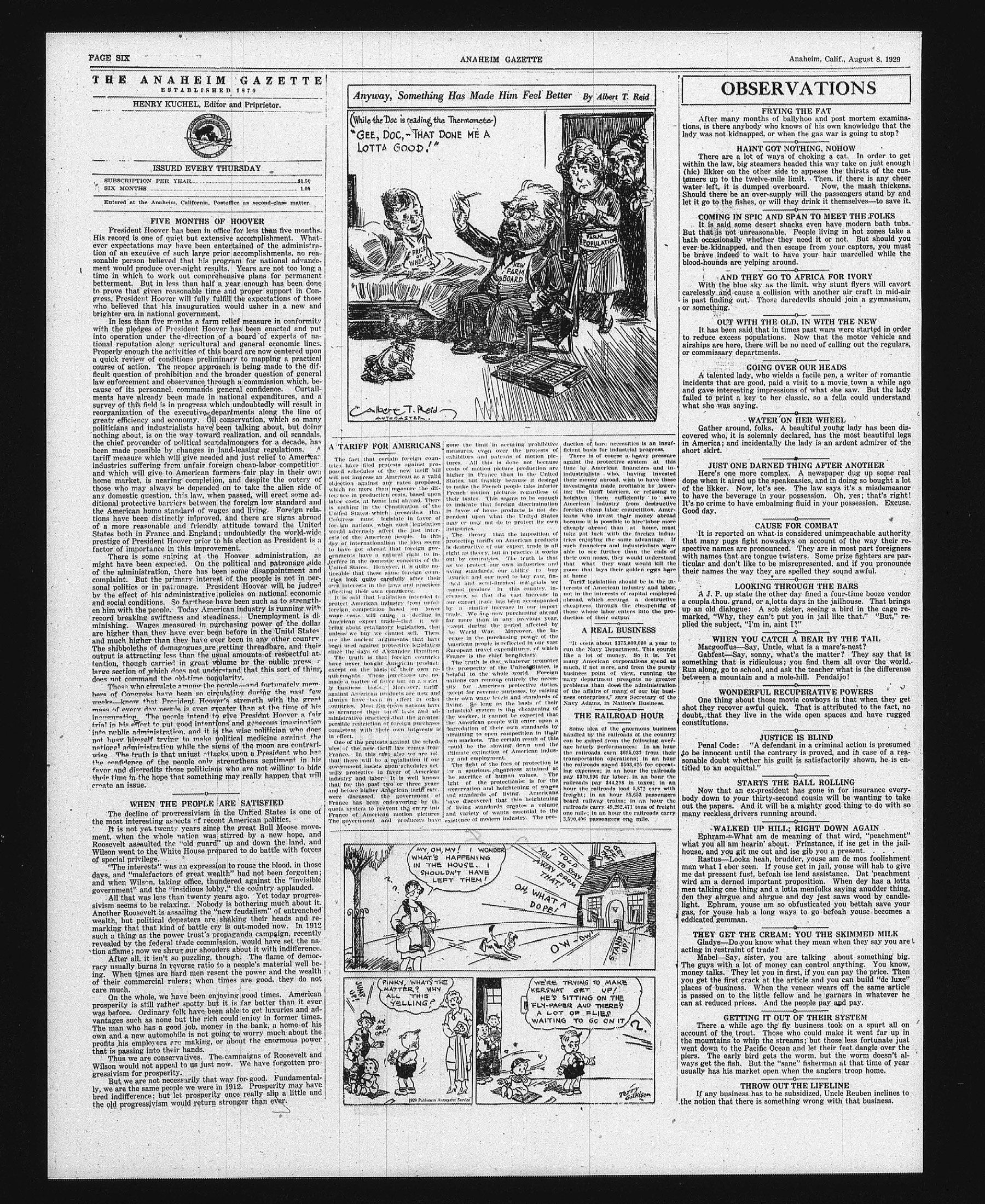
Searchable text
THE ANAHEIM GAZETTE
ESTABLISHED 1870
HENRY KUCHEL, Editor and Priprietor.
ISSUED EVERY THURSDAY
SUBSCRIPTION PER YEAR.....$1.50
SIX MONTHS.....1.00
Entered at the Anaheim, California, Postoffice as second-class matter.
FIVE MONTHS OF HOOVER
President Hoover has been in office for less than five months. His record is one of quiet but extensive accomplishment. Whatever expectations may have been entertained of the administration of an executive of such large prior accomplishments, no reasonable person believed that his program for national advancement would produce over-night results. Years are not too long a time in which to work out comprehensive plans for permanent betterment. But in less than half a year enough has been done to prove that given reasonable time and proper support in Congress, President Hoover will fully fulfill the expectations of those who believed that his inauguration would usher in a new and brighter era in national government.
In less than five months a farm relief measure in conformity with the pledges of President Hoover has been enacted and put into operation under the direction of a board of experts of national reputation along agricultural and general economic lines. Properly enough the activities of this board are now centered upon a quick review of conditions preliminary to mapping a practical course of action. The proper approach is being made to the difficult question of prohibition and the broader question of general law enforcement and observance through a commission which, because of its personnel, commands general confidence. Curtailments have already been made in national expenditures, and a survey of this field is in progress which undoubtedly will result in reorganization of the executive departments along the line of great efficiency and economy. Oil conservation, which so many politicians and industrialists have been talking about, but doing nothing about, is on the way toward realization, and oil scandals, the chief provender of political scandalmongers for a decade, has
a quick review of conditions preliminary to mapping a practical course of action. The proper approach is being made to the difficult question of prohibition and the broader question of general law enforcement and observance through a commission which, because of its personnel, commands general confidence. Curtailments have already been made in national expenditures, and a survey of this field is in progress which undoubtedly will result in reorganization of the executive departments along the line of great efficiency and economy. Oil conservation, which so many politicians and industrialists have been talking about, but doing nothing about, is on the way toward realization, and oil scandals, the chief provender of political scandalongers for a decade, has been made possible by changes in land-leasing regulations.
A tariff measure which will give needed and just relief to American industries suffering from unfair foreign cheap-labor competition and which will give to American farmers fair play in their own home market, is nearing completion, and despite the outcry of those who may always be depended on to take the alien side of any domestic question, this law, when passed, will erect some additional protective barriers between the foreign low standard and the American home standard of wages and living. Foreign relations have been distinctly improved, and there are signs abroad of a more reasonable and friendly attitude toward the United States both in France and England; undoubtedly the world-wide prestige of President Hoover prior to his election as President is a factor of importance in this improvement.
There is some snining at the Hoover administration, as might have been expected. On the political and patronage side of the administration, there has been some disappointment and complaint. But the primary interest of the people is not in personal politics or in patronage. President Hoover will be judged by the effect of his administrative policies on national economic and social conditions. So far these have been such as to strengthen him with the people. Today American industry is running with record breaking swiftness and steadiness. Unemployment is diminishing. Wages measured in purchasing power of the dollar are higher than they have ever been before in the United States and much higher than they have ever been in any other country. The shibboleths of demagogues are getting threadbare, and their output is attracting less than the usual amounts of respectful attention, though carried in great volume by the public press. A large section of which does not understand that this sort of thing does not command the old-time popularity.
Those who circulate among the people—and fortunately members of Congress have been so circulating during the past few weeks—know that President Hoover's strength with the great mass of every day people is even greater than at the time of his inauguration. The people intend to give President Hoover a fair trial in his effort to put good intentions and generous imagination into public administration, and it is the wise politician who does not busy himself trying to make political medicine against the national administration while the signs of the moon are contrariwise. The truth is that unjust attacks upon a President who has the confidence of the people only strengthens sentiment in his favor and discredits those politicians who are not willing to bide their time in the hope that something may really happen that will create an issue.
WHEN THE PEOPLE ARE SATISFIED
The decline of progressivism in the United States is one of the most interesting aspects of recent American politics.
It is not yet twenty years since the great Bull Moose movement, when the whole nation was stirred by a new hope, and Roosevelt assaulted the "old guard" up and down the land, and Wilson went to the White House prepared to do battle with forces...
WHEN THE PEOPLE ARE SATISFIED
The decline of progressivism in the United States is one of the most interesting aspects of recent American politics.
It is not yet twenty years since the great Bull Moose movement, when the whole nation was stirred by a new hope, and Roosevelt assaulted the "old guard" up and down the land, and Wilson went to the White House prepared to do battle with forces of special privilege.
"The interests" was an expression to rouse the blood, in those days, and "malefactors of great wealth" had not been forgotten; and when Wilson, taking office, thundered against the "invisible government" and the "insidious lobby," the country applauded.
All that was less than twenty years ago. Yet today progressivism seems to be relaxing. Nobody is bothering much about it. Another Roosevelt is assailing the "new feudalism" of entrenched wealth, but political dopesters are shaking their heads and remarking that that kind of battle cry is out-moded now. In 1912 such a thing as the power trust's propaganda campaign, recently revealed by the federal trade commission, would have set the nation afame; now we shrug our shoulders about it with indifference.
After all, it isn't so puzzling, though. The flame of democracy usually burns in reverse ratio to a people's material well being. When times are hard men resent the power and the wealth of their commercial rulers; when times are good, they do not care much.
On the whole, we have been enjoying good times. American prosperity is still rather spotty but it is far better than it ever was before. Ordinary folk have been able to get luxuries and advantages such as none but the rich could enjoy in former times. The man who has a good job, money in the bank, a home of his own and a new automobile is not going to worry much about the profits his employers are making, or about the enormous power that is passing into their hands.
Thus we are conservatives. The campaigns of Roosevelt and Wilson would not appeal to us just now. We have forgotten progressivism for prosperity.
But we are not necessarily that way for good. Fundamentally, we are the same people we were in 1912. Prosperity may have bred indifference; but let prosperity once really slip a little and the old progressivism would return stronger than ever.
ANYWAY, Something Has Made Him Feel Better By Albert T. Reid
(While the Doc is reading the Thermometer)
"GEE, DOC, - THAT DONE ME A LOTTA GOOD!"
ALBERT T. REID
AUTOGASTER
A TARIFF FOR AMERICANS
The fact that certain foreign countries have filed protests against proposed schedules of the new tariff bill will not impress an American as a valid objection against any rates proposed, which no more than measure the difference in production costs, based upon labor costs, at home and abroad. There is nothing in the Constitution of the United States which prescribes that Congress must legislate in favor of foreign nations, when such legislation would adversely affect the just interests of the American people. In this day of internationalism the idea seems to have got abroad that foreign governments have a natural right to interfere in the domestic concerns of the United States. However, it is quite noticeable that these same foreign countries look quite carefully after their own interests in the laws and practices affecting their own commerce.
It is said that legislation intended to protect American industry from unfair foreign competition based on lower wage costs, will cause a decline in American export trade that it will bring about retaliatory legislation, that unless we buy we cannot sell. These are the ancient arguments that have begun used against protective legislation since the days of Alexander Hamilton.
The truth is that foreign countries have never bought American products except on the basis of their own requirements. These purchases are no made a matter of favor but on a strictly business basis. Moreover, tariff against American products are now and always have been in effect in other countries. Most European nations have so arranged their tariff laws and administrative practices that the greatest possible restriction of foreign purchases consistent with their own interests is in effect.
One of the protests against the schedules of the new tariff law comes from France. In this case also we are told that there will be a retaliation if our government insists upon schedules actually protective in favor of American industry and labor. It is well known that for the past two or three years and before higher American tariff rates were discussed, the government of France has been endeavoring by the quota system to prevent the entry into France of American motion pictures. The government and producers have gone the limit in securing prohibitive measures, even over the protests of exhibitors and patrons of motion pictures. All this is done not because costs of motion picture production are higher in France than in the United States, but frankly because it desired to make the French people take inferior French motion pictures regardless of their tastes. This begins to be enough to indicate that foreign discrimination in favor of home products is not dependent upon what the United States may or may not do to protect its own industries.
The theory that the imposition of protective tariffs on American products is destructive of our export trade is all right as theory, but in practice it works out by contradictions. The truth is that as we protect our own industries and living standards, our ability to buy injuries and our need to buy raw, financed and semi-finished materials we cannot produce in this country, increases so that the vast increase in our export trade has been accompanied by a similar increase in our import trade. We are now purchasing abroad far more than in any previous year, except during the period affected by World War. Moreover, the increase in the purchasing power of the American people is reflected in our vast European travel expenditures, of which France is the chief beneficiary.
The truth is that whatever promotes the prosperity of the United States, is helpful to the whole world. Foreign nations can remove entirely the necessity for American protective duties, except for revenue purposes, by raising their own wage levels and standards of living. So long as the basis of their industrial system is the cheapening of the worker, it cannot be expected that the American people will enter upon alegregation of their own standards by submitting to open competition in their own markets. The certain result of this would be the slowing down and the ultimate extinction of American industry and employment.
The fight of the foes of protection is for a spurious cheanness attained at the sacrifice of human values. The light of the protectionist is for the preservation and heightening of wages and standards of living. Americans have discovered that this heightening of living standards creates a volume and variety of warts essential to the existence of modern industry. The production of bare necessities is an insufficient basis for industrial progress.
There is of course a heavy pressure against the protective system at this time by American financiers and industrialists who, having invested their money abroad, wish to have these investments made profitable by lowering the tariff barriers, or refusing to heighten them sufficiently to save American industry from destructive foreign cheap labor competition. Americans who invest their money abroad because it is possible to hire labor more cheaply abroad than at home, must take pot luck with the foreign industries enjoying the same advantage. If such financiers and industrialists were able to see further than the ends of their own noses, they would understand that what they want would kill the goose that lays their golden eggs here at home.
Tariff legislation should be in the interests of American industry and labor, not in the interests of capital employed abroad, which secures a destructive cheapness through the cheapingness of those whose labor enters into the production of their output.
A REAL BUSINESS
"It costs about $375,000,000 a year to run the Navy Department. This sounds like a lot of money. So it is. Yet many American corporations spend as much, if not more, and from the purely business point of view, running the navy department presents no greater problems than does the administration of the affairs of many of our big business enterprises," says Secretary of the Navy Adams, in Nation's Business.
THE RAILROAD HOUR
Some idea of the enormous business handled by the railroads of the country can be gained from the following average hourly performances: In an hour the railroads earn $695,037 from their transportation operations; in an hour the railroads spend $503,425 for operating expenses; in an hour the railroads pay $320,896 for labor; in an hour the railroads pay $44,298 in taxes; in an hour the railroads load 5,872 care with freight; in an hour 88,653 passengers board railway trains; in an hour the railroads carry 49,292,471 tons of freight one mile; in an hour the railroads carry 3,590,406 passengers one mile."
that there will be a retaliation if our government insists upon schedules actually protective in favor of American industry and labor. It is well known that for the past two or three years and before higher American tariff rates were discussed, the government of France has been endeavoring by the quota system to prevent the entry into France of American motion pictures. The government and producers have
The fight of the foes of protection is for a spurious cheanness attained at the sacrifice of human values. The light of the protectionist is for the preservation and heightening of wages and standards of living. Americans have discovered that this heightening of living standards creates a volume and variety of wants essential to the existence of modern industry. The pro-transportation operations; in an hour the railroads spend $503,425 for operating expenses; in an hour the railroads pay $320,896 for labor; in an hour the railroads pay $44,298 in taxes; in an hour the railroads load 5,872 care with freight; in an hour 83,653 passengers board railway trains; in an hour the railroads carry 49,292,471 tons of freight one mile; in an hour the railroads carry 3,590,406 passengers one mile.
MY, OH, MY! I WONDER WHAT'S HAPPENING IN THE HOUSE. I SHOULDN'T HAVE LEFT THEM!
I TOLD YOU TO STAY AWAY FROM THAT!
OH, WHAT A DOPE!
OW - OW!
STAND UP!
PINKY, WHAT'S THE MATTER? WHY ALL THIS YELLING?
WE'RE TRYING TO MAKE KERSWAT GET UP! HE'S SITTING ON THE FLY-PAPER AND THERE'S A LOT OF PLIES WAITING TO GO ON IT
Terry Gillison
OBSERVATIONS
FRYING THE FAT
After many months of ballyhoo and post mortem examinations, is there anybody who knows of his own knowledge that the lady was not kidnapped, or when the gas war is going to stop?
HAINT GOT NOTHING, NOHOW
There are a lot of ways of choking a cat. In order to get within the law, big steamers headed this way take on just enough (hic) likker on the other side to appease the thirsts of the customers up to the twelve-mile limit. Then, if there is any cheer water left, it is dumped overboard. Now, the mash thickens. Should there be an over-supply will the passengers stand by and let it go to the fishes, or will they drink it themselves—to save it.
COMING IN SPIC AND SPAN TO MEET THE FOLKS
It is said some desert shacks even have modern bath tubs. But that is not unreasonable. People living in hot zones take a bath occasionally whether they need it or not. But should you ever be kidnapped, and then escape from your captors, you must be brave indeed to wait to have your hair marcelled while the blood-hounds are yelping around.
AND THEY GO TO AFRICA FOR IVORY
With the blue sky as the limit, why stunt flyers will cavort carelessly and cause a collision with another air craft in mid-air is past finding out. Those daredevils should join a gymnasium, or something.
OUT WITH THE OLD, IN WITH THE NEW
It has been said that in times past wars were started in order to reduce excess populations. Now that the motor vehicle and airships are here, there will be no need of calling out the regulars, or commissary departments.
GOING OVER OUR HEADS
A talented lady, who wields a facile pen, a writer of romantic incidents that are good, paid a visit to a movie town a while ago and gave interesting impressions of what she saw. But the lady failed to print a key to her classic, so a fella could understand what she was saying.
WATER ON HER WHEEL
Gather around, folks. A beautiful young lady has been discovered who, it is solemnly declared, has the most beautiful legs in America; and incidentally the lady is an ardent admirer of the
GOING OVER OUR HEADS
A talented lady, who wields a facile pen, a writer of romantic incidents that are good, paid a visit to a movie town a while ago and gave interesting impressions of what she saw. But the lady failed to print a key to her classic, so a fella could understand what she was saying.
WATER ON HER WHEEL
Gather around, folks. A beautiful young lady has been discovered who, it is solemnly declared, has the most beautiful legs in America; and incidentally the lady is an ardent admirer of the short skirt.
JUST ONE DARNED THING AFTER ANOTHER
Here's one more complex. A newspaper dug up some real dope when it aired up the speakeasies, and in doing so bought a lot of the likker. Now, let's see. The law says it's a misdemeanor to have the beverage in your possession. Oh, yes; that's right! It's no crime to have embalming fluid in your possession. Excuse. Good day.
CAUSE FOR COMBAT
It is reported on what is considered unimpeachable authority that many pugs fight nowadays on account of the way their respective names are pronounced. They are in most part foreigners with names that are tongue twisters. Some prize fighters are particular and don't like to be misrepresented, and if you pronounce their names the way they are spelled they sound awful.
LOOKING THROUGH THE BARS
A J. P. up state the other day fined a four-time booze vendor a coupla.thou. grand, or a,lotta days in the jailhouse. That brings up an old dialogue: A sob sister, seeing a bird in the cage remarked, "Why, they can't put you in jail like that." "But," replied the subject, "I'm in,aint I?"
WHEN YOU CATCH A BEAR BY THE TAIL
Macgooffus—Say, Uncle, what is a mare's-nest?
Gabfest—Say, sonny, what's the matter? They say that is something that is ridiculous; you find them all over the world. Run along, go to school, and ask the teacher what is the difference between a mountain and a mole-hill. Pendaijo!
WONDERFUL RECUPERATIVE POWERS
One thing about those movie cowboys is that when they get shot they recover awful quick. That is attributed to the fact, no doubt, that they live in the wide open spaces and have rugged constitutions.
JUSTICE IS BLIND
Penal Code: "A defendant in a criminal action is presumed to be innocent until the contrary is proved, and in case of a reasonable doubt whether his guilt is satisfactorily shown, he is entitled to an acquittal."
STARTS THE BALL ROLLING
Now that an ex-president has gone in for insurance everybody down to your thirty-second cousin will be wanting to take out the papers. And it will be a mighty good thing to do with so many reckless drivers running around.
WALKED UP HILL; RIGHT DOWN AGAIN
Ephram—What am de meaning of that wird, "peachment" what you all am hearin' about. Frinstance, if ise get in the jail-house and wag me out and ice gib you a present.
STARTS THE BALL ROLLING
Now that an ex-president has gone in for insurance everybody down to your thirty-second cousin will be wanting to take out the papers. And it will be a mighty good thing to do with so many reckless drivers running around.
WALKED UP HILL; RIGHT DOWN AGAIN
Ephram—What am de meaning of that wird, "peachment" what you all am hearin' about. Frinstance, if ise get in the jail-house, and you git me out and ise gib you a present.
Rastus—Looka heah, brudder, youse am de mos foolishment man what I eber seen. If youse get in jail, youse will hab to give me dat pressent fust, befoah is lend assistance. Dat 'peachment wird am a derned important proposition. When dey has a lotta men talking one thing and a lotta menfolks saying anudder thing, den they ahrgue and ahrgue and dey jest saws wood by candle-light. Ephram, youse am so obfuscated you bettah save your gas, for youse hab a long ways to go befoah youse becomes a eddicated gemman.
THEY GET THE CREAM; YOU THE SKIMMED MILK
Gladys—Do you know what they mean when they say you are acting in restraint of trade?
Mabel—Say, sister, you are talking about something big. The guys with a lot of money can control anything. You know, money talks. They let you in first, if you can pay the price. Then you get the first crack at the article and you can build "de luxe" places of business. When the veneer wears off the same article is passed on to the little fellow and he garners in whatever he can at reduced prices. And the people pay and pay.
GETTING IT OUT OF THEIR SYSTEM
There a while ago the fly business took on a spurt all on account of the trout. Those who could make it went far up in the mountains to whip the streams; but those less fortunate just went down to the Pacific Ocean and let their feet dangle over the piers. The early bird gets the worm, but the worm doesn't always get the fish. But the "sane" fisherman at that time of year usually has his market open when the anglers troop home.
THROW OUT THE LIFELINE
If any business has to be subsidized, Uncle Reuben inclines to the notion that there is something wrong with that business.