anaheim-gazette 1929-07-18
Scanned page
Searchable text
THE ANAHEIM GAZETTE
ESTABLISHED 1870
HENRY KUCHEL, Editor and Priprietor.
ISSUED EVERY THURSDAY
SUBSCRIPTION PER YEAR..... $1.50
SIX MONTHS ..... 2.00
Entered at the Anaheim, California, Postoffice as second-class matter.
THE WORLD BANK
The United States will not participate in the world bank, which is to be set up to handle the big question of reparations payments between the allies and Germany. The announcement that the United States will not participate officially in this bank need cause no surprise. This statement is in line with the general foreign policy of the United States in dealing with international questions. We have consistently taken the position that the questions of reparations and the allied debts to the United States have no connection at all so far as we are concerned. This position is consistent and logical. The debts of the allies to the United States are the results of loans to the allies during the war. Reparations are the result of the defeat of Germany by the allied powers. Reparations were assessed in an attempt to make Germany pay the cost of the war and the damage done to the property of the allies in the course of the struggle and the invasion of allied territory by the German armies. When the loans were made there was nothing said about Germany signing the note as security. That the allies are entitled to reparations is not to be questioned. But since we have asked for no reparations ourselves the question is one which is purely between the allied governments and the German republic. In commenting on the announced policy of the United States not to take any part in the management or direction of the bank, Mr. Oliver McKee, well known Washington writer, stated recently in the Boston Transcript:
"In making known that the United States will not be officially represented on the proposed international bank, the Hoover administration is following logically the policy it laid down originally."
In making known that the United States will not be officially represented on the proposed international bank, the Hoover administration is following logically the policy it laid down originally when it banned any official participation in the work of the international committee of experts which met in Paris to put an end to the ten-year-old puzzle of reparations. It is not easy to predict just what would happen if officers of the federal reserve system, or others connected with the government, were to sit on the bank which it is proposed to set up to handle German reparations payments. Administration officials feel, however, that complications might easily arise, the result of which would be to involve the United States in the purely domestic affairs of Europe to an altogether unwarranted degree.
"Government representation in the administration of the bank would extend its functions beyond the sphere that President Hoover and Secretary Stimson believe that it ought to extend. Nor do administration officials feel that such representation would materially help the successful working of the bank. Reparations are primarily, if not wholly, a European affair, and there is no reason, as Washington sees it, why we should have any officials of this government on the directorate of the proposed bank."
Of course the policy of the United States government will not prevent the participation in the affairs of the bank by American bankers as private citizens. American financial interests helped greatly in the solving of the reparations question and may be of use likewise when the matter of organizing the bank comes around.
It will seem to the average observer, however, that the arguments of those who say that we ought to take part in the bank as a government are not well taken. They declare that we should do this to see that our interests are properly protected. There is no reason to believe, however, that our interest cannot be as well, or better, protected if we reserve some freedom of action. It is to be remembered that the reparations question is not as important to us as it is to Europe. While we will of course like to see the whole reparations settled, it is open to grave question whether the participation of the United States officially in the world bank would help toward a satisfactory solution.
NAVAL PARITY
There has been a great deal of doubt and uncertainty about the proposals for further limitation of armaments which are now being discussed by the press, both in the United States and Great Britain. We have had all sorts of reports and rumors as to what Ramsay MacDonald, the British premier, and Ambassador Dawes were working out for this purpose. There has been much speculation as to what sort of yardstick or measure would be used in making the reductions and just how it would be applied. So it was refreshing to read in the newspapers the other day the sensible statement authorized by Secretary of State Stimson for publication, as to the American idea of limitation of naval armaments. The statement said:
"The doctrine of parity in my opinion is of very great importance as a means of determining not how two great nations are to shoot at each other, but as a means of helping them agree not..."
being discussed by the press, both in the United States and Great Britain. We have had all sorts of reports and rumors as to what Ramsay MacDonald, the British premier, and Ambassador Dawes were working out for this purpose. There has been much speculation as to what sort of yardstick or measure would be used in making the reductions and just how it would be applied. So it was refreshing to read in the newspapers the other day the sensible statement authorized by Secretary of State Stimson for publication, as to the American idea of limitation of naval armaments. The statement said:
"The doctrine of parity in my opinion is of very great importance as a means of determining not how two great nations are to shoot at each other, but as a means of helping them agree not to shoot at other.
"The first step which people take when they are going to shoot at each other is to try to outbuild each other in the shape of navies. The minute they agree not to outbuild each other, they are taking one of the longest steps possible toward not having a war. That is why we are laying stress on the doctrine of parity."
There is a great deal of common sense in this statement, and it is, moreover, good American doctrine. The idea of defensive armament is of course not to equip one's self to shoot at the other fellow, but to induce the other fellow to refrain from shooting at us. The doctrine of naval parity, for this reason, becomes vital to the United States.
Uncle Sam is not asking anything unreasonable when he demands naval parity with Great Britain. Our wealth, our progress as a nation, and our world trade and security demand that we have a navy as good as the best. Before the 1921 naval conference we were rapidly becoming the most powerful naval nation in the world. By this time we would have been the most powerful nation. Yet we voluntarily sacrificed this "edge" in order to promote the theory of disarmament. This was more than a theoretical sacrifice. It meant the voluntary destruction of hundreds of millions in actual property and the giving up by Uncle Sam of his chance to have the greatest navy in the world.
This act definitely proved, or should prove, to the world that there is nothing jingoistic in our demand for a navy as good as the best. This is a comparatively modest pretension when the fact is recalled that we could have had by this time, a navy better than the best which could sail against us, and that we gave it up to promote world peace.
The people of the United States will stand squarely behind Secretary Stimson's statement of policy, embracing as it does the all-important doctrine of naval parity. No matter what measure of equality is adopted the American people will demand that we have actual, not theoretical, equality. We believe that there is no question but that the administration is alive to the importance of this issue. The statement of Mr. Stimson would indicate as much.
ANAHEIM GAZETTE
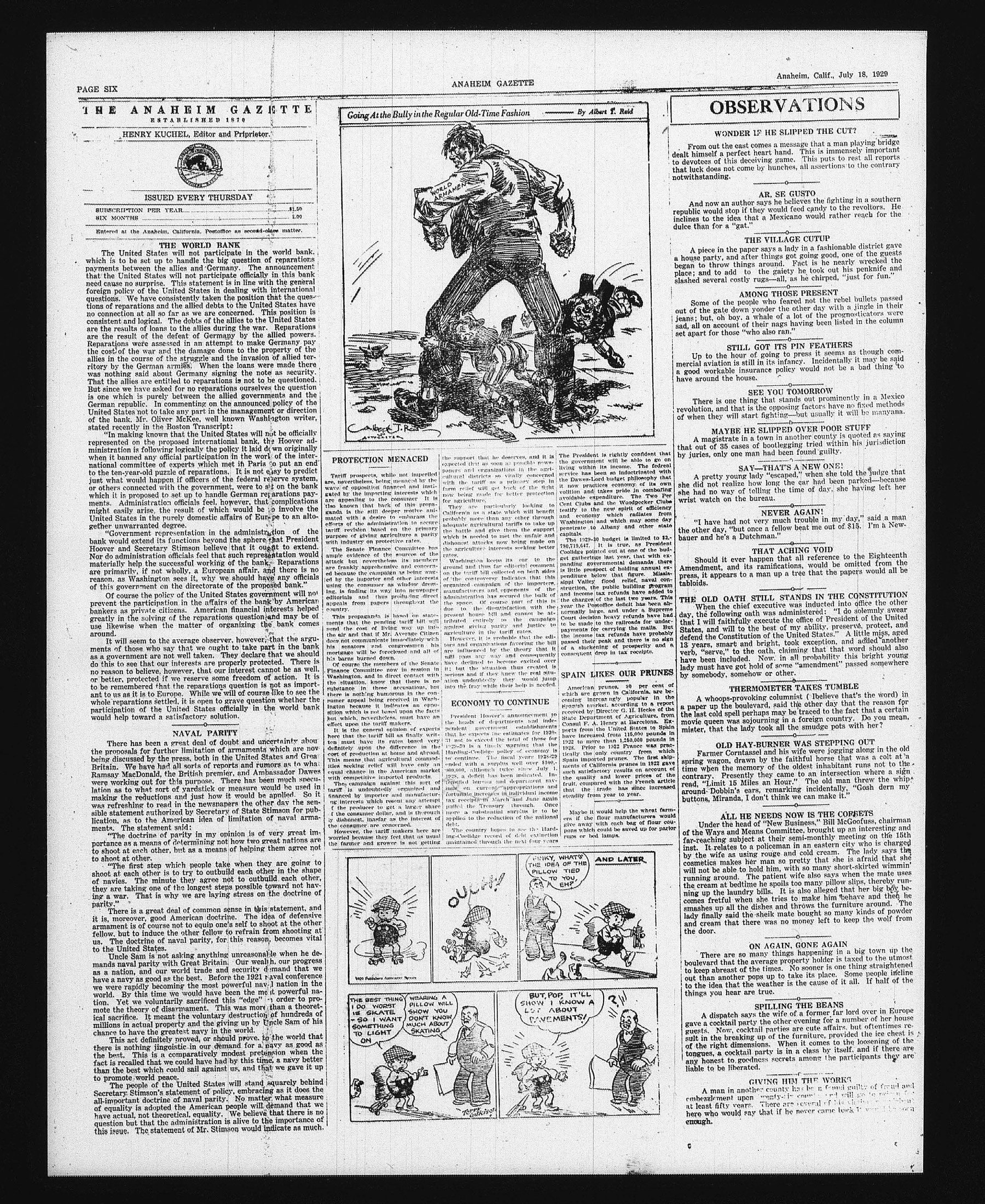
Going At the Bully in the Regular Old-Time Fashion By Albert T. Reid
WORLD ARMAMEN
Albert T. Reid
PROTECTION MENACED
Tariff prospects, while not imperiled are, nevertheless, being menaced by the wave of opposition financed and instigated by the importing interests which are appealing to the consumer. It is also known that back of this propaganda is the still deeper motive animated with a desire to embarrass the efforts of the administration to secure tariff revision based on the primary purpose of giving agriculture a parity with industry on protective rates.
The Senate Finance Committee has ample evidence of the source of the attack but nevertheless its members are frankly apprehensive and concerned because the campaign as being waged by the importer and other interests using the consumer as window dressing, is finding its way into newspaper editorials and thus producing direct appeals from papers throughout the country.
This propaganda is based on statements that the pending tariff bill will send the cost of living up into the air and that if Mr. Average Citizen does not communicate immediately with his senators and congressmen his mortgage will be foreclosed and all of his barns burned down.
Of course the members of the Senate Finance Committee now in session in Washington, and in direct contact with the situation, know that there is no substance in these accusations, but there is nothing humorous in the consumer appeal being received in Washington because it indicates an opposition which is not based upon the facts but which, nevertheless, must have an effect upon the tariff makers.
It is the general opinion of experts here that the tariff bill as finally written must have its rates based very definitely upon the difference in the cost of production at home and abroad. This means that agricultural commodities seeking relief will have only an equal chance in the American market with competitive imported products.
The campaign against this sort of tariff is undoubtedly organized and financed by importer and manufacturing interests which resent any attempt of the producer to get a larger share of the consumer dollar, and is through dishonest, insinacious the interest of the consumer are concerned.
However, the tariff makers here are worried because they feel that as usual the farmer and grower is not getting the support that he deserves, and it is expected that as soon as possible newspapers and organizations in the agricultural districts so vitally concerned with the tariff as a primary step in farm relief will get back of the fight now being made for better protection for agriculture.
They are particularly looking to California as a state which will benefit probably more than any other through adequate agricultural tariffs to take up the battle and give them the support which is needed to met the unfair and dishonest attacks now being made on the agriculture interests seeking better rates.
Washington keeps its ear to the ground and thus far editorial comment on the tariff bill collected on both sides of the controversy indicates that this organized campaign of the importers, manufacturers and opponents of the administration has secured the bulk of the space. Of course part of this is due to the dissatisfaction with the present house bill and cannot be attributed entirely to the campaign against giving parity and justice to agriculture in the tariff rates.
However, it is probable that the editors and organizations favoring the bill are influenced by the theory that it will pass any way and consequently have declined to become excited over it; but the situation thus created is serious and if they knew the real situation undoubtedly they would jump into the fray while their help is needed.
ECONOMY TO CONTINUE
President Hoover's announcement to the heads of departments and independent government establishments that he expects the estimates for 1930-31 not to exceed the total of those for 1928-30 is a timely warning that the Harding-Coalidge policy of economy is to continue. The fiscal years 1928-29 ended with a surplus well over $100,000,000, although twice since July 1, 1928, a deficit has been indicated. Insisted bureau and department savings on current appropriations and fortunate increases in individual income tax receipts in March and June again pulled the Treasury through. Once more a substantial surplus is to be applied to the reduction of the national debt.
The country hopes to see the Harding-Coalidge record of debt extinction maintained through the next four years.
The President is rightly confident that the government will be able to go on living within its income. The federal service has been so indoctrinated with the Dawes-Lord budget philosophy that it now practices economy of its own volition and takes pride in combating avoidable expenditure. The Two Per Cent Clubs and the Woodpecker Clubs testify to the new spirit of efficiency and economy which radiates from Washington and which may some day penetrate to Albany and other state capitals.
The 1929-30 budget is limited to $3,780,719,647. It is true, as President Coolidge pointed out at one of the budget gatherings last year, that with expanding governmental demands there is little prospect of holding annual expenditure below that figure. Mississippi Valley flood relief, naval construction, the public building program and income tax refunds have added to the charges of the last two years. This year the Postoffice deficit has been abnormally large, and under a Supreme Court decision heavy refunds have had to be made to the railroads for underpayments for carrying the malls. But the income tax refunds have probably passed their peak and there is no sign of a slackening of prosperity and a consequent drop in tax receipts.
SPAIN LIKES OUR PRUNES
American prunes, 90 per cent of which are grown in California, are becoming increasingly popular in the Spanish market, according to a report received by Director G. H. Hecke of the State Department of Agriculture, from Consul F. A. Henry at Barcelona. Exports from the United States to Spain have increased from 115,000 pounds in 1922 to more than 1,250,000 pounds in 1928. Prior to 1922 France was practically only country from which Spain imported prunes. The first shipments of California prunes in 1922 gave such satisfactory results on account of the quality and lower prices of the fruit, compared with the French article that the trade has since increased steadily from year to year.
Maybe it would help the wheat farmers if the flour manufacturers would give away with each bag of flour coupons which could be saved up for parlor rugs or bed lamps.
This means that agricultural commodities seeking relief will have only an equal chance in the American market with competitive imported products.
The campaign against this sort of tariff is undoubtedly organized and financed by importer and manufacturing interests which resent any attempt of the producer to get a larger share of the consumer dollar, and is thoroughly dishonest, inasfar as the interest of the consumer are concerned.
However, the tariff makers here are worried because they feel that as usual the farmer and grower is not getting
The fiscal years 1928-29 ended with a surplus well over $100,000,000, although twice since July 1, 1928, a deficit has been indicated. Intensified bureau and department savings on current appropriations and fortunate increases in individual income tax receipts in March and June again pulled the Treasury through. Once more a substantial surplus is to be applied to the reduction of the national debt.
The country hopes to see the Harding-Coalidge record of debt extinction maintained through the next four years
Maybe it would help the wheat farmers if the flour manufacturers would give away with each bag of flour coupons which could be saved up for parlor rugs or bed lamps.
OBSERVATIONS
WONDER IF HE SLIPPED THE CUT?
From out the east comes a message that a man playing bridge dealt himself a perfect heart hand. This is immensely important to devotees of this deceiving game. This puts to rest all reports that luck does not come by hunches, all assertions to the contrary notwithstanding.
AR, SE GUSTO
And now an author says he believes the fighting in a southern republic would stop if they would feed candy to the revoltors. He inclines to the idea that a Mexicano would rather reach for the dulce than for a "gat."
THE VILLAGE CUTUP
A piece in the paper says a lady in a fashionable district gave a house party, and after things got going good, one of the guests began to throw things around. Fact is he nearly wrecked the place; and to add to the gaiety he took out his penknife and slashed several costly rugs—all, as he chirped, "just for fun."
AMONG THOSE PRESENT
Some of the people who feared not the rebel bullets passed out of the gate down yonder the other day with a jingle in their jeans; but, oh boy, a whale of a lot of the prognosticators were sad, all on account of their nags having been listed in the column set apart for those "who also ran."
STILL GOT ITS PIN FEATHERS
Up to the hour of going to press it seems as though commercial aviation is still in its infancy. Incidentally it may be said a good workable insurance policy would not be a bad thing to have around the house.
SEE YOU TOMORROW
There is one thing that stands out prominently in a Mexico revolution, and that is the opposing factors have no fixed methods of when they will start fighting—but usually it will be manyana.
MAYBE HE SLIPPED OVER POOR STUFF
A magistrate in a town in another county is quoted as saying that out of 35 cases of bootlegging tried within his jurisdiction
SEE YOU TOMORROW
There is one thing that stands out prominently in a Mexico revolution, and that is the opposing factors have no fixed methods of when they will start fighting—but usually it will be manyana.
MAYBE HE SLIPPED OVER POOR STUFF
A magistrate in a town in another county is quoted as saying that out of 35 cases of bootlegging tried within his jurisdiction by juries, only one man had been found guilty.
SAY—THAT'S A NEW ONE!
A pretty young lady "escaped," when she told the judge that she did not realize how long the car had been parked—because she had no way of telling the time of day, she having left her wrist watch on the bureau.
NEVER AGAIN!
"I have had not very much trouble in my day," said a man the other day, "but once a fellow beat me out of $15. I'm a New-bauer and he's a Dutchman."
THAT ACHING VOID
Should it ever happen that all reference to the Eighteenth Amendment, and its ramifications, would be omitted from the press, it appears to a man up a tree that the papers would all be tabloids.
THE OLD OATH STILL STANDS IN THE CONSTITUTION
When the chief executive was inducted into office the other day, the following oath was administered: "I do solemnly swear that I will faithfully execute the office of President of the United States, and will to the best of my ability, preserve, protect, and defend the Constitution of the United States." A little miss, aged 13 years, smart and bright, took exception, and added another verb, "serve," to the oath, claiming that that word should also have been included. Now, in all probability this bright young lady must have got hold of some "amendment" passed somewhere by somebody, somehow or other.
THERMOMETER TAKES TUMBLE
A whoops-provoking columnist (Ibelieve that's the word) in a paper up the boulevard, said the other day that the reason for the last cold spell perhaps may be traced to the fact that a certain movie queen was sojourning in a foreign country. Do you mean, mister, that the lady took all the smudge pots with her?
OLD HAY-BURNER WAS STEPPING OUT
Farmer Corntassel and his wife were jogging along in the old spring wagon, drawn by the faithful horse that was a colt at a time when the memory of the oldest inhabitant runs not to the contrary. Presently they came to an intersection where a sign read, "Limit 15 Miles an Hour." The old man threw the whip around Dobbin's ears, remarking incidentally, "Gosh dern my buttons, Miranda, I don't think we can make it."
ALL HE NEEDS NOW IS THE CORSETS
Under the head of "New Business," Bill McGoofuss, chairman of the Ways and Means Committee, brought up an interesting and far-reaching subject at their semi-monthly meeting on the 15th inst. It relates to a policeman in an eastern city who is charged
ALL HE NEEDS NOW IS THE CORSETS
Under the head of "New Business," Bill McGoofuss, chairman of the Ways and Means Committee, brought up an interesting and far-reaching subject at their semi-monthly meeting on the 15th inst. It relates to a policeman in an eastern city who is charged by the wife as using rouge and cold cream. The lady says the cosmetics makes her man so pretty that she is afraid that she will not be able to hold him, with so many short-skirted wimmin' running around. The patient wife also says when the mate uses the cream at bedtime he spoils too many pillow slips, thereby running up the laundry bills. It is also alleged that her big boy becomes fretful when she tries to make him behave and then smashes up all the dishes and throws the furniture around. The lady finally said the sheik mate bought so many kinds of powder and cream that there was no money left to keep the wolf from the door.
ON AGAIN, GONE AGAIN
There are so many things happening in a big town up the boulevard that the average property holder is taxed to the utmost to keep abreast of the times. No sooner is one thing straightened out than another pops up to take its place. Some people incline to the idea that the weather is the cause of it all. If half of the things you hear are true.
SPILLING THE BEANS
A dispatch says the wife of a former far lord over in Europe gave a cocktail party the other evening for a number of her house guests. Now, cocktail parties are cute affairs, but oftentimes result in the breaking up of the furniture, provided the ice chest is of the right dimensions. When it comes to the loosening of the tongues, a cocktail party is in a class by itself, and if there are any honest to goodness secrets among the participants they are liable to be liberated.
GIVING HIM THE WORKS
A man in another county has been found guilty of fraud and embezzlement upon twenty-circumferences and will go to prison for at least fifty years. There are several of his clients about here who would say that if he never came back it would be seen enough.