anaheim-gazette 1929-05-30
Scanned page
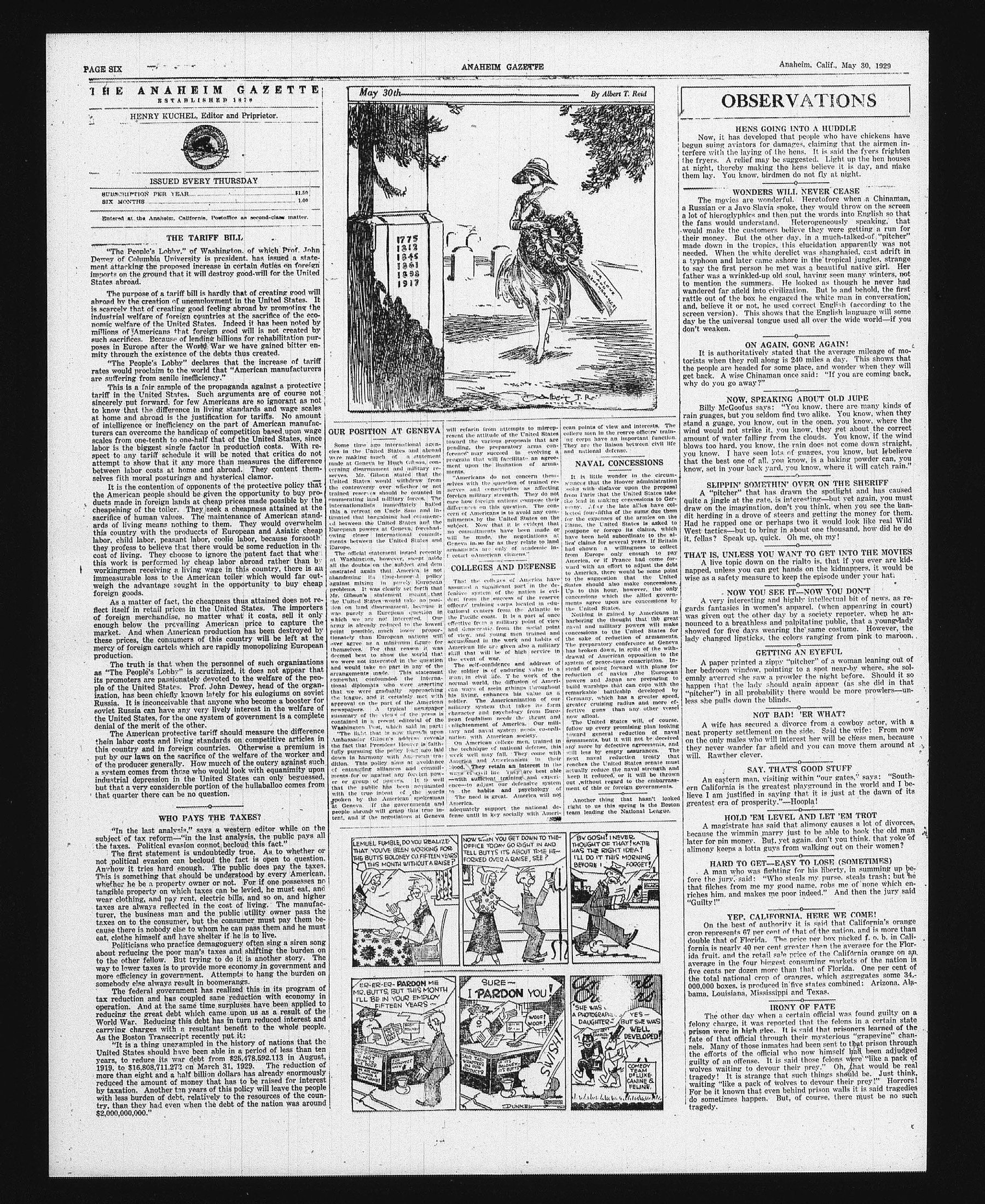
Searchable text
THE ANAHEIM GAZETTE
ESTABLISHED 1876
HENRY KUCHEL, Editor and Priprietor.
ISSUED EVERY THURSDAY
SUBSCRIPTION PER YEAR.....$1.50
SIX MONTHS.....1.00
Entered at the Anaheim, California, Postoffice an second-class matter.
THE TARIFF BILL
"The People's Lobby," of Washington, of which Prof. John Dewey of Columbia University is president, has issued a statement attacking the proposed increase in certain duties on foreign imports on the ground that it will destroy good-will for the United States abroad.
The purpose of a tariff bill is hardly that of creating good will abroad by the creation of unemployment in the United States. It is scarcely that of creating good feeling abroad by promoting the industrial welfare of foreign countries at the sacrifice of the economic welfare of the United States. Indeed it has been noted by millions of Americans that foreign good will is not created by such sacrifices. Because of lending billions for rehabilitation purposes in Europe after the World War we have gained bitter enmity through the existence of the debts thus created.
"The People's Lobby" declares that the increase of tariff rates would proclaim to the world that "American manufacturers are suffering from senile inefficiency."
This is a fair sample of the propaganda against a protective tariff in the United States. Such arguments are of course not sincerely put forward, for few Americans are so ignorant as not to know that the difference in living standards and wage scales at home and abroad is the justification for tariffs. No amount of intelligence or inefficiency on the part of American manufacturers can overcome the handicap of competition based upon wage scales from one-tenth to one-half that of the United States, since labor is the biggest single factor in production costs. With re-
"The People's Lobby" declares that the increase of tariff rates would proclaim to the world that "American manufacturers are suffering from senile inefficiency."
This is a fair sample of the propaganda against a protective tariff in the United States. Such arguments are of course not sincerely put forward, for few Americans are so ignorant as not to know that the difference in living standards and wage scales at home and abroad is the justification for tariffs. No amount of intelligence or inefficiency on the part of American manufacturers can overcome the handicap of competition based upon wage scales from one-tenth to one-half that of the United States, since labor is the biggest single factor in production costs. With respect to any tariff schedule it will be noted that critics do not attempt to show that it any more than measures the difference between labor costs at home and abroad. They content themselves fifth moral posturings and hysterical clamor.
It is the contention of opponents of the protective policy that the American people should be given the opportunity to buy products made in foreign lands at cheap prices made possible by the cheapening of the toiler. They seek a cheapness attained at the sacrifice of human values. The maintenance of American standards of living means nothing to them. They would overwhelm this country with the products of European and Asiatic cheap labor, child labor, peasant labor, coolie labor, because forsooth they profess to believe that there would be some reduction in the cost of living. They choose to ignore the patent fact that when this work is performed by cheap labor abroad rather than by workingmen receiving a living wage in this country, there is an immeasurable loss to the American toiler which would far outweigh the advantage sought in the opportunity to buy cheap foreign goods.
As a matter of fact, the cheapness thus attained does not reflect itself in retail prices in the United States. The importers of foreign merchandise, no matter what it costs, sell it only enough below the prevailing American price to capture the market. And when American production has been destroyed by these prices, the consumers of this country will be left at the mercy of foreign cartels which are rapidly monopolizing European production.
The truth is that when the personnel of such organizations as "The People's Lobby" is scrutinized, it does not appear that its promoters are passionately devoted to the welfare of the people of the United States. Prof. John Dewey, head of the organization, has been chiefly known lately for his eulogiums on Soviet Russia. It is inconceivable that anyone who become a booster for Soviet Russia can have any very lively interest in the welfare of the United States, for the one system of government is a complete denial of the merit of the other.
The American protective tariff should measure the difference their labor costs and living standards on competitive articles in this country and in foreign countries. Otherwise a premium is put by our laws on the sacrifice of the welfare of the worker and of the producer generally. How much of the outcry against such a system comes from those who would look with equanimity upon industrial depression in the United States can only beguessed, but that a very considerable portion of the hullaballoo comes from that quarter there can be no question.
WHO PAYS THE TAXES?
"In the last analysis," says a western editor while on the subject of tax reform—"in the last analysis, the public pays all the taxes. Political evasion cannot becloud this fact."
WHO PAYS THE TAXES?
"In the last analysis," says a western editor while on the subject of tax reform—"in the last analysis, the public pays all the taxes. Political evasion cannot becloud this fact."
The first statement is undoubtedly true. As to whether or not political evasion can be clouded the fact is open to question. Anyhow it tries hard enough. The public does pay the taxes. This is something that should be understood by every American, whether he be a property owner or not. For if one possesses no tangible property on which taxes can be levied, he must eat, and wear clothing, and pay rent, electric bills, and so on, and higher taxes are always reflected in the cost of living. The manufacturer, the business man and the public utility owner pass the taxes on to the consumer, but the consumer must pay them because there is nobody else to whom he can pass them and he must eat, clothe himself and have shelter if he is to live.
Politicians who practice demagoguery often sing a siren song about reducing the poor man's taxes and shifting the burden on to the other fellow. But trying to do it is another story. The way to lower taxes is to provide more economy in government and more efficiency in government. Attempts to hang the burden on somebody else always result in boomerangs.
The federal government has realized this in its program of tax reduction and has coupled sane reduction with economy in operation. And at the same time surpluses have been applied to reducing the great debt which came upon us as a result of the World War. Reducing this debt has in turn reduced interest and carrying charges with a resultant benefit to the whole people. As the Boston Transcript recently put it:
"It is a thing unexampled in the history of nations that the United States should have been able in a period of less than ten years, to reduce its war debt from $25,478,592.113 in August, 1919, to $16,808,711,272 on March 31, 1929. The reduction of more than eight and a half billion dollars has already enormously reduced the amount of money that has to be raised for interest by taxation. Another ten years of this policy will leave the people with less burden of debt, relatively to the resources of the country, than they had even when the debt of the nation was around $2,000,000,000."
May 30th
By Albert T. Reid
OUR POSITION AT GENEVA
Some time ago international agentions had been working on the issue of preserving the attitude of the United States toward the various proposals that are pending, the preparatory arms concean points of view and interests. The college men in the reserve officers' training corps have an important function. They are the liaison between civil life
OUR POSITION AT GENEVA
Some time ago international agencies in the United States and abroad were making much of a statement made at Geneva by Hugh Gibson, concerning disarmament and military reserves. Mr. Gibson stated that the United States would withdraw from the controversy over whether or not trained reserves should be counted in enumerating land military forces. The internationalists immediately halted this a retreat on Uncle Sam and estimated that bargaining had commenced between the United States and the European powers at Geneva; foreseeing closer international commitments between the United States and Europe.
The official statement issued recently at Washington, however, swept aside all the doubts on the subject and demonstrated again that America is not abandoning its time-honored policy against mixing in purely European problems. It was clearly set forth that Mr. Gibson's statement meant that the United States would take no position on land disarmament, because it was purely a European question in which we are not interested. Our army is already reduced to the lowest point possible, much lower proportionately than European nations will ever agree as a minimum figure for themselves. For that reason it was deemed best to show the world that we were not interested in the question and would take no part in any of the arrangements made.
This statement somewhat confounded the international diplomats who were asserting that we were gradually approaching the league, and it certainly met with approval on the part of the American newspapers. A typical newspaper summary of the views of the press is contained in a recent editorial of the Washington Post, which said in part:
"The light that is now thrown upon Ambassador Gibson's address reveals the fact that President Hoover is faithfully pursuing the policy long ago laid down in harmony with American tradition. This policy aims at avoidance of entangling alliances and commitments for or against any foreign power or group of powers. It is well that the public has been acquainted with the true intent of the words spoken by the American spokesman at Geneva. If the governments and people abroad will grasp this true intent, and if the negotiators at Geneva will refrain from attempts to misrepresent the attitude of the United States toward the various proposals that are pending, the preparatory arms conference may succeed in evolving a program that will facilitate an agreement upon the limitation of armaments.
"Americans do not concern themselves with the question of trained reserves and conscription as affecting foreign military strength. They do not care how foreign nations compose their differences on this question. The concern of Americans is to avoid any commitments by the United States on the subject. Now that it is evident that no commitments have been made or will be made, the negotiations at Geneva in so far as they relate to land armaments are only of academic interest."
COLLEGES AND DEFENSE
That the colleges of America have assumed a significant part in the defensive system of the nation is evident from the success of the reserve officers' training corps located in educational centers from the Atlantic to the Pacific coast. It is a part of once effective from a military point of view and democratic from the social point of view, and young men trained and accustomed in the work and habits of American life are given also a military skill that will be of high service in the event of war.
The self-confidence and address of the soldier is of enduring value to a man in civil life. The work of the normal world, the diffusion of American ways of seeing githings throughout his living, enhances his value as a soldier. The Americanization of our military system that takes its form character and psychology from European feudalism needs the thrust and enlightenment of America. Our military and naval system needs co-ordination with American society.
On American college men, trained in the technique of national defense, this work will may fall. They come with America and Americanism in their blood. They retain an interest in the ways of civil life. They are best able—with sufficient training and experience—to adjust our defensive system to the habits and psychology of the need is great. America will not America, adequately support the national defense until in key socially with Ameri-
NAVAL CONCESSIONS
It is little wonder in the circumstances that the Hoover administration looks with disfavor upon the proposal from Paris that the United States take the lead in making concessions to Germany. After the late allies have collected four-fifths of the sums due them for the expenses of the armies on the Rhine, the United States is asked to postpone or forego its claims, which have been held subordinate to the allied claims for several years. If Britain had shown a willingness to collect from Europe only enough to pay America, or if France had come forward with an effort to adjust the debt to America, there would be some point to the suggestion that the United States should also make concessions. Up to this hour, however, the only concessions which the allied governments agree upon are concessions by the United States.
Nothing is gained by Americans in harboring the thought that the great naval and military powers will make concessions to the United States for the sake of reduction of armaments. The preparatory conference at Geneva has broken down, in spite of the withdrawal of American opposition to the system of peace-time conscription. Instead of going forward with plans for reduction of navies, the European powers and Japan are preparing to build warships that can cope with the remarkable battleship developed by Germany, which has a greater speed, greater cruising radius and more effective guns than any other vessel now afloat.
The United States will, of course, follow up every promising plan looking toward general reduction of naval armaments, but it will not be deceived any more by defective agreements, and still less by empty assurances. The next naval reduction treaty that reaches the United States Senate must actually reduce the naval strength and keep it reduced, or it will be thrown out without regard to the embarrassment of this or foreign governments.
Another thing that hasn't looked right to us this spring is the Boston team leading the National League.
down in harmony with American tradition. This policy aims at avoidance of entangling alliances and commitments for or against any foreign power or group of powers. It is well that the public has been acquainted with the true intent of the words spoken by the American spokesman at Geneva. If the governments and people abroad will grasp this true intent, and if the negotiators at Geneva adequately support the national defense until in key socially with America, next naval reduction treaty that reaches the United States Senate must actually reduce the naval strength and keep it reduced, or it will be thrown out without regard to the embarrassment of this or foreign governments.
Another thing that hasn't looked right to us this spring is the Boston team leading the National League.
LEMUEL FUMBLE, DO YOU REALIZE THAT YOU'VE BEEN WORKING FOR THE BUTT'S BOLONEY CO FIFTEEN YEARS THIS MONTH WITHOUT A RAISE?
NOW WHEN YOU GET DOWN TO THE OFFICE TODAY GO RIGHT IN AND TELL BUTT'S ITS ABOUT TIME HE FORKED OVER A RAISE, SEE?
BY GOSH! I NEVER THOUGHT OF THAT! KATIE HAS THE RIGHT IDEA! ILL DO IT THIS MORNING BEFORE!
ER-ER-ER- PARDON ME MR. BUTT'S, BUT THIS MONTH I'LL BE IN YOUR EMPLOY FIFTEEN YEARS
SURE—I PARDON YOU!
WOOF! WOOF!
SAVE THE WORDPRESS ON YOUR PRODUCTS!
IT'S BOLONEY- IT'S BUTT'S
COMEDY TEAM DELUXE CANINE & FELINE.
OBSERVATIONS
HENS GOING INTO A HUDDLE
Now, it has developed that people who have chickens have begun suing aviators for damages, claiming that the airmen interfere with the laying of the hens. It is said the fyers frighten the fryers. A relief may be suggested. Light up the hen houses at night, thereby making the hens believe it is day, and make them lay. You know, birdmen do not fly at night.
WONDERS WILL NEVER CEASE
The movies are wonderful. Heretofore when a Chinaman, a Russian or a Javo Slavia spoke, they would throw on the screen a lot of hieroglyphics and then put the words into English so that the fans would understand. Heterogeneously speaking, that would make the customers believe they were getting a run for their money. But the other day, in a much-talked-of "pitcher" made down in the tropics, this elucidation apparently was not needed. When the white derelict was shanghaied, cast adrift in a typhoon and later came ashore in the tropical jungles, strange to say the first person he met was a beautiful native girl. Her father was a wrinkled-up old soul, having seen many winters, not to mention the summers. He looked as though he never had wandered far afield into civilization. But lo and behold, the first rattle out of the box he engaged the white man in conversation, and, believe it or not, he used correct English (according to the screen version). This shows that the English language will some day be the universal tongue used all over the wide world—if you don't weaken.
ON AGAIN, GONE AGAIN!
It is authoritatively stated that the average mileage of motorists when they roll along is 240 miles a day. This shows that the people are headed for some place, and wonder when they will get back. A wise Chinaman once said: "If you are coming back, why do you go away?"
NOW, SPEAKING ABOUT OLD JUPE
Billy McGoofus says: "You know, there are many kinds of rain guages, but you seldom find two alike. You know, when they stand a guage, you know, out in the open, you know, where the wind would not strike it, you know, they get about the correct amount of water falling from the clouds. You know, if the wind blows too hard, you know, the rain does not come down straight."
NOW, SPEAKING ABOUT OLD JUPE
Billy McGoofus says: "You know, there are many kinds of rain guages, but you seldom find two alike. You know, when they stand a guage, you know, out in the open, you know, where the wind would not strike it, you know, they get about the correct amount of water falling from the clouds. You know, if the wind blows too hard, you know, the rain does not come down straight, you know. I have seen lots of guages, you know, but I believe that the best one of all, you know, is a baking powder can, you know, set in your back yard, you know, where it will catch rain."
SLIPPIN' SOMETHIN' OVER ON THE SHERIFF
A "pitcher" that has drawn the spotlight and has caused quite a jingle at the gate, is interesting—but yet again, you must draw on the imagination, don't you think, when you see the bandit herding in a drove of steers and getting the money for them. Had he rapped one or perhaps two it would look like real Wild West tactics—but to bring in about one thousand, how did he do it, fellas? Speak up, quick. Oh me, oh my!
THAT IS, UNLESS YOU WANT TO GET INTO THE MOVIES
A live topic down on the rialto is, that if you ever are kidnapped, unless you can get hands on the kidnappers, it would be wise as a safety measure to keep the episode under your hat.
NOW YOU SEE IT—NOW YOU DON'T
A very interesting and highly intellectual bit of news, as regards fantasies in women's apparel. (when appearing in court) was given out the other day by a society reporter, when he announced to a breathless and palpitating public, that a young lady showed for five days wearing the same costume. However, the lady changed lipsticks, the colors ranging from pink to maroon.
GETTING AN EYEFUL
A paper printed a zippy "pitcher" of a woman leaning out of her bedroom window, pointing to a spot near-by where, she solemnly averred she saw a prowler the night before. Should it so happen that the lady should again appear (as she did in that "pitcher") in all probability there would be more prowlers—unless she pulls down the blinds.
NOT BAD! 'ER WHAT?
A wife has secured a divorce from a cowboy actor, with a neat property settlement on the side. Said the wife: From now on the only males who will interest her will be chess men, because they never wander far afield and you can move them around at will. Rawther clever.
SAY, THAT'S GOOD STUFF
An eastern man, visiting within "our gates," says: "Southern California is the greatest playground in the world and I believe I am justified in saying that it is just at the dawn of its greatest era of prosperity."—Hoopla!
HOLD 'EM LEVEL AND LET 'EM TROT
A magistrate has said that alimony causes a lot of divorces, because the wimmin marry just to be able to hook the old man later for pin money. But, yet again, don't you think, that yoke of alimony keeps a lotta guys from walking out on their women?
SAY, THAT'S GOOD STUFF
An eastern man, visiting within "our gates," says: "Southern California is the greatest playground in the world and I believe I am justified in saying that it is just at the dawn of its greatest era of prosperity."—Hoopla!
HOLD 'EM LEVEL AND LET 'EM TROT
A magistrate has said that alimony causes a lot of divorces, because the wimmin marry just to be able to hook the old man later for pin money. But, yet again, don't you think, that yoke of alimony keeps a lotta guys from walking out on their women?
HARD TO GET—EASY TO LOSE (SOMETIMES)
A man who was fighting for his liberty, in summing up before the jury, said: "Who steals my purse, steals trash; but he that filches from me my good name, robs me of none which enriches him, and makes me poor indeed." And then the jury said "Guilty!"
YEP, CALIFORNIA, HERE WE COME!
On the best of authority it is said that California's orange crop represents 67 per cent of that of the nation, and is more than double that of Florida. The price per box packed f. o. b. in California is nearly 40 per cent greater than the average for the Florida fruit, and the retail sale price of the California orange on an average in the four biggest consuming markets of the nation is five cents per dozen more than that of Florida. One per cent of the total national crop of oranges, which aggregates some 34,-000,000 boxes, is produced in five states combined: Arizona, Alabama, Louisiana, Mississippi and Texas.
IRONY OF FATE
The other day when a certain official was found guilty on a felony charge, it was reported that the felons in a certain state prison were in high glee. It is said that prisoners learned of the fate of that official through their mysterious "grapevine" channels. Many of those inmates had been sent to that prison through the efforts of the official who now himself had been adjudged guilty of an offense. It is said those felons were "like a pack of wolves waiting to devour their prey." Oh, that would be real tragedy! It is strange that such things should be. Just think, waiting "like a pack of wolves to devour their prey!" Horrors! For be it known that even behind prison walls it is said tragedies do sometimes happen. But, of course, there must be no such tragedy.