anaheim-gazette 1929-05-30
Scanned page
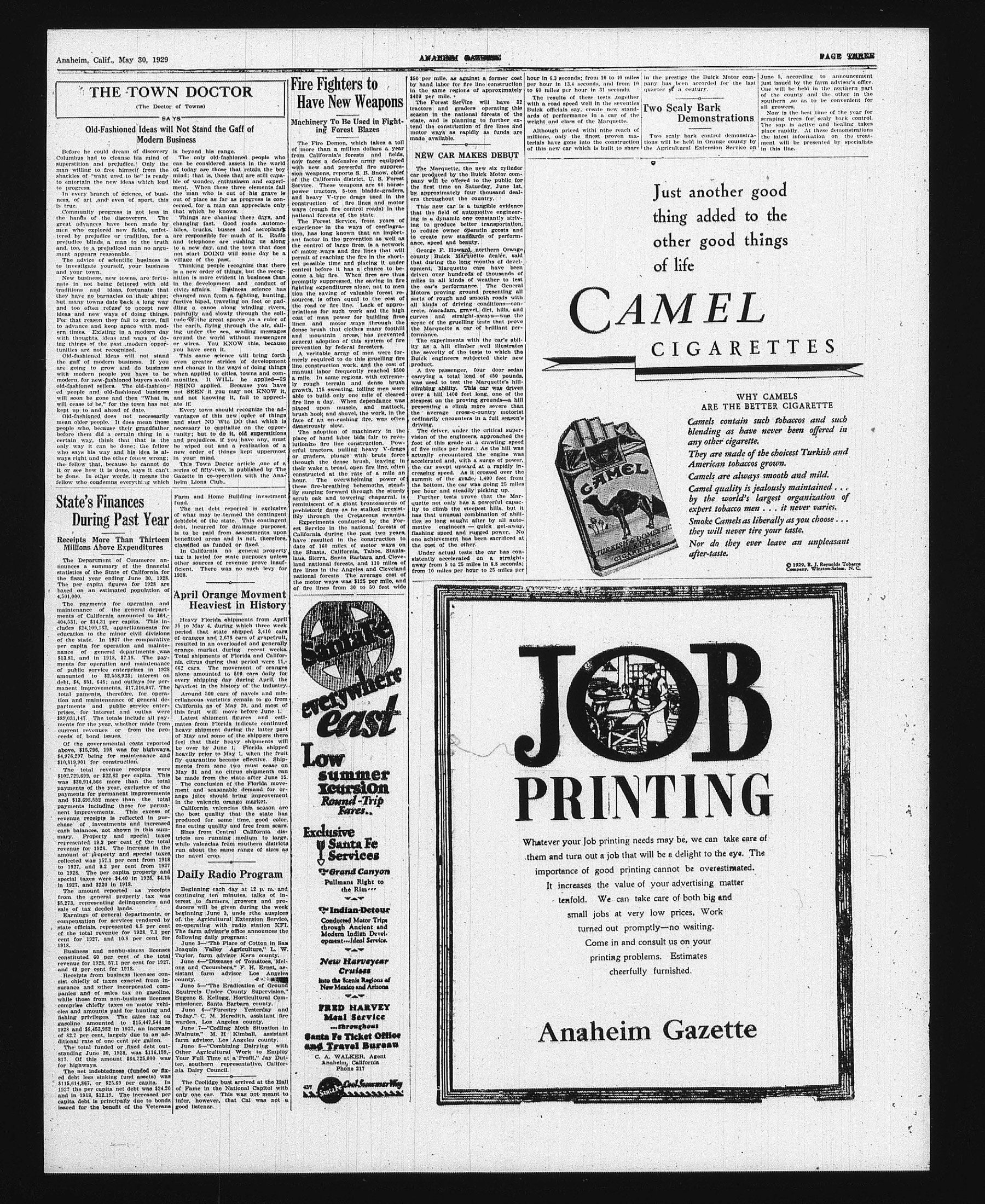
Searchable text
THE TOWN DOCTOR
(The Doctor of Towns)
SAYS
Old-Fashioned Ideas will Not Stand the Gaff of Modern Business
Before he could dream of discovery Columbus had to cleanse his mind of superstition and prejudice. Only the man willing to free himself from the shackles of "waht used to be" is ready to entertain the new ideas which lead to progress.
In every branch of science, of art, and even of sport, this is true.
Community progress is not less in the hands of the discoverers. The great advances have been made by men who explored new fields, unfettered by prejudice or tradition, for a prejudice blinds a man to the truth and, too, to a prejudiced man no argument appears reasonable.
The advice of scientific business is to investigate yourself, your business and your town.
New business, new towns, are fortunate in not being fettered with old traditions and ideas, fortunate that they have no barnacles on their ships; but many towns date back a long way and too often refuse to accept new ideas and new ways of doing things. For that reason they fail to grow, fall to advance and keep apace with modern times. Existing in a modern day with thoughts, ideas and ways of doing things of the past, modern opportunities are not recognized.
Old-fashioned ideas will not stand the gaff of modern business. If you are going to grow and do business with modern people you have to be modern, for new-fashioned buyers avoid old-fashioned people and old-fashioned business will soon be gone and then "What is, will cease to be," for the town has not kept up to and ahead of date.
Old-fashioned does not necessarily mean older people. It does mean those people who, because their grandfather before them did a certain thing in a certain way, think that that is the only way it can be done; the fellow is beyond his range.
The only old-fashioned people who can be considered assets in the world of today are those that retain the boy mind; that is, those that are still capable of wonder, enthusiasm and experiment. When these three elements fall the man who is out of his grave is out of place as far as progress is concerned, for a man can appreciate only that which he knows.
Things are chaning these days, and changing fast. Good roads, automobiles, trucks, buses and aeroplanes are responsible for much of it. Radio and telephone are rushing us along to a new day, and the town that does not start DOING will some day be a village of the past.
Thinking people recognize that there is a new order of things, but the recognition is more evident in business than in the development and conduct of civic affairs. Business science has changed man from a fighting, hunting, furious biped, traveling on foot or paddling a canoe along winding rivers, painfully and slowly through the solitude of the great spaces, to a ruler of the earth, flying through the air, sailing under the sea, sending messages around the world without messengers or wires. You KNOW this, because you have seen it.
This same science will bring forth even greater strides of development and change in the ways of doing things when applied to cities, towns and communities. It WILL be applied—IS BEING applied. Because you have not SEEN it you may not KNOW it, and not knowing it, fail to appreciate it.
Every town should recognize the advantages of this new order of things and start NO WTO DO that which is necessary to capitalize on the opportunity; but to do it, old superstitions and prejudices, if you have any, must be wiped out and a realization of a fire fighters will Have New Work Machinery To Be Used in Forest Blankets.
The Fire Demon, which of more than a million dollars from California's forests now faces a defensive array with new and powerful weaponry, reports S. B. of the California district Service. These weapons are power tractors, 5-ton blue and heavy V-type drags construction of fire lines ways (rough fire control national forests of the state).
The Forest Service, free experience in the ways of operation, has long known that ant factor in the prevention of the control of large fires, of motor ways and fire line permit of reaching the fire best possible time and place control before it has a chance to come a big fire. When fire promptly suppressed, the fire fighting expenditures alone tion the saving of valuable sources, is often equal to the road or fire line. Labrations for such work cost of man power for lines and motor ways dense brush that clothes me general adoption of this service prevention by federal force.
A veritable array of men merely required to do this line construction work, and manual labor frequently at a mile. In some regions, very rough terrain and growth, 175 sweating, tollable able to build only one mile fire line a day. When deep placed upon muscle, a brush hook and shovel, the face of an on-rushing fire disastrously slow.
The adoption of machinery place of hand labor bids lulonize fire line construc
Old-fashioned ideas will not stand the gaff of modern business. If you are going to grow and do business with modern people you have to be modern, for new-fashioned buyers avoid old-fashioned sellers. The old-fashioned people and old-fashioned business will soon be gone and then "What is, will cease to be," for the town has not kept up to and ahead of date.
Old-fashioned does not necessarily mean older people. It does mean those people who, because their grandfather before them did a certain thing in a certain way, think that that is the only way it can be done; the fellow who says his way and his idea is always right and the other few wrong; the fellow that, because he cannot do it or see how it is done, says it can't be done. In other words, it means the fellow who condemns everything which
State's Finances During Past Year
Receipts More Than Thirteen Millions Above Expenditures
The Department of Commerce announces a summary of the financial statistics of the State of California for the fiscal year ending June 30, 1928. The per capita figures for 1928 are based on an estimated population of 4,501,000.
The payments for operation and maintenance of the general departments of California amounted to $64,-404,531, or $14.31 per capita. This includes $24,109,162, apportionments for education to the minor civil divisions of the state. In 1927 the comparative per capita for operation and maintenance of general departments was $13.81, and in 1918, $7.18. The payments for operation and maintenance of public service enterprises in 1928 amounted to $2,558,923; interest on debt, $4,851,646; and outlays for permanent improvements, $17,216,047. The total pensions, therefore, for operation and maintenance of general departments and public service enterprises, for interest and outlaws were $89,031,147. The totals include all payments for the year, whether made from current revenues or from the proceeds of bond issues.
Of the governmental costs reported above, $15,796,198 was for highways, $4,976,297 being for maintenance and $10,819,901 for construction.
The total revenue receipts were $102,729,699, or $22.82 per capita. This was $30,914,566 more than the total payments of the year, exclusive of the payments for permanent improvements and $13,698,552 more than the total payments including those for permanent improvements. This excess of revenue receipts is reflected in purchase of investments and increased cash balances, not shown in this summary. Property and special taxes represented 19.3 percent of the total revenue for 1928. The increase in the farm and Home Building invsetment fund.
The net debt reported is exclusive of what may be termed the contingent debtdebt of the state. This contingent debt, incurred for drainage purposes, is to be paid from assessments upon benefited areas and is not, therefore, classified as funded or fixed.
In California no general property tax is levied for state purposes unless other sources of revenue prove insufficient. There was no such levy for 1928.
April Orange Movement Heaviest in History
Heavy Florida shipments from April 15 to May 4, during which three week period that state shipped 3,410 cars of oranges and 2,678 cars of grapefruit, resulted in an overloaded and generally orange market during recent weeks. Total shipments of Florida and California citrus during that period were 11,-662 cars. The movement of oranges alone amounted to 500 cars daily for every shipping day during April, the heaviest in the history of the industry.
Around 500 cars of navels and miscellaneous varieties remain to go from California as of May 20, and most of this fruit will move before June 1.
Latest shipment figures and estimates from Florida indicate continued heavy shipment during the latter part of May and some of the shippers there feel that their heavy shipments will be over by June 1. Florida shipped heavily prior to May 1 when the fruit fly quarantine became effective. Shipments from zone two must cease on May 31 and no citrus shipments can be made from the state after June 15.
The conclusion of the Florida movement and seasonable demand for orange juice should bring improvement in the valencia orange market.
California valencias this season are the best quality that the state has produced for some time, good color, fine eating quality and free from scars.
Sizes from Central California districts are running medium to large while valencias from southern districts run about the same range of sizes as...
The total revenue receipts were $102,729,699, or $22.82 per capita. This was $30,914,566 more than the total payments of the year, exclusive of the payments for permanent improvements and $13,698,552 more than the total payments including those for permanent improvements. This excess of revenue receipts is reflected in purchase of investments and increased cash balances, not shown in this summary. Property and special taxes represented 19.3 per cent of the total revenue for 1928. The increase in the amount of property and special taxes collected was 157.1 per cent from 1918 to 1927, and 9.2 per cent from 1927 to 1928. The per capita property and special taxes were $4.40 in 1928, $4.15 in 1927, and $220 in 1918.
The amount reported as receipts from the general property tax was $5,273, representing delinquencies and sale of tax deeded lands.
Earnings of general departments, or compensation for services rendered by state officials, represented 6.5 per cent of the total revenue for 1928. 7.1 per cent for 1927, and 10.8 per cent for 1918.
Business and nonbu-siness licenses constituted 60 per cent of the total revenue for 1928. 57.1 per cent for 1927, and 49 per cent for 1918.
Receipts from business licenses consist chiefly of taxes exacted from insurance and other incorporated companies and of sales tax on gasoline, while those from non-business licenses comprise chiefly taxes on motor vehicles and amounts paid for hunting and fishing privileges. The sales tax on gasoline amounted to $15,447,544 in 1928 and $8,453,982 in 1927, an increase of 82.7 per cent, largely due to an additional rate of one cent per gallon.
The total funded or fixed debt outstanding June 30, 1928, was $116,159,-817. Of this amount $64,725,000 was for highways.
The net indebtedness (funded or fixed debt less sinking fund assets) was $115,614,867, or $25.69 per capita. In 1928 the per capita net debt was $24.20 and in 1918, $12.19. The increased per capita debt is principally due to bonds issued for the benefit of the Veterans
Daily Radio Program
Beginning each day at 12 p.m. and continuing ten minutes, talks of interest to farmers, growers and producers will be given during the week beginning June 3, under rthe auspices of the Agricultural Extension Service, co-operating with radio station KFI. The farm advisor's office announces the following daily program:
June 3—"The Place of Cotton in San Joaquin Valley Agriculture," L.W.Taylor, farm advisor Kern county.
June 4—"Diseases of Tomatoes, Melons and Cucumbers," F.H.Ernest, assistant farm advisor Los Angeles county.
June 5—"The Eradication of Ground Squirrels Under County Supervision," Eugene S.Kellogg, Horticultural Commissioner, Santa Barbara county.
June 6—"Forestry Yesterday and Today," C.M.Meredith, assistant fire warden, Los Angeles county.
June 7—"Codling Moth Situation in Walnuts," M.H.Kimball, assistant farm advisor, Los Angeles county.
June 8—"Combining Dairying with Other Agricultural Work to Employ Your Full Time at a Profit," Jay Dutter, southern representative, California Dairy Council.
The Coolidge bust arrived at the Hall of Fame in the National Capitol with only one ear. This was not meant to infer, however, that Cal was not a good listener.
Fire Fighters to Have New Weapons
Machinery To Be Used in Fighting Forest Blazes
The Fire Demon, which takes a toll of more than a million dollars a year from California's forests and fields, now faces a defensive army equipped with new and powerful fire suppression weapons, reports S. B. Snow, chief of the California district, U. S. Forest Service. These weapons are 60 horsepower tractors, 5-ton bladde-graders, and heavy V-type drags used in the construction of fire lines and motor ways (rough fire control roads) in the national forests of the state.
The Forest Service, from years of experience in the ways of conflagration, has long known that an important factor in the prevention as well as the control of large fires is a network of motor ways and fire lines that will permit of reaching the fire in the shortest possible time and placing it under control before it has a chance to become a big fire. When fires are thus promptly suppressed, the saving in fire fighting expenditures alone, not to mention the saving of valuable forest resources, is often equal to the cost of the road or fire line. Lack of appropriations for such work and the high cost of man power for building fire lines and motor ways through the dense brush that clothes many foothill and mountain areas, has prevented general adoption of this system of fire prevention by federal foresters.
A veritable array of men were formerly required to do this gruelling fire line construction work, and the cost of manual labor frequently reached $500 a mile. In some regions, with extremely rough terrain and dense brush growth, 175 sweating, tolling men were able to build only one mile of cleared fire line a day. When dependence was placed upon muscle, and mattock, brush hook and shovel, the work, in the face of an on-rushing fire, was often disastrously slow.
The adoption of machinery in the place of hand labor bids fair to revolutionize fire line construction. Powerful steam pulling heavy V-drags $50 per mile, as against a former cost by hand labor for fire line construction in the same regions of approximately $400 per mile.
The Forest Service will have 32 tractors and graders operating this season in the national forests of the state, and is planning to further extend the construction of fire lines and motor ways as rapidly as funds are made available.
NEW CAR MAKES DEBUT
The Marquette, the new six cylinder car produced by the Buick Motor company will be offered to the public for the first time on Saturday, June 1st, by approximately four thousand dealers throughout the country.
This new car is a tangible evidence that the field of automotive engineering is a dynamic one constantly striving to produce better transportation, to reduce owner operating costs and to create new standards of performance, speed and beauty.
George F. Howard, northern Orange county Buick Marquette dealer, said that during the long months of development, Marquette cars have been driven over hundreds of thousands of miles in all kinds of weather to test the car's performance. The General Motors proving ground presenting all sorts of rough and smooth roads with all kinds of driving conditions—concrete, macadam, gravel, dirt, hills, and curves and straight-aways—was the scene of the gruelling tests that prove the Marquette a car of brilliant performance.
The experiments with the car's ability as a hill climber well illustrates the severity of the tests to which the Buick engineers subjected their new product.
A five passenger, four door sedan carrying a total load of 450 pounds, was used to test the Marquette's hill-climbing ability. This car was driven over a hill 1400 feet long, one of the steepest on the proving grounds—a hill presenting a climb more severe than the average cross-country motorist ordinarily encounters in a full season's driving.
The driver, under the critical supervision of the engineers, approached the foot of this grade at a crawling speed of five miles per hour. As the hill was hour in 6.3 seconds; from 10 to 40 miles per hour in 13.4 seconds, and from 10 to 60 miles per hour in 31 seconds.
The results of these tests together with a road speed well in the seventies Bulok officials say, create new standards of performance in a car of the weight and class of the Marquette.
Although priced within nthe reach of millions, only the finest proven materials have gone into the construction of this new car which is built to share
A veritable array of men merely required to do this gruelling fire line construction work, and the cost of manual labor frequently reached $500 a mile. In some regions, with extremely rough terrain and dense brush growth, 175 sweating, toiling men were able to build only one mile of cleared fire line a day. When dependance was placed upon muscle, and mattock, brush hook and shovel, the work, in the face of an on-rushing fire, was often disastrously slow.
The adoption of machinery in the place of hand labor bids fair to revolutionize fire line construction. Powerful tractors, pulling heavy V-drags or graders, plunge with brute force through the dense brush, leaving in their wake a broad, open fire line, often constructed at the rate of a mile an hour. The overwhelming power of these fire-breathing behemoths, steadily surging forward through the sturdy scrub oak and towering chaparral, is reminiscent of a giant brontosaurus of prehistoric days as he stalked irresistibly through the Cretaceous swamps.
Experiments conducted by the Forest Service in the national forests of California during the past two years, have resulted in the construction to date of 160 miles of motor ways on the Shasta, California, Tahoe, Stanislaus, Sierra, Santa Barbara and Cleveland national forests, and 110 miles of fire lines in the Angeles and Cleveland national forests. The average cost of the motor ways was $125 per mile, and of fire lines from 30 to 50 feet wide.
Santa
everywhere
east
Low summer excursion
Round-Trip Fares...
Exclusive
Santa Fe
Buick engineers subjected their new product.
A five passenger, four door sedan carrying a total load of 450 pounds, was used to test the Marquette's hill-climbing ability. This car was driven over a hill 1400 feet long, one of the steepest on the proving grounds—a hill presenting a climb more severe than the average cross-country motorist ordinarily encounters in a full season's driving.
The driver, under the critical supervision of the engineers, approached the foot of this grade at a crawling speed of five miles per hour. As the hill was actually encountered the engine was accelerated and, with a surge of power, the car swept upward at a rapidly increasing speed. As it crossed over the summit of the grade: 1,400 feet from the bottom, the car was going 25 miles per hour and steadily picking up.
Further tests prove that the Marquette not only has a powerful capacity to climb the steepest hills, but it has that unusual combination of abilities so long sought after by all automotive engineers — quick get-away, flashing speed and rugged power. No one achievement has been sacrificed at the cost of the other.
Under actual tests the car has consistently accelerated on a straight-away from 5 to 25 miles in 8.8 seconds; from 10 miles per hour to 25 miles per
LOW
summer
IcursiOn
Round-Trip
Fares..
Exclusive
Santa Fe
Services
Grand Canyon
Pullmans Right to
the Rim...
Indian-Detour
Conducted Motor Trips
through Ancient and
Modern Indian Development...Ideal Service.
New Harveyear
Cruises
into the Scenic Regions of
New Mexico and Arizona.
FRED HARVEY
Meal Service
...throughout
Santa Fe Ticket Office
and Travel Bureau
C. A. WALKER, Agent
Anaheim, California
Phone 217
PRINTING
Whatever your Job printing needs may be, we
them and turn out a job that will be a delight
importance of good printing cannot be
It increases the value of your advertitenfold. We can take care of both
small jobs at very low prices,
turned out promptly—no wait!
Come in and consult us on y
printing problems. Estima
cheerfully furnished.
Anaheim Ga
in the prestige the Buick Motor company has been accorded for the last quarter of a century.
Two Scaly Bark Demonstrations
Two scaly bark control demonstrations will be held in Orange county by the Agricultural Extension Service on June 5, according to announcement just issued by the farm advisor's office. One will be held in the northern part of the county and the other in the southern, so as to be convenient for all growers.
Now is the best time of the year for scraping trees for scaly bark control. The sap is active and healing takes place rapidly. At these demonstrations the latest information on the treatment will be presented by specialists in this line.
Just another good thing added to the other good things of life
CAMEL CIGARETTES
WHY CAMELS ARE THE BETTER CIGARETTE
Camels contain such tobaccos and such blending as have never been offered in any other cigarette.
WHY CAMELS ARE THE BETTER CIGARETTE
Camels contain such tobaccos and such blending as have never been offered in any other cigarette.
They are made of the choicest Turkish and American tobaccos grown.
Camels are always smooth and mild.
Camel quality is jealously maintained... by the world's largest organization of expert tobacco men... it never varies.
Smoke Camels as liberally as you choose... they will never tire your taste.
Nor do they ever leave an unpleasant after-taste.
© 1929, R. J. Reynolds Tobacco Company, Winston-Salem, N. C.
ing needs may be, we can take care of
that will be a delight to the eye. The
printing cannot be overestimated.
value of your advertising matter
can take care of both big and
very low prices, Work
promptly—no waiting.
and consult us on your
problems. Estimates
meerfully furnished.
Heim Gazette